
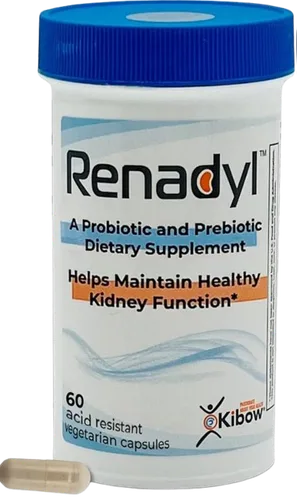
Kibow Biotech Renadyl Probiotic Supplement for Kidney Health Review
Renadyl is a specialized probiotic supplement designed for kidney health. It contains a proprietary blend of three bacterial strains: Streptococcus thermophilus, Lactobacillus acidophilus, and Bifidobacterium longum, which are intended to help metabolize nitrogenous waste in the gut.
We don’t sell supplements. We help you make decisions and get the best price.
Lowest prices
We may earn a commission from some store links. How we choose.
Finding the lowest prices at the stores now. This takes a few seconds.
Products with nearly the same formula (Matched on the main ingredients)
Study, Trial or Testing Result Summary
Members Only10 human studies · 5 improved
This product itself was tested in 3 human studies. The study of this product had no placebo group: the people in it were measured before and after taking it.
This product has been tested directly in people with kidney disease. The newest and largest study, from 2024, followed 60 people with moderate to advanced chronic kidney disease for six months without a placebo group. Renadyl improved quality of life, lowered a kidney waste toxin and a marker of cell damage, and raised protective antioxidant levels, performing about as well as a comparison kidney product [1]. A smaller 2017 pilot study of 24 people with chronic kidney disease found that 16 of them had a drop in blood urea, a waste product the kidneys normally clear, after four months [2]. However, the only placebo-controlled trial, in 22 people on dialysis, found two months of Renadyl was safe but did not significantly change waste toxin levels or quality of life [3]. The bacteria and fibers sit in a proprietary blend, so the amount of each one is not shown. Studies of other probiotic and fiber blends for kidney health are mixed: some found better kidney function or less protein in the urine [4][5], while a dialysis trial found no drop in waste toxins or inflammation versus placebo [6]. Animal and cell studies are never counted.
See all 10 studies →Hide the studies
- A review of 16 trials in 903 people with diabetes found that probiotics, prebiotics and synbiotics changed some kidney markers (creatinine, filtration rate, microalbuminuria) but not others, and raised uric acid, so the overall evidence was mixed.Renal Health Improvement in Diabetes through Microbiome Modulation of the Gut-Kidney Axis with Biotics: A Systematic and…
- In 200 prefrail and frail older adults, a 3-month inulin and oligofructose prebiotic blend beat placebo at improving frailty and kidney function, along with walking speed and grip strength.Prebiotics improve frailty status in community-dwelling older individuals in a double-blind, randomized, controlled tria…
- In 76 people with type 2 diabetic kidney disease, 12 weeks of a three-strain probiotic lowered urine albumin-to-creatinine ratio versus placebo, but kidney filtration rate did not change.Probiotics ameliorates glycemic control of patients with diabetic nephropathy: A randomized clinical study.
- In 60 people with type 2 diabetes, 60 days of an anthocyanin and prebiotic fibre supplement improved kidney filtration rate within the supplement group but not in the placebo group.Diabetes Therapeutics of Prebiotic Soluble Dietary Fibre and Antioxidant Anthocyanin Supplement in Patients with Type 2 …
- In 46 hemodialysis patients with chronic kidney disease, 3 months of probiotics did not lower uremic toxins or inflammation versus placebo, and urea, potassium and indoxyl sulfate rose within the probiotic group.Probiotic Supplementation in Chronic Kidney Disease: A Double-blind, Randomized, Placebo-controlled Trial.
- In 22 people on hemodialysis who finished a placebo-controlled crossover trial, 2 months of Renadyl was safe but did not significantly change kidney waste toxin levels or quality of life, though inflammation and a waste toxin showed non-significant downward trends.Randomized controlled trial of strain-specific probiotic formulation (Renadyl) in dialysis patients.
- In a small 8-week trial of Streptococcus thermophilus TCI633 tablets aimed at skin aging, kidney function was only checked for safety and the abstract reports no kidney results.The potential of Streptococcus thermophiles (TCI633) in the anti-aging.
- In an open-label trial of 60 people with stage 3-4 chronic kidney disease over six months, Renadyl improved quality of life and reduced indoxyl sulfate and malondialdehyde, with glutathione and nitric oxide rising, and it performed comparably to Lobun Forte.The Efficacy and Safety of Probiotic Combinations Lobun Forte® Versus Renadyl® in Patients With Chronic Kidney Disease: …
- In 13 kidney disease patients taking oligofructose-enriched inulin daily for 12 weeks in an open-label study without a control group, urine levels of the uremic toxins indoxyl sulfate and p-cresol sulfate went down.Prebiotic Administration to Chronic Kidney Disease Patients Modifies Their Fecal Microbiome and Host Metabolism.
- In a pilot study of 24 people with chronic kidney disease taking Renadyl for 4 months, 16 had a drop in blood urea nitrogen, and their starting blood metabolites differed from the others, which may help predict who benefits.Metabolic profiling of a chronic kidney disease cohort reveals metabolic phenotype more likely to benefit from a probiot…
Review Totals and Summary
Members Only1,103 reviews · 92% positive
Based on real user feedback across platforms like Amazon and Kibow, the Renadyl Probiotic Supplement for Kidney Health receives a largely positive reception, with the majority of reviewers expressing satisfaction and noting beneficial effects. Many users comment on how the supplement has become a part of their daily routine, with some reporting that their energy levels and sense of well-being improved after consistent use. For individuals dealing with ongoing kidney concerns, a recurring theme is that Renadyl provided noticeable support, with several reviewers indicating improvements in lab results such as stabilized creatinine or BUN levels. However, most reviewers are careful to mention that while it appears to complement their treatment, it is not a replacement for medical advice or prescribed therapies. Another positive motif throughout real user experiences is the tolerability of the supplement, with very few complaints about adverse reactions. A number of customers specifically appreciate that Renadyl is easy to incorporate into their regimen, either taken with meals or as instructed, and mention that they did not experience stomach upset or unpleasant aftereffects—a concern for people dealing with sensitive constitutions or multiple medications. Despite the predominance of favorable opinions, there are still a minority of users who were neutral or dissatisfied. A segment of reviewers state that after several weeks or even months of usage, they did not notice concrete benefits or changes, which led to some disappointment, especially given the product’s cost. A few users express skepticism about results, noting that any changes in lab numbers or subjective well-being could be due to several factors, making it hard to attribute improvements solely to Renadyl. Negative experiences most frequently relate to the price point, with some customers finding it to be expensive relative to the perceived results. There are limited reports of minor gastrointestinal discomfort, but these are not a dominant pattern. Most reviewers do not comment on taste, which suggests the capsules are neutral or generally easy to take. The theme of quality appears frequently, with several users stating they appreciate the supplement’s apparent purity and the careful packaging. Customer service interactions are also occasionally mentioned positively, especially when users had questions or concerns about their orders. In summary, the Renadyl Probiotic Supplement for Kidney Health is valued by a large majority for its perceived supportive benefits and gentle formulation, though a small but notable group remains ambivalent or unsatisfied, often because the results weren't as pronounced as hoped or due to considerations of cost. As with most health supplements, individual responses vary, but the overarching sentiment is one of cautious optimism, with many users willing to continue using the product as part of their broader kidney health routine.
Biohacker Summary
Members Only2 of 10 recommend it
Only one member of the panel spoke about Streptococcus thermophilus, the main ingredient in this product, so there is no group view to report. That panelist's latest position, from 2024, is neutral rather than a recommendation. He said healthy bacteria like this one can help improve serotonin concentration. No one on the panel gave a preferred form, a dose, a pairing, or a caution, and no one said they stopped taking it.
See all 1 biohackers →Hide the biohackers
Dr. Mark Hyman · Streptococcus thermophilus · neutral
- States that healthy bacteria like streptococcus thermophilus can help improve serotonin concentration.
RAL Summary
Members OnlyTier 2 for Kidney Health
Tier 2 because studies of this exact product, led by a six-month study of 60 people with chronic kidney disease, showed improvements in quality of life and a kidney waste toxin [1], though that study had no placebo group and the one placebo-controlled trial found no significant change [3].
This product itself was tested in 3 human studies. The study of this product had no placebo group: the people in it were measured before and after taking it.
Where the evidence disagrees: 3 of the 10 human studies found no effect.
More Details
Members OnlyBody systems · Combine with · Possible side effects
Body systems: Urinary system, Digestive system
Combine with: Not compulsory. Consult a healthcare provider, especially with pre-existing kidney conditions.
Possible side effects: No major side effects reported; a two-month placebo-controlled trial in dialysis patients found Renadyl to be safe.
Supplement Facts
Proprietary blend , L. acidophilus , B. longum , Xylo-oligosaccharide , Inulin ) 45 CFU
| Proprietary blend (S. thermophilus (KB19), L. acidophilus (KB27), B. longum (KB31), Xylo-oligosaccharide (prebiotic), Inulin (prebiotic)) | 45 CFU | 0% |
Directions: Take 1-2 capsules twice daily with a meal, or as suggested by your healthcare professional.
Barcode (UPC) 755332372386 · Label source: the brand's label · Report a label change
Show entire label

More kidney health products
Members OnlyThe highest ranked for the same goal
Graded October 24, 2026 by the Reverse Age Lab evidence engine, from human studies, real reviews and our biohacker panel. How we grade. Is this medical advice? No. Rala organizes the published evidence; go over any change with your doctor, especially if you take meds.
Privacy policyConsumer health dataAffiliate disclosureTermsDo Not Sell or Share My Personal InformationCookie settings