
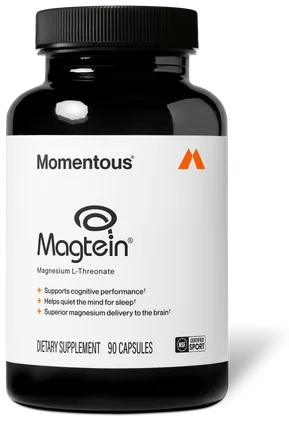
Momentous Magnesium L-Threonate Review
Momentous Magnesium L-Threonate is presented as a brain-targeted magnesium that supports cognitive function, sleep quality and calm. The product is formulated with Magtein®, described as a clinically studied form of magnesium L-threonate shown to increase magnesium levels in the brain. The page states it is designed to support cognitive function, relaxation, and deep, restorative sleep. Listed benefits include support for memory and learning through a role in synaptic plasticity, support for focus, attention and cognitive performance, support for nervous system health through regulation of neurotransmitter activity, and support for deep, restorative sleep without sedation. The page explains that magnesium L-threonate is a specialized form of magnesium designed to cross the blood-brain barrier and increase magnesium levels in the brain, and that this supports neuronal signaling, synaptic plasticity and healthy brain function. Directions say to take 3 capsules daily, approximately 30 to 60 minutes before bed, as part of a consistent nightly routine. Each serving provides magnesium 145mg from 2g of Magtein®, and the container holds 30 servings. The page notes that some individuals may notice improvements in sleep quality within about 7 days, with benefits building over time and optimal effects typically after about 4 weeks, and that individual results may vary. The product is listed as NSF Certified Sport, gluten free, GMO free and vegan. Light Labs third-party testing in January 2026 covered 11 substances for quality, and the page lists five studies on magnesium and sleep, cognition and athletes. The FAQ states that each finished batch is certified through NSF Certified for Sport and that certificates of analysis are available for every batch. The page also mentions the product is HSA/FSA eligible and offers a 30 day money back guarantee. A subscription option is shown with savings and a one-time purchase option is also available.
We don’t sell supplements. We help you make decisions and get the best price.
Lowest prices
We may earn a commission from some store links. How we choose.
Finding the lowest prices at the stores now. This takes a few seconds.
Study, Trial or Testing Result Summary
Members Only33 human studies · 17 improved
4 of these 33 human studies gave the ingredient by drip, not by mouth.
This product itself was tested in 3 human studies.
This product uses magnesium L-threonate, the form tested in several placebo-controlled trials for thinking and mental clarity. Each serving gives 145 milligrams of magnesium from 2 grams of magnesium L-threonate, and the two servings a day members are told to take count as a full dose. In a 2025 trial of 100 adults with poor sleep, 2 grams a day for 6 weeks improved overall thinking, working and everyday memory, and reaction speed compared with placebo, though a reasoning test showed no difference [1]. In a 2024 trial of 80 adults with sleep problems, 1 gram a day for 3 weeks improved mental alertness, mood, energy and sleep, though thinking was not directly tested [2]. A 2022 trial of 109 healthy adults found a magnesium L-threonate formula improved memory scores, with older people gaining more [3]. Not every study agreed. A 2023 trial of 109 women recovering from breast cancer surgery found no improvement in thinking scores after 12 weeks [4]. Other oral magnesium trials also found benefits for thinking in older adults and in people with depression [5][6]. Magnesium given by vein during surgery did not prevent thinking problems [7]. Animal and cell studies are never counted.
See all 33 studies →Hide the studies
- A review of 3 randomized trials and 12 cohort studies in adults found too few trials to judge magnesium supplements, but both low and high blood magnesium levels were linked to higher risk of dementia and cognitive impairment compared with about 0.85 mmol/L.Magnesium and Cognitive Health in Adults: A Systematic Review and Meta-Analysis.
- A review of 14 studies of nutrition for people in hospital with alcohol withdrawal included magnesium among several supplements, but the evidence was limited and no clear effect of magnesium on memory was reported.Systematic review of nutritional interventions for people admitted to hospital for alcohol withdrawal.
- A review of 32 articles on magnesium in mental disorders found results that were not consistent, though some studies suggested magnesium supplements could help depressive symptoms; cognition was not the focus.The Role and the Effect of Magnesium in Mental Disorders: A Systematic Review.
- A review of 11 studies of nutrition after mild head injury reported positive recovery outcomes for several nutrients including magnesium oxide, but the studies varied too much to make firm recommendations.Nutritional interventions to support acute mTBI recovery.
- A review of 40 animal and human studies of micronutrients including magnesium combined with a med in type 2 diabetes reported mostly beneficial interactions for brain function, but magnesium was not assessed on its own.Read the study on PubMed (41782745) →
- In a trial of 1062 women at risk of very early birth, magnesium sulfate given before birth made little difference to their children's thinking, behavior or movement at ages 6 to 11 compared with placebo.School-age outcomes of very preterm infants after antenatal treatment with magnesium sulfate vs placebo.
- In 688 very preterm babies, a single 4 g dose of magnesium sulphate given to mothers before birth lowered the rates of death, motor problems and cognitive problems at two years, with some results reaching statistical significance.[Effect of magnesium sulphate on mortality and neurologic morbidity of the very-preterm newborn (of less than 33 weeks) …
- In 389 heart surgery patients, magnesium given by vein during surgery did not reduce thinking problems at 6 weeks (44.4% with magnesium versus 44.9% with placebo).Intraoperative magnesium administration does not improve neurocognitive function after cardiac surgery.
- In 350 heart surgery patients, magnesium during surgery improved short-term nerve function and memory right after surgery compared with placebo, but by 3 months there were few differences between groups.Magnesium as a neuroprotectant in cardiac surgery: a randomized clinical trial.
- In a trial of 250 adults, personalized magnesium supplements that lowered the calcium-to-magnesium intake ratio improved cognitive function by 9.1% in those over 65 with a high ratio diet.Ca:Mg Ratio, APOE Cytosine Modifications, and Cognitive Function: Results from a Randomized Trial.
- In 209 patients with bleeding around the brain from a burst aneurysm, daily magnesium sulfate (64 mmol) during hospitalization did not change thinking scores three months later compared with placebo.Effect of magnesium on cognition after aneurysmal subarachnoid haemorrhage in a randomized trial.
- In 171 healthy adults with mild insomnia, two weeks of a combination supplement containing magnesium did not improve sleep or cognitive performance more than placebo, as both groups improved similarly.Exploring the Effect of Lactium™ and Zizyphus Complex on Sleep Quality: A Double-Blind, Randomized Placebo-Controlled Tr…
- In 108 patients having carotid artery surgery, intravenous magnesium during the operation led to less thinking decline the next day than placebo, with the low dose working best and the high dose showing no difference.Intraoperative magnesium infusion during carotid endarterectomy: a double-blind placebo-controlled trial.
- In 109 women after breast cancer surgery, 12 weeks of magnesium L-threonate did not improve cognitive function scores, pain, mood or sleep compared with placebo.A Randomized, Double-Blind, Placebo-Controlled Trial to Evaluate the Therapeutic Effect of Magnesium-L-Threonate Supplem…
- In 109 healthy Chinese adults aged 18-65, 2 grams a day of a magnesium L-threonate formula for 30 days improved memory test scores more than placebo, with older participants improving more.A Magtein®, Magnesium L-Threonate, -Based Formula Improves Brain Cognitive Functions in Healthy Chinese Adults.
- In 100 adults aged 18 to 45 with dissatisfied sleep, 2 grams daily of magnesium L-threonate for 6 weeks improved overall cognition, working and episodic memory, and reaction time versus placebo, with an estimated 7.5-year reduction in brain cognitive age, though a reasoning test showed no difference.The effects of magnesium L-threonate (Magtein®) on cognitive performance and sleep quality in adults: a randomised, doub…
- In 80 adults aged 35 to 55 with sleep problems, 1 gram daily of magnesium L-threonate for 21 days improved sleep quality, mood, energy and mental alertness compared with placebo; cognition was not directly tested.Magnesium-L-threonate improves sleep quality and daytime functioning in adults with self-reported sleep problems: A rand…
- In 80 adults having gallbladder keyhole surgery, intravenous magnesium sulfate given during anesthesia prevented the memory and learning decline seen one week after surgery in the control group and reduced a blood marker of brain cell injury.Could intraoperative magnesium sulphate protect against postoperative cognitive dysfunction?
- In 66 children with attention-deficit/hyperactivity disorder, 8 weeks of magnesium at 6 mg/kg per day plus vitamin D improved emotional, conduct, peer and total behavior difficulty scores compared with placebo, though the authors call for larger trials.The effect of vitamin D and magnesium supplementation on the mental health status of attention-deficit hyperactive child…
- In 50 adults having brain surgery, intravenous magnesium sulfate around the operation did not change the main blood marker of brain injury, but patients scored better on some thinking tests than those given saline.Effect of perioperative magnesium sulfate on neurological outcome in neurosurgical patients: a randomized double-blind c…
- In 42 adults with sleep complaints, a blend containing 12.6 mg of magnesium with mulberry leaf extract over 2 weeks improved sleep and next-morning mood but had no effect on cognitive performance compared with control.Mulberry leaf extract combined with tryptophan improves sleep and post wake mood in adults with sleep complaints - A ran…
- In 40 adults with depression, 350 mg of daily oral magnesium added to a med for 6 weeks produced greater gains in thinking test scores, especially attention and memory, than a med alone.Read the study on PubMed (42374947) →
- In 35 stressed adults, a herbal blend containing magnesium and chromium improved attention and working memory during a stressful task over 2 weeks compared with placebo, though effects without stress were less consistent.Effects of a Scutellaria baicalensis/Crataegus laevigata, magnesium and chromium supplement on stressed individuals: A r…
- In 29 outpatients with compensated liver cirrhosis, lower magnesium levels were linked to poorer cognitive test results at baseline, but the abstract does not report a post-treatment cognitive effect of magnesium oxide versus placebo.Magnesium Deficiency and Minimal Hepatic Encephalopathy among Patients with Compensated Liver Cirrhosis.
- Learning-disabled children with abnormal brain wave patterns who took magnesium valproate at 20 mg per kg of body weight daily for 6 months improved on performance IQ and on some reading and word-ordering tasks, while the placebo group did not change.Magnesium valproate in learning disabled children with interictal paroxysmal EEG patterns: Preliminary report.
- At school age, children whose mothers received magnesium sulfate before very preterm birth showed no harm, and their behavior and cognitive difficulties were lower, but these differences were not statistically significant.School-age outcomes following a randomized controlled trial of magnesium sulfate for neuroprotection of preterm infants.
- Children with attention deficit hyperactivity disorder and low blood magnesium who took about 200 mg of magnesium daily for 6 months showed a significant drop in hyperactivity, compared with a group of similar children given standard treatment without magnesium.The effects of magnesium physiological supplementation on hyperactivity in children with attention deficit hyperactivity…
- In 31 children aged 6 to 12 with attention deficit and hyperactivity, a 30-day course of magnesium with vitamin B6 improved attention and behavior more than a multivitamin given to a comparison group of 20 children.[Effect of MAGNE-B6 on the clinical and biochemical manifestations of the syndrome of attention deficit and hyperactivit…
- In 19 active young men, two nights of a zinc and magnesium supplement taken before bed did not change Stroop test performance or sleep compared with a placebo or no pill.Effects of an Acute Dose of Zinc Monomethionine Asparate and Magnesium Asparate (ZMA) on Subsequent Sleep and Next-Day M…
- In 40 children with attention deficit and hyperactivity symptoms, at least eight weeks of magnesium at 6 mg/kg per day with vitamin B6 reduced hyperactivity and aggression and improved school attention, and symptoms returned when treatment stopped.Improvement of neurobehavioral disorders in children supplemented with magnesium-vitamin B6. I. Attention deficit hypera…
- In 30 adults with chronic brain ischemia, a magnesium and vitamin B6 product for one month, then with an added drug for one more month, significantly improved scores on cognitive and mood scales, with no side effects reported; the study had no comparison group.[The possibility of using combination therapy in patients with chronic cerebral ischemia].
- In an open-label pilot of 15 adults with moderate attention-deficit/hyperactivity disorder, up to 12 weeks of L-threonic acid magnesium salt led to symptom improvement in 47% of participants, with favorable changes in IQ testing and a significant gain on a shifting subscale; no placebo group was used.L-Threonic Acid Magnesium Salt Supplementation in ADHD: An Open-Label Pilot Study.
- In 810 children aged 5 to 12 referred for attention problems, 12 weeks of omega-3 and omega-6 fatty acids with magnesium and zinc was followed by fewer attention and hyperactivity symptoms and fewer emotional problems.Supplementation of polyunsaturated fatty acids, magnesium and zinc in children seeking medical advice for attention-defi…
Review Totals and Summary
Members Only1,880 reviews · 93% positive
Momentous Magnesium L-Threonate has garnered overwhelmingly positive feedback, with approximately 1880 ratings across various stores, all of which are 4 or 5 stars. Customers consistently report significant improvements in several key areas. **What Buyers Say It Did For Them** Many users highlight a dramatic improvement in sleep quality and duration, with one noting it "improved my sleep quality and duration." They experience calmer nights and a significant reduction in nighttime awakenings, waking up feeling more rested. Beyond sleep, customers note enhanced mental clarity and focus, with one reviewer stating, "My focus is cleaner and my nights are calmer." The supplement also aids in recovery, particularly for those engaged in demanding physical and mental work. Some users found relief from anxiety and PMDD-related symptoms, including sleep issues and mood fluctuations. **Complaints** Based on the available customer feedback, there are no explicit complaints or negative experiences reported regarding Momentous Magnesium L-Threonate. **Form and Experience** The reviews do not provide specific details about the taste, smell, or pill size of the product. However, users appreciate that it helps them achieve calmer nights "without that heavy, sedated feeling," indicating a positive experience in terms of how it affects them. **Value for Money** The provided customer feedback does not contain specific comments about the product's price or its perceived value for money. **Who It Seems To Suit** This supplement appears to be well-suited for a broad range of individuals seeking to improve their sleep quality, duration, and overall restfulness. It benefits those looking for enhanced mental focus and better recovery from demanding physical and mental activities. People experiencing anxiety or PMDD-related symptoms, including sleep issues and mood fluctuations, have also found it helpful. Its broad appeal is underscored by one user who has the "Whole family on it!" Some users also noted flexibility in dosage, successfully taking less than the recommended serving. **Who It Did Not Suit** There is no feedback available to indicate who this product might not be suitable for, as all reviews are positive.
Biohacker Summary
Members Only6 of 10 recommend it
Most of the panel recommends or uses magnesium, and sleep is the main reason, with several also pointing to blood pressure, stress, muscle recovery and brain function. Three panelists take 400 mg of magnesium threonate before bed, another suggests threonate for people who are low, and others prefer glycinate, often taken 90 minutes to 2 hours before bed or at night, while a few use multi-form blends or electrolyte drinks that contain magnesium. Daily totals mentioned range from 300 to 600 mg, and one panelist aims for about a gram. Two panelists are cautious: one says the evidence that magnesium reliably improves sleep is not yet strong and that labels can make the dose look larger than it is, and another only reviews the evidence without taking a side. No one said they stopped taking it.
See all 10 biohackers →Hide the biohackers
Dr. Rhonda Patrick · Magnesium · recommends
- Explains that magnesium helps the body activate and metabolize vitamin D, and that magnesium intake has been associated with lower odds of vitamin D deficiency and insufficiency.
- Mentions that getting too little magnesium may play a role in declining testosterone levels.
- Recommends getting enough magnesium, around 300–400 mg daily from diet and supplements, as it is an essential cofactor for vitamin D metabolism. Magnesium glycinate is a good form.
- Mentions magnesium as one of the micronutrients found in multivitamins that people often don't get enough of from their diets.
- Explains that magnesium helps control blood pressure by boosting the production of substances that relax blood vessels and improve cardiovascular health, citing a meta-analysis that found magnesium supplementation at an average dose of 368 mg per day notably lowers both systolic and diastolic blood pressure.
- Magnesium supplementation has lowered blood pressure in randomized controlled trials. An analysis of 34 trials involving over 2,000 participants found modest reductions in both systolic and diastolic pressure, with a median dose of 368 mg/day.
- Warns that some magnesium supplements make the dose look much larger than it really is and that labels can fool people.
- Mentions magnesium as an important nutrient component for testosterone.
- Warns that some supplement companies mislead consumers by listing the total compound weight of magnesium citrate as the elemental magnesium dose, when the actual elemental magnesium content is much lower, potentially around 44-66 milligrams.
- States there is not yet strong, consistent evidence that magnesium supplementation reliably improves sleep, noting that while some meta-analyses suggest it can improve sleep quality scores, sleep efficiency, and sleep duration, individual studies are inconsistent and several have found no meaningful effect.
Dr. Eric Berg · Magnesium · recommends
- Recommends Magnesium glycinate, noting its high absorption rate compared to magnesium oxide, and its support for energy, sleep, muscle relaxation, and vitamin D function.
- Dr. Berg states that when nutrients like magnesium are too low, fatigue and weakness can follow.
- Recommends focusing on magnesium to support stronger bones if a neck hump is associated with osteoporosis.
- Explains that leg and calf cramps are most often caused by low magnesium, with leafy greens being a top source.
- States that magnesium is a cofactor that allows B1 to work more efficiently.
- States that magnesium is the most important mineral for energy production, as one cannot make energy without it.
- Magnesium is involved in 300 to 600 enzyme reactions, acts as a biological brake pedal, is the master controller over calcium, and is involved in making ATP, the energy currency of the body. It takes energy to go to sleep, and magnesium is required for relaxation and good sleep. Magnesium also helps balance cortisol levels and calm you.
- Dr. Eric Berg states that magnesium supports energy, muscle function, and sleep, and that most of it is stored inside cells, making deficiencies harder to detect with a standard blood test.
- Notes that magnesium could also be a factor in preventing muscle cramps.
- Recommends magnesium, specifically magnesium glycinate, stating it is key for D3 and K2 to work and is probably more important than calcium for building bone.
Thomas DeLauer · Magnesium · recommends
- Recommends taking magnesium glycinate and threonate at night to act as a brake on the nervous system, block excitatory signaling, help wind down, and support serotonin and melatonin production for better sleep.
- Mentions that magnesium glycinate also helps a lot with sleep.
- Mentions that restless leg syndrome is often treated with magnesium, but states that the sensation is actually coming from three other issues.
- Uses Element's cans which contain 30 milligram magnesium, finding that electrolytes help his workout performance.
- Uses Element's 30 mg magnesium cans first thing in the morning to prime his day and help with workout performance.
- Recommends magnesium around the time one would normally break a fast to calm the brain and dull feelings of conditioned hunger.
- Recommends magnesium, noting it is a cofactor for enzymes that build neurotransmitters, and deficiency can affect mood, happiness, and motivation.
- Notes that modern agricultural practices have led to soils depleted of trace minerals like magnesium, resulting in widespread magnesium deficiency.
- Recommends taking some magnesium glycinate tonight to help calm down and sleep.
- Mentions that magnesium in pumpkin seeds relaxes bronchial smooth muscle.
Andrew Huberman · Magnesium · recommends
- Notes that Les Spellman's team includes 'Magnesium timed right' as part of their game plan to optimize recovery in unfavorable conditions.
- Discusses Magnesium Threonate as a tool for falling asleep.
- Takes 400 mg of Magnesium Threonate before bed for sleep.
- Uses Element, an electrolyte drink with sodium, magnesium, and potassium in correct ratios and no sugar, to ensure adequate hydration and electrolytes, especially when starting days fast or during physical exercise.
- Takes 400 mg of Magnesium L-Threonate before bed for sleep.
- Confirms that magnesium is absolutely important for cognitive function, noting studies show those with lower magnesium intakes tend to perform less well on cognitive function tests, and it's related to brain changes over time and dementia risk.
- Takes 400 mg of Double Wood Magnesium L-Threonate before bed for sleep.
- He takes 400 mg of Magnesium L-Threonate from Double Wood before bed for sleep.
- Takes 400 mg of Double Wood Magnesium L-Threonate before bed for sleep.
- Takes 400 mg of magnesium L-threonate before bed for sleep.
Dr. Mark Hyman · Magnesium · recommends
- Recommends magnesium breakthrough advanced ten from Biooptimizers, which is their most complete magnesium formula with 10 bioavailable forms and 550 milligrams of elemental magnesium, designed to support restful restorative sleep, muscle recovery, stress resilience, and metabolic health.
- Recommends considering magnesium glycinate before bed for nervous system support, deeper sleep quality, and to help the body transition into rest, and states that they take it every night.
- Explains that a lack of magnesium can cause muscles and nerves to malfunction, resulting in muscle weakness, twitching, and cramps.
- Recommends Magnesium Breakthrough Advanced 10 from Bioptimizers for restful sleep, muscle recovery, stress resilience, and metabolic health, especially during stressful times of the year.
- Recommends magnesium because it is involved in over 600 reactions in the body and up to 80% of people may have low levels that never get flagged on a standard blood test.
- Recommends magnesium as a basic supplement during detoxification to support pathways, help with constipation, and provide electrolytes.
- Recommends Magnesium Breakthrough Advanced 10 from Biooptimizers, which contains 10 bioavailable forms and 550 mg of elemental magnesium, to support restful sleep, restorative sleep, muscle recovery, stress resilience, and metabolic health.
- Has recommended magnesium breakthrough from bioptimizers for years and now uses Magnesium Breakthrough Advanced 10 as part of his evening routine, especially during periods of travel, training, and higher stress, to support sleep, muscle recovery, and metabolic health.
- Recommends correcting nutrient deficiencies with magnesium.
- Recommends Magnesium Breakthrough Advance 10 from BiOptimizers, which has 10 bioavailable forms of magnesium and more elemental magnesium, as part of his evening routine for sleep, muscle recovery, and metabolic health.
Dave Asprey · Magnesium · uses
- Looks at magnesium alongside protein to keep muscle for the long run.
- Suggests adding magnesium to help keep potassium in the system longer, as they work hand in hand.
- Mentions magnesium in the context of sleep but states that it doesn't address the core issue of waking up during the night.
- Suggests that magnesium may help slow aging, support cellular repair, and improve sleep.
- States that magnesium can affect how the body responds to a supplement.
- Recommends fixing sleep with 300mg of Magnesium 101 before bed if diet and exercise aren't melting stubborn belly fat.
- Dave Asprey says his daily routine includes magnesium as part of a carefully developed combination for longevity.
- Recommends magnesium glycinate for sleep, stating that trials show it helps people fall asleep about 17 minutes faster and that he finds it incredibly effective.
- Mentions magnesium glycinate as one of the five gut-friendly, extensively researched ingredients in Kill Switch that helps with natural sleep.
- Dave Asprey recommends Magnesium Glycinate for sleep, noting human studies show it helps people fall asleep faster, is safe, and works on a fundamental aspect of health, unlike magnesium oxide which acts as a laxative.
Ben Greenfield · Magnesium · uses
- Uses magnesium during surgery because it is neuroprotective.
- Says he is drinking LMNT, which contains sodium, potassium, and magnesium, and states that he actually drinks this stuff.
- Mentions magnesium as part of a bare-minimum protocol.
- Advises getting red blood cell magnesium levels to the high end of the range as a minimum step for overall health and to slow down heart disease.
- Recommends supplementing with magnesium threonate if one is low in magnesium, as it crosses the blood-brain barrier and is demonstrated to increase hippocampus plasticity, theoretically making one smarter and improving memories.
- Uses Magnesium Breakthrough from BIOptimizers as part of their daily stack, taking four capsules in the evening to support relaxation, recovery, and a good night of sleep.
- Recommends Celtic Sea Salt's new electrolyte drink "Hydrate" for replacing electrolytes and trace minerals lost through sweat, noting it contains 70 naturally occurring trace minerals, plus magnesium, taurine, and potassium.
- Had heart palpitations when he was really overdoing magnesium, not knowing what he was taking.
- Recommends taking magnesium as a co-factor to increase vitamin D absorption.
- Notes a new study indicating that magnesium is a core dietary antioxidant closely associated with a reduced risk of accelerated biological aging.
Siim Land · Magnesium · recommends
- States that Magnesium can be a useful addition for some people for sleep.
- Recommends magnesium for sleep, especially deep sleep, and suggests trying better types like Threonate, Biscinate, or Torate, referencing a study where magnesium supplementation improved deep sleep.
- Recommends Magnesium for blood pressure, migraines and deficiency, based primarily on human research, especially randomized controlled trials showing measurable benefits.
- Lists Magnesium as one of 15 supplements backed by human studies.
- States that magnesium is a fundamental mineral governing over 600 enzymes and metabolic reactions, and recommends that most people need at least 400-500 mg/d for health, with some needing up to 600 mg/d.
- Lists seafood and pumpkin seeds as sources of Magnesium.
- Thinks magnesium has some of the strongest evidence and is worth considering.
- Recommends taking magnesium, specifically glycinate and threonate forms, 1 to 2 hours before bed for sleep benefits, noting that glycinate promotes relaxation and threonate crosses the blood-brain barrier for sleep quality and cognitive function.
- Notes that Boron reduces calcium/magnesium loss.
- Notes that magnesium is important for activating thiamine into its more biologically active form, and a magnesium deficiency can impair blood sugar regulation even with adequate thiamine intake.
Bryan Johnson · Magnesium · uses
- Takes 400 mg of Magnesium Threonate before bed for sleep.
- Takes 400 mg of Magnesium L-Threonate before bed for sleep.
- Takes 400 mg of Magnesium Threonate before bed for sleep.
- He takes 400 mg of Double Wood Magnesium L-Threonate before bed for sleep.
- Takes 400 mg of Magnesium L-Threonate before bed for sleep.
- Takes 400 mg of Magnesium Threonate before bed for sleep.
- Takes 400 mg of Magnesium L-Threonate before bed for sleep.
- Takes 400 mg of magnesium L-threonate before bed for sleep.
- He takes 400 mg of Magnesium L-Threonate before bed for sleep.
- Takes 400 mg of magnesium threonate before bed for sleep.
Peter Attia · Magnesium · neutral
- Peter reviews the evidence for select off-label medications and supplements commonly used for sleep, including glycine, magnesium, ashwagandha, and phosphatidylserine.
- Suggests that zinc and magnesium could potentially help with vasodilation and sleep, particularly for women experiencing severe symptoms in the luteal phase.
- Peter discusses electrolytes and fiber and the ketogenic diet, specifically preventing magnesium loss.
- Recommends magnesium as one of the 'big three' micronutrients for bone health, suggesting a daily intake of 300 to 500 milligrams as a minimum, and personally aims for about a gram of supplemental magnesium.
- Recommends magnesium for optimizing bone mineral density, suggesting a daily intake of 300 to 500 milligrams as a minimum, but personally aims for about a gram.
- Takes a hardline view that most people do not have adequate or optimal levels of magnesium, and suboptimal levels will impede the metabolism of vitamin D because magnesium is a cofactor in its enzymatic conversion.
- Takes a hardline view that most people do not have adequate or optimal levels of magnesium, and suboptimal levels will impede vitamin D metabolism because magnesium is a co-factor in the enzymatic conversion of vitamin D.
- Takes magnesium as a straightforward supplement.
- Mentions that magnesium intake is often super low and impactful on testosterone levels.
- Discusses the important roles of magnesium in the body, how to determine if one might be deficient, the prevalence of magnesium deficiency, and its potential cognitive benefits.
RAL Summary
Members OnlyTier 2 for Focus and Memory
A 100-person placebo-controlled trial of this exact form at this dose improved thinking, memory and reaction speed, with a second trial showing better mental alertness, and 96% of 2093 reviews are positive [1][2].
Take 2 servings a day (6 capsules) to match the dose that worked in the studies.
This product itself was tested in 3 human studies.
Where the evidence disagrees: 8 of the 33 human studies found no effect.
More Details
Members OnlyBody systems · Combine with · Possible side effects
Body systems: Nervous system
Combine with: To further enhance cognitive support and mental clarity, consider combining Magnesium L-Threonate with Omega-3 fatty acids (specifically DHA) for brain structure and function, Bacopa Monnieri for memory enhancement, and Lion's Mane mushroom for nerve growth factor support. Additionally, B vitamins, particularly B6, B9, and B12, are crucial for neurotransmitter synthesis and overall brain health, while L-Theanine can promote a state of relaxed alertness, complementing the focus benefits.
Possible side effects: No major side effects reported.
Supplement Facts
Magnesium 145 mg
| Magnesium (from 2g Magtein® Magnesium L-Threonate) | 145 mg | 35% |
Other ingredients: Rice Flour, Hypromellose (Capsule), Magnesium Stearate, Silica.
Label source: Livemomentous · Report a label change
Show entire label
More focus and memory products
Members OnlyThe highest ranked for the same goal
Read more
Our articles on this subject
- Supplements for Focus and Mental ClarityArticle · Jun 16, 2026
- How to Build a Longevity Supplement Stack: An Evidence-First ReviewArticle · Sep 7, 2026
Graded October 26, 2026 by the Reverse Age Lab evidence engine, from human studies, real reviews and our biohacker panel. How we grade. Is this medical advice? No. Rala organizes the published evidence; go over any change with your doctor, especially if you take meds.
Privacy policyConsumer health dataAffiliate disclosureTermsDo Not Sell or Share My Personal InformationCookie settings