
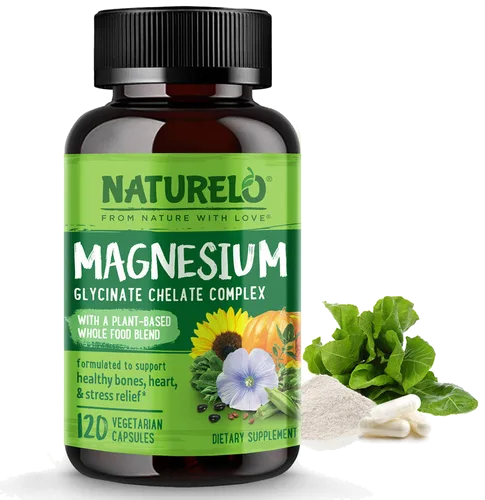
NATURELO Premium Supplements Magnesium Glycinate Chelate Complex Review
NATURELO Premium Supplements Magnesium Glycinate Chelate Complex is a magnesium supplement sold as capsules. One capsule is a serving, and each container holds 120 servings. The label lists two main ingredients per serving: Magnesium at 200 mg and a Magnesium-Rich Plants Blend at 30 mg. The other ingredients are rice flour, hypromellose and rice bran extract. The directions printed on the label read: Suggested Use: Adults take one (1) capsule a day with food and a full glass of water. Buyers most often say the capsules are easy to swallow and that they take it for sleep, stress and muscles. Many like the value for the price, while one longtime buyer objected to a change in the formula that added magnesium oxide.
We don’t sell supplements. We help you make decisions and get the best price.
Lowest prices
We hold no current store prices for it yet: check the store.
Sold at: iHerb
Products with nearly the same formula (Matched on the main ingredients)
Study, Trial or Testing Result Summary
Members Only59 human studies · 30 improved
6 of these 59 human studies gave the ingredient by drip, not by mouth.
Magnesium, at 200 mg a day here, is close to the 226 mg dose that helped in one trial. In that trial of 216 people with night leg cramps, 226 mg at bedtime for 60 days improved sleep quality more than placebo [1]. A pooled analysis of three trials in 151 older adults with insomnia found people fell asleep about 17 minutes faster, but total sleep time did not change much and the evidence was low quality [2]. In 290 people with diabetes and insomnia, two months of magnesium lowered insomnia severity [3]. In 46 older adults, 500 mg daily improved sleep time and time to fall asleep [4]. Other trials disagree. In 100 adults, 320 mg daily did not beat placebo [5]. Another trial improved how people felt about their sleep but not measured sleep [6]. A review of 12 trials called the results inconsistent and low certainty [7]. The plant blend is only 30 mg, well below studied doses, and its studies tested magnesium itself, not this blend [8]. Animal and cell studies are never counted.
See all 59 studies →Hide the studies
- Pooling three placebo-controlled trials in 151 older adults with insomnia, people taking oral magnesium fell asleep about 17 minutes faster than those on placebo, while the 16-minute gain in total sleep time was not statistically significant, and the evidence was low quality.Oral magnesium supplementation for insomnia in older adults: a Systematic Review & Meta-Analysis.
- In a review of 31 trials of sleep supplements, amino acids, melatonin and vitamin D clearly improved sleep quality, but magnesium had too little data to be pooled and was only discussed as possibly helpful.Efficacy of dietary supplements on improving sleep quality: a systematic review and meta-analysis.
- A review of 9 studies with 7,582 adults found observational links between magnesium status and better sleep, but the randomized trials of magnesium supplements gave contradictory, uncertain results.The Role of Magnesium in Sleep Health: a Systematic Review of Available Literature.
- In a review of Crohn's disease studies, low magnesium levels were linked to longer time to fall asleep and shorter sleep, but the review did not directly test magnesium supplements for sleep.Does Magnesium Provide a Protective Effect in Crohn's Disease Remission? A Systematic Review of the Literature.
- In a review of 10 trials of 482 people with restless legs syndrome across all supplements, magnesium oxide improved sleep quality and symptoms, appearing more effective than vitamin B6, though half of the trials had a high risk of bias.Effects of Dietary Supplementation in Patients with Restless Legs Syndrome: A Systematic Review.
- In a review of treatments for sleep problems in people recovering from alcohol dependence, magnesium showed benefit only in single small, mostly open-label studies.Pharmacological treatment of insomnia in alcohol recovery: a systematic review.
- A review of 12 randomized trials in adults found inconsistent results for oral magnesium on sleep, with possible modest benefits for some self-reported outcomes and low to very low certainty, so it is not supported as a routine insomnia treatment.Magnesium Supplementation for Sleep in Adults: A Systematic Review of Randomized Controlled Trials.
- In 290 people with diabetes and insomnia who finished the trial, 2 months of magnesium, potassium or both reduced insomnia severity and shifted sleep hormones (melatonin and cortisol) compared with placebo.Effects of magnesium and potassium supplementation on insomnia and sleep hormones in patients with diabetes mellitus.
- In 216 people with nighttime leg cramps (175 finished), 226 mg of magnesium oxide monohydrate at bedtime for 60 days improved sleep quality more than placebo and cut cramps more.A randomized, double-blind, placebo-controlled, multicenter study assessing the efficacy of magnesium oxide monohydrate …
- In 171 healthy adults with mild insomnia, a magnesium-containing multi-ingredient blend for 2 weeks did not improve sleep quality more than placebo, as both groups improved.Exploring the Effect of Lactium™ and Zizyphus Complex on Sleep Quality: A Double-Blind, Randomized Placebo-Controlled Tr…
- In 128 perimenopausal and postmenopausal women with sleep disturbance, a multi-ingredient supplement containing magnesium for 3 weeks improved sleep scores (90.9% responders vs 45.2% on placebo) and added about 41 minutes of sleep.Nonsedating neurotransmitter-modulating supplement for nonvasomotor sleep disturbance in menopause.
- In 121 older adults with frequent leg cramps, magnesium for 4 weeks did not reduce cramp frequency compared with placebo, and sleep-related benefit was only reported for compression stockings.Secondary prevention of leg cramps using compression stockings or magnesium supplements: a three-arm randomized clinical…
- In 120 patients having laparoscopic gallbladder surgery, intravenous magnesium sulfate was associated with better sleep quality than saline placebo during recovery, alongside lower pain and a med use.Lidocaine vs. magnesium: effect on analgesia after a laparoscopic cholecystectomy.
- In a placebo-controlled trial of 103 healthy active adults, an evening blend containing 2 grams of magnesium L-threonate (145 mg elemental magnesium), L-theanine and apigenin for 2 weeks did not show a sleep improvement reported in the abstract; the sleep gains were seen with the morning adaptogen product instead.Modulating stress and sleep through a multi-compound dietary supplement: a randomized, double-blind, placebo-controlled …
- In 100 adults with poor sleep, 320 mg of magnesium citrate daily for 7 weeks did not improve sleep more than placebo, since sleep quality improved in both groups; magnesium lowered inflammation marker CRP only in those with high baseline levels.Magnesium supplementation improves indicators of low magnesium status and inflammatory stress in adults older than 51 ye…
- In 100 chronically stressed adults, a multi-ingredient product containing magnesium improved daytime sleepiness scores over 4 weeks compared with placebo; the magnesium effect alone is unknown.Effect of a Combination of Magnesium, B Vitamins, Rhodiola, and Green Tea (L-Theanine) on Chronically Stressed Healthy I…
- In 100 adults with poor sleep, 2 g daily of magnesium L-threonate for 6 weeks improved self-reported sleep-related impairment more than placebo, but there were no group differences in objectively measured sleep.The effects of magnesium L-threonate (Magtein®) on cognitive performance and sleep quality in adults: a randomised, doub…
- In a placebo-controlled trial of 94 older adults taking magnesium oxide at bedtime for 4 weeks, sleep quality did not differ from placebo.Effect of Magnesium Oxide Supplementation on Nocturnal Leg Cramps: A Randomized Clinical Trial.
- In 89 menopausal women with sleep or mood problems, a daily tablet containing 50 mg of magnesium and Magnolia bark extract reduced insomnia and other symptoms more than calcium plus vitamin D over 24 weeks.Soy isoflavones, lactobacilli, Magnolia bark extract, vitamin D3 and calcium. Controlled clinical study in menopause.
- In a randomized placebo-controlled crossover trial of 89 women and men with fibromyalgia, a supplement combining coenzyme Q10, tryptophan and magnesium over three months improved sleep quality, though the dose of magnesium was not stated and the combination cannot be attributed to magnesium alone.Effects of Coenzyme Q10, Tryptophan, and Magnesium Supplementation on Fatigue in Patients with Fibromyalgia - A Randomiz…
- In 80 patients having lumbar spine surgery, intraoperative magnesium sulphate was linked to post-operative insomnia and pain, but the abstract does not state whether it made sleep better or worse.Effect of intra-operative Magnesium sulphate on the occurrence of post-operative delirium and insomnia in patients under…
- Adults aged 35 to 55 with self-reported sleep problems who took 1 gram a day of magnesium L-threonate for 21 days kept better sleep quality and daytime functioning than those on placebo, whose scores declined.Magnesium-L-threonate improves sleep quality and daytime functioning in adults with self-reported sleep problems: A rand…
- In 75 adults with restless legs syndrome, 250 mg of magnesium oxide daily improved sleep quality and symptom severity after two months compared with placebo, though no difference appeared in the first month.Therapeutic effects of magnesium and vitamin B6 in alleviating the symptoms of restless legs syndrome: a randomized cont…
- In 50 patients having open gallbladder surgery, intravenous magnesium sulfate gave better sleep quality on the first night after surgery than saline, without reducing morphine needs.Effect of intraoperative magnesium infusion on perioperative analgesia in open cholecystectomy.
- In 50 patients having scoliosis surgery, intravenous magnesium given with ketamine improved sleep quality on the first night after surgery compared with ketamine and saline, alongside lower morphine use.Ketamine and magnesium association reduces morphine consumption after scoliosis surgery: prospective randomised double-b…
- In 46 older adults with insomnia, 500 mg of magnesium daily for 8 weeks improved sleep time, sleep efficiency, and time to fall asleep compared with placebo.The effect of magnesium supplementation on primary insomnia in elderly: A double-blind placebo-controlled clinical trial…
- In 43 adults with trouble falling asleep, an evening blend containing 12.6 mg of magnesium plus mulberry leaf and tryptophan shortened time to fall asleep by about 3 to 4 minutes and improved next-morning sleep quality over 14 days compared with a control, though magnesium was a minor part of the blend.Mulberry leaf extract combined with tryptophan improves sleep and post wake mood in adults with sleep complaints - A ran…
- In 42 adults with nocturnal leg cramps, 900 mg of magnesium citrate twice daily for one month did not outperform placebo for cramps or the sleep disruption they caused.Magnesium for the treatment of nocturnal leg cramps: a crossover randomized trial.
- In 42 people having abdominal hysterectomy, intravenous magnesium sulfate before and after surgery led to better sleep quality in the postoperative period than saline, with insomnia rising in the saline group but not the magnesium group.Role of magnesium sulfate in postoperative analgesia.
- In a placebo-controlled trial of 40 exercise-trained adults, a recovery drink containing 420 mg magnesium citrate along with cannabinoids and amino acids, taken twice daily for 3.5 days, did not change sleep quality compared with placebo.A randomized, double-blind, placebo-controlled, repeated-dose pilot study of the safety, tolerability, and preliminary e…
- In 40 adults with depression, 250 milligrams of daily magnesium added to a med for 6 weeks produced greater improvement than a med alone, with the insomnia domain among the areas that improved most.Read the study on PubMed (41916937) →
- In 35 people with sleep problems, a bedtime coffee pod with 200 mg magnesium and 1.9 mg melatonin for 4 weeks improved sleep quality more than placebo, though scores still indicated poor sleep on average.The effects of melatonin and magnesium in a novel supplement delivery system on sleep scores, body composition and metab…
- In 35 post-menopausal women with osteoporosis taking zoledronate, 200 mg of magnesium daily for 3 months did not change sleep quality or other measured outcomes compared with baseline.Quantitative sensory testing of pain in osteoporosis: a pilot randomized clinical trial with magnesium supplementation.
- In 35 stressed adults taking a herbal supplement with magnesium and chromium for 15 days, mood and anxiety improved compared with placebo, but the abstract does not report any sleep results.Effects of a Scutellaria baicalensis/Crataegus laevigata, magnesium and chromium supplement on stressed individuals: A r…
- In 24 people after major lumbar spine surgery, a single intravenous magnesium sulphate infusion at the start of anaesthesia was followed by better sleep on the first night than saline.Effect of intra-operative magnesium sulphate on pain relief and patient comfort after major lumbar orthopaedic surgery.
- In 22 women with fibromyalgia, a Mediterranean diet enriched with 60 milligrams of magnesium and 60 milligrams of tryptophan for 16 weeks did not improve sleep quality compared with the standard diet.Psychological and Sleep Effects of Tryptophan and Magnesium-Enriched Mediterranean Diet in Women with Fibromyalgia.
- In 20 people with nerve pain, a single 3 g intravenous magnesium infusion with ketamine gave no significant improvement in sleep compared with placebo over 5 weeks.Ketamine and Magnesium for Refractory Neuropathic Pain: A Randomized, Double-blind, Crossover Trial.
- In 16 young adults, a blend that included magnesium with other ingredients taken for 3 days shortened time to fall asleep, lengthened total sleep and improved sleep efficiency compared with placebo, so the effect cannot be attributed to magnesium alone.Nutritional Modulation of Sleep Latency, Duration, and Efficiency: A Randomized, Repeated-Measures, Double-Blind Decepti…
- In 16 trained men given two nights of partial sleep loss, a zinc magnesium aspartate supplement did not improve sleep quality compared with placebo or no pill.Effects of Supplementing Zinc Magnesium Aspartate on Sleep Quality and Submaximal Weightlifting Performance, following T…
- In a randomized bowel-prep comparison for colonoscopy, a sodium picosulfate and magnesium oxide mix was tolerated better than a mannitol mix, and sleep problems were reported more often with the mannitol mix; the abstract does not report any sleep benefit from magnesium.Comparative study between manitol and sodium picosulfate with magnesium oxide solutions in the preparation for colonosco…
- In people with fibromyalgia, 100 mg of magnesium chloride daily for 1 month did not produce significant differences from placebo in sleep, though it did reduce stress in a subgroup and pain.Short-Term Magnesium Therapy Alleviates Moderate Stress in Patients with Fibromyalgia: A Randomized Double-Blind Clinica…
- In adults with temporomandibular disorders, a nightly multi-ingredient tablet containing magnesium for 40 days produced greater improvement in pain, headache and sleep or mood problems than controls, though the magnesium amount and participant numbers were not stated in the abstract.The role of nutraceuticals in the management of temporomandibular disorders.
- In a randomized bowel preparation trial, magnesium citrate caused more sleep interruption than Picolax, so it was worse for sleep in that setting.A comparative trial of magnesium citrate (Citramag) and Picolax for barium enema bowel preparation.
- In 100 people preparing for a colon scan, a prep using diet, magnesium citrate and barium caused less sleep disturbance than a standard prep with polyethylene glycol, though magnesium was only one part of this bowel prep.Dietary fecal tagging as a cleansing method before CT colonography: initial results polyp detection and patient acceptan…
- In 92 adults with high blood pressure given 320 mg a day of magnesium with vitamin B6, complaints of sleep disorders were reported less often afterward, though sleep was only one of many symptoms tracked and there was no placebo comparison for it.[Level of total and ionized magnesium fraction based on biochemical analysis of blood and hair and effect of supplemente…
- In 60 patients before heart surgery, 500 mg of magnesium oxide daily for five days improved sleep quality scores compared with routine care alone.Effect of short-term magnesium supplementation on anxiety, depression and sleep quality in patients after open-heart sur…
- In 43 long-term care residents with chronic trouble sleeping, a nightly supplement containing 225 mg magnesium plus melatonin and zinc for 8 weeks improved sleep quality more than placebo, though the magnesium effect cannot be separated from the other ingredients.The effect of melatonin, magnesium, and zinc on primary insomnia in long-term care facility residents in Italy: a double…
- In an open-label pilot of 12 adults with restless legs syndrome, 200 milligrams of magnesium citrate daily for 8 weeks significantly reduced symptom scores and improved quality of life, though without a placebo group the results are preliminary.Magnesium citrate monotherapy improves restless legs syndrome symptoms and multiple suggested immobilization test scores…
- In 10 adults with restless legs or leg-movement insomnia, an evening magnesium dose of 12.4 mmol for 4 to 6 weeks reduced leg-movement arousals and improved sleep efficiency, with 7 of 10 reporting better sleep, in an open study without a placebo group.Magnesium therapy for periodic leg movements-related insomnia and restless legs syndrome: an open pilot study.
- In a large national survey of U.S. adults, those who slept under 7 hours a night had lower usual magnesium intake from food and supplements than those who slept longer, though this study cannot show that low magnesium causes short sleep.Micronutrient Inadequacy in Short Sleep: Analysis of the NHANES 2005-2016.
- In a large long-term study of young adults, those with the highest magnesium intake were less likely to report short sleep under 7 hours; the link to sleep quality was borderline.Association of magnesium intake with sleep duration and sleep quality: findings from the CARDIA study.
- In a large Swiss cohort of 3887 adults, taking magnesium supplements was not consistently linked to better sleep measured by questionnaire or sleep study, though users reported more nighttime leg cramps.Magnesium supplements, sleep quality, and nocturnal leg cramps: a combination of cross-sectional and prospective studies…
- In a cross-sectional survey of 1041 Saudi adults, low serum or dietary magnesium was linked to higher odds of poor sleep quality, though this does not show that magnesium causes the change.Magnesium and Zinc Are Associated with Sleep Quality in Saudi Adults: Evidence from a Cross-Sectional Study.
- In 810 children aged 5 to 12 referred for attention problems, 12 weeks of a fatty acid, magnesium and zinc supplement was followed by fewer problems falling asleep, though this uncontrolled cohort cannot separate magnesium's effect from the other ingredients.Supplementation of polyunsaturated fatty acids, magnesium and zinc in children seeking medical advice for attention-defi…
- In 112 young Japanese women, a later preferred midpoint of sleep and an evening-type body clock were linked to lower magnesium intake from the diet, though this study cannot show that magnesium affects sleep timing.Dietary intake is associated with human chronotype as assessed by both morningness-eveningness score and preferred midpo…
- In 40 obese adults with sleep apnea, the inflammatory profile of their diet did not correlate with the condition, though a better diet pattern was related to better sleep, and their magnesium intake was low.Dietary Inflammatory Index of Obese Individuals with Obstructive Sleep Apnea: A Descriptive Study.
- In 34 younger adults tracking their daily food intake and sleep with a wrist monitor, higher magnesium intake was only linked to a non-significant trend toward less disrupted sleep (P=.09), so no clear sleep benefit was shown.Higher daytime intake of fruits and vegetables predicts less disrupted nighttime sleep in younger adults.
- In 19 healthy active men given one dose of a zinc and magnesium supplement before bed for two nights, sleep measured by a wrist activity monitor did not change compared with placebo or no pill.Effects of an Acute Dose of Zinc Monomethionine Asparate and Magnesium Asparate (ZMA) on Subsequent Sleep and Next-Day M…
- In eight people with nerve pain, weekly intravenous magnesium lowered pain in four; some reported good sleep afterward, but sleep was not formally measured.[Relief of neuropathic pain with intravenous magnesium].
Review Totals and Summary
Members Only10,612 reviews · 95% positive
Across the stores that sell it, this magnesium carries about 10612 ratings, and the reviews here lean strongly positive, with one clear complaint about a change in the formula. **What buyers say it did for them:** Most reviewers take it for sleep, stress and muscles. One says "love the quality sleep I've gained." Another takes it at night "to relax and ease my anxious mind." A third says it is "helping me a lot" with trouble sleeping and stress. Several also mention joints, muscles and hormones as reasons they take it, and one says they "can feel the effects quickly." **What they complain about:** The one negative review is from a long-time buyer who says the formula changed. They say it used to be only magnesium bisglycinate and now "contains MAGNESIUM OXIDE." They say they will no longer buy it. No other complaints appear in these reviews. **Taste, smell, pill size and form:** Reviewers describe the capsules as easy to swallow. One says there is "no after taste as others do," and another says the capsules are "not big as others." Another reviewer says the size and taste are easy to swallow. The capsules are described as vegetarian, and one reviewer lists non-GMO, no soy and no gluten. **Value for money:** Buyers who mention price are happy with it. One says "the package size is good compared to the price." Another says "great quality and great price." Packaging gets a good word from two reviewers as well. **Who it seems to suit and who it did not:** It seems to suit people who want a daily magnesium for sleep, stress and muscle comfort, and people who like ingredients from plant sources. One reviewer likes that it includes magnesium rich foods. Another says the dose of 200 mg per capsule is "excellent." Some take one capsule a day, and one takes one twice a day. It did not suit a longtime buyer who wanted a formula with only magnesium glycinate and no other magnesium forms.
Biohacker Summary
Members Only7 of 10 recommend it
Most of the panel recommends or uses magnesium, and sleep is the most common reason, with others citing muscle cramps and recovery, stress, blood pressure, bone health, and helping the body use vitamin D. Forms matter to them: glycinate is favored for sleep, cramps, and absorption, while threonate is favored for bedtime and brain effects, and three of them take 400 mg of threonate before bed. Other doses mentioned were 300 to 400 mg a day from food and supplements, 400 to 500 mg a day as a minimum, and one panelist who aims for about a gram of supplemental magnesium. Some get it through electrolyte drinks, and others pair it with vitamin D, potassium, or protein. One panelist says magnesium does not fix waking in the night, and one stays neutral and only reviews the sleep evidence, but no one said they stopped taking it.
See all 10 biohackers →Hide the biohackers
Dr. Eric Berg · Magnesium · neutral
- Notes that B1 depends on magnesium to work.
- Names magnesium as a cofactor needed for vitamin D to work, abundant in meat.
- Says magnesium is necessary for vitamin D to be effective and says many people fail to take it, so it should be taken alongside vitamin D.
- Recommends magnesium glycinate as the gold standard for good absorption with few GI problems, since magnesium helps relax arteries and keep blood pressure from rising.
- Says the natural remedy for a heel spur, which reflects a calcium problem, is magnesium glycinate at 400 milligrams.
- Recommends supplementing magnesium during prolonged fasting to prevent feeling unwell, especially since many individuals are already deficient.
- Recommends taking magnesium glycinate to fix intense leg cramps, stating that this form absorbs better and helps relax muscles.
- Recommends magnesium, specifically magnesium glycinate, for blood pressure control, sleep, stress reduction, prevention of muscle cramps, and energy support.
- States that magnesium could also be a factor in preventing muscle cramps.
- Recommends Magnesium glycinate, noting its high absorption rate compared to magnesium oxide, and its support for energy, sleep, muscle relaxation, and vitamin D function.
Thomas DeLauer · Magnesium · recommends
- Speaker would add magnesium glycinate, citing a 2022 meta-analysis of 17 studies showing reduced C-reactive protein and fibrinogen, linked to cardiovascular inflammation.
- Says taking boatloads or truckloads of magnesium because you sleep poorly is not how the system works, and that supplements should replace a blood-work-defined deficiency rather than be stacked.
- Recommends pre-bed magnesium glycinate to lower evening cortisol through GABA-A support and to drop core temperature for sleep onset.
- Recommends taking magnesium glycinate and threonate at night to act as a brake on the nervous system, block excitatory signaling, help wind down, and support serotonin and melatonin production for better sleep.
- Mentions that magnesium glycinate also helps a lot with sleep.
- Mentions that restless leg syndrome is often treated with magnesium, but states that the sensation is actually coming from three other issues.
- Uses Element's cans which contain 30 milligram magnesium, finding that electrolytes help his workout performance.
- Uses Element's 30 mg magnesium cans first thing in the morning to prime his day and help with workout performance.
- Recommends magnesium around the time one would normally break a fast to calm the brain and dull feelings of conditioned hunger.
- Recommends magnesium, noting it is a cofactor for enzymes that build neurotransmitters, and deficiency can affect mood, happiness, and motivation.
Ben Greenfield · Magnesium · uses
- Often mixes two scoops of Magnesium Breakthrough powder with psyllium husk powder before bed, using about 4 ounces of water, and uses the raspberry lemonade flavor.
- Uses magnesium during surgery because it is neuroprotective.
- Says he is drinking LMNT, which contains sodium, potassium, and magnesium, and states that he actually drinks this stuff.
- Mentions magnesium as part of a bare-minimum protocol.
- Advises getting red blood cell magnesium levels to the high end of the range as a minimum step for overall health and to slow down heart disease.
- Recommends supplementing with magnesium threonate if one is low in magnesium, as it crosses the blood-brain barrier and is demonstrated to increase hippocampus plasticity, theoretically making one smarter and improving memories.
- Uses Magnesium Breakthrough from BIOptimizers as part of their daily stack, taking four capsules in the evening to support relaxation, recovery, and a good night of sleep.
- Recommends Celtic Sea Salt's new electrolyte drink "Hydrate" for replacing electrolytes and trace minerals lost through sweat, noting it contains 70 naturally occurring trace minerals, plus magnesium, taurine, and potassium.
- Had heart palpitations when he was really overdoing magnesium, not knowing what he was taking.
- Recommends taking magnesium as a co-factor to increase vitamin D absorption.
Dr. Mark Hyman · Magnesium · recommends
- Recommends Magnesium Breakthrough Advanced 10 from Biooptimizers, stating it has 10 bioavailable forms and 550 milligrams of elemental magnesium, designed to support restful sleep, restorative sleep, muscle recovery, stress resilience, and metabolic health.
- Recommends magnesium breakthrough advanced ten from Biooptimizers, which is their most complete magnesium formula with 10 bioavailable forms and 550 milligrams of elemental magnesium, designed to support restful restorative sleep, muscle recovery, stress resilience, and metabolic health.
- Recommends considering magnesium glycinate before bed for nervous system support, deeper sleep quality, and to help the body transition into rest, and states that they take it every night.
- Explains that a lack of magnesium can cause muscles and nerves to malfunction, resulting in muscle weakness, twitching, and cramps.
- Recommends Magnesium Breakthrough Advanced 10 from Bioptimizers for restful sleep, muscle recovery, stress resilience, and metabolic health, especially during stressful times of the year.
- Recommends magnesium because it is involved in over 600 reactions in the body and up to 80% of people may have low levels that never get flagged on a standard blood test.
- Recommends magnesium as a basic supplement during detoxification to support pathways, help with constipation, and provide electrolytes.
- Recommends Magnesium Breakthrough Advanced 10 from Biooptimizers, which contains 10 bioavailable forms and 550 mg of elemental magnesium, to support restful sleep, restorative sleep, muscle recovery, stress resilience, and metabolic health.
- Has recommended magnesium breakthrough from bioptimizers for years and now uses Magnesium Breakthrough Advanced 10 as part of his evening routine, especially during periods of travel, training, and higher stress, to support sleep, muscle recovery, and metabolic health.
- Recommends correcting nutrient deficiencies with magnesium.
Bryan Johnson · Magnesium · uses
- Takes 400 mg of Magnesium Threonate before bed for sleep.
- Takes 400 mg of Magnesium Threonate before bed for sleep.
- Takes 400 mg of Magnesium L-Threonate before bed for sleep.
- Takes 400 mg of Magnesium Threonate before bed for sleep.
- He takes 400 mg of Double Wood Magnesium L-Threonate before bed for sleep.
- Takes 400 mg of Magnesium L-Threonate before bed for sleep.
- Takes 400 mg of Magnesium Threonate before bed for sleep.
- Takes 400 mg of Magnesium L-Threonate before bed for sleep.
- Takes 400 mg of magnesium L-threonate before bed for sleep.
- He takes 400 mg of Magnesium L-Threonate before bed for sleep.
Dr. Rhonda Patrick · Magnesium · recommends
- Explains that magnesium helps the body activate and metabolize vitamin D, and that magnesium intake has been associated with lower odds of vitamin D deficiency and insufficiency.
- Mentions that getting too little magnesium may play a role in declining testosterone levels.
- Recommends getting enough magnesium, around 300–400 mg daily from diet and supplements, as it is an essential cofactor for vitamin D metabolism. Magnesium glycinate is a good form.
- Notes that magnesium is very important for preventing damage to DNA and cancer, and that half the US population doesn't get enough of it.
- Mentions magnesium as one of the micronutrients found in multivitamins that people often don't get enough of from their diets.
- Explains that magnesium helps control blood pressure by boosting the production of substances that relax blood vessels and improve cardiovascular health, citing a meta-analysis that found magnesium supplementation at an average dose of 368 mg per day notably lowers both systolic and diastolic blood pressure.
- Magnesium supplementation has lowered blood pressure in randomized controlled trials. An analysis of 34 trials involving over 2,000 participants found modest reductions in both systolic and diastolic pressure, with a median dose of 368 mg/day.
- Warns that some magnesium supplements make the dose look much larger than it really is and that labels can fool people.
- Mentions magnesium as an important nutrient component for testosterone.
- Warns that some supplement companies mislead consumers by listing the total compound weight of magnesium citrate as the elemental magnesium dose, when the actual elemental magnesium content is much lower, potentially around 44-66 milligrams.
Andrew Huberman · Magnesium · recommends
- Notes that Les Spellman's team includes 'Magnesium timed right' as part of their game plan to optimize recovery in unfavorable conditions.
- Discusses Magnesium Threonate as a tool for falling asleep.
- Takes 400 mg of Magnesium Threonate before bed for sleep.
- Uses Element, an electrolyte drink with sodium, magnesium, and potassium in correct ratios and no sugar, to ensure adequate hydration and electrolytes, especially when starting days fast or during physical exercise.
- Takes 400 mg of Magnesium L-Threonate before bed for sleep.
- Confirms that magnesium is absolutely important for cognitive function, noting studies show those with lower magnesium intakes tend to perform less well on cognitive function tests, and it's related to brain changes over time and dementia risk.
- Takes 400 mg of Double Wood Magnesium L-Threonate before bed for sleep.
- He takes 400 mg of Magnesium L-Threonate from Double Wood before bed for sleep.
- Takes 400 mg of Double Wood Magnesium L-Threonate before bed for sleep.
- Takes 400 mg of magnesium L-threonate before bed for sleep.
Dave Asprey · Magnesium · uses
- Looks at magnesium alongside protein to keep muscle for the long run.
- Suggests adding magnesium to help keep potassium in the system longer, as they work hand in hand.
- Mentions magnesium in the context of sleep but states that it doesn't address the core issue of waking up during the night.
- Suggests that magnesium may help slow aging, support cellular repair, and improve sleep.
- States that magnesium can affect how the body responds to a supplement.
- Recommends fixing sleep with 300mg of Magnesium 101 before bed if diet and exercise aren't melting stubborn belly fat.
- Dave Asprey says his daily routine includes magnesium as part of a carefully developed combination for longevity.
- Recommends magnesium glycinate for sleep, stating that trials show it helps people fall asleep about 17 minutes faster and that he finds it incredibly effective.
- Mentions magnesium glycinate as one of the five gut-friendly, extensively researched ingredients in Kill Switch that helps with natural sleep.
- Dave Asprey recommends Magnesium Glycinate for sleep, noting human studies show it helps people fall asleep faster, is safe, and works on a fundamental aspect of health, unlike magnesium oxide which acts as a laxative.
Siim Land · Magnesium · recommends
- States that Magnesium can be a useful addition for some people for sleep.
- Recommends magnesium for sleep, especially deep sleep, and suggests trying better types like Threonate, Biscinate, or Torate, referencing a study where magnesium supplementation improved deep sleep.
- Recommends Magnesium for blood pressure, migraines and deficiency, based primarily on human research, especially randomized controlled trials showing measurable benefits.
- Lists Magnesium as one of 15 supplements backed by human studies.
- States that magnesium is a fundamental mineral governing over 600 enzymes and metabolic reactions, and recommends that most people need at least 400-500 mg/d for health, with some needing up to 600 mg/d.
- Lists seafood and pumpkin seeds as sources of Magnesium.
- Thinks magnesium has some of the strongest evidence and is worth considering.
- Recommends taking magnesium, specifically glycinate and threonate forms, 1 to 2 hours before bed for sleep benefits, noting that glycinate promotes relaxation and threonate crosses the blood-brain barrier for sleep quality and cognitive function.
- Notes that Boron reduces calcium/magnesium loss.
- Notes that magnesium is important for activating thiamine into its more biologically active form, and a magnesium deficiency can impair blood sugar regulation even with adequate thiamine intake.
Peter Attia · Magnesium · neutral
- Peter reviews the evidence for select off-label medications and supplements commonly used for sleep, including glycine, magnesium, ashwagandha, and phosphatidylserine.
- Suggests that zinc and magnesium could potentially help with vasodilation and sleep, particularly for women experiencing severe symptoms in the luteal phase.
- Peter discusses electrolytes and fiber and the ketogenic diet, specifically preventing magnesium loss.
- Recommends magnesium as one of the 'big three' micronutrients for bone health, suggesting a daily intake of 300 to 500 milligrams as a minimum, and personally aims for about a gram of supplemental magnesium.
- Recommends magnesium for optimizing bone mineral density, suggesting a daily intake of 300 to 500 milligrams as a minimum, but personally aims for about a gram.
- Takes a hardline view that most people do not have adequate or optimal levels of magnesium, and suboptimal levels will impede the metabolism of vitamin D because magnesium is a cofactor in its enzymatic conversion.
- Takes a hardline view that most people do not have adequate or optimal levels of magnesium, and suboptimal levels will impede vitamin D metabolism because magnesium is a co-factor in the enzymatic conversion of vitamin D.
- Takes magnesium as a straightforward supplement.
- Mentions that magnesium intake is often super low and impactful on testosterone levels.
- Discusses the important roles of magnesium in the body, how to determine if one might be deficient, the prevalence of magnesium deficiency, and its potential cognitive benefits.
RAL Summary
Members OnlyTier 4 for Sleep
Tier 5 needs good human studies showing magnesium does not work for sleep, but the studies given are mixed with more positive than null trials, and over 10,000 reviews are 95% positive, which fits tier 3. So it is graded Tier 4, as the studies disagree.
- Emerging: not enough evidence to rank higher yet.
Where the evidence disagrees: 22 of the 59 human studies found no effect.
More Details
Members OnlyBody systems · Combine with · Possible side effects
Body systems: Nervous system, Muscular system
Combine with: For Sleep, magnesium is often paired with glycine, because both act on calming pathways in the brain tied to sleep. It is often paired with L-theanine, which works on a related relaxation pathway. Vitamin B6 is often paired with it because it helps magnesium get into cells. Melatonin is often paired with it as it acts on the body clock, a separate pathway from magnesium.
Possible side effects: No major side effects reported.
Supplement Facts
Magnesium 200 mg · Magnesium-Rich Plants Blend 30 mg
| Magnesium | 200 mg | |
| Magnesium-Rich Plants Blend | 30 mg | † |
Other ingredients: Rice Flour, Hypromellose, Rice Bran Extract.
Directions: Suggested Use: Adults take one (1) capsule a day with food and a full glass of water.
Barcode (UPC) 628110628305 · Label source: NIH label database · Report a label change
Show entire label
More sleep products
Members OnlyThe highest ranked for the same goal
Read more
Our articles on this subject
- Melatonin vs Magnesium for Sleep: What the Studies ShowArticle · Nov 3, 2026
- Best Supplements for Sleep and the Habits That Matter MoreArticle · Jun 15, 2026
Graded November 23, 2026 by the Reverse Age Lab evidence engine, from human studies, real reviews and our biohacker panel. How we grade. Is this medical advice? No. Rala organizes the published evidence; go over any change with your doctor, especially if you take meds.
Privacy policyConsumer health dataAffiliate disclosureTermsBrand and legal noticesDo Not Sell or Share My Personal InformationCookie settings