
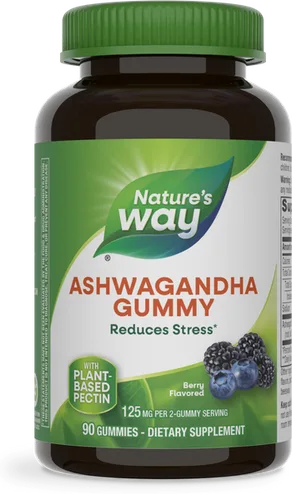
Nature's Way Ashwagandha Gummy Berry Flavored Review
Nature's Way Ashwagandha Gummy Berry Flavored is a chewable gummy supplement with a berry flavor. It comes as gummies in a container that holds 45 servings. One serving is 2 gummies. Per serving, the label lists 25 calories, 6 g of total carbohydrates and 15 mg of sodium. The main ingredient is Sensoril, listed at 125 mg per serving. The other ingredients printed on the label are glucose syrup, cane sugar, purified water, natural flavors, pectin, citric acid, sodium citrate, vegetable juice and beeswax. The directions printed on the label read: Recommendation: Adults chew 2 gummies daily. Since the serving is 2 gummies and the container holds 45 servings, the container has 90 gummies in all. The label puts the amount of Sensoril in the supplement facts panel, while the sugars and syrups appear in the other ingredients list. If you are comparing it with other products on the shelf, check the serving size, the number of servings and the amount of Sensoril per serving printed on each label.
We don’t sell supplements. We help you make decisions and get the best price.
Lowest prices
We may earn a commission from some store links. How we choose.
Finding the lowest prices at the stores now. This takes a few seconds.
Study, Trial or Testing Result Summary
Members OnlyHuman studies
This gummy is listed as containing Sensoril, a branded ashwagandha root and leaf extract, along with the calories, carbohydrates and sodium that come with a gummy. The label we have does not show the amount of ashwagandha per serving, so we cannot say whether it matches any studied dose. For this goal, reversing aging and supporting cellular and DNA repair, we were given no human studies on ashwagandha or any other ingredient in this product. That means there is no study evidence here that it slows biological aging, repairs DNA, or improves aging markers in people. Shoppers rate it well: of 225 reviews, nine in ten are positive. But no written reviews could be read, so we do not know what buyers were judging, whether taste, sleep, mood or something else, and the ratings do not show any effect on aging. Until human studies on this goal are available, treat any anti-aging claim for this product as unproven. Animal and cell studies are never counted.
Review Totals and Summary
Members Only225 reviews · 90% positive
No written reviews read yet.
Biohacker Summary
Members Only9 of 10 recommend it
The panel treats both ingredients here as smaller ingredients in this product, so the picture is mixed rather than a clear group verdict. Sodium drew the most comments: several panelists use or recommend it for hydration, often in electrolyte drinks with potassium and magnesium, one suggesting 3,000 to 4,000 mg a day and another taking 500 mg cans in the morning, while a few warn that most people get too much, and one says low sodium may signal fatigue rather than a need for more. Ashwagandha is recommended by about half the panel for stress, sleep and lowering cortisol, with doses given of 250 mg a day and 400 to 600 mg a day, and a preference for standardized extracts such as KSM-66 or Sensoril. One panelist advises two weeks on and two weeks off, another says it is only a little helpful for sleep and not for everyone, and another suggests establishing proper cortisol patterns first.
See all 10 biohackers →Hide the biohackers
Thomas DeLauer · Ashwagandha · recommends
- Recommends ashwagandha, but only after establishing proper cortisol patterns, as it helps the testosterone-cortisol axis by removing cortisol-mediated suppression of testosterone.
- Recommends Element electrolytes, mentioning new flavors and sparkling cans with half the sodium, and suggests a lemonade iced tea flavor with caffeine is perfect in the morning.
- Recommends Element electrolytes, noting they are focused on sodium first, then potassium, then magnesium, helping with sending signals and hydrating tissue.
- Uses Element's 500 mg sodium cans first thing in the morning to prime his day and enhance workout performance, noting that the pump is often driven by sodium.
- Uses Element's 500 mg sodium cans first thing in the morning to prime his day and help with workout performance and pump.
- Has been starting his day with 500 to 1,000 milligrams of sodium before coffee, noticing a significant difference in mental acuity before going to the gym.
- Recommends ashwagandha extract, noting a study where 57 overweight men over 40 saw a 14.7% increase in testosterone and an 18% increase in DHEA over 16 weeks, suggesting it removes the cortisol block suppressing the entire hormonal cascade.
- Suggests that the amount of sodium in restaurant food makes a difference in how one feels, implying a negative impact.
- Mentions ashwagandha as part of a full testosterone protocol, supporting production through different pathways.
- Has been starting his day with 500 to 1,000 milligrams of sodium before coffee, noticing a significant difference in mental acuity when he goes to the gym an hour later.
- Recommends Element's ready-to-drink sparkling electrolyte drinks as a low or zero-calorie soda replacement that provides 1,000 milligrams of sodium, 200 milligrams of potassium, and 60 milligrams of magnesium.
- Uses Element Electrolytes for about eight years, noting they contain 1000 mg sodium, 200 mg potassium, and 60 mg magnesium, and help curb appetite without adding many calories.
- Suggests that pairing watermelon with sodium post-workout enhances muscle glucose uptake through the insulin-dependent pathway, strategically using both glucose uptake doors.
- Recommends ashwagandha, noting it modulates the HPA axis and dropped cortisol by approximately 23% in 60 days, but advises cycling it, especially if feeling emotionally numb.
Dave Asprey · Sodium · recommends
- Suggests adding sodium to help keep potassium in the system longer, as they work hand in hand.
- Recommends that people who feel bad try more sodium, as it often works, especially for those with low blood pressure and anxiety.
- Dave Asprey notes that ashwagandha, when taken as a real standardized extract at a real dose, genuinely lowers cortisol and shows effects on stress and sleep quality in randomized trials, but lacks polysomnography data.
- They get into why ketosis works better when you cycle in and out of it, how sodium and electrolytes play a bigger role in insulin resistance than most people realize.
- Dave Asprey discusses ashwagandha as part of an adaptogen trio that works together for stress response and human performance.
- Mentions ashwagandha as an adaptogen in MTE that helps blunt the cortisol spike.
- Advises against ashwagandha for low cortisol, stating that salt and water are needed instead.
- Warns that ashwagandha can raise testosterone in women, causing irritability, and therefore needs to be cycled.
- Dave Asprey mentions ashwagandha as a supplement and cofactor that supports thyroid activation.
- Recommends ashwagandha as a cofactor that can help thyroid function, especially with conversion issues.
- Dave Asprey lists ashwagandha as part of a supplement stack that supports healthy hormone levels.
- Explains why electrolytes, especially sodium, potassium, and magnesium, are foundational for recovery.
- Recommends significantly more sodium for people with nervous system, immune system, and endocrine system dysregulation, suggesting starting low and building up to eight grams a day for some.
- Notes that the sodium in the Vineia blood flow hydration product is all sea salt.
Dr. Rhonda Patrick · Sodium · recommends
- Notes that lowering sodium intake can help individuals improve their vascular system and blood flow, which is beneficial if hypertension contributes to cognitive problems.
- Advises limiting sodium, ideally closer to 1,500 mg/day and not above 2,300 mg/day, for a diet linked to longer life.
- Warns that most people get too much sodium.
- Recommends Ashwagandha supplementation, specifically standardized for withanolides (KSM-66 at 5% or Sensoril at 10%), to indirectly boost testosterone by reducing cortisol levels, and also to improve anxiety, stress resilience, and sleep quality.
- Recommends ashwagandha, specifically patented extracts like Sensoril or KSM66 standardized to sufficient quantities of withanolides, for its indirect effect on testosterone by suppressing cortisol and stress response, which can be beneficial for anxious individuals and improve sleep.
- Is very bullish on Ashwagandha, citing meta-analyses showing improved lean mass, strength, sleep, and stress management. He notes it also raises testosterone but not enough to explain the lean mass changes.
- Discusses ashwagandha.
- Uses ashwagandha as a supplement to help with sleep.
- She takes LMNT for electrolyte replacement when she does high-intensity workouts or uses the sauna, preferring its high sodium concentration and variety of flavors.
- In this Aliquot, I explore how genetics, lifestyle, and potassium balance influence sodium's role in...
- Dr. Rhonda Patrick discusses curcumin & ashwagandha safety.
- His regular sleep supplements are glycine, ashwagandha, magnesium L-threonate, and magnesium oxide.
- She mentions that Peter Attia takes 600 milligrams of ashwagandha from Solgar.
Dr. Eric Berg · Sodium · neutral
- Dr. Eric Berg discusses sodium in relation to blood pressure, noting that the ratio between sodium and potassium matters.
- States that hydration is water plus electrolytes like sodium, implying its importance for proper hydration.
- Recommends around 3000 to 4000 mg of sodium each day to maintain healthy hydration levels, which is equal to about 1½ to 2 teaspoons of salt per day.
- Recommends ashwagandha, suggesting 250 milligrams per day over time to increase stress tolerance and help the cortisol receptor.
- Recommends consuming 3,000 to 4,000 mg of sodium per day to stay hydrated, which is about 1 and 1/2 teaspoons of salt. He explains that most people do not consume enough salt, leading to low blood volume and various symptoms.
- States that reducing salt isn’t always the best solution for high blood pressure, emphasizing the importance of the sodium-to-potassium ratio.
- States that adequate sodium can support better sleep.
- Recommends consuming sodium and other electrolytes for excess water.
- Recommends adding sea salt if one's diet is too low in sodium to help with frequent urination at night.
- Notes that low sodium can disturb sleep.
- Rates Ashwagandha on a scale from 1 to 10.
- Notes that some people may benefit from correcting low sodium levels.
- Lists ashwagandha as one of the best ways to lower luteinizing hormone, which goes too high as people age and is related to dementia.
- Notes that some people take ashwagandha or other adaptogens to help calm them down when they assume their problem is cortisol, and sometimes it works.
Dr. Mark Hyman · Ashwagandha · recommends
- Lists ashwagandha as an herb that can help lower anxiety or depression symptoms.
- States that sodium is essential for fluid balance, nerve signaling, and muscle function, and that low levels can cause weakness, confusion, and dizziness, while high levels may indicate dehydration or too much salt.
- States that with sodium, water can fully cross the cell membrane and get inside where it's needed for intracellular hydration.
- Notes that there was a recent study on ashwagandha for sperm health, indicating it's an evolving area of research.
- Warns that if sodium is low, it's not necessarily about ingesting more sodium or electrolytes, but rather a systematic marker indicating acute or chronic fatigue, overtraining, or sympathetic overdrive.
- Suggests trying ashwagandha, noting that some people respond to it, and recommends a dose of 400 to 600 mg.
- Recommends adaptogenic herbs like ashwagandha, particularly at night, rhodiola, lemon balm, and catclaw for stress relief.
- Recommends ashwagandha at night as an adaptogen to help with high cortisol and promote sleep for those who are tired and wired.
- Recommends using a sugar-free electrolyte powder such as Element, which contains a balanced ratio of sodium, potassium, and magnesium, to help with hydration before, during, and after drinking alcohol.
- Recommends ashwagandha, stating it can help convert T4 to T3, but advises ensuring a clear source and monitoring liver enzymes.
- Suggests adaptogens like rhodiola, ashwagandha, ginseng, and Siberian ginseng can be helpful for actively managing stress.
- States that Mosh protein bars contain ashwagandha to support a healthy brain.
- Recommends adaptogens like Ashwagandha if one has a lot of stress.
- States that ashwagandha can stimulate osteoblasts, which helps with bone building, especially for those with a genetic predisposition to low bone density.
Ben Greenfield · Sodium · uses
- Says he is drinking LMNT, which contains sodium, potassium, and magnesium, and states that he actually drinks this stuff.
- Ashwagandha, taken as 120–1,000 mg for at least 6 weeks, with most studies providing a dose of 400–600 mg/d, can lower cortisol levels, improve sleep quality, and enhance cognitive resilience for athletes during challenging phases consisting of high-volume resistance training.
- Notes that while sodium is known to affect blood pressure, the balance between sodium and magnesium is also important, and isolated sodium chloride in ultra-processed foods is more problematic than sodium from other sources.
- Notes that ashwagandha is an ingredient in MTE.
- Warns that sodium nitrate hurts endurance exercise adaptations in women.
- Mentions Ashwagandha as a supplement people cycle through when still sleeping poorly, suggesting it might not be addressing the true sleep problem.
- Notes that ashwagandha is a nightshade herb, but it is taken as a supplement and not used for cooking.
- Recommends sodium as it is relied upon by the creatine transporter for better creatine efficacy.
- Opens a sparkling electrolyte drink from LMNT, noting it contains 500 mg of sodium, and says he just needs something to wet his whistle.
- Adds a pinch of Celtic Sea Salt® to his post-workout smoothie to replace sodium and trace minerals lost during training, noting it retains minerals like magnesium, potassium, and calcium.
- Uses Celtic Sea Salt in everything from smoothies to roast chicken, not just for taste, but because its mineral content influences hydration, electrolyte balance, and how the body handles sodium.
- Warns that free-flowing white table salt has been stripped, bleached, and reduced to little more than straight sodium chloride.
- Explains how sodium supports performance, buffers acidity, and reduces fatigue during fasting or ketosis.
- Recommends a pinch of normal salt to alleviate keto flu symptoms, which are often caused by low sodium levels during fasting.
Siim Land · Sodium · neutral
- Mentions that sodium is a mineral necessary for making collagen.
- Recommends Ashwagandha for stress, sleep and performance, based primarily on human research, especially randomized controlled trials showing measurable benefits.
- Lists Ashwagandha as one of 15 supplements backed by human studies.
- Notes that Ashwagandha is one of several supplements with human evidence.
- States that ashwagandha, unless contaminated, is not going to raise liver enzymes.
- Stopped taking ashwagandha because it immediately caused a mouth sore.
- States that ashwagandha consistently reduces stress and anxiety in randomized controlled trials.
- States that Ashwagandha helps with testosterone primarily in stressed out or poor sleeping people.
- Mentions sodium as one of the factors related to blood sugar covered in his book.
- States that ashwagandha has strong evidence for increasing testosterone, mostly in stressed or infertile men.
- Mentions ashwagandha as an example of a testosterone-boosting supplement he has no interest in taking.
- Places Ashwagandha, specifically the KSM66 form, in the 'god tier' due to extensive research supporting its benefits for stress, sleep, testosterone production, estrogen, and even V2 max, while personally not experiencing any negative side effects some people report.
- States he does not quantify his sodium intake and doesn't regularly salt his food or drink electrolytes, estimating his intake to be around 2,500 milligrams a day, which is on the lower end.
- States that he consumes around 5-6 grams of sodium per day, emphasizing its importance for overall health.
Peter Attia · Sodium · neutral
- Peter discusses lifestyle factors impacting blood pressure, including sodium.
- Peter reviews the evidence for select off-label medications and supplements commonly used for sleep, including glycine, magnesium, ashwagandha, and phosphatidylserine.
- Mentions that dietary sodium guidelines are around 5 grams per day, but some newer information suggests 8 to 10 grams might be acceptable before concern.
- Finds ashwagandha a little bit helpful for sleep, though notes it may not be for everyone.
- Finds ashwagandha "a little bit helpful" for sleep, but notes that it may not be for everyone.
- Finds ashwagandha a little bit helpful for sleep, but notes it may not be for everyone.
- States that the data for ashwagandha are weak.
- Discusses the current evidence for ashwagandha's effects on sleep, stress, and anxiety.
- Mentions ashwagandha as an evergreen shrub historically used in traditional Indian medicine for indications such as sleep, stress, and immune health.
- Warns that for individuals with gene polymorphisms making them sensitive to salt, a higher sodium intake can significantly increase blood pressure.
- Mentions ashwagandha as something that can help with sleep in the setting of chronic stress and hypercortisolemia.
- Takes 600 mg of Solgar ashwagandha at night, having recently switched to this brand and returned to taking it after a previous hiatus.
- Takes 600 milligrams of ashwagandha at night, having recently switched to the Solgar brand and having returned to taking it after a long break.
- Peter discusses lifestyle factors impacting blood pressure, including sodium.
Andrew Huberman · Sodium · uses
- Uses Element, an electrolyte drink with sodium, magnesium, and potassium in correct ratios and no sugar, to ensure adequate hydration and electrolytes, especially when starting days fast or during physical exercise.
- Uses Element, which contains sodium in the correct ratios, to ensure proper hydration and electrolyte intake for brain and body function.
- He shares science-based tools for modulating aggression, including supplementation with ashwagandha.
- Warns that while ashwagandha is a potent inhibitor of cortisol, chronic supplementation for longer than two weeks can disrupt other hormone and neurotransmitter pathways, so it should be used with a two-week break after two weeks of use.
- Explains how salt (sodium) affects mental and physical performance, as well as cellular health, and how the brain monitors sodium levels to regulate thirst and fluid balance.
- Uses Element, an electrolyte drink with sodium, magnesium, and potassium in correct ratios and no sugar, to ensure adequate hydration and electrolytes, drinking it first thing in the morning and during physical exercise.
- Uses Element, an electrolyte drink with sodium, magnesium, and potassium in correct ratios and no sugar, to ensure he is hydrated and has sufficient electrolytes. He drinks it first thing in the morning and during physical exercise, especially on hot days.
- Uses Element, an electrolyte drink with sodium, magnesium, and potassium but no sugar, to ensure adequate hydration and electrolytes, especially when waking up and during exercise.
- Uses LMNT, an electrolyte drink with sodium, magnesium, and potassium in correct ratios and no sugar, to ensure adequate hydration and electrolytes for brain and body function, especially when starting his day fast or during physical exercise.
- Uses Element, which contains sodium, for proper hydration and electrolyte balance.
- Recommends Ashwagandha as a supplement to reduce cortisol.
- Ensures adequate intake of sodium, magnesium, and potassium, which are vital electrolytes for the functioning of all body cells, especially neurons, by drinking Element.
- Uses Element, an electrolyte drink with sodium, magnesium, and potassium, to ensure adequate hydration and electrolytes for optimal brain and body function, especially when waking up and during physical exercise.
- Explains how to optimize hormone levels through supplements such as ashwagandha.
Bryan Johnson · Sodium · warns
- Warns that Taco Bell's beefy five-layer burrito contains 1,290 mg of sodium, almost maxing out the daily reasonable consumption recommended by the American Heart Association, and that sodium increases blood volume, putting pressure on blood vessels.
- Drinks his Blueprint longevity mix with additional morning supplements, including ashwagandha.
- Warns against excess sodium, stating it can negatively affect the ability to absorb and hold onto calcium intake.
- States that Blueprint Ashwagandha can be used to stabilize mood.
- Mentions that Ashwagandha is included in the LA Longevity Mix, which condenses his 100 daily pills into a drink.
- Mentions ashwagandha as a potential therapy that could positively influence sperm health.
- Mentions ashwagandha as an ingredient in his 'bag of goodies', indicating he uses it.
- Takes ashwagandha for anti-anxiety, improved cortisol management, improved sleep, and increased testosterone.
- Recommends sodium at 200 to 400 mg daily for women during the luteal phase.
- Recommends ashwagandha at 300 to 600 mg daily to support stress resilience and overall well-being during the luteal phase for women.
- Ashwagandha + Rhodiola is part of the Blueprint protocol for energy and stress support.
- Suggests ashwagandha as an optional supplement to support calmness and resilience during stress, and to support the body's healthy response to stress.
- Lists "Ashwagandha + Rhodiola" with "120mg" as part of his supplements, implying its use.
RAL Summary
Members OnlyTier 4 for Healthy Aging
Tier 3 needs some study support for this goal, but no human studies on reverse aging or cellular and DNA repair were given for its ingredients, so the evidence is thin and supports tier 4. So it is graded Tier 4, lower than the rules alone gave.
- Emerging: not enough evidence to rank higher yet.
- No human studies on this goal for its ingredients.
More Details
Members OnlyBody systems · Combine with · Possible side effects
Body systems: Nervous system, Endocrine system
Combine with: Ashwagandha is often paired with NMN, because both are discussed around cellular energy and ageing pathways, and NMN supplies a building block the body uses for NAD. It is also often paired with resveratrol, since both are studied alongside the same sirtuin pathway. Another common pairing is magnesium glycinate, as magnesium is used up during stress responses that ashwagandha is also linked with. Quercetin is often paired with it for cellular upkeep, because the two act on related pathways.
Possible side effects: No major side effects reported.
Supplement Facts
Total Carbohydrates 6 g · Sensoril 125 mg
| Calories | 25 | |
| Total Carbohydrates | 6 g | |
| Sodium | 15 mg | |
| Sensoril | 125 mg | † |
Other ingredients: Glucose Syrup, Cane Sugar, Water, Purified, Natural Flavors, Pectin, Citric Acid, Sodium Citrate, Vegetable Juice, Beeswax.
Directions: Recommendation: Adults chew 2 gummies daily.
Barcode (UPC) 033674139837 · Label source: NIH label database · Report a label change
Show entire label
More healthy aging products
Members OnlyThe highest ranked for the same goal
Read more
Our articles on this subject
- Healthy Aging Tips: A Science-Backed Guide to Living Better for LongerArticle · Mar 17, 2026
- NAD Anti-Aging Supplements: Benefits, Evidence, and How to ChooseArticle · Jun 15, 2026
Graded November 18, 2026 by the Reverse Age Lab evidence engine, from human studies, real reviews and our biohacker panel. How we grade. Is this medical advice? No. Rala organizes the published evidence; go over any change with your doctor, especially if you take meds.
Privacy policyConsumer health dataAffiliate disclosureTermsBrand and legal noticesDo Not Sell or Share My Personal InformationCookie settings