
NOW A & D 10,000/400 IU - Softgels Review
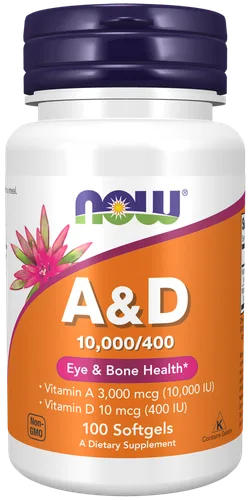
NOW A & D 10,000/400 IU is a softgel supplement that combines vitamin A and vitamin D3 in one capsule. The softgels are sold in a container holding 100 servings, and one softgel is one serving. Each serving lists Vitamin A at 3000 mcg and Vitamin D3 at 10 mcg. The IU numbers in the product name, 10,000 and 400, match these two amounts. The other ingredients are soybean oil, plus the softgel capsule itself, which is made of gelatin, glycerin and water. The label has no other active ingredients listed in the supplement facts. The printed directions under Suggested Usage read: take 1 softgel daily with a meal. With 100 servings in the container and one softgel per day, the label's directions work out to 100 days of use. The softgel form means the oil-based contents are sealed inside a gelatin shell, so the capsule is swallowed whole. If you are comparing bottles on a shelf, check the serving size line, the 100 servings count, and the two amounts in the supplement facts panel, since those are the details this label prints for the product.
We don’t sell supplements. We help you make decisions and get the best price.
Lowest prices
We may earn a commission from some store links. How we choose.
We hold no current store prices for it yet: check the store.
- AmazonPrice at AmazonCheck price at Amazon (opens in a new tab)
Also at: NOW · PureFormulas. Some links earn us a commission; price comes first, and a commission only decides the order of prices within 2%. As an Amazon Associate we earn from qualifying purchases.
Products with nearly the same formula (Matched on the main ingredients)
Study, Trial or Testing Result Summary
Members Only58 human studies · 20 improved
This softgel gives 3000 micrograms of vitamin A and 10 micrograms of vitamin D3 a day, which is 400 international units. That vitamin D amount is well below the 2,000 international units used in many studies. For vitamin A, the strongest evidence pooled 14 trials with 25,758 mothers and babies. High-dose vitamin A after birth raised vitamin A in breast milk but did not reduce illness or death [1]. In one trial of 127 Mexican infants, vitamin A lowered norovirus infections and diarrhea, but the virus was shed for longer [2]. In a small study of people with Sjogren's syndrome, a very high dose boosted some immune cell activity but also raised a blood marker of fat damage [3]. For vitamin D, a pooled analysis of 25 trials found about 12 percent lower odds of sudden respiratory infection, mostly in very deficient people [4]. A later update found only about 3 percent lower risk [5]. Large trials found no benefit. These included 15,804 older adults taking 2,000 international units daily [6], 2,157 adults over 70 [7], 8,851 schoolchildren [8], and 408 adults with asthma [9]. Overall, the evidence that this product supports immunity is weak and mixed. Animal and cell studies are never counted.
See all 58 studies →Hide the studies
- In 14 trials of 25,758 mother and infant pairs, high-dose vitamin A given after birth raised breast milk vitamin A but did not reduce illness or death in mothers or infants compared with placebo or no treatment.Vitamin A supplementation for postpartum women.
- Across 25 trials with 11,321 people of all ages, vitamin D supplements lowered the odds of a sudden respiratory infection by about 12%, with the biggest benefit in very deficient people and those taking daily or weekly doses rather than large single doses.Vitamin D supplementation to prevent acute respiratory infections: individual participant data meta-analysis.
- Across nine studies of 2,367 people, vitamin D deficiency was not overall linked to the immune response to flu vaccination, though protection rates for two strains were lower in deficient people.Does Vitamin D Deficiency Affect the Immunogenic Responses to Influenza Vaccination? A Systematic Review and Meta-Analys…
- Pooled randomized trials in adults found vitamin D supplements slightly reduced the risk of acute respiratory infections (3% lower) and shortened symptom duration by about 6%.Effect of micronutrient supplements on influenza and other respiratory tract infections among adults: a systematic revie…
- Across 22 supplementation studies in people with multiple sclerosis, vitamin D3 did not clearly reduce relapses or disability overall, but high doses did lower the yearly relapse rate while low doses did not.Vitamin D status, supplementation, and multiple sclerosis: a systematic review and meta-analysis.
- A review of 20 trials in healthy adults (8 on vitamin D) found micronutrients other than vitamin C, including vitamin D, may not prevent colds or reduce symptom severity.Zinc Supplementation Reduces Common Cold Duration among Healthy Adults: A Systematic Review of Randomized Controlled Tri…
- A review of 9 reviews found low vitamin D levels linked to higher risk of COVID-19 infection, but trials are still needed to confirm whether supplements help with severity or death.The role of vitamin D in prevention OF COVID-19 and its severity: an umbrella review.
- A review of the literature suggests vitamin D plays a role in innate immunity and that supplementation may help prevent or treat COVID-19, though this is a hypothesis.Vitamin D in SARS-CoV-2 infection.
- In a review of 14 diet trials in people with lupus, vitamin D was linked to better inflammation markers in most studies but not to better disease activity scores.Diet and Systemic Lupus Erythematosus (SLE): From Supplementation to Intervention.
- A review of 28 systematic reviews on diet and lupus looked at vitamin D among other nutrients but the abstract gives no clear result for vitamin D, and no specific dietary recommendations were established.The Interconnection Between Systemic Lupus Erythematosus and Diet: Unmet Needs, Available Evidence, and Guidance-A Patie…
- A guideline review of evidence made a conditional recommendation against vitamin D supplements for preventing eczema in children.Guidelines of care for the primary prevention of atopic dermatitis and awareness of comorbid conditions in pediatric ato…
- In 15,804 older adults, 2,000 IU of vitamin D3 daily did not significantly lower the risk of upper respiratory infection at 1 year compared with placebo.Effect of Daily Vitamin D Supplementation on Risk of Upper Respiratory Infection in Older Adults: A Randomized Controlle…
- In 8,851 schoolchildren in Mongolia, 14,000 IU of vitamin D3 weekly for 3 years did not lower tuberculosis infection (3.6% vs 3.3% with placebo), tuberculosis disease, or respiratory infection.Vitamin D Supplements for Prevention of Tuberculosis Infection and Disease.
- In 2157 adults aged 70 or older, 2000 IU of vitamin D3 daily for 3 years did not significantly reduce infection rates or improve blood pressure, physical performance, cognition, or fractures compared with placebo.Effect of Vitamin D Supplementation, Omega-3 Fatty Acid Supplementation, or a Strength-Training Exercise Program on Clin…
- In 881 pregnant women, 4,400 IU daily of vitamin D started at 10-18 weeks of pregnancy did not lower preeclampsia compared with 400 IU (8.08% vs 8.33%), though women with higher vitamin D blood levels had lower risk.Early pregnancy vitamin D status and risk of preeclampsia.
- In 597 Chinese infants revaccinated against tuberculosis, 3 months of daily vitamin A plus 500 IU vitamin D raised positive skin test response to 96.1% versus 89.7% in the control group.Enhancement of vitamin A combined vitamin D supplementation on immune response to Bacille Calmette-Guérin vaccine revacc…
- In 408 adults with mild to moderate asthma, vitamin D for 28 weeks did not reduce cold severity or frequency compared with placebo, and African American participants had more colds on vitamin D.Vitamin D Supplementation and the Risk of Colds in Patients with Asthma.
- In 275 adults with early COVID-19 given a 10-day multi-drug and supplement combination including vitamin D3, with or without famotidine, the treatment was safe and well tolerated, but there was no placebo group and the effect of vitamin D alone was not tested.Read the study on PubMed (41693032) →
- In 254 older adults with COVID-19, a single high dose of 400,000 IU vitamin D3 lowered deaths at 14 days compared with 50,000 IU (6% vs 11%), but the benefit was gone by 28 days.High-dose versus standard-dose vitamin D supplementation in older adults with COVID-19 (COVIT-TRIAL): A multicenter, ope…
- In 247 high school students, 2000 IU of vitamin D3 daily for 2 months did not lower overall influenza A (13.5% vs 12.1% on placebo), though a post hoc look showed fewer cases in the first month only.Effects of vitamin D supplements on influenza A illness during the 2009 H1N1 pandemic: a randomized controlled trial.
- In 245 breastfeeding mothers given 600 IU vitamin D2 plus 1800 IU vitamin A daily for 2 months, infant fever, respiratory infection, diarrhoea and eczema were not lower than with placebo; the effect of vitamin D alone cannot be separated.Impact of Maternal Daily Oral Low-Dose Vitamin A Supplementation on the Mother-Infant Pair: A Randomised Placebo-Control…
- In 228 health care workers, vitamin D2 raised blood vitamin D levels but did not change COVID-19 infection rates (50.5% vs 52.4%), symptoms, or inflammation markers compared with no treatment.Randomized trial of influence of vitamin D on the prevention and improvement of symptomatic COVID-19.
- In 127 Mexican children aged 5 to 15 months, vitamin A lowered norovirus GII infections and norovirus-linked diarrhea compared with placebo, but lengthened how long the virus was shed.Vitamin A supplementation has divergent effects on norovirus infections and clinical symptoms among Mexican children.
- In 120 children with acute Kawasaki disease, adding vitamin D to standard treatment brought fever down faster (27 vs 50 hours) and lowered inflammatory markers compared with standard treatment alone.Read the study on PubMed (40996174) →
- In 112 women with repeated implantation failure, vitamin D alone gave a 17.8% pregnancy rate versus 10.7% for control, and only the combination with vaginal probiotics (46.4%) significantly changed immune markers.The effect of vitamin D supplementation and vaginal probiotics on fertility in women with recurrent implantation failure…
- In 91 adults with cystic fibrosis given a large vitamin D3 dose during a lung flare-up then every other week for a year, there was no difference from placebo in time to next flare-up or death, lung function, or an infection-fighting protein.Vitamin D for the Immune System in Cystic Fibrosis (DISC): a double-blind, multicenter, randomized, placebo-controlled c…
- In 91 health care workers given 5000 or 2000 IU of vitamin D3 daily for 3 months, vitamin D intake was not linked to lower COVID-19 illness, though the higher dose group had only asymptomatic cases.Vitamin D Intake May Reduce SARS-CoV-2 Infection Morbidity in Health Care Workers.
- In 87 lung transplant recipients, 100,000 IU of vitamin D monthly for 2 years did not change chronic lung rejection, inflammation or other outcomes compared with placebo.High-dose vitamin D after lung transplantation: A randomized trial.
- In 82 adolescent swimmers, 12 weeks of vitamin D3 versus placebo did not change thymus activity markers, and these were not linked to respiratory infection severity or duration.Thymus Activity, Vitamin D, and Respiratory Infections in Adolescent Swimmers.
- In 53 people with multiple sclerosis, 48 weeks of vitamin D3 did not change immune cell CD25 or IL2RA gene activity compared with placebo, though some CD25 measures fell only in the placebo group.Vitamin D3 supplementation and the IL-2/IL-2R pathway in multiple sclerosis: Attenuation of progressive disturbances?
- In 40 adults with active rheumatoid arthritis, adding vitamin D to standard drugs for 3 months raised regulatory immune cell levels more than standard drugs alone, alongside lower disease activity scores.Vitamin D: does it help Tregs in active rheumatoid arthritis patients.
- In 40 postmenopausal women, 2 mcg a day of active vitamin D3 for 2 weeks slightly raised CD3 and CD8 T cell counts while 1 mcg a day changed nothing and CD4 cells were unchanged.The effect of 1,25(OH)2 vitamin D3 on CD4+/CD8+ subsets of T lymphocytes in postmenopausal women.
- In 39 women with early rheumatoid arthritis, a single 300,000 IU dose of vitamin D3 added to standard treatment improved general health over 3 months, but did not change immune cell subtypes or bone-cell precursors.Vitamin D and immunomodulation in early rheumatoid arthritis: A randomized double-blind placebo-controlled study.
- In 38 hemodialysis patients, 12 weeks of vitamin D3 normalized blood vitamin D levels but did not change monocyte counts, T helper cell frequencies, or inflammation markers compared with placebo.Influence of cholecalciferol supplementation in hemodialysis patients on monocyte subsets: a randomized, double-blind, p…
- In 38 people with relapsing multiple sclerosis, high-dose vitamin D3 (20,400 IU every other day) reduced sugar-chain branching on T and natural killer cells but mostly did not change immune cell numbers compared with low-dose.Effect of vitamin D supplementation on N-glycan branching and cellular immunophenotypes in MS.
- In 32 people given 2,000 IU of vitamin D daily for 10 weeks before a tetanus booster shot, antibody response was slightly higher than with placebo, while other immune measures were similar.Efficient tetanus toxoid immunization on vitamin D supplementation.
- In 28 healthy adults with an induced chemical skin rash, a single 200,000 IU dose of vitamin D3 reduced skin inflammation in all participants, with effects lasting 6 weeks.Vitamin D3 and deconvoluting a rash.
- In 22 hospitalized people with mild COVID-19 and heart disease, 10,000 IU of vitamin D3 daily reduced inflammatory markers and was linked to less severe illness, fewer hospital days, and lower death rate than placebo.Vitamin D3 supplementation in COVID-19 patients with cardiovascular disease and gut dysbiosis.
- In HIV-infected adults in a flu vaccine trial, taking vitamin D supplements did not improve the immune response to the vaccine.Vitamin D supplementation does not increase immunogenicity of seasonal influenza vaccine in HIV-infected adults.
- In a 3-month supplementation study of breastfeeding mothers and infants, higher maternal vitamin D status was linked to lower infant TNF levels and stronger infant immune cell responses to challenge, with some responses tied to the infant's own vitamin D.Maternal Vitamin D Status Correlates to Leukocyte Antigenic Responses in Breastfeeding Infants.
- Among 180 COVID-19 patients, those with vitamin D deficiency were hospitalized more often (41.3% vs 12.5%), and those given vitamin D3 recovered from hospital about 5 days sooner than deficient patients.Importance of Vitamin D3 in COVID-19 Patients.
- In 16 people with cystic fibrosis, 3 months of vitamin D2 or D3 was linked to lower T cell activation markers in a dose-dependent way compared with controls.Vitamin D treatment modulates immune activation in cystic fibrosis.
- In infertile women with low vitamin D, supplementation (23 tested before and after) lowered the ratio of Th1 to Th2 immune cells, and 11 of 23 (47.8%) reached sufficient vitamin D levels.Vitamin D Regulates Maternal T-Helper Cytokine Production in Infertile Women.
- In 18 older adults low in vitamin D, taking 6,400 IU of vitamin D3 daily for 14 weeks strengthened the skin immune response to a chickenpox virus antigen and reduced inflammatory cell build-up.Vitamin D3 replacement enhances antigen-specific immunity in older adults.
- In healthy young adults in Cape Town given high-dose vitamin D3 in winter, HIV-1 replication in blood cells fell, circulating white blood cells rose, and winter-associated anemia reversed.High-dose vitamin D3 reduces deficiency caused by low UVB exposure and limits HIV-1 replication in urban Southern Africa…
- In people with inflammatory bowel disease, 12 weeks of vitamin D was linked to lower disease activity and inflammation markers and shifts in immune responses to gut bacteria, with no control group.Multi-omics reveal vitamin D regulation of immune-gut microbiome interactions and tolerogenic pathways in inflammatory b…
- In 250 Nigerian children under five with respiratory infections compared with 250 without, blood vitamin D was slightly lower in those with infections and lowest in those with lower respiratory infections.Vitamin D and Acute Respiratory Infections in Children.
- In 414 severely ill COVID-19 patients, lower vitamin D3 blood levels on admission were linked to higher inflammation markers, longer stays, more ventilator days and death.Cholecalciferol level and its impact on COVID-19 patients.
- In 207 Nigerian children with fever, eating red palm oil, a source of vitamin A precursors, had little effect on malaria severity.Lack of influence of red palm oil on severity of malaria infection in pre-school Nigerian children.
- After measles, preschool children had low vitamin A levels, frequent infections for about six months, and slower weight gain, although vitamin A therapy improved their eye lesions.Effect of measles on the nutritional status of preschool children.
- In 80 adults with dengue, lower blood vitamin D levels were linked to more severe disease, but no supplement was given.Association of systemic vitamin D on the course of dengue virus infection in adults: a single-centre dengue cohort study…
- In 16 children with vitamin D deficient rickets compared with 15 healthy children, low vitamin D went along with fewer T cells and more frequent infections; no supplement was tested.Lymphocyte subpopulations in children with vitamin D deficient rickets.
- In a large population study of adults in Catalonia, cholecalciferol was linked to slightly lower COVID-19 infection risk (4.0% vs 4.2%), and both forms were linked to better outcomes only in people reaching blood levels of 30 ng/ml or higher, while calcifediol overall did not reduce infection or death.Vitamin D supplementation and COVID-19 risk: a population-based, cohort study.
- In healthy German adults followed for 24 weeks after COVID-19 vaccination, antibody response did not differ by vitamin D blood level.Relationship between Vitamin D Status and Antibody Response to COVID-19 mRNA Vaccination in Healthy Adults.
- In 35 adults with chronic immune thrombocytopenia who had failed meds or splenectomy, the meds all-trans retinoic acid raised platelet counts in 54% of patients, and this drug is not a standard vitamin A supplement.Efficacy of immunomodulatory therapy with all-trans retinoid acid in adult patients with chronic immune thrombocytopenia…
- In 12 healthy volunteers, a nasal dose of 400 IU cholecalciferol did not produce detectable levels of the antimicrobial peptide hBD-2, while bacterial lysates did.Human β-defensin-2 induction in nasal mucosa after administration of bacterial lysates.
- In people with Sjogren's syndrome, 100,000 units of vitamin A daily for two weeks increased some immune cell killing activity but also raised a marker of fat damage in the blood.Effect of vitamin A treatment on immune reactivity and lipid peroxidation in patients with Sjögren's syndrome.
- In laboratory dishes, vitamin D changed activation markers on immune T-cells, but in 10 healthy people blood vitamin D levels were not significantly linked to those markers.Vitamin D modulates the expression of HLA-DR and CD38 after in vitro activation of T-cells.
Review Totals and Summary
Members OnlyWhat buyers say
No written reviews read yet.
Biohacker Summary
Members Only8 of 10 recommend it
Vitamin D is the main ingredient here, and nine of the ten panelists spoke about it, with most recommending it or taking it themselves; vitamin A got only passing mentions from a few, mostly as neutral facts about skin and vision. People take vitamin D for brain and mood support, immune function, bone health, heart health, and because they get little sun in winter or limit their sun exposure. The form they name is D3, often paired with K2, with doses of 5000 IU in the morning from three of them and a minimum of 10,000 IU from one. Several advise taking it with dietary fat for better absorption, and others suggest checking blood levels, since one warned that guessing from sun exposure is a bad bet and another said supplementing makes little sense unless you are deficient. No one said they stopped taking it.
See all 10 biohackers →Hide the biohackers
Dave Asprey · Vitamin A · uses
- Takes D3 with K2 through Vitamin DAKE from Suppgrade Labs.
- Warns that guessing one's vitamin D levels from sun exposure is a bad bet, as even after six weeks in Hawaii, their 25(OH)D levels were still low.
- Takes Vitamin DAKE from Suppgrade Labs.
- Suggests that vitamin D supports brain health, muscle function, and focus.
- Host Dave Asprey explains why correcting a vitamin D deficiency still makes sense for male fertility, even though supplementation did not improve overall semen parameters in a randomized trial.
- States that currently, he is only taking vitamin C and vitamin D.
- Recommends vitamin D, noting it's actually a hormone and that most people are deficient, even those who take it, because they don't take enough.
- Recommends real vitamin A for people on the spectrum, noting that many cannot convert plant vitamin A and need the good stuff he includes in his Vitam DAKNE product.
- States that most people on the spectrum are low in vitamin D and need more of it, mentioning his own product, Vitam DAKNE, which contains real vitamin A.
- Dave Asprey recommends Vitamin D3 with K2, explaining D3 is a hormone made from sunlight and K2 directs calcium into bones, not arteries, highlighting its low cost, widespread deficiency, and the ability to test its effectiveness.
- Recommends Vitamin D as one of the most important supplements for overall health.
- Takes Vitamin DAKE from Suppgrade Labs because D3, A, K2, and E work together.
- Takes Vitamin DAKE from Suppgrade Labs because D3, A, K2, and E work together.
- Includes vitamin K2 as a critical ingredient in Vitamin DAKE, stating that the body needs the right fat soluble vitamins for thousands of reactions.
Dr. Eric Berg · Vitamin D · neutral
- Dr. Berg states that Vitamin D helps maintain healthy skin, support cell repair, and protect against oxidative damage.
- Dr. Berg states that Vitamin A helps maintain healthy skin, support cell repair, and protect against oxidative damage.
- Recommends Vitamin D3, especially, for reducing plaque in arteries.
- States that Vitamin A is essential for healthy vision, especially when eyes need to adjust to darkness, and a deficiency can cause night blindness.
- Recommends Vitamin D3, noting it's a hormonal precursor involved in a med hormones, and suggests a minimum dose of 10,000 IUs, preferably with K2.
- Discusses Vitamin D in relation to prostate health.
- Lists Vitamin D as a natural cancer remedy.
- Lists Vitamin D as an ingredient found in sardines.
- Mentions that the body relies on healthy fats to absorb essential vitamins like A, D, E, and K, which help support skin health, moisture, and normal cell function.
- Recommends Vitamin D3 because it's nearly impossible to get enough from food and most people don't get enough sun, advising to aim for blood levels of at least 50 to 80 ng/mL.
- Dr. Berg states that when nutrients like vitamin D are too low, fatigue and weakness can follow.
- Warns against generic multivitamins, stating they are often full of fillers and synthetics.
- Recommends focusing on vitamin D3 to support stronger bones if a neck hump is associated with osteoporosis.
- Recommends a minimum of 10,000 IU of vitamin D per day to support natural killer cells.
Bryan Johnson · Vitamin D · uses
- Takes 5000 IU of Vitamin D3 in the morning for longevity.
- Takes 5000 IU of Vitamin D3 in the morning for general health.
- Takes 5000 IU of Vitamin D3 in the morning for general health.
- Mentions that the sunlight assessment claims low vitamin D levels cause the immune system to misfire, and notes that their vitamin D has been measured.
- Takes 5000 IU of Vitamin D3 in the morning for longevity.
- He takes 5000 IU of Vitamin D3 in the morning for general health.
- Takes 5000 IU of Vitamin D3 in the morning for general health.
- Takes 5,000 IU of Vitamin D3 in the morning for longevity.
- Takes 5,000 IU of Vitamin D3 in the morning.
- Takes 5,000 IU of Vitamin D3 in the morning.
Dr. Rhonda Patrick · Vitamin D · neutral
- States that people taking vitamin D supplements have a 40% lower risk of dementia, and those with lower vitamin D levels have a 50 to 80% higher risk of dementia.
- Notes that vitamin D from sunlight, food, or supplements needs to undergo conversions in the liver and kidneys to become its active hormone form, calcitriol.
- States that Vitamin D supplementation has been associated with a 40% lower dementia risk, and low levels are linked to a 50 to 80% higher risk.
- Recommends getting adequate vitamin D, noting that people taking vitamin D supplements have a 40% lower risk of dementia, while those with lower vitamin D have a 50-80% higher risk.
- Vitamin D supplementation was linked to a 40% lower risk of dementia in an observational study of more than 12,000 older adults.
- Mentions that vitamin D also plays a role in maintaining muscle mass.
- Recommends ensuring adequate vitamin D intake for men's sperm health.
- Vitamin D and strength training alone did not, but adding them strengthened the effect on one clock, with the full combination slowing that measure by ~3.8 months.
- Lutein and zeaxanthin can also be obtained from certain multivitamins.
- Lutein and zeaxanthin can also be obtained from certain multivitamins.
- Recommends Vitamin D, noting it regulates over 5% of the genome, including genes involved in immune defense, neurotransmitter synthesis, and longevity, and correcting deficiency may slow epigenetic aging.
- Choosing a multivitamin that includes lutein and zeaxanthin ensures you get meaningful amounts every day.
- Suggests avoiding a multivitamin if it contains biotin before a testosterone blood test to prevent confounding results.
- Multiple randomized controlled trials show older adults taking a standard multivitamin (like Centrum Silver) had measurable improvements in processing speed, cognition, and episodic memory.
Thomas DeLauer · Vitamin D · recommends
- Recommends taking Vitamin D3 in the morning, between 6:00 and 10:00 a.m., to align with the body's natural metabolic activation phase and sunlight-triggered vitamin D production.
- Uses vitamin D3 in the fall and winter months when getting less sun, as it's important to supplement it then.
- Recommends taking a massive amount of vitamin D simultaneously with an early morning massive breakfast to help reset circadian rhythms and address hyperphagia.
- Recommends Vitamin D, stating that it has receptors throughout the brain and deficiency can quickly impact brain and mood.
- Takes supplemental vitamin D because he is skin sensitive and from northern latitudes, limiting his UV exposure.
- Recommends taking vitamin D on non-liver days to ensure both nutrients get proper receptor access.
- Takes Purity's liquid vitamin D3 with K2 because she is constantly inside during the day; D3 is for overall wellness and K2 helps the body absorb calcium properly.
- Recommends getting vitamin D, suggesting it can be obtained while walking.
- States that vitamin D is best obtained from the sun, but getting it from food definitely helps, and notes its role as a hormone influencing many cells.
- Recommends D3, suggesting a dose of 2000-4000 IU, and notes that MK-7 slowed bone loss over three years.
- Recommends vitamin A, obtainable from eggs, dairy, and liver, as a raw material for goblet cells to produce mucus.
- Recommends using a multivitamin to ensure adequate micronutrient intake, especially when wholesome food is less available.
- Advises checking multivitamins because many contain 100, 200, or 300% of the daily value of selenium, which can contribute to excessive intake.
- Recommends taking a multivitamin to ensure adequate intake of important cofactors like B vitamins, magnesium, iron, and zinc, which are essential for the signaling system to be operational.
Dr. Mark Hyman · Vitamin D · uses
- Consumes Zetopia's Atlantic salmon to get Vitamin D, particularly in the winter months, as it is one of the few foods that provides both Omega-3s and Vitamin D.
- Mentions that the body makes vitamin D from sunlight exposure, and a deficiency can hinder calcium absorption, which is crucial for strong bones.
- Recommends Vitamin D for health, stating that amazing things happen when patients' vitamin D statuses reach optimal levels.
- Mentions vitamin D as an existing biomarker that plays a role in mental health, which Function Health includes in their measurements.
- Notes that vitamin D plays a role in immune function.
- Mentions that vitamin A levels can be looked at to get a deep sense of what's happening with nutrient levels.
- Recommends checking vitamin D levels and states that if they had to pick one single intervention for immune health, vitamin D would be it.
- Dr. Hyman discusses vitamin D in relation to sun exposure patterns.
- States that vitamin D supplementation can help with oxidative stress.
- Mentions vitamin D as a key nutrient for supporting immune function.
- States that vitamin D is probably the single most important intervention for immune health, recommending levels of 45 to 70 and emphasizing testing to determine the right dose.
- Recommends taking 50,000 units of vitamin A for three to five days right at the onset of symptoms if one feels they might be getting sick.
- Notes that night blindness is caused by vitamin A deficiency.
- Mentions vitamin A as something that might be helpful for gut repair.
Siim Land · Vitamin D · recommends
- Advises against taking vitamin D in the morning with other supplements because it is fat soluble and requires dietary fat for better absorption.
- Recommends taking Vitamin D with fat for better absorption.
- States that Vitamin D connects biology to light and that UVB reaching the skin enables its production.
- Lists liver and carrots as sources of Vitamin A.
- Thinks vitamin D has some of the strongest evidence and is worth considering.
- Notes that Vitamin K2 pairs well with vitamin D by regulating calcium and bone mineralization.
- Recommends taking vitamin D supplements with some fat to maximize its absorption, suggesting with food or a teaspoon of olive oil.
- Notes that taking vitamin D3 with a fat-containing meal resulted in 32% higher peak blood vitamin D levels.
- Recommends taking Vitamin D in the morning or at lunch with fat.
- Notes that Boron improves vitamin D.
- Recommends Vitamin D because microglia contain Vitamin D receptors, and Vitamin D helps keep the immune system properly regulated, with low levels associated with greater neuroinflammation and a higher risk of autoimmune conditions.
- States that the biggest evidence for multivitamin is that it improves cognition and enhances episodic memory in elderly people, who tend to have worse diets and are more likely to be deficient.
- Created Microvitamin, a supplement that bundled all the supplements he was taking, to help fund his a med trial.
- Places multivitamins in the 'good' tier, noting that while formulations vary and they don't reduce mortality risk, clinical trials show they can help with cognitive function in elderly people, though generally healthy individuals may not gain much.
Ben Greenfield · Vitamin D · recommends
- Notes that Vitamin D is actually a hormone and recommends patients aim for levels around 40 to 50, or even 60 for fracture healing, for optimal healing, as opposed to just above 20 which is considered normal.
- Notes that Vitamin A is a fat-soluble vitamin that supports healthy skin cell turnover.
- Mentions vitamin D as part of a bare-minimum protocol.
- Advises getting vitamin D levels between 60 and 100 nanograms per milliliter as a minimum step for overall health and to slow down heart disease.
- Has been taking Vitamin D3 K2 for over a decade.
- Notes that sunlight influences more than just vitamin D production.
- Recommends keeping vitamin D levels high, suggesting that a supplement is probably not a bad idea, especially given that many people are deficient due to spending most of their time indoors.
- Recommends getting enough vitamin D for blood pressure management.
- Recommends optimizing vitamin D levels to a serum score of around 50 to 80 nanograms per milliliter, as deficiency is linked to tinnitus volume and can assist with it.
- Recommends using hormone building blocks like vitamin D for hormone optimization.
- Notes that vitamin D deficiency is the most common deficiency.
- Recommends vitamin A derivatives like retinol for targeting wrinkles and laxity, as they work deeper without aggravating the surface.
- Advises people not to miss information about vitamin A or beta carotene, suggesting that the evidence against it was accidental and that these are synthetic analogs to what is in food.
- Warns that supplementing with huge doses of vitamin A while drinking alcohol on a regular basis without blood tests could create liver issues, despite alcohol being a vitamin A activator.
Andrew Huberman · Vitamin D · neutral
- Notes that most people are probably deficient in vitamin D and benefit from supplementing, but there's no point in doing it unless you're deficient for most things.
- Takes 5,000 IU of Vitamin D3 in the morning for longevity.
- Takes 5000 IU of Vitamin D3 in the morning for general health.
- States that Vitamin D is one of the critical nutrients with the best evidence for cognitive function and reducing the risk of dementia.
- Takes 5000 IU of Vitamin D3 in the morning.
- He takes 5,000 IU of Vitamin D3 in the morning for overall health.
- Takes 5000 IU of Vitamin D3 in the morning.
- Takes 5,000 IU of Vitamin D3 in the morning for general health.
- Takes 5000 IU of Vitamin D3 every day for longevity.
- Takes a multivitamin every day for longevity.
- Takes 5,000 IU of Vitamin D3 in the morning.
- Found the Met RX Big 100 Bar to be 'magic' on the trail because it's a hunk of calories with protein and fortified with vitamins and minerals, despite being something they would never eat in normal life.
- Highlights Vitamin A as essential for vision and recommends it for supporting vision.
- Mentions that the process of converting light into electrical signals in the retina requires vitamin A, a fat-soluble vitamin, and carotenoids, which is why carrots are said to help vision.
Peter Attia · Vitamin D · uses
- Lists vitamin D as one of her staple supplements.
- Notes that several studies show patients taking vitamin D can reduce TPO levels and prolong the honeymoon period of Hashimoto's disease.
- States that in mouse studies, there was a combined effect of alpha ketoglutarate with vitamin D for both sexes.
- Notes that in mouse studies, there was a combined effect of alpha ketoglutarate with vitamin A for male mice.
- Uses vitamin D as an example of how people might dismiss its efficacy due to failed clinical trials that didn't adjust the dose or measure levels.
- In mouse studies, Peter Attia's team found a combined effect of AKG with Vitamin D for both sexes.
- In mouse studies, Peter Attia's team found a combined effect of AKG with Vitamin A for male mice.
- Suggests that supplementing with lots of vitamin D might help overcome the negative effects of phenytoin on bone health by improving calcium absorption, though he is unaware of studies on this.
- Recommends Vitamin D3 as one of the 'big three' micronutrients for bone health, suggesting a daily intake of 800 to 1,000 IU, which can be obtained through sunlight or supplementation.
- Suggests that supplementing with lots of vitamin D might overcome the negative effects of phenytoin on bone health by counteracting increased catabolism of vitamin D and subsequent decreased calcium absorption.
- Recommends vitamin D for people who tend to be vitamin D deficient, such as those living in Portland, Oregon.
- Mentions that a lot of the profound transformation of a cell into a sperm, specifically the making of a tail, is vitamin A driven.
- Discusses evaluating vitamin D, understanding deficiency, and optimal levels.
- Notes that antioxidants like vitamins A, C, and E have been looked at for cataract formation but have shown no effect.
RAL Summary
Members OnlyTier 4 for Immune Health
Emerging tier because the best vitamin A evidence shows no benefit for illness [1], and vitamin D studies are mixed [4][6] and used doses well above the 400 international units here. No reviews were counted.
- Emerging: not enough evidence to rank higher yet.
- Vitamin D: below the dose that worked in studies
Where the evidence disagrees: 24 of the 58 human studies found no effect.
More Details
Members OnlyBody systems · Combine with · Possible side effects
Body systems: Immune system, Respiratory system
Combine with: For immune system support, vitamin A and vitamin D3 are often paired with zinc, because zinc is involved in how the body carries and uses vitamin A, so the two work along the same route. They are also often paired with vitamin C, as both vitamin C and vitamin D feed into the same immune pathways. Vitamin K2 is often paired with vitamin D3 because the two work together in handling calcium, and magnesium is often paired with vitamin D3 because the body uses magnesium to process it.
Possible side effects: In one small study, a very high daily vitamin A dose raised a blood marker of fat damage. In one asthma trial, African American participants had more colds on vitamin D.
Supplement Facts
Vitamin A 3000 mcg · Vitamin D3 10 mcg
| Vitamin A | 3,000 mcg | |
| Vitamin D3 | 10 mcg |
Other ingredients: Soybean oil, and softgel capsule (gelatin, glycerin, water).
Directions: Suggested Usage: Take 1 softgel daily with a meal.
Label source: Reverseagelab · Report a label change
Sizes and barcodes: 100 Softgel(s), UPC 7 33739 00350 8 (replaced by a newer label)
Show entire label

More immune health products
Members OnlyThe highest ranked for the same goal
Read more
Our articles on this subject
- How to Improve Gut Health Naturally: Fiber, Foods and the Probiotic Strains With Human TrialsArticle · Sep 15, 2026
- How to Build a Longevity Supplement Stack: An Evidence-First ReviewArticle · Sep 7, 2026
Graded November 20, 2026 by the Reverse Age Lab evidence engine, from human studies, real reviews and our biohacker panel. How we grade. Is this medical advice? No. Rala organizes the published evidence; go over any change with your doctor, especially if you take meds.
Privacy policyConsumer health dataAffiliate disclosureTermsBrand and legal noticesDo Not Sell or Share My Personal InformationCookie settings