
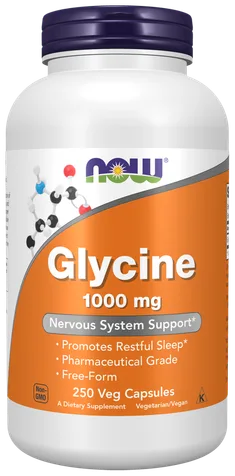
now foods NOW Foods, Glycine, 1,000 mg, Veg Capsules Review
NOW Foods Glycine is a dietary supplement sold as veg capsules, each labeled 1,000 mg. The serving size is 3 veg capsules, and one container holds 83 servings. The Supplement Facts panel lists one active ingredient: glycine at 3 g per serving. The other ingredients printed on the label are hypromellose (cellulose capsule), hydroxypropyl cellulose, stearic acid (vegetable source) and silicon dioxide. No directions are printed in the information provided, so check the bottle for any use instructions. Because the capsules are made from cellulose rather than gelatin, the label describes them as a vegetable capsule. Buyers most often say they use it in the evening and that it helps them relax and sleep better. Many also say the capsules are easy to swallow, though a few find three capsules a lot to take at once. A small number of reviewers report problems such as poor sleep, vivid dreams or a change in quality.
We don’t sell supplements. We help you make decisions and get the best price.
Lowest prices
We hold no current store prices for it yet: check the store.
- AmazonPrice at AmazonCheck price at Amazon (opens in a new tab)
Also at: iHerb · Vitacost · Walmart
Some store links earn us a commission.
Study, Trial or Testing Result Summary
Members Only9 human studies · 5 improved
1 of these 9 human studies gave glycine by drip, not by mouth.
This product gives 3 grams of glycine a day, the dose used in the main sleep studies. In a small controlled trial of 20 urology outpatients, 3 grams of glycine twice daily for 4 weeks shortened the time to fall asleep compared with a placebo [1]. In healthy volunteers who slept about a quarter less than usual for 3 nights, 3 grams before bed reduced next-day tiredness and improved alertness test results compared with placebo [2]. A review of 52 studies found that longer-term glycine improved sleep in healthy people, but those studies were small and at high risk of bias [3]. In young children with sleep problems, glycine for 28 days lowered sleep complaint scores, but that trial had no placebo group and another product did better [4]. A week of glycine-rich collagen reduced night awakenings in 13 young men but did not change total sleep time or time to fall asleep; this was collagen, not plain glycine [5]. A blend containing glycine and other ingredients improved sleep in 16 young adults, so the effect cannot be credited to glycine alone [6]. Overall, the evidence is encouraging but limited by small trials. Animal and cell studies are never counted.
See all 9 studies →Hide the studies
- A review of 52 studies in healthy and diseased adults found glycine mostly helped the nervous system; longer-term glycine improved sleep in healthy people, but those studies were small and at high risk of bias.The effect of glycine administration on the characteristics of physiological systems in human adults: A systematic revie…
- In 90 children aged six or younger with sleep problems, glycine for 28 days lowered median sleep complaint scores from 7.0 to 4.0, but a homeopathic product (89 children) worked better in this open-label trial with no placebo group.A Comparative Randomized Controlled Clinical Trial on the Effectiveness, Safety, and Tolerability of a Homeopathic Medic…
- In 16 young adults, a 3-day course of a blend containing glycine and other ingredients cut the time to fall asleep by 24 minutes, added 22 minutes of sleep and improved sleep efficiency compared with placebo.Nutritional Modulation of Sleep Latency, Duration, and Efficiency: A Randomized, Repeated-Measures, Double-Blind Decepti…
- In 13 active young men with sleep complaints, 15 g of collagen peptides before bed for 7 nights reduced night awakenings and improved a memory-type test, but did not change sleep time, time to fall asleep or sleep efficiency.Collagen peptide supplementation before bedtime reduces sleep fragmentation and improves cognitive function in physicall…
- In 20 urology outpatients, 3 g of glycine taken twice daily for 4 weeks, after 4 weeks of a glucose placebo, shortened time to fall asleep compared with placebo.Dietary glycine improves urine storage symptoms in urology outpatients.
- In healthy volunteers who slept about 25% less than usual for 3 nights, taking 3 g of glycine before bed reduced next-day fatigue and improved performance on a vigilance test compared with placebo.The effects of glycine on subjective daytime performance in partially sleep-restricted healthy volunteers.
- In 37 healthy adults taking an amino acid supplement for 30 days, most reported better fatigue and sleep, but the study had no control group and the glycine dose was not stated.Diverse characteristics of the urinary excretion of amino acids in humans and the use of amino acid supplementation to r…
- In 459 postmenopausal women, dietary glycine intake was linked to more daytime napping, while total fat intake was linked to shorter measured sleep; this observational study cannot show that glycine caused any change.Relationships among dietary nutrients and subjective sleep, objective sleep, and napping in women.
- In 50 people with substance use disorder who received about four weeks of infusions that included glycine, average sleep rose from 6.28 to 7.34 hours, but the change was not statistically significant.Complex NADASE Infusions Improve Clinical Outcome in Substance Use Disorder: Descriptive Annotation in Fifty Cases.
Review Totals and Summary
Members Only27,789 reviews · 94% positive
Buyers rate this glycine well overall, with about 27789 ratings across the stores that sell it, and most of the starred reviews give 4 or 5. Sleep and winding down come up again and again, and there are a few sharp complaints. **What buyers say it did for them:** Sleep is the main theme. People describe it as helping them relax in the evening and sleep better. One says it helps "unwind before sleep" and another reports "No grogginess in the morning." One reviewer says they "sleep deeply & dream through the night." A couple of people say it works better alongside other things they already take, such as a sleep aid or magnesium. One adds that their smart watch shows better sleep. A few mention muscle recovery, joints or mental relaxation after work. **What they complain about:** The negative reviews are few but pointed. One buyer got no help falling asleep and had "vivid, terrible nightmares" three nights in a row. Another says production moved and it is "not the same" quality, and that both they and their spouse felt unwell on it. One order never arrived. One buyer wishes the capsules were stronger, since you need to take several to reach a dose. **Taste, smell, pill size and form:** Most say the capsules are easy to swallow, and one notes "No strong taste or smell." Someone else calls the serving of three capsules "3 huge capsules" that are hard to get down. One buyer opens a capsule and puts the powder under the tongue, and finds it sweet and tasty. A buyer likes that the capsules are vegetable based. **Value for money:** Buyers who mention price are positive. They speak of competitive and affordable pricing, and one praises the quantity, especially when taking three a day. Several trust the brand for quality, price and availability, and one cites third party testing and US manufacture. **Who it seems to suit and who it did not:** It seems to suit people who want a simple, plain evening supplement and who are fine taking several capsules at a time. Night shift workers, gym goers and couples trying it together appear among the happy buyers. It did not suit the buyer who had nightmares, the two who felt unwell after a change in production, or anyone who finds three large capsules a chore.
Biohacker Summary
Members Only9 of 10 recommend it
Most of the panel recommends or uses glycine, and the main reason is sleep. Seven or eight of the ten take it before bed, usually at 2 grams, while one takes 3 grams and one mentions 5 to 6 grams in connection with cell protection; one panelist takes it about 30 to 60 minutes before bed. Others value it for cooling the body at night, steadying blood sugar, building collagen and helping the body make glutathione, and one pairs it with NAC. A few say many people lack glycine and note that food or collagen can supply it, and one prefers collagen over a separate supplement. One panelist warns that 10 to 30 grams a day could form sharp oxalate crystals, and no one on the panel says they stopped taking it.
See all 10 biohackers →Hide the biohackers
Thomas DeLauer · Glycine · uses
- Takes 3g of glycine before bed, which he says helps him thermoregulate during sleep.
- Recommends about three grams of glycine before bed to lower core body temperature and improve sleep depth without relaxing the airway.
- Says glycine is the workhorse behind TMG and glutathione and ROS reduction, that most people are glycine deficient, and that supplemental glycine is becoming important, though food should come first.
- States that glycine on its own is one of the most underrated sleep tools, offering benefits like cooling the body and preventing nighttime urination.
- Mentions that glycine could be powerful for helping people sleep through the night due to its calming and cooling effect on the extremities, which can impact restless legs.
- Explains that glycine is critical for collagen synthesis, which supports the intestinal wall, and deficiency can slow down the repair process.
- Explains that the body needs roughly 10g more of glycine per day than a typical modern diet provides, and that this deficit can lead to issues with creatine production, connective tissue repair, and sleep. He recommends increasing glycine intake.
- Shifts towards glycine when cutting to keep their nervous system calm through the deficit.
- Explains that glycine is a critical amino acid for glutathione production, and the body often has a significant shortage of it, with creatine synthesis consuming a large amount of available glycine.
- Recommends glycine, either from supplements or food sources like bone broth, collagen peptides, and chicken skin, to help build up glutathione.
Siim Land · Glycine · neutral
- Says the body uses glycine to make creatine, and compares glycine's effects with creatine's in a video.
- Says they take a very small amount of supplements, including glycine.
- Glycine is described as very popular for sleep, blood sugar, and healthy aging. Siim Land explains that the body uses glycine to make creatine, that glycine also supports collagen, heme and glutathione synthesis, and that the body's demand for glycine is much higher than its demand for creatine.
- Mentions that Glycine increased median lifespan by about 6% in males and 4% in females in mouse studies.
- Suggests that glycine can help one to be more relaxed and feel sleepy, with human trials finding that 3g before bed can improve subjective sleep quality and lead to shorter times to fall asleep and enter deep sleep faster.
- Suggests that a higher glycine to methionine ratio appears to preferentially target visceral fat and improve insulin sensitivity.
- Recommends pairing NAC with glycine to support antioxidant activity in your sleep.
- Believes glycine is the best longevity supplement and encourages viewers to learn more about its longevity benefits.
- States that Glycine can be a useful addition for some people for sleep.
- Increased his glycine supplementation to 10g a day, noting that it balances methionine and improves blood sugar and glycation.
Bryan Johnson · Glycine · uses
- Takes 2 grams of Glycine before bed for sleep.
- Takes 2 grams of Glycine before bed for sleep.
- Takes 2 grams of Glycine before bed for sleep.
- Takes 2 grams of Glycine before bed for sleep.
- He takes 2 g of Glycine before bed for sleep.
- Takes 2 grams of Glycine before bed for sleep.
- Takes 2 grams of Glycine before bed for sleep.
- Takes 2 grams of Glycine before bed for sleep.
- Takes 2 grams of glycine before bed for sleep.
- He takes 2 grams of Glycine before bed for sleep.
Dr. Eric Berg · Glycine · recommends
- Recommends glycine as a key amino acid for building collagen, helping with sleep, building antioxidants, and maintaining the slick coating inside arteries.
- Recommends Glycine as a cofactor, especially for collagen.
- Glycine is classified as a non-essential amino acid because the body can make it, but many people are still deficient. It plays a critical role in red blood cell health, DNA and RNA production, bile salts, and glutathione, and is vital for the immune system and quality sleep.
- States that glycine is a powerful anti-aging secret that most people don't know about, and that many people are deficient despite it being a non-essential amino acid.
- Explains that glycine is essential for bile production, glutathione production, and immune function, and that consuming high-quality collagen can help increase glycine intake rather than taking a separate supplement.
- Dr. Berg states that a chronic deficiency in glycine could be the cause of joint aches, difficulty sleeping, and gut health issues, as it is essential for building collagen.
- Dr. Berg states that most glycine in the diet comes from collagen.
- Used to take 3 grams of glycine before bed as a remedy to help with sleep, but now prefers magnesium glycinate to get both benefits.
- Explains that glycine is a non-essential amino acid that many people are deficient in, playing a critical role in red blood cell health, DNA and RNA production, bile salts, glutathione, immune system, and quality sleep, and that low levels can contribute to visible aging.
- States that 95% of adults are chronically short on glycine and that the body needs about 15 grams per day, but most people only get 1.5 to 2 grams from their diet.
Dave Asprey · Glycine · recommends
- Recommends GlyNAC (glycine and NAC together) as very affordable amino acids that he would bet his coffee on if he had to choose just one thing for longevity, as they help the body make glutathione, the master antioxidant.
- Dave discusses safe upper limits for glycine before it starts working against you, mentioning oxalate crystal and Parkinson's-like risks of overdoing it.
- Dave Asprey warns that taking too much glycine, such as 10-30 grams a day, can lead to the formation of razor-sharp calcium oxalate crystals, similar to eating high-oxalate foods, and can contribute to diseases of aging.
- Recommends taking 2 grams of glycine to level out blood sugar.
- He takes 2 grams of Glycine before bed for sleep.
- Warns that glycine can convert into oxalate via the glyioxilate pathway, contributing to kidney stones, and suggests cutting down to three grams a day or increasing lemon juice intake.
- Recommends pairing L-theanine with the amino acid glycine to strengthen the calming effect with no sedation.
- States that if he had to pick three raw materials that matter most for aging, glycine would be one of them, as it helps make glutathione.
- Warns that mega-dosing glycine could actually be causing more problems than it's solving due to its breakdown into oxalate.
- Recommends taking 1-2 g of glycine before meals to stabilize glucose levels.
Andrew Huberman · Glycine · uses
- Takes 2 grams of Glycine before bed for sleep.
- Takes 2 grams of Glycine before bed for sleep.
- Takes 2 grams of Double Wood Glycine before bed for sleep.
- He takes 2 grams of Glycine before bed for sleep.
- Takes 2 grams of Glycine before bed for sleep.
- Takes 2 grams of glycine before bed for sleep.
- Takes 2 grams of Glycine before bed for sleep.
- Takes 2 grams of Glycine before bed for sleep.
- He takes 2 grams of Glycine before bed for sleep.
- Takes 2 grams of Glycine before bed for sleep.
Dr. Mark Hyman · Glycine · uses
- Takes 2 grams of Glycine before bed for sleep.
- Takes 2 grams of Glycine before bed for sleep.
- Takes 2 grams of Glycine before bed for sleep.
- Takes 2 grams of Glycine before bed for sleep.
- Recommends glycine, an amino acid often lacking in modern diets, for its potential role in overall health.
- Recommends supplementing with glycine, an amino acid often not obtained enough, which may have a role in overall health.
- Takes 2 grams of glycine before bed for sleep.
- Takes 2 grams of glycine before bed for sleep.
- Notes that Paleo Valley's bone broth protein is rich in glycine, an amino acid we often don't get enough of, and that glycine may have a role in overall health.
- Recommends glycine, an amino acid, for supporting sleep quality by helping to lower core body temperature and promote deeper, more restorative sleep.
Peter Attia · Glycine · neutral
- Peter reviews the evidence for select off-label medications and supplements commonly used for sleep, including glycine, magnesium, ashwagandha, and phosphatidylserine.
- Mentions that they also see positive effects of glycine, among other things.
- Mentions that collagen tends to be rich in glycine, among other amino acids.
- Takes 2 grams of Thorne glycine at night.
- Takes 2 grams of glycine at night, using the Thorne brand.
- Notes that the amino acid glycine has equally strong effects in males and females, but the effect is tiny, so it has fallen by the wayside in favor of more effective drugs.
- Mentions studies showing that people get better sleep if they take 3 to 6 grams of glycine before bed at night, likely in powder form.
- Takes 2 grams of Thorne Glycine before bed for sleep.
Ben Greenfield · Glycine · uses
- Mentions Dr. James Di Nicolantonio's claim that glycine, at 5 to 6 grams, can help protect cell membranes against damage from oxidized oils, citing rodent studies.
- Takes 2 grams of Glycine before bed for sleep.
- Takes 2 grams of Glycine before bed for sleep.
- He takes 2 grams of Glycine before bed for sleep.
- Takes 2 grams of Glycine before bed for sleep.
- Takes 2 grams of Glycine before bed for sleep.
- He takes 2 grams of Glycine before bed for sleep.
- He takes 2 grams of Glycine before bed for sleep.
- Includes Glycine in his Liver Complex Formula for bile production.
- Takes 2 grams of Glycine before bed for sleep.
Dr. Rhonda Patrick · Glycine · uses
- Rhonda takes 2 grams of Glycine before bed for sleep.
- Recommends glycine as a better option for a sleep-promoting supplement.
- Recommends Glycine as a sleep supplement that promotes relaxation and reduces nighttime awakenings, offering meaningful improvements to sleep quality.
- Notes that glycine seems to promote inhibitory effects and suggests that if someone is taking amino acids at night for recovery, one with extra glycine would be better.
- Uses glycine, taken about 30-60 minutes before bed, as it may improve subjective sleep quality due to its nervous system effects.
- Uses glycine as a supplement to help with sleep.
- Dr. Patrick explains that glycine is very abundant in hydrolyzed collagen powder and is necessary for making collagen, also noting its potential as an anti-inflammatory signaling molecule and inhibitory neurotransmitter.
- Glycine is another big one. I've been hearing a lot of people come back and give me comments on glycine and how, if they take it about 30 minutes to an hour before bed, their subjective sleep quality the next day is much better. Even their sleep-tracking data seems to improve, with fewer nighttime awakenings as well. And so, the dose that seems to be the sweet spot there is about three grams of glycine. This is something that I'm personally going to experiment with. In fact, I just ordered some glycine. So, stay tuned on that.
- His regular sleep supplements are glycine, ashwagandha, magnesium L-threonate, and magnesium oxide.
- She notes that Peter Attia takes 2 grams of glycine from Thorne.
RAL Summary
Members OnlyTier 3 for Sleep
Tier 3 fits: over 27,000 reviews are 94% positive, and small controlled trials of 3 grams of glycine show shorter time to fall asleep and less next-day tiredness [1][2], though the evidence is too small and biased to support a higher tier [3].
Where the evidence disagrees: 1 of the 9 human studies found no effect.
More Details
Members OnlyBody systems · Combine with · Possible side effects
Body systems: Nervous system
Combine with: For sleep, glycine is often paired with magnesium, because both are linked to calming the nervous system and winding down before bed. It is often paired with inositol, as both act on pathways tied to relaxation and a bedtime routine. It is also often paired with NAC, since the body uses glycine along with it to make glutathione, so adding NAC supplies a partner ingredient in that process.
Possible side effects: The studies given report no major side effects. One reviewer reported vivid nightmares, two said they felt unwell after a change in production, and some find the three large capsules hard to swallow.
Supplement Facts
Glycine 3 g
| Glycine | 3 g | † |
Other ingredients: Hypromellose (cellulose capsule), Hydroxypropyl Cellulose, Stearic Acid (vegetable source) and Silicon Dioxide.
Barcode (UPC) 733739001313 · Label source: Reverseagelab · Report a label change
Other sizes and barcodes: 100 Veg Capsule(s), UPC 7 33739 00107 8 (found for sale)
Show entire label

More sleep products
Members OnlyThe highest ranked for the same goal
Read more
Our articles on this subject
- Melatonin vs Magnesium for Sleep: What the Studies ShowArticle · Nov 3, 2026
- Best Supplements for Sleep and the Habits That Matter MoreArticle · Jun 15, 2026
Graded November 24, 2026 by the Reverse Age Lab evidence engine, from human studies, real reviews and our biohacker panel. How we grade. Is this medical advice? No. Rala organizes the published evidence; go over any change with your doctor, especially if you take meds.
Privacy policyConsumer health dataAffiliate disclosureTermsBrand and legal noticesDo Not Sell or Share My Personal InformationCookie settings