
Puritan's Pride Horse Chestnut Extract 300 mg Review
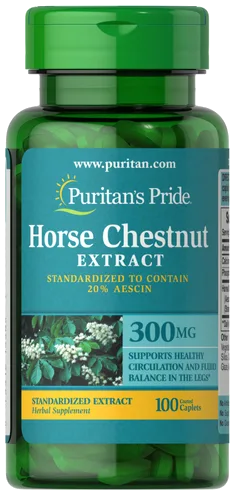
This page is for Puritan's Pride Horse Chestnut Standardized Extract 300 mg, item #005585, sold as caplets with a potency of 300 mg and a size of 100 caplets. The page states that the item is no longer carried and is currently out of stock, and it offers an email notification for when the item becomes available again. The page lists the product as gluten free, coated for easy swallowing, and vegetarian. The product description says it supports healthy circulation and fluid balance in the legs. It notes that throughout the day, fluid balance and circulation in the legs can be affected by several factors, including sitting or standing for long periods, inadequate physical activity, or wearing tight-fitting clothes. The description explains that the ancient Horse Chestnut tree is native to northern Greece, where its bark, leaves and seeds were believed to have many health benefits. It states that the seeds of the Horse Chestnut tree contain a biologically active compound called Aescin, and that research has demonstrated Aescin supports vein health by promoting healthy circulation and fluid balance in the legs. The directions say that for adults, one caplet should be taken in the morning and one in the evening, preferably with meals. The label notes no artificial color, flavor or sweetener, no sugar, no milk, no lactose, no soy, no gluten, no wheat, no fish, and sodium free. The warnings state that the product is not intended for use by pregnant or nursing women, and that people taking any medication or having a medical condition should consult a doctor before use. It advises avoiding the product if there is liver or kidney disease, discontinuing use and consulting a doctor if adverse reactions occur, and keeping it out of reach of children. It is not intended for persons under 18 and should be stored at room temperature. The customer should not use the product if the seal under the cap is broken or missing. The About Puritan's Pride section says the company has helped families pursue a lifestyle of wellness for more than 50 years, and that its products are tested or inspected as many as 15 times during manufacturing.
We don’t sell supplements. We help you make decisions and get the best price.
Lowest prices
We may earn a commission from some store links. How we choose.
Finding the lowest prices at the stores now. This takes a few seconds.
Products with nearly the same formula (Matched on the main ingredients)
Study, Trial or Testing Result Summary
Members Only20 human studies · 5 improved
3 of these 20 human studies gave the ingredient by drip, not by mouth.
Horse chestnut seed extract, at the full 300 milligram dose here and standardized to its main active compound aescin, has some human support for blood flow, though most studies are small. In a randomized trial of 62 people who had eye surgery for thyroid-related eye disease, adding the extract improved blood flow in a main eye vein more than surgery alone over 3 months [1]. In a small study without a placebo group, 15 people with poor leg vein circulation took aescin for 3 weeks, and leg symptoms fully or partly eased in 12 of them [2]. A controlled study of 53 people after hand surgery found swelling and inflammation settled faster with aescin [3]. A review of controlled trials said the extract may help heart disease risk factors, but stronger evidence is needed [4]. The calcium and phosphorus on the label are small mineral amounts. No study showed either one helps blood flow; calcium studies used infusions, not pills, and some showed reduced vessel widening [5], while extra phosphate raised blood pressure in one trial [6]. Animal and cell studies are never counted.
See all 20 studies →Hide the studies
- A review of 26 controlled trials of plant-derived compounds concluded that horse chestnut seed extract, among others, may help reduce heart disease risk factors, though stronger evidence is still needed.A Systematic Review of the Efficacy of Bioactive Compounds in Cardiovascular Disease: Carbohydrates, Active Lipids and N…
- In 391 adults having a cardiac arrest outside hospital, up to two doses of calcium chloride (5 mmol each) given into a vein or bone did not significantly improve return of a sustained heartbeat compared with saline (19% vs 27%), and the trial was stopped early over concerns about harm.Effect of Intravenous or Intraosseous Calcium vs Saline on Return of Spontaneous Circulation in Adults With Out-of-Hospi…
- In 62 patients with thyroid-related eye disease who had orbital decompression surgery, adding horse chestnut seed extract improved blood flow in the superior eye vein significantly more than surgery alone over 3 months.Orbital decompression surgery and horse chestnut seed extract improved superior orbital vein blood flow in patients with…
- In 20 healthy young adults given extra sodium phosphate for 11 weeks, 24-hour blood pressure and pulse rose compared with the low-phosphate group, while blood vessel function and artery elasticity did not change.A Controlled Increase in Dietary Phosphate Elevates BP in Healthy Human Subjects.
- In 14 hemodialysis patients, a high-calcium dialysis bath raised blood calcium and increased arterial stiffness during treatment, while a low-calcium bath did not.Arterial stiffness alterations during hemodialysis: the role of dialysate calcium.
- In people with atherosclerosis of the leg arteries, a rehabilitation program that included baths with horse chestnut was reported to be effective for microcirculatory blood flow, though the abstract gives no sample size or numbers.[Assessment of the influence of the balneo-physiotherapeutic procedures on microcirculatory blood flow in patients with …
- In 53 patients after hand surgery, those given beta-escin (27) had skin temperature fall quickly after two days, while untreated controls (26) stayed elevated until day four, indicating faster reduction of swelling and inflammation.[Thermometric investigations about the efficacy of beta-escin to reduce postoperative edema (author's transl)].
- In 17 healthy young men, a single 1200 mg phosphorus dose did not change blood vessel widening in the main analysis, though an exploratory analysis found lower widening 20 minutes after the dose.The impact of an acute oral phosphate load on endothelium dependent and independent brachial artery vasodilation in heal…
- In 8 healthy adults, a small rise in local blood calcium reduced resting forearm blood flow and blunted the blood-vessel dilation caused by verapamil, which recovered after the infusion stopped.Effect of small increments in plasma calcium concentration on the responsiveness of forearm resistance vessels to verapa…
- In 15 people with chronic venous insufficiency, three weeks of beta-aescin capsules fully or partly relieved leg symptoms in 12 of 15, and capillary filtration in the legs dropped to about 66% of baseline, with no placebo group.[Beta-aescin in the treatment of chronic venous insufficiency].
- In a large UK Biobank study of hypertensive adults without heart disease, higher blood phosphate was one of the factors linked to a positive arterial stiffness index, meaning stiffer arteries.Arterial stiffness and biological parameters: A decision tree machine learning application in hypertensive participants.
- In 602 patients with end-stage kidney disease, the relationship between blood phosphorus and flow-mediated artery dilation was U-shaped, with both low and high levels associated with less dilation.Vascular Function at Baseline in the Hemodialysis Fistula Maturation Study.
- In 500 people with untreated high blood pressure, higher serum phosphorus within the normal range was linked to a weaker widening of forearm blood vessels in response to acetylcholine, a sign of impaired vessel function.Serum phosphorus levels are associated with endothelial dysfunction in hypertensive patients.
- In 42 people with hypoparathyroidism compared with 60 volunteers, higher blood phosphorus was linked to higher pulse wave velocity, a sign of stiffer arteries, and independently predicted it along with age.Central and peripheral blood pressures and arterial stiffness increase in hypoparathyroidism.
- In 98 people with chronic kidney disease, higher blood phosphate was linked to more heart muscle thickening and poorer heart pumping and filling function.The relation of calcium-phosphorus metabolism-related indexes with cardiac damages.
- In 82 hospitalized older adults, higher blood phosphorus, alongside higher FGF23 levels, was correlated with greater arterial stiffness and higher central blood pressure.Deterioration of Phosphate Homeostasis Is a Trigger for Cardiac Afterload - Clinical Importance of Fibroblast Growth Fac…
- In 50 people on haemodialysis, blood phosphorus was positively correlated with the endothelial nitric oxide synthase enzyme level, while high phosphorus was described as reducing that enzyme, so the direction of the effect is unclear.Association of Circulating Endothelial Nitric Oxide Synthase Levels with Phosphataemia in Patients on Haemodialysis.
- In 42 adults with chronic kidney disease, higher daily dietary phosphorus intake was associated with lower arterial stiffness (pulse wave velocity), but it was not associated with flow-mediated dilation, a separate measure of blood vessel function.Diet quality, unprocessed plant-based foods, and vascular function in adults with CKD: Secondary analysis of a pilot ran…
- In 19 healthy volunteers in a crossover study, phosphate loading reduced blood vessel widening (endothelial function) compared with binders, and high phosphate also impaired vessel relaxation in rat and human vessels in the lab.Phosphate as a cardiovascular risk factor: effects on vascular and endothelial function.
- In healthy volunteers, infusing calcium into the arm blunted the blood-vessel dilation caused by magnesium, while dilation caused by potassium was not affected.Attenuated vasodilator responses to Mg2+ in young patients with borderline hypertension.
Review Totals and Summary
Members Only211 reviews · 92% positive
Customers mostly describe this product as a good-value alternative to pricier store brands for leg complaints. Many say it noticeably helped swollen, tired or heavy legs. One Amazon reviewer said a relative recommended it and judged it as good as the overpriced versions sold in stores, and the lower price came up repeatedly. An eBay buyer in the US said a coworker had pointed them to it. A caregiver said it worked well for a parent's swelling. Several reviewers describe relief of restless or uncomfortable legs, which goes beyond the label's circulation claim. Some buyers report effects that are anecdotal and outside the product's stated purpose. One said that after a month of daily use they passed a small kidney stone and felt comfortable afterward. These accounts are individual and unverified. Reviewers often mention that results build slowly. One said it may take about a month of daily use before benefits appear. This suggests the product suits patient, consistent use more than quick relief. Customers commonly mention good quality and good value. They also mention that the product arrived as described, in new condition, and shipped quickly through the retailer's listings. UK buyers used short phrases such as "life saver" and "great value," and described it as working. A few WebMD-style reviews of horse chestnut in general also appear in the same market. They mention helping with leg pain, shin itching and a vein ulcer after sclerotherapy. One reviewer specifically liked that the Puritan's Pride version did not upset their stomach. That matches the supplement's usual tolerability, though digestive upset is the most common complaint reported for horse chestnut products overall. Critical feedback is a small share of the Amazon rating. About 8% of raters gave three stars and about 8% gave one or two stars. Those buyers tend to report no noticeable effect, which is common with circulation supplements, since results depend on the underlying cause of the swelling. The pages I could read offered few detailed complaints about pill size or taste. One UK reviewer apparently urged others to check the side-effect list before buying. Overall, buyers are enthusiastic about value and mild leg-swelling relief, with the main caveats being slow onset and variable results.
Biohacker Summary
Members Only7 of 10 recommend it
Only two of the ten panelists spoke about horse chestnut, the main ingredient in this product, so the panel's view is thin. One recommends it as the best remedy for spider veins and poor vein circulation, crediting its main compound, aescin. The other uses it for its plant compounds, which he says fight bacteria and block an enzyme that gut microbes use to make methane. Neither gave a dose or a preferred form, and neither named anything to pair it with or any caution. Calcium is a smaller ingredient in this product; most of the panel backs it for bone health, but several warn against calcium pills and prefer food sources like sardines, dairy and leafy greens, citing heart risks.}
See all 10 biohackers →Hide the biohackers
Ben Greenfield · Horse Chestnut · uses
- Says Horse Chestnut is another polyphenol with flavonoids and saponins that works to get rid of bacteria and, more importantly, blocks the methyl coenzyme reductase (MCR) enzyme that archaea bacteria use to make methane.
- Is considering whether he needs a calcium supplement because lead can displace calcium in bones, affecting bone strength.
- Mentions calcium as a common deficiency.
- Recommends adequate intake of calcium for bone strength.
- Is using calcium chloride mixed with PRP before injecting for the P-shot.
- Advises people to stop taking calcium supplements as part of the Root Cause Protocol.
- Warns that in high doses, calcium without the right cofactors can raise cardiovascular risk by contributing to arterial calcification instead of bone strength, and may increase the risk of osteoporosis.
- Explains that 10X separates calcium and zinc into different micro beads, releasing them at different rates and locations in the digestive tract to prevent competition and optimize absorption.
- Covers calcium as a key supplement for kids.
- Warns of calcium deficiency on a carnivore diet, as there is not an appreciable amount in meat, and recommends eating fish with bones or taking a calcium supplement or bone mineral matrix.
- Notes that excess calcium intake can contribute to calcium buildup in the arteries.
- Recommends a supplement with polyphenols from horse chestnut for gas, bloating, and constipation, noting it can also improve recovery from exercise-induced muscle damage.
- Recommends Atrantil, a macromolecule with horse chestnut and peppermint leaf, for stopping bloating, gas, constipation, and leaky gut, and personally uses it before getting on airplanes.
- Explains that Atrantil contains a natural antibacterial from horse chestnut, which shuts down methane production in archaea bacteria.
Dr. Eric Berg · Horse Chestnut · recommends
- Recommends Horse Chestnut as the absolute best remedy for spider veins and chronic venous insufficiency, stating that its main element, aescin, helps in the permeability of the inner lining of the veins and arteries to absorb more nutrients, thereby increasing circulation.
- Lists phosphorus as an ingredient found in sardines.
- States that one can of sardines contains 382 mg of calcium.
- Warns against calcium supplements, citing studies that link them to a higher risk of heart attack, especially in postmenopausal women, and suggests getting calcium from dairy instead.
- Recommends focusing on calcium to support stronger bones if a neck hump is associated with osteoporosis.
- Warns against calcium carbonate, calling it limestone and the worst source of calcium, stating it takes 12 steps to be converted in the body and is like eating rocks.
- Warns that bone loss cannot be fixed with just calcium, as bone is primarily collagen with other essential minerals.
- Dr. Berg includes calcium carbonate among the synthetic supplements to avoid.
- Warns against calcium carbonate, also known as limestone, stating that while it lowered hip fractures in a study, it also increased kidney stones and is not good for arteries, requiring the body to work hard to use it.
- Notes that tannins in tea bind calcium, blocking its absorption.
- Indicates that horizontal thin white lines near the base of the nails are indicative of low calcium.
- Warns that calcium carbonate can build up in the arteries and kidneys and increase the risk of a heart attack.
- Recommends increasing phosphorus for best kidney health.
- Warns that the damaging phosphorus is found in junk food like Coke, as it is absorbed 100%, unlike phosphorus from other foods.
Siim Land · Calcium · neutral
- Lists dairy and sardines as sources of Calcium.
- Notes that Boron reduces calcium/magnesium loss.
- Recommends a high calcium intake for bone health.
- Places calcium supplementation in the 'bad tier' due to its association with increased cardiovascular events, recommending dairy or bones as easier ways to get calcium, though it can be useful for postmenopausal women with low bone density.
- Mentions that eating enough calcium matters for bone density, but states that it alone won't transform bone density.
- Warns that calcium is linked to a higher risk of heart disease, though people with low calcium status and intake can take it safely.
- Warns that calcium supplements increase the risk of heart disease by raising blood calcium levels too high, leading to hypercalcemia and more calcium being stored in the arteries, and also increase the risk of arrhythmias.
- Warns against calcium supplementation for most people due to its association with increased cardiovascular events, but notes it can be useful for postmenopausal women with low bone density who don't consume dairy.
- Discusses Calcium as a supplement.
- Recommends consuming calcium from dairy, tofu, leafy greens, and bones, as it is a key nutrient required for ATP synthase in mitochondrial energy production.
- Warns that a diet too high in phosphorus, especially in the absence of sufficient magnesium, can damage kidneys and lead to kidney disease.
- Attributes an improvement in his kidney function to a reduction in phosphorus intake, which in excess can negatively affect kidney function.
- Warns that phosphorus in excess is bad.
- Warns that consuming too much phosphorus can accelerate the decline in kidney function, promote vascular calcification, heart disease, and increase the risk of mortality in both healthy and sick people.
Thomas DeLauer · Calcium · neutral
- Notes that milk contains 120mg of calcium, while sardines contain 351mg, highlighting a 3x difference.
- Recommends getting calcium, along with vitamin D, zinc, and magnesium, from foods like sardines, as they are important for inflammatory pathways in the gut.
- Explains that eating sardines with their soft bones provides a serious hit of calcium, which is a perfect combination for bones and may contribute to satiety.
- Mentions that magnesium and calcium should not be taken together as they cancel each other out.
- Tries to get multivitamins without calcium or with a low amount, as he believes supplemental calcium impacts the absorption of other vitamins and minerals and is not as beneficial as hyped. He cautions against it for most people due to the risk of coronary artery calcification.
- Recommends getting calcium from dairy sources like milk, yogurt, kefir, and cheese in the morning to support neurotransmitter synchronization crucial for deep and REM sleep, noting that low dietary calcium is linked to insomnia.
- Warns that calcium competes with magnesium for the same absorption channels, advising to separate magnesium intake from calcium supplements or dairy by at least an hour or two.
- Recommends providing the body with adequate dietary calcium, not a calcium supplement, to ensure a clean, strong spark for efficient insulin release.
- Warns that calcium and magnesium should not be taken together as they cancel each other out, though some products use delayed absorption to mitigate this.
- Warns that most people consume too much calcium relative to magnesium, which can disrupt the balance needed for proper bodily function, comparing it to an electrical circuit.
- States that phosphorus is extremely rich in turkey and is a critical cofactor for anabolism and protein synthesis, which is imperative at the end of a fast to rebuild or protect muscle tissue.
- Explains that phosphorus is exceptionally high in turkey and is important for proper protein synthesis after a longer fast, as phosphorus levels tend to decline.
- Recommends restoring phosphorus levels after fasting, which can be obtained from pork jerky.
- Suggests adding phosphorus with the break fast meal if one is really trying to keep electrolytes balanced.
Dr. Mark Hyman · Calcium · recommends
- Notes that calcium is in bones but is also essential for nerves, muscles, and the heart, and low levels can affect muscle function and heart rhythm.
- States that green leafy vegetables are great sources of calcium.
- Notes that calcium needs are lower than advertised and that stress, soda, and excess sugar can drive calcium loss.
- Does not prescribe calcium supplements at all, teaching people to get it from whole foods instead, because calcium supplements don't work for building bones or preventing fractures, and it's bone quality, not density, that matters.
- Warns that acid blockers inhibit calcium absorption.
- Lists calcium as another important nutrient that people can be tested for and measured.
- States that high doses of calcium supplementation in the elderly were not really impacting bone density, as osteopenic patients still became osteoporotic.
- Warns that meds (meds) impair the absorption of calcium, which increases the risk of hip fractures and osteoporosis.
- Recommends calcium citrate, about 600 milligrams a day, for bone health, noting that much can also be obtained from diet through leafy greens, sesame seeds, tahini, and chia seeds.
- Dr. Hyman notes that while calcium deficiency is not common in terms of blood levels, insufficient intake can lead to osteoporosis as the body pulls calcium from bones. He advises caution with calcium supplementation due to potential heart issues.
- States that phosphorus is less of an issue for most people because it's in food.
Dr. Rhonda Patrick · Calcium · neutral
- Mentions that kale delivers calcium, a micronutrient many diets fall short on.
- Notes additional gaps in calcium.
- Reports that alcohol use disorder is associated with a 20-50% greater prevalence of Calcium deficiency.
- Around 38% doesn't meet the requirement for calcium.
- Takes a calcium-magnesium pill because he believes people tend to be short of both and that the body cares about the ratio of these similar molecules.
- States that 1,000 milligrams of calcium per day is the recommended intake for bone density, and supplementation is an option if this requirement is not met.
- Takes a calcium, vitamin K2, and vitamin D combination supplement in the morning, providing about 600 mg of calcium and another 1,000 IUs of vitamin D.
- Dr. Rhonda Patrick discusses calcium needs.
Dave Asprey · Calcium · neutral
- Notes that when energy intake is too low for training demand, nutrient intake often falls short, especially for calcium, which is associated with reduced bone health.
- Explains that calcium provides the raw material for bones, but it isn't a standalone input and needs a whole system to be effective.
- Notes that people take calcium for their bones.
- Warns that taking calcium without vitamin D, A, and K2 can lead to calcium going into tissues, causing bone spurs and other issues, and recommends a two-to-one ratio of calcium to magnesium.
- Recommends taking calcium citrate during a high oxalate meal to bind the oxalate in the gut.
- Notes that people often take calcium for bone health.
- Believes calcium supplements are overrated, as most people need more vitamin K2 and vitamin D instead.
- Advises taking iron and calcium separately because they will bind together.
- Takes extra calcium to help deal with the burden when eating chocolate or anything with higher levels of oxalates.
- Discusses calcium citrate as a counter to oxalate crystals, specifically when consumed through dairy, but questions if it's the primary form of calcium in dairy.
Peter Attia · Calcium · recommends
- Recommends calcium as one of the 'big three' micronutrients for bone health, suggesting a daily intake of 1,000 to 1,200 milligrams, which can be supplemented with calcium carbonate or calcium citrate.
- Explains that bone is 50 to 70% mineral, predominantly calcium, and that virtually all of the body's calcium is contained within bone, making bone important for calcium homeostasis.
- Recommends calcium for bone health, stating that teenagers probably need about 1000 milligrams a day.
- Discusses bone acting as a reservoir for calcium and how resorption and formation release calcium into the blood when needed.
- Notes that bone is 50 to 70 percent mineral, with calcium being the predominant mineral, and virtually all of the body's calcium is contained within bone.
- Recommends getting about a gram of calcium a day from organic bone meal, which provides calcium hydroxyapatite, the form humans are meant to consume.
- Suggests that calcium is one of the other signals involved in regulating mitochondrial number, beyond AMPK activation.
- States that in postmenopausal women not on estrogen, calcium and vitamin D have no protective effect against hip fracture because the problem is not the shell of the bone, which is fed by calcium and vitamin D, but the internal girder network.
- Notes that compelling evidence links calcium to reduced risk of osteoporosis, which can impact mortality from specific causes.
Bryan Johnson · Phosphorus · recommends
- Recommends phosphorus as a mineral that, along with calcium, magnesium, and boron, is deposited to fortify the bone structure.
- Recommends calcium as a mineral that, along with phosphorus, magnesium, and boron, is deposited to fortify the bone structure after the collagen scaffold is in place.
- Agrees that a little extra calcium is probably okay, especially for women, to really hit home for bone mineral density.
- Recommends calcium at 1,200 mg daily for women during the follicular phase, depending on dietary intake.
- Recommends prioritizing calcium intake for postmenopausal women to help maintain bone density and reduce the risk of osteoporosis.
- Bryan Johnson takes Calcium daily as part of his Longevity Mix, which supports healthy bones and teeth.
Andrew Huberman · Calcium · neutral
- Discusses "hard water" and the role of magnesium and calcium in cardiovascular health.
- Adequate intake of calcium is vital for bone health.
RAL Summary
Members OnlyTier 2 for Circulation
More Details
Members OnlyBody systems · Combine with · Possible side effects
Body systems: Cardiovascular system
Combine with: For venous and circulatory support, horse chestnut pairs well with diosmin and hesperidin (a flavonoid complex that improves venous tone), butcher's broom (ruscogenins), and grape seed extract or pycnogenol (OPCs that strengthen capillaries). Vitamin C and rutin support collagen and vessel wall integrity. If the user truly wants blood pressure support, add separate agents with evidence for it, such as magnesium, potassium-rich foods, CoQ10, hawthorn, or aged garlic extract, and consult a physician. Horse chestnut may interact with meds, antiplatelet drugs, meds, and may affect kidney or liver function in sensitive people, so medical guidance is advised.
Possible side effects: The horse chestnut studies reported no major side effects. Digestive upset is the most common complaint mentioned for horse chestnut products in general, though one reviewer said this version did not upset their stomach.
Supplement Facts
Calcium 142 mg · Phosphorus 110 mg · Horse Chestnut Seed Extract 300 mg
| Calcium | 142 mg | |
| Phosphorus | 110 mg | |
| Horse Chestnut Seed Extract | 300 mg | † |
Other ingredients: Dicalcium Phosphate, Cellulose, Stearic Acid, Silica, natural Palm leaf glaze, Magnesium Stearate.
Directions: Directions: For adults, take one (1) caplet in the morning and one (1) in the evening, preferably with meals.
Barcode (UPC) 074312155857 · Label source: NIH label database · Report a label change
Show entire label
More circulation products
Members OnlyThe highest ranked for the same goal
Read more
Our articles on this subject
- Supplements for Focus and Mental ClarityArticle · Jun 16, 2026
Graded November 10, 2026 by the Reverse Age Lab evidence engine, from human studies, real reviews and our biohacker panel. How we grade. Is this medical advice? No. Rala organizes the published evidence; go over any change with your doctor, especially if you take meds.
Privacy policyConsumer health dataAffiliate disclosureTermsDo Not Sell or Share My Personal InformationCookie settings