
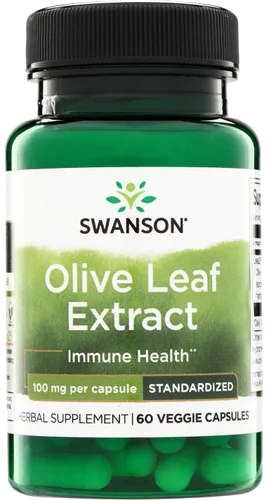
Swanson Superior Herbs Maximum-Strength Olive Leaf Extract 100 mg Review
Swanson Superior Herbs Olive Leaf Extract - Standardized, 100 mg, 60 veggie capsules, is presented as a source of antioxidant support. The page explains that olive leaves contain phenolic compounds known for antioxidant activity by scavenging reactive oxygen species known as free radicals. It highlights hydroxytyrosol, described as a metabolite of oleuropein, which the page says protects against all five common free radical species with roughly 10 times the oxygen radical absorbance capacity (ORAC) of green tea, and says this surpasses blueberries, strawberries and acai berries. The page lists potential benefits for the brain, cardiovascular system, immune system and more. The capsules feature Olea25, described as an extract made from 100% organically grown olive leaves and standardized to 25% hydroxytyrosol, the same concentration the page says is used in clinical studies. The product is labeled as supporting the body's natural defenses and promoting healthy blood pressure and cholesterol levels, and is noted as verified vegan, with a note that packaging is being updated so labels may vary during the transition. The Supplement Facts list one veggie capsule per serving, 60 servings per container, with 100 mg of Olea25 Hydroxytyrosol Olive Leaf Extract. Suggested use is one veggie capsule per day with food and water. The page includes a warning that the product is for adults only and that people who are pregnant or nursing, taking medication, or with a medical condition should consult a healthcare provider. Storage instructions say to keep out of reach of children, not to use if the seal is broken, and to store in a cool, dry place. The FAQ section describes olive leaf extract as derived from olive tree leaves, explains oleuropein as a primary bioactive compound, and states the product is vegan and non-GMO. The page carries the disclaimer that statements have not been evaluated by the Food and Drug Administration and that the product is not intended to diagnose, treat, cure, or prevent any disease. The listing shows a 100% Money-Back Guarantee badge and SKU SWH238.
We don’t sell supplements. We help you make decisions and get the best price.
Lowest prices
We may earn a commission from some store links. How we choose.
Finding the lowest prices at the stores now. This takes a few seconds.
Study, Trial or Testing Result Summary
Members OnlyHuman studies
This product holds one active ingredient at a full listed amount: 100 milligrams of olive leaf extract standardized to 25 percent hydroxytyrosol, an antioxidant compound found in olives. For immune system support, no human studies on this ingredient were provided, so there is no study evidence yet showing that this extract strengthens immune defenses in people. Nothing is hidden in a blend and nothing is below a studied dose, because no studied dose was given to compare against. Buyer feedback is small but favorable. There are 31 ratings, about nine in ten positive and none negative. Buyers mostly praise the price and the hydroxytyrosol standardization, and one repeat buyer credits it with helping their immunity. Others take it for heart and brain support. Some compare it with the same brand's other olive leaf products, which are standardized to a different compound, and one says they cannot tell whether it works better. Personal reports like these cannot confirm an immune benefit. Until human trials on this extract and this goal are available, it remains an early-stage option. Animal and cell studies are never counted.
Review Totals and Summary
Members Only31 reviews · 90% positive
Across the two stores there are 31 ratings for this olive leaf extract, and the themes below come from the written reviews that could be read on their pages, which amounted to only a handful (three on one store, five on the other, several of them apparently the same reviews shared between the sites). Nothing from other product forms was needed, so the feedback here concerns the capsules only. Ratings are strongly positive. One store shows 84% five stars, 5% four stars and 11% three stars, with no one- or two-star ratings. The other shows eleven of its twelve ratings at four or five stars and one at three stars. The written comments fit that pattern. Value is the most common theme. Reviewers repeatedly call it a good price for an olive leaf extract, and one store tags "Value For Money" five times as a frequent mention. One short review simply says it is good stuff at a good price. The second main point of praise is the hydroxytyrosol standardization. One reviewer says this was exactly what they were looking for and describes the product as a wonderful antioxidant and cardiovascular support supplement. Others describe it as good for the heart and brain. A repeat buyer says they order it every month, credits it with helping their immunity in several ways, says they cannot live without it, and calls the potency great. The criticisms are mild and are not about the product's performance. One five-star reviewer objects to the naming. They also use Swanson's Super Strength Olive Leaf Extract, which contains oleuropein, and note that this Maximum Strength version contains hydroxytyrosol instead. They argue that the two phenolic components are both important and different, and that the names imply one product is stronger than the other. They use both products and say they will keep doing so until Swanson offers a single supplement with both standardized components. A four-star reviewer takes two capsules and regularly uses Swanson's 750 mg extra strength olive leaf extract. They say they cannot tell whether this 100 mg version is better, because the benefit cannot be proved. That is a measured comparison rather than a complaint. In terms of who it suits, the reviewers are people who want hydroxytyrosol specifically, those seeking antioxidant, heart, brain or immune support, and people who already use other Swanson olive leaf products and are comparing strengths or choosing between the two types. The four-star reviewer's use of two capsules suggests some take more than one at a time, though no one gives dosing guidance beyond that. Several things are not covered. No visible review mentions taste, capsule or pill size, digestion, sleep, side effects or effectiveness problems, so anyone wanting detail on those will not find it here. One page also mentions a Show More option whose additional reviews were not available to read, so the themes may not represent every buyer. Overall, the written feedback is brief and positive, centered on price, the hydroxytyrosol content and perceived potency, with the naming and strength comparison to the brand's other olive leaf product as the main point of discussion.
Biohacker Summary
Members Only9 of 10 recommend it
The product is an olive leaf extract, but no one on the panel spoke about olive leaf extract itself, so there is nothing from the panel to say about the main ingredient. The panel's talk was about two smaller ingredients in this product. Leucine, a smaller ingredient in this product, drew comments from nearly everyone, and most of the panel recommend it for building and keeping muscle, often from food, with doses of about 2 to 3 grams per meal, 1 gram in a capsule with a meal, or 8 to 9 grams a day. Cautions came from a few: one said it adds little if you already eat enough high quality protein, and others warned that high levels may be linked to aging or disease risk. Hydroxytyrosol, also a smaller ingredient in this product, was mentioned as a longevity compound found in olive oil and leaves, and one panelist who used it before has since stopped.
See all 9 biohackers →Hide the biohackers
Ben Greenfield · Leucine · recommends
- Describes leucine as the 'ignition' that turns on the signal for muscle protein synthesis, and that a sufficient dose is needed to hit the dose response and then have other essential amino acids to maintain the signal.
- States that leucine is the primary trigger for muscle protein synthesis and recommends an essential amino acid blend with about 40% leucine for maximum stimulation.
- Recommends pulsing with compounds like leucine for maintaining and building muscle and maximizing muscle protein synthesis.
- Lists hydroxytyrosol as a compound found in olive leaves.
- Recommends Dileucine as a next-generation supplement for muscle recovery and protein synthesis, stating it delivers 86% more leucine to muscles and triggers 60% more protein synthesis than regular leucine, especially when paired with exercise.
- Dave Pascoe mixes up a concoction of different protein powders, leucine, and L-citrulline as a pre-workout drink.
- Discusses the role of leucine in boosting muscle protein synthesis on plant-based diets.
- Mixes leucine into a concoction of protein powders before his workout.
- Discusses a study that claimed escalating doses of leucine from animal-based protein could cause issues with monocytes and macrophages, potentially leading to atherosclerosis, but he refutes the generalizability of these findings to humans.
- Warns against using only leucine, as it induces only a short, transient response in muscle protein synthesis, which is not enough for long-term gains in muscle mass and function.
- Suggests that Urolithin A blends well with branched-chain amino acids like leucine and isoleucine, making them top things to stack with.
Dr. Eric Berg · Leucine · recommends
- The amino acid leucine is important for muscle growth, but getting sufficient protein is just as essential for maintaining muscle mass.
- Mentions that animal protein provides leucine, an amino acid beneficial for muscle building.
- Recommends getting enough leucine, a key amino acid for muscle growth, to help prevent and correct muscle loss.
- Explains that leucine is an essential amino acid that signals muscles to grow, and its requirements increase with age, making it important for maintaining muscle after menopause.
- Mentions that eggs contain all essential amino acids, including leucine, which is a key amino acid for building muscle.
- Notes that the amino acid leucine, found in animal protein, stimulates insulin.
- Notes that red meat contains leucine, an amino acid that triggers the synthesis of muscle.
- States that olives contain hydroxytyrosol, which protects against the growth of cancer cells.
- Explains that leucine is essential for muscle growth and that plant-based proteins often lack sufficient amounts of it.
- Notes that leucine is a potent stimulus for muscle production and is often low in plant-based foods.
- Highlights leucine as an essential amino acid that has been found to stimulate muscle growth and prevent muscle loss, making it good for muscle atrophy.
Thomas DeLauer · Leucine · recommends
- Identifies leucine as the primary trigger for the mtorc1 pathway, which is the master switch for muscle protein synthesis, and recommends 2 to 3 grams per meal for those under 40, and 3 to 4 grams for those over 40.
- Explains that leucine is important for muscle, with beef, whey, milk, and sardines clearing the 2-3g leucine threshold per meal, and that the threshold increases with age.
- States that leucine is what flips the switch for muscle protein synthesis, and that adding leucine and essential amino acids to a small dose of whey can match the effect of a full 25-gram dose of protein.
- Notes that olive oil contains hydroxytyrosol and other antioxidants.
- Notes that leucine, an important amino acid for muscle growth, activates mTOR signaling after exercise, triggering the first step in building new muscle, and that leucine plus carbs together have the strongest signaling effect.
- Recommends taking 3 to 5 grams of leucine with meals, especially for older individuals who may struggle to meet minimum protein requirements, as it can help preserve muscle and increase muscle protein synthesis.
- Recommends protein sources that are high in leucine as a '401k of your fat burner' because they lead to more metabolically active lean tissue, especially for people dropping weight.
- Explains that leucine skyrockets mTor and phosphorylates P7S6K, which is exactly what one wants to be activating, especially post-workout but throughout the day if trying to build muscle and recover.
- Notes that leucine, found in whey protein, is highly anabolic and can help add muscle even without significant resistance training, which takes stress off the liver.
- Advises considering the leucine content of proteins and the ileal digestibility to maximize protein absorption for muscle growth.
- Notes that mTor is activated by branch chain amino acids, particularly leucine, and that higher circulating leucine generally leads to higher mTor activity.
- Warns that hydroxytyrosol is such a potent antioxidant and anti-inflammatory that it should not be consumed immediately surrounding a workout, as it can quell the inflammatory response needed for recovery.
- Mentions that hydroxytyrosol, found in olives, has been shown in some studies to inhibit the synthesis of fatty acids, potentially helping to prevent excess fat storage, and also offers antioxidant effects.
- Explains that hydroxytyrosol, a natural antioxidant in olive oil, could inhibit fatty acid synthesis and promote fatty acid oxidation, making it harder to develop fatty acids around the liver.
Dr. Rhonda Patrick · Leucine · recommends
- Notes that foods high in leucine are going to really support muscle protein synthesis.
- Explains that Leucine is the critical signal driving robust activation of mTOR, which plays key roles in skeletal muscle growth by driving muscle protein synthesis and recovery, but also notes a study suggesting Leucine might activate mTOR in the vascular system, promoting plaque buildup.
- Highlights that leucine is an amino acid with strong signaling properties, stimulating the mTOR pathway and setting off the anabolic cascade for muscle protein synthesis.
- Mentions that leucine, a branched-chain amino acid, and other essential amino acids may be partially protective against declines in muscle mass, but not entirely effective against strength declines.
- Discusses leucine as an amino acid that kick-starts the muscle-growth process, noting that 2 to 3 grams may be important for older individuals to kick-start that process, but does not recommend it as a supplement if consuming high-quality animal-based protein sources.
- Warns that leucine is extraordinarily bitter and requires food science to mask its taste. He also states that leucine supplementation should be a last resort, advocating for a food-first approach.
- Identifies leucine as a major activator of mTORC1, which is critical for muscle protein synthesis.
- Notes that leucine is the highest affinity amino acid sensor for mTORC1, explaining why branched-chain amino acids, particularly leucine, are used to enhance muscle growth or prevent degradation during exercise. He believes 5 grams during a workout is probably not harmful.
Dr. Mark Hyman · Leucine · recommends
- Dr. Mark Hyman, agreeing with the guest, highlights leucine as a primary amino acid important for muscle protein synthesis.
- States that leucine is important for muscle health and is the rate-limiting amino acid for turning on the switch that starts muscle building.
- Recommends leucine, an amino acid, for making muscle.
- Highlights leucine as an essential amino acid that is nearly highest in protein sources and acts as a unique amino acid for metabolic signaling, like a switch that turns on muscle building.
- States that high amounts of leucine, an amino acid mostly found in animal protein, are needed to activate the switch to turn on muscle building, specifically about 2.5 grams per serving.
- Warns that leucine, which is much higher in animal protein, is the rate-limiting step for building muscle, and without 2.5 grams in a protein meal, the switch to build muscle won't be turned on.
- Explains that leucine is very low in plant proteins and is necessary to trigger protein synthesis, which is critical for building muscle.
- Mentions that hydroxytyrosol, a polyphenol found in olives and olive oil, has been shown to interfere with the binding of the SARS-CoV-2 coronavirus to human cells.
- Mentions that leucine is important for building muscle and that some plant proteins are 'jacked up' with extra amino acids and leucine, citing an example of a plant protein with 2.5 grams of leucine.
- Recommends supplementing with leucine, an amino acid critical for activating muscle synthesis, especially for those on a vegan diet, as plant proteins are typically low in it.
- Recommends eating for leucine, an amino acid that comes in the right amounts to feed skeletal muscle.
- Recommends hydroxytyrosol, derived from olive oil, for its antioxidant and anti-inflammatory effects, noting that it is the most important polyphenol in olives.
- Mentions hydroxytyrosol as a natural chemical found in healthy plant-based foods that can help sensitize cells to absorb energy, improve insulin sensitivity, and switch bad fat into good brown fat.
- Notes that hydroxytyrosol, a polyphenol found in olives and olive oil, has been shown to interfere with the binding of the SARS-CoV-2 coronavirus to human cells.
Andrew Huberman · Leucine · recommends
- Suggests that adding free leucine, perhaps one gram in a capsule with a normal meal, can significantly boost protein synthetic response, especially for plant-based individuals.
- Suggests that leucine, because it triggers cellular growth by activating the mTOR pathway, is actually pro-aging, similar to growth hormone and testosterone, offering immediate benefits at the expense of long-term health.
- Andrew Huberman explains that leucine is an essential amino acid important for inducing muscle protein synthesis, and it is found in high levels in sources like whey protein, beef, chicken, and eggs.
- Discusses leucine.
- States that leucine is uniquely stimulating to skeletal muscle and recommends consuming closer to 9 grams of leucine per day, which is two to three times the RDA, for optimal muscle health.
- Notes that leucine, isoleucine, and valine, which are branch chain amino acids, make insulin go up.
- Explains that leucine is almost exclusively responsible for increasing muscle protein synthesis when protein is consumed, but supplementing with leucine does not make people more muscular because muscle building involves both synthesis and degradation.
- Suggests that leucine, by triggering cellular growth through the mTOR pathway, could be pro-aging, and that maximizing muscle growth through such supplements might come at the expense of long-term health.
- Huberman states that the amino acid leucine is vital for cell growth, including muscle growth, due to its relationship with the mTOR pathway, and suggests ingesting it early in the day for maintaining or increasing muscle mass.
- Clarifies that Leucine, an amino acid, is important for muscle building, muscle growth, and strength, distinguishing it from Lutein.
Dave Asprey · Hydroxytyrosol · recommends
- Discusses Wonderfeel's first product, Younger, which includes NMN, hydroxytyrosol, resveratrol, and ergoionine. He praises the formula as elegant and well-thought-out for increasing NAD while preventing its depletion, noting its economic efficiency compared to buying individual ingredients.
- Dave discusses how hydroxytyrosol may support NAD longevity through CD38 inhibition.
- Dave states that he used hydroxytyrosol when he was involved with Bulletproof, and believes it was the first big commercial supplement to use it, but he no longer uses it since he was removed from the company.
- States that very low levels of leucine are probably promoting high levels of protection against aging and diseases, but also promoting frailty, and high levels of this amino acid could be a risk for developing a number of diseases.
- Mentions that hydroxytyrosol is a longevity compound found in olive oil.
- Mentions that he previously formulated something using hydroxytyrosol when he was at Bulletproof, but that verboscide is a much more powerful compound than even that.
- States that he takes 100 milligrams of hydroxytyrosol, which is the active compound in olive oil, equivalent to about a thousand bottles worth.
- Takes hydroxytyrosol in a capsule, noting that it provides the equivalent of a thousand liters of olive oil in antioxidants, which is more effective than consuming excessive olive oil.
- Includes Hydroxytyrosol from olive oil in his product because it is a blocker of CD38.
- Takes a hydroxytyrosol capsule, which is the primary antioxidant in olive oil, because he would not feel good if he had the equivalent amount of olive oil.
- Mentions hydroxytyrosol as the primary and most potent antioxidant in olive oil.
- Recommends ensuring enough Leucine, specifically two and a half grams, to activate muscle protein synthesis, otherwise consumed protein may not be effective.
- States that 2.5 grams of leucine are needed in a meal to activate mTOR and stimulate muscle synthesis.
- Recommends consuming leucine, which preserves body muscle and is found in higher amounts in animal foods.
Peter Attia · Leucine · recommends
- States that leucine is critical for muscle protein synthesis and recommends around 8 or 9 grams a day for optimal muscle health.
- Recommends two to three grams of leucine a day for muscle health, with optimal health probably around eight or nine grams.
- Recounts a story where a vegan doctor chastised him for suggesting ingesting five grams of leucine during a workout due to its negative effect on mTOR and potential link to cancer, which Peter Attia found amusing.
- Warns that there is no benefit to supplementing leucine specifically if one is already consuming enough high-quality protein, and notes that leucine tastes horrible.
- Mentions that estimations suggest two to three grams of Leucine in a meal will induce a rapid increase in circulating Leucine, stimulating muscle protein synthesis.
- Highlights that leucine content is an important factor in the anabolic response, and adding free leucine to casein can increase its anabolic effect.
- Recommends tracking amino acids and ensuring 2 to 4 grams per serving of leucine for muscle mass.
- Discusses experiments on Leucine and its effect on muscle protein turnover and fat metabolism.
- Mentions Leucine as one of the four signals that regulate mTOR, which is involved in protein synthesis.
- Explains that leucine binds to a protein called sestrin, which acts as its receptor, and the crystal structure shows how leucine is nestled in a small pocket, making it difficult to mimic its anabolic effects with other molecules.
Siim Land · Leucine · uses
- Despite high protein and whey intake, Siim Land's leucine levels remain low, hovering around 70, which he attributes to increased muscle mass and the body fighting infection.
- States that leucine is associated with longevity, and most studies indicate that higher levels are important for longevity.
- Mentions that leucine, an essential amino acid, acts as a signal for muscle protein synthesis, though not as strong as resistance training.
- Siim Land, agreeing with the guest, states that 2.5 grams of Leucine per meal maximizes anabolic protein synthesis in the muscle, ensuring muscle tissue maintenance.
- Identifies leucine as an essential amino acid that is most responsible for increasing mTOR activation and muscle protein synthesis, linking it to protein intake, aging, and cancer.
- Recommends consuming at least 2.5 grams of leucine to reach the optimal intake for muscle protein synthesis.
- Explains that leucine is a critical amino acid for turning on MTOR and promoting protein synthesis, and while it is pro-growth, its impact on aging is complex.
- Explains that leucine is the most anabolic amino acid responsible for mTOR activation, with a threshold of around 2 to 3 grams.
- States that leucine-rich foods like eggs and dairy are the highest sources of leucine, which activates mTOR.
- States that leucine specifically activates mTOR C1 the most and promotes muscle protein synthesis.
RAL Summary
Members OnlyTier 4 for Immune Health
Tier 4 fits because no human studies on immune support were provided for this olive leaf extract, and its 31 ratings, though 90% positive, are too few for a higher tier.
- Emerging: not enough evidence to rank higher yet.
- No human studies on this goal for its ingredients.
More Details
Members OnlyBody systems · Combine with · Possible side effects
Body systems: Immune system, Cardiovascular system
Combine with: For immune support, olive leaf pairs well with vitamin C (500-1000 mg), zinc (15-30 mg), vitamin D3 with K2, elderberry, and quercetin. Vitamin C and quercetin complement its antioxidant polyphenols, while zinc and vitamin D support immune cell function. If the user still wants cellular and DNA repair support, a separate regimen would be more appropriate: NMN or NR for NAD+, trans-resveratrol, CoQ10 or ubiquinol, PQQ, and alpha-lipoic acid. Spermidine, fisetin, and magnesium are other options. Consult a healthcare provider before combining supplements, especially if taking blood pressure or blood sugar medications, since olive leaf may lower both.
Possible side effects: No major side effects reported.
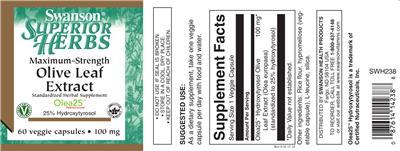
Supplement Facts
Olea25 Hydroxytyrosol Olive leaf extract 100 mg
| Olea25 Hydroxytyrosol Olive leaf extract | 100 mg | † |
Other ingredients: Rice Flour, Hypromellose, L-Leucine, Silica.
Directions: Suggested use: As a dietary supplement, take one veggie capsule per day with food and water.
Barcode (UPC) 087614142388 · Label source: NIH label database · Report a label change
Show entire label
More immune health products
Members OnlyThe highest ranked for the same goal
Read more
Our articles on this subject
- How to Improve Gut Health Naturally: Fiber, Foods and the Probiotic Strains With Human TrialsArticle · Sep 15, 2026
- How to Build a Longevity Supplement Stack: An Evidence-First ReviewArticle · Sep 7, 2026
Graded November 7, 2026 by the Reverse Age Lab evidence engine, from human studies, real reviews and our biohacker panel. How we grade. Is this medical advice? No. Rala organizes the published evidence; go over any change with your doctor, especially if you take meds.
Privacy policyConsumer health dataAffiliate disclosureTermsDo Not Sell or Share My Personal InformationCookie settings