
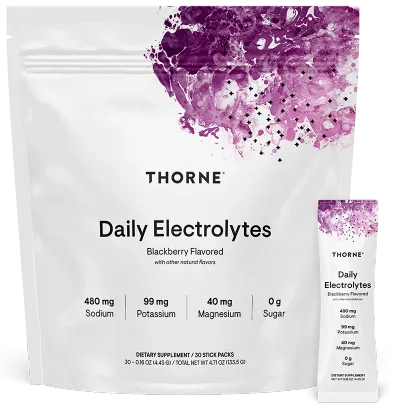
Thorne Daily Electrolytes - Blackberry Review
Thorne Daily Electrolytes Blackberry is a drink mix in single-serve stick packs, presented as a way to promote healthy cellular hydration and support recovery. The page says optimal cellular hydration and electrolyte balance support cellular energy production, benefit cell signaling, and enhance muscle performance. It explains that the body loses water and essential minerals through sweat, including sodium, potassium, magnesium, calcium, and chloride, and that replenishing these nutrients is a key step to think, perform, and feel your best. The stick packs are designed to take to the gym, the outdoors, or travel. Listed benefits include replenishing electrolytes lost through sweat, restoring optimal fluid balance and cellular hydration, enhancing recovery after exercise, supporting endurance and athletic performance, benefiting cellular energy production, and supporting magnesium and calcium needed for muscle function. Sodium, chloride, and potassium are described as regulating and maintaining fluid balance. The features section describes an optimal rehydration formula with no sugar and with flavors and colors derived from all-natural sources. It notes single-serve packaging that is easy to pack for travel or a gym bag, and six flavor options plus two variety packs. The page names athletes and non-athletes seeking rehydration, active individuals replacing sweat losses, people in hot and humid environments, frequent flyers seeking hydration while airborne, and anyone wanting a delicious way to boost water intake as intended users. The product carries NSF Certified for Sport, and the page explains that each batch is tested for compliance with label claims and for the absence of nearly 300 substances banned by many major athletic organizations. Serving size is one packet, with 30 servings per container. Directions in the FAQ say to mix one stick pack with at least 12 ounces of water daily, or as recommended by a health-care practitioner, and to use it around exercise, in hot or humid conditions, during air travel, or whenever hydration needs increase. The page states that the product contains no sugar and uses sweeteners derived from natural sources. The Blackberry flavor is described as derived from natural blackberry with other natural flavors. The warnings say the product is contraindicated for anyone with a history of hypersensitivity to its ingredients, and that pregnant people should consult a health-care practitioner before use. The page reports no known adverse interactions or contraindications at the publication date. Testing information says each ingredient is tested for identity, purity, and potency, and that finished products are checked for contaminants such as heavy metals, pesticides, and harmful microbes.
We don’t sell supplements. We help you make decisions and get the best price.
Lowest prices
We may earn a commission from some store links. How we choose.
Finding the lowest prices at the stores now. This takes a few seconds.
Products with nearly the same formula (Matched on the main ingredients)
Study, Trial or Testing Result Summary
Members Only48 human studies · 14 improved
2 of these 48 human studies gave the ingredient by drip or injection, not by mouth.
At two servings a day, magnesium reaches the 80 milligram amount studied. In 30 adults with metabolic conditions, magnesium water at that amount for 4 weeks reduced fatigue [1]. Magnesium also improved energy and fatigue scores in 64 women with polycystic ovary syndrome [2], and magnesium with B vitamins reduced fatigue in 98 adults with inflammatory bowel disease [3]. Strong results in chronic fatigue syndrome came from weekly injections, not drinks [4]. Other trials found no fatigue benefit, including in fibromyalgia [5][6]. Chloride, from salt, has thin support. One small uncontrolled study in chronic fatigue syndrome helped about half of a subgroup [7], but several small exercise trials found no gain in endurance [8][9]. Potassium evidence is limited, and one large diet trial linked a high-potassium, low-salt diet to more fatigue [10]. Calcium is present only at a trace amount, far below the studied dose, and most calcium trials found no energy benefit [11][12]. Animal and cell studies are never counted.
See all 48 studies →Hide the studies
- A review of 32 studies of phone apps for osteoporosis self-management found no clear effect on fatigue or on calcium intake; this was not a test of calcium supplements.Digital Health Technologies for Long-term Self-management of Osteoporosis: Systematic Review and Meta-analysis.
- A review of 26 trials in 3,273 people with chronic fatigue syndrome found most supplements did not help, but magnesium and NADH showed benefit, though the trials were small and at high risk of bias.Complementary and alternative medicine for patients with chronic fatigue syndrome: a systematic review.
- A review of four diet trials in people with multiple sclerosis found that two diets providing enough folate and magnesium reduced fatigue, but firm conclusions were not possible.Is there an effect of dietary intake on MS-related fatigue? - A systematic literature review.
- In 697 adults with mild high blood pressure, a low-sodium, high-potassium diet with placebo for 6 months was linked to more fatigue (34%) than the usual diet (18%) or a weight loss diet (15%).Effect of antihypertensives on sexual function and quality of life: the TAIM Study.
- In 171 adults with mild insomnia, a blend containing magnesium taken for 2 weeks did not improve sleep or physical fatigue more than placebo, as both groups improved similarly.Exploring the Effect of Lactium™ and Zizyphus Complex on Sleep Quality: A Double-Blind, Randomized Placebo-Controlled Tr…
- In 148 men aged 70 and older, 20 weeks of calcium, vitamin D and protein with strength training and testosterone reduced tiredness and improved chair-stand performance compared with no intervention, but calcium's own effect cannot be separated.Beneficial effects of exercise, testosterone, vitamin D, calcium and protein in older men-A randomized clinical trial.
- In 110 people with fibromyalgia, 3 months of a supplement with coenzyme Q10, tryptophan and magnesium did not significantly reduce fatigue (placebo improved significantly), though pain, sleep and overall impact improved.Effects of Coenzyme Q10, Tryptophan, and Magnesium Supplementation on Fatigue in Patients with Fibromyalgia - A Randomiz…
- In 98 adults with inflammatory bowel disease in remission, 4 weeks of magnesium plus B vitamins reduced fatigue more than placebo, and also lowered ulcerative colitis symptom scores but not Crohn's disease scores.Effects of B vitamins and magnesium on fatigue, disease activity and quality of life in inflammatory bowel disease.
- In 94 adults, a 4-week high-calcium diet was compared with a DASH-type diet and the abstract reports mood benefits only for the low-sodium, high-potassium diet, not for the high-calcium diet.Dietary electrolytes are related to mood.
- In 86 people with mental fatigue, a single dose of homeopathic potassium phosphate taken before an attention test did not work better than placebo, though the test's ceiling effect limits the result.Homeopathy for mental fatigue: lessons from a randomized, triple blind, placebo-controlled cross-over clinical trial.
- In 64 women with polycystic ovary syndrome, 10 weeks of magnesium improved the energy and fatigue score and total quality of life compared with placebo.The effects of magnesium supplementation on abnormal uterine bleeding, alopecia, quality of life, and acne in women with…
- In 49 patients after colon surgery, magnesium oxide (1 g every 12 hours) did not change fatigue or bowel recovery compared with placebo.Effect of the laxative magnesium oxide on gastrointestinal functional recovery in fast-track colonic resection: a double…
- In 44 healthy people, asthma patients and COPD patients, a single dose of ammonium chloride that made the blood more acidic did not change muscle strength or muscle endurance compared with placebo.Respiratory muscle strength and muscle endurance are not affected by acute metabolic acidemia.
- In 32 people with chronic fatigue syndrome, weekly magnesium sulphate injections for 6 weeks led 12 of 15 treated patients to report benefit and better energy, versus 3 of 17 on placebo.Red blood cell magnesium and chronic fatigue syndrome.
- In 30 adults with hypertension, diabetes or high blood fats, drinking water with 80 mg of magnesium daily for 4 weeks improved body mass index, insulin, triglycerides and fatigue compared with placebo water.Effects of deep ocean-derived magnesium-enhanced water on metabolic diseases with microbiome changes.
- In 24 adults with low parathyroid function, one month each of calcium citrate and calcium carbonate showed no difference in quality of life scores; the abstract does not report a fatigue difference.Calcium Citrate Versus Calcium Carbonate in the Management of Chronic Hypoparathyroidism: A Randomized, Double-Blind, Cr…
- In 22 college-aged adults taking 350 mg of magnesium daily for 10 days, muscle soreness and perceived recovery improved compared with placebo, but performance gains did not reach statistical significance.Effects of Magnesium Supplementation on Muscle Soreness and Performance.
- In 20 junior cyclists, a daily multi-nutrient tablet containing magnesium for 4 weeks led to faster fatigue recovery than a plain vitamin product, but magnesium was not tested alone.Studies concerning the ergogenic value of Cantamega-2000 supply in top junior cyclists.
- In 18 trained adults, three days of hydrogen-rich calcium powder lowered breathing rate and blood pH during exercise but did not change oxygen uptake compared with placebo.Application of Molecular Hydrogen as an Antioxidant in Responses to Ventilatory and Ergogenic Adjustments during Increme…
- In 18 young men, a single dose of ammonium chloride (0.3 g per kg body weight) did not change the cycling power at which fatigue began compared with sodium bicarbonate.The effect of ammonium chloride and sodium bicarbonate ingestion on the physical working capacity at the fatigue thresho…
- In 16 trained men with two nights of short sleep, zinc magnesium aspartate had no effect on sleep, ratings of fatigue or morning weightlifting performance compared with placebo.Effects of Supplementing Zinc Magnesium Aspartate on Sleep Quality and Submaximal Weightlifting Performance, following T…
- In 14 trained men, sodium chloride was used only as the placebo; sodium bicarbonate improved sprint power and fatigue compared with it, so chloride itself showed no benefit.Effects of sodium bicarbonate and carbohydrate intake after 14-h fasting on anaerobic performance and muscular endurance…
- In 13 men exercising in heat, drinks containing sodium with glycerol did not improve time to exhaustion compared with water.Hyperhydration with Glycerol, Sodium, and Isomaltulose or Sucrose on Fluid Balance, Thermoregulation, and Exercise Capac…
- In 11 active people, sodium chloride was the placebo; sodium bicarbonate lengthened exercise time in low oxygen compared with it, so chloride itself showed no benefit.Sodium bicarbonate supplementation improves severe-intensity intermittent exercise under moderate acute hypoxic conditio…
- In 10 male endurance-trained subjects, rinsing the mouth with a 6% salt solution during 30 minutes of cycling helped preserve muscle force after exercise compared with water rinsing.Effect of glucose and sodium chloride mouth rinses on neuromuscular fatigue: a preliminary study.
- In eight men doing calf contractions to exhaustion, calcium carbonate used as the control had no effect on time to fatigue, which was similar to the acid and alkaline trials, showing that changing muscle pH did not alter fatigue.The effect of pH on fatigue during submaximal isometric contractions of the human calf muscle.
- In 8 men dehydrated by exercise, drinks with more sodium chloride improved rehydration but did not change time to exhaustion 4 hours later.Rehydration with drinks differing in sodium concentration and recovery from moderate exercise-induced hypohydration in m…
- In 8 healthy men, sodium chloride was used as the placebo; running time to exhaustion after repeated sprints was similar with sodium bicarbonate (78 seconds) and sodium chloride (75 seconds), so chloride itself showed no energy effect.The effect of sodium bicarbonate ingestion on high-intensity intermittent running and subsequent performance.
- In 8 active young men, a single dose of sodium chloride given with fizzy water and a script suggesting it would help performance increased time to exhaustion in hard cycling by 9.5% compared with the same salt given with a neutral script.Expectancy of ergogenicity from sodium bicarbonate ingestion increases high-intensity cycling capacity.
- In eight men, a glucose drink lowered blood potassium during and after intense cycling, but it did not delay fatigue compared with placebo.A single oral glucose load decreases arterial plasma [K+ ] during exercise and recovery.
- In 7 well-trained runners, drinking a prescribed volume of a potassium-containing carbohydrate-electrolyte drink during 4 hours of recovery from a long run let them keep running about 16% longer later than drinking as much as they wanted.Influence of fluid intake pattern on short-term recovery from prolonged, submaximal running and subsequent exercise capa…
- In young women with premenstrual syndrome, 500 mg of calcium carbonate twice daily for 3 months reduced early tiredness compared with placebo.Effects of calcium supplement therapy in women with premenstrual syndrome.
- In people with fibromyalgia, 100 mg of magnesium daily for one month did not change fatigue more than placebo.Short-Term Magnesium Therapy Alleviates Moderate Stress in Patients with Fibromyalgia: A Randomized Double-Blind Clinica…
- In 218 men and women with early coronary ischemia, salt baths improved exercise endurance only in those with moderate muscle power, while underwater massage showers improved it in everyone.[Cardiovascular effects of sodium chloride bath and underwater shower in coronary ischemia].
- In 92 patients with high blood pressure, magnesium at 320 mg a day reduced some complaints such as nervousness and sleep problems but had no effect on mental or physical fatigue.[Level of total and ionized magnesium fraction based on biochemical analysis of blood and hair and effect of supplemente…
- In 11 male runners, 4 days of calcium phosphate loading did not improve maximal aerobic capacity or time to exhaustion compared with placebo.Phosphate supplementation, cardiovascular function, and exercise performance in humans.
- Nine trained cyclists exercising to fatigue at high intensity did not perform significantly differently on a glucose and electrolyte drink or an electrolyte-only drink than on a non-electrolyte placebo drink, although seven of nine rode longer on the active drinks.Fluid replacement drinks during high intensity exercise: effects on minimizing exercise-induced disturbances in homeosta…
- Eight healthy young men taking 6 grams of potassium-magnesium aspartate over 24 hours before a hard cycling test lasted about as long to exhaustion as those given placebo, so no endurance benefit was seen.The effects of oral administration of salts of aspartic acid on the metabolic response to prolonged exhausting exercise …
- In 8 men, an intravenous salt water infusion during hard cycling extended time to exhaustion to about 32 minutes versus 19 minutes with no infusion.Intravenous bicarbonate and sodium chloride both prolong endurance during intense cycle ergometer exercise.
- In six healthy people, ammonium chloride that made the blood more acidic did not significantly change peak power or total work in a 30-second all-out cycling test compared with placebo.Effects of pH on maximal power output and fatigue during short-term dynamic exercise.
- In breast cancer patients taking 400 mg of magnesium oxide daily for 4 weeks, fatigue was significantly reduced, though this single-group pilot study had no placebo comparison.A pilot phase II trial of magnesium supplements to reduce menopausal hot flashes in breast cancer patients.
- In 24 women with fibromyalgia who completed a 4-week feasibility study, sprays of magnesium chloride on the arms and legs twice daily improved fibromyalgia impact and quality-of-life scores, though energy itself was not measured.Effects of transdermal magnesium chloride on quality of life for patients with fibromyalgia: a feasibility study.
- In a large cohort of about 81,500 women aged 60 and older followed for a median of 16 years, higher magnesium intake was linked to a lower risk of frailty, with the top fifth of intake showing 12% lower risk than the bottom fifth.Total magnesium intake and risk of frailty in older women.
- Red blood cell magnesium was normal in 89 people with chronic fatigue syndrome, and a magnesium loading test in 6 of them found no deficiency, so the authors saw no reason to use magnesium treatment for this condition.Normal red cell magnesium concentrations and magnesium loading tests in patients with chronic fatigue syndrome.
- In 65 adults with self-reported gluten sensitivity on a gluten-free diet, average calcium intake from food was 695 mg a day, below recommendations, and energy was not studied.Dietary and symptom assessment in adults with self-reported non-coeliac gluten sensitivity.
- In adults with hypophosphatasia, a higher calcium to phosphorus intake ratio was associated with more tiredness and fatigue, and very high or very low calcium intake was linked to more symptoms, based on a 7-day diary.Mineral Intake and Clinical Symptoms in Adult Patients with Hypophosphatasia.
- A survey of U.S. adults found that drinkers had higher energy intake than non-drinkers, but their diets were less nutrient dense, including for calcium; the survey did not test calcium for energy.Alcohol consumption and nutrient density of diets in the Nationwide Food Consumption Survey.
- In 78 people with chronic fatigue syndrome, 1200 mg of sustained-release sodium chloride for 3 weeks was given to 22 with low blood pressure on standing; 11 of these 22 reported improved symptoms over 8 weeks, while 10 still had the blood pressure drop.Pathogenesis and management of delayed orthostatic hypotension in patients with chronic fatigue syndrome.
Review Totals and Summary
Members Only2,038 reviews · 79% positive
Across the two store pages there are 930 ratings in total (465 on each), and the themes below come from the written reviews that could be read on those pages, which amounted to only about five short reviews per page plus each page's own AI-generated summary. Only the powder is covered here; no other forms of the product appeared in the summaries. Taste is the most common praise. Reviewers call the Blackberry flavor delicious, refreshing and a great flavor, and several say they love the drink mix. The page summaries say the taste makes it easier to drink more water, which fits the product description of a tasty way to boost water intake. One buyer said this brand is very good and singled out Blackberry as delicious, and others simply named Thorne Electrolytes and praised the brand. Effectiveness is the second theme, though it rests mainly on the pages' own AI summaries rather than detailed reviewer accounts. These say customers feel the electrolytes help restore fluid balance and improve performance, and describe the product as a top choice for athletes. Individual reviewers rarely explain why it works. Their comments are brief and enthusiastic, with headlines such as "So good," "Good stuff" and "Great." One buyer said the product was what they expected and thanked the seller. Packaging and convenience form a third theme. The summaries name convenient packaging as something customers appreciate, and the single-serve stick packs are described as easy to take to the gym, in a training bag or while travelling. The on-the-go format matches how the product is marketed. Variety is mentioned too. One reviewer praised great flavor and variety, which may reflect the Daily Electrolytes line, which one page says includes six flavor options and two variety packs. On complaints, none appear in the readable written text. No reviewer described problems with taste, mixing, price, side effects or stomach comfort. That does not mean nobody was unhappy: one page's star distribution shows 23 two-star and 40 one-star ratings out of 465, a meaningful minority of lower ratings. The lower-rated reviewers are not quoted, so their reasons cannot be identified, and the positive written sample should not be taken as representative of every buyer. As for who it suits, the feedback points to people who want a flavored way to drink more water, athletes and gym-goers, and travellers who value portable single-serve sticks. Price was not discussed in the written reviews. The star ratings suggest a broadly positive reception overall. Anyone wanting more detail could use the full review lists, which can be filtered by rating and topics such as results, quality, feel, packaging, hydration and price.
Biohacker Summary
Members Only9 of 10 recommend it
Magnesium is the main ingredient, and most of the panel recommends or uses it, with the rest staying neutral and none saying they stopped. The most common reason is sleep, usually taken before bed, though one panelist says the evidence for sleep is not yet consistent. Others take it for muscle function and cramps, blood pressure, bone health, workout performance, and hydration, often in electrolyte drinks. Panelists favor glycinate or threonate forms, with doses from 30 milligrams in a drink to 400 milligrams of threonate before bed, and 300 to 500 milligrams a day cited as a minimum. One panelist cautions that labels can overstate the real magnesium dose, and potassium is a smaller ingredient in this product that a few panelists mention for muscle and gut function.
See all 10 biohackers →Hide the biohackers
Dr. Mark Hyman · Magnesium · uses
- Recommends considering magnesium glycinate before bed for nervous system support, deeper sleep quality, and to help the body transition into rest, and states that they take it every night.
- Recommends Magnesium Breakthrough Advanced 10 from Bioptimizers for restful sleep, muscle recovery, stress resilience, and metabolic health, especially during stressful times of the year.
- Warns that potassium bromate, a dough conditioner banned in the EU, UK, and Canada, is still allowed in U.S. bread.
- Recommends magnesium because it is involved in over 600 reactions in the body and up to 80% of people may have low levels that never get flagged on a standard blood test.
- Recommends magnesium as a basic supplement during detoxification to support pathways, help with constipation, and provide electrolytes.
- Recommends Magnesium Breakthrough Advanced 10 from Biooptimizers, which contains 10 bioavailable forms and 550 mg of elemental magnesium, to support restful sleep, restorative sleep, muscle recovery, stress resilience, and metabolic health.
- Has recommended magnesium breakthrough from bioptimizers for years and now uses Magnesium Breakthrough Advanced 10 as part of his evening routine, especially during periods of travel, training, and higher stress, to support sleep, muscle recovery, and metabolic health.
- Recommends correcting nutrient deficiencies with magnesium.
- Recommends Magnesium Breakthrough Advance 10 from BiOptimizers, which has 10 bioavailable forms of magnesium and more elemental magnesium, as part of his evening routine for sleep, muscle recovery, and metabolic health.
- Has recommended Magnesium Breakthrough from Bio Optimizers for years and now uses Magnesium Breakthrough Advanced 10 as part of his evening routine, especially during periods of travel, training, and higher stress, to support sleep, muscle recovery, and metabolic health.
- Recommends Magnesium Breakthrough Advance 10 from Bio Optimizers, which contains 10 bioavailable forms of magnesium, as it plays a critical role in sleep recovery, stress regulation, and muscle function, and has become part of his evening routine, especially during periods of travel, training, and higher stress.
- States that potassium plays a critical role in nerve signaling and muscle contraction, especially in the heart, and low levels can lead to dangerous irregular heart rhythms.
- Explains that chloride works with sodium to maintain fluid balance and supports digestion.
- Notes that calcium is in bones but is also essential for nerves, muscles, and the heart, and low levels can affect muscle function and heart rhythm.
Dave Asprey · Magnesium · neutral
- Mentions magnesium in the context of sleep but states that it doesn't address the core issue of waking up during the night.
- Suggests that magnesium may help slow aging, support cellular repair, and improve sleep.
- States that magnesium can affect how the body responds to a supplement.
- Recommends fixing sleep with 300mg of Magnesium 101 before bed if diet and exercise aren't melting stubborn belly fat.
- Dave Asprey says his daily routine includes magnesium as part of a carefully developed combination for longevity.
- Recommends magnesium glycinate for sleep, stating that trials show it helps people fall asleep about 17 minutes faster and that he finds it incredibly effective.
- Mentions magnesium glycinate as one of the five gut-friendly, extensively researched ingredients in Kill Switch that helps with natural sleep.
- Dave Asprey recommends Magnesium Glycinate for sleep, noting human studies show it helps people fall asleep faster, is safe, and works on a fundamental aspect of health, unlike magnesium oxide which acts as a laxative.
- Dave Asprey recommends adding 300 or 400 mg of magnesium glycinate before bed to improve deep sleep quality, support growth hormone release, and burn visceral fat while asleep.
- Mentions magnesium glycinate as one of the extensively researched ingredients in Kill Switch that helps with natural sleep.
- Notes that when energy intake is too low for training demand, nutrient intake often falls short, especially for calcium, which is associated with reduced bone health.
- Explains that calcium provides the raw material for bones, but it isn't a standalone input and needs a whole system to be effective.
- Notes that people take calcium for their bones.
- Warns that taking calcium without vitamin D, A, and K2 can lead to calcium going into tissues, causing bone spurs and other issues, and recommends a two-to-one ratio of calcium to magnesium.
Dr. Eric Berg · Magnesium · neutral
- Dr. Eric Berg states that magnesium supports energy, muscle function, and sleep, and that most of it is stored inside cells, making deficiencies harder to detect with a standard blood test.
- States that people need more potassium than any other mineral, yet most people aren’t getting enough.
- Notes that magnesium could also be a factor in preventing muscle cramps.
- Explains that potassium is essential for peristalsis, the pumping action through the colon, and without it, things can sit there, leading to constipation.
- Recommends magnesium, specifically magnesium glycinate, stating it is key for D3 and K2 to work and is probably more important than calcium for building bone.
- Recommends increasing magnesium to restore balance and support healthy blood pressure.
- Explains that the normal requirements for potassium are 4,700 mg every single day, and that very few people get half of that amount. They describe potassium's role in the sodium potassium pump, which is essential for cellular electricity, muscle contraction, and heart function. Deficiency can lead to tiredness, muscle cramps, heart palpitations, or rising blood pressure.
- Recommends increasing potassium to restore balance and support healthy blood pressure.
- Warns that bone loss cannot be fixed with just calcium, as bone is primarily collagen with other essential minerals.
- Dr. Eric Berg suggests that magnesium could help support deeper, more restful sleep.
- Recommends Magnesium Glycinate, noting that the combination of magnesium and glycine is helpful for connective tissue, sleep, and reducing stress.
- Recommends taking magnesium 90 minutes to 2 hours before bedtime to support better sleep.
- Suggests that magnesium glycinate can help support the missing 'break pads' on the nervous system, which contribute to constant pain.
- States that potassium is the most important electrolyte and that most people are not getting enough of it, needing around 4,700 mg daily, or even more, to avoid issues like fatigue, muscle cramps, heart palpitations, high blood pressure, and fluid retention.
Ben Greenfield · Magnesium · uses
- Uses magnesium during surgery because it is neuroprotective.
- Says he is drinking LMNT, which contains sodium, potassium, and magnesium, and states that he actually drinks this stuff.
- Says he is drinking LMNT, which contains sodium, potassium, and magnesium, and states that he actually drinks this stuff.
- Mentions magnesium as part of a bare-minimum protocol.
- Advises getting red blood cell magnesium levels to the high end of the range as a minimum step for overall health and to slow down heart disease.
- Recommends supplementing with magnesium threonate if one is low in magnesium, as it crosses the blood-brain barrier and is demonstrated to increase hippocampus plasticity, theoretically making one smarter and improving memories.
- Uses Magnesium Breakthrough from BIOptimizers as part of their daily stack, taking four capsules in the evening to support relaxation, recovery, and a good night of sleep.
- Recommends Celtic Sea Salt's new electrolyte drink "Hydrate" for replacing electrolytes and trace minerals lost through sweat, noting it contains 70 naturally occurring trace minerals, plus magnesium, taurine, and potassium.
- Recommends Celtic Sea Salt's new electrolyte drink 'Hydrate' for replenishing electrolytes and trace minerals lost through sweat, noting it contains 70 naturally occurring trace minerals, magnesium, taurine, and potassium, with no added sugar, artificial colors, or synthetic ingredients.
- Had heart palpitations when he was really overdoing magnesium, not knowing what he was taking.
- Recommends taking magnesium as a co-factor to increase vitamin D absorption.
- Notes a new study indicating that magnesium is a core dietary antioxidant closely associated with a reduced risk of accelerated biological aging.
- Is considering whether he needs a calcium supplement because lead can displace calcium in bones, affecting bone strength.
- Mentions calcium as a common deficiency.
Dr. Rhonda Patrick · Magnesium · neutral
- Magnesium supplementation has lowered blood pressure in randomized controlled trials. An analysis of 34 trials involving over 2,000 participants found modest reductions in both systolic and diastolic pressure, with a median dose of 368 mg/day.
- Warns that some magnesium supplements make the dose look much larger than it really is and that labels can fool people.
- Mentions magnesium as an important nutrient component for testosterone.
- Warns that some supplement companies mislead consumers by listing the total compound weight of magnesium citrate as the elemental magnesium dose, when the actual elemental magnesium content is much lower, potentially around 44-66 milligrams.
- States there is not yet strong, consistent evidence that magnesium supplementation reliably improves sleep, noting that while some meta-analyses suggest it can improve sleep quality scores, sleep efficiency, and sleep duration, individual studies are inconsistent and several have found no meaningful effect.
- States that magnesium may help modestly lower blood pressure by playing an important role in regulating vascular tone and influencing calcium signaling, with studies showing a reduction in systolic and diastolic blood pressure by 2 mmHg at a dose of around 370 mg/day for about 3 months.
- Recommends considering magnesium to improve mood.
- Recommends Magnesium, stating that roughly half of Americans don’t get enough and it is a cofactor for over 300 biological processes, including DNA repair and energy production.
- Mentions that kale delivers magnesium, a micronutrient many diets fall short on.
- Mentions that kale delivers calcium, a micronutrient many diets fall short on.
- Recommends Magnesium, stating it is a cofactor for over 300 biological processes, including DNA repair, energy production, and sleep regulation.
- Recommends getting enough potassium, noting that most people get too much sodium and not enough potassium.
- Notes additional gaps in calcium.
- Reports that alcohol use disorder is associated with a 20-50% greater prevalence of Calcium deficiency.
Thomas DeLauer · Magnesium · uses
- Uses Element's cans which contain 30 milligram magnesium, finding that electrolytes help his workout performance.
- Uses Element's cans which contain 100 milligram potassium, finding that electrolytes help his workout performance.
- Uses Element's 30 mg magnesium cans first thing in the morning to prime his day and help with workout performance.
- Uses Element's 100 mg potassium cans first thing in the morning to prime his day and help with workout performance.
- Recommends magnesium around the time one would normally break a fast to calm the brain and dull feelings of conditioned hunger.
- Recommends magnesium, noting it is a cofactor for enzymes that build neurotransmitters, and deficiency can affect mood, happiness, and motivation.
- Notes that modern agricultural practices have led to soils depleted of trace minerals like magnesium, resulting in widespread magnesium deficiency.
- Recommends taking some magnesium glycinate tonight to help calm down and sleep.
- Mentions that magnesium in pumpkin seeds relaxes bronchial smooth muscle.
- Compares magnesium content, stating bananas have 32mg and pumpkin seeds have 156mg per ounce, a 5x difference.
- Notes that milk contains 120mg of calcium, while sardines contain 351mg, highlighting a 3x difference.
- Recommends Magnesium glycinate, stating that 200-400mg elemental helps with sleep as glycine cools the body and magnesium calms.
- Notes that magnesium sits on the NMDA receptor and regulates excitatory transmission, in the context of feeling stressed.
- Recommends Element's ready-to-drink sparkling electrolyte drinks as a low or zero-calorie soda replacement that provides 1,000 milligrams of sodium, 200 milligrams of potassium, and 60 milligrams of magnesium.
Siim Land · Magnesium · recommends
- States that Magnesium can be a useful addition for some people for sleep.
- Recommends magnesium for sleep, especially deep sleep, and suggests trying better types like Threonate, Biscinate, or Torate, referencing a study where magnesium supplementation improved deep sleep.
- Recommends Magnesium for blood pressure, migraines and deficiency, based primarily on human research, especially randomized controlled trials showing measurable benefits.
- Lists Magnesium as one of 15 supplements backed by human studies.
- States that magnesium is a fundamental mineral governing over 600 enzymes and metabolic reactions, and recommends that most people need at least 400-500 mg/d for health, with some needing up to 600 mg/d.
- Lists seafood and pumpkin seeds as sources of Magnesium.
- Lists potatoes and fruit as sources of Potassium.
- Lists dairy and sardines as sources of Calcium.
- Thinks magnesium has some of the strongest evidence and is worth considering.
- Recommends taking magnesium, specifically glycinate and threonate forms, 1 to 2 hours before bed for sleep benefits, noting that glycinate promotes relaxation and threonate crosses the blood-brain barrier for sleep quality and cognitive function.
- Notes that Boron reduces calcium/magnesium loss.
- Notes that Boron reduces calcium/magnesium loss.
- Notes that magnesium is important for activating thiamine into its more biologically active form, and a magnesium deficiency can impair blood sugar regulation even with adequate thiamine intake.
- Notes that bananas have potassium but there are at least 8 other foods with more potassium than bananas.
Andrew Huberman · Magnesium · neutral
- Discusses Magnesium Threonate as a tool for falling asleep.
- Takes 400 mg of Magnesium Threonate before bed for sleep.
- Uses Element, an electrolyte drink with sodium, magnesium, and potassium in correct ratios and no sugar, to ensure adequate hydration and electrolytes, especially when starting days fast or during physical exercise.
- Uses Element, an electrolyte drink with sodium, magnesium, and potassium in correct ratios and no sugar, to ensure adequate hydration and electrolytes, especially when starting days fast or during physical exercise.
- Takes 400 mg of Magnesium L-Threonate before bed for sleep.
- Confirms that magnesium is absolutely important for cognitive function, noting studies show those with lower magnesium intakes tend to perform less well on cognitive function tests, and it's related to brain changes over time and dementia risk.
- Takes 400 mg of Double Wood Magnesium L-Threonate before bed for sleep.
- He takes 400 mg of Magnesium L-Threonate from Double Wood before bed for sleep.
- Takes 400 mg of Double Wood Magnesium L-Threonate before bed for sleep.
- Takes 400 mg of magnesium L-threonate before bed for sleep.
- Takes 400 mg of Magnesium Threonate before bed for sleep.
- Uses Element, which contains potassium in the correct ratios, to ensure proper hydration and electrolyte intake for brain and body function.
- Mentions potassium as an electrolyte.
- Uses Element, an electrolyte drink with sodium, magnesium, and potassium in correct ratios and no sugar, to ensure adequate hydration and electrolytes, drinking it first thing in the morning and during physical exercise.
Bryan Johnson · Magnesium · uses
- Takes 400 mg of Magnesium Threonate before bed for sleep.
- Takes 400 mg of Magnesium L-Threonate before bed for sleep.
- Takes 400 mg of Magnesium Threonate before bed for sleep.
- He takes 400 mg of Double Wood Magnesium L-Threonate before bed for sleep.
- Takes 400 mg of Magnesium L-Threonate before bed for sleep.
- Takes 400 mg of Magnesium Threonate before bed for sleep.
- Takes 400 mg of Magnesium L-Threonate before bed for sleep.
- Takes 400 mg of magnesium L-threonate before bed for sleep.
- He takes 400 mg of Magnesium L-Threonate before bed for sleep.
- Takes 400 mg of magnesium threonate before bed for sleep.
- Recommends calcium as a mineral that, along with phosphorus, magnesium, and boron, is deposited to fortify the bone structure after the collagen scaffold is in place.
- Agrees that a little extra calcium is probably okay, especially for women, to really hit home for bone mineral density.
Peter Attia · Magnesium · neutral
- Peter reviews the evidence for select off-label medications and supplements commonly used for sleep, including glycine, magnesium, ashwagandha, and phosphatidylserine.
- States there is some evidence that increasing dietary potassium through potassium-rich foods like bananas and potatoes, rather than supplements, can lower blood pressure.
- Suggests that zinc and magnesium could potentially help with vasodilation and sleep, particularly for women experiencing severe symptoms in the luteal phase.
- Peter discusses electrolytes and fiber and the ketogenic diet, specifically preventing magnesium loss.
- Recommends magnesium as one of the 'big three' micronutrients for bone health, suggesting a daily intake of 300 to 500 milligrams as a minimum, and personally aims for about a gram of supplemental magnesium.
- Recommends calcium as one of the 'big three' micronutrients for bone health, suggesting a daily intake of 1,000 to 1,200 milligrams, which can be supplemented with calcium carbonate or calcium citrate.
- Recommends magnesium for optimizing bone mineral density, suggesting a daily intake of 300 to 500 milligrams as a minimum, but personally aims for about a gram.
- Explains that bone is 50 to 70% mineral, predominantly calcium, and that virtually all of the body's calcium is contained within bone, making bone important for calcium homeostasis.
- Recommends calcium for bone health, stating that teenagers probably need about 1000 milligrams a day.
- Discusses bone acting as a reservoir for calcium and how resorption and formation release calcium into the blood when needed.
- Takes a hardline view that most people do not have adequate or optimal levels of magnesium, and suboptimal levels will impede the metabolism of vitamin D because magnesium is a cofactor in its enzymatic conversion.
- Takes a hardline view that most people do not have adequate or optimal levels of magnesium, and suboptimal levels will impede vitamin D metabolism because magnesium is a co-factor in the enzymatic conversion of vitamin D.
- Takes magnesium as a straightforward supplement.
- Mentions that magnesium intake is often super low and impactful on testosterone levels.
RAL Summary
Members OnlyTier 4 for Energy
The 80 percent improvement figure behind tier 2 comes from a single study of magnesium injections in chronic fatigue syndrome, not oral magnesium malate, and the oral magnesium studies are mixed, with 7 improved and 9 showing no effect. So it is graded Tier 4, lower than the rules alone gave.
Take 2 servings a day (2 sticks) to match the dose that worked in the studies.
- Emerging: not enough evidence to rank higher yet.
Where the evidence disagrees: 29 of the 48 human studies found no effect.
More Details
Members OnlyBody systems · Combine with · Possible side effects
Body systems: Muscular system, Nervous system, Cardiovascular system, Renal system
Combine with: For blood pressure support, consider pairing this with, or choosing instead, targeted nutrients with clinical evidence: magnesium glycinate or taurate (200-400 mg), omega-3 fish oil (EPA/DHA, 1-2 g), CoQ10 (100-200 mg), and potassium-rich foods. Aged garlic extract, beetroot or nitrate-rich extracts, and hawthorn may also help. If blood pressure is a concern, choose a low-sodium or sodium-free electrolyte option and consult a physician, especially if taking antihypertensives such as meds, ARBs or potassium-sparing meds, because extra potassium can cause hyperkalemia. Kidney disease also calls for medical guidance before use.
Possible side effects: No major side effects reported. One large diet trial linked a high-potassium, low-salt diet to more fatigue.
Supplement Facts
Calcium 70 mg · Magnesium 40 mg · Chloride 750 mg
| Calories | 5 | |
| Total Carbohydrate | 1 g | |
| Calcium | 70 mg | |
| Magnesium | 40 mg | |
| Chloride | 750 mg | |
| Sodium | 480 mg | |
| Potassium | 99 mg |
Other ingredients: Natural Flavors, Malic Acid, Silicon Dioxide, Rebaudioside M, Fruit and Vegetable Juice (color).
Directions: Mix 1 stick pack with at least 12 ounces of water daily or as recommended by your health-care practitioner.
Barcode (UPC) 693749016038 · Label source: Reverseagelab · Report a label change
Show entire label

More energy products
Members OnlyThe highest ranked for the same goal
Read more
Our articles on this subject
- Magnesium Glycinate vs Citrate: What the Studies ShowArticle · Oct 30, 2026
- Melatonin vs Magnesium for Sleep: What the Studies ShowArticle · Nov 3, 2026
Graded November 6, 2026 by the Reverse Age Lab evidence engine, from human studies, real reviews and our biohacker panel. How we grade. Is this medical advice? No. Rala organizes the published evidence; go over any change with your doctor, especially if you take meds.
Privacy policyConsumer health dataAffiliate disclosureTermsDo Not Sell or Share My Personal InformationCookie settings