
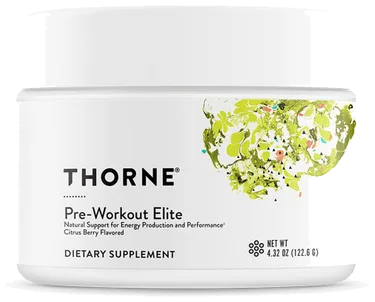
Thorne Pre-Workout Elite Citrus Berry Flavored Review
Thorne Pre-Workout Elite Citrus Berry Flavored, 4.32 oz, 24 servings, is presented as a pre-workout product for athletic performance. The highlights state that it is designed to optimize focus, strength, output, and recovery to support muscle function with naturally derived ingredients that help you perform your best without unwanted side effects. It highlights a patented form of adenosine 5'-triphosphate disodium (ATP), described as the fuel for cellular energy production, which is said to boost physical and mental output during training and competition. Guayusa leaf extract is listed as a natural source of caffeine to benefit cognitive function during exercise, and a targeted blend of adaptogenic mushrooms is said to support the body's ability to adapt to physical and mental stressors. The product is NSF Certified for Sport, tested for compliance with label claims and to ensure the absence of nearly 300 substances banned by many major athletic organizations. Thorne states it is trusted by 100+ professional sports teams and describes itself as the number one most recommended clinical brand by consumers and health-care practitioners, based on a 2026 independent survey of US supplement consumers and health-care practitioners. The brand description says Thorne has been tested and trusted since 1984 and applies scientific rigor, clinical expertise, and uncompromising standards to its products. Thorne says its supplements go through four rounds of testing, ingredient validation, and trusted third-party certifications, and that decades of clinical experience drive product development, translating research into bioavailable formulations. Its No List identifies 33 ingredient categories of fillers, binders, and additives the company says it refuses to use. The company says it offers personalized recommendations backed by scientific data and that its work is guided by researchers, physicians, athletes, and partners. Thorne is headquartered in Summerville, South Carolina, and says it manufactures supplements in the USA using globally sourced ingredients. The page notes certifications including an exemplary record of compliance with FDA current Good Manufacturing Practices (cGMP), NSF certification described as the gold standard for quality for dietary supplements, and an A rating from Australia's TGA. The item is currently out of stock at the time of capture, priced at $46.00, and is marked as a final sale item that cannot be returned or exchanged. It is sold and shipped by Pattern. The page shows no guest ratings or reviews yet.
We don’t sell supplements. We help you make decisions and get the best price.
Lowest prices
We may earn a commission from some store links. How we choose.
Finding the lowest prices at the stores now. This takes a few seconds.
Study, Trial or Testing Result Summary
Members Only54 human studies · 35 improved
1 of these 54 human studies gave caffeine by drip, not by mouth.
Caffeine is the main active ingredient here. The label figure of 5.11 grams of caffeine per serving looks like a misread, likely the serving weight, since reviewers describe a modest dose of about 70 milligrams. That would sit slightly below the smallest dose that worked in the studies given. In controlled trials, a single 86 milligram dose raised energetic mood and sped reaction time [1]. Doses of 200 to 400 milligrams reduced boredom and fatigue during repetitive tasks [2]. A review of 13 crossover studies found low to moderate doses before or during exercise improved self-reported energy, mood and attention [3]. Pooled analyses of trials found caffeine improved running endurance [4], energy production and time to exhaustion in combat sports [5], and overall exercise test results by about 12 percent [6]. Most of these exercise studies used doses scaled to body weight, well above what this product likely provides. The mushroom blend has no study findings here, so its effect is unknown. Animal and cell studies are never counted.
See all 54 studies →Hide the studies
- In a meta-analysis of 21 trials involving 254 recreational and trained runners, acute intake of 3 to 9 milligrams per kilogram of caffeine improved running time to exhaustion and reduced the time needed to complete endurance running time trials compared to placebo.Effects of Caffeine Intake on Endurance Running Performance and Time to Exhaustion: A Systematic Review and Meta-Analysi…
- Across 11 trials with 234 participants, taking caffeine combined with taurine improved time to exhaustion, increased peak anaerobic power, and reduced perceived exertion compared to placebo.Effects of Caffeine-Taurine Co-Supplementation on Exercise Performance: A Systematic Review and Meta-Analysis.
- A meta-analysis of 40 double-blind studies found that caffeine ingestion improved overall exercise test outcomes by 12.3 percent compared to placebo, especially during endurance and time-to-exhaustion tests.Effects of caffeine ingestion on exercise testing: a meta-analysis.
- A review of 13 crossover studies found that taking a low to moderate dose of caffeine before or during exercise improved attention, accuracy, speed, mood, and self-reported energy compared to placebo.Caffeine and Cognitive Functions in Sports: A Systematic Review and Meta-Analysis.
- In a review of 55 trials on combat sports, taking 5 to 10 milligrams per kilogram of caffeine improved energy production, time to exhaustion, power, handgrip strength, reaction time, and the number of attacks.Nutritional Ergogenic Aids in Combat Sports: A Systematic Review and Meta-Analysis.
- A systematic review of 23 articles examining beetroot juice for endurance in athletes noted that its positive effects on cardiorespiratory endurance could potentially be undermined when combined with caffeine.Effects of Beetroot Juice Supplementation on Cardiorespiratory Endurance in Athletes. A Systematic Review.
- In a systematic review of 12 randomized controlled studies, consuming energy drinks with alcohol counteracted alcohol-related fatigue, weakness, and simple cognitive deficits, though it increased impulsivity.Acute impact of caffeinated alcoholic beverages on cognition: A systematic review.
- In a systematic review of 17 studies, caffeine consistently improved marksman reaction time and showed some evidence of reducing fatigue-related accuracy declines, though it did not improve overall marksmanship accuracy.The effects of caffeine on marksmanship accuracy and reaction time: a systematic review.
- A review of 16 studies found that shift workers frequently consume caffeine as a fatigue-management strategy, though this practice conflicts with standard sleep hygiene recommendations.Sleep hygiene in shift workers: A systematic literature review.
- In a review of 33 studies on countermeasures against mental fatigue, taking caffeine before a mentally fatiguing task was found to be one of the most promising interventions to combat mental fatigue compared to control or placebo.How to Tackle Mental Fatigue: A Systematic Review of Potential Countermeasures and Their Underlying Mechanisms.
- In a systematic review of 8 studies in basketball players, taking 3 to 6 milligrams per kilogram of caffeine before exercise improved vertical jump height, running time, agility, and simulated game performance, had mixed effects on aerobic capacity, and did not change perceived exertion.Acute Effects of Caffeine on Overall Performance in Basketball Players-A Systematic Review.
- In 162 smokers quitting tobacco and tracked for up to one year, those who continued using caffeine avoided the increased fatigue and decreased stimulation experienced by those who abstained from caffeine during the first 3 days of quitting.The impact of caffeine use on tobacco cessation and withdrawal.
- In 95 healthy young adults, a single oral dose of 200 or 400 mg of caffeine decreased boredom and fatigue during repetitive tasks while 200 mg facilitated performance on difficult math cancellation tasks.Effects of caffeine on mood and memory.
- In 64 moderate caffeine consumers after overnight abstinence, a single 86 mg dose of caffeine increased energetic mood and improved reaction time just as much as two or three spaced doses totaling 172 mg or 258 mg compared to placebo.Mood and psychomotor performance effects of the first, but not of subsequent, cup-of-coffee equivalent doses of caffeine…
- In 54 resistance-trained men, taking a single 300 milligram dose of caffeine from anhydrous caffeine or coffee 30 minutes before exercise prevented drops in sprint power across repeated sprints, but did not improve strength or repetitions to fatigue more than placebo.Effects of coffee and caffeine anhydrous on strength and sprint performance.
- In 54 physically active men, taking 300 milligrams of caffeine daily from anhydrous caffeine or coffee alongside creatine for 5 days did not improve strength, repetitions to fatigue, or sprint power compared to placebo.Effects of Coffee and Caffeine Anhydrous Intake During Creatine Loading.
- In 44 young adults, a single dose of 40 mg of caffeine combined with 97 mg of L-theanine increased alertness, reduced tiredness, and improved task-switching accuracy within 70 minutes compared to placebo.The combination of L-theanine and caffeine improves cognitive performance and increases subjective alertness.
- Forty-one patients with advanced cancer receiving a med therapy were given 200 milligrams of intravenous caffeine or placebo daily for two days, resulting in reduced drowsiness after the first day and slightly lower pain after the second day.Read the study on PubMed (23498965) →
- In 30 prostate cancer survivors, a single dose of about 6 mg per kilogram of body weight of anhydrous caffeine 1 hour before testing increased exercise capacity by 3% without changing postexercise fatigue or perceived exertion compared with placebo.Effect of caffeine on exercise capacity and function in prostate cancer survivors.
- In 30 chronically sleep-restricted young drivers, 100 mg of caffeinated gum improved driving performance compared with placebo, while subjective sleepiness improved only when caffeine was combined with bright light.Bright light alone or combined with caffeine improves sleepiness in chronically sleep-restricted young drivers.
- In 28 trained young adults doing resistance training for 6 weeks, taking 3 milligrams of caffeine per kilogram of body weight daily before workouts did not improve strength, endurance, or fatigue compared to placebo.Effects of Creatine and Caffeine Supplementation During Resistance Training on Body Composition, Strength, Endurance, Ra…
- In 25 resistance-trained adults taking a pre-workout drink with 200 milligrams of caffeine for 7 days, acute intake increased leg press repetitions to fatigue and lifting volume compared to placebo, but did not improve cycling time-trial performance.Short-Term Effects of a Ready-to-Drink Pre-Workout Beverage on Exercise Performance and Recovery.
- In 22 men, a single dose of 5 mg per kilogram of body weight of caffeine 60 minutes before exercise enhanced peak power and lowered perceived exertion during upper body anaerobic exercise compared to placebo.The effect of acute caffeine ingestion on upper and lower body anaerobic exercise performance.
- In 22 elite traditional jiu-jitsu athletes, a single dose of 3 mg of caffeine per kg of body weight taken 60 minutes before testing decreased fatigue perception, increased perceived power and endurance, and improved throwing fitness test performance compared to placebo.Effects of 3 mg/kg Body Mass of Caffeine on the Performance of Jiu-Jitsu Elite Athletes.
- In 20 active adults who regularly consume caffeine, a single dose of Turkish coffee providing 3 mg of caffeine per kg of body weight increased subjective feelings of energy and improved reaction time compared to decaffeinated Turkish coffee.The effect of an acute ingestion of Turkish coffee on reaction time and time trial performance.
- In 20 middle-aged adults drinking at least 300 ml per day of green tea for 7 days, standard caffeinated green tea resulted in higher accumulated fatigue, higher stress markers, and lower sleep quality compared to low-caffeine green tea.Reduced Stress and Improved Sleep Quality Caused by Green Tea Are Associated with a Reduced Caffeine Content.
- In 18 men taking a single dose of 6 mg per kilogram of body weight of caffeine, jump height improved and those who had better exercise performance reported a lower sense of effort during fatiguing exercise.Effects of caffeine on neuromuscular function in a non-fatigued state and during fatiguing exercise.
- In 16 physically active adults, a single dose of caffeine at 6 mg per kg of body weight increased peak muscle torque compared to placebo, but had no effect on relative fatigue or muscle soreness after exercise.Effect of Caffeine Supplementation on Quadriceps Performance After Eccentric Exercise.
- In 12 skilled male golfers playing a 2-day tournament, taking about 1.9 mg of caffeine per kg of body weight before and during rounds increased perceived energy, reduced fatigue, and improved golf scores and drive distance compared to placebo.Effect of Caffeine on Golf Performance and Fatigue during a Competitive Tournament.
- In 12 trained male runners, a single 300 mg dose of caffeinated chewing gum improved running exercise tolerance by 18%.Effects of Caffeine Chewing Gum on Exercise Tolerance and Neuromuscular Responses in Well-Trained Runners.
- In 12 healthy participants, a single dose of 3 mg per kilogram of body weight of caffeine before 1 hour of cycling decreased self-perceived fatigue during exercise and increased feelings of vigor afterward compared with placebo.Caffeine increases whole-body fat oxidation during 1 h of cycling at Fatmax.
- Twelve healthy young adults took a single dose of 5 milligrams of caffeine per kilogram of body weight during exercise in the heat, which lowered perceived exertion and prolonged high-intensity cycling duration compared to placebo.In-Exercise Caffeine Improves Exercise Performance in the Heat without Exacerbating Hyperventilation and Brain Hypoperfu…
- In 11 trained male cyclists, a single dose of 5 mg per kilogram of body weight of caffeine improved 4-kilometer cycling performance and blunted the increase in perceived exertion without altering muscle fatigue compared to placebo.Caffeine ingestion increases endurance performance of trained male cyclists when riding against a virtual opponent witho…
- Ten male volunteers taking a single capsule of 6 milligrams of caffeine per kilogram of body weight 1 hour before exercise increased their time to muscle fatigue by an average of 20.5 percent compared to placebo, with 7 of the 10 participants responding.Caffeine increases time to fatigue by maintaining force and not by altering firing rates during submaximal isometric con…
- In 9 trained men, a single dose of 6 milligrams of anhydrous caffeine per kilogram of body weight taken 60 minutes before a workout did not change workout performance, muscle power, strength, or perceived exertion compared to placebo.Effect of caffeine supplementation on exercise performance, power, markers of muscle damage, and perceived exertion in t…
- In 9 healthy men taking creatine for 6 days, adding 5 mg of caffeine per kg of body weight daily completely eliminated the muscle torque improvements seen with creatine alone during an exercise fatigue test.Caffeine counteracts the ergogenic action of muscle creatine loading.
- In eight men given a single dose of 6 milligrams of caffeine per kilogram of body weight, caffeine increased central excitability before and during a muscle fatigue protocol compared to placebo, but did not enhance maximal voluntary muscle activation during fatigue or recovery.Central excitability does not limit postfatigue voluntary activation of quadriceps femoris.
- Eight resistance-trained college-age men taking a pre-workout supplement containing caffeine 10 minutes before exercise performed more repetitions with greater power than placebo, but reported no differences in subjective feelings of energy, focus, or fatigue.Effect of a pre-workout energy supplement on acute multi-joint resistance exercise.
- In 8 male Olympic-level boxers, a single dose of 6 mg per kilogram of body weight of caffeine improved peak and mean anaerobic power and jump height without altering lower limb fatigue compared to placebo.Caffeine Supplementation Improves Anaerobic Performance and Neuromuscular Efficiency and Fatigue in Olympic-Level Boxers…
- In 7 adult men cycling in low-oxygen conditions, a single dose of 4 mg per kilogram of body weight of caffeine improved time to exhaustion by 12% and reduced subjective fatigue and perceived effort compared to placebo.Effects of caffeine on neuromuscular fatigue and performance during high-intensity cycling exercise in moderate hypoxia.
- In five male rugby athletes, taking caffeine combined with carnitine improved exercise endurance time more than water, caffeine alone, or carnitine alone.Effects of carnitine coingested caffeine on carnitine metabolism and endurance capacity in athletes.
- In a crossover trial, a single 150 mg dose of caffeine reduced mental fatigue and improved visual information processing and reaction time, while combining it with 250 mg of L-theanine also increased alertness and reduced tiredness compared to placebo.The effects of L-theanine, caffeine and their combination on cognition and mood.
- In a pilot randomized controlled trial of healthy men, taking caffeine improved sustained attention compared to placebo.Read the study on PubMed (33201262) →
- In 36 people with anxiety disorders or no disorder, single doses of 250 mg and 500 mg of oral caffeine altered physical tiredness reactivity in panic disorder patients while increasing anxiety and sweating in generalized anxiety patients.Anxiogenic effects of caffeine in patients with anxiety disorders.
- In 24 young men, a single 100 mg dose of caffeine in a beverage significantly decreased lethargy and fatigue and increased vigor.Effects of theobromine and caffeine on mood and vigilance.
- In 21 sleep-restricted adults with treated sleep apnea, consuming two cans of coffee containing 255 mg of caffeine mitigated driver sleepiness more than a single can containing 127.5 mg of caffeine.Optimising the caffeine nap for counteracting driver sleepiness in CPAP treated obstructive sleep apnoea patients.
- In 13 healthy male military reservists, a single 300 mg dose of caffeine alleviated tiredness and cold stress during a 2.5-hour outdoor shooting session compared to placebo, though it did not affect marksmanship.Effect of caffeine on target detection and rifle marksmanship.
- Thirteen male field hockey players taking a single dose of 5 milligrams of caffeine per kilogram of body weight had lower perceived exhaustion, greater readiness to invest physical and mental effort, and better post-fatigue skill performance than with placebo.The effect of caffeine ingestion on field hockey skill performance following physical fatigue.
- In 11 male volunteers, a single dose of 6 mg per kilogram of body weight of caffeine increased time to muscle fatigue by 25.8% and increased maximal voluntary knee activation compared to placebo.Effects of caffeine on neuromuscular function.
- In 6 adults doing a simulated night shift, a single 200 mg dose of caffeine taken immediately before a 30-minute nap improved vigilant attention and subjective fatigue compared to decaffeinated coffee.A pilot study investigating the impact of a caffeine-nap on alertness during a simulated night shift.
- Young adults who consumed caffeine in a beverage perceived preserved mental energy throughout a two-hour testing period, although cognitive performance did not improve.Feeling smart: Effects of caffeine and glucose on cognition, mood and self-judgment.
- In a cross-sectional study of 135 adolescents aged 16 to 17 years, consuming caffeinated beverages was correlated with increased fatigue, insomnia, and feelings of a lack of rest.[Energy drink consumption patterns and its adverse effects on adolescent health.].
- Among 32 helicopter pilots studied over 4 to 5 day work trips, daily caffeine consumption increased by 42 percent while subjective fatigue and negative mood still worsened by the end of trip days.Flight crew fatigue III: North Sea helicopter air transport operations.
- Normal young adults taking 400 milligrams of caffeine three times daily for one week experienced poor sleep, increased anxiety, and increasing fatigue despite heightened physiological activation.Insomnia, metabolic rate and sleep restoration.
Review Totals and Summary
Members Only2 reviews
I could read only a limited sample of reviews. Most came from iHerb, which shows about 72 ratings, mostly positive. The sample covers several countries, including the US and Australia. I did not see large volumes of reviews from every retailer, so these themes are directional. The most common praise is for "clean" energy. Reviewers describe sustained drive through hard sets, with no jitters and no crash afterward. Many contrast it with stimulant-heavy pre-workouts that left them wired or shaky. A second theme is mental clarity and focus. Some customers say this matters as much to them as the physical boost. Others report noticeable gains in stamina and endurance after a few weeks of regular use. Customers also like the absence of skin tingling or itching, which they associate with beta-alanine products. Brand trust shows up repeatedly. Several buyers already use other Thorne products and cite the quality, the testing and the all-natural formula. Reviewers also note convenience: it mixes easily in water, and they find the dosing simple. Taste is the main point of disagreement. Some people call the citrus berry flavor refreshing, not too sweet and easy to drink. Others say the taste is not great, though they accept that because it is natural and they feel it works. A smaller group of comments are one-line endorsements with little detail, such as "quality perfect" or "Thorne, enough said". The less favorable feedback mostly concerns expectations. Because the caffeine dose is modest, about 70 mg per serving, people who want a strong stimulant hit may find it mild. Price per serving is also a likely concern, as for most premium NSF-certified products. That is my inference, since I did not see many explicit price complaints in the reviews I read. Overall, customers value the smooth, jitter-free focus and the clean ingredient profile. They are more divided on flavor, and on whether the effect is strong enough for them.
Biohacker Summary
Members Only5 of 10 recommend it
Caffeine is the main ingredient, and the panel is split, with no clear majority recommending it. Four of the ten use it, for morning alertness, focus, fasted training and fat burning, and for long stretches of mental work; doses mentioned run from 100 to 150 milligrams up to 300 or 400 milligrams, with 100 to 200 milligrams suggested before focused work, and one person uses slow release caffeine. Several recommend pairing it with L-theanine to smooth out jitters, and one adds Alpha GPC and MCT to coffee. Three warn against it, citing stress, worry, a crash later in the day, and poor sleep, and many advise stopping by noon or lunch, with one adding that people who clear caffeine slowly are most affected; one person stopped for a year, and another suggests avoiding it for three months before conception. One panelist cautions against combining caffeine with a large dose of glycine, and another notes it cannot fix brain fog on its own.
See all 10 biohackers →Hide the biohackers
Dave Asprey · Caffeine · uses
- Loves coffee, has the caffeine molecule tattooed on his arm, drinks it every morning, and says it does amazing things for your brain and for how long you can live, but it can't clear most brain fog on its own.
- Created Danger Coffee, a mineral-enriched, lab-tested, mold-free coffee that delivers rich flavor and clean caffeine without all the junk, and recommends it to others.
- Dave Asprey's lab proved that caffeine is a flow hack and the only known substance to actually make you flow prone. Coffee will make you more flow prone.
- Dave explains why the 1:2 ratio of caffeine to L-theanine beats coffee alone for working memory, accuracy, and calm, sustained concentration.
- States that his entire career started on caffeine and he uses it every morning, but notes it's like a loan from your future self, leading to an afternoon crash.
- Dave Asprey's company used caffeine, which is a safe ingredient, but they stopped using it because it doesn't provide the type of results and change in the skin that newer ingredients do.
- States that caffeine is one of his superpowers and increases the rate of ketone formation, which fuels neurons.
- Once I’ve hydrated and taken my creatine, I reach for Danger Coffee for caffeine and essential minerals in one cup.
- Uses caffeine, noting it blocks adenosine to increase norepinephrine and dopamine signaling, fueling the prefrontal cortex for focus. He mentions it got him through business school and is part of his longevity journey.
- Does not believe caffeine is a nootropic, considering it just a stimulant.
Thomas DeLauer · Caffeine · neutral
- Explains that caffeine from green tea mobilizes fatty acids, which can be converted into ketones, providing a ketone boost, especially in a fasted or low-carb state.
- Warns that treating brain fog with caffeine without addressing underlying inflammation is ineffective and likely to make the situation worse.
- Notes that caffeine significantly increased fat metabolism and fat oxidation during exercise, especially at lower intensities, and that adding coffee around an exercise bout led to more calories and fat burned.
- Says that caffeine significantly increased fat metabolism and that at low intensity cardio or exercise caffeine works better at mobilizing and utilizing fat.
- Might have some caffeine before fasted training.
- Recommends caffeine as a must on the fasting day to create a low-grade energy demand that forces the body to favor lipolysis.
- Recommends drinking 150 to 200 mg of caffeine immediately before a 20-minute nap to enhance alertness and performance, as the caffeine peaks when the nap has cleared adenosine.
- States that caffeine is probably the most studied ergogenic aid with a profound effect on fat mobilization, suggesting that simple is better.
- Mentions that people try cutting out caffeine when dealing with sleep issues, but it's not always the root cause.
- Warns that consuming more than 50-60 mg of caffeine in the first hour after waking stacks a stimulant on top of the body's natural cortisol-driven alertness, leading to a sharp spike and mid-morning crash, and building tolerance faster.
Andrew Huberman · Caffeine · uses
- Used caffeine, taking 400 milligrams, to improve his mood and physical vigor during mundane tasks like swimming, noting that it made life not so bad and allowed him to rip through the water.
- Mentions caffeine in a discussion about supplement use.
- Discusses caffeine timing as a tool related to sleep.
- He recommends caffeine, in coffee or tea form, or in tablet or capsule form at lower dosages than found in coffee and tea, as a reasonable way to explore stimulant-based approaches for enhancing cognitive function and focus.
- Huberman states that caffeine can improve focus and concentration, with a general useful range of 100 to 400 milligrams, and most people do well with 100 to 200 milligrams prior to focused work.
- Discusses caffeine as a tool for improving attention, noting its impact on focus and sleep.
- Mentions that coffee and tea produce caffeine, which were likely defense chemicals, and that plants learned it was better to alter consciousness than kill predators outright.
- Discusses caffeine and its health benefits.
- Recommends caffeine as a tool to increase motivation and dopamine.
- Huberman explains that regular ingestion of caffeine at safe levels of about 100 to 250 mg increases the number of D2 and D3 dopamine receptors, making circulating dopamine more potent.
Dr. Rhonda Patrick · Caffeine · neutral
- Explains that caffeine can activate AMPK, a cellular energy sensor involved in fat burning and glucose regulation, which helps muscle cells take up glucose and promotes using fatty acids for energy.
- Recommends pairing caffeine with L-theanine to enhance alertness and focus while mitigating anxiety and jitteriness, suggesting a dose of 100 to 150 mg of caffeine.
- Recommends pairing coffee with L-theanine to enhance cognitive performance, noting that L-theanine can help balance caffeine’s stimulatory effects.
- Recommends cutting out caffeine in the three months before conception for both men and women, as it affects sperm.
- Recommends caffeine for alertness and focus, especially when combined with L-theanine to smooth out the response and maintain cognitive benefits, suggesting a practical dose of 100-150 mg.
- Recommends cutting down or eliminating caffeine when actively trying to conceive.
- Warns that a very high dose of caffeine, around 350 mg pre-workout, may blunt some of creatine's performance benefit due to opposite effects on muscle relaxation.
- Self-administers 350 mg of caffeine in a bolus right after returning from mass and his workout, and before eating, noting that he likes dark roast Starbucks.
- The newest literature on Caffeine dose and its link to multiple cardiometabolic disease risk reduction shows that even the ≥400 mg group was healthier than 0 mg.
- Explains that caffeine works by blocking adenosine, a molecule that builds up and makes one feel tired, and that timing coffee intake is about leveraging adenosine biology for peak cognitive alertness.
Siim Land · Caffeine · recommends
- Recommends stopping caffeine earlier to improve sleep.
- Notes that polyphenolic compounds in coffee, both decaf and regular caffeinated, can influence cellular stress pathways and have been seen to increase autophagy activity in mice, with regular coffee appearing more potent due to caffeine's additional energetic stress.
- Recommends moving caffeine intake earlier in the day because having it too late can disrupt sleep, especially for slow metabolizers.
- Recommends not having caffeine after lunch, noting that 400 mg 4 hours before bed reduced deep sleep by approximately 30 minutes in a trial, although he personally has a fast caffeine metabolism.
- Warns that combining a large dose of glycine with caffeine can amplify negative experiences, as caffeine independently increases arousal and can cause restlessness, anxiety, and increased heart rate.
- States that regular coffee promotes visceral fat loss, and going from low or zero intake to moderate intake increases fat loss due to caffeine and polyphenols.
- Suggests that higher caffeine intake might be useful for older people because caffeine raises cortisol, and consuming it in the morning contributes to circadian regulation.
- States that caffeine has proven benefits for increasing exercise performance when used correctly and at the right time.
- States that caffeine raises blood pressure, but mostly if one is not used to consuming it, and habitual caffeine consumers develop tolerance to these effects.
- Quotes a tweet suggesting that without caffeine, civilization would be 100 years behind.
Ben Greenfield · Caffeine · stopped
- Came off caffeine for a year after his separation.
- Quit caffeine in the same year he quit testosterone replacement therapy and alcohol.
- Uses caffeine, such as coffee or green tea, in his morning fasted fat-burning session to slightly increase the oxidation of fats.
- Advises against relying on caffeine for morning energy, suggesting that natural sugar-based stimulants combined with hydration and meditation can provide sufficient wakefulness.
- Recommends Caffeine, noting that it can improve focus, mood, and training, help control appetite, raise calories burned, and reduce fatigue.
- Notes that 3 mg/kg of caffeine increases fat oxidation by 31%, and 5 mg/kg increases it by 51% compared to a placebo.
- Caffeine on its own isn’t particularly impressive as an ergogenic aid, but when combined with taurine, there are significant increases in power production.
- Mentions that caffeine can help mitigate the negative effects of a caloric deficit on lean muscle mass and metabolism.
- Has talked before about caffeine as a supplement that seems to assist with sleep deprivation.
- Warns that energy drinks can deliver large doses of caffeine quickly, which may overstimulate the heart and cause abnormal heart rhythms and electrocardiogram changes, especially in children.
Dr. Mark Hyman · Caffeine · warns
- Discusses with patients their caffeine consumption, suggesting that too much caffeine can artificially increase their stress response.
- Recommends stopping caffeine by noon.
- States that caffeine's effect on ADHD depends on the person, as it can help focus but also activate irritation or stress, and its impact is related to individual caffeine metabolism.
- Warns that drinking coffee first thing in the morning before eating layers caffeine on top of already elevated stress hormones, providing unsustainable energy and setting up for an afternoon crash.
- Notes that caffeine is one of the things that drives the hormone imbalance causing PMS.
- States that drinking coffee on an empty stomach, which is how most people do it, is probably not the best thing as it gives a jolt of caffeine and adrenaline before eating.
- Warns that caffeine, alcohol, and spicy foods can be potent triggers for hot flashes, and excess caffeine should be avoided.
- Warns that adding fiber does not cancel out the negative effects of caffeine and other processed additives.
- Warns that high caffeine intake, especially coffee, can contribute to dehydration by increasing fluid loss and masking fatigue, leading to a deficit if not balanced with sufficient water intake.
- Warns that caffeine without adequate protein creates blood sugar chaos, sending a stress signal to the brain and hindering healing.
Dr. Eric Berg · Caffeine · warns
- Warns that caffeine can keep you awake and advises to watch out for hidden sources of caffeine.
- Stimulating the body with caffeine can actually make fatigue worse.
- Dr. Berg warns that stimulating the body with caffeine can actually make fatigue worse.
- Warns that too much caffeine is a common cause of worry, indecision, fear, and tension, and that it depletes vitamin B1, negatively affecting the nervous system.
- Warns that even a lot of caffeine in the morning can inhibit melatonin at night.
- Warns that coffee does not give you energy; instead, caffeine binds to adenosine receptors, inhibiting sleep signals and merely preventing sleepiness.
- States that caffeine can affect the ability to absorb magnesium and cause a deficiency.
- Warns that drinking caffeinated beverages later in the day can keep you awake because the liver needs to detoxify the caffeine.
- Warns that consuming caffeine can worsen tinnitus, citing a person who noticed this effect.
- Stimulating the body with caffeine can actually make fatigue worse.
Bryan Johnson · Caffeine · uses
- Drinks coffee when starting to fade, ensuring the last cup is between 10 and 12 hours before bed so caffeine doesn't affect sleep.
- Used 300 mg of caffeine in the morning as part of their jet lag recovery.
- Uses 300 mg of slow release caffeine in the morning as part of a jet lag recovery protocol.
- Notes that coffee affects the gut, which then affects the brain, and that it is the coffee bean, not the caffeine, doing most of the work.
- Notes that the culture in DC involves running on caffeine, along with alcohol and sleep deprivation, leading to poor nutrition and an unhealthy environment.
- Warns that caffeine has a 6-hour half-life, so consuming it later in the day will leave a significant amount in the body at bedtime, recommending consumption earlier in the day.
- Recommends consuming no caffeine past noon due to its 6-hour half-life, suggesting that if sleep is nailed, caffeine might not be needed.
- Warns against stimulants like caffeine for sleep, advising to have the last cup of coffee before noon if going to bed at 10:00 p.m.
- Advises that if one is going to drink caffeine, they should try to have it earlier in the day and experiment to find the right time that doesn't disrupt their sleep.
- Has stopped all caffeine, as it has helped him improve his sleep.
Peter Attia · Caffeine · uses
- States that he needs two to three times the normal dose of any medication or drug to feel an effect, including caffeine, and can drink four cups of coffee without feeling anything.
- Mentions data suggesting caffeine might be more helpful in the luteal phase to help with fatigue components.
- Uses caffeine in combination with Alpha GPC, MCT, and Theanine, often adding it to coffee for long periods of cognitive work.
- Finds Alpha GPC works well with caffeine, and he puts a product containing Alpha GPC, MCT, and caffeine into his coffee for long periods of cognitive work.
- Mentions that experimenting with the timing of caffeine is a great idea for sleep.
- Warns that decaffeinated coffee can contain significant amounts of caffeine and advises cutting off all coffee, including decaf, by 11 a.m. for better sleep quality.
- Explains that caffeine is problematic because it blocks adenosine receptors, leading to a 'caffeine crash' when it wears off and adenosine floods the receptors, causing sleepiness.
- States that caffeine does not wake him up, which contributed to his belief that he did not have an addiction gene.
- States that caffeine does not wake him up.
- Warns that constantly consuming caffeine and Red Bull to turn up the sympathetic dial is a sign that the sympathetic system isn't working as it should, possibly due to overstimulation from stress.
RAL Summary
Members OnlyTier 4 for Energy
More Details
Members OnlyBody systems · Combine with · Possible side effects
Body systems: Nervous system, Muscular system
Combine with: For its intended pre-workout purpose, this product pairs well with creatine monohydrate (3-5 g daily) for strength and power, L-citrulline or citrulline malate for blood flow and endurance, and electrolytes (sodium, potassium, magnesium) for hydration during training. Post-workout, whey or plant protein and magnesium glycinate support recovery and sleep, which caffeine can disrupt if taken late in the day. L-theanine can smooth out caffeine jitters. If your real goal is vision support, choose a separate evidence-based eye formula containing lutein, zeaxanthin (AREDS2-style), astaxanthin, omega-3 DHA/EPA, zinc, and vitamin C and E, and take it independently of the pre-workout.
Possible side effects: No major side effects reported in the studies at single doses; reviewers describe no jitters or crash, though some find the taste unpleasant.
Supplement Facts
Total Carbohydrates 2 g · PeakO2 1000 mg · Alpha-Glycerylphosphorylcholine 600 mg
| Calories | 15 | |
| Total Carbohydrates | 2 g | |
| PeakO2 | 1,000 mg | † |
| Alpha-Glycerylphosphorylcholine | 600 mg | † |
| Peak ATP | 450 mg | † |
| Guayusa leaf extract | 350 mg | † |
| Zynamite | 140 mg | † |
| Quercetin Phytosome | 35 mg | † |
Other ingredients: Flavor, Maltodextrin, Medium Chain Triglyceride Oil, Rebaudioside A, Citric Acid.
Directions: Suggested use: Mix 1 scoop with at least 10 ounces of water or preferred beverage. Consume 15-30 minutes before your workout or as recommended by your health-care practitioner.
Barcode (UPC) 693749014362 · Label source: NIH label database · Report a label change
Show entire label

More energy products
Members OnlyThe highest ranked for the same goal
Read more
Our articles on this subject
Graded November 6, 2026 by the Reverse Age Lab evidence engine, from human studies, real reviews and our biohacker panel. How we grade. Is this medical advice? No. Rala organizes the published evidence; go over any change with your doctor, especially if you take meds.
Privacy policyConsumer health dataAffiliate disclosureTermsDo Not Sell or Share My Personal InformationCookie settings