
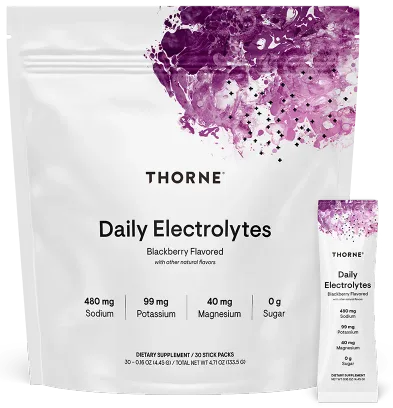
Thorne Research Daily Electrolytes Review
Thorne Daily Electrolytes - Variety Pack is a hydration product from Thorne designed to replenish electrolytes lost through sweat. The product is positioned to promote healthy cellular hydration and boost recovery. The page explains that the body loses water and essential minerals such as sodium, potassium, magnesium, calcium, and chloride through sweat, and that replenishing these nutrients is an essential step to think, perform, and feel your best. Daily Electrolytes are packaged in convenient stick packs to take to the gym, the great outdoors, or across the globe. The listed benefits include replenishing the electrolytes lost through sweat, restoring optimal fluid balance and cellular hydration, enhancing recovery after exercise, supporting endurance and athletic performance, benefiting cellular energy production, and supporting muscle function through magnesium and calcium. Sodium, chloride, and potassium are described as regulating and maintaining fluid balance. The page lists features including a no-sugar formula with flavours and colours derived from all-natural sources, single-serve packaging for travel or a gym bag, and six flavour options across two variety packs. The product is suggested for athletes and non-athletes seeking rehydration, active individuals who need to replace sweat losses, people living or working in hot and humid environments, frequent flyers seeking extra hydration while airborne, and anyone wanting a flavourful way to increase water intake. The page notes that every batch of an NSF Certified for Sport product is tested for compliance with label claims and to ensure the absence of nearly 300 substances banned by many major athletic organizations. The FAQ says each ingredient is tested for identity, purity, and potency, and that the product is checked for contaminants such as heavy metals, pesticides, and harmful microbes. The recommended use is one stick pack mixed with at least 12 ounces of water daily, or as advised by a health-care practitioner, around exercise, in hot or humid conditions, during air travel, or whenever hydration needs increase. The warnings state that the product is contraindicated in anyone with a history of hypersensitivity to its ingredients, and that pregnant users should consult a health-care practitioner before use. The page reports no known adverse interactions at publication date.
We don’t sell supplements. We help you make decisions and get the best price.
Lowest prices
We may earn a commission from some store links. How we choose.
Finding the lowest prices at the stores now. This takes a few seconds.
Products with nearly the same formula (Matched on the main ingredients)
Study, Trial or Testing Result Summary
Members Only26 human studies · 9 improved
7 of these 26 human studies gave the ingredient by drip, not by mouth.
The main ingredient here is salt, which supplies chloride and sodium. The best direct evidence is small but positive. In 10 men resting at high altitude, a salt and citrate drink restored blood plasma volume better than plain water [1]. In 12 female cyclists and triathletes exercising in the heat, a salt drink taken 2 hours beforehand helped the body hold more fluid and lose less weight than a placebo drink [2]. Most other chloride studies tested salt water given into a vein to protect hospital patients' kidneys from contrast dye, with mixed results, and they do not speak to everyday hydration [3][4]. The magnesium is a trace amount, far below the 800 milligrams used in the trial where cells held more water, and that trial also gave creatine, so magnesium alone cannot be credited [5]. A 200 milligram dose eased bloating in women only after two months [6]. For calcium, the only study was in women past menopause and did not test hydration [7]. For potassium, two small studies in men did not show that it improves hydration [8][9]. Animal and cell studies are never counted.
See all 26 studies →Hide the studies
- Across 60 trials of 21,293 patients, intravenous saline was no better than no hydration at preventing contrast-related kidney injury, and other hydration methods worked better than saline.Hydration Strategies for Preventing Contrast-Induced Acute Kidney Injury: A Systematic Review and Bayesian Network Meta-…
- In 22 trials of 5,686 patients, sodium bicarbonate was no better than 0.9% saline for preventing contrast-related kidney injury, kidney replacement therapy, or death.Sodium bicarbonate versus isotonic saline solution to prevent contrast-induced nephropathy : a systematic review and met…
- In 19 trials of 3,609 patients, sodium chloride hydration led to more contrast-related kidney injury than sodium bicarbonate hydration.Sodium bicarbonate therapy for the prevention of contrast-induced acute kidney injury – a systematic review and meta-ana…
- In 16 trials of 3,537 patients having heart procedures, sodium chloride hydration was linked to more contrast-related kidney injury than sodium bicarbonate, though the evidence was not definitive.How Strong Is the Evidence for Sodium Bicarbonate to Prevent Contrast-Induced Acute Kidney Injury After Coronary Angiogr…
- In 14 trials of 2,290 patients, large trials found no difference between sodium bicarbonate and sodium chloride hydration for kidney injury; benefit appeared only in small, lower-quality trials.Sodium bicarbonate for the prevention of contrast induced-acute kidney injury: a systematic review and meta-analysis.
- In 10 trials of 1,090 adults, sodium chloride hydration led to more contrast-related kidney injury than sodium bicarbonate, though trial quality was often limited.Hydration with sodium bicarbonate for the prevention of contrast-induced nephropathy: a meta-analysis of randomized cont…
- A review of 24 studies in cisplatin chemotherapy patients, including 4 on magnesium, found magnesium supplementation may protect the kidneys, but it did not look at body hydration in healthy men.A Systematic Review of Strategies to Prevent Cisplatin-Induced Nephrotoxicity.
- A review of 27 studies of patients having cisplatin chemotherapy found that seven of nine studies on electrolytes showed magnesium supplementation reduced kidney damage risk, but it did not measure body hydration in healthy men.Hydration Methods for Cisplatin Containing Chemotherapy: A Systematic Review.
- In 487 stroke patients, enhanced saline hydration for 72 hours did not reduce early worsening of neurological function compared with standard hydration (2.9% vs 2.0%).Enhanced versus standard hydration in acute ischemic stroke: REVIVE-A randomized clinical trial.
- In 401 heart attack patients, intravenous saline before and after contrast dye cut kidney injury to 7.1% versus 14.1% without hydration.Avoiding the emergence of contrast-induced acute kidney injury in acute coronary syndrome: routine hydration treatment.
- In 396 patients having a heart catheter procedure, fluid given by heart pressure guidance cut contrast-related kidney injury to 6.7% versus 16.3% with standard fluid, though both groups got the same starting saline.Haemodynamic-guided fluid administration for the prevention of contrast-induced acute kidney injury: the POSEIDON random…
- In 240 healthy postmenopausal women given 500 mg of calcium daily or placebo for one year, calcium raised urine calcium and kidney stone risk, but this risk was largely eliminated in those with higher urine volume (more fluid intake).Effects of Hydration and Calcium Supplementation on Urine Calcium Concentration in Healthy Postmenopausal Women.
- In 124 adults with early chronic kidney disease (67% men), a year of coaching to drink more water raised urine volume but caused no statistically significant change in kidney function.Early Coaching to Increase Water Intake in CKD.
- In 72 terminally ill cancer patients given weekly intravenous saline for 4 weeks, adding vitamins and trace elements improved appetite loss, pain, and blood chloride, phosphorus, potassium and protein compared with saline alone.Clinical effects of hydration, supplementary vitamins, and trace elements during end-of-life care for cancer patients.
- In 45 children and teens with migraine in an emergency department, a 10 mL/kg saline IV bolus gave only a small, clinically insignificant pain reduction, and expecting medication did not change the result.Randomized controlled trial of treatment expectation and intravenous fluid in pediatric migraine.
- In 38 women given 200 mg of magnesium daily for two menstrual cycles, fluid retention symptoms such as swelling and bloating fell more than with placebo in the second month but not the first.Magnesium supplementation alleviates premenstrual symptoms of fluid retention.
- In 35 people taking 800 mg magnesium with 5 g creatine daily for 2 weeks, the magnesium-creatine chelate group had more water inside their cells and less outside them, and greater knee strength, while the placebo group did not.Magnesium-creatine supplementation effects on body water.
- In 23 healthy elderly people with dry lower legs, a urea cream with added salt and a urea cream alone worked about equally well at moving skin impedance toward normal, which was attributed to hydration.Urea and sodium chloride in moisturisers for skin of the elderly--a comparative, double-blind, randomised study.
- In 18 abdominally obese men, a single drink with 10 mmol potassium nitrate did not change blood vessel function or blood pressure over 4 hours compared with a potassium chloride placebo drink; hydration was not measured.Acute Effects of Inorganic Nitrate Intake on Brachial and Femoral Flow-Mediated Vasodilation, and on Carotid Artery Reac…
- In 12 female cyclists and triathletes exercising in the heat, drinking a sodium chloride solution 2 hours beforehand increased fluid retention and reduced body mass loss compared with a placebo drink.Hydration Responses to Pre-Exercise Sodium Hyperhydration at Rest and During Cycling in the Heat and Across Menstrual Cy…
- In 10 healthy young men who drank 1 litre of either skimmed milk or soya beverage, urine output and sodium balance did not differ between the two drinks, though chloride balance was higher after milk.Fluid and electrolyte balance following consumption of skimmed milk and a plant-based soya beverage at rest in euhydrate…
- In 10 men resting for 12 hours at 2800 meters altitude, a sodium chloride and citrate drink restored blood plasma volume significantly more than plain water did.Sodium chloride-citrate beverages attenuate hypovolemia in men resting 12 h at 2800 m altitude.
- In 60 patients (only 4 men) using nasal gels twice daily for 7 days each, the stronger 6.0 mg/g gel was more comfortable and stung less, but nasal moisture did not differ between the two.New Ringer's lactate gel formulation on nasal comfort and humidification.
- In 8 men during two 4-day heavy exercise diets, a low potassium diet (25 mEq per day) raised blood plasma volume the most (15%) but did not meaningfully reduce total body potassium compared with the control diet (80 mEq per day).Dietary potassium and heavy exercise: effects on muscle water and electrolytes.
- In a retrospective study of 52 patients with high-output double bowel openings, a salt and bicarbonate solution given through the colon let 15 patients stop all intravenous fluids and reduced daily intravenous fluid volumes in those still needing them.Hydration by colonic enteroclysis: An alternative to parenteral hydration in patients with high-output double enterostom…
- In 32 young adults given a 30-minute intravenous salt-water infusion, brain connectivity between two salt-sensing regions rose in 17 men but fell in 15 women, while thirst and blood pressure rose similarly in both sexes.Sex differences in central salt sensing in the human brain.
Review Totals and Summary
Members Only2,383 reviews · 83% positive
Across the stores, Thorne Research Daily Electrolytes powder has about 1,275 ratings and is received very warmly, mostly for its taste. On the Thorne page, 334 of 464 ratings are five stars, but 62 are one or two stars, and none of the text I had explains why. **What buyers say it did for them:** The written feedback says little about results. One buyer says it was "What I expected, Thank You," and the store's own summary says customers value the effective electrolytes. Most comments express general satisfaction rather than describing effects on training, hydration or recovery. **What they complain about:** No written complaints appeared in the reviews. The Thorne page shows 40 one-star and 22 two-star ratings, so a minority were clearly unhappy, but the reasons aren't given. I can't say what went wrong for them. **Taste, smell, form:** Flavour is the most common praise. Reviewers call it "Very refreshing and delicious" and "Great flavor and variety." The Blackberry flavour is singled out: "The Blackberry is delicious." The store summary describes the variety pack as single-serve stick packs that dissolve easily and are easy to carry to the gym, on trips or to work. One buyer also notes "zero sugar" and a "clean product." Nobody mentioned smell or texture. **Value for money:** Neither the reviews nor the store summaries mention price or value, so there is nothing to report here. **Who it seems to suit and who it did not:** It seems to suit people who want a pleasant-tasting, sugar-free electrolyte drink in portable packets, and who like trying several flavours. The store summary adds that the product is NSF Certified for Sport, which may matter to athletes. The written feedback doesn't identify any group it didn't suit. The low ratings suggest some buyers were disappointed, but their reasons aren't known. **A note on the evidence:** The written feedback is thin, a handful of short comments plus one dated review on a second store, so these themes are general impressions rather than detailed experiences. I haven't seen any reviews of other forms of the product, so nothing had to be left out on that account.
Biohacker Summary
Members Only10 of 10 recommend it
Magnesium is the main ingredient here, and nearly the whole panel spoke about it: about half use it themselves and most of the rest recommend it. The most common reason is sleep, with several taking it before bed, though one panelist says the evidence for sleep is not yet consistent and another says it does not fix waking in the night. Preferred forms are glycinate and L-threonate, with 400 mg before bed named by three panelists and others giving ranges of 300 to 600 mg a day, while some use electrolyte drinks with sodium, potassium and magnesium for workouts and fasting. Other reasons given include muscle cramps, blood pressure, constipation and bone health, and one panelist cautions that some labels list the whole compound weight so the real magnesium dose is much lower than it looks. Potassium, a smaller ingredient in this product, is backed by two panelists, one who prefers getting it from foods rather than supplements; no one said they stopped taking anything.
See all 10 biohackers →Hide the biohackers
Dr. Mark Hyman · Magnesium · uses
- Recommends considering magnesium glycinate before bed for nervous system support, deeper sleep quality, and to help the body transition into rest, and states that they take it every night.
- Recommends Magnesium Breakthrough Advanced 10 from Bioptimizers for restful sleep, muscle recovery, stress resilience, and metabolic health, especially during stressful times of the year.
- Warns that potassium bromate, a dough conditioner banned in the EU, UK, and Canada, is still allowed in U.S. bread.
- Recommends magnesium because it is involved in over 600 reactions in the body and up to 80% of people may have low levels that never get flagged on a standard blood test.
- Recommends magnesium as a basic supplement during detoxification to support pathways, help with constipation, and provide electrolytes.
- Recommends Magnesium Breakthrough Advanced 10 from Biooptimizers, which contains 10 bioavailable forms and 550 mg of elemental magnesium, to support restful sleep, restorative sleep, muscle recovery, stress resilience, and metabolic health.
- Has recommended magnesium breakthrough from bioptimizers for years and now uses Magnesium Breakthrough Advanced 10 as part of his evening routine, especially during periods of travel, training, and higher stress, to support sleep, muscle recovery, and metabolic health.
- Recommends correcting nutrient deficiencies with magnesium.
- Recommends Magnesium Breakthrough Advance 10 from BiOptimizers, which has 10 bioavailable forms of magnesium and more elemental magnesium, as part of his evening routine for sleep, muscle recovery, and metabolic health.
- Has recommended Magnesium Breakthrough from Bio Optimizers for years and now uses Magnesium Breakthrough Advanced 10 as part of his evening routine, especially during periods of travel, training, and higher stress, to support sleep, muscle recovery, and metabolic health.
- Recommends Magnesium Breakthrough Advance 10 from Bio Optimizers, which contains 10 bioavailable forms of magnesium, as it plays a critical role in sleep recovery, stress regulation, and muscle function, and has become part of his evening routine, especially during periods of travel, training, and higher stress.
- States that potassium plays a critical role in nerve signaling and muscle contraction, especially in the heart, and low levels can lead to dangerous irregular heart rhythms.
- Notes that calcium is in bones but is also essential for nerves, muscles, and the heart, and low levels can affect muscle function and heart rhythm.
- Explains that chloride works with sodium to maintain fluid balance and supports digestion.
Dave Asprey · Magnesium · neutral
- Mentions magnesium in the context of sleep but states that it doesn't address the core issue of waking up during the night.
- Suggests that magnesium may help slow aging, support cellular repair, and improve sleep.
- States that magnesium can affect how the body responds to a supplement.
- Recommends fixing sleep with 300mg of Magnesium 101 before bed if diet and exercise aren't melting stubborn belly fat.
- Dave Asprey says his daily routine includes magnesium as part of a carefully developed combination for longevity.
- Recommends magnesium glycinate for sleep, stating that trials show it helps people fall asleep about 17 minutes faster and that he finds it incredibly effective.
- Mentions magnesium glycinate as one of the five gut-friendly, extensively researched ingredients in Kill Switch that helps with natural sleep.
- Dave Asprey recommends Magnesium Glycinate for sleep, noting human studies show it helps people fall asleep faster, is safe, and works on a fundamental aspect of health, unlike magnesium oxide which acts as a laxative.
- Dave Asprey recommends adding 300 or 400 mg of magnesium glycinate before bed to improve deep sleep quality, support growth hormone release, and burn visceral fat while asleep.
- Mentions magnesium glycinate as one of the extensively researched ingredients in Kill Switch that helps with natural sleep.
- Notes that when energy intake is too low for training demand, nutrient intake often falls short, especially for calcium, which is associated with reduced bone health.
- Explains that calcium provides the raw material for bones, but it isn't a standalone input and needs a whole system to be effective.
- Notes that people take calcium for their bones.
- Warns that taking calcium without vitamin D, A, and K2 can lead to calcium going into tissues, causing bone spurs and other issues, and recommends a two-to-one ratio of calcium to magnesium.
Dr. Eric Berg · Magnesium · neutral
- Dr. Eric Berg states that magnesium supports energy, muscle function, and sleep, and that most of it is stored inside cells, making deficiencies harder to detect with a standard blood test.
- States that people need more potassium than any other mineral, yet most people aren’t getting enough.
- Notes that magnesium could also be a factor in preventing muscle cramps.
- Explains that potassium is essential for peristalsis, the pumping action through the colon, and without it, things can sit there, leading to constipation.
- Recommends magnesium, specifically magnesium glycinate, stating it is key for D3 and K2 to work and is probably more important than calcium for building bone.
- Recommends increasing magnesium to restore balance and support healthy blood pressure.
- Explains that the normal requirements for potassium are 4,700 mg every single day, and that very few people get half of that amount. They describe potassium's role in the sodium potassium pump, which is essential for cellular electricity, muscle contraction, and heart function. Deficiency can lead to tiredness, muscle cramps, heart palpitations, or rising blood pressure.
- Recommends increasing potassium to restore balance and support healthy blood pressure.
- Warns that bone loss cannot be fixed with just calcium, as bone is primarily collagen with other essential minerals.
- Dr. Eric Berg suggests that magnesium could help support deeper, more restful sleep.
- Recommends Magnesium Glycinate, noting that the combination of magnesium and glycine is helpful for connective tissue, sleep, and reducing stress.
- Recommends taking magnesium 90 minutes to 2 hours before bedtime to support better sleep.
- Suggests that magnesium glycinate can help support the missing 'break pads' on the nervous system, which contribute to constant pain.
- States that potassium is the most important electrolyte and that most people are not getting enough of it, needing around 4,700 mg daily, or even more, to avoid issues like fatigue, muscle cramps, heart palpitations, high blood pressure, and fluid retention.
Ben Greenfield · Magnesium · uses
- Uses magnesium during surgery because it is neuroprotective.
- Says he is drinking LMNT, which contains sodium, potassium, and magnesium, and states that he actually drinks this stuff.
- Says he is drinking LMNT, which contains sodium, potassium, and magnesium, and states that he actually drinks this stuff.
- Mentions magnesium as part of a bare-minimum protocol.
- Advises getting red blood cell magnesium levels to the high end of the range as a minimum step for overall health and to slow down heart disease.
- Recommends supplementing with magnesium threonate if one is low in magnesium, as it crosses the blood-brain barrier and is demonstrated to increase hippocampus plasticity, theoretically making one smarter and improving memories.
- Uses Magnesium Breakthrough from BIOptimizers as part of their daily stack, taking four capsules in the evening to support relaxation, recovery, and a good night of sleep.
- Recommends Celtic Sea Salt's new electrolyte drink "Hydrate" for replacing electrolytes and trace minerals lost through sweat, noting it contains 70 naturally occurring trace minerals, plus magnesium, taurine, and potassium.
- Recommends Celtic Sea Salt's new electrolyte drink 'Hydrate' for replenishing electrolytes and trace minerals lost through sweat, noting it contains 70 naturally occurring trace minerals, magnesium, taurine, and potassium, with no added sugar, artificial colors, or synthetic ingredients.
- Had heart palpitations when he was really overdoing magnesium, not knowing what he was taking.
- Recommends taking magnesium as a co-factor to increase vitamin D absorption.
- Notes a new study indicating that magnesium is a core dietary antioxidant closely associated with a reduced risk of accelerated biological aging.
- Is considering whether he needs a calcium supplement because lead can displace calcium in bones, affecting bone strength.
- Mentions calcium as a common deficiency.
Dr. Rhonda Patrick · Magnesium · neutral
- Magnesium supplementation has lowered blood pressure in randomized controlled trials. An analysis of 34 trials involving over 2,000 participants found modest reductions in both systolic and diastolic pressure, with a median dose of 368 mg/day.
- Warns that some magnesium supplements make the dose look much larger than it really is and that labels can fool people.
- Mentions magnesium as an important nutrient component for testosterone.
- Warns that some supplement companies mislead consumers by listing the total compound weight of magnesium citrate as the elemental magnesium dose, when the actual elemental magnesium content is much lower, potentially around 44-66 milligrams.
- States there is not yet strong, consistent evidence that magnesium supplementation reliably improves sleep, noting that while some meta-analyses suggest it can improve sleep quality scores, sleep efficiency, and sleep duration, individual studies are inconsistent and several have found no meaningful effect.
- States that magnesium may help modestly lower blood pressure by playing an important role in regulating vascular tone and influencing calcium signaling, with studies showing a reduction in systolic and diastolic blood pressure by 2 mmHg at a dose of around 370 mg/day for about 3 months.
- Recommends considering magnesium to improve mood.
- Recommends Magnesium, stating that roughly half of Americans don’t get enough and it is a cofactor for over 300 biological processes, including DNA repair and energy production.
- Mentions that kale delivers magnesium, a micronutrient many diets fall short on.
- Mentions that kale delivers calcium, a micronutrient many diets fall short on.
- Recommends Magnesium, stating it is a cofactor for over 300 biological processes, including DNA repair, energy production, and sleep regulation.
- Recommends getting enough potassium, noting that most people get too much sodium and not enough potassium.
- Notes additional gaps in calcium.
- Reports that alcohol use disorder is associated with a 20-50% greater prevalence of Calcium deficiency.
Thomas DeLauer · Magnesium · uses
- Uses Element's cans which contain 30 milligram magnesium, finding that electrolytes help his workout performance.
- Uses Element's cans which contain 100 milligram potassium, finding that electrolytes help his workout performance.
- Uses Element's 30 mg magnesium cans first thing in the morning to prime his day and help with workout performance.
- Uses Element's 100 mg potassium cans first thing in the morning to prime his day and help with workout performance.
- Recommends magnesium around the time one would normally break a fast to calm the brain and dull feelings of conditioned hunger.
- Recommends magnesium, noting it is a cofactor for enzymes that build neurotransmitters, and deficiency can affect mood, happiness, and motivation.
- Notes that modern agricultural practices have led to soils depleted of trace minerals like magnesium, resulting in widespread magnesium deficiency.
- Recommends taking some magnesium glycinate tonight to help calm down and sleep.
- Mentions that magnesium in pumpkin seeds relaxes bronchial smooth muscle.
- Compares magnesium content, stating bananas have 32mg and pumpkin seeds have 156mg per ounce, a 5x difference.
- Notes that milk contains 120mg of calcium, while sardines contain 351mg, highlighting a 3x difference.
- Recommends Magnesium glycinate, stating that 200-400mg elemental helps with sleep as glycine cools the body and magnesium calms.
- Notes that magnesium sits on the NMDA receptor and regulates excitatory transmission, in the context of feeling stressed.
- Recommends Element's ready-to-drink sparkling electrolyte drinks as a low or zero-calorie soda replacement that provides 1,000 milligrams of sodium, 200 milligrams of potassium, and 60 milligrams of magnesium.
Siim Land · Magnesium · recommends
- States that Magnesium can be a useful addition for some people for sleep.
- Recommends magnesium for sleep, especially deep sleep, and suggests trying better types like Threonate, Biscinate, or Torate, referencing a study where magnesium supplementation improved deep sleep.
- Recommends Magnesium for blood pressure, migraines and deficiency, based primarily on human research, especially randomized controlled trials showing measurable benefits.
- Lists Magnesium as one of 15 supplements backed by human studies.
- States that magnesium is a fundamental mineral governing over 600 enzymes and metabolic reactions, and recommends that most people need at least 400-500 mg/d for health, with some needing up to 600 mg/d.
- Lists seafood and pumpkin seeds as sources of Magnesium.
- Lists potatoes and fruit as sources of Potassium.
- Lists dairy and sardines as sources of Calcium.
- Thinks magnesium has some of the strongest evidence and is worth considering.
- Recommends taking magnesium, specifically glycinate and threonate forms, 1 to 2 hours before bed for sleep benefits, noting that glycinate promotes relaxation and threonate crosses the blood-brain barrier for sleep quality and cognitive function.
- Notes that Boron reduces calcium/magnesium loss.
- Notes that Boron reduces calcium/magnesium loss.
- Notes that magnesium is important for activating thiamine into its more biologically active form, and a magnesium deficiency can impair blood sugar regulation even with adequate thiamine intake.
- Notes that bananas have potassium but there are at least 8 other foods with more potassium than bananas.
Andrew Huberman · Magnesium · neutral
- Discusses Magnesium Threonate as a tool for falling asleep.
- Takes 400 mg of Magnesium Threonate before bed for sleep.
- Uses Element, an electrolyte drink with sodium, magnesium, and potassium in correct ratios and no sugar, to ensure adequate hydration and electrolytes, especially when starting days fast or during physical exercise.
- Uses Element, an electrolyte drink with sodium, magnesium, and potassium in correct ratios and no sugar, to ensure adequate hydration and electrolytes, especially when starting days fast or during physical exercise.
- Takes 400 mg of Magnesium L-Threonate before bed for sleep.
- Confirms that magnesium is absolutely important for cognitive function, noting studies show those with lower magnesium intakes tend to perform less well on cognitive function tests, and it's related to brain changes over time and dementia risk.
- Takes 400 mg of Double Wood Magnesium L-Threonate before bed for sleep.
- He takes 400 mg of Magnesium L-Threonate from Double Wood before bed for sleep.
- Takes 400 mg of Double Wood Magnesium L-Threonate before bed for sleep.
- Takes 400 mg of magnesium L-threonate before bed for sleep.
- Takes 400 mg of Magnesium Threonate before bed for sleep.
- Uses Element, which contains potassium in the correct ratios, to ensure proper hydration and electrolyte intake for brain and body function.
- Mentions potassium as an electrolyte.
- Uses Element, an electrolyte drink with sodium, magnesium, and potassium in correct ratios and no sugar, to ensure adequate hydration and electrolytes, drinking it first thing in the morning and during physical exercise.
Bryan Johnson · Magnesium · uses
- Takes 400 mg of Magnesium Threonate before bed for sleep.
- Takes 400 mg of Magnesium L-Threonate before bed for sleep.
- Takes 400 mg of Magnesium Threonate before bed for sleep.
- He takes 400 mg of Double Wood Magnesium L-Threonate before bed for sleep.
- Takes 400 mg of Magnesium L-Threonate before bed for sleep.
- Takes 400 mg of Magnesium Threonate before bed for sleep.
- Takes 400 mg of Magnesium L-Threonate before bed for sleep.
- Takes 400 mg of magnesium L-threonate before bed for sleep.
- He takes 400 mg of Magnesium L-Threonate before bed for sleep.
- Takes 400 mg of magnesium threonate before bed for sleep.
- Recommends calcium as a mineral that, along with phosphorus, magnesium, and boron, is deposited to fortify the bone structure after the collagen scaffold is in place.
- Agrees that a little extra calcium is probably okay, especially for women, to really hit home for bone mineral density.
Peter Attia · Potassium · recommends
- States there is some evidence that increasing dietary potassium through potassium-rich foods like bananas and potatoes, rather than supplements, can lower blood pressure.
- Peter reviews the evidence for select off-label medications and supplements commonly used for sleep, including glycine, magnesium, ashwagandha, and phosphatidylserine.
- Suggests that zinc and magnesium could potentially help with vasodilation and sleep, particularly for women experiencing severe symptoms in the luteal phase.
- Peter discusses electrolytes and fiber and the ketogenic diet, specifically preventing magnesium loss.
- Recommends magnesium as one of the 'big three' micronutrients for bone health, suggesting a daily intake of 300 to 500 milligrams as a minimum, and personally aims for about a gram of supplemental magnesium.
- Recommends calcium as one of the 'big three' micronutrients for bone health, suggesting a daily intake of 1,000 to 1,200 milligrams, which can be supplemented with calcium carbonate or calcium citrate.
- Recommends magnesium for optimizing bone mineral density, suggesting a daily intake of 300 to 500 milligrams as a minimum, but personally aims for about a gram.
- Explains that bone is 50 to 70% mineral, predominantly calcium, and that virtually all of the body's calcium is contained within bone, making bone important for calcium homeostasis.
- Recommends calcium for bone health, stating that teenagers probably need about 1000 milligrams a day.
- Discusses bone acting as a reservoir for calcium and how resorption and formation release calcium into the blood when needed.
- Takes a hardline view that most people do not have adequate or optimal levels of magnesium, and suboptimal levels will impede the metabolism of vitamin D because magnesium is a cofactor in its enzymatic conversion.
- Takes a hardline view that most people do not have adequate or optimal levels of magnesium, and suboptimal levels will impede vitamin D metabolism because magnesium is a co-factor in the enzymatic conversion of vitamin D.
- Takes magnesium as a straightforward supplement.
- Mentions that magnesium intake is often super low and impactful on testosterone levels.
RAL Summary
Members OnlyTier 3 for Hydration Men
Tier 3 rests on 2,383 reviews with 83% positive, backed by some study support from small trials where oral salt drinks improved plasma volume and fluid retention [1][2]. Evidence for the magnesium, calcium and potassium at these doses is thin or absent.
- Magnesium: trace amount
Where the evidence disagrees: 14 of the 26 human studies found no effect.
More Details
Members OnlyBody systems · Combine with · Possible side effects
Body systems: Kidneys and urinary system, Cardiovascular system, Muscular system
Combine with: For hydration use, pair with a quality multivitamin or B-complex and adequate plain water; vitamin C and a small amount of carbohydrate can aid absorption during intense exercise. If the real aim is blood pressure support, consider a sodium-free approach such as magnesium glycinate or taurate (200-400 mg), potassium from food sources (leafy greens, beans, bananas, avocado) rather than high-sodium mixes, omega-3 fish oil (EPA/DHA), CoQ10 (100-200 mg), and possibly beetroot/nitrate or hibiscus extract. Those with kidney disease or taking meds, ARBs, or potassium-sparing meds should consult a clinician before adding potassium or magnesium supplements.
Possible side effects: In one study, calcium at a much higher dose raised urine calcium and kidney stone risk, mostly offset by drinking more fluid. Reviews describe no specific side effects.
Supplement Facts
Calcium 70 mg · Magnesium 40 mg · Chloride 750 mg
| Calories | 5 | |
| Total Carbohydrate | 1 g | |
| Calcium | 70 mg | |
| Magnesium | 40 mg | |
| Chloride | 750 mg | |
| Sodium | 480 mg | |
| Potassium | 99 mg |
Other ingredients: Citric Acid, Flavors, Rebaudioside M (from stevia), Silicon Dioxide, Malic Acid, Calcium Silicate, Beet Juice (color).
Directions: Mix 1 stick pack with at least 12 ounces of water daily or as recommended by your health-care practitioner.
Barcode (UPC) 693749015253 · Label source: Reverseagelab · Report a label change
Show entire label

More hydration men products
Members OnlyThe highest ranked for the same goal
Graded November 5, 2026 by the Reverse Age Lab evidence engine, from human studies, real reviews and our biohacker panel. How we grade. Is this medical advice? No. Rala organizes the published evidence; go over any change with your doctor, especially if you take meds.
Privacy policyConsumer health dataAffiliate disclosureTermsDo Not Sell or Share My Personal InformationCookie settings