
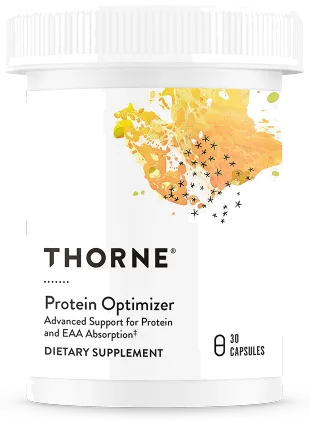
Thorne Research Protein Optimizer Review
Thorne Protein Optimizer is a probiotic and enzymatic capsule formula that the brand describes as a way to maximize the benefits of every gram of protein a person consumes. The product works along the gut-muscle axis, which the page defines as the connection between gastrointestinal health, nutrient absorption, and muscle function. Thorne states that the formula is intended to improve protein digestion and the absorption of amino acids, promoting muscle recovery and digestive comfort. The core blend is Mycosha™, described as a mix of three probiotic bacterial strains (Lactobacillus acidophilus, Lacticaseibacillus rhamnosus, and Bifidobacterium breve), a yeast strain (Saccharomyces boulardii), and the digestive enzyme amylase. The page also features Bacillus coagulans SNZ 1969®, a spore-forming probiotic strain that the brand says can survive stomach acid and reach the intestines. Each capsule is listed with 21mg of Mycosha™ Probiotic Blend and 20mg of Bacillus coagulans SNZ 1969®, with 30 servings per container. The product is labeled as providing a minimum of 3 billion active cultures per capsule. The suggested use is one capsule taken once daily with any meal. The page states that the product is stable at room temperature and needs no refrigeration. Thorne says it pairs well with its Whey Protein Isolate or Plant Protein, and it is aimed at people who take protein powders, follow plant-based diets, use meds with reduced protein intake, or are athletes who want better protein uptake. The page lists benefits such as supporting amino acid absorption, bowel regularity, gut barrier health, and relief from occasional gas and bloating. The product carries NSF Certified for Sport® status, which Thorne says means each batch is tested for compliance with label claims and for the absence of nearly 300 banned substances. The warnings section says the product is contraindicated in people with a history of hypersensitivity to any ingredient, and that pregnant people should consult a health-care provider before use. The page also says the product contains no protein itself.
We don’t sell supplements. We help you make decisions and get the best price.
Lowest prices
We may earn a commission from some store links. How we choose.
Finding the lowest prices at the stores now. This takes a few seconds.
Study, Trial or Testing Result Summary
Members Only87 human studies · 62 improved
No study tested this product, its Mycohsa blend or its two ingredients together, so the support for easing after-meal upper stomach discomfort comes from other probiotics. The one study that included this exact Bacillus coagulans strain tested it inside a three-strain Bacillus blend: over 30 to 37 days, 60 adults with stomach discomfort had less bloating, belching, sour taste and pain than on placebo [1]. That study did not report the dose. Other strains of the same species also helped. Two billion spores a day of one strain for 4 weeks cut indigestion scores in adults with gas and bloating [2]. A two-strain Bacillus blend helped 48% of people with after-meal distress versus 20% on placebo [3]. Some strains ranked among the best probiotics for abdominal pain in irritable bowel syndrome [4]. For the Mycohsa blend, the evidence comes only from unrelated strains, such as a Bifidobacterium strain that gave relief to 90% of people with indigestion versus 58% on placebo [5] and a Lactobacillus gasseri yogurt [6]. These results may not apply to the blend in this product. Animal and cell studies are never counted.
See all 87 studies →Hide the studies
- In a pooled analysis of 26 randomized trials (41,048 people with type 2 diabetes), adding probiotics to a med lowered the risk of diarrhea, bloating and constipation, though the review was mainly about drug combinations and not about a specific probiotic blend.Read the study on PubMed (39065748) →
- In 82 trials of 10,332 adults with irritable bowel syndrome, some probiotics and probiotic combinations eased overall symptoms, pain and bloating compared with placebo, but the certainty of the evidence was low to very low.Efficacy of Probiotics in Irritable Bowel Syndrome: Systematic Review and Meta-analysis.
- In 81 trials of 9,253 adults with irritable bowel syndrome, only some probiotic strains and mixtures beat placebo, with benefits for abdominal pain and bloating depending on the strain used.Outcome-Specific Efficacy of Different Probiotic Strains and Mixtures in Irritable Bowel Syndrome: A Systematic Review a…
- In 43 trials of 5,531 people with irritable bowel syndrome, Bacillus coagulans ranked best for easing symptoms, pain and bloating, and longer treatment (around 8 weeks) worked better for pain, while results differed by probiotic species.Efficacy of Probiotics for Irritable Bowel Syndrome: A Systematic Review and Network Meta-Analysis.
- In 15 placebo-controlled trials with 1,793 people with irritable bowel syndrome, probiotics improved the chance of pain relief and overall symptom improvement and reduced symptom severity scores compared with placebo.Effectiveness of probiotics in irritable bowel syndrome: Updated systematic review with meta-analysis.
- In 18 trials of 1,309 children with functional abdominal pain, probiotics led to more treatment success than placebo (50% versus 33%), but complete pain resolution was not clearly better and the evidence was low certainty.Probiotics for management of functional abdominal pain disorders in children.
- In six placebo-controlled trials of 970 adults with irritable bowel syndrome, probiotics reduced abdominal pain and bloating but did not significantly lower overall symptom severity or improve quality of life, with highly varied results.Efficacy and safety of probiotics in the treatment of irritable bowel syndrome: A systematic review and meta-analysis of…
- Across five randomized trials in adults with functional dyspepsia, probiotics or prebiotics modestly improved symptoms versus placebo, but probiotics alone did not clearly improve symptoms and the best strains were unclear.Efficacy of prebiotics and probiotics for functional dyspepsia: A systematic review and meta-analysis.
- In a review of 21 studies on reflux and indigestion symptoms, including 3 probiotic studies, probiotic yoghurt improved symptoms in one study while the other probiotic interventions showed no clear effect.What is the efficacy of dietary, nutraceutical, and probiotic interventions for the management of gastroesophageal reflu…
- Across 26 randomized trials, adding Lactobacillus probiotics to standard Helicobacter pylori treatment raised eradication rates and reduced nausea, diarrhea and abdominal pain, but did not significantly reduce bloating.Efficacy of Lactobacillus spp. Supplementation in Helicobacter pylori Eradication: A Systematic Meta-Analysis of Randomi…
- A review of meta-analyses found probiotics lowered the risk of upper-abdominal (epigastric) pain, bloating, nausea and diarrhea, with stronger effects over shorter periods and with multi-strain products, though study quality was often low.Probiotics and gastrointestinal disorders: an umbrella meta-analysis of therapeutic efficacy.
- In a review of 13 studies in adults with reflux and related upper-digestive symptoms, 11 of 14 probiotic comparisons (79%) reported symptom benefits, though more rigorous placebo-controlled trials are needed.Gastroesophageal Reflux Disease and Probiotics: A Systematic Review.
- In 650 adults taking standard meds for Helicobacter pylori, 14 days of probiotic capsules reduced epigastric pain, bloating, flatulence and other side effects more than placebo, and raised cure rates.Probiotics for standard triple Helicobacter pylori eradication: a randomized, double-blind, placebo-controlled trial.
- In 503 hospital patients taking meds, a higher daily dose of a four-strain probiotic lowered the rate of a med-associated diarrhea and reduced fever, abdominal pain and bloating compared with placebo.Read the study on PubMed (24291194) →
- In 350 generally healthy adults with bloating, 6 weeks of a multispecies synbiotic reduced bloating, gas and abdominal discomfort more than placebo, with 72.3% reporting never or rarely bloating versus 55.9% on placebo.A Randomized, Placebo-Controlled Trial Evaluating Multi-Species Synbiotic Supplementation for Bloating, Gas, and Abdomin…
- In 301 people after colonoscopy, taking a probiotic capsule (0.5 g three times daily) for 28 days improved abdominal symptoms early compared with placebo and increased beneficial gut bacteria.Effect of Probiotics on the Gut Microbiota After Colonoscopy: A Multicenter, Randomized, Placebo-Controlled Clinical Stu…
- In 12 weeks of a daily Lactobacillus reuteri supplement, 290 adults over 65 showed no lasting improvement in digestive symptoms compared with placebo.Probiotic administration among free-living older adults: a double blinded, randomized, placebo-controlled clinical trial…
- In 290 adults with diarrhea-predominant irritable bowel syndrome, 4 weeks of a Bifidobacterium tablet gave a 67.6% response rate versus 36.6% on placebo for combined relief of abdominal pain and diarrhea.The Short-Term Efficacy of Bifidobacterium Quadruple Viable Tablet in Patients With Diarrhea-Predominant Irritable Bowel…
- In 6 weeks of eating fermented milk with Bifidobacterium animalis DN-173 010, 65.2% of people with constipation-predominant irritable bowel syndrome had a responder improvement in discomfort quality of life at week 3, compared with 47.7% on the yoghurt control, and bloating also decreased more.Effect of a fermented milk containing Bifidobacterium animalis DN-173 010 on the health-related quality of life and symp…
- After colonoscopy, a probiotic capsule shortened the number of days with abdominal pain (1.99 vs 2.78 days) compared with placebo, but did not significantly change bloating or return to normal bowel habits.Randomized controlled trial of probiotics after colonoscopy.
- In 259 children with irritable bowel symptoms, adding Bacillus clausii to usual treatment for 8 weeks did not improve symptoms more than placebo.Efficacy and Safety of the Adjuvant Use of Probiotic Bacillus clausii Strains in Pediatric Irritable Bowel Syndrome: A R…
- In 257 women taking meds for Helicobacter pylori, 14 days of Lactiplantibacillus plantarum MH-301 reduced bloating, constipation and side effects compared with placebo.Lactiplantibacillus plantarum MH-301 reduces Helicobacter pylori treatment-related adverse events via gut-vaginal axis: …
- In 229 adults with functional constipation, taking the probiotic HN019 daily for 8 weeks did not increase complete bowel movements more than placebo.Eight-Week Supplementation With Bifidobacterium lactis HN019 and Functional Constipation: A Randomized Clinical Trial.
- In 4 weeks of one daily capsule of Lactobacillus plantarum 299v, pain and bloating fell more than on placebo in 214 people with irritable bowel syndrome, and 78.1% rated the effect as excellent or good versus 8.1% on placebo.Clinical trial: Lactobacillus plantarum 299v (DSM 9843) improves symptoms of irritable bowel syndrome.
- In 201 adults with irritable bowel symptoms, a nine-strain synbiotic for 12 weeks improved symptom severity, abdominal pain and bloating more than placebo, and 70% of the synbiotic group reported adequate relief.Effectiveness of a Balanced Nine-Strain Synbiotic in Primary-Care Irritable Bowel Syndrome Patients-A Multi-Center, Rand…
- In 200 people with functional dyspepsia, the high dose of BL-99 taken for 8 weeks gave a clinical response in 90% of users versus 58% on placebo.Efficacy of Bifidobacterium animalis subsp. lactis BL-99 in the treatment of functional dyspepsia: a randomized placebo-…
- In 200 adults with diarrhea-predominant irritable bowel syndrome, taking the probiotic ES1 daily for 12 weeks reduced symptom severity more than placebo, with abdominal pain also improving.A randomized double-blind, placebo-controlled trial to evaluate the safety and efficacy of live Bifidobacterium longum C…
- In 179 people with irritable bowel syndrome, a daily probiotic yoghurt for up to 12 weeks did not give better symptom relief than a non-probiotic yoghurt, and at 8 weeks placebo relief was higher.A randomised controlled trial of a probiotic 'functional food' in the management of irritable bowel syndrome.
- In 174 adults taking treatment for stomach infection, a multistrain probiotic during 4 weeks of therapy reduced reflux, diarrhea and dyspepsia symptoms by week 8 compared with placebo.Multistrain probiotics alleviate gastrointestinal symptoms during bismuth quadruple therapy for Helicobacter pylori infe…
- In 156 adults with new type 2 diabetes or prediabetes, adding BB-12 probiotic to a med for 3 months gave fewer stomach side effects such as abdominal pain, diarrhea and bloating than a med alone, along with better adherence and blood sugar control.Read the study on PubMed (36098362) →
- In 150 patients after colonoscopy, probiotic capsules over 2 weeks did not significantly reduce discomfort, bloating or time to normal bowel function compared with placebo, though a subgroup with existing symptoms had less bloating.Randomized controlled trial of probiotic use for post-colonoscopy symptoms.
- In 141 children aged 4-12 with irritable bowel syndrome, Bacillus coagulans Unique IS2 taken daily for 8 weeks reduced pain, abdominal discomfort and bloating more than placebo.Efficacy of Bacillus coagulans Unique IS2 in treatment of irritable bowel syndrome in children: a double blind, randomis…
- In 136 adults with irritable bowel syndrome, 2 billion CFU of Bacillus coagulans Unique IS2 daily for 8 weeks improved abdominal discomfort, pain and bowel movements more than placebo, with no change in inflammation markers.Randomized clinical trial: the effect of probiotic Bacillus coagulans Unique IS2 vs. placebo on the symptoms management …
- In 131 adults with bipolar disorder or schizophrenia spectrum disorder, 3 months of a multistrain probiotic did not change psychiatric symptoms, but indigestion decreased in men only.Probiotic Formulation for Patients With Bipolar or Schizophrenia Spectrum Disorder: A Double-Blind, Randomized Placebo-C…
- In 125 children with recurrent abdominal pain, Lactobacillus reuteri for 4 weeks gave pain relief in 32 of 65 children who took it, versus 8 on placebo, with significant improvement in the functional dyspepsia subgroup.Evaluating the effects of probiotics in pediatrics with recurrent abdominal pain.
- In 120 people with irritable bowel syndrome, a probiotic taken for 12 weeks improved symptoms more than placebo, raised short-chain fatty acid levels, and lowered inflammatory markers.Effects of short-chain fatty acid-producing probiotic metabolites on symptom relief and intestinal barrier function in p…
- In 110 patients recovering from heart valve surgery, taking Bifidobacterium animalis subsp. lactis LPL-RH for 14 days reduced abdominal pain, bloating and overall gut symptoms more than placebo and shortened time to bowel recovery.Bifidobacterium animalis subsp. lactis LPL-RH improves postoperative gastrointestinal symptoms and nutrition indexes by …
- In 106 adults with functional dyspepsia but no H. pylori infection, a yogurt with Lactobacillus gasseri OLL2716 taken for 12 weeks cleared major symptoms in 35.3% of people versus 17.3% on placebo yogurt (p = 0.048).The Ameliorating Effect of Lactobacillus gasseri OLL2716 on Functional Dyspepsia in Helicobacter pylori-Uninfected Indiv…
- In 101 children with functional abdominal pain, 4 weeks of Lactobacillus reuteri reduced how often and how severely they had belly pain compared with placebo.Lactobacillus reuteri DSM 17938 for the Management of Functional Abdominal Pain in Childhood: A Randomized, Double-Blind…
- In 100 healthy adults, drinking 100 mL of fermented milk containing Bifidobacterium bifidum YIT 10347 daily for 4 weeks relieved postmeal discomfort and upper stomach pain more than placebo milk.Bifidobacterium bifidum YIT 10347 fermented milk exerts beneficial effects on gastrointestinal discomfort and symptoms i…
- In 94 adults with Helicobacter pylori taking standard a med therapy, adding MN-LF23 for 6 weeks lowered overall gut symptom scores and improved constipation and dyspepsia compared with placebo, though it did not improve infection clearance.Impact of supplementing Limosilactobacillus fermentum MN-LF23 on the eradication of Helicobacter pylori with 14-day stan…
- In 90 people treated for Helicobacter pylori infection, adding a Lactobacillus reuteri probiotic for 4 weeks improved indigestion and abdominal pain more than placebo and raised eradication rates.Probiotic containing Lactobacillus reuteri DSM 17648 as an adjunct treatment for Helicobacter pylori infection: A random…
- In 81 children hospitalized with acute diarrhea, taking Lactobacillus casei twice daily for 7 days improved abdominal pain, bloating and diarrhea and lowered gut inflammation markers compared with no probiotic.Probiotic Lactobacillus casei: Effective for Managing Childhood Diarrhea by Altering Gut Microbiota and Attenuating Feca…
- In 80 people with irritable bowel syndrome, a two-strain acidophilus probiotic taken daily for 8 weeks did not significantly reduce abdominal pain compared with placebo, but it did reduce flatus and a combined symptom score.A 2-strain mixture of Lactobacillus acidophilus in the treatment of irritable bowel syndrome: A placebo-controlled rando…
- In 76 healthy adults, taking Bacillus subtilis BS50 daily for 6 weeks improved bloating, burping, and gas symptoms more often than placebo, with no safety concerns.The probiotic Bacillus subtilis BS50 decreases gastrointestinal symptoms in healthy adults: a randomized, double-blind, …
- In 73 children, 6 weeks of a three-Bifidobacteria mixture improved abdominal pain and quality of life in irritable bowel syndrome more than placebo, with 48% reporting better quality of life, but no benefit was seen in functional dyspepsia.A Mixture of 3 Bifidobacteria Decreases Abdominal Pain and Improves the Quality of Life in Children With Irritable Bowel…
- In 73 patients after gastric bypass surgery, 90 days of Lactobacillus acidophilus and Bifidobacterium lactis reduced bloating compared with placebo, but overall symptom scores did not differ between groups.Effects of Probiotics Supplementation on Gastrointestinal Symptoms and SIBO after Roux-en-Y Gastric Bypass: a Prospectiv…
- In a 12-week pilot of five probiotic and nutrient combinations versus placebo in 72 adults with functional gut symptoms, symptom scores did not change significantly overall, though two combinations showed clinically notable improvements.Efficacy of probiotics and nutrients in functional gastrointestinal disorders: a preliminary clinical trial.
- In 71 children with irritable bowel syndrome, twice-daily Bifidobacterium lactis B94 for 4 weeks improved belching, abdominal fullness and bloating after meals compared with prebiotic treatment, with significant gains over baseline.Efficacy of synbiotic, probiotic, and prebiotic treatments for irritable bowel syndrome in children: A randomized contro…
- In 70 adults with gas and bloating, 2 billion spores daily of Bacillus coagulans MTCC 5856 for 4 weeks lowered indigestion scores from 8.91 to 3.06, versus 9.42 to 8.43 with placebo.The effects of Bacillus coagulans MTCC 5856 on functional gas and bloating in adults: A randomized, double-blind, placeb…
- In 68 people with functional dyspepsia, a spore-forming probiotic taken twice daily for 8 weeks produced clinical response in 48% of users versus 20% on placebo, with few adverse events.Efficacy and safety of spore-forming probiotics in the treatment of functional dyspepsia: a pilot randomised, double-bli…
- In 67 elderly adults with irritable bowel syndrome, a daily synbiotic containing Lactobacillus paracasei DKGF1 and Opuntia humifusa for 4 weeks produced more responders than placebo (51.5% vs 23.5%), with better abdominal pain relief, but no difference in gas or bloating.Efficacy of a Synbiotic Containing Lactobacillus paracasei DKGF1 and Opuntia humifusa in Elderly Patients with Irritable…
- In 67 people with self-reported functional gut symptoms, a deactivated Bacillus subtilis strain taken for 4 weeks improved constipation more than placebo, with smaller exploratory gains in indigestion and dyspepsia.Bacillus Subtilis (BG01-4TM) Improves Self-Reported Symptoms for Constipation, Indigestion, and Dyspepsia: A Phase 1/2A …
- In 61 adults with gas symptoms after meals, Bacillus coagulans GBI-30 for 4 weeks improved abdominal pain and total symptom scores more than placebo, though a strong placebo effect was seen.A prospective, randomized, double-blind, placebo-controlled parallel-group dual site trial to evaluate the effects of a …
- In 60 patients after gastric bypass surgery, two weeks of probiotics improved quality of life scores for gas, bloating and abdominal pain, with similar results to a digestive enzyme group.Effect of probiotics on postoperative quality of gastric bypass surgeries: a prospective randomized trial.
- In 60 adults with stomach discomfort, a three-strain Bacillus blend improved bloating, belching, sour taste, pain and satisfaction scores over 30 to 37 days compared with placebo, with no adverse events.A prospective, randomized, double-blind, placebo-controlled, parallel-group study to evaluate the efficacy and safety of…
- In 60 adults with chronic constipation, 29 days of GutBio Plus capsules improved bowel movements, abdominal pain and bloating more than placebo.Probiotics for chronic constipation: A randomized, prospective, placebo-controlled study.
- In 60 people with acute diarrhea and abdominal discomfort, Bacillus coagulans LBSC eased abdominal pain and diarrhea and improved quality of life compared with placebo.A prospective, interventional, randomized, double-blind, placebo-controlled clinical study to evaluate the efficacy and …
- In dialysis patients, 12 weeks of Lactobacillus paracasei N1115 reduced gastrointestinal symptoms, particularly dyspepsia and constipation, compared with placebo.Probiotic treatment induces changes in intestinal microbiota but does not alter SCFA levels in peritoneal dialysis patie…
- In 56 adults with functional constipation, Lactobacillus reuteri DSM 17938 taken for 105 days improved abdominal discomfort, pain and bloating compared with placebo.Randomised double blind placebo controlled trial on Lactobacillus reuteri DSM 17938: improvement in symptoms and bowel h…
- In 56 healthy adults, a kefir-derived probiotic taken daily for 3 weeks reduced abdominal pain and bloating in men compared with control, but this effect was not shown in women.Putative Probiotic Strains Isolated from Kefir Improve Gastrointestinal Health Parameters in Adults: a Randomized, Singl…
- In 52 adults with irritable bowel syndrome, taking a simethicone and Bacillus coagulans combination three times a day after meals for 4 weeks reduced bloating and discomfort more than placebo.A randomized double-blind placebo-controlled clinical trial on efficacy and safety of association of simethicone and Bac…
- In 50 people with diarrhea-predominant irritable bowel syndrome, 2 billion CFU of Bacillus coagulans daily for about 8 weeks reduced abdominal pain, bloating, diarrhea and stool frequency compared with placebo.The role of Weizmannia (Bacillus) coagulans LMG S-31876 in treating IBS-diarrhea.
- In 49 people with irritable bowel syndrome, a multispecies probiotic taken twice daily for 4 weeks substantially relieved symptoms in 68% of people versus 37.5% on placebo (p < 0.05), with improved abdominal pain and bloating.Effect of multispecies probiotics on irritable bowel syndrome: a randomized, double-blind, placebo-controlled trial.
- In 44 people with irritable bowel syndrome, taking Bacillus coagulans once daily for 8 weeks improved abdominal pain and bloating scores from baseline at every weekly check, while the placebo group improved only in abdominal pain at weeks 6 and 8.Bacillus coagulans significantly improved abdominal pain and bloating in patients with IBS.
- In 41 adults with functional constipation, taking BL-99 for 4 weeks reduced abdominal discomfort and pain during bowel movements more than placebo, and the benefit lasted 2 weeks after stopping.Efficacy of Bifidobacterium animalis subsp. lactate BL-99 in relieving functional constipation: a randomized placebo-con…
- In 3 months of two probiotic tablets a day (60 mg each) in older people with Parkinson's disease, abdominal pain and bloating improved about as much as with trimebutine, though constipation did not improve as well.Nonmotor gastrointestinal disorders in older patients with Parkinson's disease: is there hope?
- In 40 adults with irritable bowel syndrome, 6 billion Bacillus coagulans daily for 80 days improved bloating, cramping and abdominal pain more than placebo.Efficacy and safety of Bacillus coagulans LBSC in irritable bowel syndrome: A prospective, interventional, randomized, d…
- In 37 adults with type 2 diabetes who could not tolerate a med, periods on a multi-strain probiotic reduced nausea, abdominal bloating and pain, and improved tolerance of a med compared with periods on placebo.Read the study on PubMed (37812890) →
- In 36 adults with diarrhea-predominant irritable bowel syndrome, 2 billion CFU of Bacillus coagulans MTCC 5856 daily for 90 days, alongside standard care, significantly reduced bloating, abdominal pain, and stool frequency compared with placebo.Bacillus coagulans MTCC 5856 supplementation in the management of diarrhea predominant Irritable Bowel Syndrome: a doubl…
- In 31 girls with anorexia nervosa and constipation, taking Lactobacillus reuteri alongside nutrition therapy for 3 months did not significantly relieve constipation compared with placebo, but it raised stool frequency and improved body weight normalization by 6 months."The role of L. reuteri DSM17938 in nutritional recovery and treatment of constipation in children and adolescents with …
- In 31 patients after sleeve gastrectomy, one month of probiotics increased weekly bowel movements and reduced constipation compared with controls.Initial Study on the Impact of Probiotics on Postoperative Gastrointestinal Symptoms and Gut Microbiota after Sleeve Gas…
- In 30 adults with irritable bowel syndrome with constipation, 8 weeks of this probiotic improved bloating severity, bloating frequency and bowel discomfort compared with placebo.Effect of Lacticaseibacillus rhamnosus IDCC 3201 on irritable bowel syndrome with constipation: a randomized, double-bli…
- In 28 people with mild to moderate delayed stomach emptying, daily LG21 yogurt for 12 weeks did not clearly speed gastric emptying compared with placebo yogurt, though salivary amylase was lower.The Effect of Continuous Intake of Lactobacillus gasseri OLL2716 on Mild to Moderate Delayed Gastric Emptying: A Randomi…
- In 23 people with lactose intolerance and ongoing stomach symptoms, taking a probiotic blend with vitamin B6 for 30 days reduced bloating and eased constipation more than placebo.Effects of Bifidobacterium longum and Lactobacillus rhamnosus on Gut Microbiota in Patients with Lactose Intolerance and…
- In 8 weeks of taking two capsules a day of Lactobacillus plantarum 299v, people with irritable bowel syndrome had no more abdominal pain relief than those on placebo.Randomized clinical trial: effect of Lactobacillus plantarum 299 v on symptoms of irritable bowel syndrome.
- In healthy adults over 12 weeks, three different probiotics reduced how often bloating, stomach rumbling, stomach pains and incomplete bowel emptying occurred compared with placebo, with results varying by product.The gastrointestinal status of healthy adults: a post hoc assessment of the impact of three distinct probiotics.
- In 122 people with functional abdominal bloating, adding a Lactobacillus helveticus probiotic for 2 weeks to standard anti-bloating treatment improved the sense of bloating and visible abdominal distension more than standard treatment alone (p = 0.008).Impact of cefixime and probiotics on functional abdominal bloating: a pilot study.
- In a randomized pilot of children with acute leukemia on chemotherapy, Lactobacillus rhamnosus given twice daily as 5 billion CFU sachets reduced nausea, vomiting and abdominal distension compared with no probiotic.Probiotic Supplementation Decreases Chemotherapy-induced Gastrointestinal Side Effects in Patients With Acute Leukemia.
- In 50 older adults with indigestion, a Bacillus coagulans and digestive enzyme syrup taken daily for 5 days improved dyspepsia scores, abdominal pain, and gas more than the control syrup, with no major side effects; the study was open-label.A prospective, randomized, open-label, placebo-controlled comparative study of Bacillus coagulans GBI-30,6086 with diges…
- In people with functional dyspepsia treated with Lactobacillus gasseri OLL2716 yogurt, symptoms improved in some patients, and those patients also showed lower stomach fluid volume and a restored stomach bacterial community.Gastric microbiota in the functional dyspepsia patients treated with probiotic yogurt.
- In an open pilot of 40 people with systemic sclerosis and small intestine bacterial overgrowth, 2 months of Saccharomyces boulardii alone or with metronidazole reduced diarrhea, abdominal pain, and gas and bloating.Effectiveness of Saccharomyces boulardii and Metronidazole for Small Intestinal Bacterial Overgrowth in Systemic Scleros…
- In 32 pregnant women with a small intestine bacterial overgrowth and underactive thyroid, 21 days of probiotics plus prebiotics lowered digestive symptom scores and inflammation markers, but there was no placebo group.Probiotics and Prebiotics in Subclinical Hypothyroidism of Pregnancy with Small Intestinal Bacterial Overgrowth.
- In 30 patients with type 2 diabetes and chronic kidney disease who had constipation, Bifidobacterium bifidum G9-1 taken for 12 weeks in an open-label study reduced abdominal pain and bloating, though without a control group.Efficacy of probiotics (Bifidobacterium bifidum G9-1) in patients with type 2 diabetes mellitus and chronic kidney disea…
- In a retrospective comparison over 12 months, 77.4% of people with uncomplicated diverticular disease taking Clostridium butyricum CBM588 daily reported adequate symptom relief, versus 44% of those on cyclic rifaximin.Management of symptomatic uncomplicated diverticular disease (SUDD) of the colon with Clostridium butyricum CBM588 versu…
- In 30 people with brain fogginess, gas and bloating, all were taking probiotics, and their symptoms improved after stopping probiotics and taking meds, suggesting probiotics may contribute to bloating in some people.Brain fogginess, gas and bloating: a link between SIBO, probiotics and metabolic acidosis.
- In adults with fructose intolerance and digestive disorders, a 30-day course of a three-strain probiotic significantly reduced bloating and abdominal pain, though the study had no placebo group and a small cohort.Clinical and Metabolomic Effects of Lactiplantibacillus plantarum and Pediococcus acidilactici in Fructose Intolerant Pa…
Review Totals and Summary
Members Only7 reviews · 80% positive
Across the two stores there are 5 ratings in total (one at Thorne and one at The Feed), and the themes below come from the written reviews that could be read on their pages, which amounts to a single written review per store, so two reviews in all. No other forms of the product appeared in the summaries, so nothing had to be left out on that count. What buyers praise: The only positive account comes from Laci R., a verified buyer on The Feed who gave 5 out of 5 under the title "I think it's working." She donates plasma regularly on top of training and had an ongoing problem keeping her protein levels high enough. Since starting Thorne's Protein Optimizer she reports that her protein levels have been much higher than before, and she plans to keep taking it for that reason. She also ticks that she would recommend it. Her profile tags list the product's standout qualities as easy to take, fast-acting, easy on the stomach, a great daily supplement, and noticeable results. What buyers complain about: The only criticism comes from Dennis S., a verified buyer on Thorne's own page, who gave 2 stars under the headline "Having noticed much." He says he has taken other probiotics that produced better results. After taking Protein Optimizer for over a month, he noticed no changes in his digestion. His review was published on 10/11/26, and 3 people marked it helpful while 2 marked it unhelpful. Beyond this lack of perceived digestive benefit compared with other probiotic products, no complaints appear on either page. The Feed page shows no negative points at all. Who it seems to suit: The positive reviewer is a runner, aged 40-59, female, training 5-10 hours per week, who donates plasma and wants to keep protein levels up. The page at Thorne describes benefits such as digestive comfort and protein absorption, but the one reviewer there reports no observed change, so it is not clear that digestive support is a reason to buy based on this feedback. Taste, form and value: Neither review comments on taste, capsule size, bloating, gas, muscle recovery or price. The only related remarks are the Feed reviewer's tags describing the product as easy to take and easy on the stomach. Overall picture: The two accounts point in opposite directions, with one buyer seeing noticeably higher protein levels and another seeing no digestive change after a month. They also measure different things, protein levels in one case and digestion in the other. With just one written review per store, there is no trend over time and no star breakdown to rely on, so these should be read as two individual experiences rather than a broad verdict on how well the capsules work for most buyers.
Biohacker Summary
Members Only4 of 10 recommend it
The only ingredient the panel spoke about is Bacillus coagulans, a smaller ingredient in this product, and five of the ten panelists commented on it. Two of them recommend it, one for its use as a spore-based probiotic said to ease bloating and digestive trouble, and as a gut-friendly, anti-inflammatory soil-based organism, and the other for being a heavily researched probiotic in a bar. One panelist uses it in homemade yogurt to help control gut overgrowth and has also used it as a binder in a detox plan. Two are neutral, with one noting that it helps dry a product for fermentation and the other noting that kombucha provides it. No doses, preferred pairings, cautions or reports of anyone stopping were given.
See all 5 biohackers →Hide the biohackers
Ben Greenfield · Bacillus Coagulans · uses
- Uses B. coagulans as one of the bacterial strains in his homemade SIBO yogurt to help control SIBO.
- He uses bacillus coagulans as a binder to help remove compounds from the body as part of the body phase of his detox protocol.
Dr. Mark Hyman · Bacillus Coagulans · recommends
- Recommends Lactospore, a shelf-stable, spore-based probiotic (Bacillus coagulans) that has been well-studied and shown to significantly reduce bloating, irritable bowel, vomiting, diarrhea, pain, depression, and improve sleep and quality of life.
- Mentions bacillus coagulans as another soil-based organism that has been shown in clinical studies to be anti-inflammatory and encourage the growth of beneficial bacteria.
- Recommends Bacillus coagulans as a soil-based organism that has been shown in clinical studies to be anti-inflammatory and encourage the growth of beneficial gut bacteria.
- Recommends bacillus coagulans, a soil-based organism, as a probiotic that has been shown in clinical studies to be anti-inflammatory and encourage the growth of F. prausnitzii.
Dave Asprey · Bacillus Coagulans · neutral
- Mentions that Bacillus Coagulans is a spore former that maintains its integrity in an aqueous format and helps get the product fully dry, aiding in the fermentation process.
- Dave Asprey takes the Just Thrive Health probiotic because it contains bacillus indicus HU36, which makes compounds beneficial for eye health, and he believes doing both the probiotic and separate supplements is the right approach.
Thomas DeLauer · Bacillus Coagulans · recommends
- Highlights the inclusion of Bacillus coagulans SNZ 1969 in the Redd Bar, calling it a 'heavily researched blend' of probiotics.
Dr. Eric Berg · Bacillus Coagulans · neutral
- Dr. Berg mentions that kombucha provides Bacillus coagulans.
RAL Summary
Members OnlyTier 4 for After-Meal Comfort: Long-Term Relief
Emerging: related probiotic strains eased indigestion in controlled trials, including a blend containing this Bacillus coagulans strain [1], but the Mycohsa blend itself is untested and there are only 7 reviews.
Take 2 servings a day (2 capsules) to match the dose that worked in the studies.
- Emerging: not enough evidence to rank higher yet.
Where the evidence disagrees: 9 of the 87 human studies found no effect.
More Details
Members OnlyBody systems · Combine with · Possible side effects
Body systems: Digestive system
Combine with: Thorne Protein Optimizer pairs protease with betaine HCl to support protein digestion and reduce post-meal fullness, heaviness, or upper-abdominal discomfort in people with low stomach acid or sluggish protein breakdown. For long-term support, it can be stacked with a broad-spectrum digestive enzyme that adds amylase and lipase for carbohydrate and fat digestion. Ox bile or other gallbladder support helps if heavy or fatty meals are a trigger. Ginger or artichoke leaf extract may support gastric motility and bile flow. A quality multi-strain probiotic and prebiotic fiber such as partially hydrolyzed guar gum can support overall gut balance. Zinc (carnosine) supports stomach lining integrity and acid production. Eating slowly, chewing thoroughly, and taking the product with protein-containing meals improves results. Betaine HCl should be avoided by people with active ulcers, gastritis, or those who take meds or acid-suppressing medication unless a clinician approves.
Possible side effects: No major side effects reported; the related studies noted few or no adverse events.
Supplement Facts
Mycohsa™ Probiotic Blend† 1 billion CFUs 21 mg · Bacillus coagulans SNZ 1969®†† 2 billion CFUs 20 mg
| Mycohsa™ Probiotic Blend† | 1 billion CFUs 21 mg | † |
| Bacillus coagulans SNZ 1969®†† | 2 billion CFUs 20 mg | † |
Other ingredients: Microcrystalline Cellulose, Hypromellose (derived from cellulose) capsule, Calcium Laurate, Silica.
Directions: Take 1 capsule daily with a meal or as recommended by your health-care practitioner.
Barcode (UPC) 693749017493 · Label source: Reverseagelab · Report a label change
Show entire label

More after-meal comfort: long-term relief products
Members OnlyThe highest ranked for the same goal
Graded November 5, 2026 by the Reverse Age Lab evidence engine, from human studies, real reviews and our biohacker panel. How we grade. Is this medical advice? No. Rala organizes the published evidence; go over any change with your doctor, especially if you take meds.
Privacy policyConsumer health dataAffiliate disclosureTermsDo Not Sell or Share My Personal InformationCookie settings