
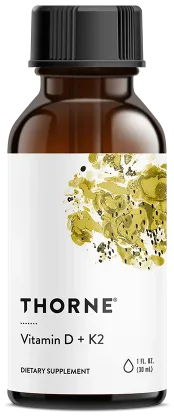
Thorne Vitamin D + K2 Review
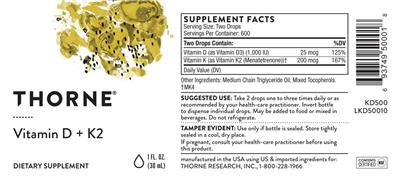
Vitamin D + K2 Liquid from Thorne is a combination of vitamin D3 and vitamin K2 designed to promote bone health, healthy immune function, and cardiovascular health. The page states that the combination of vitamin D3 and K2 provides greater benefits together than either does individually. According to the details section, maintaining an optimal level of vitamin D throughout all stages of life helps maintain strong bones and healthy immune function. Adding vitamin K2 helps move calcium to the bones to protect soft tissues, such as the arteries and kidneys, from calcification. The formula's vitamin K2 is MK-4, which the page describes as the most clinically studied form of vitamin K. Vitamin D is provided in its D3 form, described as a more potent and better absorbed form than D2. The product is a liquid with a self-dispensing top that meters individual drops, allowing individualized dosing. The page's suggested use is 2 drops one to three times daily, and drops can be dispensed directly or added to food or beverages; the page says not to refrigerate. Each serving is 2 drops, with 600 servings per container. The formula is in medium chain triglyceride oil and preserved with mixed tocopherols. The page lists the product as free from gluten, dairy, and soy. Benefits listed include support for a healthy heart and blood circulation, promotion of bone health and calcium absorption, benefit to immune function, and advanced bone health support. Thorne states the product has been third-party tested and certified to verify that what is in the package matches the label and contains no unsafe levels of contaminants such as heavy metals, pesticides, and microorganisms. The warnings section notes the product is contraindicated for individuals with a history of hypersensitivity to any ingredient, advises pregnant users to consult a health-care practitioner, and warns that vitamin K interferes with a med drugs such as a med so concurrent use should be avoided. It is not intended for children under 12 months. Thorne also recommends having vitamin D levels tested to determine whether supplementation is appropriate.
We don’t sell supplements. We help you make decisions and get the best price.
Lowest prices
We may earn a commission from some store links. How we choose.
Finding the lowest prices at the stores now. This takes a few seconds.
Products with nearly the same formula (Matched on the main ingredients)
Study, Trial or Testing Result Summary
Members Only63 human studies · 25 improved
Vitamin K is the best supported ingredient here, at a full daily amount. A review of 16 trials in 6,425 women after menopause found vitamin K2 improved lower spine bone density, with no clear drop in fractures and no extra side effects [1]. A review of eight trials in 971 people found vitamin K taken with vitamin D raised total bone density [2]. A review of 43 trials found vitamin K raised markers of bone building [3]. A three year trial of 244 women found 180 micrograms a day of a form of vitamin K2 slowed bone loss in the spine and hip [4]. Not all trials agree. Three year trials of vitamin K1 at 500 micrograms [5] and at 5 milligrams [6] found no change in bone density. Vitamin D, also at a full daily amount, has mixed results. Older adults taking 700 to 800 units a day had fewer hip and other fractures [7]. But a review of nine studies found no clear drop in fractures [8], and a large review of women with thinning bones found only a small gain in pelvic bone density and no fewer fractures [9]. Animal and cell studies are never counted.
See all 63 studies →Hide the studies
- In five observational studies of 80,982 people, those with the highest dietary vitamin K intake had about 22% lower fracture risk than those with the lowest.Vitamin K intake and the risk of fractures: A meta-analysis.
- In 11 trials of 43,869 postmenopausal women with osteoporosis, calcium plus vitamin D modestly improved pelvic bone density but not spine, neck of femur or total hip density, and did not reduce fractures.The effects of combined calcium and vitamin D supplementation on bone mineral density and fracture risk in postmenopausa…
- This review of smartphone apps for osteoporosis self-management did not test vitamin D supplements and found no significant effect on vitamin D intake.Digital Health Technologies for Long-term Self-management of Osteoporosis: Systematic Review and Meta-analysis.
- In trials of older adults, 700 to 800 IU a day of vitamin D cut hip fracture risk by 26% and other nonvertebral fractures by 23%, while 400 IU a day gave no significant benefit.Fracture prevention with vitamin D supplementation: a meta-analysis of randomized controlled trials.
- Across 16 trials of 6,425 postmenopausal women, vitamin K2 improved lower spine bone density and lowered undercarboxylated osteocalcin, with no overall fracture reduction unless one outlier study was excluded and no extra side effects.Efficacy of vitamin K2 in the prevention and treatment of postmenopausal osteoporosis: A systematic review and meta-anal…
- In 43 trials of 5,184 postmenopausal women, vitamin K gave the largest rise in a bone formation marker (bone alkaline phosphatase), and vitamin K with vitamin D most increased other bone formation markers.Effects of dietary supplements on bone turnover markers in women after menopause: a network meta-analysis.
- In eight trials of 971 people, vitamin K combined with vitamin D increased total bone density and lowered undercarboxylated osteocalcin, with doses under 500 mcg per day working well.The combination effect of vitamin K and vitamin D on human bone quality: a meta-analysis of randomized controlled trials…
- Across nine studies, vitamin D3 did not significantly reduce nonvertebral or vertebral fractures versus placebo or calcium alone, with only a borderline trend toward fewer falls.The effect of cholecalciferol (vitamin D3) on the risk of fall and fracture: a meta-analysis.
- In 23 trials of 1,209 kidney transplant recipients, vitamin D analogues (2 trials, 51 patients) improved lumbar spine and femoral neck bone density versus no treatment, but no trial showed fewer fractures.Interventions for preventing bone disease in kidney transplant recipients: a systematic review of randomized controlled …
- In 18 small trials of 576 children with chronic kidney disease, vitamin D preparations lowered parathyroid hormone levels, but there were few data on growth or bone deformities and no clear differences between preparations.Interventions for metabolic bone disease in children with chronic kidney disease.
- In three small trials of 70 people with cystic fibrosis, it is very uncertain whether vitamin K changes bone density, though undercarboxylated osteocalcin fell.Vitamin K supplementation for cystic fibrosis.
- One small trial of 39 people with sickle cell disease found vitamin D3 for six weeks raised blood vitamin D and reduced pain days versus placebo, but no bone outcomes were reported and the evidence was low quality.Vitamin D supplementation for sickle cell disease.
- In nine trials of postmenopausal women without osteoporosis, vitamin D raised blood vitamin D and improved some bone remodeling measures, but only one study found fewer fractures, so a fracture benefit could not be confirmed.Supplementation of vitamin D isolated or calcium-associated with bone remodeling and fracture risk in postmenopausal wom…
- A review of Japanese trials reports vitamin K2 and K1 were linked to maintained or higher bone density and fewer fractures, though a larger trial with fractures as the main outcome is still needed.[Vitamin K2].
- In a review of seven trials of at least two years in postmenopausal women, high-dose vitamin K1 and K2 improved femoral neck bone strength indices and reduced clinical fractures despite little change in bone density.High-dose vitamin K supplementation reduces fracture incidence in postmenopausal women: a review of the literature.
- In five trials in postmenopausal women, vitamin K1 cut clinical fractures versus placebo in one good trial, while the K2 trials were poorly reported with mixed results and the larger one showed no reduced vertebral fractures.Vitamin K to prevent fractures in older women: systematic review and economic evaluation.
- This review looked at vitamin K levels, diet and supplements in relation to bone health, but the abstract says findings across studies were conflicting and unclear.Vitamin K and osteoporosis: Myth or reality?
- This review of ten studies on vitamin K for osteoporosis in postmenopausal women did not report clear results in its abstract, so the size of any benefit is not stated.The Anti-osteoporosis Effects of Vitamin K in Postmenopausal Women.
- In 500 elderly women with Alzheimer disease who all took 1000 IU of vitamin D2 plus calcium, adding risedronate for 18 months raised bone density 4.1% and cut hip fracture risk compared with placebo, but vitamin D itself was not tested alone and the paper was retracted.The prevention of hip fracture with risedronate and ergocalciferol plus calcium supplementation in elderly women with Al…
- Children whose mothers took 1000 IU of vitamin D3 daily during pregnancy had higher whole-body bone mineral content and density at ages 6-7 than children whose mothers took placebo.Pregnancy vitamin D supplementation and offspring bone mineral density in childhood follow-up of a randomized controlled…
- In 452 men and women aged 60-80 who also took calcium and vitamin D, 500 micrograms a day of vitamin K1 for 3 years did not change bone density at the hip, spine or whole body compared with no vitamin K1.Effect of vitamin K supplementation on bone loss in elderly men and women.
- In 440 postmenopausal women with low bone density, 5 mg a day of vitamin K1 for 2 to 4 years did not change bone density compared with placebo, though fewer women had clinical fractures (9 versus 20), a small secondary finding.Vitamin K supplementation in postmenopausal women with osteopenia (ECKO trial): a randomized controlled trial.
- In 379 healthy older adults, 500 mcg per day of phylloquinone for 3 years did not change inflammatory markers or bone density changes compared with no supplement.Vitamin K, circulating cytokines, and bone mineral density in older men and women.
- In 325 postmenopausal women, 45 mg per day of menatetrenone for 3 years increased bone mineral content and femoral neck width compared with placebo and kept hip bone strength unchanged, though overall bone density was not changed.Vitamin K2 supplementation improves hip bone geometry and bone strength indices in postmenopausal women.
- In 244 healthy postmenopausal women, 180 mcg of MK-7 daily for 3 years slowed the age-related loss of bone mineral density in the lumbar spine and femoral neck compared with placebo.Three-year low-dose menaquinone-7 supplementation helps decrease bone loss in healthy postmenopausal women.
- In 242 elderly men with Parkinson disease who all took 1000 IU of vitamin D2, adding risedronate for 2 years raised bone density, but vitamin D was not compared against placebo and the paper was retracted.Risedronate and ergocalciferol prevent hip fracture in elderly men with Parkinson disease.
- In 219 healthy young and older adults, 1000 mcg per day of phylloquinone for 2 weeks raised vitamin K levels about tenfold and lowered undercarboxylated osteocalcin, a vitamin K status marker, but did not change other bone turnover markers.Vitamin K supplementation reduces serum concentrations of under-gamma-carboxylated osteocalcin in healthy young and elde…
- In 181 postmenopausal women aged 50 to 60, 1 mg per day of vitamin K1 added to minerals and vitamin D for 3 years reduced femoral neck bone loss compared with placebo, but did not change lumbar spine bone loss.Vitamin K1 supplementation retards bone loss in postmenopausal women between 50 and 60 years of age.
- In a 12-month placebo-controlled trial of 148 postmenopausal women, 375 mcg of vitamin K2 (MK-7) daily cut undercarboxylated osteocalcin, a bone marker, by about 70% compared with a small change on placebo.Vitamin K2 (menaquinone-7) increases plasma adiponectin but does not affect insulin sensitivity in postmenopausal women:…
- In a 3-year placebo-controlled trial of 142 postmenopausal women with low bone mass, 375 mcg daily of menaquinone-7 added to calcium and vitamin D raised carboxylated osteocalcin but did not change bone mineral density or bone structure compared with placebo.The effect of vitamin MK-7 on bone mineral density and microarchitecture in postmenopausal women with osteopenia, a 3-ye…
- In 123 people on dialysis, 360 mcg of MK-7 daily for 2 years prevented lumbar spine bone loss compared with placebo but sped up bone loss in the distal radius, so the authors do not recommend it for bone protection.Vitamin K supplementation and bone mineral density in dialysis: results of the double-blind, randomized, placebo-control…
- In a placebo-controlled trial of 120 adults, 100 mcg daily of menaquinone-7 for 12 weeks improved the activation of the bone protein osteocalcin compared with placebo, and a dose-finding trial suggested 100 mcg or more is needed.Low-Dose Daily Intake of Vitamin K(2) (Menaquinone-7) Improves Osteocalcin γ-Carboxylation: A Double-Blind, Randomized C…
- Female endurance athletes who took vitamin K1 or placebo for two years lost similar amounts of hip bone density, and vitamin K did not prevent the bone loss.Factors affecting bone loss in female endurance athletes: a two-year follow-up study.
- In 110 healthy children and adults, MK-7 supplements improved vitamin K status most in people who were most deficient, and adults over 40 may benefit, though bone outcomes were not directly measured.Vitamin K status in healthy volunteers.
- In 105 postmenopausal women with osteoporosis taking meds, 1 mg of vitamin K1 daily for 18 months did not change bone density or bone turnover compared with placebo, though it had a small effect on some hip shape measures.Read the study on PubMed (37338608) →
- In a 1-year randomized double-blind trial of 94 lung and heart transplant recipients, 180 mcg daily of menaquinone-7 gave a favorable change in lumbar spine bone density compared with placebo, though the difference was borderline in the overall group.Dietary vitamin K2 supplement improves bone status after lung and heart transplantation.
- Adults with Crohn's disease who took 1000 micrograms of vitamin K1 daily with calcium and vitamin D for a year had no better bone turnover or bone density than those on placebo, apart from a small gain in forearm bone mass.Effect of phylloquinone (vitamin K1) supplementation for 12 months on the indices of vitamin K status and bone health in…
- In elderly hip fracture patients over 4 months, vitamin K1, calcium and vitamin D raised blood vitamin K1 levels but did not change bone turnover markers compared with usual care.Effects of nutritional intervention upon bone turnover in elderly hip fracture patients. Randomized controlled trial.
- In 68 people with type 2 diabetes and heart disease, 360 mcg of vitamin K2 daily for 6 months did not slow vertebral bone density loss compared with placebo.Six months vitamin K treatment does not affect systemic arterial calcification or bone mineral density in diabetes melli…
- In 60 adults with type 2 diabetes, 200 mcg per day of menaquinone-7 for 12 weeks did not change body composition, including bone mass, compared with placebo.The effect of menaquinone-7 supplementation on dp-ucMGP, PIVKAII, inflammatory markers, and body composition in type 2 d…
- In a 2-year placebo-controlled trial of 40 children with galactosemia, daily vitamin K1 with calcium and vitamin D3 raised lumbar spine bone mineral content, and this gain was seen only in the younger, prepubertal children.Effect of calcium, vitamins K1 and D3 on bone in galactosemia.
- In a 14-week placebo-controlled pilot of 33 postmenopausal women, a combination including 1000 mcg of vitamin K1 per day lowered serum osteocalcin, a bone turnover marker, by about 31% while placebo raised it by 19%.Hop rho iso-alpha acids, berberine, vitamin D3 and vitamin K1 favorably impact biomarkers of bone turnover in postmenopa…
- Postmenopausal women who took 200 or 500 micrograms of vitamin K1 daily for six weeks improved their vitamin K levels, but their bone turnover markers did not change compared with placebo.Effect of phylloquinone supplementation on biochemical markers of vitamin K status and bone turnover in postmenopausal w…
- Postmenopausal women who ate 450 micrograms of vitamin K1 daily for a few weeks had a modest drop in a bone breakdown marker, but bone formation and mineral handling did not change.Dietary phylloquinone depletion and repletion in postmenopausal women: effects on bone and mineral metabolism.
- In 20 postmenopausal women with osteoporosis and wrist fractures, two weeks of vitamin K supplements corrected a defect in how bone protein osteocalcin was activated, and the benefit was still detectable four weeks later.Carboxylation of osteocalcin in post-menopausal osteoporotic women following vitamin K and D supplementation.
- In a one-year randomized pilot of 16 a med-treated patients, adding vitamin K2 to risedronate gave no extra reduction in bone turnover markers beyond risedronate alone.Read the study on PubMed (20190467) →
- In 15 young adults in a crossover study, hydrogenated vitamin K (dihydrophylloquinone) at 200 mcg per day for 10 days was less absorbed than regular phylloquinone and had no measurable effect on markers of bone formation or breakdown.Effects of a hydrogenated form of vitamin K on bone formation and resorption.
- Elderly Chilean adults with thin hip bones who took a multi-nutrient supplement containing 60 micrograms of vitamin K daily for a year saw no change in bone density compared with the usual supplement, although their vitamin D rose and some bone turnover markers fell.Effect of a nutritional supplementation on bone health in Chilean elderly subjects with femoral osteoporosis.
- In a 6-month randomized trial of Indian premenopausal women aged 25 to 44, a daily protein beverage fortified with 55 mcg of vitamin K, plus calcium and vitamin D, lowered bone turnover markers compared with a non-fortified placebo drink.Randomised Controlled Trial of Nutritional Supplement on Bone Turnover Markers in Indian Premenopausal Women.
- Over 2 years, young Chinese women aged 20 to 35 who drank milk powder with 80 mcg of vitamin K1 and 1000 mg calcium did not gain more bone density than the control group, which received nothing.Milk supplementation and bone health in young adult chinese women.
- Elderly women with Parkinson's disease and low vitamin D who took 45 mg of vitamin K2 daily for a year had bone density in the hand that rose slightly, while untreated women lost bone, and fewer of the treated women broke a hip; this paper has been retracted.Amelioration of osteoporosis by menatetrenone in elderly female Parkinson's disease patients with vitamin D deficiency.
- In 108 stroke patients with vitamin D and K deficiency, 45 mg of menatetrenone daily for 12 months raised bone density on the paralyzed side by 4.3% while untreated patients lost 4.7%.Menatetrenone ameliorates osteopenia in disuse-affected limbs of vitamin D- and K-deficient stroke patients.
- In healthy volunteers, menaquinone-7 was absorbed well and fully activated osteocalcin, a bone protein, more completely than synthetic vitamin K1, but no bone density or fracture outcome was measured.Vitamin K-containing dietary supplements: comparison of synthetic vitamin K1 and natto-derived menaquinone-7.
- In healthy women given 1 mg of vitamin K daily, bone-related blood markers changed in some women, and in women who lost the most urinary calcium, calcium loss fell by about 30%; the abstract was truncated and the results are mixed.Vitamin K-induced changes in markers for osteoblast activity and urinary calcium loss.
- In 109 postmenopausal women with osteoporosis, 45 mg of menatetrenone daily for 6 months raised active bone-building osteocalcin compared with calcium aspartate, but urinary bone-breakdown marker NTX also rose, so the effect on bone turnover was mixed.Short-term menatetrenone therapy increases gamma-carboxylation of osteocalcin with a moderate increase of bone turnover …
- Postmenopausal women with osteoporotic fractures who took 5 mg of vitamin K2 daily cut their undercarboxylated osteocalcin, a marker of low vitamin K, by about three-quarters, and 45 mg gave no further gain.Maximal dose-response of vitamin-K2 (menaquinone-4) on undercarboxylated osteocalcin in women with osteoporosis.
- Patients with severe motor and intellectual disabilities who received vitamin K1 food-based therapy for three months had better vitamin K status, but bone formation and breakdown markers both rose, so the bone effect is unclear.Nutritional Therapy with Vitamin K1 Is Effective in the Improvement of Vitamin K Status and Bone Turnover Markers in Pat…
- In 8 female elite athletes, one month of 10 mg daily vitamin K raised bone-building markers by about 15-20% and lowered bone-breakdown markers by about 20-25%, with no placebo group for comparison.Improved bone metabolism in female elite athletes after vitamin K supplementation.
- In Tuscany, Italy, most people who broke a hip from 2011 to 2015 were not taking vitamin D supplements, and only 30-35% were on cholecalciferol one year after the fracture; no bone outcome was measured against a comparison group.The use of cholecalciferol in patients with hip fracture.
- In a case-control study of 99 people with Crohn's disease and 56 controls, low vitamin K intake was more common in Crohn's patients with metabolic bone disease, but this study did not test giving vitamin K.Risk factors for metabolic bone disease in Crohn's disease patients.
- In postmenopausal women, vitamin K lowered urinary calcium loss in a subgroup with high calcium loss, while long-term blood-thinning treatment that blocks vitamin K was linked to more calcium loss in young men than in untreated controls.Read the study on PubMed (8435316) →
- In a 2-year cross-sectional study of 116 pre- and post-menopausal obese and non-obese women, daily vitamin D and calcium intake was low and osteoporosis was less common in obese women, though blood vitamin D levels were within normal range.Dietary Pattern and Bone Health in Pre and Post-menopausal Obese Women.
- In children with cystic fibrosis, higher vitamin K intake was linked to bone markers, suggesting possible bone health benefits, though the study details were limited.Vitamin K supplementation in cystic fibrosis.
Review Totals and Summary
Members Only9,623 reviews · 86% positive
Thorne Vitamin D + K2 liquid is well liked for how easy it is to take and for the effects buyers report, but the dropper is a serious sore point for a sizable group. It carries about 9,623 ratings across the stores, and written opinion is split: half of the starred reviews give 4 or 5 stars. **What buyers say it did for them:** Many report a noticeable effect. One says, "I am finding that I have more energy," and another says they "can feel the difference almost immediately." One reviewer says their "numbers have improved," and a doctor recommended Thorne. Another says it helps "that deficiency." One reviewer's husband gets crabby when low on vitamin D, and the liquid has worked for them both. A Vitacost reviewer reports nail ridges disappearing, though the same person was less sure about their children's growth. Some reviewers say they will only know the results after their next blood work. **What they complain about:** The dispensing system is the main complaint. Reviewers call it "the most frustrating vitamin delivery system ever" and say "It feels like an eternity for even one drop." Others say the drops come out in different sizes, splatter, and make it hard to be sure of the dose. One wonders why there is no squeeze dropper. Some who tried the recommended 45-degree hold said it did little. Others say the dropper "works just fine" if held upside down at an angle, and one calls it "a non issue." One reviewer received a bottle with a broken seal that had leaked in the package, and another had an order delivered to the wrong house. Vitacost reviewers also raised a critique that the product contains only the MK4 form of K2. **Taste, smell, form:** Taste is rarely a problem. One reviewer finds it "completely flavorless as near as I can tell," and Vitacost reviewers describe a neutral or almost no taste. One store summary says opinions on taste and dosing vary. The liquid form helps people who dislike pills: "I have a difficult time swallowing tablets and capsules." Another says it is easy to take, and the Walmart summary says it blends into food and drinks. Reviews of other forms of this product were left out. **Value for money:** Buyers call it "cost effective" and an "affordable" way to raise vitamin D. Store summaries say the price seems reasonable for the quality, and that one bottle lasts a long time. Combining D and K2 in one product is seen as convenient. **Who it seems to suit and who it did not:** It suits people who struggle with pills, who are deficient in vitamin D, or who have not tolerated other D3 supplements. One reviewer said others gave them hot flashes, but this did not. People already trust the Thorne brand, and several say they love its products. It suits those willing to learn the dropper technique. It did not suit buyers who lost patience with slow or uneven drops, or who wanted certainty about their dose. Two reviewers said they would return it or never buy again, and one gave 3 stars while saying they would keep using it because they are deficient.
Biohacker Summary
Members Only9 of 10 recommend it
Vitamin D is the main focus, and nearly the whole panel backs it: about half recommend it outright and several more take it themselves, while two stay neutral and say it matters most if you are deficient. People take it for immune support, brain and mood, bone health, muscle, and general health or longevity, and several advise testing blood levels first, with targets that range from 40 up to 100 nanograms per milliliter. Doses given are 5,000 IU of vitamin D3 each morning by three of them, at least 10,000 IU daily in winter from one, and one who says the true need is near 8,895 IU; one adds that it is fat soluble and should be taken with dietary fat, and another takes it in fall and winter when sun is scarce. Vitamin K2, also a main ingredient here, comes up with several panelists: two take 90 mcg and one takes 100 mcg in the morning, and others pair it with vitamin D to keep calcium in the bones and support arteries, with the MK-4 and MK-7 forms mentioned. No one said they stopped, and the only cautions are to test your levels and not to supplement without need.
See all 10 biohackers →Hide the biohackers
Dr. Eric Berg · Vitamin D · warns
- Dr. Berg warns that the recommended daily intake for vitamin D is based on a massive error and that the actual necessary amount is closer to 8,895 IU, with millions remaining deficient.
- Recommends getting vitamin D levels tested to ensure they are between 50 and 70, as vitamin D is intimately involved in regulating prostate size.
- Discusses foods that contain Vitamin K2.
- Recommends taking at least 10,000 IUs of vitamin D3 every single day in the winter, stating it is the most important vitamin to lower cancer risk.
- Recommends vitamin D to support the immune system, aiming for blood levels between 80 to 100 ng per ml.
- Recommends taking no less than 10,000 IU's of vitamin D3 for osteoporosis, alongside magnesium and K2.
- Recommends increasing vitamin D to restore balance and support healthy blood pressure.
- Recommends taking 40 to 45 milligrams of vitamin K2 daily for osteoporosis, citing a study from Japan with great results.
- States that a lack of vitamin D can potentially cause achy bones or crashing mood.
- Mentions that easy bruising can result from a lack of vitamin K1.
- States that vitamin D is intimately involved in the immune system and recommends taking at least 10,000 IUs each day.
- States that taking high doses of vitamin D3 for 14 days can improve mood, sleep, low back pain, skin issues, and blood pressure, as well as act as a natural anti-inflammatory and reduce susceptibility to sickness.
- Mentions that grass-fed liver has vitamin D.
- Mentions that grass-fed liver has vitamin K2.
Dave Asprey · Vitamin D · uses
- Takes Vitamin DAKE from Suppgrade Labs.
- Suggests that vitamin D supports brain health, muscle function, and focus.
- Host Dave Asprey explains why correcting a vitamin D deficiency still makes sense for male fertility, even though supplementation did not improve overall semen parameters in a randomized trial.
- States that currently, he is only taking vitamin C and vitamin D.
- Recommends taking vitamin K2 with vitamin D to keep calcium in the bones, and suggests kids also take it for stronger bones.
- Recommends Vitamin K2, stating it supports healthy calcium metabolism.
- Recommends vitamin D, noting it's actually a hormone and that most people are deficient, even those who take it, because they don't take enough.
- Recommends adding vitamin K2 to vitamin D supplementation.
- States that most people on the spectrum are low in vitamin D and need more of it, mentioning his own product, Vitam DAKNE, which contains real vitamin A.
- Dave Asprey recommends Vitamin D3 with K2, explaining D3 is a hormone made from sunlight and K2 directs calcium into bones, not arteries, highlighting its low cost, widespread deficiency, and the ability to test its effectiveness.
- Recommends Vitamin D as one of the most important supplements for overall health.
- Mentions that natto is a good source of vitamin K2, which is probably its primary benefit.
- Takes Vitamin DAKE from Suppgrade Labs because D3, A, K2, and E work together.
- Mentions taking vitamin D in the morning, comparing it to the daily dosing of testosterone.
Siim Land · Vitamin D · recommends
- Advises against taking vitamin D in the morning with other supplements because it is fat soluble and requires dietary fat for better absorption.
- Recommends taking Vitamin D with fat for better absorption.
- States that Vitamin D connects biology to light and that UVB reaching the skin enables its production.
- Notes that Vitamin K2 helps activate proteins involved in bone mineralization and calcium regulation.
- Mentions that prunes contain vitamin K, which is a factor in their ability to help with bone density.
- Recommends Vitamin K2 for bone health and calcium metabolism, based primarily on human research, especially randomized controlled trials showing measurable benefits.
- Lists Vitamin K2 as one of 15 supplements backed by human studies.
- Lists leafy greens as a source of Vitamin K1.
- Thinks vitamin D has some of the strongest evidence and is worth considering.
- Notes that Vitamin K2 pairs well with vitamin D by regulating calcium and bone mineralization.
- Thinks vitamin K2 has some of the strongest evidence and is worth considering.
- Notes that Vitamin K2 pairs well with vitamin D by regulating calcium and bone mineralization.
- Recommends taking vitamin D supplements with some fat to maximize its absorption, suggesting with food or a teaspoon of olive oil.
- Notes that taking vitamin D3 with a fat-containing meal resulted in 32% higher peak blood vitamin D levels.
Ben Greenfield · Vitamin D · recommends
- Notes that Vitamin D is actually a hormone and recommends patients aim for levels around 40 to 50, or even 60 for fracture healing, for optimal healing, as opposed to just above 20 which is considered normal.
- Mentions vitamin D as part of a bare-minimum protocol.
- Advises getting vitamin D levels between 60 and 100 nanograms per milliliter as a minimum step for overall health and to slow down heart disease.
- Discusses vitamin K2, specifically the menaquinone forms, as crucial for arterial health and notes that it breaks down into MK-4 and MK-7.
- Explains that gut bacteria liberate K from the diet or make the K needed, and that poor absorption of vitamin K due to bacterial imbalances is linked to heart disease.
- Has been taking Vitamin D3 K2 for over a decade.
- Notes that sunlight influences more than just vitamin D production.
- Recommends keeping vitamin D levels high, suggesting that a supplement is probably not a bad idea, especially given that many people are deficient due to spending most of their time indoors.
- Recommends taking vitamin K complex as a co-factor to increase vitamin D absorption.
- Recommends getting enough vitamin D for blood pressure management.
- Recommends optimizing vitamin D levels to a serum score of around 50 to 80 nanograms per milliliter, as deficiency is linked to tinnitus volume and can assist with it.
- Recommends using hormone building blocks like vitamin D for hormone optimization.
- Notes that vitamin D deficiency is the most common deficiency.
- Lists vitamin D3 and K2 for the immune system as a recommended intervention on the True Age test.
Dr. Mark Hyman · Vitamin D · recommends
- Recommends Vitamin D for health, stating that amazing things happen when patients' vitamin D statuses reach optimal levels.
- Mentions vitamin D as an existing biomarker that plays a role in mental health, which Function Health includes in their measurements.
- Notes that vitamin D plays a role in immune function.
- Recommends checking vitamin D levels and states that if they had to pick one single intervention for immune health, vitamin D would be it.
- Dr. Hyman discusses vitamin D in relation to sun exposure patterns.
- States that vitamin D supplementation can help with oxidative stress.
- Mentions vitamin D as a key nutrient for supporting immune function.
- States that vitamin D is probably the single most important intervention for immune health, recommending levels of 45 to 70 and emphasizing testing to determine the right dose.
- Notes that rickets, which causes terrible bone deformities, is caused by vitamin D deficiency.
- Notes that vitamin D is an important nutrient for brain performance and aging, and that many people have gaps in these nutrients.
- Takes 100 mcg of Vitamin K2 in the morning for general health.
- Takes 100 mcg of Vitamin K2 in the morning.
- Takes 90 mcg of Vitamin K2 in the morning for overall health.
- States that green leafy vegetables are great sources of vitamin K.
Thomas DeLauer · Vitamin D · uses
- Uses vitamin D3 in the fall and winter months when getting less sun, as it's important to supplement it then.
- Recommends taking a massive amount of vitamin D simultaneously with an early morning massive breakfast to help reset circadian rhythms and address hyperphagia.
- Recommends Vitamin D, stating that it has receptors throughout the brain and deficiency can quickly impact brain and mood.
- Takes supplemental vitamin D because he is skin sensitive and from northern latitudes, limiting his UV exposure.
- Recommends taking vitamin D on non-liver days to ensure both nutrients get proper receptor access.
- Takes Purity's liquid vitamin D3 with K2 because she is constantly inside during the day; D3 is for overall wellness and K2 helps the body absorb calcium properly.
- Recommends getting vitamin D, suggesting it can be obtained while walking.
- States that vitamin D is best obtained from the sun, but getting it from food definitely helps, and notes its role as a hormone influencing many cells.
- Recommends D3, suggesting a dose of 2000-4000 IU, and notes that MK-7 slowed bone loss over three years.
- Recommends vitamin D, especially for Hashimoto's, explaining that it drives T reg expansion to suppress autoimmune responses that attack the thyroid, and notes that vitamin D and selenium deficiencies often co-occur.
- Recommends using a multivitamin to ensure adequate micronutrient intake, especially when wholesome food is less available.
- Notes that grass-fed butter provides more Vitamin K2, which plays a role in directing calcium towards bones instead of arteries, contributing to bone health.
- Advises checking multivitamins because many contain 100, 200, or 300% of the daily value of selenium, which can contribute to excessive intake.
- Recommends Vitamin K2 for bone density, stating it must be taken with D3.
Bryan Johnson · Vitamin K · uses
- Takes 90 mcg of Vitamin K2 in the morning for general health.
- Takes 5000 IU of Vitamin D3 in the morning for general health.
- Takes 5000 IU of Vitamin D3 in the morning for general health.
- Mentions that the sunlight assessment claims low vitamin D levels cause the immune system to misfire, and notes that their vitamin D has been measured.
- Takes 100 mcg of Vitamin K2 in the morning for longevity.
- Takes 5000 IU of Vitamin D3 in the morning for longevity.
- He takes 100 mcg of Vitamin K2 in the morning for general health.
- He takes 5000 IU of Vitamin D3 in the morning for general health.
- Takes 5000 IU of Vitamin D3 in the morning for general health.
- Takes 100 mcg of Vitamin K2 in the morning for longevity.
- Takes 5,000 IU of Vitamin D3 in the morning for longevity.
- Takes 90 mcg of Vitamin K2 in the morning.
- Takes 5,000 IU of Vitamin D3 in the morning.
- Takes 100 mcg of Vitamin K2 in the morning.
Dr. Rhonda Patrick · Vitamin D · neutral
- Vitamin D supplementation was linked to a 40% lower risk of dementia in an observational study of more than 12,000 older adults.
- Mentions that vitamin D also plays a role in maintaining muscle mass.
- Recommends ensuring adequate vitamin D intake for men's sperm health.
- Vitamin D and strength training alone did not, but adding them strengthened the effect on one clock, with the full combination slowing that measure by ~3.8 months.
- Lutein and zeaxanthin can also be obtained from certain multivitamins.
- Lutein and zeaxanthin can also be obtained from certain multivitamins.
- Recommends Vitamin D, noting it regulates over 5% of the genome, including genes involved in immune defense, neurotransmitter synthesis, and longevity, and correcting deficiency may slow epigenetic aging.
- Uses Vitamin D3 as an example of a supplement that an AI model could track to see its impact on other metrics like glucose levels.
- Mentions that kale delivers vitamin K, a micronutrient many diets fall short on.
- Recommends Vitamin D, explaining that it regulates over 5% of the genome, including genes involved in immune defense, neurotransmitter synthesis, and longevity.
- Combining omega-3s with vitamin D and exercise has an additive effect, translating to ~3 months of slowed biological aging.
- The effect got stronger when omega-3 was combined with vitamin D and resistance training, with the full stack delaying phenotypic aging by about 3.8 months.
- Rhonda takes 100 mcg of Vitamin K2 (MK-7) daily for general health.
- Choosing a multivitamin that includes lutein and zeaxanthin ensures you get meaningful amounts every day.
Andrew Huberman · Vitamin D · neutral
- Notes that most people are probably deficient in vitamin D and benefit from supplementing, but there's no point in doing it unless you're deficient for most things.
- Takes 5,000 IU of Vitamin D3 in the morning for longevity.
- Takes 90 mcg of Vitamin K2 in the morning for longevity.
- Takes 5000 IU of Vitamin D3 in the morning for general health.
- States that Vitamin D is one of the critical nutrients with the best evidence for cognitive function and reducing the risk of dementia.
- Takes 5000 IU of Vitamin D3 in the morning.
- Takes 90 mcg of Vitamin K2 in the morning.
- He takes 5,000 IU of Vitamin D3 in the morning for overall health.
- He takes 90 mcg of Vitamin K2 in the morning for overall health.
- Takes 5000 IU of Vitamin D3 in the morning.
- Takes 100 mcg of Vitamin K2 in the morning.
- Takes 5,000 IU of Vitamin D3 in the morning for general health.
- Takes 90 mcg of Vitamin K2 in the morning for general health.
- Takes 5000 IU of Vitamin D3 every day for longevity.
Peter Attia · Vitamin D · uses
- Lists vitamin D as one of her staple supplements.
- Notes that several studies show patients taking vitamin D can reduce TPO levels and prolong the honeymoon period of Hashimoto's disease.
- States that in mouse studies, there was a combined effect of alpha ketoglutarate with vitamin D for both sexes.
- Uses vitamin D as an example of how people might dismiss its efficacy due to failed clinical trials that didn't adjust the dose or measure levels.
- In mouse studies, Peter Attia's team found a combined effect of AKG with Vitamin D for both sexes.
- Suggests that supplementing with lots of vitamin D might help overcome the negative effects of phenytoin on bone health by improving calcium absorption, though he is unaware of studies on this.
- Recommends Vitamin D3 as one of the 'big three' micronutrients for bone health, suggesting a daily intake of 800 to 1,000 IU, which can be obtained through sunlight or supplementation.
- Suggests that supplementing with lots of vitamin D might overcome the negative effects of phenytoin on bone health by counteracting increased catabolism of vitamin D and subsequent decreased calcium absorption.
- Recommends vitamin D for people who tend to be vitamin D deficient, such as those living in Portland, Oregon.
- Discusses evaluating vitamin D, understanding deficiency, and optimal levels.
- Takes 100 mcg of Vitamin K2 in the morning to maintain levels.
RAL Summary
Members OnlyTier 2 for Bone Health
More Details
Members OnlyBody systems · Combine with · Possible side effects
Body systems: Skeletal system
Combine with: For bone health, pair with magnesium (glycinate or citrate), which is needed to activate vitamin D, and with dietary or supplemental calcium if intake is low. Collagen peptides, boron, and vitamin C can further support bone matrix. Omega-3 fish oil complements the cardiovascular side of K2. If blood sugar support is the actual goal, consider adding berberine, chromium picolinate, alpha-lipoic acid, or cinnamon extract, along with magnesium, which also supports insulin sensitivity. Those taking a med should avoid K2 unless supervised by a physician, and anyone on meds should consult their doctor before adding glucose-lowering supplements.
Possible side effects: No major side effects reported. The large vitamin K2 review found no extra side effects compared with placebo.
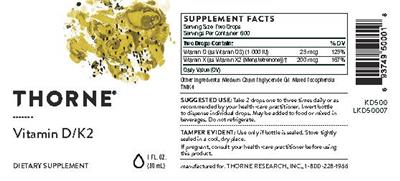
Supplement Facts
Vitamin D 25 mcg · Vitamin K 200 mcg
| Vitamin D | 25 mcg | |
| Vitamin K | 200 mcg |
Other ingredients: Medium Chain Triglyceride Oil, Mixed Tocopherols.
Directions: Suggested use: Take 2 drops one to three times daily or as recommended by your health-care practitioner. Invert bottle to dispense individual drops. May be added to food or mixed in beverages.
Barcode (UPC) 693749500018 · Label source: NIH label database · Report a label change
Show entire label
More bone health products
Members OnlyThe highest ranked for the same goal
Read more
Our articles on this subject
- Supplement and Medication Interactions You Should KnowArticle · Oct 20, 2026
- What Supplements and Vitamins Should Not Be Taken TogetherArticle · Sep 7, 2026
Graded November 6, 2026 by the Reverse Age Lab evidence engine, from human studies, real reviews and our biohacker panel. How we grade. Is this medical advice? No. Rala organizes the published evidence; go over any change with your doctor, especially if you take meds.
Privacy policyConsumer health dataAffiliate disclosureTermsDo Not Sell or Share My Personal InformationCookie settings