
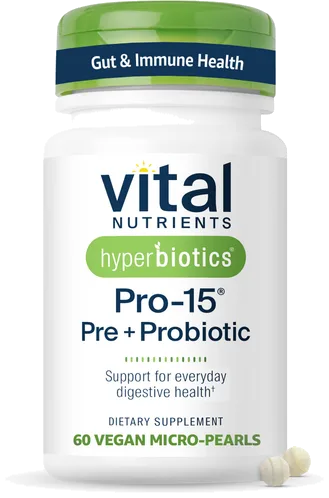
Vital Nutrients Pro-15 Pre & Probiotics, Digestive Health Support, 60 Count Review
Backed by clinical research and leveraging proprietary BIO-tract delivery technology, Hyperbiotics Pro-15 Pre + Probiotic is presented as a foundational probiotic for men's and women's health. The formula combines 15 well-researched probiotic strains with prebiotic fructooligosaccharide, and the page states it replenishes beneficial bacteria throughout the gastrointestinal tract for a well-balanced gut microbiome. The product is described as clinically shown to ease occasional symptoms of inflammatory bowel disease, including diarrhea, digestive discomfort, and absorption of key vitamins and minerals. BIO-tract delivery technology is described as a proprietary time-release system that offers advanced protection for the probiotic organisms so they reach deep into the intestinal tract, where they are most effective. The page states the formula offers up to 15X more probiotic survivability than standard vegetarian capsules under in vitro test conditions, allowing a lower CFU, and notes that BIO-tract is a registered trademark of Probi. The product includes 9 Lactobacillus strains, 5 Bifidobacterium strains, and 1 Streptococcus strain. The listed strains are Lactobacillus fermentum, Lactobacillus plantarum, Lactobacillus acidophilus, Bifidobacterium bifidum, Bifidobacterium breve, Bifidobacterium infantis, Bifidobacterium lactis, Bifidobacterium longum, Lactobacillus casei, Lactobacillus gasseri, Lactobacillus paracasei, Lactobacillus reuteri, Lactobacillus rhamnosus, Lactobacillus salivarius, and Streptococcus thermophilus. The shelf-stable probiotic does not require refrigeration and is taken as one small, easy-to-swallow pearl tablet per day. The Key Benefits section says it supports everyday gut, digestive, and immune health and occasional constipation, diarrhea, gas, and bloating, and that the daily probiotic is designed to optimize nutrient absorption, improve bowel regularity, and help with digestive comfort. The page says the formula is free from gluten, dairy, peanut, tree nut, fish, shellfish, soy, sesame, egg, and active yeast, is non-GMO, and is made without artificial fillers, coatings, binders, or colors. The other ingredients are microcrystalline cellulose, hydroxypropyl methylcellulose, pectin, stearic acid, sodium carbonate, guar gum, and turmeric. The product selector lists 30 CT and 60 CT counts. The page notes that packaging and label may vary. The SuppCo product TrustScore is 8.88, described as Very good, with inactive ingredients rated safe, manufacturing standards, testing benchmarks, and product quality rated high, and product certifications rated low. The FAQ states that Vital Nutrients earns an Elite TrustScore from SuppCo, ranking in the top 10 percent of the most popular brands for SuppCo users. Companion products shown on the page include a once daily multivitamin, a hair growth complex, and vitamin D3.
We don’t sell supplements. We help you make decisions and get the best price.
Lowest prices
We may earn a commission from some store links. How we choose.
Finding the lowest prices at the stores now. This takes a few seconds.
Study, Trial or Testing Result Summary
Members Only33 human studies · 14 improved
This product's main ingredient is a 15-strain probiotic blend, 5 billion live cultures a day, sold as a proprietary blend, so the amount of each strain is not shown. The trials tested other multi-strain blends, not this exact one. Most found that probiotic blends eased bloating and irregularity. In 200 adults with irritable bowel syndrome, a two-strain blend improved overall symptoms, pain and bloating more than placebo [1]. In 132 older adults with constipation, 88% responded versus 26% on placebo, with much less bloating [2]. In 108 adults with irritable bowel syndrome, 85% got satisfactory relief versus 47% on placebo [3]. Not all trials agreed. A two-week trial found no bloating benefit [4], a trial in people with fibromyalgia found none [5], and a trial in diverticular disease eased constipation and diarrhea but not bloating [6]. The prebiotic fiber in this product is 25 milligrams, far below the gram-level doses studied. Reviews of trials found this fiber alone did not ease bloating [7][8], and high doses of 10 to 20 grams raised gas and bloating [9][10]. Animal and cell studies are never counted.
See all 33 studies →Hide the studies
- Across 11 trials with 729 adults with irritable bowel conditions, prebiotics did not reduce bloating, pain or overall symptoms compared with placebo, though they raised bifidobacteria, and inulin-type fructans worsened flatulence.Prebiotics in irritable bowel syndrome and other functional bowel disorders in adults: a systematic review and meta-anal…
- In eight trials with 388 people, fructooligosaccharides increased bifidobacteria in the gut but did not change bloating, flatulence or other digestive symptoms compared with controls.Effect of Fructooligosaccharides Supplementation on the Gut Microbiota in Human: A Systematic Review and Meta-Analysis.
- In 17 studies of people with inflammatory bowel disease, the fructooligosaccharide kestose helped induce remission in ulcerative colitis, while oligofructose-enriched inulin caused more flatulence and bloating than controls.Prebiotics for Induction and Maintenance of Remission in Inflammatory Bowel Disease: Systematic Review and Meta-Analysis…
- A review of 41 trials of over-the-counter constipation treatments found insufficient evidence for fructo-oligosaccharide, with bloating among the common side effects of these products.Efficacy and Safety of Over-the-Counter Therapies for Chronic Constipation: An Updated Systematic Review.
- In three winter-season trials of 721 healthy volunteers, synbiotic formulations containing FOS reduced bloating and made bowel movements more regular compared with placebo.A new chance of preventing winter diseases by the administration of synbiotic formulations.
- In 200 adults with non-constipated irritable bowel syndrome, a two-strain probiotic taken for 84 days improved overall symptoms, pain and bloating more than placebo (19.3% vs 8.9% responders at day 28), though gut bacteria overall did not differ between groups.Probiotic Blend of Lactobacillus acidophilus LA-5 and Bifidobacterium animalis ssp. Lactis BB-12 in Non-constipated Irri…
- In 156 adults with constipation and bloating, a five-strain probiotic taken for 2 weeks did not reduce bloating more than placebo, though a post-hoc analysis showed less flatulence.The effect of a probiotic blend on gastrointestinal symptoms in constipated patients: a double blind, randomised, placeb…
- In 143 adults with symptomatic diverticular disease, a liquid probiotic for 3 months did not reduce abdominal pain more than placebo or bloating frequency, but did reduce constipation, diarrhea, mucus discharge and back pain.A randomized double-blind placebo-controlled trial of a multi-strain probiotic in treatment of symptomatic uncomplicated…
- In 132 middle-aged and older adults with chronic constipation, a multi-strain probiotic for 28 days markedly reduced bloating (0.70 vs 2.60 score) and 88% responded versus 26% on placebo.A multi-strain probiotic formulation alleviates chronic constipation in middle-aged and older adults: A randomized, doub…
- In 110 people with fibromyalgia, VSL#3 for 12 weeks did not improve abdominal pain, bloating or gas more than placebo.The Probiotic VSL#3® Does Not Seem to Be Efficacious for the Treatment of Gastrointestinal Symptomatology of Patients wi…
- In 108 adults with irritable bowel syndrome and bloating, a multi-strain probiotic twice daily for 4 weeks gave satisfactory relief in 85% versus 47% on placebo and reduced bloating and pain more.Therapeutic effects, tolerability and safety of a multi-strain probiotic in Iranian adults with irritable bowel syndrome…
- In 98 healthy young adults taking 16 g oligofructose daily for 8 weeks, stool frequency increased but digestive symptoms including bloating and flatulence were higher than in the control group.Consuming foods with added oligofructose improves stool frequency: a randomised trial in healthy young adults.
- In 84 healthy adults taking 5 to 20 g of inulin-type fructans daily for 2 weeks, digestive symptoms including bloating tended to rise mildly, significantly only at 20 g of one product, and all were considered well tolerated.Digestive tolerance of inulin-type fructans: a double-blind, placebo-controlled, cross-over, dose-ranging, randomized st…
- In 72 older adults taking yacon providing 7.4 g of FOS daily for 9 weeks, bowel transit was not adversely affected and it did not cause bloating, flatulence or discomfort, while blood glucose fell.Freeze-dried powdered yacon: effects of FOS on serum glucose, lipids and intestinal transit in the elderly.
- In 60 adults with unexplained digestive discomfort, a three-strain Bacillus probiotic improved bloating, belching, sour taste and total dyspepsia scores more than placebo by day 30, with no adverse events.A prospective, randomized, double-blind, placebo-controlled, parallel-group study to evaluate the efficacy and safety of…
- In 40 healthy adults taking 2.5 to 10 grams a day for 7 days, gut bifidobacteria increased more than with placebo at every dose, but bloating was worse at 2.5 and 5 grams a day and other symptoms did not differ from placebo.The capacity of short-chain fructo-oligosaccharides to stimulate faecal bifidobacteria: a dose-response relationship stu…
- In 40 adults with small intestinal bacterial overgrowth, a week of a med followed by short-chain fructo-oligosaccharides each month for 6 months improved 4 of 6 symptoms (66.6%), not significantly different from the probiotic group (83.3%).Read the study on PubMed (23244247) →
- In 38 adults with functional constipation or diarrhea, a multi-strain probiotic for 8 weeks reduced bloating severity and its effect on quality of life compared with placebo.Therapeutic Modulation of the Gut Microbiome by Supplementation with Probiotics (SCI Microbiome Mix) in Adults with Func…
- In 37 adults with type 2 diabetes who could not tolerate a med, a multi-strain probiotic taken for 12 weeks in a crossover trial reduced nausea, abdominal bloating and pain, and improved how well they tolerated a med compared with placebo.Read the study on PubMed (37812890) →
- In 34 healthy men taking 20 grams a day for 2 weeks, fructooligosaccharides increased bifidobacteria and lactobacilli but also increased flatulence, bloating and stool mucin, while gut permeability was unchanged.Dietary fructooligosaccharides affect intestinal barrier function in healthy men.
- In 32 healthy adults, single desserts containing maltitol and short-chain fructo-oligosaccharides caused mildly higher gas, rumbling, bloating and discomfort scores than the dextrose dessert, though blood sugar responses were lower.Digestive tolerance and postprandial glycaemic and insulinaemic responses after consumption of dairy desserts containing…
- In 26 healthy adults given a breakfast challenge, 10 grams of oligofructose substantially increased gut symptoms such as gas and bloating compared with placebo, while up to 5 grams a day was well tolerated.Gastrointestinal tolerance of chicory inulin products.
- In 23 children with irritable bowel syndrome, three days of meals containing fructans caused more abdominal pain, bloating, and gas than meals containing a maltodextrin placebo.Fructans Exacerbate Symptoms in a Subset of Children With Irritable Bowel Syndrome.
- In 16 healthy adults, 20 grams of yacon daily (6.4 grams of fructooligosaccharides) for 2 weeks shortened colon transit time from about 60 to 38 hours, without significantly more bloating than placebo.Effect of yacon (Smallanthus sonchifolius) on colonic transit time in healthy volunteers.
- In 14 healthy volunteers, gradually building up fructo-oligosaccharide intake did not improve tolerance, with excess gas appearing above about 30 grams a day and bloating above about 40 grams a day.Symptomatic response to varying levels of fructo-oligosaccharides consumed occasionally or regularly.
- In 22 women who do not restrict their eating, a single 10 g dose of oligofructose in a chocolate bar did not change fullness or food intake, but it caused the most bloating and gas of the fibers tested.Fermentable fibers do not affect satiety or food intake by women who do not practice restrained eating.
- In a human feeding study, an enteral formula with a blend of fibers including fructo-oligosaccharides produced higher fecal short-chain fatty acids than the formula without fiber, indicating greater bacterial fermentation in the gut.Estimation and interpretation of fermentation in the gut: coupling results from a 24 h batch in vitro system with fecal …
- In an open study of 636 adults with constipation-type irritable bowel syndrome, a symbiotic with fructooligosaccharides for about 5 weeks increased stool frequency and reduced moderate-to-severe bloating from 63 percent to 10 percent of patients.Effect of a symbiotic preparation on the clinical manifestations of irritable bowel syndrome, constipation-variant. Resu…
- In an open-label study of 188 adults with functional gastrointestinal symptoms, 85.1% reported overall gut well-being improvement after 30 days of a 5-strain probiotic, with no safety signals, though without a placebo group.An Open-label, Multicenter Study to Assess the Efficacy and Safety of a Novel Probiotic Blend in Patients With Functiona…
- In a 4-week open-label study of 39 airline pilots with chronic gastritis, taking a Saccharomyces boulardii and Enterococcus faecium probiotic twice daily reduced stomach pain and bloating more than no treatment, at both the low and high doses tested.Probiotic Supplementation With Saccharomyces boulardii and Enterococcus faecium Improves Gastric Pain and Bloating in Ai…
- In 12 healthy older adults, 8 g daily of short-chain fructo-oligosaccharides for 4 weeks raised fecal bifidobacteria, but excess gas and bloating were more frequent, though mild.Four-week short chain fructo-oligosaccharides ingestion leads to increasing fecal bifidobacteria and cholesterol excreti…
- After colon cancer surgery, patients given a nutrition formula with added fructo-oligosaccharides were more likely to pass formed stool (76.7% vs 27.3%) and reported less bloating from days 4 to 7 than those given the formula without fiber.[Clinical observation of early oral enteral nutrition after laparoscopic colectomy].
- In a case series of 4 children and teenagers with severe recessive dystrophic epidermolysis bullosa, 3 who completed 12 weeks of a daily multistrain liquid probiotic (1 mL per kg) reported less abdominal pain, bloating, nausea and flatulence, firmer stools, and better appetite, and two could cut back or stop laxative gel; there was no placebo group.The impact of using a multistrain probiotic supplement on gastrointestinal function in children and adolescents with sev…
Review Totals and Summary
Members Only14,750 reviews · 87% positive
Vital Nutrients Pro-15 Pre & Probiotics, Digestive Health Support, 60 Count, has garnered about 178 ratings across various stores, with customers largely expressing satisfaction and reporting significant digestive benefits. **What it did for them:** Many users found this probiotic effective for improving their digestive health. Customers reported feeling generally better and experiencing relief from various gastrointestinal issues. One user stated it was "very good for my digestive system" and believed it helped regulate gut enzymes. Others noted a clear improvement in overall "gut health." For those suffering from specific conditions, the product offered considerable relief; one long-term user reported it "eliminated my acid indigestion and heartburn" for over two years. Individuals with Irritable Bowel Syndrome (IBS) also found it beneficial, with one reviewer experiencing a "huge improvement in my IBS" within days, leading to a "normal" and "oh so happy" stomach within a week. The product is often described as a "life changer" for its positive impact. **Complaints:** The primary complaint comes from repeat customers who previously used a discontinued formula called Pro-Lean. These users found that while Pro-15 generally helps with digestive issues, it does not offer the same support for lactose intolerance that Pro-Lean did. Consequently, they now need to take additional medication, such as Lactaid, when consuming dairy. One customer noted that Pro-15 "isn't as effective as the Pro-Lean was" for this specific issue, making it "very inconvenient for me to have to take additional medication." This lack of lactose intolerance support is the main drawback highlighted by these customers. **Taste, Smell, Pill Size, or Form:** The customer reviews and store summaries do not extensively discuss the taste, smell, or specific size of the pearls. The product is described as being in "pearl form," with a recommendation of one pearl per day. Most reviews are short and do not provide detailed feedback on these physical attributes. **Value for Money:** Information regarding the product's value for money is not a prominent theme in the provided customer reviews or store summaries. Most feedback focuses on the efficacy of the product rather than its cost-effectiveness. **Who it seems to suit and who it did not:** This probiotic appears well-suited for individuals seeking general digestive health support, including relief from gas, bloating, IBS, acid indigestion, and heartburn. Many users, including those who had tried other probiotics, found this one to be particularly effective, with one reviewer saying, "I would recommend this product to anyone." However, it did not fully meet the needs of customers who specifically relied on the previous Pro-Lean formula for lactose intolerance support. For these individuals, Pro-15 helps with general digestion but requires supplemental medication for dairy consumption, as "Pro-15 seems to help with everything except for the lactose intolerance."
Biohacker Summary
Members Only10 of 10 recommend it
Probiotics are the main ingredient here, and the panel is broadly positive: of the seven who spoke, three recommend or use probiotic blends and the rest are neutral or mention a strain without taking a side. Two of them point to the same synbiotic, a probiotic and prebiotic in one capsule, and one says it is the only probiotic he personally uses, taking it for gut health, regularity, less bloating and gas, and as a way to shift the gut microbes when changing diet. One suggests taking it a couple of hours apart from fermented foods, and another pairs it with honey. The strain Lactobacillus plantarum comes up most, with panelists linking it to constipation relief, gut balance, mood and memory, and folate production, and noting it is found in sauerkraut, kimchi and pickles. No one gave a dose, and no one reported a caution or stopping. The panel did not discuss any smaller ingredients in this product.
See all 7 biohackers →Hide the biohackers
Thomas DeLauer · Probiotic Blend · recommends
- Recommends Seed probiotic, stating it's the only probiotic he would ever recommend due to its scientific approach and multi-stage delivery system.
- Highly recommends Seed Daily Synbiotic, a prebiotic and probiotic, to capitalize on the beneficial effects of fermented foods and improve gut health, suggesting it be taken a couple of hours apart from fermented foods.
- Recommends Seed Daily Synbiotic, a prebiotic and probiotic in one, especially when changing diet or acclimating to a new diet style, and offers a discount code.
- Recommends Seed's daily symbiotic, which is a prebiotic and probiotic in one capsule, as a great tool to use in conjunction with honey to shift and alter the microbiome rapidly.
- Is a huge fan of Seed Daily Symbiotic and states it's the only probiotic he personally uses, appreciating their transparency in publishing clinical trials, even when results aren't in their favor.
- Recommends Seed's daily symbiotic, which contains a prebiotic and probiotic in one capsule, for good digestive health and notes the brand's commitment to microbiome research.
- Recommends Seed Daily Synbiotic, stating it's the only probiotic he would ever recommend, especially when in a caloric deficit or changing one's diet, due to its unique capsule-in-capsule technology for better colonization of bacteria in the gut.
- Describes a study where subjects were required to take Lactobacillus plantarum, a specific probiotic, per day to support the gut microbiome.
- Recommends Seed's daily symbiotic, which contains a prebiotic and probiotic in one capsule, for those looking to improve their gut microbiome, noting its unique technology and the company's funding of microbiome research.
- Recommends Seed, a synbiotic that combines a probiotic and prebiotic, for people who are intermittent fasting and may not be getting a wide variety of food, to help support their gut biome.
- Likes that Ample includes a probiotic blend, specifically mentioning L-rhamnosus as a highly researched strain.
- The study had participants take Lactobacillus plantarum, a specific probiotic strain, two times a day.
- Recommends consuming Lactobacillus plantarum, found in sauerkraut, for IBS, stating it is tremendous for restoring the gut biome and can dramatically improve symptoms by reducing inflammation.
Dr. Mark Hyman · Probiotic Blend · uses
- Continues to recommend and take Seed's DS-01 Daily Synbiotic, highlighting its 24 unique probiotic strains, capsule-in-capsule technology, and clinical evidence for reducing bloating, alleviating gas, and improving regularity.
- Mentions Lactobacillus plantarum as a protective strain connected with anxiety and mental health issues.
- Mentions that many bacteria, including lactobacillus plantarum, can help produce GABA in the gut, which is a relaxation neurotransmitter.
- Mentions that lactobacillus plantarum influences dopamine and serotonin levels, which are related to anxiety.
- Mentions Lactobacillus plantarum, found in fermented foods like sauerkraut, as an ingredient that helps stimulate T effector memory cells.
- Used Lactobacillus plantarum in their study because a healthy gut microbiome makes B complex vitamins and it has been shown to increase endogenous microbial production of natural folates.
- Used Lactobacillus plantarum in their study because a healthy gut microbiome makes a B complex and this specific probiotic has been shown to increase endogenous microbial production of natural folates.
- Gave a good general probiotic blend to a patient to improve gut health.
Ben Greenfield · Probiotic Blend · neutral
- Notes that IM8health includes a full probiotic blend for the gut.
- Recommends Seed's Daily Synbiotic for those who want to add a probiotic + prebiotic to their daily routine, noting that gut health affects whole-body health.
- Uses probiotic blends APO-808™ and APO-19™ as part of Dr. John Lieurance's Travel Hacking Kit, which are designed to assist in gut health by placing probiotics in the lower intestine.
- Ben recommends probiotics like Lactobacillus plantarum for constipation.
- Ben lists Lactobacillus plantarum as a probiotic strain.
Siim Land · Lactobacillus plantarum · recommends
- Lists Lactobacillus plantarum as a researched probiotic strain that can degrade microplastics, found in sauerkraut, pickles, sourdough bread, and brined olives.
- Used Lactobacillus plantarum in their study, hoping it would support folate production, and observed a significant increase in circulating methyl folate in participants.
Dr. Eric Berg · Lactobacillus plantarum · neutral
- Explains that lactobacillus plantarum is the dominant microbe in both sauerkraut and kimchi, and it can survive harsh environments like stomach acid, helping to balance good and bad bacteria and prevent leaky gut.
- Dr. Berg notes that Lactobacillus plantarum appears especially beneficial for managing gastroparesis.
Dave Asprey · Lactobacillus plantarum · neutral
- Mentions that some species of lactobacillus plantarum, a common probiotic, can produce uricase.
Dr. Rhonda Patrick · Lactobacillus plantarum · neutral
- Cites a study where a daily dose of Lactobacillus plantarum probiotic supplement improved attention, working memory, and verbal memory in individuals with mild cognitive impairment, strongly correlating with increased serum BDNF levels.
RAL Summary
Members OnlyTier 3 for Gut Bacteria Balance
Tier 3 because 97% of 961 reviews are positive and most human trials of other multi-strain probiotic blends found less bloating and irregularity [3][2]. Tier 2 is not supported because this exact blend was not tested and the strain doses are hidden.
Where the evidence disagrees: 13 of the 33 human studies found no effect.
More Details
Members OnlyBody systems · Combine with · Possible side effects
Body systems: Digestive system
Combine with: To further support digestive health and address occasional bloating and irregularity, consider combining this pre- and probiotic supplement with digestive enzymes, especially those containing amylase, lipase, and protease, to aid in the breakdown of food. Additionally, a fiber supplement, such as psyllium husk or glucomannan, can promote regularity and provide additional nourishment for beneficial gut bacteria. For gut lining integrity, L-Glutamine is an excellent synergistic amino acid. Herbal carminatives like ginger or peppermint can also offer additional comfort for occasional gas and bloating.
Possible side effects: High doses of the prebiotic fiber caused more gas and bloating in studies, but the dose here is very small. No major side effects were reported for the probiotics.
Supplement Facts
Includes 0 g Added Sugars 0 g · Proprietary Probiotic Blend¤ L. plantarum, L. fermentum, L. acidophilus, B. infantis, L. casei, B. longum, L. rhamnosus, B. lactis, L. reuteri, L. salivarius, L. paracasei, L. gasseri, B. bifidum, B. breve, S. thermophilus 120 mg (5 Billion CFU¥) · Prebiotic Fructooligosaccharide ¤ 25 mg
| Total Carbohydrate | 0 g | <1%§ |
| Total Sugars | 0 g | |
| Includes 0 g Added Sugars | 0 g | 0%§ |
| Proprietary Probiotic Blend¤ L. plantarum, L. fermentum, L. acidophilus, B. infantis, L. casei, B. longum, L. rhamnosus, B. lactis, L. reuteri, L. salivarius, L. paracasei, L. gasseri, B. bifidum, B. breve, S. thermophilus | 120 mg (5 Billion CFU¥) | † |
| Prebiotic Fructooligosaccharide (FOS)¤ | 25 mg | † |
Other ingredients: Microcrystalline Cellulose, Hydroxypropyl Methylcellulose, Pectin*, Stearic Acid, Sodium Carbonate, Guar Gum, Turmeric.
Label source: Vitalnutrients · Report a label change
Show entire label
More gut bacteria balance products
Members OnlyThe highest ranked for the same goal
Read more
Our articles on this subject
- Probiotics for Gut Health: The Complete GuideArticle · Mar 17, 2026
- Best Probiotic for Bloating: The Strains With Human Trials, and How to Choose OneArticle · Oct 27, 2026
Graded October 28, 2026 by the Reverse Age Lab evidence engine, from human studies, real reviews and our biohacker panel. How we grade. Is this medical advice? No. Rala organizes the published evidence; go over any change with your doctor, especially if you take meds.
Privacy policyConsumer health dataAffiliate disclosureTermsDo Not Sell or Share My Personal InformationCookie settings