
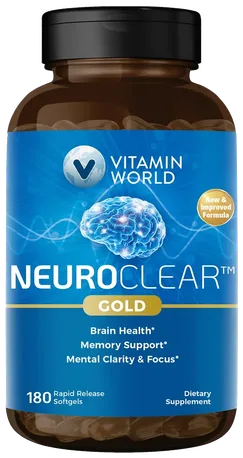
Vitamin World Neuro-PS Gold Plus Review
Vitamin World Neuro-PS Gold Plus is a softgel supplement listed on SuppCo. The page shows that it does not yet have a TrustScore, and the TrustScore section explains that the product has not been evaluated by the TrustScore system because there is insufficient data. A request option for a priority trust score is offered on the page. The page states that the serving size is 3 softgels, with 30 servings per container. The Vitamin World brand is shown with a score of 8.01 on the brand badge. The page lists Protein at 1g as a key active ingredient, and the supplement facts show Neuro-PS Gold Complex at 1660mg, with Neuro-PS at 1500mg made from phosphatidylserine and soy lecithin. Other listed nutrients include Acetyl L-Carnitine Hydrochloride at 10mg, Vinpocetine at 100mcg, Gotu Kola Extract 6:1 at 10mg, Ginkgo biloba extract at 120mg with Ginkgo Flavone Glycosides, Docosahexaenoic Acid at 10mg, and Choline Bitartrate at 10mg. The label also lists 25 calories, 15 calories from fat, 1g of total carbohydrates, and 2g of total fat. The suggested use is three softgels daily, preferably with a meal. The inactive ingredient section lists gelatin as a capsule material and binder, vegetable glycerin as a humectant and solvent, and soybean oil as an emollient and carrier oil, with each rated as safe. The page notes that the product has backing from ISO 17025-accredited third-party testing and NSF-certified manufacturing, but that product-specific testing is not currently verified by SuppCo. No price, cost per month, or written reviews are shown on this page, and no rating histogram is available. The page also carries the standard disclaimer that the statements have not been evaluated by the Food and Drug Administration and that the products and informational content are not intended to diagnose, treat, cure, or prevent any disease.
We don’t sell supplements. We help you make decisions and get the best price.
Lowest prices
We may earn a commission from some store links. How we choose.
Finding the lowest prices at the stores now. This takes a few seconds.
Study, Trial or Testing Result Summary
Members Only12 human studies · 8 improved
Phosphatidylserine, the main ingredient here, has fairly consistent support for thinking and memory in human trials, but this product hides its amount in a blend, so we cannot tell whether it reaches the doses that worked. In people with probable Alzheimer's disease, 300 mg a day for 12 weeks improved several thinking measures, most clearly in milder cases [1]. In older adults with mild memory decline, a combination giving about 63 mg a day along with ginkgo flavonoids improved arithmetic and short-term memory over 12 months [2]. In healthy adults, a magnesium and phosphatidylserine formula improved memory scores within 30 days [3]. In children with attention problems, 200 mg a day for 2 months improved attention and short-term memory [4]. A pooled analysis of three trials in children found less inattention but no clear change in overall symptoms, and the evidence was low quality [5]. A larger pooled analysis of studies in children and teens ranked phosphatidylserine well for attention, but those studies were also low quality [6]. Because several trials used combination formulas and the dose here is unknown, these results may not apply to this product. Animal and cell studies are never counted.
See all 12 studies →Hide the studies
- In a pooled analysis of 48 studies with 3,650 children and teens with attention problems, phosphatidylserine ranked best for parent-rated attention and total score on one scale, but the studies were low quality, so the rankings should be read with caution.Safety and efficacy of antioxidant therapy in children and adolescents with attention deficit hyperactivity disorder: A …
- In a pooled analysis of three placebo-controlled trials with 216 children with attention-deficit disorder, 200-300 mg a day of phosphatidylserine reduced inattention more than placebo, but overall symptoms and hyperactivity did not improve significantly, and the evidence was low quality.Phosphatidylserine for the Treatment of Pediatric Attention-Deficit/Hyperactivity Disorder: A Systematic Review and Meta…
- In 190 older adults with mild cognitive impairment, a combination supplement giving about 63 mg a day of phosphatidylserine plus alpha-linolenic acid and ginkgo flavonoids for 12 months improved arithmetic, similarity and short-term memory scores compared with placebo.Effects of a food supplement containing phosphatidylserine on cognitive function in Chinese older adults with mild cogni…
- In 109 healthy Chinese adults, 2 grams a day of a magnesium L-threonate and phosphatidylserine formula for 30 days improved all memory test categories and overall memory score compared with placebo, with larger gains in older participants.A Magtein®, Magnesium L-Threonate, -Based Formula Improves Brain Cognitive Functions in Healthy Chinese Adults.
- In 51 patients with probable Alzheimer's disease, 300 mg a day of bovine cortex phosphatidylserine for 12 weeks improved several thinking measures compared with placebo, most clearly in those with milder impairment.Effects of phosphatidylserine in Alzheimer's disease.
- In 40 adults with mild to moderate Alzheimer-type dementia, 200 mg a day of phosphatidylserine for three months gave smaller cognitive gains than selegiline, a drug it was compared against, with no placebo group.Selegiline in the treatment of mild to moderate Alzheimer-type dementia.
- In 36 children with attention-deficit hyperactivity disorder, 200 mg a day of soy phosphatidylserine for 2 months improved symptoms, short-term auditory memory and attention compared with placebo.The effect of phosphatidylserine administration on memory and symptoms of attention-deficit hyperactivity disorder: a ra…
- In 28 healthy young adults, a single 120 mg dose of ginkgo extract bound to phosphatidylserine improved memory and memory speed over six hours compared with placebo, while plain ginkgo extract did not improve the main measures.Acute cognitive effects of standardised Ginkgo biloba extract complexed with phosphatidylserine.
- In 122 older adults with memory complaints, 100 mg a day of phosphatidylserine with omega-3 for 15 weeks improved attention and memory recognition in new users and kept thinking skills steady in those who continued.Phosphatidylserine containing omega-3 Fatty acids may improve memory abilities in nondemented elderly individuals with m…
- In 30 older adults with memory complaints, 300 mg a day of soybean phosphatidylserine for 12 weeks improved memory, executive function and mental flexibility, with no control group.The effect of soybean-derived phosphatidylserine on cognitive performance in elderly with subjective memory complaints: …
- In 18 healthy older adults with age-related memory problems (15 finished), 300 mg a day of plant-derived phosphatidylserine for 12 weeks improved most thinking measures by week 6, and the gains held at week 12, with no control group.An open trial of plant-source derived phosphatydilserine for treatment of age-related cognitive decline.
- This summary describes the methods of an Italian trial of bovine phosphatidylserine in Alzheimer's disease and reports no results for people.Phosphatidylserine in the treatment of clinically diagnosed Alzheimer's disease. The SMID Group.
Review Totals and Summary
Members Only22 reviews
Overall, buyers of the softgels are positive, mostly describing better focus and mental clarity, with no complaints in the feedback provided. The reviews are short, so the detail is limited. **What buyers say it did for them:** The main benefit reported is sharper focus and thinking. One buyer notes "a noticable improvement in my focus and cognition," and another calls it "the best thing for staying focused." A long-term user says "Been using neuroclear for years It really has helped." Another reviewer is more cautious: "So far so good." One Spanish-language reviewer simply recommends it ("Excelente la recomiendo"). **What they complain about:** No complaints appear in the reviews. One reviewer specifically says they have had no problems with digestion or heartburn and no "crazy dreams," which suggests that some buyers might expect or worry about those issues. That reviewer reports none of them, but it is a single account. **Taste, smell, pill size or form:** The reviews do not say anything about taste, smell or the size of the softgels. One reviewer refers to them as softgels, but no one comments on how easy they are to swallow. If these points matter to you, the feedback here cannot help. **Value for money:** Nobody comments on price or value. Some reviewers refer to long use ("for years"), which suggests that at least one person found it worth continuing, but this is not stated as a judgment about cost. **Who it seems to suit and who it did not:** It seems to suit people looking for help with focus and mental performance, including at least one person who has taken it for a long time. Because there are no negative reviews, there is no evidence about who it did not suit. The feedback also gives no details about the buyers' ages, health or reasons for taking it beyond focus. **Scope note:** Only feedback about the softgels is summarized here. Reviews of other forms of the product, such as gummies, capsules or powder, were left out. Some reviewers call the product "NeuroClear" rather than by the Vitamin World name, so it is possible that these remarks refer to a similar or renamed version of the same product. It is worth checking the label before buying. **Bottom line:** The feedback is favorable but thin. It points to improved focus and to good tolerance for at least one buyer, but it says nothing about taste, size, price or any downsides. Treat it as encouraging rather than conclusive.
Biohacker Summary
Members Only10 of 10 recommend it
Most of the panel recommends or uses phosphatidylserine, and eight of the ten spoke about it, while two stayed neutral on it. The main reason is to lower or blunt cortisol, the stress hormone, which several take at night or on stressful days to help sleep and ease jet lag, and others take it for memory, learning and focus. Doses ranged from 100 to 300 milligrams for some, 300 to 400 for others, and up to 400 to 800 for a few, with one panelist saying 400 was more effective than 800 in trials. Timing advice varied: bedtime, the morning if cortisol peaks then, lunch, or just after learning, and one panelist said krill oil is a good food source. One panelist cautioned that the higher emergency dose of 100 to 300 milligrams should not be used consistently, and several limit it to travel or time zone changes, while one pairs it with ashwagandha and magnolia in a blend.
See all 9 biohackers →Hide the biohackers
Dr. Eric Berg · Phosphatidylserine · recommends
- Recommends phosphatidylserine, stating that 400 to 800 milligrams over several months can greatly help upgrade cortisol receptor sensitivity and support the nervous system.
Thomas DeLauer · Phosphatidylserine · recommends
- Recommends phosphatidylserine as a runner-up for stress and cortisol reduction, explaining it directly blunts the cortisol response, especially post-exercise, and helps regulate the hypothalamic-pituitary-adrenal axis.
- Recommends 400 mg of phosphatidylserine daily, noting that studies show it normalizes the HPA axis and cortisol response in chronically stressed individuals, addressing cortisol resistance.
- Recommends 100 to 300 mg of phosphatidylserine as an 'emergency switch' to blunt cortisol on highly stressful days, noting that it normalizes the cortisol response to stress but should not be used consistently.
- Recommends 100 to 300 milligrams of Phosphatidylserine as a temporary break on cortisol, helping to calm the body and blunt cortisol rhythms during stressful days.
- Recommends taking 3 to 800 milligrams of phosphatidylserine in supplemental form at lunch to calm the brain and have a statistically significant effect on cortisol levels.
- Expresses skepticism about Focus Factor, stating it's mostly a mineral blend with some ingredients like DMAE and phosphatidylserine, but highlights that N-acetyl tyrosine is worthless and suggests a bigger mental benefit would come from straight DHA from fish oil.
Peter Attia · Phosphatidylserine · neutral
- Peter reviews the evidence for select off-label medications and supplements commonly used for sleep, including glycine, magnesium, ashwagandha, and phosphatidylserine.
- Mentions phosphatidylserine as something that can help with sleep in the setting of chronic stress and hypercortisolemia.
- Occasionally takes 400 mg of Jarrow's phosphatidylserine gel caps for travel, particularly on long flights to overcome significant time zone changes.
- Occasionally takes Jarrow's phosphatidylserine gel caps, typically 400 mg, for travel to help overcome significant time zone changes.
- Uses 400 to 600 milligrams of phosphatidylserine in the evening to suppress cortisol production and facilitate sleep, especially when dealing with jet lag or time zone changes.
- Says that slamming yourself with 600 mg of phosphatidylserine really seems to move the needle in terms of both glucose and cortisol response.
- Takes 300 mg of Thorne Phosphatidylserine before bed for sleep.
Dr. Rhonda Patrick · Phosphatidylserine · uses
- Rhonda takes 300 mg of Phosphatidylserine before bed for sleep.
- Uses phosphatidylserine only when jet lagging or time zone hopping.
- Dr. Patrick notes that krill oil is a great source of phosphatidylserine, which accumulates in mitochondrial and cell membranes and has been shown to decrease in concentration with age, playing a role in neurodegenerative diseases like Parkinson's and Alzheimer's.
- He reserves melatonin and phosphatidylserine for jet lag.
- She mentions that Peter Attia takes 400 milligrams of phosphatidylserine from Jarrow when he travels.
Andrew Huberman · Phosphatidylserine · neutral
- Mentions that Phosphatidylserine can enhance learning and memory, and advises taking it late in or immediately after a learning episode for optimal results.
- He highlights specific nutrients, including phosphatidylserine, and discusses their recommended doses and dietary sources for brain structure, function and long-term cognitive health.
- Mentions Phosphatidylserine in the context of attention effects.
- Recommends Phosphatidylserine, stating it has been reliably demonstrated to tamp down the cortisol response, which can be helpful for insomnia patients whose cortisol spikes as they try to fall asleep.
- States that Phosphatidylserine (PS) is super effective at reducing cortisol, with 400 mg being more effective than 800 mg in trials, and recommends taking it in the morning if cortisol peaks high then, or at night if cortisol is high at night.
- Huberman suggests that acetylcholine precursors like phosphatidylserine are better ways to optimize nicotinic receptor activity.
- Mentions that Thesis uses high-quality ingredients like phosphatidylserine, which he has discussed before and uses himself.
- Mentions Phosphatidylserine as an example of a compound that can be researched on examine.com to find information about its effects.
- Used to take phosphatidylserine before sitting down to learn information or a physical skill, but now realizes this is not optimal for enhancing learning and memory.
- Mentions that Thesis uses high-quality ingredients like phosphatidylserine, which he has discussed on the podcast before.
Dave Asprey · Phosphatidylserine · recommends
- Identifies phosphatidylserine as one of the four best ingredients to reverse brain fog, noting that most people don't get enough of it.
- Says that phosphatidylserine or phosphatidylcholine would be life-changing for his mitochondrial lipids.
Dr. Mark Hyman · Phosphatidylserine · recommends
- Mentions that phosphatidylserine has good data, though not specifically for sleep, and suggests a dose of 300 to 400 milligrams.
- Mentions that phosphatidylserine also helps the brain.
- Took phosphatidylserine, which has been shown to reduce cortisol.
- Highlights Phosphatidylserine, a phospholipid integral to brain cell membranes, as being shown to improve memory, learning, and cognitive function.
- Uses Cortisol Manager, which contains ashwagandha, magnolia, and phosphatidylserine, to help lower cortisol levels for sleep.
- Mentions phosphatidylserine as a component for mitochondrial support.
- Recommends phosphatidylserine for mitochondrial support in patients with post-COVID syndrome.
Ben Greenfield · Phosphatidylserine · recommends
- Recommends phosphatidylserine at 100 to 300 milligrams per day for improved memory, attention, and cognitive performance, especially in older people, and also for controlling cortisol when taken at night if stressed.
- Recommends phosphatidylserine to be taken at night, in doses of 100 to 300 milligrams, to make the pituitary more sensitive to cortisol and lower nighttime cortisol over time.
- Recommends phosphatidylserine as a supplement to use whilst traveling.
- Recommends phosphatidylserine for modulating cortisol.
- Recommends phosphatidylserine for lowering plasma cortisol, noting good research on it and liking Thorne's ISO Phos supplement for this purpose.
- Uses phosphatidylserine in the evening, finding it excellent for lowering cortisol, especially on days with workouts or heavy stress.
- Warns against relying on phosphatidylserine as an exogenous way to control stress and cortisol.
- Implies that relying on phosphatidylserine to lower cortisol is less effective than deep breathing before bed.
- Suggests that 500 to 600 milligrams of phosphatidylserine may help lower elevated cortisol levels that can occur during fasting.
- Warns that if heavy metals are already present in the endothelial vasculature, using phosphatidylserine as an IV could push the heavy metals deeper into the vasculature. He recommends removing heavy metals first before using it.
Siim Land · Phosphatidylserine · recommends
- Mentions that Phosphatidylserine comes up as a recommendation because of its effect on cortisol.
RAL Summary
Members OnlyTier 4 for Focus and Memory
The review summary quotes buyers describing a product called NeuroClear, while the review count is zero and no written reviews could be read, so this feedback cannot be confirmed as being about Vitamin World Neuro-PS Gold Plus. Its reviews are set aside, so it is graded on its studies alone. Its studied ingredients are not at the doses that worked in studies, and reviews are not strong enough on their own.
- Emerging: not enough evidence to rank higher yet.
- Phosphatidylserine: amount hidden in a blend
Where the evidence disagrees: 1 of the 12 human studies found no effect.
More Details
Members OnlyBody systems · Combine with · Possible side effects
Body systems: Nervous system
Combine with: For cognitive support, this product pairs well with bacopa monnieri for memory, citicoline or alpha-GPC for acetylcholine support, omega-3 fatty acids (DHA/EPA) for neuronal membrane health, and B vitamins (B6, B12, folate) for neurotransmitter metabolism. Lion's mane and magnesium L-threonate may add further support. If the user truly wants muscle building, a separate stack would be more appropriate: creatine monohydrate, whey or other complete protein, leucine or EAAs, vitamin D3, and magnesium, combined with resistance training and adequate calories. Ginkgo can have blood-thinning effects, so people on meds should consult a healthcare provider first.
Possible side effects: No major side effects reported.
Supplement Facts
Total Carbohydrates 1 g · Neuro-PS Gold Complex 1660.1 mg
| Calories | 25 | |
| Total Fat | 2 g | |
| Total Carbohydrates | 1 g | |
| Protein | 1 g | |
| Neuro-PS Gold Complex | 1,660.1 mg | † |
Other ingredients: Gelatin, Medium Chain Triglycerides, Vegetable Glycerin, Soybean Oil, natural Caramel color.
Directions: Directions: For adults, take three (3) softgels daily, preferably with a meal.
Barcode (UPC) 766443536147 · Label source: NIH label database · Report a label change
Other sizes and barcodes: 180 Rapid Release Softgel(s), UPC 7 66443 17163 8 (not checked yet); 90 Rapid Release Softgel(s), UPC 7 66443 17148 5 (off market)
Show entire label
More focus and memory products
Members OnlyThe highest ranked for the same goal
Read more
Our articles on this subject
- Supplements for Focus and Mental ClarityArticle · Jun 16, 2026
- How to Build a Longevity Supplement Stack: An Evidence-First ReviewArticle · Sep 7, 2026
Graded November 8, 2026 by the Reverse Age Lab evidence engine, from human studies, real reviews and our biohacker panel. How we grade. Is this medical advice? No. Rala organizes the published evidence; go over any change with your doctor, especially if you take meds.
Privacy policyConsumer health dataAffiliate disclosureTermsDo Not Sell or Share My Personal InformationCookie settings