
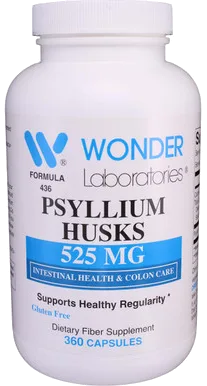
Wonder Laboratories Psyllium Husks 525 mg Review
Wonder Laboratories Psyllium Husks 525 mg is a dietary supplement sold as capsules. Each container holds 90 servings, and one serving is 2 capsules. That makes 180 capsules in all, going by the serving math on the label. Per serving, the Supplement Facts panel lists Calories 5, Total Carbohydrates 1 g and Psyllium Husks 1050 mg. Psyllium husks are the only active ingredient listed. The other ingredients printed on the label are k-Gelatin, Vegetable Cellulose and Vegetable Magnesium Stearate. The label prints these directions: Psyllium Husks should be taken with at least a full glass of liquid. For adults, as a dietary supplement, take 2 capsules three times daily, with a minimum of 8 fl oz of water, 30-60 minutes before meals. That adds up to 6 capsules on a day when the directions are followed three times, which is 3150 mg of psyllium husks, since each serving of 2 capsules carries 1050 mg. The name on the front says 525 mg, which matches the amount in a single capsule.
We don’t sell supplements. We help you make decisions and get the best price.
Lowest prices
We may earn a commission from some store links. How we choose.
We hold no current store prices for it yet: check the store.
- AmazonPrice at AmazonCheck price at Amazon (opens in a new tab)
Some links earn us a commission; price comes first, and a commission only decides the order of prices within 2%. As an Amazon Associate we earn from qualifying purchases.
Products with nearly the same formula (Matched on the main ingredients)
Study, Trial or Testing Result Summary
Members OnlyHuman studies
This product is psyllium husk in 525 milligram capsules, sold for regularity and relief of occasional constipation. Our records hold no human studies for its ingredients on this goal, so we cannot say from research whether it helps, how much is needed, or how it compares with other options. The label we have is incomplete and lists no dose details beyond the calorie line, so the amount of psyllium per serving could not be checked against any studied dose. No member reviews were counted or read, so there is no real-world feedback on how well it works or how it is tolerated. Until studies or reviews are added, treat this product as unproven for this goal in our database. Animal and cell studies are never counted.
Review Totals and Summary
Members OnlyWhat buyers say
No written reviews read yet.
Biohacker Summary
Members Only6 of 10 recommend it
Psyllium is only a smaller ingredient in this product, yet the panel had plenty to say, and most of it leaned positive. Six of the ten recommended it or said they use it, mainly for cholesterol, blood sugar, gut health and keeping things moving, and they take it as husk powder, often 5 to 10 grams, mixed into yogurt, taken before meals, or baked into bread and muffins. Doses ranged from a quarter cup in a bread recipe to one panelist's 30 grams twice a day for cholesterol. Two of them were neutral, saying it works if used strategically and tolerated, and two raised cautions: one said high doses can irritate the gut and cause bloating, and another warned that taking it without water can cause a blockage and constipation.
See all 9 biohackers →Hide the biohackers
Dave Asprey · Psyllium · recommends
- Has invested in a company that made a fine ground psyllium husk that worked well and advises people to try it.
- States that psyllium husk does not have a prebiotic effect and can cause rapid fermentation and bloating, which is counterintuitive to gut health. He also mentions that in high doses, it can be abrasive and not nourishing to the microbiome.
- Dave Asprey highlights activated psyllium as the star ingredient in Uprising Food, detailing its benefits as a prebiotic fiber and bio-active polysaccharide.
Siim Land · Psyllium · recommends
- Suggests trying psyllium husk to improve lipids and blood sugar.
- Recommends Psyllium husk for LDL, blood sugar and gut health, based primarily on human research, especially randomized controlled trials showing measurable benefits.
- Lists Psyllium husk as one of 15 supplements backed by human studies.
- Notes that kiwis were as effective as psyllium matched for fiber in improving constipation symptoms.
- Takes 10 grams of psyllium husk mixed with yogurt.
- Considers psyllium husk 'god tier' as a high source of fiber that helps with cholesterol and digestion, calling it one of the easiest ways to lower cholesterol.
- Includes 1 tbsp of psyllium husk in their first meal of the day.
- Recommends Psyllium Husk as a food powder that is a high source of fiber, helps with cholesterol, and aids digestion.
- Gives Apollo psyllium husk mixed with his food to support daily bowel movements.
- Adds psyllium husk to his protein shake to make it thicker.
Thomas DeLauer · Psyllium · recommends
- Recommends psyllium husk as a powerful source of soluble fiber to aid in detoxification by binding to bile acids and speeding up gut transit time.
- Recommends psyllium fiber as one of the things that support the gut.
- Suggests using psyllium as an alternative to oatmeal for lowering cholesterol, implying it works through the same mechanism of binding to bile salts.
- Uses 5g of psyllium husk pre meals because the viscous gel it forms slows gastric emptying.
- Recommends Psyllium, stating that it can help move ingested microplastics through the gut, as studies show microplastics in feces.
- Recommends adding psyllium husk to carbs to slow down how fast they hit the bloodstream, thereby preventing visceral fat accumulation.
- Recommends psyllium as a good fiber supplement choice, noting it has a strong research track record, forms a gel to slow glucose, curbs appetite, and shifts gut bacteria to increase butyrate producers.
- Recommends taking 5 to 10 grams of psyllium husk mixed with water, allowing it to form a gel, 5 to 10 minutes before a carb-heavy meal to create a physical barrier in the gut that slows glucose absorption.
- Suggests using psyllium husk as a prebiotic fiber to pair with collagen.
- If someone needs to bring on fiber, Thomas DeLauer recommends starting with a small amount of psyllium and gradually increasing it.
Andrew Huberman · Psyllium · uses
- Mentions that he recently started supplementing with powdered psyllium husk and found that it made post-meal sensations feel good, which he did not expect.
- Mentions that some family members take a small amount of psyllium husk to increase fiber, which is inexpensive and can benefit colon health and reduce inflammation for most people.
- Mentions that doctors are now telling many people to take a little bit of psyllium husk for supplemental fiber, noting it's ground into a powder.
Dr. Eric Berg · Psyllium · recommends
- Recommends using psyllium husk powder as an ingredient for making healthy bread.
- Suggests psyllium husk as a fiber that can bind to bile salt to help with excess bile and prevent diarrhea.
- Uses ¼ cup of psyllium husk powder in their healthy bread recipe.
- Dr. Berg uses ¼ cup of psyllium husk powder as an ingredient in his healthy bread recipe.
- Includes psyllium husk powder as an ingredient in their recommended healthy bread recipe.
- Notes that the fiber in psyllium seed produces a very small, almost insignificant effect on cholesterol.
- Used to take psyllium seed as part of a colema cleanse, but he found the cleanse problematic due to unstable blood sugar and lack of electrolytes.
- Dr. Berg talks about psyllium husk, noting it is a refined fiber from the Plantago Ovata plant that provides a laxative effect and is normally taken for constipation.
- Lists Black psyllium as one of the 7 best natural laxatives for constipation, noting it swells with water.
- Explains that psyllium husks come from the plantago ovata plant and are mainly used as a natural laxative.
Dr. Rhonda Patrick · Psyllium · uses
- If Dr. Rhonda Patrick needs fuel before training, they will have a homemade muffin made with psyllium husk.
- Rhonda's current diet includes a homemade blueberry, whey protein, and psyllium husk muffin as a pre-workout.
- Recommends soluble fibers like psyllium husk, stating they form a viscous gel that can limit microplastic absorption.
- States that arabinoxylan, which is found in psyllium husk, will actually drop cholesterol.
- Dr. Rhonda Patrick discusses beta-glucan versus psyllium for lowering LDL.
Dr. Mark Hyman · Psyllium · neutral
- States that psyllium is good if used strategically and if it's tolerated.
- Mentions psyllium as helpful for gut health.
- Clarifies that when discussing soluble fiber, they do not mean the chunky sawdust kind like psyllium husk.
Ben Greenfield · Psyllium · warns
- Notes that psyllium husk has been shown to slow glucose absorption and improve hemoglobin A1c at 10g a day, but he doesn't like it because it can irritate the digestive tract and cause gastric inflammation at those doses.
- Mentions that his teachers never taught him what to do if constipated beyond just taking a bunch of psyllium husk.
- Ben Greenfield mentions psyllium husk extract as a potential solution for constipation.
- Warns that taking psyllium powder or fiber without water could result in an intestinal obstruction and constipation.
- Notes that psyllium fiber showed decent certainty of evidence for weight loss in a meta-analysis, attributing its effect to being fiber-based and promoting fullness.
- Suggests that supporting vagal nerve function and doing deep tissue work can be more effective than taking another round of psyllium husk for constipation.
- Warns that psyllium husk should be used carefully because it can feed SIBO, which many people have without knowing it.
- Ben mentions psyllium husk as a fiber source that can help get the bowels moving.
- Includes psyllium husk as part of their prebiotic blend to increase gut microbiome diversity.
- Includes psyllium in his smoothie.
Peter Attia · Psyllium · neutral
- Identifies psyllium husk as a common soluble fiber supplement.
- States that psyllium husk is soluble fiber, and while the food industry adds it to products like Fiber One bars, it doesn't make a difference because both soluble and insoluble fiber are needed for functional fiber.
- Takes 30 grams of psyllium fiber twice a day for cholesterol.
RAL Summary
Members OnlyTier 4 for Regularity: Long-Term Relief
Tier 4 fits because no human studies on this goal were given for its ingredients and there are no reviews, so the evidence is thin.
- Emerging: not enough evidence to rank higher yet.
- No human studies on this goal for its ingredients.
More Details
Members OnlyBody systems · Combine with · Possible side effects
Body systems: Digestive system
Combine with: For Regularity and Occasional constipation Long Term Relief, psyllium is often paired with magnesium citrate, because both draw water into the gut and act on the same stool-softening pathway. It is also often paired with aloe vera, which acts on the same pathway by moving water into the colon. Probiotic strains such as Bifidobacterium lactis are often paired with it because fermentation of fiber feeds them, helping them thrive.
Possible side effects: No major side effects reported.
Supplement Facts
Total Carbohydrates 1 g · Psyllium Husks 1050 mg
| Calories | 5 | |
| Total Carbohydrates | 1 g | |
| Psyllium Husks | 1,050 mg | † |
Other ingredients: K-Gelatin, Vegetable Cellulose, Vegetable Magnesium Stearate.
Directions: Psyllium Husks should be taken with at least a full glass of liquid Directions: For adults, as a dietary supplement, take 2 capsules three times daily, with a minimum of 8 fl oz of water, 30-60 minutes before meals.
Barcode (UPC) 099528436187 · Label source: NIH label database · Report a label change
Other sizes and barcodes: 360 Capsule(s), UPC 0 99528 43636 1 (not checked yet)
Show entire label
More regularity: long-term relief products
Members OnlyThe highest ranked for the same goal
Read more
Our articles on this subject
- Magnesium Glycinate vs Citrate: What the Studies ShowArticle · Oct 30, 2026
- Psyllium vs Metamucil: Same Fiber, Different ExtrasArticle · Nov 1, 2026
Graded November 19, 2026 by the Reverse Age Lab evidence engine, from human studies, real reviews and our biohacker panel. How we grade. Is this medical advice? No. Rala organizes the published evidence; go over any change with your doctor, especially if you take meds.
Privacy policyConsumer health dataAffiliate disclosureTermsBrand and legal noticesDo Not Sell or Share My Personal InformationCookie settings