XYMOGEN Nattokinase 4000 Review
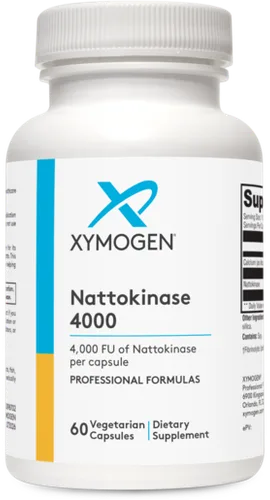
Nattokinase 4000 (60 Capsules) by Xymogen is a dietary supplement in capsule form. The product's key ingredient is Nattokinase, and the manufacturer suggested use is to take 1 capsule daily, or use as directed by your healthcare professional. Each container holds 60 servings, and the serving size is 1 capsule. The Supplement Facts panel lists Calcium (as dicalcium phosphate) at 57 mg, which is 4% of the daily value, and Nattokinase at 200 mg, labeled as 4,000 FU (fibrinolytic units). The Nattokinase amount carries a note stating that the Daily Value is not established. The other ingredients are the capsule (hypromellose and water), ascorbyl palmitate, and silica. The product contains soy. The allergen information states that the product contains soy and is formulated to exclude wheat, gluten, yeast, animal and dairy products, fish, shellfish, peanuts, tree nuts, egg, sesame, ingredients derived from genetically modified organisms, artificial colors, and artificial sweeteners. The page lists the product as gluten-free, dairy-free, nut-free, free of artificial colors and artificial sweeteners, and non-GMO. The manufacturer warnings advise consulting a healthcare professional before use, and state that individuals taking medication should discuss potential interactions with their healthcare professional. The warnings also say not to use the product if the tamper seal is damaged. People with a bleeding disorder, or those taking any drug that affects blood coagulation or blood pressure such as heparin, a med , meds, meds, or meds, should consult a healthcare professional before taking the product. The page notes that the statements have not been evaluated by the Food and Drug Administration and that the product is not intended to diagnose, treat, cure, or prevent any disease. Shoppers are advised to consult a doctor, pharmacist, or other qualified health care professional before deciding to purchase or use a dietary supplement. The product should be kept out of reach of children. Purchase options on the page include a one-time purchase at $53.99 USD, and a subscription option with 10% off, delivering every month or every 2 months at $48.59 USD. Subscriptions auto-renew and can be skipped or cancelled at any time. The page also notes a special offer of free shipping on Xymogen formulas when a customer spends $200 or more, and states that Xymogen does not accept returns or exchanges, as the item is final sale. The page advises that formulas, ingredients, directions, warnings, and allergen information may change, and that the packaging received may differ from the page, so users should always refer to and follow the actual product packaging before use.
We don’t sell supplements. We help you make decisions and get the best price.
Lowest prices
We may earn a commission from some store links. How we choose.
Finding the lowest prices at the stores now. This takes a few seconds.
Study, Trial or Testing Result Summary
Members Only9 human studies · 3 improved
3 of these 9 human studies gave the ingredient by drip, not by mouth.
The main ingredient is nattokinase at 200 milligrams, or 4,000 fibrinolytic units, which is above the 2,000 unit dose used in most studies. The strongest study gave 265 older adults without heart disease 2,000 units daily or placebo for about 3 years and found no change in artery wall thickness, artery stiffness, blood pressure, or clotting and inflammation measures [1]. A 6-month trial of 8,000 units daily in 120 adults with narrowed brain or neck arteries did not improve overall thinking scores, though an exploratory check showed less decline in visuospatial skills [2]. Smaller studies were more positive. In 9 healthy men, a single dose helped hands rewarm faster after cold water [3]. A related natto product, not pure nattokinase, reduced cold hands and feet and shoulder stiffness in women [4] and raised clot-dissolving activity in an uncontrolled study of 28 volunteers [5]. The product also has 57 milligrams of calcium, mainly from its capsule filler. Studies of calcium and blood flow gave it by vein or into an artery, not by mouth, and showed no benefit or possible harm [6][7]. Overall, evidence that this product improves blood flow is limited and mixed. Animal and cell studies are never counted.
See all 9 studies →Hide the studies
- In 391 adults having a cardiac arrest outside hospital, up to two doses of calcium chloride (5 mmol each) given into a vein or bone did not significantly improve return of a sustained heartbeat compared with saline (19% vs 27%), and the trial was stopped early over concerns about harm.Effect of Intravenous or Intraosseous Calcium vs Saline on Return of Spontaneous Circulation in Adults With Out-of-Hospi…
- In 265 older adults without heart disease, taking nattokinase (2,000 fibrinolytic units) for about 3 years did not change artery wall thickness, artery stiffness, blood pressure or blood clotting and inflammation measures compared with placebo.Nattokinase atherothrombotic prevention study: A randomized controlled trial.
- In 120 adults with symptom-free narrowing of brain or neck arteries, 6 months of nattokinase (8,000 fibrinolytic units daily) did not improve overall thinking scores versus placebo, though an exploratory check found less decline in visuospatial skills.Nattokinase supplementation for cognitive enhancement in asymptomatic intracranial/carotid stenosis: A randomized contro…
- In 14 hemodialysis patients, a high-calcium dialysis bath raised blood calcium and increased arterial stiffness during treatment, while a low-calcium bath did not.Arterial stiffness alterations during hemodialysis: the role of dialysate calcium.
- In a double-blind crossover study of 9 healthy men, a single 2,000 fibrinolytic unit dose of nattokinase helped skin temperature in the hand recover faster after cold water immersion than placebo, without changing heart rate or cardiac output.A single dose of oral nattokinase accelerates skin temperature recovery after cold water immersion: A double-blind, plac…
- In 8 healthy adults, a small rise in local blood calcium reduced resting forearm blood flow and blunted the blood-vessel dilation caused by verapamil, which recovered after the infusion stopped.Effect of small increments in plasma calcium concentration on the responsiveness of forearm resistance vessels to verapa…
- In a crossover study of women with lifestyle diseases, 4 weeks of the natto-derived supplement NKCP reduced self-rated shoulder stiffness, low back pain and cold extremities more than an active placebo, but headache did not change.Effects of Bacillus subtilis var. natto products on symptoms caused by blood flow disturbance in female patients with li…
- In uncontrolled studies of 28 volunteers taking the natto-derived NKCP tablet for 2 weeks, and 23 volunteers for several months, clot-dissolving activity increased and shoulder stiffness improved.Fibrinolytic and anti-thrombotic effect of NKCP, the protein layer from Bacillus subtilis (natto).
- In healthy volunteers, infusing calcium into the arm blunted the blood-vessel dilation caused by magnesium, while dilation caused by potassium was not affected.Attenuated vasodilator responses to Mg2+ in young patients with borderline hypertension.
Review Totals and Summary
Members Only63 reviews · 90% positive
Review data for this exact XYMOGEN 4000 product is thin. Most retailers carry only a handful of reviews, and the larger sample comes from the standard 2,000 FU XYMOGEN Nattokinase and from other brands' 4,000 FU products. With that caveat, the clearest theme is cardiovascular and blood-pressure benefit. One reviewer on a practitioner-supply site called it the best blood-pressure product they had used. They said it made a big difference in lowering their readings. Another buyer said a holistic nurse practitioner recommended it for people with a genetic predisposition to stroke. This points to a pattern of practitioner-guided use. Buyers of comparable 4,000 FU products say they take it for arteries and circulation. One said their bloodwork looked more normal at a doctor's visit after regular use, and that they had to take several capsules daily to feel results. On WebMD, the general nattokinase category gets praise for fast blood-pressure improvement, with one user reporting a quick drop within days. Value for money is a second theme. Shoppers on mass-market sites call 4,000 FU products a good price. By comparison, the practitioner-grade XYMOGEN is the more premium option, and buyers appear to choose it for trust in the brand's quality and professional sourcing. That trust is also visible in comments about retailers' service. The complaints are scattered but telling. One reviewer of the 2,000 FU product pointed out that the label dose covers two capsules, not one. The reviewer said the strength is therefore lower than a quick glance suggests. This is a labeling-clarity complaint, and the 4,000 version addresses it by putting the full amount in one capsule. The overall rating on one site was a middling 3.0, driven by a single negative review among only two. Some users report no noticeable effect, and a few reviews of nattokinase generally describe patience. One WebMD user hoped results would improve the longer they took it. A serious but rare complaint, on a comparable product, said it caused other health problems. This reinforces the common caution about interactions with meds and medications. A few retailer reviews also drift off-topic. They mention gut or detox uses, such as one person who takes it for spike-protein detox. Those are individual claims that go beyond the product's labeled purpose. In short, satisfied customers praise blood-pressure and circulation support and trust the practitioner-recommended brand. The recurring reservations are the premium price, subtle effects that take time, and the need to consult a doctor first.
Biohacker Summary
Members Only7 of 10 recommend it
The product is named for nattokinase, but the panel's statements treat calcium as the main ingredient, and most of what they say is about calcium. Of the ten, five recommend calcium for bone health (one gives 1,000 to 1,200 milligrams a day, with calcium carbonate or calcium citrate as supplement forms), while several others stay neutral and point to food sources like sardines, dairy and leafy greens. Four of them warn against calcium supplements, citing a possible higher risk of heart attack, calling calcium carbonate a poor source, or saying supplements do not build bone, though one allows them for postmenopausal women with low bone density. One advised against taking magnesium and calcium together, and another noted that bone needs more than calcium, since it is mostly collagen with other minerals. On nattokinase, one panelist started taking it after a blood test showed slightly high LDL cholesterol, and a follow-up test showed it came down, while another recommends high doses of 12,000 to 20,000 units at night on an empty stomach, and one takes it fasted; another doubts it works for plaque, and one does not see convincing evidence for heart or stroke prevention.
See all 10 biohackers →Hide the biohackers
Dr. Eric Berg · Calcium · neutral
- States that one can of sardines contains 382 mg of calcium.
- Warns against calcium supplements, citing studies that link them to a higher risk of heart attack, especially in postmenopausal women, and suggests getting calcium from dairy instead.
- Recommends focusing on calcium to support stronger bones if a neck hump is associated with osteoporosis.
- Warns against calcium carbonate, calling it limestone and the worst source of calcium, stating it takes 12 steps to be converted in the body and is like eating rocks.
- Warns that bone loss cannot be fixed with just calcium, as bone is primarily collagen with other essential minerals.
- Dr. Berg includes calcium carbonate among the synthetic supplements to avoid.
- Warns against calcium carbonate, also known as limestone, stating that while it lowered hip fractures in a study, it also increased kidney stones and is not good for arteries, requiring the body to work hard to use it.
- Notes that tannins in tea bind calcium, blocking its absorption.
- Indicates that horizontal thin white lines near the base of the nails are indicative of low calcium.
- Warns that calcium carbonate can build up in the arteries and kidneys and increase the risk of a heart attack.
- Recommends Nattokinase as a top natural remedy for clots.
- Dr. Berg states that nattokinase, found in natto, is a very effective compound to reduce clotting.
- Recommends nattokinase as a supplement to prevent clotting.
- States that Nattokinase may help remove arterial plaque buildup naturally.
Andrew Huberman · Nattokinase · uses
- Started supplementing with nattokinase to naturally help reduce LDL cholesterol after learning his blood lipids were slightly out of range.
- Started supplementing with nattokinase after a Function Health test revealed slightly out-of-range blood lipids, and a follow-up test confirmed it helped reduce his LDL cholesterol.
- Learned from a Function test that some of his blood lipids were slightly out of range, so he decided to start supplementing with nattokinase, which naturally helps reduce LDL cholesterol, and it worked.
- Started supplementing with nattokinase to naturally help reduce LDL cholesterol after a Function test showed his blood lipids were slightly out of range, and a follow-up test confirmed it worked.
- Started supplementing with nattokinase to naturally help reduce LDL cholesterol after a Function test showed his blood lipids were slightly out of range, and a follow-up test confirmed its effectiveness.
- Started supplementing with nattokinase after a Function Health test showed his blood lipids were slightly out of range, and a follow-up test confirmed this strategy worked to reduce LDL cholesterol.
- Started supplementing with nattokinase after a Function Health test showed some blood lipids were slightly out of range, and confirmed in a follow-up test that it helped reduce LDL cholesterol.
- Started supplementing with nattokinase to naturally help reduce LDL cholesterol after a Function test showed his blood lipids were slightly out of range, and a follow-up test confirmed it worked.
- States that he started supplementing with nattokinase to naturally help reduce LDL cholesterol after learning his blood lipids were slightly out of range, and confirmed its effectiveness with a follow-up test.
- Started supplementing with nattokinase to naturally help reduce LDL cholesterol after learning their blood lipids were out of range, and a follow-up test confirmed its effectiveness.
- Discusses "hard water" and the role of magnesium and calcium in cardiovascular health.
- Adequate intake of calcium is vital for bone health.
Ben Greenfield · Nattokinase · neutral
- Questions the efficacy of nattokinase for plaque melting, asking how an enzyme can get through stomach acid and if the gut bacteria can utilize its chemical trash to make K.
- Notes there is good evidence that high-dose lumbrokinase and nattokinase from a specific source may help reduce or regress plaque, and he is looking into high-dose nattokinase as part of his damage control.
- Is considering whether he needs a calcium supplement because lead can displace calcium in bones, affecting bone strength.
- Mentions calcium as a common deficiency.
- Recommends adequate intake of calcium for bone strength.
- Is glad that people are finally catching on to the idea of a high dose nattokinase protocol for heart health/plaque, emphasizing the importance of using adequate amounts, preferably more than 8000 units.
- Is using calcium chloride mixed with PRP before injecting for the P-shot.
- Recommends nattokinase for plaque regression, stating that most supplements only have 1,000 to 2,000 units, but data shows an impact only at 8,000 units or more.
- Advises people to stop taking calcium supplements as part of the Root Cause Protocol.
- Warns that in high doses, calcium without the right cofactors can raise cardiovascular risk by contributing to arterial calcification instead of bone strength, and may increase the risk of osteoporosis.
- Used to take nattokinase pills, but found the "earthy stuff" (fermented soybeans) to be more effective for shrinking plaque.
- Explains that 10X separates calcium and zinc into different micro beads, releasing them at different rates and locations in the digestive tract to prevent competition and optimize absorption.
- Covers calcium as a key supplement for kids.
- Ben Greenfield recommends looking into nattokinase if concerned about plaque, noting its effect on coronary artery calcification.
Dave Asprey · Nattokinase · recommends
- Recommends Nattokinase as one of the eight compounds in BioPurify for circulation and cellular health.
- Recommends Nattokinase, stating it supports healthy circulation and helps the body break down blood clots.
- Recommends taking nattokinase at night before bed on an empty stomach to help make a med, and notes it's also good for spike protein.
- Recommends taking high-dose nattokinase, starting at 12,000 units and potentially increasing to 20,000 units, to minimize the impact of the COVID vaccine, as it directly breaks up spike protein and reduces soft plaque.
- The episode discusses how nattokinase, a natural enzyme, has shown the ability to break down the spike protein.
- Notes that when energy intake is too low for training demand, nutrient intake often falls short, especially for calcium, which is associated with reduced bone health.
- Nattokinase, an enzyme found in natto, breaks up protein clumps including blood clots, and studies show that at higher doses it can even reverse cardiovascular disease.
- Explains that calcium provides the raw material for bones, but it isn't a standalone input and needs a whole system to be effective.
- Notes that people take calcium for their bones.
- For the last 25 years, Dave Asprey has been on a high dose of either serrapeptase or nattokinase to reduce stroke risk by breaking up thrombin and fibrinogen, also noting nattokinase breaks up soft plaque.
- Uses a lot of nattokinase and lumbrokinase to address histamine spike protein issues.
- Warns that taking calcium without vitamin D, A, and K2 can lead to calcium going into tissues, causing bone spurs and other issues, and recommends a two-to-one ratio of calcium to magnesium.
- Recommends taking calcium citrate during a high oxalate meal to bind the oxalate in the gut.
- Recommends nattokinase and other things to make blood flow well, especially for those with long COVID or who had COVID.
Siim Land · Calcium · neutral
- Lists dairy and sardines as sources of Calcium.
- Notes that Boron reduces calcium/magnesium loss.
- Notes that some trials show nattokinase improving atherosclerotic plaque, with high doses showing an effect where low doses did not, and more studies are needed to find the threshold effect.
- Recommends a high calcium intake for bone health.
- Places calcium supplementation in the 'bad tier' due to its association with increased cardiovascular events, recommending dairy or bones as easier ways to get calcium, though it can be useful for postmenopausal women with low bone density.
- Notes there are interesting studies suggesting Nattokinase might reduce atherosclerotic plaque and personally believes it does based on current evidence, but more clinical trials are needed to determine effective doses.
- Mentions that eating enough calcium matters for bone density, but states that it alone won't transform bone density.
- Warns that calcium is linked to a higher risk of heart disease, though people with low calcium status and intake can take it safely.
- Warns that calcium supplements increase the risk of heart disease by raising blood calcium levels too high, leading to hypercalcemia and more calcium being stored in the arteries, and also increase the risk of arrhythmias.
- Warns against calcium supplementation for most people due to its association with increased cardiovascular events, but notes it can be useful for postmenopausal women with low bone density who don't consume dairy.
- Discusses Calcium as a supplement.
- Believes Nattokinase might reduce atherosclerotic plaque and blood viscosity, making it useful for people over 50, especially men, who have a higher risk of blood clotting.
- Discusses Nattokinase as a supplement.
- Recommends consuming calcium from dairy, tofu, leafy greens, and bones, as it is a key nutrient required for ATP synthase in mitochondrial energy production.
Thomas DeLauer · Calcium · neutral
- Notes that milk contains 120mg of calcium, while sardines contain 351mg, highlighting a 3x difference.
- Recommends getting calcium, along with vitamin D, zinc, and magnesium, from foods like sardines, as they are important for inflammatory pathways in the gut.
- Suggests increasing intake of nattokinase when in a fasted state to induce autophagy through a separate pathway from ghrelin, extending the autophagy period.
- Explains that eating sardines with their soft bones provides a serious hit of calcium, which is a perfect combination for bones and may contribute to satiety.
- Mentions that magnesium and calcium should not be taken together as they cancel each other out.
- Tries to get multivitamins without calcium or with a low amount, as he believes supplemental calcium impacts the absorption of other vitamins and minerals and is not as beneficial as hyped. He cautions against it for most people due to the risk of coronary artery calcification.
- Recommends getting calcium from dairy sources like milk, yogurt, kefir, and cheese in the morning to support neurotransmitter synchronization crucial for deep and REM sleep, noting that low dietary calcium is linked to insomnia.
- Warns that calcium competes with magnesium for the same absorption channels, advising to separate magnesium intake from calcium supplements or dairy by at least an hour or two.
- Recommends providing the body with adequate dietary calcium, not a calcium supplement, to ensure a clean, strong spark for efficient insulin release.
- Warns that calcium and magnesium should not be taken together as they cancel each other out, though some products use delayed absorption to mitigate this.
- Warns that most people consume too much calcium relative to magnesium, which can disrupt the balance needed for proper bodily function, comparing it to an electrical circuit.
- Notes that nattokinase, a component of natto, may help clear out beta-amyloid plaque, which is a large contributor to Alzheimer's and dementia.
- Mentions that natto contains nattokinase, which helps clear out beta amyloid plaque, a primary contributor to Alzheimer's and dementia, noting the extremely low dementia count in Japan.
- Explains that nattokinase, a component of natto, may help clear out beta amyloid plaque, which is a large contributor to Alzheimer's and dementia.
Dr. Mark Hyman · Calcium · recommends
- Notes that calcium is in bones but is also essential for nerves, muscles, and the heart, and low levels can affect muscle function and heart rhythm.
- Uses nattokinase to break open bacterial biofilms, allowing antimicrobials to be more effective.
- States that green leafy vegetables are great sources of calcium.
- Notes that calcium needs are lower than advertised and that stress, soda, and excess sugar can drive calcium loss.
- Does not prescribe calcium supplements at all, teaching people to get it from whole foods instead, because calcium supplements don't work for building bones or preventing fractures, and it's bone quality, not density, that matters.
- Warns that acid blockers inhibit calcium absorption.
- Lists calcium as another important nutrient that people can be tested for and measured.
- States that high doses of calcium supplementation in the elderly were not really impacting bone density, as osteopenic patients still became osteoporotic.
- Mentions using Nattokinase to lower lipoprotein little a, although it only lowers it by 20-30% and doesn't bring it back to normal.
- Warns that meds (meds) impair the absorption of calcium, which increases the risk of hip fractures and osteoporosis.
- Recommends calcium citrate, about 600 milligrams a day, for bone health, noting that much can also be obtained from diet through leafy greens, sesame seeds, tahini, and chia seeds.
- Dr. Hyman notes that while calcium deficiency is not common in terms of blood levels, insufficient intake can lead to osteoporosis as the body pulls calcium from bones. He advises caution with calcium supplementation due to potential heart issues.
- Recommends nattokinase for individuals with hypercoagulability to improve cognition.
- Mentions nattokinase as a natural supplement that can help thin blood and reduce inflammation and clotting.
Dr. Rhonda Patrick · Calcium · neutral
- Mentions that kale delivers calcium, a micronutrient many diets fall short on.
- States that Nattokinase isn't high on their list for cardiovascular prevention and they don't see convincing evidence for it as a primary strategy for cardiovascular disease or stroke risk reduction.
- Notes additional gaps in calcium.
- Reports that alcohol use disorder is associated with a 20-50% greater prevalence of Calcium deficiency.
- Around 38% doesn't meet the requirement for calcium.
- Takes a calcium-magnesium pill because he believes people tend to be short of both and that the body cares about the ratio of these similar molecules.
- States that 1,000 milligrams of calcium per day is the recommended intake for bone density, and supplementation is an option if this requirement is not met.
- Takes a calcium, vitamin K2, and vitamin D combination supplement in the morning, providing about 600 mg of calcium and another 1,000 IUs of vitamin D.
- Dr. Rhonda Patrick discusses calcium needs.
- Dr. Rhonda Patrick reviews the evidence for nattokinase and its potential to protect the heart.
Peter Attia · Calcium · recommends
- Recommends calcium as one of the 'big three' micronutrients for bone health, suggesting a daily intake of 1,000 to 1,200 milligrams, which can be supplemented with calcium carbonate or calcium citrate.
- Explains that bone is 50 to 70% mineral, predominantly calcium, and that virtually all of the body's calcium is contained within bone, making bone important for calcium homeostasis.
- Recommends calcium for bone health, stating that teenagers probably need about 1000 milligrams a day.
- Discusses bone acting as a reservoir for calcium and how resorption and formation release calcium into the blood when needed.
- Notes that bone is 50 to 70 percent mineral, with calcium being the predominant mineral, and virtually all of the body's calcium is contained within bone.
- Recommends getting about a gram of calcium a day from organic bone meal, which provides calcium hydroxyapatite, the form humans are meant to consume.
- Mentions Nattokinase as an over-the-counter supplement that showed more evidence for preventing DVT than a med, and it is plant-derived.
- Suggests that calcium is one of the other signals involved in regulating mitochondrial number, beyond AMPK activation.
- States that in postmenopausal women not on estrogen, calcium and vitamin D have no protective effect against hip fracture because the problem is not the shell of the bone, which is fed by calcium and vitamin D, but the internal girder network.
- Notes that compelling evidence links calcium to reduced risk of osteoporosis, which can impact mortality from specific causes.
Bryan Johnson · Calcium · recommends
- Recommends calcium as a mineral that, along with phosphorus, magnesium, and boron, is deposited to fortify the bone structure after the collagen scaffold is in place.
- Agrees that a little extra calcium is probably okay, especially for women, to really hit home for bone mineral density.
- Recommends calcium at 1,200 mg daily for women during the follicular phase, depending on dietary intake.
- Recommends prioritizing calcium intake for postmenopausal women to help maintain bone density and reduce the risk of osteoporosis.
- Bryan Johnson takes Calcium daily as part of his Longevity Mix, which supports healthy bones and teeth.
RAL Summary
Members OnlyTier 4 for Circulation
The ineffective grade leans partly on calcium, a minor filler-level ingredient whose studies all gave calcium by vein, artery or dialysis rather than by mouth, while the main ingredient, nattokinase, has one large null trial and several small positive studies that disagree. So it is graded Tier 4, as the studies disagree.
- Emerging: not enough evidence to rank higher yet.
Where the evidence disagrees: 5 of the 9 human studies found no effect.
More Details
Members OnlyBody systems · Combine with · Possible side effects
Body systems: Cardiovascular system, Blood and clotting
Combine with: For circulation and cardiovascular support, nattokinase pairs well with omega-3 fish oil (EPA/DHA) for endothelial and triglyceride support, CoQ10 or ubiquinol for cardiac energy, and magnesium for vascular relaxation. Vitamin K2 (MK-7) supports healthy calcium distribution in arteries; note that nattokinase products are usually vitamin K-free, so K2 is best taken separately if not on a med. L-citrulline or L-arginine can support nitric oxide production, and garlic extract may add complementary circulatory benefits. Caution: nattokinase has blood-thinning activity, so consult a healthcare provider before combining it with meds, antiplatelet drugs, a med, high-dose fish oil, or before surgery. Those with a soy allergy should also avoid it.
Possible side effects: No major side effects reported in the nattokinase studies; reviews mention a rare report of other health problems and caution about combining it with meds. The product contains soy.
Supplement Facts
Calcium 57 mg · Nattokinase 200 mg
| Calcium | 57 mg | |
| Nattokinase | 200 mg | † |
Other ingredients: Capsule (hypromellose and water), ascorbyl palmitate, and silica.
Directions: Take 1 capsule daily, or use as directed by your healthcare professional.
Barcode (UPC) 722537513814 · Label source: Reverseagelab · Report a label change
Show entire label

More circulation products
Members OnlyThe highest ranked for the same goal
Read more
Our articles on this subject
- Supplements for Focus and Mental ClarityArticle · Jun 16, 2026
Graded November 11, 2026 by the Reverse Age Lab evidence engine, from human studies, real reviews and our biohacker panel. How we grade. Is this medical advice? No. Rala organizes the published evidence; go over any change with your doctor, especially if you take meds.
Privacy policyConsumer health dataAffiliate disclosureTermsDo Not Sell or Share My Personal InformationCookie settings