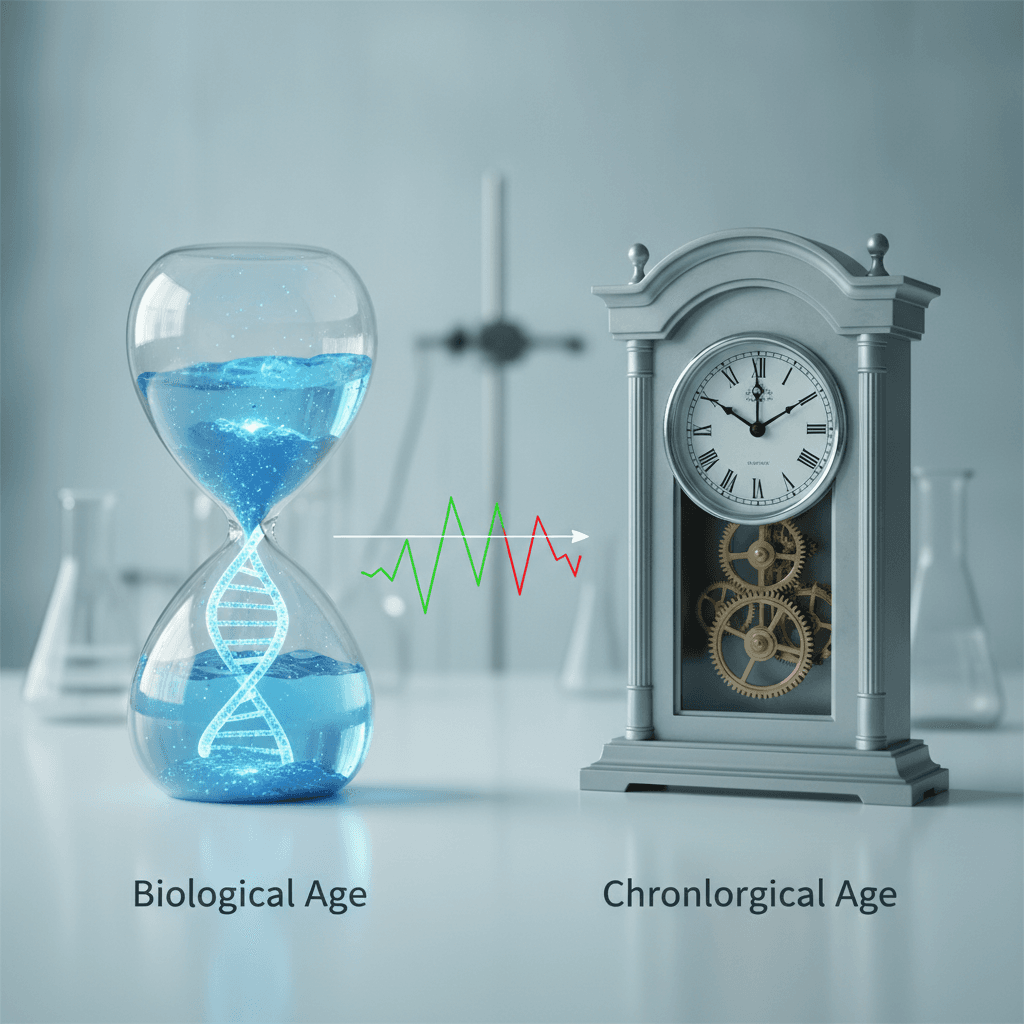
You have two ages. One is the number of years since you were born, and the other is how old your body actually behaves. They are often different, and the gap between them tells you more about your health and how you are aging than your birthday ever could.
The short answer: chronological age counts years and never changes. Biological age estimates how old your body behaves, measured by epigenetic clocks and blood markers, and it moves with exercise, diet, sleep, stress and a few studied supplements. The gap between the two is the number worth tracking.
This is a clear breakdown of biological age versus chronological age, what each one means, why the difference matters, how it is measured, and whether you can change it. This compares biological age vs chronological age and what moves each one.
Key takeaways
Chronological age is fixed. Biological age is an estimate of how your cells and systems behave.
The gap between the two is the useful signal, because only one of them responds to how you live.
Epigenetic clocks read chemical tags on your DNA. DunedinPACE estimates your current pace of aging instead of a single number.
A standard blood panel also reflects parts of biological aging and is far cheaper.
Use the same test each time so the comparison means something.
Chronological Age: The Number on Your Birthday
Chronological age is simple. It is the amount of time that has passed since you were born, measured in years. It is fixed, it moves at exactly one year per year for everyone, and there is nothing you can do to change it. It is useful for legal and administrative purposes, but it is a surprisingly poor measure of your actual health, since two people who are both fifty can be in completely different physical condition.
Biological Age: How Old Your Body Actually Behaves
Biological age is an estimate of how old your cells, tissues, and systems behave, based on measurable markers in your body. Unlike chronological age, it is not fixed. It reflects the real wear, repair, and function happening inside you, shaped by genetics but also heavily by your diet, activity, sleep, stress, and environment. Your biological age can be younger or older than your chronological age, and that is exactly the point.
Question | Chronological age | Biological age |
|---|---|---|
What it measures | Years since birth | How your cells and systems behave |
Can it change | No | Yes, it responds to diet, exercise, sleep and stress |
How it is measured | Your birth certificate | Epigenetic clocks, DunedinPACE, blood markers |
What it predicts | Little about your health | Health outcomes better than the calendar |
What to do with it | Nothing | Set a baseline, change your habits, retest |
Biological age vs chronological age: why the gap matters
The difference between your two ages is the useful signal. If your biological age is lower than your chronological age, your body is generally functioning like that of a younger person, which is associated with better long-term health outcomes. If it is higher, it can be an early warning that you are aging faster on the inside than the calendar suggests. Because biological age responds to your habits, it gives you something a birthday cannot, a number you can actually move in the right direction. GrimAge, one of the leading clocks, predicts time to death and disease better than chronological age does (Lu et al., 2019).
How Biological Age Is Measured
Scientists estimate biological age using biomarkers, measurable signs of what is happening in your body. The most studied tools are epigenetic clocks, which read chemical tags on your DNA, a process called DNA methylation, to estimate how old your cells behave. Newer measures like DunedinPACE estimate your current pace of aging rather than a single age number. Beyond specialized tests, a standard blood panel covering markers like fasting glucose, cholesterol, and inflammation also reflects aspects of biological aging. None of these is perfect, but together they give a far richer picture than a birthday. Sources: the original multi tissue clock (Horvath, 2013), DunedinPACE (Belsky et al., 2022) and PhenoAge, which is built from standard blood markers (Levine et al., 2018).
Can You Change Your Biological Age?
This is where it gets genuinely hopeful, and the answer is yes, within limits. Because biological age reflects how you live, it responds to the fundamentals. Regular exercise that combines cardio and strength, a whole-food diet, consistent sleep, managed stress, and a few genuinely study-backed supplements are the levers with the most evidence. A small 2021 controlled study even tied an eight-week diet-and-lifestyle program to a roughly three-year reduction in measured biological age, though larger studies are still needed. Among supplements, calcium alpha-ketoglutarate stands out, with a human study tying it to an average reduction of roughly eight years in biological age. You cannot rewind your chronological age, but you can meaningfully influence your biological one. Sources: the eight week trial (Fitzgerald et al., 2021), the calcium alpha-ketoglutarate study (Demidenko et al., 2021) and cardiorespiratory fitness and mortality (Mandsager et al., 2018). The step by step plan is in how to lower your biological age.
How to Find and Track Yours
If you want to know your biological age, start with a baseline, a standard blood panel and, if you want a deeper read, an epigenetic age test. Then make focused changes, hold them for a few months, and retest. This diagnose, act, and retest loop turns an abstract concept into a personal experiment with real feedback, and it is the most reliable way to know whether your efforts are working. The full loop, with the tests named, is in a daily protocol that lowers your biological age.
Make It Actionable
Understanding the difference between your two ages is the easy part. Turning it into a plan that actually lowers your biological age, built around your body and goals, is the hard part, and it is exactly what Reverse Age Lab is built to do. Rala, our patented AI, reviews the human studies and real reviews behind supplements, diet, and exercise, then turns them into one personalized daily protocol organized so the pieces work together, and helps you refine it as you retest. Build your protocol free at ReverseAgeLab.net. Our grading rules are on the methodology page.
Frequently Asked Questions
What is the difference between biological and chronological age?
Chronological age is simply the number of years since you were born, and it never changes. Biological age is an estimate of how old your body actually behaves, based on measurable markers, and it can be higher or lower than your chronological age depending on your genetics and lifestyle.
Can your biological age be lower than your real age?
Yes. Many people who exercise, eat well, sleep enough, and manage stress have a biological age lower than their chronological age, meaning their bodies function like those of younger people. The reverse is also possible if those habits are neglected.
How do you test biological age?
The most common methods are epigenetic age tests, which analyze DNA methylation patterns, and measures like DunedinPACE that estimate your pace of aging. A standard blood panel also reflects aspects of biological aging. For tracking progress, the key is to use the same method over time and compare.
Can you reduce your biological age?
You can meaningfully lower it for many people, though not without consistent effort. Exercise, a whole-food diet, quality sleep, stress management, and a few well-studied supplements are the most evidence-backed levers, and early research suggests sustained lifestyle changes can shift the markers in the right direction.
Want to move yours? Rala turns your test results, goals and habits into one daily protocol of supplements, diet and exercise, with the studies attached. Reverse Age Lab sells no supplements. Start your 7 day free trial, or check any product with the free research tool.
Related reading:Age reversal: what is real and what is hype · Can aging be reversed? · Science backed ways to slow aging