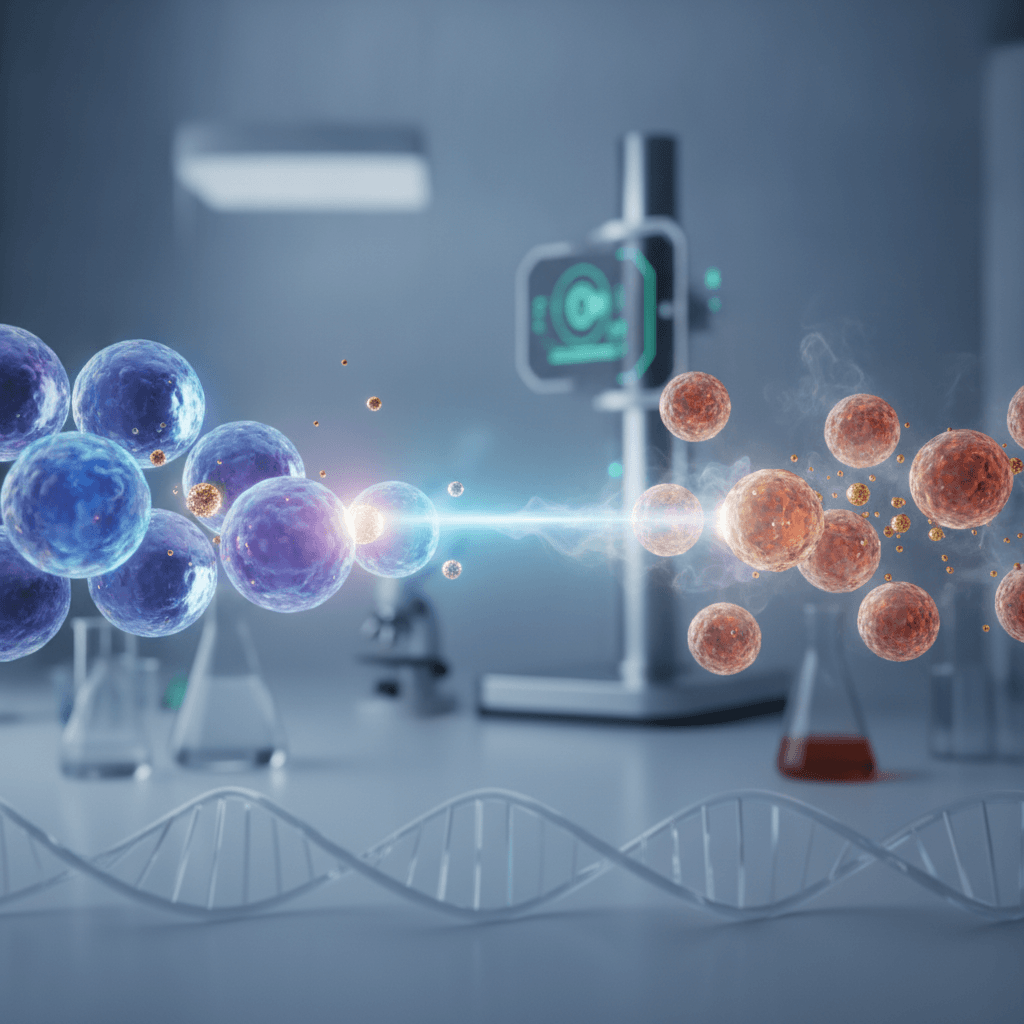
Aging is not one thing that happens to you all at once. It is the slow accumulation of changes inside your cells, and the speed of that process is far more in your control than most people assume. Slow it down, and you buy yourself more years of feeling strong, sharp, and capable.
The short answer: aging is a set of cellular processes, the hallmarks of aging, and their pace responds to how you live. Keep muscle with resistance training and protein, build cardiovascular fitness, eat whole foods with little processed food, sleep seven to nine hours, and use only the supplements with human data on aging. Measure a baseline and retest.
What follows is what the science says is happening at the cellular level, and the handful of levers that meaningfully move it. It covers what cellular aging is and the levers that slow it.
Key takeaways
Cellular aging is a set of connected processes called the hallmarks of aging, and their pace responds to how you live.
Keep muscle with resistance training and enough protein.
Build cardiovascular fitness, which tracks mortality with no upper limit.
Eat whole food with little ultra processed food, and sleep seven to nine hours.
Use only the supplements with human data on aging itself.
Measure a baseline and retest, or you are guessing.
What Cellular Aging Actually Is
Researchers describe aging through what they call the hallmarks of aging, a set of interconnected processes that drive your body's decline over time. A few of the most important are worth understanding, because each one is something you can influence. The framework comes from López-Otín et al. (2013), expanded to twelve hallmarks in the 2023 update.
Your mitochondria, the tiny power plants inside your cells, become less efficient with age and produce less clean energy. Senescent cells, sometimes called zombie cells, stop dividing but refuse to die and leak inflammatory signals into surrounding tissue. Chemical tags on your DNA shift in ways that change how your genes are read, and low-grade chronic inflammation quietly accelerates damage across the whole system.
The encouraging part is that these are not fixed. The pace at which they progress responds to how you live.
Lever | What it does to cellular aging | Evidence |
|---|---|---|
Resistance training and protein | Protects muscle, the most protective tissue you have | 30 to 60 minutes a week means 10 to 17 percent lower mortality |
Cardiovascular fitness | Improves the mitochondria that decline with age | Stepwise lower mortality, no upper limit |
Whole food eating | Reduces blood sugar swings and inflammation | Heavy ultra processed intake linked to 62 percent higher mortality |
Sleep | Most cellular repair happens while you sleep | Short sleep raises inflammatory markers across 72 studies |
Selected supplements | A thin extra layer, not a foundation | Calcium alpha-ketoglutarate, GlyNAC, NAD precursors, urolithin A |
The Levers That Actually Move It
Build and Keep Muscle
Muscle is one of the most protective tissues you have, and it is also one of the first things people lose with age. Resistance training two or three times a week, paired with enough protein, preserves strength, supports metabolic health, and is consistently associated with better long-term outcomes. You do not need to chase a physique, you need to keep the muscle you have. Thirty to sixty minutes a week of muscle strengthening activity is associated with 10 to 17 percent lower all cause mortality (Momma et al., 2022), and protein above the standard allowance supports muscle mass and function (Journal of Cachexia, Sarcopenia and Muscle, 2022).
Train Your Cardiovascular Engine
Cardiorespiratory fitness is one of the strongest predictors of how long and how well you live. A mix of easy, conversational cardio most days plus an occasional harder effort improves the efficiency of the very mitochondria that decline with age. Few interventions have this much evidence behind them. (Mandsager et al., 2018.)
Eat to Lower the Aging Signals
There is no magic anti-aging diet, but there is a clear pattern. Whole, mostly plant-forward foods, adequate protein, plenty of fiber, and a sharp reduction in ultra-processed foods and added sugar all reduce the blood-sugar swings and inflammation that push cellular aging forward. Simple and unglamorous beats exotic here. Heavy ultra processed food intake was associated with 62 percent higher mortality in a large cohort (Rico-Campà et al., 2019).
Prioritize Sleep and Recovery
Most cellular repair happens while you sleep. Consistently short or fragmented sleep raises inflammation and impairs the systems that clear cellular waste. Seven to nine hours on a steady schedule does more for your cells than any supplement on the shelf. (Irwin et al., 2016.) The sleep stack is in sleep: how to do it right.
Use Supplements as a Real Layer
Supplements support a strong routine rather than replacing one, but the right ones are a real layer, not an afterthought. Most products on the shelf have thin human evidence, so the sensible moves are to correct a real deficiency, fill a genuine gap, and otherwise be selective. A short list does have human data on aging itself, including calcium alpha-ketoglutarate, which a human study tied to a notable drop in biological age, GlyNAC for glutathione and strength in older adults, NAD precursors like those in Elysium Basis, and urolithin A for muscle endurance. Build any stack around what is actually studied for your goals, not around whatever is trending. Sources: calcium alpha-ketoglutarate (Demidenko et al., 2021), GlyNAC (Kumar et al., 2023), nicotinamide riboside with pterostilbene (Dellinger et al., 2017) and urolithin A (Liu et al., 2022). Each is examined in reverse aging supplements: what the evidence supports.
What About the Anti-Aging Hype?
The longevity market is loud, and a lot of the noise is unearned. The distinction worth making is between compounds with real human data on aging, like calcium alpha-ketoglutarate and GlyNAC, and the ones whose human case is still thin, like NMN on its own, resveratrol, spermidine, and senolytics. The first group earns a place when it fits your goals. The second is worth watching, not building on. Either way, never let an exciting headline replace the fundamentals above, because the boring basics are still where the real, repeatable results come from. Sources for the thin group: NMN (Yoshino et al., 2021), resveratrol exposure and mortality (Semba et al., 2014), spermidine intake (Kiechl et al., 2018) and fisetin in mice (Yousefzadeh et al., 2018).
Measure, Adjust, Repeat
The most reliable way to know whether your approach is working is to stop guessing and start measuring. Establish a baseline with a standard blood panel and, if you want a deeper read, an epigenetic age test. Change a few inputs, hold them for a few months, then retest. That feedback loop is what separates a real strategy from a pile of good intentions.
One Plan Instead of Guesswork
Each of these levers is simple on its own. The hard part is combining them into something personal and sustainable, without the conflicting advice that makes people give up. That is what Reverse Age Lab is built to do. Rala, our patented AI, reviews the human studies and real reviews behind supplements, diet, and exercise, then turns them into one personalized daily protocol built around your body and goals, organized so the pieces work together, and helps you refine it as you retest. Build your protocol free at ReverseAgeLab.net. Our grading rules are on the methodology page.
Ready to combine them? Rala builds one daily protocol of supplements, diet and exercise around your goals and test results, with the studies attached. Reverse Age Lab sells no supplements. Start your 7 day free trial, or check any product with the free research tool.
Related reading:Can aging be reversed? · How to lower your biological age · How to build a longevity protocol that works