
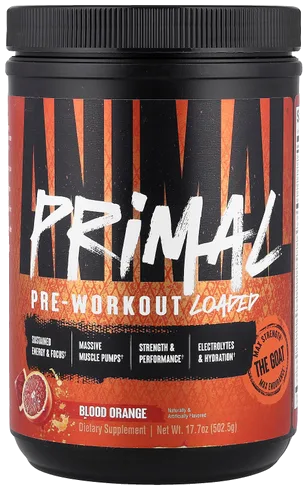
Animal, Primal™ Pre-Workout Loaded, Blood Orange, (502.5 g) Review
We don’t sell supplements. We help you make decisions and get the best price.
Lowest prices
We may earn a commission from some store links. How we choose.
Study, Trial or Testing Result Summary
Members OnlyHuman studies
This product is a blood orange flavored pre-workout powder, with a serving size of 20.4 grams listed on the label. Our research found no human studies showing that any of its ingredients relieve occasional heartburn or acid indigestion. The label information we have does not break out the individual ingredients or their amounts. Because of this, we cannot say whether any ingredient is present at a dose that has been studied, or whether ingredients are hidden inside a blend. The product has 91 customer ratings, and most of them are positive. However, we could not read any written reviews. That means we do not know whether buyers used it for heartburn at all. The positive ratings most likely reflect its use as a workout supplement. Pre-workout products are not designed to relieve heartburn, and nothing we were given suggests this one does. If you need fast relief from occasional heartburn, choose a product with study support for that goal. No study citations are available for this product and goal. Animal and cell studies are never counted.
Review Totals and Summary
Members Only91 reviews · 88% positive
Extensive customer reviews and qualitative feedback are currently being aggregated for this product. Check back soon for a detailed sentiment analysis.
Biohacker Summary
Members Only10 of 10 recommend it
Magnesium is a smaller ingredient in this product, yet nearly the whole panel spoke about it, and most recommend or use it, mainly for sleep. Four of them take or suggest magnesium glycinate or threonate before bed, and one gives 400 milligrams of threonate as his nightly dose; another says 300 to 400 milligrams a day from food and supplements is enough, with glycinate a good form. Others link it to muscle cramps, stress, blood pressure, and helping the body use vitamin D, and a few get it from electrolyte drinks that also contain sodium and potassium. One panelist adds that magnesium does not fix waking up during the night. Potassium, sodium, choline, and calcium are smaller ingredients in this product: one panelist warns that the common limit on potassium supplements rests on weak evidence, and another prefers potassium from food over supplements.
See all 10 biohackers →Hide the biohackers
Dr. Eric Berg · Potassium · warns
- Criticizes the mainstream limit of 99 milligrams for potassium supplements, stating it's based on a weak 1972 study that incorrectly attributed problems to potassium chloride instead of a med.
- Recommends supplementing magnesium during prolonged fasting to prevent feeling unwell, especially since many individuals are already deficient.
- Recommends taking magnesium glycinate to fix intense leg cramps, stating that this form absorbs better and helps relax muscles.
- Recommends magnesium, specifically magnesium glycinate, for blood pressure control, sleep, stress reduction, prevention of muscle cramps, and energy support.
- States that one can of sardines contains 382 mg of calcium.
- States that without potassium, one can experience insomnia and inability to sleep, describing it as a physiological tranquilizer that relaxes the body.
- Recommends potassium as an important electrolyte, noting that most people get less than half of the 4700 mg RDA.
- States that magnesium could also be a factor in preventing muscle cramps.
- Recommends Magnesium glycinate, noting its high absorption rate compared to magnesium oxide, and its support for energy, sleep, muscle relaxation, and vitamin D function.
- Dr. Berg states that when nutrients like magnesium are too low, fatigue and weakness can follow.
- Warns against calcium supplements, citing studies that link them to a higher risk of heart attack, especially in postmenopausal women, and suggests getting calcium from dairy instead.
- Recommends focusing on magnesium to support stronger bones if a neck hump is associated with osteoporosis.
- Explains that leg and calf cramps are most often caused by low magnesium, with leafy greens being a top source.
- States that magnesium is a cofactor that allows B1 to work more efficiently.
Thomas DeLauer · Magnesium · recommends
- Recommends pre-bed magnesium glycinate to lower evening cortisol through GABA-A support and to drop core temperature for sleep onset.
- Recommends taking magnesium glycinate and threonate at night to act as a brake on the nervous system, block excitatory signaling, help wind down, and support serotonin and melatonin production for better sleep.
- Recommends Element electrolytes, mentioning new flavors and sparkling cans with half the sodium, and suggests a lemonade iced tea flavor with caffeine is perfect in the morning.
- Mentions that magnesium glycinate also helps a lot with sleep.
- Mentions that restless leg syndrome is often treated with magnesium, but states that the sensation is actually coming from three other issues.
- Recommends Element electrolytes, noting they are focused on sodium first, then potassium, then magnesium, helping with sending signals and hydrating tissue.
- Recommends Element electrolytes, noting they are focused on sodium first, then potassium, then magnesium, helping with sending signals and hydrating tissue.
- Uses Element's cans which contain 30 milligram magnesium, finding that electrolytes help his workout performance.
- Uses Element's 500 mg sodium cans first thing in the morning to prime his day and enhance workout performance, noting that the pump is often driven by sodium.
- Uses Element's cans which contain 100 milligram potassium, finding that electrolytes help his workout performance.
- Uses Element's 30 mg magnesium cans first thing in the morning to prime his day and help with workout performance.
- Uses Element's 500 mg sodium cans first thing in the morning to prime his day and help with workout performance and pump.
- Uses Element's 100 mg potassium cans first thing in the morning to prime his day and help with workout performance.
- Recommends magnesium around the time one would normally break a fast to calm the brain and dull feelings of conditioned hunger.
Dr. Mark Hyman · Magnesium · recommends
- Recommends Magnesium Breakthrough Advanced 10 from Biooptimizers, stating it has 10 bioavailable forms and 550 milligrams of elemental magnesium, designed to support restful sleep, restorative sleep, muscle recovery, stress resilience, and metabolic health.
- Recommends getting choline from sources like liver, soy, eggs, and fish, or taking choline supplements on a regular basis for membrane health.
- Recommends magnesium breakthrough advanced ten from Biooptimizers, which is their most complete magnesium formula with 10 bioavailable forms and 550 milligrams of elemental magnesium, designed to support restful restorative sleep, muscle recovery, stress resilience, and metabolic health.
- Recommends considering magnesium glycinate before bed for nervous system support, deeper sleep quality, and to help the body transition into rest, and states that they take it every night.
- Explains that a lack of magnesium can cause muscles and nerves to malfunction, resulting in muscle weakness, twitching, and cramps.
- Recommends Magnesium Breakthrough Advanced 10 from Bioptimizers for restful sleep, muscle recovery, stress resilience, and metabolic health, especially during stressful times of the year.
- Warns that potassium bromate, a dough conditioner banned in the EU, UK, and Canada, is still allowed in U.S. bread.
- Recommends magnesium because it is involved in over 600 reactions in the body and up to 80% of people may have low levels that never get flagged on a standard blood test.
- Recommends magnesium as a basic supplement during detoxification to support pathways, help with constipation, and provide electrolytes.
- Recommends Magnesium Breakthrough Advanced 10 from Biooptimizers, which contains 10 bioavailable forms and 550 mg of elemental magnesium, to support restful sleep, restorative sleep, muscle recovery, stress resilience, and metabolic health.
- Has recommended magnesium breakthrough from bioptimizers for years and now uses Magnesium Breakthrough Advanced 10 as part of his evening routine, especially during periods of travel, training, and higher stress, to support sleep, muscle recovery, and metabolic health.
- Recommends correcting nutrient deficiencies with magnesium.
- States that potassium plays a critical role in nerve signaling and muscle contraction, especially in the heart, and low levels can lead to dangerous irregular heart rhythms.
- States that sodium is essential for fluid balance, nerve signaling, and muscle function, and that low levels can cause weakness, confusion, and dizziness, while high levels may indicate dehydration or too much salt.
Bryan Johnson · Magnesium · uses
- Takes 400 mg of Magnesium Threonate before bed for sleep.
- Takes 400 mg of Magnesium Threonate before bed for sleep.
- Takes 400 mg of Magnesium L-Threonate before bed for sleep.
- Takes 400 mg of Magnesium Threonate before bed for sleep.
- He takes 400 mg of Double Wood Magnesium L-Threonate before bed for sleep.
- Takes 400 mg of Magnesium L-Threonate before bed for sleep.
- Takes 400 mg of Magnesium Threonate before bed for sleep.
- Takes 400 mg of Magnesium L-Threonate before bed for sleep.
- Takes 400 mg of magnesium L-threonate before bed for sleep.
- He takes 400 mg of Magnesium L-Threonate before bed for sleep.
- Warns that Taco Bell's beefy five-layer burrito contains 1,290 mg of sodium, almost maxing out the daily reasonable consumption recommended by the American Heart Association, and that sodium increases blood volume, putting pressure on blood vessels.
- Warns against excess sodium, stating it can negatively affect the ability to absorb and hold onto calcium intake.
- Recommends calcium as a mineral that, along with phosphorus, magnesium, and boron, is deposited to fortify the bone structure after the collagen scaffold is in place.
- Agrees that a little extra calcium is probably okay, especially for women, to really hit home for bone mineral density.
Dr. Rhonda Patrick · Magnesium · recommends
- Explains that magnesium helps the body activate and metabolize vitamin D, and that magnesium intake has been associated with lower odds of vitamin D deficiency and insufficiency.
- Mentions that getting too little magnesium may play a role in declining testosterone levels.
- Recommends getting enough magnesium, around 300–400 mg daily from diet and supplements, as it is an essential cofactor for vitamin D metabolism. Magnesium glycinate is a good form.
- Notes that magnesium is very important for preventing damage to DNA and cancer, and that half the US population doesn't get enough of it.
- Mentions magnesium as one of the micronutrients found in multivitamins that people often don't get enough of from their diets.
- Explains that magnesium helps control blood pressure by boosting the production of substances that relax blood vessels and improve cardiovascular health, citing a meta-analysis that found magnesium supplementation at an average dose of 368 mg per day notably lowers both systolic and diastolic blood pressure.
- Magnesium supplementation has lowered blood pressure in randomized controlled trials. An analysis of 34 trials involving over 2,000 participants found modest reductions in both systolic and diastolic pressure, with a median dose of 368 mg/day.
- Notes that lowering sodium intake can help individuals improve their vascular system and blood flow, which is beneficial if hypertension contributes to cognitive problems.
- Warns that some magnesium supplements make the dose look much larger than it really is and that labels can fool people.
- Mentions magnesium as an important nutrient component for testosterone.
- Warns that some supplement companies mislead consumers by listing the total compound weight of magnesium citrate as the elemental magnesium dose, when the actual elemental magnesium content is much lower, potentially around 44-66 milligrams.
- Advises limiting sodium, ideally closer to 1,500 mg/day and not above 2,300 mg/day, for a diet linked to longer life.
- Mentions that kale delivers calcium, a micronutrient many diets fall short on.
- Warns that most people get too much sodium.
Andrew Huberman · Magnesium · recommends
- Notes that Les Spellman's team includes 'Magnesium timed right' as part of their game plan to optimize recovery in unfavorable conditions.
- Discusses Magnesium Threonate as a tool for falling asleep.
- Takes 400 mg of Magnesium Threonate before bed for sleep.
- Recommends choline-rich foods to enhance focus and acetylcholine.
- Uses Element, an electrolyte drink with sodium, magnesium, and potassium in correct ratios and no sugar, to ensure adequate hydration and electrolytes, especially when starting days fast or during physical exercise.
- Uses Element, an electrolyte drink with sodium, magnesium, and potassium in correct ratios and no sugar, to ensure adequate hydration and electrolytes, especially when starting days fast or during physical exercise.
- Uses Element, an electrolyte drink with sodium, magnesium, and potassium in correct ratios and no sugar, to ensure adequate hydration and electrolytes, especially when starting days fast or during physical exercise.
- Takes 400 mg of Magnesium L-Threonate before bed for sleep.
- Confirms that magnesium is absolutely important for cognitive function, noting studies show those with lower magnesium intakes tend to perform less well on cognitive function tests, and it's related to brain changes over time and dementia risk.
- Mentions choline as a structural lipid component, obtainable from nuts, seeds, or eggs, that seems related to cognitive function, though with slightly less evidence for brain changes over time and dementia risk.
- Takes 400 mg of Double Wood Magnesium L-Threonate before bed for sleep.
- He takes 400 mg of Magnesium L-Threonate from Double Wood before bed for sleep.
- Takes 400 mg of Double Wood Magnesium L-Threonate before bed for sleep.
- Takes 400 mg of magnesium L-threonate before bed for sleep.
Dave Asprey · Magnesium · uses
- Looks at magnesium alongside protein to keep muscle for the long run.
- Suggests adding magnesium to help keep potassium in the system longer, as they work hand in hand.
- Suggests adding sodium to help keep potassium in the system longer, as they work hand in hand.
- Explains that potassium helps open a gate, allowing creatine to slip through and cross the blood-brain barrier more effectively.
- Mentions magnesium in the context of sleep but states that it doesn't address the core issue of waking up during the night.
- Suggests that magnesium may help slow aging, support cellular repair, and improve sleep.
- States that magnesium can affect how the body responds to a supplement.
- Recommends increasing choline intake, noting that it is missing in most people's diets and is important for cell membranes and liver function. He switched to a new American-made, plant-based choline called Vitacoline, which has prenatal clinical studies.
- Recommends fixing sleep with 300mg of Magnesium 101 before bed if diet and exercise aren't melting stubborn belly fat.
- Dave Asprey recommends eating eggs or taking a supplement that raises acetylcholine when taking racetams, as racetams can burn through choline, which the brain needs for focus.
- Recommends that people who feel bad try more sodium, as it often works, especially for those with low blood pressure and anxiety.
- Dave Asprey says his daily routine includes magnesium as part of a carefully developed combination for longevity.
- Recommends magnesium glycinate for sleep, stating that trials show it helps people fall asleep about 17 minutes faster and that he finds it incredibly effective.
- Mentions magnesium glycinate as one of the five gut-friendly, extensively researched ingredients in Kill Switch that helps with natural sleep.
Ben Greenfield · Magnesium · uses
- Uses magnesium during surgery because it is neuroprotective.
- Says he is drinking LMNT, which contains sodium, potassium, and magnesium, and states that he actually drinks this stuff.
- Says he is drinking LMNT, which contains sodium, potassium, and magnesium, and states that he actually drinks this stuff.
- Says he is drinking LMNT, which contains sodium, potassium, and magnesium, and states that he actually drinks this stuff.
- Mentions magnesium as part of a bare-minimum protocol.
- Advises getting red blood cell magnesium levels to the high end of the range as a minimum step for overall health and to slow down heart disease.
- Recommends supplementing with magnesium threonate if one is low in magnesium, as it crosses the blood-brain barrier and is demonstrated to increase hippocampus plasticity, theoretically making one smarter and improving memories.
- Uses Magnesium Breakthrough from BIOptimizers as part of their daily stack, taking four capsules in the evening to support relaxation, recovery, and a good night of sleep.
- Addresses her MTHFR gene by taking choline rather than high doses of methylolate.
- Recommends Celtic Sea Salt's new electrolyte drink "Hydrate" for replacing electrolytes and trace minerals lost through sweat, noting it contains 70 naturally occurring trace minerals, plus magnesium, taurine, and potassium.
- Recommends Celtic Sea Salt's new electrolyte drink 'Hydrate' for replenishing electrolytes and trace minerals lost through sweat, noting it contains 70 naturally occurring trace minerals, magnesium, taurine, and potassium, with no added sugar, artificial colors, or synthetic ingredients.
- Had heart palpitations when he was really overdoing magnesium, not knowing what he was taking.
- Recommends taking magnesium as a co-factor to increase vitamin D absorption.
- Notes that while sodium is known to affect blood pressure, the balance between sodium and magnesium is also important, and isolated sodium chloride in ultra-processed foods is more problematic than sodium from other sources.
Siim Land · Magnesium · recommends
- States that Magnesium can be a useful addition for some people for sleep.
- Mentions that sodium is a mineral necessary for making collagen.
- Recommends magnesium for sleep, especially deep sleep, and suggests trying better types like Threonate, Biscinate, or Torate, referencing a study where magnesium supplementation improved deep sleep.
- Recommends Magnesium for blood pressure, migraines and deficiency, based primarily on human research, especially randomized controlled trials showing measurable benefits.
- Lists Magnesium as one of 15 supplements backed by human studies.
- States that magnesium is a fundamental mineral governing over 600 enzymes and metabolic reactions, and recommends that most people need at least 400-500 mg/d for health, with some needing up to 600 mg/d.
- Lists seafood and pumpkin seeds as sources of Magnesium.
- Lists potatoes and fruit as sources of Potassium.
- Lists dairy and sardines as sources of Calcium.
- Thinks magnesium has some of the strongest evidence and is worth considering.
- Recommends taking magnesium, specifically glycinate and threonate forms, 1 to 2 hours before bed for sleep benefits, noting that glycinate promotes relaxation and threonate crosses the blood-brain barrier for sleep quality and cognitive function.
- Notes that Boron reduces calcium/magnesium loss.
- Notes that Boron reduces calcium/magnesium loss.
- Notes that magnesium is important for activating thiamine into its more biologically active form, and a magnesium deficiency can impair blood sugar regulation even with adequate thiamine intake.
Peter Attia · Sodium · neutral
- Peter discusses lifestyle factors impacting blood pressure, including sodium.
- States there is some evidence that increasing dietary potassium through potassium-rich foods like bananas and potatoes, rather than supplements, can lower blood pressure.
- Peter reviews the evidence for select off-label medications and supplements commonly used for sleep, including glycine, magnesium, ashwagandha, and phosphatidylserine.
- Suggests that zinc and magnesium could potentially help with vasodilation and sleep, particularly for women experiencing severe symptoms in the luteal phase.
- Mentions that dietary sodium guidelines are around 5 grams per day, but some newer information suggests 8 to 10 grams might be acceptable before concern.
- Peter discusses electrolytes and fiber and the ketogenic diet, specifically preventing magnesium loss.
- Recommends magnesium as one of the 'big three' micronutrients for bone health, suggesting a daily intake of 300 to 500 milligrams as a minimum, and personally aims for about a gram of supplemental magnesium.
- Recommends calcium as one of the 'big three' micronutrients for bone health, suggesting a daily intake of 1,000 to 1,200 milligrams, which can be supplemented with calcium carbonate or calcium citrate.
- Recommends magnesium for optimizing bone mineral density, suggesting a daily intake of 300 to 500 milligrams as a minimum, but personally aims for about a gram.
- Explains that bone is 50 to 70% mineral, predominantly calcium, and that virtually all of the body's calcium is contained within bone, making bone important for calcium homeostasis.
- Recommends calcium for bone health, stating that teenagers probably need about 1000 milligrams a day.
- Discusses bone acting as a reservoir for calcium and how resorption and formation release calcium into the blood when needed.
- Warns that for individuals with gene polymorphisms making them sensitive to salt, a higher sodium intake can significantly increase blood pressure.
- Takes a hardline view that most people do not have adequate or optimal levels of magnesium, and suboptimal levels will impede the metabolism of vitamin D because magnesium is a cofactor in its enzymatic conversion.
RAL Summary
Members OnlyTier 4 for Occasional Heartburn: Fast Relief
Tier 3 requires some study support, but no human studies on heartburn or acid indigestion were found for this pre-workout powder's ingredients, so the evidence is thin and supports only tier 4. So it is graded Tier 4, lower than the rules alone gave.
- Emerging: not enough evidence to rank higher yet.
- No human studies on this goal for its ingredients.
More Details
Members OnlyBody systems · Combine with · Possible side effects
Body systems: Digestive system
Combine with: Combine with a healthy diet and lifestyle.
Possible side effects: No major side effects reported.
Supplement Facts
Choline 110 mg · Calcium 160 mg · Magnesium 10 mg
| Calories | 20 | |
| Total Carbohydrate | 2 g | 1% |
| Choline (as choline bitartrate) | 110 mg | 20% |
| Calcium | 160 mg | 12% |
| Magnesium | 10 mg | 2% |
| Sodium | 110 mg | 5% |
| Potassium | 40 mg | 1% |
| Primal Pump Complex: 3DPUMP-Breakthrough® [L-Citrulline (Vegan Fermented), Glycerol, Amla (Phyllanthus emblica) Fruit Extract] | 6,000 mg | † |
| Beta-Alanine | 3,200 mg | † |
| Betaine Anhydrous | 2,500 mg | † |
| L-Taurine | 1,000 mg | † |
| L-Tyrosine | 1,000 mg | † |
| Choline Bitartrate | 300 mg | † |
| Theacrine (as TeaCrine® 40%) | 50 mg | † |
| Huperzine A [Huperzia serrata extract (whole herb)] | 100 mcg | † |
| Caffeine Anhydrous | 300 mg | † |
| Herbal Energy Blend [Green Tea Leaf Extract, Green Coffee Bean Extract, Guarana Seed] | 200 mg | † |
| Monopotassium Phosphate | 100 mg | † |
| Sodium Bicarbonate | 100 mg | † |
| Magnesium Oxide | 25 mg | † |
| Calcium Carbonate | 25 mg | † |
| Sea Salt | 250 mg | † |
| AstraGin™ [Panax notoginseng Extract (root), Astragalus membranaceus Extract (root)] | 25 mg | † |
| Senactiv® [Panax notoginseng Extract (root), Rosa roxburghii Tratt Extract (fruit)] | 25 mg | † |
Other ingredients: Citric acid, calcium silicate, malic acid, natural flavor, silicon dioxide, natural & artificial flavor, sucralose, acesulfame potassium, FD&C Red 40 Lake.
Label source: Animalpak · Report a label change
Show entire label
More occasional heartburn: fast relief products
Members OnlyThe highest ranked for the same goal
Graded November 21, 2026 by the Reverse Age Lab evidence engine, from human studies, real reviews and our biohacker panel. How we grade. Is this medical advice? No. Rala organizes the published evidence; go over any change with your doctor, especially if you take meds.
Privacy policyConsumer health dataAffiliate disclosureTermsBrand and legal noticesDo Not Sell or Share My Personal InformationCookie settings