
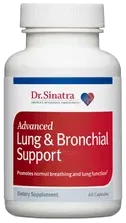
Dr. Sinatra Ultimate Lung & Bronchial Support Review
Dr. Sinatra Ultimate Lung & Bronchial Support is a softgel supplement. The serving size is 2 softgels, and each container holds 30 servings. Per serving, the label lists Thymocid at 1 g, AP-Bio at 200 mg, AlvioLife Herbal Blend at 200 mg, Quercetin at 150 mg and Astragalus root extract at 50 mg. One serving also provides 15 calories, 1.5 g of total fat and 1 mg of cholesterol. The other ingredients printed on the label are gelatin, glycerin, olive oil, sunflower lecithin, yellow beeswax, purified water, turmeric extract and maltodextrin. The directions printed on the label are labeled Doctor's Suggested Use: take 2 softgels once daily with a meal. At 30 servings per container, that daily pattern works out to a month's supply of softgels in each package. The label lists the amounts in the same order as the ingredients appear in the supplement facts panel, so the largest listed amount, Thymocid at 1 g, comes first.
We don’t sell supplements. We help you make decisions and get the best price.
Lowest prices
We may earn a commission from some store links. How we choose.
Finding the lowest prices at the stores now. This takes a few seconds.
Study, Trial or Testing Result Summary
Members Only12 human studies · 8 improved
The main studied ingredient here is quercetin. Members take three servings a day, which is close to the 500 milligrams used in studies. Most of the evidence comes from people with rheumatoid arthritis. A 2025 pooled analysis of 18 studies with 1674 people ranked quercetin the most effective of 10 plant substances for lowering pain [1]. In a placebo-controlled trial, 50 women with rheumatoid arthritis who took 500 milligrams a day for 8 weeks had less morning stiffness, pain, disease activity and inflammation [2]. A review of 27 trials found moderate-strength evidence that quercetin lowered disease activity [3]. A larger pooled analysis found that plant compounds improved disease activity, but it included quercetin in only 2 trials [4]. A small 4-week trial found no clear change [5]. For knee pain, quercetin was tested only inside a combination product, and overall results did not beat placebo [6]. Astragalus is included at 50 milligrams, well below the 480 milligrams that eased knee pain in one trial [7]. A second Astragalus trial did not clearly beat placebo [8]. Thymocid, AP-Bio and the AlvioLife herbal blend have no human studies for joints. The AlvioLife blend's contents and amounts are not listed. Animal and cell studies are never counted.
See all 12 studies →Hide the studies
- Across 47 trials with 3852 people with rheumatoid arthritis, dietary plant compounds (including quercetin in 2 trials) improved disease activity, lowered inflammation and oxidative stress without more side effects.Efficacy and safety of dietary polyphenols in rheumatoid arthritis: A systematic review and meta-analysis of 47 randomiz…
- In a pooled analysis of 18 studies of 1674 people with rheumatoid arthritis, quercetin was ranked as the most effective of 10 plant substances for lowering pain scores.Effects of plant active substances in rheumatoid arthritis-a systematic review and network meta-analysis.
- A review of 27 trials in rheumatoid arthritis found moderate-strength evidence that quercetin, among other supplements, lowered disease activity.Do Interventions with Diet or Dietary Supplements Reduce the Disease Activity Score in Rheumatoid Arthritis? A Systemati…
- In 100 Japanese adults with knee pain taking a combination supplement including 90 mg quercetin glycosides for 16 weeks, overall results did not differ from placebo, but those with mild-to-severe pain had greater knee strength and walking speed.Glucosamine-containing supplement improves locomotor functions in subjects with knee pain: a randomized, double-blind, p…
- In 90 adults aged 18-60 with functional knee pain, 480 mg a day of Astragalus root extract for 28 days reduced knee pain after walking and improved knee function scores, stair climbing and range of motion compared with placebo, with no serious side effects.Astragalus membranaceus extract reduces functional knee joint pain: a randomized, double-blinded, placebo-controlled tri…
- In 50 women with rheumatoid arthritis, 500 mg of quercetin daily for 8 weeks reduced morning stiffness, pain, disease activity and a key inflammation marker compared with placebo.The Effect of Quercetin on Inflammatory Factors and Clinical Symptoms in Women with Rheumatoid Arthritis: A Double-Blind…
- In 40 Japanese adults with knee osteoarthritis, a supplement with 45 mg quercetin glycosides plus glucosamine and chondroitin for 16 weeks improved symptom scores more than placebo.Effect of a dietary supplement containing glucosamine hydrochloride, chondroitin sulfate and quercetin glycosides on sym…
- In 20 people with rheumatoid arthritis, quercetin with vitamin C for 4 weeks did not significantly change inflammation markers or disease severity versus placebo, though pain tended to drop.Effects of antioxidant supplements intervention on the level of plasma inflammatory molecules and disease severity of rh…
- In a multi-center trial of rheumatoid arthritis patients with qi-blood deficiency, a high 30 gram dose of Astragalus within a multi-herb decoction taken with tofacitinib improved symptoms and response rates and lowered inflammatory indicators, though the Astragalus effect could not be separated from the other herbs and the drug.Exploring the dosage-effect relationship and mechanism of Huangqi in Huangqi Guizhi Wuwu decoction for treating rheumato…
- In healthy adults aged 20-70 with knee discomfort, 12 weeks of one daily Astragalus saponin capsule improved step count, knee movement and knee symptom scores compared with the start of the study, but the differences versus placebo in step count and recovery time were not statistically significant.Evaluation of the Effect of Astragalus membranaceus Saponins Administration on Knee Function and Cartilage Biomarkers in…
- In this study, people with rheumatoid arthritis or fibromyalgia who switched to an uncooked vegan diet rich in berries, fruits, vegetables, and sprouts reported less joint stiffness and pain, and the authors say objective measures supported the rheumatoid arthritis improvement. Quercetin was not given as a supplement; its intake was higher only because of the diet's high berry content.Antioxidants in vegan diet and rheumatic disorders.
- In 22 people with rheumatoid arthritis, 3 months of a glucosamine, chondroitin and quercetin glucoside supplement did not improve knee synovial fluid properties or symptoms, while the same product helped people with knee osteoarthritis; there was no placebo group.Effects of an oral administration of glucosamine-chondroitin-quercetin glucoside on the synovial fluid properties in pat…
Review Totals and Summary
Members Only145 reviews · 84% positive
No written reviews read yet.
Biohacker Summary
Members Only6 of 10 recommend it
Of the nine panelists who spoke about quercetin, the main ingredient, most recommend it or use it, though several stay neutral and one warns. The most common reasons are calming mast cells and histamine for allergies, plus longevity, where it is used as a senolytic to clear aging cells; others cite lower inflammation and antioxidant effects. Many point to food sources like capers and red onions, one prefers a phytosome form, and one pairs it with bromelain for absorption. The only dose given is 250 mg once a month for 3 days by one panelist, while another uses it by IV about every 3 months and a third saw no big effects in tests. Two panelists note there are no human trials on its aging effects and that much mast cell evidence comes from animal work, and one warns that quercetin in red wine can impair alcohol metabolism. Astragalus is a smaller ingredient in this product, and the two panelists who mentioned it cite immune support and slower telomere shortening.
See all 9 biohackers →Hide the biohackers
Thomas DeLauer · Quercetin · recommends
- Recommends considering quercetin as a mast cell stabilizer.
- Recommends quercetin from food sources like capers and red onions, stating it inhibits the xanthine oxidase enzyme that produces uric acid.
- Describes quercetin as 'unreal' and notes its high presence in apples and onions, stating it stabilizes mast cells to release less histamine.
- States that capers are the highest quality and most potent source of quercetin, which has huge impacts as an antioxidant and helps upregulate natural antioxidants in the body.
- Recommends quercetin as a polyphenol to be consumed in the evening, stating it's a great one that extends the repair window by inhibiting mTOR and acting as an HDAC inhibitor.
- Personally takes quercetin supplements because quercetin is awesome, and notes it is found in high concentrations in capers and also in maple syrup.
- States that quercetin is currently their favorite supplement in the longevity space, citing its performance properties for recovery, immune benefits, and its role as a powerful senolytic and anti-inflammatory that can be taken at any age.
- Notes that quercetin, found in polyphenol-rich foods like onions, shallots, and capers, can increase in skeletal muscle, allowing glucose to be absorbed into muscle cells without insulin.
- Notes that quercetin, which is in red onion, didn't perform as well as red onion itself in studies but still had a powerful benefit for fat loss.
- Mentions that bee pollen contains quercetin, which can help with the NRF2 pathway and the upregulation of the body's natural antioxidants like superoxide dismutase and glutathione.
- Takes Astragalus during the winter time, not regularly, but when he feels run down, as he finds adaptogens work best when taken only when needed to help regulate the body.
- Used to take Astragalus for recovery and immune function but now warns that adaptogens like Astragalus should not be taken all the time, as they could potentially 'trap' one in a perpetual state of issues if taken when feeling run down.
Siim Land · Quercetin · neutral
- Mentions quercetin as a phytochemical that has been shown to stimulate GLP-1 expression directly, and also increase glucose uptake and insulin sensitivity.
- Uses IV quercetin every 3 months or so as part of his senolytic regimen, followed by a med.
- Mentions that Quercetin is one of the most common senolytics, but there are no human clinical trials on these yet.
- Did not see huge effects from quercetin in their tests.
- Discusses Quercetin as a senolytic supplement with potential longevity effects, but notes there are no human clinical trials yet to confirm its efficacy, placing it in the 'okay' tier based on current limited evidence.
- Mentions quercetin as a senolytic compound that helps eliminate senescent cells, which accumulate during aging and spread inflammation.
- The absorption rate for quercetin is around 1-3%, which is even lower than pure PCC1, explaining why much bigger doses are needed.
- Warns that quercetin, as a senolytic, can block MAOA, potentially raising adrenaline and causing anxiety or poor sleep in some individuals.
- Places Quercetin in the 'okay tier' for longevity, acknowledging its senolytic properties and potential life extension effects in animals, but highlights the limited human data on its effectiveness and the lack of established protocols for its use.
- Notes that quercetin, a flavonoid found in many fruits and vegetables, when combined with a med, was shown to induce senolysis or death of senescent cells in culture.
- Warns that Astragalus Root can inhibit the COMT or MAO genes, effectively 'plugging the drain' for adrenaline and leading to overstimulation, and is often found in thyroid supplements.
- States that astragalus is the source of ingredients like those in TA-65 and 818, and consuming it on a regular basis is not a bad idea for telomere health.
- Highlights astragalus as a significant longevity herb, with one of its main roles being immune modulation.
Dr. Eric Berg · Quercetin · recommends
- Dr. Eric Berg recommends adding more quercetin-rich foods such as red onions, capers, kale, dill, and radishes to your diet for seasonal allergies.
- Explains that the quercetin in onions decreases DHT, a powerful form of testosterone that is often the reason for hair loss.
- Lists quercetin as an epigenetic factor that may help with cancer prevention.
- Recommends quercetin-rich foods like onions, broccoli, and capers, as they support a healthy inflammatory response and help protect cells from oxidative stress for kidney health.
- Suggests that quercetin can be beneficial to counter some of the effects of a hypoxic state in cancer and inflammation.
- Recommends quercetin, found in onions, for kidney health.
- States that quercetin has great properties for the kidney, including anti-inflammatory effects and preventing scar tissue.
- States that quercetin is very beneficial for building up antioxidant reserves.
- Recommends quercetin as a way to get iron out of tissues, with onions being one of the best sources.
- Recommends quercetin, found in onions, as a food that can increase NAD and should be part of a healthy diet for people over 50.
- Astragalus is a natural immunomodulator.
- Recommends choosing one or two herbs, including Astragalus, to help inhibit EBV from coming out of remission.
- Recommends Astragalus, a Chinese herb, to help put the Epstein-Barr virus back into remission.
- Recommends astragalus as an adrenal adaptogen that helps counter stress.
Dave Asprey · Quercetin · recommends
- Recommends quercetin, found in foods like capers and red onions, as a plant compound that directly slows down the demolition crew inside cells, which destroys NAD+.
- Dave Asprey recommends quercetin, a plant compound found in capers and red onions, as it has been shown to directly slow down the demolition crew inside cells that breaks down NAD+.
- Believes quercetin is important for addressing mast cell activation.
- Sees great success with quercetin as a mast cell stabilizer.
- Recommends quercetin as a strategy to decrease inflammation, particularly post-COVID anxiety.
- Dave Asprey mentions that supplements like quercetin rival pharmaceuticals in keeping uric acid under control.
- Mentions that something as simple as quercetin could make a big difference in IQ if histamine is holding it down.
- Mentions that quercetin has anti-parasitic properties and is useful.
- Dave states that pure quercetin is not well absorbed orally because it never existed in isolated form in nature, making rutin a better option.
- Lists quercetin as a mass cell stabilizer that works well for treating Mass Cell Activation.
- Mentions that astragalus is used in some of their products, noting that in huge amounts it is a very advanced telomere lengthening supplement, and at lower doses, it is a well-known adaptogen.
- Mentions that astragalus is added to Flying Embers products during fermentation and acts as an adaptogen to help turn stress responses on and off more effectively.
- Discusses Astragalus as an adaptogen for stress and sex.
- Lists astragalus as an ingredient in Mighty Gum, which is recommended for hacking biology.
Dr. Mark Hyman · Quercetin · uses
- States that he uses Quercetin, a flavonoid and one of the best-studied natural mast cell stabilizers, for allergies and as a longevity compound, noting it pairs well with bromelain for absorption.
- Puts astragalus, a Japanese herb, into his chicken soup because it has a huge effect on the immune system and improves immune response.
- Mentions that HTB Immune Energy Chews contain over 100 immune active polyphenols like quercetin, which are studied for supporting healthy immune balance and longevity.
- Notes that quercetin is one of the immune active polyphenols found in sprouted Himalayan tardy buckwheat, studied for supporting healthy immune balance and longevity.
- Dr. Mark Hyman, agreeing with the guest, mentions Quercetin as a supplement that can help with modifying the histamine response.
- Recommends quercetin, a natural mast cell stabilizer and plant bioflavonoid, to help stabilize mast cells that release histamine, which causes allergy symptoms.
- Recommends quercetin, a polyphenol from onion skins, as part of a 4 or 5-day senolytic intervention to kill zombie cells and lower the burden of toxic, pro-inflammatory cells.
- Uses Himalayan tartary buckwheat sprout powder daily, which is high in quercetin, and recommends quercetin for its antiviral, anti-inflammatory, anti-cancer, and antioxidant properties, noting its effectiveness against COVID-19 and its ability to reverse biological age.
- Recommends quercetin, stating it is a mast cell stabilizer, helps the body excrete uric acid, is great for longevity, works on AMPK, and can help lower uric acid and improve fatty liver.
- Recommends focusing on foods naturally rich in quercetin, such as onions and apples, and also adding quercetin supplements, due to their natural a med qualities.
- Recommends pairing high-dose IV vitamin C and L-lysine with a lot of antiviral supplements, including quercetin, to have as much antiviral fighting capacity on a daily basis as possible.
- Recommends astragalus for immune system issues and helping repair a leaky gut, noting it's a top herb in Chinese medicine and a great example of one that strengthens the body's system to fight off viruses.
- Recommends Astragalus as a great example of an herb that strengthens one's own system to better fight off a virus.
- Recommends astragalus for long-term prevention and strengthening of the immune system, noting its ability to help repair a leaky gut and support the gut-related immune system.
Ben Greenfield · Quercetin · uses
- States that quercetin inhibits proteasome, which has an effect on Nrf2 activation.
- Mentions Astragalus as one of the Chinese herbs used, noting its potential in decreasing the rate at which telomeres shorten.
- Mentions quercetin or other senolytics to clear senescent cells as a recommended intervention on the True Age test.
- States that quercetin, a powerful flavonoid, is found in fruit tree leaves and was named after its inclusion in oak tree leaves.
- Mentions quercetin as a polyphenol that can confer benefits when consumed.
- Includes quercetin in their Lumat blue product along with methylene blue, phycocyanin, riboflavin, green tea extract, and lutein.
- Considers astragalus a really good adaptogen to use with lunch to help with afternoon naps.
- Ben Greenfield uses Astragalus as an adaptogen to help him nap.
- Ben Greenfield mentions quercetin as an exercise mimetic.
- Mentions that a report for a client with high gut inflammation suggested using quercetin.
- Mentions quercetin as an example of a senolytic agent that helps get rid of senescent cells.
- Ben mentions reading up on a book while lying in bed at night with astragalus tincture as a resource for learning about plants.
- Expresses caution about quercetin, noting it is an anti-cancer drug with antimitotic activities, and questions how hard one should push the body for extra years compared to living a good lifestyle.
- Recommends layering in quercetin to support antioxidant stores, especially for those with high oxidative loads.
Peter Attia · Quercetin · warns
- Quercetin, a bioactive flavonoid present in red wine, can impair alcohol metabolism.
- Notes that Quercetin is often given in combination with a med as an anti-senescent drug.
- Mentions that quercetin, found in fruits and onions, was one of the first two plant molecules discovered to activate human sirtuin one, alongside piceatannol, before resveratrol was identified.
- Takes 250 mg of Quercetin once a month for 3 days for longevity.
- Identifies Quercetin as a flavonoid compound and senolytic, often used with a med, and details its dosage in a pilot study for mild cognitive impairment or early-stage AD.
Dr. Rhonda Patrick · Quercetin · neutral
- Discusses a hypothesis that quercetin 3-glucuronide, a derivative of quercetin present in red wine, may cause red wine headaches by inhibiting an enzyme responsible for metabolizing acetaldehyde.
- Discusses quercetin, a flavonoid found in various plants, noting its reported ability to block the entry of SARS-CoV-1 in host cells and its potential role as a zinc ionophore, with clinical trials for SARS-CoV-2 beginning.
- Mentions quercetin, found in onions, as a plant polyphenol that has hormetic effects.
- Has supplemented with quercetin, particularly during COVID-19 for its antiviral properties, and now has the phytosome form from Thorne, which she might take again due to its anti-inflammatory and senescence effects.
- States that flavonoids like quercetin inhibit mast cell activation and histamine release, but much of the evidence is from animal work.
- Dr. Rhonda Patrick mentions that quercetin has been reported to block the entry of SARS-CoV-1 into host cells.
- Quercetin functions as a polyphenolic antioxidant, donating electrons and upregulating endogenous antioxidant enzymes to neutralize ROS.
- Notes that quercetin, found in yellow onions, activates FOXO3, which is associated with longevity.
- Extracts of the astragalus root, the key ingredient in the dietary supplement TA-65, promoted telomerase activity and increased telomere length as much as 40 percent in humans.
Andrew Huberman · Quercetin · uses
- Takes quercetin supplements, noting that it activates sirtuins and helps kill senescent cells, contributing to longevity.
RAL Summary
Members OnlyTier 2 for Joints and Mobility
Human studies of quercetin, used here at close to the studied dose across three daily servings, show reduced pain and disease activity in rheumatoid arthritis [1][2], and 82% of 155 reviews are positive.
Take 3 servings a day (6 softgels) to match the dose that worked in the studies.
Where the evidence disagrees: 2 of the 12 human studies found no effect.
More Details
Members OnlyBody systems · Combine with · Possible side effects
Body systems: Musculoskeletal system, Immune system
Combine with: For joint health, quercetin is often paired with bromelain, because bromelain is thought to help quercetin absorb. Quercetin is also often paired with vitamin C, since the two are commonly grouped for their shared antioxidant role. Astragalus is often paired with glucosamine and chondroitin, which act on the cartilage-building pathway that joint tissue relies on. Turmeric curcumin is often paired with black pepper extract, because piperine helps curcumin absorb.
Possible side effects: The studies reported no extra or serious side effects from quercetin or Astragalus. No written reviews could be read.
Supplement Facts
Thymocid 1 g · AP-Bio 200 mg · AlvioLife Herbal Blend 200 mg
| Calories | 15 | |
| Total Fat | 1.5 g | |
| Cholesterol | 1 mg | |
| Thymocid | 1 g | † |
| AP-Bio | 200 mg | † |
| AlvioLife Herbal Blend | 200 mg | † |
| Quercetin | 150 mg | † |
| Astragalus root extract | 50 mg | † |
Other ingredients: Gelatin, Glycerin, Olive Oil, Sunflower Lecithin, yellow Beeswax, Water, Purified, Turmeric Extract, Maltodextrin.
Directions: Doctor's Suggested Use: Take 2 softgels once daily with a meal.
Barcode (UPC) 810047390404 · Label source: NIH label database · Report a label change
Show entire label
More joint health products
Members OnlyThe highest ranked for the same goal
Read more
Our articles on this subject
- Natural Remedies for Joint Pain and Inflammation: What the Evidence SupportsArticle · Oct 23, 2026
- Fish Oil vs Krill Oil: Which Omega-3 Is Worth It?Article · Nov 10, 2026
Graded November 18, 2026 by the Reverse Age Lab evidence engine, from human studies, real reviews and our biohacker panel. How we grade. Is this medical advice? No. Rala organizes the published evidence; go over any change with your doctor, especially if you take meds.
Privacy policyConsumer health dataAffiliate disclosureTermsBrand and legal noticesDo Not Sell or Share My Personal InformationCookie settings