
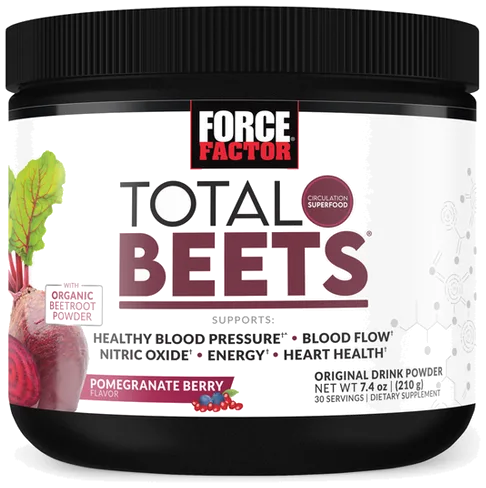
Force Factor Total Beets Review
CIRCULATION SUPERFOOD POWERHOUSE. Total Beets original powder is a great-tasting, heart-healthy drink mix that contains natural beetroot and innovative NO3-T nitrates to boost nitric oxide production and support healthy blood flow. This helps you experience more energy, endurance, and stamina without having to use heart-straining stimulants. It is easier than ever to harness the power of this natural circulation superfood and fully Unleash Your Potential. The page graphics list key benefits for healthy blood pressure, circulation, nitric oxide, energy and endurance beside a beet drink. A premium quality panel shows beetroot powder with a spoon and states organic beetroot, NO3-T nitrates and caffeine free. Ways to enjoy it are listed as a morning power-up, before workouts and an afternoon boost, and the page shows it in smoothies and shakes. Each serving is one scoop (7g) mixed with 4 to 8 fl oz of cold water or a beverage of your choice, with one serving per day, and the container holds approximately 30 servings. Nutrition per serving includes 10 calories, 2 g total carbohydrate, 340 mg potassium as dipotassium phosphate, and 5000 mg Total Beets Superblend, made up of 3000 mg beet powder (root) and 2000 mg betaine nitrate as NO3-T. The other ingredients are natural flavors, maltodextrin, silicon dioxide, citric acid and stevia. The page lists the flavours Pomegranate and Black Cherry. Force Factor branding on the page describes smart science, quality nutrition, ultimate convenience, a made in the USA claim, and a CarbonNeutral certified company status. Buy links are provided for Amazon, Walmart, iHerb, Vitamin Shoppe, Walgreens and CVS. The page also promotes Total Beets Ultimate Heart Health chews and capsules with CoQ10, which are separate products from this powder and are not the product described here.
We don’t sell supplements. We help you make decisions and get the best price.
Lowest prices
We may earn a commission from some store links. How we choose.
Lowest cost per month first, in stock, at 1 serving a day. Checked Nov 4.
- TargetLowest$14.99 a bottle$14.99/moBuy at Target (opens in a new tab)
- iHerb$15.98 a bottle$15.98/moBuy at iHerb (opens in a new tab)
- Walmart$19.98 a bottle$19.98/moBuy at Walmart (opens in a new tab)
Also at: Force Factor · Vitacost · CVS · The Vitamin Shoppe
Study, Trial or Testing Result Summary
Members OnlyHuman studies
We found no human studies on blood pressure for the ingredients in this product, so there is no research to report on whether it lowers blood pressure. The store listing describes a powder with 3000 milligrams of beet root powder and 2000 milligrams of betaine nitrate per scoop, along with potassium. The label we hold lists only maltodextrin, a carbohydrate filler, at 6.7 grams per serving. The actual amounts of the active ingredients could not be confirmed from the label. Buyers rate it highly: about 86 percent of 2267 counted reviews are positive and 6 percent are negative. We could not read any written reviews ourselves, so we cannot say what those reviewers mention. Our separate summary of store reviews says people often report more energy, describe it as good for the heart and blood flow, and like the fruit flavor. One reviewer said it helped with high blood pressure. Taken together, reviews are favorable, but there is no study evidence given here to back a blood pressure benefit. Members should treat any blood pressure effect as unproven. Animal and cell studies are never counted.
Review Totals and Summary
Members Only19,130 reviews · 89% positive
Force Factor Total Beets has garnered approximately 19130 ratings across various stores, with a strong majority of feedback being positive; 67% of star-rated reviews give 4 or 5 stars. This supplement generally receives praise for its perceived health benefits, though recent changes to its formulation have led to some dissatisfaction regarding taste and texture. **What it did for buyers** Many customers report positive health outcomes from taking Total Beets. Users frequently mention increased energy levels and a general feeling of improved well-being. Some specifically note benefits for cardiovascular health, including better circulation and antioxidant support. A significant number of users, under medical supervision, have seen their "blood pressure and heart rate returned to within normal range," highlighting its effectiveness for managing high blood pressure. One user stated, "I like how it makes me feel," while another found "after a week or so I had more energy." **What buyers complain about** The most common complaints revolve around recent changes to the product's formula. Long-time users express disappointment, noting that the "company has changed the flavor" and texture, often for the worse. These changes have introduced "unpleasant smell and after-taste," with some describing the new "smell, taste AND texture are terrible." Another concern raised is the potential for high sodium intake from supplements in general, prompting a reminder to "be sure to read the supplement labels" carefully. Occasional issues with product availability or receiving the wrong form (e.g., chews instead of capsules) are also mentioned. **Taste, smell, and form** Feedback on taste is mixed and highly dependent on the version consumed. Some customers love the "strawberry" or "berry taste," finding it "so wonderful you want to eat more." However, those who have experienced formula changes often describe the new flavors as "synthetic" or "terrible," and the texture as "stickier." The product is primarily available as chewable tablets, which some find "easy to take" and convenient, while others express a preference for capsules. **Value for money** One customer noted switching to this brand "for the price" and found it comparable to other brands they had used previously, suggesting it offers good value. **Who it suits and who it did not** Total Beets appears to suit individuals seeking general health improvements, increased energy, and cardiovascular support, especially those managing high blood pressure under a doctor's care. It is also well-received by those who appreciate the convenience of chewable supplements. However, it may not be suitable for those highly sensitive to changes in taste and texture, particularly with newer formulations. Individuals needing to monitor their sodium intake closely should also review the supplement facts carefully. Long-term users who preferred the original formula are among those least satisfied with recent changes.
Biohacker Summary
Members Only9 of 10 recommend it
The panel's main ingredient for this product is not clearly defined, since every ingredient is listed as a smaller one, but potassium drew the most comment, with nearly all ten speaking about it. Most of them recommend or use it: several drink electrolyte mixes with sodium, magnesium and potassium first thing in the morning and during exercise for hydration, while others recommend getting enough because most people eat too much sodium and too little potassium, and they link it to healthy blood pressure, muscle and nerve function, and heart rhythm. Some prefer getting potassium from foods like bananas, potatoes and other fruit and vegetables rather than supplements, and one gave a daily smoothie amount of about 5,800 milligrams. Cautions came from two panelists: too much potassium from supplements can be dangerous, and it is risky for people with kidney disease or conditions that raise potassium levels, so they advise asking a physician; another noted that meds can flush potassium out. Beet is a smaller ingredient in this product, and three panelists use it as juice, powder or hummus, mainly to support nitric oxide before workouts.
See all 10 biohackers →Hide the biohackers
Dr. Eric Berg · Potassium · recommends
- Recommends potassium as an important electrolyte, noting that most people get less than half of the 4700 mg RDA.
- States that people need more potassium than any other mineral, yet most people aren’t getting enough.
- Recommends beet tops as a low-carb, potassium-rich food.
- Explains that potassium is essential for peristalsis, the pumping action through the colon, and without it, things can sit there, leading to constipation.
- Explains that the normal requirements for potassium are 4,700 mg every single day, and that very few people get half of that amount. They describe potassium's role in the sodium potassium pump, which is essential for cellular electricity, muscle contraction, and heart function. Deficiency can lead to tiredness, muscle cramps, heart palpitations, or rising blood pressure.
- Recommends increasing potassium to restore balance and support healthy blood pressure.
- States that potassium is the most important electrolyte and that most people are not getting enough of it, needing around 4,700 mg daily, or even more, to avoid issues like fatigue, muscle cramps, heart palpitations, high blood pressure, and fluid retention.
- Dr. Eric Berg states that potassium is essential for health, supporting healthy muscles, nerves, and heart function, but warns that getting too much, especially from supplements, can be dangerous.
- Dr. Eric Berg states that most people are getting nowhere near enough potassium to balance the amount of sodium they’re already eating, implying a recommendation for increased potassium intake.
- Explains that potassium relaxes blood vessels, keeps elasticity in arteries, lowers adrenaline, supports the sympathetic nervous system, protects the endothelial layer of arteries, increases nitric oxide, and keeps insulin receptors sensitive.
- Was very successful in practice using potassium for hypertension, noting that bodies need 4700 mg of potassium every single day.
- Mentions that beet tops have 1,300 mg of potassium.
- States he added 500 mg of betaine to his creatine product because it helps the body make more creatine.
- Recommends betaine hydrochloride for constant bloating and gas, especially if it's due to low stomach acid.
Dave Asprey · Potassium · recommends
- Explains that potassium helps open a gate, allowing creatine to slip through and cross the blood-brain barrier more effectively.
- Recommends taking betaine HCL (stomach acid) with meals to improve protein absorption, as stomach acid decreases with age.
- Recommends having more potassium during a fast to increase mineral intake.
- States that people who are salt-sensitive hypertensives usually need more potassium.
- Explains why electrolytes, especially sodium, potassium, and magnesium, are foundational for recovery.
- States that potassium is a really important electrolyte for everyone, but the demand is significantly higher for people with nervous system, immune system, and endocrine system dysregulation.
- Recommends using potassium citrate, if tolerated, to raise urinary citrate and block crystal formation.
- Notes that the potassium in the Vineia blood flow hydration product is from coconut water.
- Takes stomach acid, betaine HCL, and enzymes to help digest food, which he says speeds healing and resilience.
- States that if you take Pepsid, you have to take betaine and enzymes to counteract the digestion-ruining effects, and also suggests taking a little betaine with a meal to help with nutrient absorption.
- Mentions that atrial fibrillation has to do with mineral status, including potassium.
- Takes a lot of potassium.
- Recommends lots of potassium citrate to help remove oxalates from the body.
- Recommends always taking Betaine HCL, which is stomach acid, with food when taking Pepcid AC for long COVID protocols, as it's necessary for the Pepcid to work effectively.
Thomas DeLauer · Potassium · recommends
- Recommends Element electrolytes, noting they are focused on sodium first, then potassium, then magnesium, helping with sending signals and hydrating tissue.
- Uses Element's cans which contain 100 milligram potassium, finding that electrolytes help his workout performance.
- Uses Element's 100 mg potassium cans first thing in the morning to prime his day and help with workout performance.
- Recommends Element's ready-to-drink sparkling electrolyte drinks as a low or zero-calorie soda replacement that provides 1,000 milligrams of sodium, 200 milligrams of potassium, and 60 milligrams of magnesium.
- Uses Element Electrolytes for about eight years, noting they contain 1000 mg sodium, 200 mg potassium, and 60 mg magnesium, and help curb appetite without adding many calories.
- Personally drinks Element's pink lemonade or sparkling drinks, which contain 1,000 mg sodium, 200 potassium, and 60 magnesium, to hydrate and feel satiated, curbing hunger without stopping the ghrelin response.
- Suggests that beet juice can be a nutritional way to achieve similar benefits to nitric oxide supplements for improving tissue quality, though it may not be as easy.
- Sometimes pivots to straight potassium supplementation when generally depleted.
- Uses Element ready-to-drinks as a perfect electrolyte blend to start his day, noting that they contain 500 mg of sodium, 100 mg of potassium, and 30 mg of magnesium, and are slightly carbonated.
- Mentions potassium as an important electrolyte but suggests there's another layer to performance beyond just focusing on it.
- States that potassium is important for hydration, skin repair, and fluid balance in the skin, and recommends countering sodium intake with potassium.
- Would start taking trimethylglycine (TMG), also known as betaine, due to increasing evidence of its benefits for insulin resistance and its ability to increase fat oxidation.
- Recommends TMG (trimethylglycine or betaine) for improving body composition and insulin sensitivity, and for supporting methylation pathways that keep the endothelium healthy, complementing the shear stress benefits of walking.
- Recommends TMG, also known as betaine, to aid the liver's ability to clear excess cortisol from the system.
Ben Greenfield · Potassium · uses
- Says he is drinking LMNT, which contains sodium, potassium, and magnesium, and states that he actually drinks this stuff.
- Recommends Celtic Sea Salt's new electrolyte drink 'Hydrate' for replenishing electrolytes and trace minerals lost through sweat, noting it contains 70 naturally occurring trace minerals, magnesium, taurine, and potassium, with no added sugar, artificial colors, or synthetic ingredients.
- Notes that sodium nitrate is common in beet root extract.
- Recommends adding potassium sulfate to a Morasco cold plunge.
- Mentions that potassium can be helpful for blood pressure but also risky for people with kidney disease or other conditions prone to elevated potassium levels, advising consultation with a physician.
- Recommends beet juice as a nitrate-rich food that converts into nitric oxide.
- Mentions beets or beet juice as natural sources to increase blood flow for pre-workout.
- Warns of potassium deficiency on a carnivore diet if a lot of octopus and salmon are not consumed.
- Ben has had better results with beet powder for erections.
- Recommends taking trimethylglycine, also known as betaine, beforehand with NAD IVs to stave off gastric distress and sympathetic nervous system stimulation.
- Highlights the importance of potassium for numerous body benefits, noting that Vascanox is a good source of potassium nitrite.
- Ben has always had better results with nitric oxide supplements like beet powder.
- Anthony plans to do half sodium citrate and half potassium citrate to get the citrate for pH balancing and add more potassium.
- Recommends betaine hydrochloride, three a day, one per meal, to help with digestion and nutrient absorption.
Dr. Mark Hyman · Potassium · warns
- Warns that potassium bromate, a dough conditioner banned in the EU, UK, and Canada, is still allowed in U.S. bread.
- States that potassium plays a critical role in nerve signaling and muscle contraction, especially in the heart, and low levels can lead to dangerous irregular heart rhythms.
- Notes that meds flush out potassium.
- Dr. Mark Hyman designed 'The World's Smartest Smoothie' using organic ingredients, including Organic Beet Juice.
- States that with potassium, water can fully cross the cell membrane and get inside where it's needed for intracellular hydration.
- Recommends using targeted electrolyte support, advising to look for products with meaningful amounts of sodium, potassium, and magnesium, low sugar content, and avoidance of artificial colors, flavors, and sweeteners.
- Warns that potassium bromate, a chemical dough conditioner, has been linked to cancer, oxidative stress, DNA damage, and reproductive harm in animal studies.
- Warns that electrolyte drinks, while marketed for hydration, are loaded with high-glycemic sugars, synthetic potassium salts, and artificial dyes that can trigger insulin resistance, blood sugar crashes, and inflammation.
- Recommends promoting potassium enriched low sodium salts as a great life hack, stating that changing the brand of salt used at home can reduce the risk of heart attack, stroke, or early death.
- Includes beet as a good carbohydrate source in his evening carb refeeding.
- Warns that if potassium is trailing high, it's not necessarily about needing a banana, but rather a systematic marker indicating acute or chronic fatigue, overtraining, or sympathetic overdrive.
- Notes that 96% of the US population does not meet the adequate intake for potassium, and that the ideal ratio of potassium to sodium should be 10 to 1, but it's currently the other way around. They explain that potassium plays an important role in regulating blood pressure.
- Uses Betaine HCl to provide stomach acid, which helps digest food and reduce SIBO.
- Suggests that betaine hydrochloride can be used to acidify the digestive system, helping to relieve digestive problems associated with chronic pancreatic insufficiency.
Siim Land · Potassium · neutral
- Lists potatoes and fruit as sources of Potassium.
- Notes that bananas have potassium but there are at least 8 other foods with more potassium than bananas.
- States that potassium is the most abundant intracellular cation that helps to maintain intracellular fluid volume and that without it, one greatly increases the risk of hypertension, cardiovascular disease, diabetes, and stroke.
- States that potassium lowers blood pressure.
- Takes nitric oxide generating beet powder in the morning to increase nitric oxide production before working out and going into the sauna.
- Grinds up fermented beets and puts them on soups and salads, trying to slowly move towards eating a beet a day as suggested in Dr. Kara Fitzgerald's Younger You program for methylation and DNA methylation age.
- Travels with Upgraded Formulas' potassium, manganese, boron, and zinc, considering them fundamental minerals he is usually deficient in.
- Notes that potassium bromate is banned in the EU due to being a possible carcinogen, while it is allowed in the US as a whitening and raising agent in bread products.
- Found that adding 198 MGS of potassium to his diet within 24 hours stopped his frequent urination, which had been occurring 30 to 50 times a day.
- Recommends getting trimethylglycine (TMG), also known as betaine, from whole foods like beetroot, shrimps, spinach, wheat germ, wheat bran, mushrooms, and various vegetables to support DNA methylation.
- Recommends TMG (trimethylglycine or betaine) for longevity and DNA methylation, especially for poor methylators who might need up to 2000-3000 milligrams per day, while those with good methylation genes might not need to supplement if they eat TMG-rich foods.
- States that betaine, or trimethylglycine, has been shown to decrease plasma homocysteine levels, with supplementation of at least 4 grams a day for a minimum of six weeks being effective.
- Recommends potassium for muscle cramps, noting that a Carnivore diet may lack it, and suggests adding fruit or mineral waters.
- Mentions potassium as an electrolyte needed to help with insulin sensitivity, alongside magnesium and sodium.
Peter Attia · Potassium · recommends
- States there is some evidence that increasing dietary potassium through potassium-rich foods like bananas and potatoes, rather than supplements, can lower blood pressure.
- Notes that evolutionary ancestors consumed much more potassium than modern humans and suggests adding it back to the diet, ideally through whole foods.
- Mentions taking magnesium and potassium in addition to salt for minerals and electrolytes.
Andrew Huberman · Potassium · uses
- Uses Element, an electrolyte drink with sodium, magnesium, and potassium in correct ratios and no sugar, to ensure adequate hydration and electrolytes, especially when starting days fast or during physical exercise.
- Uses Element, which contains potassium in the correct ratios, to ensure proper hydration and electrolyte intake for brain and body function.
- Mentions potassium as an electrolyte.
- Uses Element, an electrolyte drink with sodium, magnesium, and potassium in correct ratios and no sugar, to ensure adequate hydration and electrolytes, drinking it first thing in the morning and during physical exercise.
- Uses Element, an electrolyte drink with sodium, magnesium, and potassium in correct ratios and no sugar, to ensure he is hydrated and has sufficient electrolytes. He drinks it first thing in the morning and during physical exercise, especially on hot days.
- Uses Element, an electrolyte drink with sodium, magnesium, and potassium but no sugar, to ensure adequate hydration and electrolytes, especially when waking up and during exercise.
- Uses LMNT, an electrolyte drink with sodium, magnesium, and potassium in correct ratios and no sugar, to ensure adequate hydration and electrolytes for brain and body function, especially when starting his day fast or during physical exercise.
- Uses Element, which contains potassium, for proper hydration and electrolyte balance.
- Ensures adequate intake of sodium, magnesium, and potassium, which are vital electrolytes for the functioning of all body cells, especially neurons, by drinking Element.
- Uses Element, an electrolyte drink with sodium, magnesium, and potassium, to ensure adequate hydration and electrolytes for optimal brain and body function, especially when waking up and during physical exercise.
- Discusses betaine as a potential alternative for creatine non-responders, taken at 1 to 3 grams per day, which helps with amino acid synthesis and energy shunting.
- Mentions that there is some evidence that betaine, also called trimethylglycine, can improve lean mass and power output.
- Notes that many people who have difficulty adjusting their gut pH and microbiota have benefited from taking betaine HCL pepsin tablets or capsules during meals, starting with one or two and experimenting to find a comfortable level.
- Discusses beet powder and beet juices as compounds that increase nitric oxide, leading to vasodilation and improved blood delivery for long bouts of endurance work, noting that some people like them while others don't feel good taking them.
Dr. Rhonda Patrick · Potassium · recommends
- Recommends getting enough potassium, noting that most people get too much sodium and not enough potassium.
- Mentions betaine or trimethylglycine as something that may improve power output during exercise.
- States that maintaining a high potassium intake is important for hypertension.
- Recommends getting enough potassium from veggies, bananas, and fruit because the body cares about the sodium-potassium ratio.
- Dr. Patrick states that her smoothie, containing avocado and banana, has around 5,800 milligrams of potassium, which meets the adequate intake requirement for maintaining normal blood pressure and decreasing the risk of kidney stones.
- Dr. Rhonda Patrick states that eating more potassium, not less sodium, is the key to healthy blood pressure.
Bryan Johnson · Beet · uses
- Eats beet hummus for breakfast.
- Recommends potassium at 200 to 400 mg daily for women during the luteal phase.
RAL Summary
Members OnlyTier 4 for Blood Pressure
Tier 3 needs some study support, but no human studies on blood pressure were given for this product's ingredients, so the evidence is thin and supports tier 4. So it is graded Tier 4, lower than the rules alone gave.
- Emerging: not enough evidence to rank higher yet.
- No human studies on this goal for its ingredients.
More Details
Members OnlyBody systems · Combine with · Possible side effects
Body systems: Cardiovascular system
Combine with: To further support heart health and blood pressure alongside Total Beets, consider combining it with magnesium, which plays a crucial role in blood vessel relaxation and overall cardiovascular function. Omega-3 fatty acids are also beneficial for maintaining healthy blood pressure and reducing inflammation. Additionally, CoQ10 can support cellular energy production in the heart and contribute to cardiovascular well-being.
Possible side effects: No major side effects reported. Some reviewers found the beet taste too strong.
Supplement Facts
Total Beets® Superblend 5000 mg · Organic Beet Powder 3000 mg · Betaine Nitrate 2000 mg
| Calories | 0 | |
| Total Carbohydrate | 1 g | 0% |
| Sodium (as Trisodium Citrate Dihydrate) | 150 mg | 6% |
| Total Beets® Superblend | 5,000 mg | † |
| Organic Beet (Beta vulgaris) Powder (root) | 3,000 mg | † |
| Betaine Nitrate (as NO3-T®) | 2,000 mg | † |
Other ingredients: Natural Flavors, Silica, Stevia Leaf Extract.
Label source: Forcefactor · Report a label change
Sizes and barcodes: 90 Vegetable Capsules, UPC 8 10126 66182 1 (on market); 120 Tablet(s), UPC 8 18594 01547 4 (on market)
Show entire label
More blood pressure products
Members OnlyThe highest ranked for the same goal
Read more
Our articles on this subject
- How to Lower Diastolic Blood Pressure for LongevityArticle · Sep 17, 2026
- DASH Diet for High Blood Pressure: What It Lowers, What to Eat, and How to StartArticle · Sep 19, 2026
Graded October 26, 2026 by the Reverse Age Lab evidence engine, from human studies, real reviews and our biohacker panel. How we grade. Is this medical advice? No. Rala organizes the published evidence; go over any change with your doctor, especially if you take meds.
Privacy policyConsumer health dataAffiliate disclosureTermsDo Not Sell or Share My Personal InformationCookie settings