
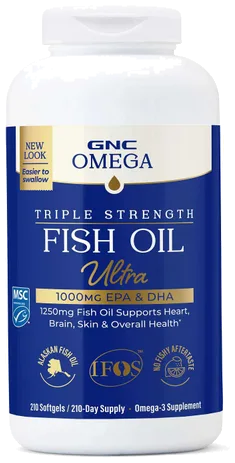
GNC Preventive Nutrition Triple Strength Fish Oil Review
GNC Triple Strength Fish Oil Ultra provides 1000mg of EPA and DHA in one softgel, aimed at general omega-3 support for overall health. The page describes it as a purified fish oil softgel with 5-in-1 benefits, supporting heart, brain, skin, eye, and joint health, and says that research suggests omega-3s may also support muscle health and a balanced mood. The fish oil is made from wild-caught, deep-ocean Alaskan fish, described as sustainably sourced and purified to reduce contaminants including mercury. The fish oil is in ethyl ester form. Each softgel contains natural lemon flavor, which the page says is intended to help avoid a fishy aftertaste and help control fishy burps, so that only one softgel is needed per day to deliver full support. The label lists 15 calories and 1.5g of total fat per softgel, with 1250 mg of fish oil, 1000 mg of total EPA plus DHA, 713 mg of EPA, and 287 mg of DHA. The product is described as suitable for men and women, as gluten free, with no artificial colors or flavors, and as porcine free. The fish oil is said to meet the Marine Stewardship Council environmental standard for fishing and to be certified by the International Fish Oil Standards program for quality, safety, and purity. The page also highlights that the softgel is smaller and easy to swallow. The FAQ explains that triple strength fish oil delivers a higher concentration of EPA and DHA per serving, so more omega-3s come in fewer softgels. It notes that the new version keeps the same level of EPA and DHA as the previous formula while adding upgrades in quality, sustainability, and experience. The page advises taking one lemon-flavored softgel daily with food, keeping it out of reach of children, and storing it in a cool, dry place. It also states that the product is distributed by GNC Holdings, LLC, in Pittsburgh, Pennsylvania, and that the statements have not been evaluated by the Food and Drug Administration. The product contains fish (Alaska Pollock) and cannot be shipped to Canada or Japan.
We don’t sell supplements. We help you make decisions and get the best price.
Lowest prices
Finding the lowest prices at the stores now. This takes a few seconds.
Products with nearly the same formula (Matched on the main ingredients)
Study, Trial or Testing Result Summary
Members Only65 human studies · 30 improved
This fish oil gives about 647 milligrams of eicosapentaenoic acid and 253 milligrams of docosahexaenoic acid a day. Both are well below the doses that worked in studies, so expect smaller effects. Across 90 trials with about 72,600 people, omega-3 fats lowered triglycerides and total cholesterol minus good cholesterol roughly in step with the dose, most clearly above 2 grams a day. Effects on bad and good cholesterol were uneven [1]. Large reviews of 79 and 86 trials found triglycerides fell by about 15 percent, with little or no change in other cholesterol measures [2][3]. In adults with high triglycerides, 4 grams a day of purified eicosapentaenoic acid lowered leftover cholesterol in triglyceride-rich particles by about 26 to 30 percent [4]. At lower doses, bad cholesterol tended to rise [5]. One review found a slight rise in bad cholesterol of 2 points or less [6]. Docosahexaenoic acid alone lowered triglycerides but raised total, bad and good cholesterol in one trial [7]. Animal and cell studies are never counted.
See all 65 studies →Hide the studies
- In 86 trials with about 162,800 adults followed for 1 to 7 years, extra long-chain omega-3 (EPA and DHA) had little or no effect on most lipids but lowered triglycerides by about 15% in a dose-dependent way.Omega-3 fatty acids for the primary and secondary prevention of cardiovascular disease.
- In 17 trials with about 141,000 patients, this analysis looked at heart events rather than cholesterol; it reported no cholesterol results, and combined EPA+DHA lowered cardiovascular death compared with usual care.Eicosapentaenoic Acid for Cardiovascular Events Reduction- Systematic Review and Network Meta-Analysis of Randomized Con…
- In 79 trials with about 112,000 adults followed for 1 to 6 years, long-chain omega-3 slightly lowered triglycerides and raised HDL (good) cholesterol.Omega-3 fatty acids for the primary and secondary prevention of cardiovascular disease.
- In 79 trials with about 112,000 adults followed for 1 to 6 years, long-chain omega-3 did not change cholesterol overall but lowered triglycerides by about 15% in a dose-dependent way.Omega-3 fatty acids for the primary and secondary prevention of cardiovascular disease.
- Across 90 trials with 72,598 people, omega-3 intake lowered triglycerides and non-HDL cholesterol almost in proportion to the dose (especially above 2 g a day), while LDL and HDL cholesterol showed J-shaped curves.Association Between Omega-3 Fatty Acid Intake and Dyslipidemia: A Continuous Dose-Response Meta-Analysis of Randomized C…
- In 21 trials of about 1,950 adults with metabolic syndrome features, marine omega-3 cut triglycerides substantially (up to about 57 mg/dL at high doses), but LDL cholesterol rose at low doses.Marine-Based Omega-3 Fatty Acids and Metabolic Syndrome: A Systematic Review and Meta-Analysis of Randomized Controlled …
- In 30 trials with 1,368 people, diets with a low omega-6 to omega-3 ratio lowered triglycerides and raised HDL cholesterol, with EPA and DHA showing the clearer effects on both.Effect of low-ratio n-6/n-3 PUFA on blood lipid level: a meta-analysis.
- In 18 trials with 1,018 people with rheumatoid arthritis, omega-3 supplements lowered triglycerides and raised blood EPA and DHA levels.Effects of omega-3 supplementation on lipid metabolism, inflammation, and disease activity in rheumatoid arthritis: a me…
- This review of 61 trials found marine oils lower triglycerides and raise HDL cholesterol, but also raise LDL cholesterol slightly (2 mg/dL or less).Omega-3 Fatty Acids and Cardiovascular Disease: An Updated Systematic Review.
- This broad review of non-a med lipid drugs notes icosapent ethyl is approved as a triglyceride-lowering add-on to meds, but gives no EPA-specific cholesterol numbers.Read the study on PubMed (33836639) →
- Across 17 trials in people with metabolic syndrome, omega-3 doses above 1 g for at least 3 months lowered triglycerides by 7% to 25%, but doses of 3 g a day or more may raise LDL cholesterol and no clear effects were seen on other markers.The effect of EPA and DHA on metabolic syndrome patients: a systematic review of randomised controlled trials.
- In 13,078 a med-treated people at high heart risk, 4 grams a day of EPA plus DHA did not reduce major heart events compared with corn oil, and cholesterol results were not reported in the abstract.Effect of High-Dose Omega-3 Fatty Acids vs Corn Oil on Major Adverse Cardiovascular Events in Patients at High Cardiovas…
- In 8,179 a med-treated people with high triglycerides, 4 grams a day of icosapent ethyl for a median of 4.9 years reduced total heart events by 30% versus placebo; cholesterol changes were not reported.Effects of Icosapent Ethyl on Total Ischemic Events: From REDUCE-IT.
- In 1,446 people with heart failure, icosapent ethyl lowered triglycerides by a median of 15.4% and inflammation (hs-CRP) by 35.1% compared with placebo over 2 years.Impact of Icosapent Ethyl on Cardiovascular Risk Reduction in Patients With Heart Failure in REDUCE-IT.
- In elderly people after a heart attack taking 1.8 g a day of EPA and DHA for 2 years, bigger rises in blood levels went with lower triglycerides and higher HDL cholesterol, and rises in DHA were not significantly linked to heart events or atrial fibrillation.Changes in eicosapentaenoic acid and docosahexaenoic acid and risk of cardiovascular events and atrial fibrillation: A s…
- In 520 adults with severe high triglycerides, 4 grams daily of krill oil omega-3 lowered triglycerides more than placebo at 12 weeks, and non-HDL cholesterol fell more at 26 weeks, while LDL and HDL cholesterol did not differ from placebo.Effectiveness of a Novel ω-3 Krill Oil Agent in Patients With Severe Hypertriglyceridemia: A Randomized Clinical Trial.
- In two 12-week trials of adults with high triglycerides, 4 grams a day of icosapent ethyl lowered remnant cholesterol by about 26 to 30% versus placebo.Icosapent ethyl (eicosapentaenoic acid ethyl ester): Effects on remnant-like particle cholesterol from the MARINE and AN…
- In 309 adults with type 2 diabetes and high triglycerides, 4 grams of fish oil daily for 12 weeks lowered triglycerides more than corn oil placebo.Impact of omega-3 fatty acids on hypertriglyceridemia, lipidomics, and gut microbiome in patients with type 2 diabetes.
- In 259 older adults with memory complaints, a daily fish oil and cocoa flavanol combination for 12 months lowered triglycerides and raised the ratio of good cholesterol to total cholesterol compared with control, though it did not improve cognition.A combined DHA-rich fish oil and cocoa flavanols intervention does not improve cognition or brain structure in older adu…
- In 214 patients with carotid artery narrowing, taking a multi-ingredient supplement containing omega-3s for about 30 days before surgery lowered the cholesterol and lipid content of removed plaques compared with placebo, though the supplement was not DHA alone.Aterofisiol(®) in carotid plaque evolution.
- In 162 people on dialysis for kidney failure, 1.7 grams of omega-3 fats daily for 3 months did not change adiponectin, a blood protein linked to heart health, compared with placebo.n-3 polyunsaturated fatty acids and adiponectin in patients with end-stage renal disease.
- In 124 elderly adults, 1 gram a day of fish oil (120 mg DHA) for 6 months did not significantly change cholesterol levels, though it prevented the triglyceride rise seen in the placebo group.The effects of low dose n-3 fatty acids on serum lipid profiles and insulin resistance of the elderly: a randomized cont…
- In 114 normal-cholesterol vegetarians, 8 weeks of 0.94 grams a day of microalgal DHA lowered triglycerides by 23% compared with olive oil placebo, but total, LDL and HDL cholesterol all rose.Microalgal docosahexaenoic acid decreases plasma triacylglycerol in normolipidaemic vegetarians: a randomised trial.
- In healthy adults over 65, 4 grams a day of krill oil for six months increased muscle strength and muscle size compared with placebo, but had no effect on other secondary outcomes including blood lipids.The effect of krill oil supplementation on skeletal muscle function and size in older adults: A randomised controlled tr…
- In 93 adults with high triglycerides, 14 weeks of microalgal DHA and EPA oil lowered triglycerides by 18.9% compared with a 3.5% rise on control, but LDL cholesterol rose 4.6% and HDL cholesterol rose 4.3%.A new, microalgal DHA- and EPA-containing oil lowers triacylglycerols in adults with mild-to-moderate hypertriglyceridem…
- In 79 adults with impaired fasting glucose, four fatty fish meals a week for 12 weeks raised blood EPA and DHA but did not improve cholesterol, whereas camelina oil lowered total and LDL cholesterol.Camelina Sativa Oil, but not Fatty Fish or Lean Fish, Improves Serum Lipid Profile in Subjects with Impaired Glucose Met…
- In 73 adults with abdominal obesity and no diabetes, 2 grams daily of DHA-enriched fish oil for 12 weeks reduced fasting insulin and insulin resistance compared with corn oil; the abstract did not report cholesterol results.DHA-enriched fish oil reduces insulin resistance in overweight and obese adults.
- In males with X-linked retinitis pigmentosa, high-dose docosahexaenoic acid for four years did not change blood cholesterol levels compared with placebo, and side effects were mostly mild stomach upset.Safety assessment of docosahexaenoic acid in X-linked retinitis pigmentosa: the 4-year DHAX trial.
- In 53 adults with mildly high triglycerides, 3 grams daily of omega-3-enriched yoghurt for 10 weeks lowered triglycerides and raised HDL cholesterol compared with control yoghurt.Randomized placebo-controlled intervention with n-3 LC-PUFA-supplemented yoghurt: effects on circulating eicosanoids and…
- In 50 patients with plaque in stented arteries, 1800 mg EPA a day plus a med 10 mg for one year lowered LDL cholesterol from 89 to 70 mg/dL, while it did not change on low-dose a med alone, though the effect cannot be separated from the higher a med dose.Read the study on PubMed (31334703) →
- In 50 adults with fatty liver disease from inflammation, taking a flaxseed and fish oil capsule blend for 6 months lowered triglycerides after 3 months compared with baseline, but the blend did not clearly change liver scores compared with placebo, and placebo users also had higher fish fats in their blood.Omega-3 polyunsaturated fatty acids in treating non-alcoholic steatohepatitis: A randomized, double-blind, placebo-contr…
- In 44 people with high cholesterol already on meds, 8 weeks of 4 grams a day of EPA plus DHA lowered small dense LDL, triglycerides, VLDL and total cholesterol more than olive oil placebo, but LDL cholesterol did not differ from placebo.Read the study on PubMed (36050695) →
- In people with Chagas heart disease, 1.2 grams a day of docosahexaenoic acid plus 1.8 grams of eicosapentaenoic acid for eight weeks lowered blood triglycerides more than corn oil and improved an anti-inflammatory marker, interleukin 10.Omega-3 supplementation on inflammatory markers in patients with chronic Chagas cardiomyopathy: a randomized clinical st…
- In 40 healthy volunteers, 4 grams of docosahexaenoic acid daily for 30 days was less effective than eicosapentaenoic acid at reducing vascular inflammation markers, and the abstract reports no clear benefit for docosahexaenoic acid.Omega-3 fatty acids ameliorate vascular inflammation: A rationale for their atheroprotective effects.
- In 34 men with high triglycerides, 3 grams of docosahexaenoic acid daily for 90 days lowered fasting triglycerides by 24% and small dense LDL particles, but raised LDL cholesterol by 12.6% compared with olive oil placebo.Docosahexaenoic acid supplementation improves fasting and postprandial lipid profiles in hypertriglyceridemic men.
- In adults with metabolic syndrome, 4 grams a day of prescription omega-3 fatty acids for 16 weeks partly reversed abnormal inflammatory fats carried in the blood's cholesterol particles.Abnormal lipoprotein oxylipins in metabolic syndrome and partial correction by omega-3 fatty acids.
- In 30 active young men doing strength training, 3150 mg a day of omega-3 (EPA and DHA) for 8 weeks lowered LDL cholesterol and triglycerides and raised HDL cholesterol compared with training alone.The Effects of Omega-3 Supplementation Combined with Strength Training on Neuro-Biomarkers, Inflammatory and Antioxidant…
- In 25 postmenopausal vegetarian women, 2.14 grams of DHA daily for 6 weeks lowered total cholesterol compared with corn oil, with no change in LDL or HDL cholesterol or triglycerides.Effects of docosahexaenoic acid supplementation on blood lipids, estrogen metabolism, and in vivo oxidative stress in po…
- In 25 adolescents aged 10 to 19 with high triglycerides, 3360 mg daily of omega-3 for 6 months lowered triglycerides, but the drop did not differ significantly from placebo.Using high-dose omega-3 fatty acid supplements to lower triglyceride levels in 10- to 19-year-olds.
- In 24 adults with type 2 diabetes, 1800 mg a day of EPA ethyl ester for 8 weeks raised LDL cholesterol without changing triglycerides; the 900 mg dose showed no cholesterol change.Effects of low-dose EPA-E on glycemic control, lipid profile, lipoprotein(a), platelet aggregation, viscosity, and plate…
- In 24 healthy young adults with normal cholesterol, taking 1.5 to 1.8 grams of fish oil rich in omega-3 fat for 13 weeks did not change total cholesterol, LDL, HDL, or triglycerides compared with a control oil.Docosahexaenoic acid-rich fish oil does not affect serum lipid concentrations of normolipidemic young adults.
- In 21 older adults with low-grade inflammation, 3 grams a day of docosahexaenoic acid for 10 weeks lowered blood triglycerides but also raised LDL cholesterol, unlike eicosapentaenoic acid, which did not raise it.Ethyl EPA and ethyl DHA cause similar and differential changes in plasma lipid concentrations and lipid metabolism in su…
- In children with high cholesterol, 1.2 grams a day of docosahexaenoic acid for six weeks increased large, buoyant cholesterol particles by 91% and lowered small, dense cholesterol particles by 48% compared with placebo.Effect of docosahexaenoic acid on lipoprotein subclasses in hyperlipidemic children (the EARLY study).
- In 6 adults with high triglycerides, about 2 months of fish oil lowered very-low-density lipoprotein, triglycerides and apoB100 particle levels, with changes in their fat and sphingolipid content.Omega 3 Improves Both apoB100-containing Lipoprotein Turnover and their Sphingolipid Profile in Hypertriglyceridemia.
- In overweight postmenopausal women, a docosahexaenoic acid-rich omega-3 supplement for 16 weeks lowered circulating triglycerides and diastolic blood pressure compared with olive oil placebo.Effects of DHA-Rich n-3 Fatty Acid Supplementation and/or Resistance Training on Body Composition and Cardiometabolic Bi…
- In 80 young adults taking 680 mg of fish-oil DHA plus 900 mg of EPA for 4 weeks, the fish fats in good and bad cholesterol particles did not depend on a gene variant, and DHA in good cholesterol particles tracked with HDL cholesterol only in those without the variant.Disrupted fatty acid distribution in HDL and LDL according to apolipoprotein E allele.
- In 55 men with mildly high triglycerides, 3 grams daily of fish oil for 6 weeks lowered triglycerides compared with olive oil, while LDL cholesterol rose, and the rise in LDL cholesterol was linked to higher docosahexaenoic acid levels in the blood.Eicosapentaenoic acid and docosahexaenoic acid from fish oils: differential associations with lipid responses.
- In adults with diabetes and high cholesterol already on a med and fibrate drugs, 3.6 grams a day of omega-3 fats for three months lowered blood triglycerides by 28% compared with the olive oil period.Read the study on PubMed (16214329) →
- In men with coronary artery disease and high cholesterol, 6 grams of omega-3 daily for 60 days lowered total cholesterol but raised LDL cholesterol, and 2 grams had no effect on serum lipids; 4 grams lowered total cholesterol.[Dyslipidemic patients with coronary cardiopathy. Effect of different doses of OMEGA-3 fatty acids on serum lipids and l…
- In 20 children with inherited high cholesterol, 6 weeks of 1.2 grams a day of DHA improved blood vessel function but raised total, LDL and HDL cholesterol compared with the diet alone.Docosahexaenoic acid restores endothelial function in children with hyperlipidemia: results from the EARLY study.
- In 20 men with high triglycerides, 12 grams a day of fish oil (3.6 grams of EPA and DHA combined) for 3 weeks lowered triglycerides and VLDL cholesterol compared with olive oil, but raised LDL and HDL cholesterol.[Influence of fish oil on serum lipoprotein level in endogenous hypertriglyceridemia].
- In 15 volunteers, a two-week mackerel-rich diet lowered triglycerides, total cholesterol, and blood pressure compared with baseline, with effects that returned toward starting levels 3 months later; the study had no placebo group.Clinical studies on lipid and blood pressure lowering effect of eicosa-pentaenoic acid-rich diet.
- Over 2 months, 7.5 grams a day of fish oil or a fish-rich diet raised EPA and DHA in blood but did not change cholesterol levels.Diet and fatty acids: can fish substitute for fish oil?
- In Japanese adults with high total cholesterol taking a med, 1800 mg of EPA daily for about 4.6 years reduced major coronary events by 19% compared with a med alone, though LDL cholesterol fell about 25% in both groups.Effects of eicosapentaenoic acid on major coronary events in hypercholesterolaemic patients (JELIS): a randomised open-l…
- In 100 adults with high triglycerides, a free fatty acid form of eicosapentaenoic acid and docosapentaenoic acid lowered triglycerides about as much as icosapent ethyl over 4-week periods, and it reduced inflammation marker levels while icosapent ethyl raised them, without raising LDL cholesterol.A Head-to-Head Comparison of a Free Fatty Acid Formulation of Omega-3 Pentaenoic Acids Versus Icosapent Ethyl in Adults …
- In 30 adults with type 2 diabetes taking a med, 2.6 grams a day of EPA and DHA for 28 days changed HDL cholesterol and apoA-I levels at different times, with effects linked to DHA levels rather than a clear overall improvement.Read the study on PubMed (29031392) →
- In 24 young and older adults taking 3.9 grams a day of omega-3s, including 1.2 grams of DHA, triglycerides and VLDL particles fell and HDL cholesterol rose modestly in an open-label study with no placebo group.Distinct Influence of Omega-3 Fatty Acids on the Plasma Metabolome of Healthy Older Adults.
- In a large claims study of a med users without prior atrial fibrillation, icosapent ethyl was linked to a higher 2-year rate of atrial fibrillation than omega-3 ethyl esters (5.2% vs 4.1%).Read the study on PubMed (40673511) →
- In 276 adults aged 65 to 95, higher omega-3 index levels (EPA plus DHA in red blood cells) were linked to lower triglycerides and higher HDL cholesterol, though this study did not give DHA as a supplement.Association between omega-3 index and blood lipids in older Australians.
- In a Hong Kong population survey, vegetarians had lower total cholesterol than omnivores but also lower blood levels of eicosapentaenoic acid and other long-chain omega-3 fats.Serum fatty acid, lipid profile and dietary intake of Hong Kong Chinese omnivores and vegetarians.
- In a small comparison of 11 distance runners and 12 non-running controls, HDL, LDL and total cholesterol did not differ between the groups, although triglycerides were lower in the runners.Lipids and platelet function in runners.
- In a nested case-control study in China, docosahexaenoic acid in the blood was associated with heart attack, ischemic stroke and brain bleeding risk, but the abstract does not state the direction of the link.Lipids, Lipoproteins, and Metabolites and Risk of Myocardial Infarction and Stroke.
- In 38 people with normal cholesterol, 28 days of high-dose icosapent ethyl lowered triglycerides, remnant cholesterol, and apoB, and reduced how well apoB particles stick to artery-wall proteoglycans.Icosapent ethyl-induced lipoprotein remodeling and its impact on cardiovascular disease risk markers in normolipidemic i…
- In a post-hoc analysis of icosapent ethyl trials, higher doses raised EPA levels in blood, and the rise in EPA tracked with greater triglyceride lowering, with 4 g/day reaching the approved effect.Icosapent ethyl: Eicosapentaenoic acid concentration and triglyceride-lowering effects across clinical studies.
- In patients with thrombotic diseases taking 1.8 to 2.7 grams of purified EPA daily for 16 weeks, serum cholesterol and triglycerides fell in those with high cholesterol, though the abstract does not report a control group or participant count.Anti-thrombotic and anti-atherogenic action of eicosapentaenoic acid.
Review Totals and Summary
Members Only659 reviews · 89% positive
Across the stores, this product shows 659 ratings in total (33 of them on the GNC page, the only store here), and the themes below come from the written reviews that could be read on that page. Only softgel reviews are covered, and no reviews of other forms were included. The reviews are short and mostly positive, and taste is the theme that comes up most often. Several reviewers say the softgels leave no aftertaste at all. One says the fish oil never caused a fishy burp over 30 days of use. Customers also describe the oil inside each softgel as clear, clean and consistent, and they treat that as a sign of a quality product. Softgel size is the other repeated point of praise. Reviewers call the small gels easy to swallow, comfortable and a perfect size. One says they are smaller and more comfortable than before. One reviewer calls the new version a great improvement, especially for a daily routine, and describes the product as an excellent addition to their health supplements. Trust and loyalty also come through. Some buyers call it a long-time favourite daily supplement and say they have taken it for years without issues. That suggests it suits people who want a steady, low-fuss fish oil for everyday use, and people who dislike fishy aftertaste or find large capsules hard to swallow. One reviewer who wrote a brief note only says they are glad to have the product. The main complaint is about price and promotions, not the product itself. One long-term customer says they usually bought it on a buy-one-get-one offer and is disappointed that the deal seems to have ended. They say they may order from another retailer if the promotion is gone for good. No one in the readable reviews criticises the taste, the softgel quality or how well it works, though reviewers say little about specific health results. In short, the recurring themes are no aftertaste, few or no fishy burps, easy swallowing, a small and comfortable softgel, and steady confidence in quality. Price and the loss of the buy-one-get-one deal are the one area of concern.
Biohacker Summary
Members Only7 of 10 recommend it
Our biohacker panel has not discussed this product’s ingredients yet.
RAL Summary
Members OnlyTier 3 for Cholesterol
Tier 3 rests on 659 reviews, 89 percent of them positive. Study support is limited: omega-3 fats lower triglycerides, mainly above 2 grams a day [1], and this product gives under 1 gram.
- Eicosapentaenoic Acid: below the dose that worked in studies
- Docosahexaenoic Acid: below the dose that worked in studies
Where the evidence disagrees: 17 of the 65 human studies found no effect.
More Details
Members OnlyBody systems · Combine with · Possible side effects
Body systems: Cardiovascular system, Metabolic system
Combine with: If vision is the goal, pair fish oil with lutein (10-20 mg) and zeaxanthin (2-4 mg) to support macular pigment density, plus astaxanthin (4-12 mg) for antioxidant protection and eye fatigue. Zinc (with a little copper), vitamin C, and vitamin E reflect the AREDS2 formula for slowing progression of age-related macular degeneration. Bilberry or anthocyanin extracts may support night vision and eye comfort. For heart support, which suits this product best, combine it with CoQ10, magnesium, and a vitamin K2/D3 combination. Take fish oil with a fat-containing meal to improve absorption, and consult a doctor if you take meds.
Possible side effects: Studies found that bad cholesterol can rise slightly, especially at low doses or with docosahexaenoic acid alone. No other major side effects were reported.
Supplement Facts
Eicosapentaenoic Acid 647 mg · Docosahexaenoic Acid 253 mg
| Calories | 15 | |
| Total Fat | 1.5 g | |
| Eicosapentaenoic Acid | 647 mg | † |
| Docosahexaenoic Acid | 253 mg | † |
Other ingredients: Fish Body Oil, Gelatin, Glycerin, Vitamin E, Enteric Coating.
Directions: DIRECTIONS: As a dietary supplement, take contents of one pack daily.
Label source: NIH label database · Report a label change
Show entire label

More cholesterol products
Members OnlyThe highest ranked for the same goal
Read more
Our articles on this subject
- Best Diet for High Cholesterol: What to Eat, What to Cut, and What the Trials ShowArticle · Sep 13, 2026
- How to Lower LDL Cholesterol: A Practical Plan Based on Your Blood WorkArticle · Oct 27, 2026
Graded November 5, 2026 by the Reverse Age Lab evidence engine, from human studies, real reviews and our biohacker panel. How we grade. Is this medical advice? No. Rala organizes the published evidence; go over any change with your doctor, especially if you take meds.
Privacy policyConsumer health dataTermsDo Not Sell or Share My Personal InformationCookie settings