
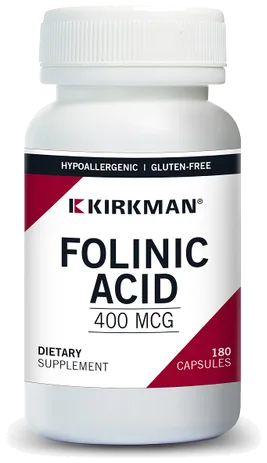
Kirkman Folinic Acid 400 mcg Review
Kirkman Folinic Acid 400 mcg is a dietary supplement sold as a capsule. Each container holds 180 capsules, and the serving size is one capsule, so a container gives 180 servings. The Supplement Facts panel lists one main ingredient: folate, at 667 mcg DFE per serving. The product name says folinic acid 400 mcg, and the panel prints the folate amount as 667 mcg DFE. The other ingredients are microcrystalline cellulose, hypromellose and water. Hypromellose is the material that forms the capsule shell. The label gives its suggested use as follows: take one capsule daily or as directed by a physician. If you are comparing bottles on the shelf, check the serving size line, which reads 1 capsule, and the count of 180 servings per container. The panel lists folate and no other active nutrient, so the amount per capsule is the single figure to compare against other products. The ingredient list is short, with three other ingredients named after the folate entry. The directions are printed on the label under the heading Suggested Use.
We don’t sell supplements. We help you make decisions and get the best price.
Lowest prices
We hold no current store prices for it yet: check the store.
- AmazonPrice at AmazonCheck price at Amazon (opens in a new tab)
Some store links earn us a commission.
Study, Trial or Testing Result Summary
Members Only26 human studies · 7 improved
2 of these 26 human studies gave folate by injection, not by mouth.
This product gives folate as folinic acid at 667 mcg a day in food folate terms, which is below the 1.43 mg level linked to benefit in studies. The trials below tested folic acid, a related form. Results for energy and tiredness are mixed. In 80 people with advanced kidney disease, adding folic acid to usual care for 6 months lowered fatigue scores [1]. In 44 people with rheumatic diseases taking a med, a higher weekly folic acid dose lowered fatigue slightly more than a lower dose [2]. A large survey of adults aged 40 and older linked higher blood levels of active folate to lower odds of fatigue, though a survey cannot show cause [3]. On the other side, in 112 women with anemia after childbirth, adding 1 mg a day of folic acid to iron for 4 weeks did not change fatigue [4]. In 202 dialysis patients, a multinutrient supplement that included folic acid did not change fatigue or quality of life [5]. A review of 16 trials could not judge fatigue because only one trial measured it [6]. Overall, any benefit appears limited to specific patient groups. Animal and cell studies are never counted.
See all 26 studies →Hide the studies
- Across 16 trials with 6276 people, B12 with or without folic acid showed no effect on thinking or depression, and only one study looked at fatigue so it could not be analysed.Effects of Vitamin B12 Supplementation on Cognitive Function, Depressive Symptoms, and Fatigue: A Systematic Review, Met…
- In 16 studies of 616 people with multiple sclerosis and 655 healthy people, folate and B12 blood levels did not differ, suggesting they are not drivers of worse physical function; this was not a supplement trial.The Relationship of Cobalamin and/or Folate to the Patient-Centred Outcomes in Multiple Sclerosis: A Systematic Review a…
- In a review of four diet trials in people with multiple sclerosis lasting 3 to 12 months, two diets supplying enough folate and magnesium reported improved fatigue, but firm conclusions were not possible.Is there an effect of dietary intake on MS-related fatigue? - A systematic literature review.
- In 311 people receiving a med agonist therapy, a daily fruit smoothie for 16 weeks did not change fatigue, fitness, or folate levels compared with standard treatment alone.Read the study on PubMed (40877839) →
- In 202 dialysis patients given a multinutrient supplement containing folic acid or placebo for 12 weeks, fatigue and quality of life did not differ between groups, though some heart rate and immune measures improved.Effects of nutritional supplementation on fatigue, and autonomic and immune dysfunction in patients with end-stage renal…
- In 162 adults on a weight loss meal replacement program, folate levels improved in both groups, and energy and fatigue improved slightly more with daily calorie restriction alone than with added alternate day fasting; folate was not tested alone.Randomized Trial of a High Protein, Partial Meal Replacement Program with or without Alternate Day Fasting: Similar Effe…
- In 112 women with anemia after childbirth, adding 1 mg a day of folic acid to iron for 4 weeks did not change fatigue scores, hemoglobin or health status compared with iron alone.A randomized controlled trial examining the addition of folic acid to iron supplementation in the treatment of postpartu…
- In 80 people with advanced chronic kidney disease followed for 6 months, adding folic acid (alone or with pentoxifylline) to usual care reduced fatigue scores and improved kidney blood tests compared with usual care alone.The potential adding therapeutic effect of pentoxifylline and/or folic acid for chronic kidney disease patients: randomi…
- In 59 adults with chronic stress and exhaustion, a 12-week amino acid and micronutrient blend (including folic acid) improved perceived stress more than placebo, but folate was not tested on its own.Impact of a Specific Amino Acid Composition with Micronutrients on Well-Being in Subjects with Chronic Psychological Str…
- In 44 patients with rheumatic diseases taking a med, 10 mg per week of folic acid for 12 weeks (vs 5 mg) showed no difference in most outcomes but did lower fatigue severity slightly.Read the study on PubMed (42249242) →
- In 33 soldiers during a 12-day tropical training exercise, folate status declined in all groups and those eating combat rations reported more fatigue than those eating fresh food; folate was not given as a separate supplement.The physiological and psychological effects of combat ration feeding during a 12-day training exercise in the tropics.
- In 26 overweight middle-aged women doing aerobic training for 3 months, drinking 500 ml of orange juice daily (raising folate intake 61%) lowered blood lactate more (27% vs 17%), suggesting less muscle fatigue, but folate's effect cannot be separated from the juice.Orange juice improved lipid profile and blood lactate of overweight middle-aged women subjected to aerobic training.
- In 25 healthy adults, a single dose of a pre-workout supplement containing 50 mg folic acid plus caffeine and other ingredients raised self-reported vigor and energy and cognitive scores versus placebo, with no change in lifting or sprint performance.Effects of acute ingestion of a pre-workout dietary supplement with and without p-synephrine on resting energy expenditu…
- In 15 people with chronic fatigue syndrome, injected liver extract with folic acid and vitamin B12 did not improve fatigue-related function more than placebo, and the placebo response was strong.Liver extract-folic acid-cyanocobalamin vs placebo for chronic fatigue syndrome.
- In 73 children and young people with mild thalassemia, 3 months of carnitine with or without 1 mg a day of folic acid reduced bone pain and muscle weakness, but the benefit was attributed to carnitine and fatigue was not reported separately.Determining and surveying the role of carnitine and folic acid to decrease fatigue in β-thalassemia minor subjects.
- A once-daily food-derived iron supplement that also contains folate for 8 weeks resolved iron deficiency in 23 nonanemic women, and self-reported fatigue and energy improved, though the study had no control group.A Food-Derived Dietary Supplement Containing a Low Dose of Iron Improved Markers of Iron Status Among Nonanemic Iron-Def…
- In a large survey of adults aged 40 and older, higher blood levels of active folate (5-methyltetrahydrofolate) were linked to lower odds of moderate or severe fatigue, and this link was strongest among people with higher folate levels.Dietary intake of live microbes is inversely associated with fatigue and modified by serum folate among adults aged 40 y…
- In 602 healthy adults, higher homocysteine (which tracks lower folate and vitamin B12) was linked to some fatigue measures in a sex-specific way, but the links were inconsistent and disappeared when homocysteine was measured as a continuous value.Associations of Plasma Homocysteine Reflecting Vitamin B12 and Folate Status with Fatigue-Related Outcomes in Healthy Ad…
- Older adults with fatigue had higher blood folic acid than those without fatigue, and lower vitamin D tracked with more fatigue; this study did not test folate supplements.Decrease in Serum Vitamin D Level of Older Patients with Fatigue.
- In a cross-sectional survey of 283 people with multiple sclerosis in Iran, folic acid intake was below recommended levels, but the study did not report any link between folate and energy or fatigue.Anthropometric indices, nutrient intakes and health-related characteristics of patients with multiple sclerosis: a cross…
- In 101 people with relapsing multiple sclerosis, lower dietary folate intake was linked to higher fatigue scores, but this cross-sectional study cannot show cause.Dietary intake of nutrients and its correlation with fatigue in multiple sclerosis patients.
- In 65 adults with self-reported gluten sensitivity following a gluten-free diet, folic acid intake was below recommended levels, and the baseline report did not link folate to energy or tiredness.Dietary and symptom assessment in adults with self-reported non-coeliac gluten sensitivity.
- Half of 60 people with chronic fatigue syndrome had low serum folate levels, but this survey did not test whether folate supplements improve energy.Serum folate and chronic fatigue syndrome.
- In a survey of 38 people with chronic fatigue syndrome or fibromyalgia, those who rated themselves much improved had taken more vitamin B12 injections and higher daily folic acid for longer, though this was not a controlled test.Response to vitamin B12 and folic acid in myalgic encephalomyelitis and fibromyalgia.
- In a small cross-sectional pilot of 20 adults with mild-to-moderate multiple sclerosis, higher folate intake was linked to better walking and physical function scores, but folate was not linked to fatigue.Impact of Nutritional Intake on Function in People with Mild-to-Moderate Multiple Sclerosis.
- In 765 patients with chronic diseases, a personalised plan to correct nutrient deficiencies, including low 5-methyltetrahydrofolate, over about 13 months was followed by significant improvement in energy levels, though there was no control group and folate was not studied on its own.Metabolomics-based treatment for chronic diseases: results from a multidisciplinary clinical study.
Review Totals and Summary
Members Only58 reviews · 84% positive
No written reviews read yet.
Biohacker Summary
Members Only4 of 10 recommend it
Folate is the only ingredient the panel discusses, and all ten of them spoke about it; four lean toward recommending it, five are neutral, and one recommends it for pregnancy. Most of the panel take or favor methylfolate, the active form, over synthetic folic acid, mainly to lower homocysteine, and also for methylation, brain health, mitochondrial function and pregnancy. One panelist shared a dose, taking the lower of two available strengths once a day to keep homocysteine below nine, and others point to leafy greens, liver and fermented dairy as food sources. Some of them pair it with B12 and other B vitamins, one with taurine and B6, and one noted that birth control pills and a med can deplete folate. Cautions came from two of them: one said many people overdo methylfolate and get overstimulation, especially with creatine, along with muscle tension and anxiety, and another saw blood levels go too high from supplementing.
See all 10 biohackers →Hide the biohackers
Dr. Rhonda Patrick · Folate · neutral
- Mentions folate as one of the micronutrients found in multivitamins that people often don't get enough of from their diets.
- Recommends ensuring adequate methyl folate intake, ideally through a prenatal vitamin, for women preparing for IVF.
- Notes that dark leafy greens are a great source of folate.
- States that for his mother, who is homozygous for MTHFR, methyl folate along with a high dose B supplement is necessary to prevent her homocysteine and blood pressure from going high.
- Dr. Patrick mentions that her smoothie is rich in folate, which is required for producing thymine and prevents DNA strand breaks.
- Has experimented with L-methylfolate in the past to lower homocysteine, as he is a poor methylator.
- Dr. Patrick states that studies have shown supplementing with 5-methyltetrahydrofolate can successfully circumvent some shortcomings of MTHFR gene polymorphisms and lower homocysteine levels.
- Dr. Patrick states that her smoothie, containing spinach, has around 480 micrograms of folate, which is essential for the incorporation of thymine into DNA and is very important in regulating epigenetics.
- Dr. Patrick states that adequate levels of folate have been shown to prevent cancer, and conversely, inadequate levels can damage DNA, which is known to cause cancer.
- Says they have not seen studies showing folate lowers heart disease or Alzheimer's risk, though lowering homocysteine improved hippocampal volume in people with Alzheimer's.
Dr. Mark Hyman · Folate · neutral
- Notes that taking folate can lower homocysteine levels, which has shown health benefits and physical improvements in brain scans in clinical trials.
- Notes that some people may need a little bit extra folate with a supplement.
- Optimized a child's nutrient status with folate, as the child had low folate levels and was not eating greens.
- Notes that a med depletes folate.
- States that folate is a nutritional deficiency that impacts mental health.
- Recounts giving a patient with MCI high-dose methylfolate, along with B12 shots and B6, which completely cured her MCI.
- Recommends folate with vitamin B6 and B12 as supplements with strong evidence for PMS.
- Explains that folate metabolism is very involved in neurotransmitter function and mood, and that folate can be a treatment for some cases of depression, especially for those with MTHFR genetic variants.
- Explains why methylated folate matters and differentiates it from folic acid in the context of prenatal vitamins.
- Recommends folate for male fertility, stating it targets cellular damage.
Dr. Eric Berg · Folate · neutral
- Notes that birth control pills deplete the body of folate, which is needed for the brain to make serotonin.
- Dr. Berg mentions that fermented dairy contains vital nutrients, including folate.
- States that folate is a co-factor or nutrient involved in making melatonin.
- States that if one is deficient in folate, cells cannot repair, and recommends dark leafy green vegetables, liver, and avocados as good sources.
- Mentions that fermented dairy provides vital nutrients such as folate.
- States that Folate (vitamin B9) repairs DNA, helps prevent cancer, and supports melanin production.
- Mentions that eggs contain folate, which is beneficial for methylation, DNA repair, detoxification, and neurotransmitter production, particularly for those with genetic predispositions.
- Mentions a trial where synthetic folate boosted IQs by 25% to 50% compared to a placebo.
- Mentions recommending natural methylfolate for an average person, noting that it handles one pathway, while the synthetic version handles multiple pathways and bypasses absorption barriers.
- Recommends ensuring sufficient folate intake, as a deficiency can cause DNA damage similar to radiation exposure, and suggests getting it from dark leafy green vegetables or liver.
Dave Asprey · Folate · neutral
- States that folate can affect how the body responds to a supplement.
- Recommends methylfolate as a better option than folic acid.
- Dave Asprey notes that 80% of their clients have a problem absorbing certain forms of folate, and when the exact form of folate or folinic acid is dialed in, clients experience shifts, with the brain waking up as one of the first improvements.
- Dave breaks down why a daily stack of taurine, B6, folate, and B12 works for motivation when either ingredient alone doesn't.
- Warns that many people who take methylfolate experience muscle tension and anxiety from it, suggesting it's not always the right form for methylation issues.
- Notes that not everyone can metabolize methylfolate.
- Warns against taking methyl folate, stating that it causes muscle cramping throughout the body and that overmethylating is a nasty sensation.
- States that most people can use methylfolate as their best brain source for making neurotransmitters, and mentions studies showing 15 milligrams was effective for depression with no side effects.
- Explains that methylfolate is the bioactive form of folate required for DNA replication and that deficiency can impair peristaltic activity in the gut.
- Discusses the potential to simulate the effects of adding more methylfolate to a virtual body based on personal genetics.
Ben Greenfield · Folate · recommends
- Recommends methylfolate as an active form of folate that the body can use directly without conversion.
- Recommends bioavailable folate, not synthetic folic acid, as folate deficiencies seem to impact hearing health in older individuals.
- Recommends introducing methylfolate into the diet to address high homocysteine levels.
- Would refine the guidelines to include clearer distinctions between synthetic folic acid and natural folate.
- Notes that some people do better on certain forms of B12, B complexes, SAM E, and methylated folates, specifically five methyl folates, for methylation.
- Notes that magnesium requires co-factors like B12 and folate to work, and BiOptimizers has considered these nutrients to help lower homocysteine levels and protect against DNA damage, promoting better health and longevity.
- Warns of folate deficiency on a carnivore diet, as it is low in meat but found in organ meats like liver, heart, kidney, and thymus glands.
- Ben recommends treating methylation deficits with bioavailable sources of natural folic acid like methylfolate or methyl tetrahydrofolate.
- Recommends looking for methyl tetrahydrofolate (MTHF) as an alternative to folic acid in supplements and foods, as it does not cause the negative effects associated with synthetic folic acid.
- Ben discusses the debate on folic acid versus methyltetrahydrofolate, agreeing with Ivor that folate or MTHF is the preferred form.
Thomas DeLauer · Folate · recommends
- Recommends taking methylfolate as a methylated form of B vitamin for mitochondrial function.
- Recommends methylfolate as a runner-up for insulin resistance, especially for individuals with the MTHFR variant, as it directly enters the methylation cycle without conversion.
- Mentions folate as a critical B vitamin for reducing homocysteine.
- Lists folate as a metal donor found in green leafy vegetables, liver, and legumes, especially sprouted legumes.
- Mentions methylfolate as the usable form that folic acid is converted into in the human body.
- Suggests that avocados' high folate content helps break down homocysteine, increasing circulation and energy to the brain, which reduces neuroinflammation and positively impacts mood.
- States that macadamia nut oil is higher in Folate (B9), which is associated with metabolism and neurological functions.
- Recommends supplementing with good amounts of folate (Vitamin B9) for telomere regeneration and stabilization, citing a study where it prevented telomere damage from sleep deprivation.
- Mentions that Folate (Vitamin B9), along with Vitamin B12, regulates communication between the gut microbiome and the host, suggesting attention to it for synergistic communication.
- Recommends natural folates like B9 from vegetables, stating they are critical for metabolic function and proper glucose metabolism.
Siim Land · Folate · neutral
- States that Homocysteine levels can often be improved through adequate folate intake.
- Notes that Brian's folate levels are over 20, which is too high and above the reference range, possibly due to supplementation.
- Warns that many people are overdosing on methyl folate, which can contribute to overstimulation when combined with creatine.
- Notes that folate resulted in negative effects on epigenetic age, meaning it increased epigenetic age.
- Takes methylfolate, and his levels were 'off the charts' and 'maxed out' at 24, in an effort to reduce homocysteine.
- Personally needs more methyl folate.
- States that glycine synthesis is dependent on carbohydrate and folate, and that converting serine to glycine requires the unmethylated form of folate, thus requiring a high folate intake.
- Folate is a methyl donor that can be obtained from leafy green vegetables and is important for DNA methylation.
- Warns against excessively pushing methylation forward by simply taking supplemental folate and B12, as it doesn't lead to living forever and can have reasons for concern.
- Mentions folate as a nutraceutical with anti-thrombotic potential, increasing cyclic GMP.
Andrew Huberman · Folate · recommends
- States that B12, folate, and iron are essential to mitochondrial function and if deficient, mitochondria will not function properly, which is consistent with the mitochondrial theory of neuropsychiatric disorders.
- Recommends taking methyl folate as part of methylated B vitamins to lower homocysteine levels and reduce cardiovascular risk.
- Takes methyl folate because elevated levels of homocysteine are associated with negative outcomes, and taking methyl folate is known to lower homocysteine. This might lower ADMA and SDMA and raise nitric oxide synthesis, potentially impacting vascular disease.
- Discusses folate as a potential factor in mitigating cancer risk, particularly in relation to alcohol consumption.
- Recommends the consumption of folate and other B vitamins, especially B12, as it has been shown to partially decrease cancer risk in people who ingest alcohol, though it does not completely offset it.
- Discusses L-5-Methyltetrahydrofolate as a novel pain relief compound and mentions it in the context of a protocol for pain.
- Explains that 5-methyltetrahydrofolate (5-MTHF) is now being used as a strategy to increase endogenous SAMe levels, as it is a precursor molecule necessary for its conversion.
- Recommends Methylfolate as part of methylated B vitamins to lower homocysteine and reduce cardiovascular risk.
Peter Attia · Folate · recommends
- Highlights folate supplementation as a significant practical progress in nutrition science, which has radically reduced spinabifida.
- Takes Jarrow methylfolate to keep homocysteine levels below nine, taking the lower of two available strengths once a day.
- Takes Jarrow methylfolate, a methylated version, once a day at the lower of two strengths, to keep homocysteine levels below nine.
- Mentions that in a mouse model for obesity, the amount of folate given to the mother mouse during pregnancy affects the epigenetics of her offspring, leading to changes in coat color and obesity.
- Personally takes methylfolate to help get homocysteine into the desired zone and prefers the Jarrow brand.
- Takes methyl folate as a supplement.
- Considers 400 micrograms of methylfolate in a typical supplement to be reasonable and more than sufficient, but notes that if it doesn't fix homocysteine, the deficit lies elsewhere.
- Uses and vouches for Jarrow's combined lozenge of methylfolate and methyl B12, stating they choose specific supplements because they know they work and are verified by blood tests.
Bryan Johnson · Folate · recommends
- Recommends supplementing with folate for brain health for both the mother and the baby during pregnancy.
RAL Summary
Members OnlyTier 4 for Energy
The folate trials for fatigue disagree, with two small trials in kidney disease and rheumatic disease patients finding less fatigue and two others finding no change, so the evidence is mixed rather than showing it does not work. So it is graded Tier 4, as the studies disagree.
- Emerging: not enough evidence to rank higher yet.
Where the evidence disagrees: 14 of the 26 human studies found no effect.
More Details
Members OnlyBody systems · Combine with · Possible side effects
Body systems: Blood and circulation, Nervous system
Combine with: For Energy, folate is often paired with vitamin B12, because the two work together in the same pathway that handles homocysteine and helps make red blood cells. It is often paired with riboflavin, since that B vitamin helps the body convert folate into its active form. It is also often paired with iron, because iron supports the same red blood cell production that folate does, so the pairing covers two parts of one process.
Possible side effects: No major side effects reported.
Supplement Facts
Folate 667 mcg DFE
| Folate | 667 mcg DFE |
Other ingredients: Microcrystalline Cellulose, Hypromellose, Water.
Directions: Suggested Use: Take one capsule daily or as directed by a physician.
Barcode (UPC) 812325021666 · Label source: NIH label database · Report a label change
Show entire label
More energy products
Members OnlyThe highest ranked for the same goal
Read more
Our articles on this subject
- Best Vitamins for Fatigue and the Habits That Matter MoreArticle · Jun 15, 2026
- Ashwagandha vs Rhodiola: What the Human Studies Show About EachArticle · Nov 18, 2026
Graded November 28, 2026 by the Reverse Age Lab evidence engine, from human studies, real reviews and our biohacker panel. How we grade. Is this medical advice? No. Rala organizes the published evidence; go over any change with your doctor, especially if you take meds.
Privacy policyConsumer health dataAffiliate disclosureTermsBrand and legal noticesDo Not Sell or Share My Personal InformationCookie settings