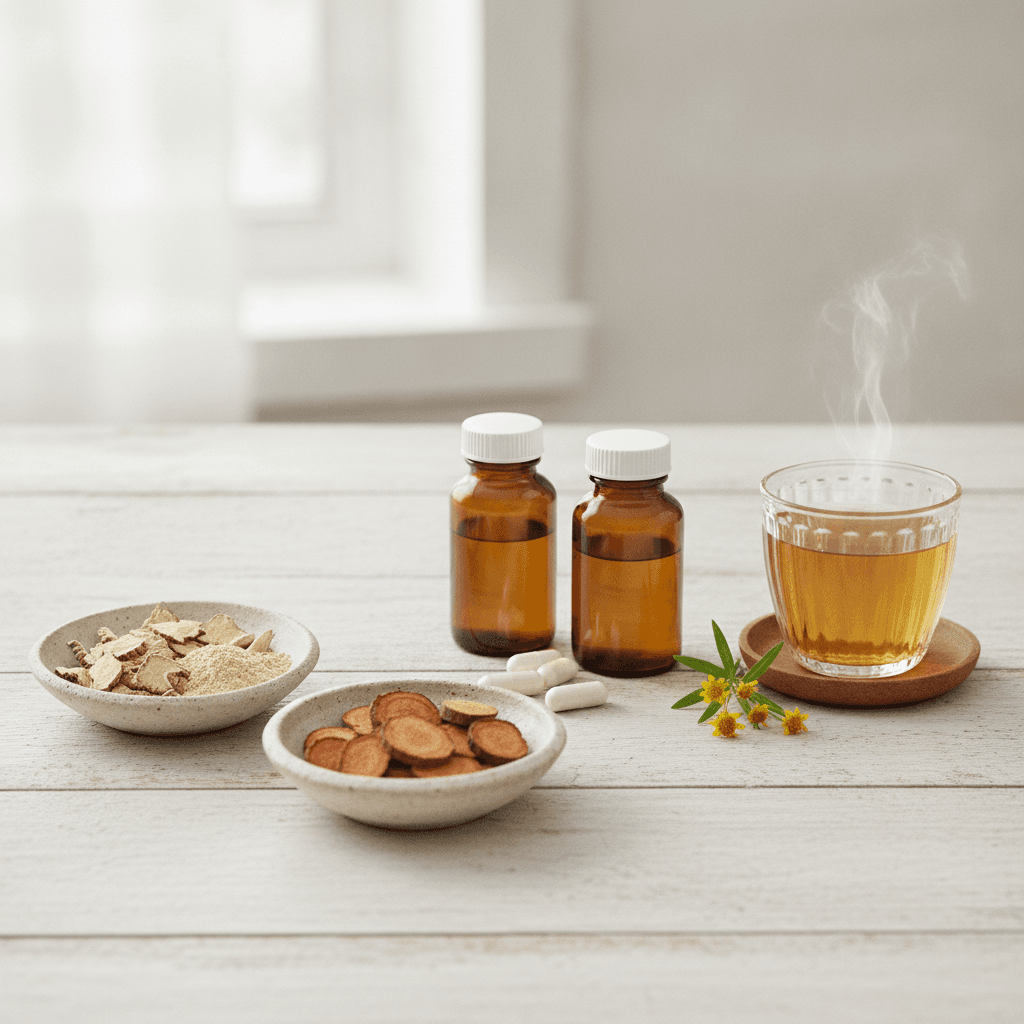
Ashwagandha vs rhodiola is a choice between two herbs sold for the same thing, stress, whose human studies point in different directions. The ashwagandha trials mostly measured calm: stress scores, cortisol and sleep. The rhodiola trials mostly measured fatigue: mental work when tired, focus and endurance. We found no trial that compared the two head to head.
Our evidence engine has graded 126 human studies of ashwagandha and 76 of rhodiola. Below you'll find what each herb is, what those studies found goal by goal, how the two compare on cortisol, whether they can be taken together, and who should check with a doctor first. If you have searched for "is rhodiola better than ashwagandha", this is the research behind the question; the choice stays yours.
What Ashwagandha and Rhodiola Are
Ashwagandha (Withania somnifera) is a shrub whose root has been used in Ayurvedic medicine in India for centuries. Most trials used a root or root-and-leaf extract standardized to its withanolides. Our ashwagandha page lists its studies, doses and products.
Rhodiola (Rhodiola rosea), also called golden root, grows in cold mountain and Arctic regions and has a long history of use in Scandinavia and Russia. Most trials used root extracts standardized to rosavins and salidroside, and many of the older ones used one extract, SHR-5. See the rhodiola page.
Both are called adaptogens, a label for plants said to help the body handle stress. The label is a description, not a measured effect, so the sections below look at what each did in people.
Ashwagandha vs Rhodiola: What Our Grades Show, Goal by Goal
Each row counts the human studies our engine graded for that goal, with how many found an improvement. A study counts once per goal, and pooled reviews count as one study each.
| Goal | Ashwagandha | Rhodiola |
|---|---|---|
| Stress and Calm | 48 studies: 46 improved, 2 mixed | 27 studies: 20 improved, 5 mixed, 2 no effect |
| Sleep | 30 studies: 29 improved, 1 mixed | None graded for sleep on its own |
| Mood | 38 studies: 32 improved, 2 mixed, 4 no effect | 31 studies: 21 improved, 4 mixed, 6 no effect |
| Energy | 20 studies: 15 improved, 3 mixed, 2 no effect | 30 studies: 20 improved, 4 mixed, 5 no effect, 1 worse |
| Focus and Memory | 20 studies: 14 improved, 6 mixed | 23 studies: 16 improved, 2 mixed, 5 no effect |
| Middle daily dose in studies that improved | 600 mg of extract | 400 mg of extract |
| Head-to-head trials | None found | None found |
Ashwagandha has more studies for stress, sleep and mood and a higher share of them improved. Rhodiola has as many or more for energy and focus, with more results that found no effect. Each goal page ranks every ingredient studied for it, so you can see where both sit among the others.
Ashwagandha: The Research on Stress, Cortisol and Sleep
Stress. Across 12 trials of 1,002 adults, ashwagandha lowered stress and anxiety scores more than placebo, with the stress effect strongest at 300 to 600 mg a day; the authors rated the certainty of the evidence as low because the trials varied a lot (Akhgarjand 2022). Across 9 trials of 558 people, it lowered perceived stress, anxiety scores and blood cortisol, and four trials reported mild to moderate side effects (Arumugam 2024).
Cortisol and hormones. Pooling 23 placebo-controlled trials of 1,706 adults, ashwagandha lowered cortisol, raised the thyroid hormone T4 a little and raised testosterone in men but not in women (Fornalik 2026). A smaller analysis of 488 people found the same drop in cortisol, about 1.16 µg/dL, but no significant change in perceived stress, a reminder that a lower hormone level and feeling less stressed are not the same result (Albalawi 2025).
Sleep. Across 5 trials of 400 adults, ashwagandha extract had a small but significant effect on overall sleep. The effect was larger in adults diagnosed with poor sleep, at 600 mg a day or more, and after 8 weeks or longer, and people felt more alert on waking (Cheah 2021). Our guide to supplements for sleep shows where it sits among the others.
Focus and memory. Across 20 trials of 1,249 adults, ashwagandha improved memory, attention and processing speed, and executive function compared with control (Zhu 2026).
Rhodiola: The Research on Fatigue, Focus and Endurance
Mental work when tired. In 161 young cadets, a single dose of rhodiola extract reduced fatigue during mental work more than placebo, and a dose 50% higher did no better (Shevtsov 2003). In 56 young doctors on night duty, a low daily dose for two weeks improved mental performance tests compared with placebo (Darbinyan 2000).
Stress-related fatigue. In 60 adults with long-lasting fatigue from stress, 576 mg a day for 28 days improved scores on a burnout scale and on attention tests more than placebo and changed the cortisol response on waking. Both groups improved, so part of the gain was a placebo effect (Olsson 2009).
Endurance. Across 26 trials of 668 healthy, mostly young people taking rhodiola for about a month, oxygen uptake, time to exhaustion and time-trial results improved, along with antioxidant markers (Wang 2025). See the Energy goal page.
The caveat. An earlier review of 11 trials found the rhodiola results contradictory: 2 of 6 trials of physical fatigue and 3 of 5 of mental fatigue found a benefit, and every trial had a high or unclear risk of bias (Ishaque 2012). The newer pooled analysis of endurance is more positive, but many rhodiola trials are small and short.
Ashwagandha vs Rhodiola for Cortisol
A review of 52 randomized human trials of plants and plant nutrients, rhodiola among them, found the effect on cortisol and the other stress hormones unclear for most. The most consistent finding was a drop in morning cortisol with ashwagandha (Lopresti 2022). Rhodiola changed the cortisol response on waking in the 60-person fatigue trial above, but it has far fewer trials that measured cortisol. On this one marker, ashwagandha has the larger and more consistent body of evidence.
Can You Take Ashwagandha and Rhodiola Together?
A 2026 trial gave both together. In 103 healthy, physically active adults, a morning capsule of 600 mg ashwagandha and 300 mg rhodiola for two weeks lowered weekly perceived stress and improved sleep quality and positive mood more than placebo, though daily stress ratings did not differ (Mastrofini 2026). Our news story on that trial has the details. Because the two were given together, the trial cannot say which herb did what.
A 2026 review of 24 randomized trials, 19 of ashwagandha at 120 to 1,000 mg a day and 5 of rhodiola at 290 to 1,500 mg a day for 3 to 16 weeks, reported less stress and anxiety, better mood and sleep for both, but called the trials small and varied (Łuszczak 2026).
Not sure how they fit with what you already take? Get a protocol that checks it for you.
Who Should Check With a Doctor First (People on Meds)
Talk to your doctor or pharmacist before starting either herb if you take meds, especially meds for the thyroid, mood, sleep, blood pressure or blood sugar, or if you are pregnant or breastfeeding. Ashwagandha raised T4 a little in the pooled trials, and rare cases of liver injury have been reported: five people in Iceland and the US developed jaundice 2 to 12 weeks after starting ashwagandha products, and the four who were followed up recovered within one to five months (Björnsson 2020). In the rhodiola fatigue trial, no serious side effects were linked to the extract (Olsson 2009). Rala, the AI behind Reverse Age Lab, checks every product in your stack against your meds before it places anything in your Daily Protocol, and blood work is optional.
Is this medical advice? No. This guide sets out the published research on two herbs; it is not a diagnosis, and Rala isn't a medical device or a clinician. Talk to your doctor before adding ashwagandha or rhodiola, especially if you take meds.
Bottom Line: What the Human Studies Show About Each
Ashwagandha has the larger body of human studies, and they lean toward calm: lower stress scores, lower cortisol and modestly better sleep, with the stress effect strongest at 300 to 600 mg a day and the sleep effect larger at 600 mg or more over 8 weeks or longer. Rhodiola's studies lean toward fatigue: better mental work when tired, better focus under stress and better endurance, often within days to weeks, though more of its trials found no effect and many are small. No trial has compared them head to head, and the one recent trial of both together cannot separate them. Which fits depends on whether your goal is calm and sleep or energy and focus, on what else you take and on what your doctor says about your meds.
Check Your Adaptogens Against Your Whole Stack
Your Daily Protocol adds up the ashwagandha and rhodiola in every product you take, including stress blends and sleep formulas, checks them against your meds and places each one at the right time of day. Build My Protocol – 7-Day Free Trial. Our guide to supplements for stress and anxiety covers the other ingredients studied for stress.
Frequently Asked Questions
Is rhodiola better than ashwagandha?
Neither has been shown better in a head-to-head trial. In our grading, ashwagandha has more studies and a higher share of improvements for stress, sleep and mood; rhodiola's studies lean toward fatigue, focus and endurance.
Which is better for cortisol, ashwagandha or rhodiola?
Ashwagandha has more evidence. It lowered cortisol across 23 placebo-controlled trials, and a review of 52 plant trials found its morning cortisol drop the most consistent. Rhodiola changed the cortisol response on waking in one 60-person trial.
Ashwagandha or rhodiola for anxiety?
Ashwagandha lowered anxiety scores more than placebo across 12 trials of 1,002 adults, with low certainty. A 2026 review that included 5 rhodiola trials reported less stress and anxiety across both herbs, but the trials were small and varied. Our Stress and Calm page ranks both.
Which is better for sleep?
Ashwagandha has the sleep trials: a small but significant effect across 5 trials of 400 adults, larger at 600 mg a day or more and after 8 weeks. We have no study grading rhodiola for sleep on its own.
Can you take ashwagandha and rhodiola together?
One 2026 trial gave 600 mg ashwagandha and 300 mg rhodiola together each morning for two weeks, and perceived stress, sleep quality and mood improved more than on placebo. Check with your doctor first if you take meds.
Ashwagandha vs rhodiola for women?
Most trials of both included women and men. In the pooled hormone trials, ashwagandha raised testosterone in men but not in women, and lowered cortisol overall. We found no trial comparing the two herbs in women.
Sources
Akhgarjand C, Asoudeh F, Bagheri A et al. Does ashwagandha supplementation have a beneficial effect on the management of anxiety and stress? A systematic review and meta-analysis of randomized controlled trials. Phytotherapy Research, 2022. PubMed.
Arumugam V, Vijayakumar V, Balakrishnan A et al. Effects of ashwagandha (Withania somnifera) on stress and anxiety: a systematic review and meta-analysis. Explore, 2024. PubMed.
Fornalik M, Malkiewicz A, Adamczak D et al. Hormonal modulation with Withania somnifera: systematic review and meta-analysis of randomized-controlled trials. Planta Medica, 2026. PubMed.
Albalawi AA. Dual impact of ashwagandha: significant cortisol reduction but no effects on perceived stress. A systematic review and meta-analysis. Nutrition and Health, 2025. PubMed.
Cheah KL, Norhayati MN, Husniati Yaacob L et al. Effect of ashwagandha (Withania somnifera) extract on sleep: a systematic review and meta-analysis. PLoS One, 2021. PubMed.
Zhu X, Zeng Q, Lei Y et al. Effects of Withania somnifera (L.) Dunal (ashwagandha) on cognitive and physical function in adults: a systematic review and meta-analysis. Frontiers in Pharmacology, 2026. PubMed.
Shevtsov VA, Zholus BI, Shervarly VI et al. A randomized trial of two different doses of a SHR-5 Rhodiola rosea extract versus placebo and control of capacity for mental work. Phytomedicine, 2003. PubMed.
Darbinyan V, Kteyan A, Panossian A et al. Rhodiola rosea in stress induced fatigue: a double blind cross-over study of a standardized extract SHR-5 with a repeated low-dose regimen on the mental performance of healthy physicians during night duty. Phytomedicine, 2000. PubMed.
Olsson EM, von Schéele B, Panossian AG. A randomised, double-blind, placebo-controlled, parallel-group study of the standardised extract SHR-5 of the roots of Rhodiola rosea in the treatment of subjects with stress-related fatigue. Planta Medica, 2009. PubMed.
Wang X, Yang X, Gao Z et al. The effect of Rhodiola rosea supplementation on endurance performance and related biomarkers: a systematic review and meta-analysis. Frontiers in Nutrition, 2025. PubMed.
Ishaque S, Shamseer L, Bukutu C et al. Rhodiola rosea for physical and mental fatigue: a systematic review. BMC Complementary and Alternative Medicine, 2012. PubMed.
Lopresti AL, Smith SJ, Drummond PD. Modulation of the hypothalamic-pituitary-adrenal (HPA) axis by plants and phytonutrients: a systematic review of human trials. Nutritional Neuroscience, 2022. PubMed.
Mastrofini GF, Romersi RF, Lombardi MG et al. Modulating stress and sleep through a multi-compound dietary supplement: a randomized, double-blind, placebo-controlled trial. Journal of the International Society of Sports Nutrition, 2026. PubMed.
Łuszczak J, Kocki J. Clinical evidence for the adaptogenic effects of Withania somnifera and Rhodiola rosea: a systematic review with molecular interpretation of psychometric outcomes. Annals of Agricultural and Environmental Medicine, 2026. PubMed.
Björnsson HK, Björnsson ES, Avula B et al. Ashwagandha-induced liver injury: a case series from Iceland and the US Drug-Induced Liver Injury Network. Liver International, 2020. PubMed.