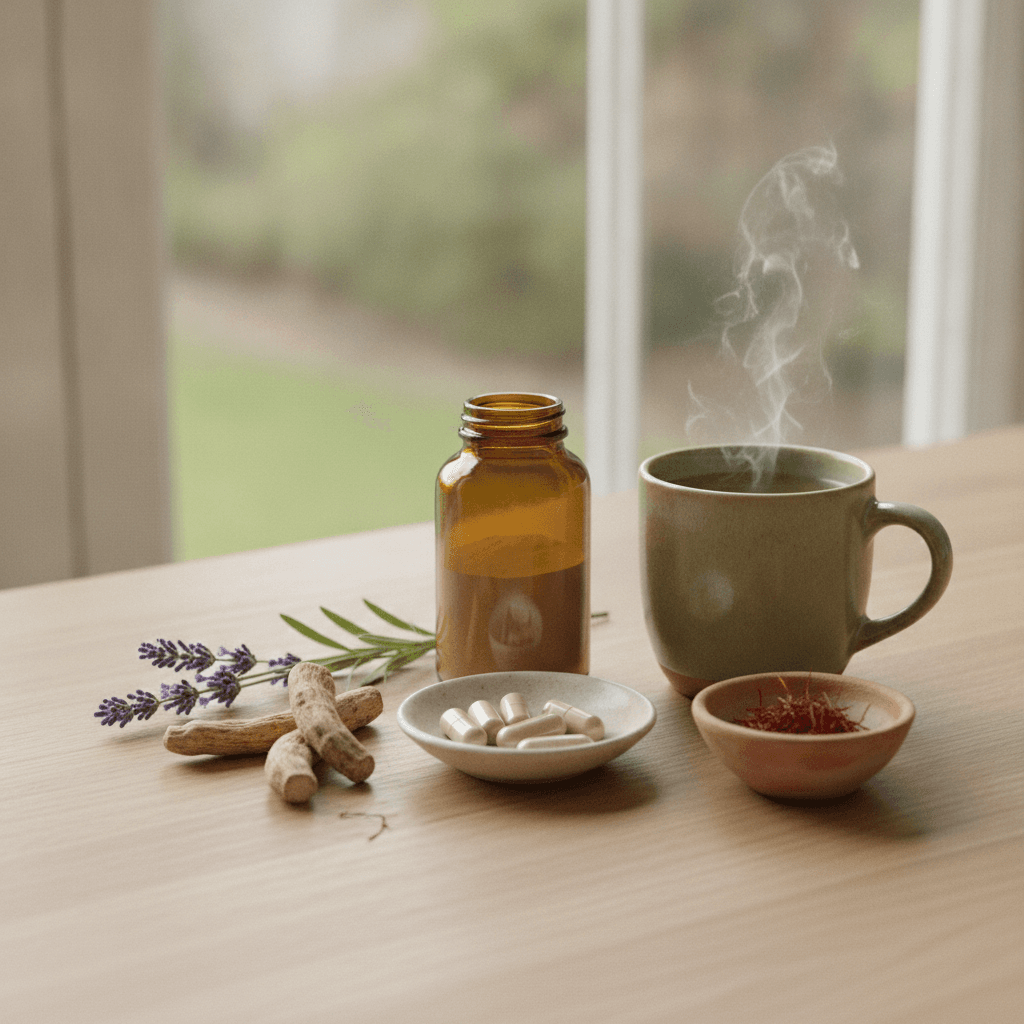
The stress anxiety relief supplements with the most human evidence are ashwagandha root extract and Silexan, an oral lavender oil. L-theanine, magnesium, saffron and rhodiola have smaller or mixed trials, and GABA and kava have weak evidence or a safety question. Whichever you try, give it the length of time the trials used and check it against any meds you take.
Stress supplements are sold on big promises, and the trials behind them range from a dozen pooled studies to a single small one. Below is what the human studies found for each option, the doses they tested and how long they ran, how to stay safe with your meds, and how to build a stress stack that fits you. Our Stress and Calm goal page ranks the products in our catalog by the same evidence.
Quick Answer: The Stress Anxiety Relief Supplements With the Most Evidence
This table sets out each supplement, the dose the trials used, how long they ran and how strong the evidence is. The sections after it give the details and the studies.
| Supplement | Dose studied | How long the trials ran | What the trials found | Strength of evidence |
|---|---|---|---|---|
| Ashwagandha root extract | 300 to 600 mg a day | About 8 weeks | Lower stress and anxiety scores than placebo across 12 trials of 1,002 adults | The most trials, low certainty |
| Lavender oil (Silexan) | 80 mg a day | 10 weeks | Lower anxiety scores than placebo across 3 trials of 697 adults, with better sleep and no drowsiness | Consistent trials, one product |
| L-theanine | 200 mg once, or 200 to 400 mg a day | 30 to 60 minutes, up to 8 weeks | Sharper attention; a modest effect on stress and an inconsistent one on anxiety | Mixed |
| Magnesium | About 300 mg a day | 8 weeks | Helped in about half the studies of people prone to anxiety; most were small | Mixed, poor quality |
| Saffron extract | 28 mg a day | 4 weeks | Less stress and anxiety in adults with low mood; a lower dose did nothing | Promising |
| Rhodiola rosea | 576 mg a day | 4 weeks | Better focus and burnout scores in 60 adults with stress-related fatigue | Limited |
| GABA | Varied | Varied | Limited evidence for stress across 14 small studies | Weak |
| Kava | Varied extracts | 1 to 24 weeks | Lower anxiety scores than placebo, but linked to rare serious liver injury | Works in trials, safety question |
Not sure which one fits you? Get a personalized stress protocol built around your goals, your sleep and everything you already take.
Ashwagandha: What the Human Trials Show
Ashwagandha (Withania somnifera) is the most studied herb for stress. A 2022 review pooled 12 placebo-controlled trials with 1,002 adults aged 25 to 48 and found that ashwagandha lowered both anxiety and stress scores more than placebo. The stress effect was clearest at 300 to 600 mg of root extract a day. The reviewers rated the certainty of the evidence as low, because the trials were small and their results varied (Akhgarjand 2022).
A 2024 review of nine trials with 558 people came to the same answer from a different set of studies: ashwagandha lowered the Perceived Stress Scale by about 4.7 points, cut anxiety scores and reduced blood cortisol, the main stress hormone, compared with placebo. Four of the nine trials reported mild to moderate side effects (Arumugam 2024).
Most trials ran for about eight weeks, so that is a fair test. One caution belongs here, not only in the safety section: ashwagandha has been linked to rare cases of liver injury, usually weeks after starting it (Björnsson 2020; Philips 2023). Stop it and see a doctor if you notice yellow skin or eyes, dark urine or itching, and skip it if you have a liver condition or are pregnant.
Magnesium: Who May Benefit Most
Magnesium is often sold for calm, and the evidence is real but thin. A review of 18 studies found that magnesium eased anxiety in four of eight studies of mildly anxious people and in four of seven studies of women with premenstrual symptoms, but had no effect after childbirth. Every study chose people who were already prone to anxiety, and the reviewers judged the quality of the evidence poor (Boyle 2017).
The largest stress trial gave 264 stressed adults with low blood magnesium 300 mg a day for eight weeks. Stress scores fell by about 42% on magnesium alone and 45% with vitamin B6 added. There was no placebo group, so part of that drop may have happened anyway, but the people with the most severe stress did better with the B6 (Pouteau 2018).
So magnesium may help most if your intake is low: little leafy green food, nuts, seeds or whole grains, or a lot of sweating or alcohol. Higher doses can loosen stools. Our guide to magnesium for sleep, stress and healthy aging covers the forms and doses in more detail.
L-Theanine: For Calm Focus Without Drowsiness
L-theanine is the amino acid in tea that makes a cup feel calming rather than jittery. The largest analysis so far pooled 31 placebo-controlled trials with 1,168 people. A single 200 mg dose taken 30 to 60 minutes before a task sharpened attention and reaction time. Its effect on stress was modest and came mostly from studies at high risk of bias, and its effect on anxiety was inconsistent (Gerolymos 2026).
An earlier review of nine trials concluded that 200 to 400 mg a day may help people under stressful conditions, and called for larger, longer studies (Williams 2020). L-theanine does not make people drowsy, which is why it is often taken during the day, and it has better evidence for sleep quality than for anxiety. Our guide to supplements for better sleep covers that side.
Rhodiola, Saffron and Lavender Oil (Silexan): Newer Options With Promising Trials
Lavender oil (Silexan). Silexan is a specific lavender oil taken by mouth, not the aromatherapy oil. A pooled analysis of three placebo-controlled trials gave 697 adults with anxiety symptoms 80 mg a day for 10 weeks. Silexan lowered the Hamilton anxiety score by about 3.8 points more than placebo, improved sleep as anxiety eased, and did not cause drowsiness (Möller 2019). A comparison of 12 herbs across 29 trials also found it effective (Zhang 2022). The evidence is for this one standardized product, so other lavender capsules may not behave the same way.
Saffron. In a four-week trial of 128 adults with low mood, a saffron extract at 28 mg a day reduced stress and anxiety symptoms compared with placebo, while 22 mg a day did no better than placebo (Kell 2017). A 2026 review of 34 trials found saffron lowered self-rated anxiety scores, with moderate certainty, though not every anxiety scale changed (Mahmoudi 2026).
Rhodiola rosea. In 60 adults with stress-related fatigue, 576 mg a day of the SHR-5 extract for four weeks improved burnout scores, concentration and the cortisol response on waking more than placebo, though both groups felt better (Olsson 2009). Rhodiola is studied more for fatigue and focus under stress than for anxiety itself.
Popular Options With Weak Evidence: GABA and Kava
GABA. GABA is the brain's main calming messenger, which makes it an easy sell as a pill. A review of 14 placebo-controlled studies of oral GABA found limited evidence for stress and very limited evidence for sleep (Hepsomali 2020). It has far less evidence behind it than the options above.
Kava. Kava did work in trials: a Cochrane review of 11 trials with 645 people found kava extract lowered anxiety scores more than placebo, with mild side effects over 1 to 24 weeks (Pittler and Ernst 2003). The reason for caution is rare but serious liver injury reported with kava products, which led several countries to restrict its sale (Teschke 2010). That safety question is why kava sits in this section despite its trial results. If you consider it, talk to your doctor first, and do not combine it with alcohol or with ashwagandha.
Safety: Supplements, Stress and Your Meds
Calming supplements can add to the effect of meds that calm the nervous system or make you drowsy, and some can change how other meds are handled by the liver. Ashwagandha and kava have both been linked to liver injury. A few rules keep the risk low:
If you take any meds, especially for mood, sleep or anxiety, check with your doctor or pharmacist before adding a stress supplement.
Start one supplement at a time, so you know what helped and what caused a side effect.
Avoid ashwagandha and kava if you are pregnant or have a liver condition, and stop either one if you notice yellow skin or eyes or dark urine.
Do not stop or change a prescribed med because a supplement seems to be working.
Taking meds? Check your stack for interactions before you add anything. Our guide to supplement and medication interactions explains the most common ones.
Habits That Make Supplements Work Better
No supplement in these trials was tested in place of the basics, and the basics may matter as much as any capsule.
Sleep. Short or broken sleep makes the next day feel more stressful. A steady wake time and a dark, cool room may help.
Breathing. A few minutes of slow breathing may help settle a racing heart before a stressful task.
Exercise. Regular movement, even a daily brisk walk, is one of the habits most studied for stress.
Caffeine. Coffee and energy drinks can feel like anxiety in sensitive people. If you are on edge, try stopping caffeine after noon before buying anything.
How to Build a Stress Stack That Fits Your Health and Meds
Pick the option whose trials match your situation: ashwagandha or Silexan for steady, everyday stress, L-theanine for calm focus on demanding days, and magnesium if your diet is low in it. Give one product the length of its trials, about eight weeks for ashwagandha and ten for Silexan, and score your stress from 0 to 10 once a week. If nothing has changed by then, that supplement is unlikely to help you.
Reverse Age Lab does this work for you. Choose the Stress and Calm goal and Rala builds a daily protocol of the habits and graded supplements with human trials behind them, checked against everything you already take. We sell no supplements, so the answer is often fewer bottles. The first seven days are free.
Is this medical advice? No. This guide sets out the published research on supplements for stress; it is not a diagnosis, and Rala isn't a medical device or a clinician. If anxiety is getting in the way of your days, talk to your doctor, and go over any change with them, especially if you take meds.
Frequently Asked Questions
What is the best supplement for stress and anxiety?
The one with the most human evidence is ashwagandha root extract: 12 placebo-controlled trials with 1,002 adults found lower stress and anxiety scores, clearest at 300 to 600 mg a day for about eight weeks. Silexan, an oral lavender oil, has consistent trials for anxiety symptoms at 80 mg a day. Which one fits you depends on your health, your sleep and the meds you take.
How long does ashwagandha take to work?
Most trials measured results after about eight weeks (60 days), and some ran for 12. Give it eight weeks at a steady dose with a weekly stress score before deciding whether it helps you.
Can I take magnesium and ashwagandha together?
We found no trial that tested the two together on their own, and they work in different ways. Many people take both. Start one at a time, two to three weeks apart, so you can tell which one helps, and check the pair against any meds you take.
Are stress and anxiety supplements safe with meds?
Not always. Ashwagandha, kava, L-theanine and other calming supplements can add to the effect of meds for mood, sleep or anxiety, and ashwagandha and kava have been linked to liver injury. Ask your doctor or pharmacist before adding any of them, and never stop a prescribed med on your own.
Sources
Akhgarjand C, Asoudeh F, Bagheri A et al. Does Ashwagandha supplementation have a beneficial effect on the management of anxiety and stress? A systematic review and meta-analysis of randomized controlled trials. Phytotherapy Research, 2022. PubMed.
Arumugam V, Vijayakumar V, Balakrishnan A et al. Effects of Ashwagandha (Withania somnifera) on stress and anxiety: a systematic review and meta-analysis. Explore, 2024. PubMed.
Björnsson HK, Björnsson ES, Avula B et al. Ashwagandha-induced liver injury: a case series from Iceland and the US Drug-Induced Liver Injury Network. Liver International, 2020. PubMed.
Philips CA, Valsan A, Theruvath AH et al. Ashwagandha-induced liver injury: a case series from India and literature review. Hepatology Communications, 2023. PubMed.
Boyle NB, Lawton C, Dye L. The effects of magnesium supplementation on subjective anxiety and stress: a systematic review. Nutrients, 2017. PubMed.
Pouteau E, Kabir-Ahmadi M, Noah L et al. Superiority of magnesium and vitamin B6 over magnesium alone on severe stress in healthy adults with low magnesemia: a randomized, single-blind clinical trial. PLoS One, 2018. PubMed.
Gerolymos C, Saddier E, Boyer L et al. Cognitive and affective effects of L-theanine: a systematic review and meta-analysis of 31 randomized trials. Molecular Psychiatry, 2026. PubMed.
Williams JL, Everett JM, D'Cunha NM et al. The effects of green tea amino acid L-theanine consumption on the ability to manage stress and anxiety levels: a systematic review. Plant Foods for Human Nutrition, 2020. PubMed.
Möller HJ, Volz HP, Dienel A et al. Efficacy of Silexan in subthreshold anxiety: meta-analysis of randomised, placebo-controlled trials. European Archives of Psychiatry and Clinical Neuroscience, 2019. PubMed.
Zhang W, Yan Y, Wu Y et al. Medicinal herbs and anxiety: a systematic review and network meta-analysis of 29 trials. Pharmacological Research, 2022. PubMed.
Kell G, Rao A, Beccaria G et al. affron, a novel saffron extract (Crocus sativus L.), improves mood in healthy adults over 4 weeks in a double-blind, parallel, randomized, placebo-controlled clinical trial. Complementary Therapies in Medicine, 2017. PubMed.
Mahmoudi R, Mohammadi-Sartang M, Servatyari K et al. Effect of saffron on mood: a GRADE assessed systematic review and meta-analysis of 34 randomized controlled trials. Nutritional Neuroscience, 2026. PubMed.
Olsson EM, von Schéele B, Panossian AG. A randomised, double-blind, placebo-controlled, parallel-group study of the standardised extract SHR-5 of the roots of Rhodiola rosea in subjects with stress-related fatigue. Planta Medica, 2009. PubMed.
Hepsomali P, Groeger JA, Nishihira J et al. Effects of oral gamma-aminobutyric acid (GABA) administration on stress and sleep in humans: a systematic review. Frontiers in Neuroscience, 2020. PubMed.
Pittler MH, Ernst E. Kava extract and anxiety: a review of 11 placebo-controlled trials. Cochrane Database of Systematic Reviews, 2003. PubMed.
Teschke R. Kava hepatotoxicity: a clinical review. Annals of Hepatology, 2010. PubMed.