
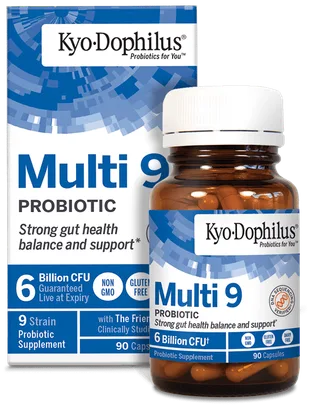
Kyo-Dophilus Multi 9 Probiotic Review
Kyo-Dophilus Probiotics are formulated to support healthy digestive and immune systems. The page says the product is designed to deliver efficacy, quality, and extended live cell viability without refrigeration. Its core is The Friendly Trio, a clinically studied proprietary blend of the human strains Lactobacillus gasseri KS-13, Bifidobacterium bifidum G9-1, and Bifidobacterium longum MM-2. The page states that L. gasseri has been shown to support the body's GI function and immune health. The highlights listed are Probiotics for You, strong gut health balance and support, DNA sequencing verified, and 6 billion CFC guaranteed live at expiry. The page labels the item as a prebiotic and probiotic product that is gluten free and non-GMO. The listing is sold and shipped by iHerb and is a final sale item that cannot be returned or exchanged. It is priced at $55.99, with free shipping subject to exclusions. The page shows an overall rating of 5 out of 5 stars from a single rating, and it prints no ingredient list, no supplement facts, no serving count, and no barcode in the text provided.
We don’t sell supplements. We help you make decisions and get the best price.
Lowest prices
We hold no current store prices for it yet: check the store.
- AmazonPrice at AmazonCheck price at Amazon (opens in a new tab)
Also at: iHerb · Swanson · Target. Some links earn us a commission; price comes first, and a commission only decides the order of prices within 2%. As an Amazon Associate we earn from qualifying purchases.
Study, Trial or Testing Result Summary
Members OnlyHuman studies
We found no human studies of this product's probiotic strains for sensitive bowels, gas, bloating or irregularity, so no study findings can be given here. The store listing describes a proprietary blend of 6 billion live cells from nine strains, including Lactobacillus gasseri, Lactobacillus rhamnosus and several Bifidobacterium strains such as longum, breve, bifidum, infantis and lactis. Because the strains are in a proprietary blend, the amount of each one is not disclosed, so no single strain can be compared with any studied dose. Its standing comes from buyers rather than research. About 3,208 ratings are 94 percent positive and 2 percent negative. Buyers most often describe easier digestion, less bloating and better regularity, including after meds. A smaller number report no effect, or mild diarrhea or bloating. Reviewers find the capsules easy to swallow and like that they need no refrigeration. Opinions on price are mixed. Treat this as a well-liked everyday probiotic whose benefit for sensitive digestion has not been shown in studies we could review. Animal and cell studies are never counted.
Review Totals and Summary
Members Only3,208 reviews · 94% positive
Kyo-Dophilus Multi 9 capsules are well liked as an everyday probiotic, with about 3,208 ratings across the stores and most written feedback positive. Buyers praise gentle digestive support and convenience, while the complaints are mostly about price, slow results and a few side effects. **What buyers say it did for them:** The most common benefit is easier digestion, with less bloating and better regularity. One buyer wrote, "less bloating and much better regularity." Another used it after meds and was "genuinely impressed with how quickly it helped." Long-term users are strongly positive: "30 years using this" and "got rid chronic constipation and yeast infections." One reviewer felt less brain fog in the morning but admitted it was hard to judge. Store summaries add that some people saw benefits quickly, while more cautious ones say a few months are needed before judging. **What they complain about:** Complaints are few. The store summaries mention a small number of reports of diarrhea or bloating, and some reviewers noticed no effect at all. One reviewer called it "not the most powerful probiotic" and best seen as a general baseline option. One review was only about an incomplete order of the 180-count bottle, which says nothing about the capsules. **Taste, smell, pill size and form:** Reviewers describe the capsules as easy to take. One said they are "easy to swallow and gentle on the stomach," and another called the size "comfortable, not too big." The shelf-stable formula is a frequent plus: "I don't have to worry about refrigeration." Reviewers also like the once-daily capsule, which fits easily with morning vitamins or travel. No one mentions taste or smell. **Value for money:** Opinions are mixed. Some find it good value, with one saying it is "a lot cheaper" on iHerb, "even cheaper with Auto ship." Another said the value is "excellent compared to other brands." Others disagree: "A little too pricy." Store summaries describe price as the most common criticism on Walmart, while iHerb shoppers lean toward calling it reasonable. Shipping from iHerb is described as fast and well packed. **Who it seems to suit and who it did not:** It seems to suit people who want a gentle daily probiotic for maintenance, including those who travel and want no refrigeration. The store summaries say people with sensitive stomachs or histamine intolerance report positive experiences. Several long-term users have taken it for years, and one buyer's doctor recommended it for its quality. It suits less well anyone wanting a strong, targeted probiotic, or anyone who expects results within days. A few people reported no effect or mild digestive side effects, and those who find the price high may prefer other options. Only reviews of the capsules are covered here. Reviews of other forms of the product, such as gummies or powder, were left out.
Biohacker Summary
Members Only10 of 10 recommend it
Probiotics are a smaller ingredient in this product, and the panel leans toward them: six of the ten recommend them and two more say they use them, while one is neutral. The main reasons given are rebuilding gut bacteria after a course of meds, supporting digestion, immune health and overall gut health, and some also mention blocking inflammation. Panelists point to foods such as yogurt, kefir and sauerkraut juice as alternatives or companions, and one pairs probiotics with prebiotics and fiber. They advise picking strains that survive stomach acid and taking them at the end of a meal or earlier in the day, though no one gives a dose. Cautions came from three of them: two say most probiotics are not useful or are destroyed by stomach acid unless the strains are matched to you, and one stops them during a gut microbiome transplant protocol because they can skew the result.
See all 9 biohackers →Hide the biohackers
Dr. Eric Berg · Probiotics · recommends
- States that probiotics can be helpful when taking meds, recommending to look for strains that can survive stomach acid and take them simultaneously alongside meds.
- Recommends taking probiotics during the process of taking a med to help put some good microbes back in while a med is killing both good and bad bacteria, and advises choosing probiotics that survive stomach acid.
- Recommends probiotics for overall health, stating they are microbes that help make nutrients available, provide immune protection, protect against pathogens, support detoxification, improve digestion, and help make vitamins.
- Lists probiotics as an epigenetic factor that may help with cancer prevention.
- Dr. Eric Berg recommends taking probiotic supplements or consuming probiotic foods at the end of a meal or earlier in the day to support the survival of probiotics in the stomach.
- Recommends taking probiotics simultaneously with meds to maximize gut health.
- Recommends probiotics, fermented foods, kefir, sauerkraut, and kimchi as a fix when taking broad-spectrum meds to compensate for the loss of nitric oxide.
- Recommends focusing on probiotics as part of an eating plan for better gut health.
- Warns that probiotics can worsen SIBO, causing more bloating, even though they are generally considered healthy.
- Recommends probiotics from fermented foods like kefir, yogurt, and raw cheese to support the gut-brain axis and prevent dementia.
- Highly recommends bifidobacterium longum, stating it has been extensively used to help take the stress off the kidney.
- Combines Lactobacillus reuteri with Lactobacillus gasseri in a yogurt for its bacteria-producing and small intestinal colonizer properties, contributing to SIBO normalization.
- Combines Lactobacillus reuteri with Lactobacillus gasseri in their homemade yogurt because it's another big bacteriocin producer and small intestinal colonizer, helping to normalize SIBO.
- Dr. Berg recommends looking for Bifidobacterium longum on probiotic labels, as these microbes will start making lactase to break down lactose.
Dr. Mark Hyman · Probiotics · recommends
- Recommends supplementing with probiotics to heal the gut.
- Gave a patient with psoriatic arthritis some probiotics, which contributed to significant improvement in her condition.
- Recommends rebuilding the gut microbiome with probiotics.
- Took a lot of probiotics to restore his gut health after being on meds.
- Mentions a new field of science involving bioengineered probiotics that could interfere with specific body functions, but notes they are not yet available for clinical use and lack clinical trial evidence.
- Discusses why probiotics may not provide the personalized answers many people expect.
- Used probiotics to rebuild the gut microbiome of a nine-year-old girl with severe behavioral issues after clearing out bad bugs.
- Uses four probiotics with 500 billion of different probiotics twice a day during the nine-week dapsone protocol.
- Recommends targeted probiotics, especially Saccharomyces boulardii, to rebuild the gut and reduce yeast overgrowth when meds are being taken.
- Recommends choosing probiotics carefully, leaning towards histamine neutral or histamine degrading strains like Bifidobacterium species, lactobacillus rhamnosus, and plantarum, as some lactobacillus strains can produce histamine.
- Mentions a specific strain, Bifidobacterium longum 1714, that a patient took and found improved the quality of deep sleep.
Peter Attia · Probiotics · recommends
- Recommends using probiotics, such as live yogurt at least once a week, to replace probiotics and potentially help avoid colorectal cancer, though notes this is based on no direct evidence.
- Notes that private industry is funding research on different probiotics and bacteria that can be introduced.
- Mentions ongoing research suggesting that pre-operative probiotics might reduce the risk of surgical infections, based on studies in mice where altering the gut microbiome prior to surgery reduced infection.
- Mentions that there is ongoing research suggesting that pre-operative probiotics may reduce the risk of surgical infections by altering the gut microbiome.
- Discusses the potential therapeutic uses of probiotics, particularly Akkermansia, for gut health, based on insights from an interview with Colleen Cutcliffe.
- Would probably double down on the probiotics they are taking if they were going to go on meds, as studies show it can lead to a healthier gut microbiome on the other side.
- Explains that the most well-documented impact of consuming probiotics, including lactobacillus and bifidobacterium in yogurts, is around GI symptoms like gas, bloating, diarrhea, and constipation, with many people reporting better GI health.
- Would probably double down on probiotics during a med course and then come in hard and strong with a high-fiber diet afterward to reconstitute the gut microbiome.
- Suggests that taking appropriate probiotics at the same time as meds or afterward is helpful for repopulating the gut.
- Recommends re-inoculating the gut with probiotics where necessary, which can be through fermented foods or probiotic supplements, noting that some things out there really work.
Andrew Huberman · Probiotics · recommends
- States that probiotics are a way to change the plasticity of the gut microbiome.
- Notes that AG1 contains probiotics, which help support a healthy gut microbiome, digestion, immune system, mood, and mental focus.
- Notes that AG1 contains probiotics and prebiotics, which help support a healthy gut microbiome, impacting immune status, metabolic health, and hormone health.
- Discusses whether probiotics are useful tools for gut health.
- Uses probiotics as part of AG1, which helps support a healthy gut microbiome.
- Discusses probiotics in relation to mood, depression, gut health, and vagal signaling.
- Discusses a study where probiotics, magnesium orotate, and coenzyme Q10 showed a short-term improvement in symptoms of major depression.
- Andrew Huberman notes that the new AG1 formula includes enhanced probiotics and specific clinically studied probiotic strains that support digestive health, immune system health, bowel regularity, and reduce bloating.
- Mark Hyman gave a patient some probiotics as part of a simple plan to heal her gut and reduce inflammation.
- Mentions that Dr. Whitman will discuss probiotics as a tool for the gut and oral microbiome.
Siim Land · Probiotics · neutral
- States that probiotics are an underexplored way to block microplastic absorption.
- Mentions that several studies have found that probiotics help to degrade microplastics.
- States that most probiotics are 'bad' because people don't know which strains they need without a gut microbiome test, recommending fermented foods and fiber instead, with Seed being an exception due to clinical validation.
- Recommends certain probiotics and prebiotics, stating that emerging research shows they can protect the gut from microplastic damage and help excrete microplastics from the body.
- Warns that most probiotics are not useful unless tailored to individual needs via a gut microbiome test, and recommends fermented foods and fiber instead.
- Discusses Probiotics as a supplement.
- Recommends probiotics for fatty liver, explaining that many people with the condition have an overrepresentation of unhelpful bacteria in their gut, and probiotics help optimize the gut environment for healthier bacteria to thrive.
- Recommends probiotics as part of a supplement regimen for biological age reduction.
- Believes that the best approach to probiotics is to study one's gut microbiome to identify missing 'good' bacteria and elevated 'bad' ones, then use targeted probiotics or dietary approaches to optimize it, rather than taking random strains.
- Is going to start experimenting with probiotics to see if they can change glucose metabolism in the gut to affect spikes and fasting levels.
Ben Greenfield · Probiotics · uses
- Experiments with different probiotics and puts them on rotation to maintain gut health.
- Mentions probiotics are included in IM8Health to support digestion and nutrient absorption.
- Explains that one stops most probiotics during the three-phase FMT protocol.
- Discusses why one would stop most probiotics during FMT treatment.
- Generally suggests avoiding probiotics during FMT treatment because they can skew the microbiome, as the goal is to establish a healthy community, not a healthy community plus specific probiotic strains.
- Ben Greenfield's Bifidobacterium longum, which plays a role in immune education and is sensitive to meds, increased after FMT, contributing to reduced food sensitivities.
- Mentions probiotics as part of IM8 Health, which supports digestion and nutrient utilization.
- Recommends probiotics in the form of synbiotics for improving sperm quality.
- Explains that a synbiotic is a combination of probiotics and a non-fermenting prebiotic.
- Probiotics can help support gut-associated lymphoid tissue, which influences immune performance, but they only work if they are alive when they reach your intestines.
- Recommends spore-based probiotics, specifically from JustThriveHealth, because they are clinically shown to survive gastric acidity and arrive alive in the intestines to support microbial balance.
- Uses L. gasseri as one of the bacterial strains in his homemade SIBO yogurt to help control SIBO.
- Recommends Lactobacillus gasseri as a specific probiotic strain that is good for NK cell function.
- Ben lists Bifidobacterium longum as a probiotic strain.
Dave Asprey · Probiotics · recommends
- Suggests that precision probiotics could one day be used to boost testosterone by influencing gut bacteria that metabolize sex hormones.
- Suggests looking at probiotics to fix bad gut issues for people on the spectrum.
- Has used Just Thrive probiotics for years because he believes if your gut isn't working well, your body won't get the full benefit from food and supplements. He notes that Just Thrive's spore-based strains get into the body 100% alive.
- Dave discusses how inhaled probiotics could become the next frontier in functional medicine.
- Recommends using probiotics to block inflammatory pathways for longevity.
- Uses a targeted strain of B. longum 1714 paired with three B vitamins to fix brain fog from the gut up.
- Dave Asprey discusses why 98 percent of conventional probiotics die in the stomach before they ever work.
- Discusses how most conventional probiotics are decimated by stomach acid, with only about 2% surviving, and that even dead probiotic parts (paraprobiotics) can be metabolically active and beneficial for the immune system.
- Notes that people who take probiotics sometimes lose their cravings for alcohol and stop drinking, and also lower elevated liver enzymes.
- Recommends probiotics from Qualia Life for extra support for gut health.
- Notes that recent human studies, including randomized trials and meta-analyses, show that probiotics improve sleep quality, helping people fall asleep faster, sleep longer, and report better overall sleep.
- Dave Asprey discusses a unique species of Bifidobacterium longum that has an exopolysaccharide covering made of peptidoglycan, which is important for balancing mood, reducing inflammation, and negating the negative effects of cortisol in the gut.
Thomas DeLauer · Probiotics · uses
- Incorporates probiotics, specifically a shot of sauerkraut juice, into their detoxification protocol to encourage good gut bacteria during the process.
- Uses probiotics but leans on real food first, recommending kefir as a superior alternative.
- Loves probiotics conditionally, noting they can make things worse for some, but for him, they helped create an environment in the gut to populate more beneficial bacteria after multiple courses of meds.
- Most probiotics are a joke because they are destroyed by hydrochloric acid in the gut.
- Recommends probiotics for combating estrogen and fat accumulation, particularly for men, and for improving the microbiome which determines apigenin absorption.
- Suggests replacing probiotics with fermented dairy or kefir.
- States that they do not always take probiotics because many are 'complete garbage'.
- Recommends probiotics to shift fuel handling.
- Notes that certain probiotic strains, particularly Lactobacillus Gasseri, found in foods like yogurt and kefir, have been shown to have huge effects, with one study finding an 8% reduction in abdominal fat in 12 weeks.
- Mentions probiotics as one of the things that can be done to improve gut health and reduce inflammation.
- Mentions a meta-analysis showing that some probiotics seem to be associated with and linked towards increasing grip strength in the elderly population.
Dr. Rhonda Patrick · Probiotics · recommends
- Mentions that probiotics may improve the composition of the gut microbiome, enhance gut barrier integrity, and reduce inflammation in the gut, leading to improved symptoms.
- Confirms that probiotics can be used to manipulate the microbiome to increase spermidine production.
- Suggests focusing on prebiotics and probiotics to repopulate gut diversity after a med use, as they have had difficulty doing so despite consuming various types.
- Probiotics increase serum levels of BDNF in addition to their ability to improve cognitive function.
- Mentions Fiber and Probiotics in the context of Parkinson's disease.
- Dr. Rhonda Patrick suggests probiotics as a promising option to improve gut microbiota composition, gut barrier integrity, and inflammation, though they have not been specifically studied for alcohol use disorder.
- Recommends probiotics, either in supplement form or fermented foods, for recovery after major gut perturbations like meds, as they can shorten the duration of a med-associated diarrhea and act as placeholders while the microbiota recovers.
RAL Summary
Members OnlyTier 3 for Digestion and Bloating
It is rated tier 3 on buyer feedback: 94 percent of about 3,208 ratings are positive. No human studies of its ingredients for this goal were found.
- No human studies on this goal for its ingredients.
More Details
Members OnlyBody systems · Combine with · Possible side effects
Body systems: Digestive system
Combine with: For digestive support, pair this probiotic with a prebiotic fiber such as inulin, partially hydrolyzed guar gum or GOS to feed the beneficial bacteria, plus digestive enzymes if meals cause bloating. L-glutamine and zinc carnosine can support gut lining integrity, and omega-3 fish oil can help calm intestinal inflammation. If the real goal is cellular and DNA repair, use dedicated ingredients instead: NMN or NR with resveratrol or pterostilbene for NAD+ and sirtuin support, CoQ10 or PQQ for mitochondrial health, and spermidine, quercetin or fisetin for cellular maintenance. The probiotic can remain as a complementary gut-health base.
Possible side effects: A small number of buyers reported diarrhea or bloating. No side effects come from studies, since none were found.
Supplement Facts
Proprietary Blend 0
| Proprietary Blend | 0 | † |
Other ingredients: Starch, Gelatin, Silicon Dioxide, Calcium Phosphate.
Directions: Suggested use: Adults take two capsules with a meal daily. Take two capsules of Kyo-Dophilus Multi 9 Probiotic with a meal every day to balance your gut microbiome to support a healthy digestion and immune response for your general wellbeing.
Label source: NIH label database · Report a label change
Show entire label

More digestion and bloating products
Members OnlyThe highest ranked for the same goal
Read more
Our articles on this subject
- How to Improve Gut Health Naturally: Fiber, Foods and the Probiotic Strains With Human TrialsArticle · Sep 15, 2026
- Best Probiotic for Bloating: The Strains With Human Trials, and How to Choose OneArticle · Oct 27, 2026
Graded November 4, 2026 by the Reverse Age Lab evidence engine, from human studies, real reviews and our biohacker panel. How we grade. Is this medical advice? No. Rala organizes the published evidence; go over any change with your doctor, especially if you take meds.
Privacy policyConsumer health dataTermsDo Not Sell or Share My Personal InformationCookie settings