
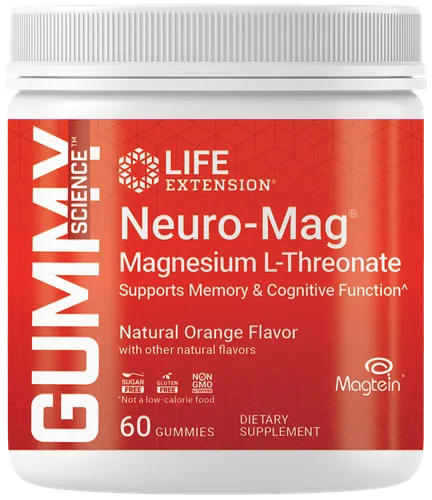
Life Extension - Neuro-Mag Magnesium L-Threonate GUMMIES - Natural Orange - Review
This is Neuro-Mag Magnesium L-Threonate Gummies from Life Extension, in Natural Orange flavor. It comes as chewable gummies. The serving size is 4 gummies, and each container holds 15 servings. Per serving, the label lists 144 mg of magnesium, 35 calories, 9 g of total carbohydrate, 0 g of total sugars with 0 g of added sugars, and 9 g of sugar alcohols. The other ingredients printed are maltitol, erythritol, gelatin, citric acid, pectin, natural flavors, sodium citrate and annatto extract. No directions are printed in the information provided, so check the container for how to use it. Buyers most often mention that the gummies are easy to take and are preferred to capsules, with taste opinions split between pleasant and bland. Some report feeling more focused or calmer, while one saw no difference.
We don’t sell supplements. We help you make decisions and get the best price.
Lowest prices
We hold no current store prices for it yet: check the store.
- AmazonPrice at AmazonCheck price at Amazon (opens in a new tab)
Also at: Vitacost
Some store links earn us a commission.
Study, Trial or Testing Result Summary
Members Only38 human studies · 21 improved
4 of these 38 human studies gave magnesium by drip, not by mouth.
This gummy supplies magnesium in the L-threonate form, the same form used in several of the strongest thinking studies, and the daily amount counts as a full dose. In 109 healthy adults, a magnesium L-threonate formula taken for 30 days improved memory scores more than placebo, with older people improving most [1]. In 100 younger adults with poor sleep, magnesium L-threonate taken for 6 weeks improved overall thinking, memory and reaction time compared with placebo [2]. In 80 middle-aged adults with sleep problems, a smaller daily amount for 3 weeks improved mental alertness, mood, energy and daytime productivity [3]. Other forms of magnesium also helped. Personalized magnesium improved thinking in people over 65 whose diets were high in calcium compared with magnesium [4]. Magnesium added to a med improved attention and memory in adults with depression [5]. Not every result was positive. A 2024 review found too few trials to judge magnesium supplements for thinking, though it noted that both low and high blood magnesium levels were linked to higher dementia risk [6]. Animal and cell studies are never counted.
See all 38 studies →Hide the studies
- A review of 3 randomized trials and 12 cohort studies in adults found too few trials to judge magnesium supplements, but both low and high blood magnesium levels were linked to higher risk of dementia and cognitive impairment compared with about 0.85 mmol/L.Magnesium and Cognitive Health in Adults: A Systematic Review and Meta-Analysis.
- A review of 14 studies of nutrition for people in hospital with alcohol withdrawal included magnesium among several supplements, but the evidence was limited and no clear effect of magnesium on memory was reported.Systematic review of nutritional interventions for people admitted to hospital for alcohol withdrawal.
- A review of 32 articles on magnesium in mental disorders found results that were not consistent, though some studies suggested magnesium supplements could help depressive symptoms; cognition was not the focus.The Role and the Effect of Magnesium in Mental Disorders: A Systematic Review.
- A review of 11 studies of nutrition after mild head injury reported positive recovery outcomes for several nutrients including magnesium oxide, but the studies varied too much to make firm recommendations.Nutritional interventions to support acute mTBI recovery.
- A review of 40 animal and human studies of micronutrients including magnesium combined with a med in type 2 diabetes reported mostly beneficial interactions for brain function, but magnesium was not assessed on its own.Read the study on PubMed (41782745) →
- In a trial of 1062 women at risk of very early birth, magnesium sulfate given before birth made little difference to their children's thinking, behavior or movement at ages 6 to 11 compared with placebo.School-age outcomes of very preterm infants after antenatal treatment with magnesium sulfate vs placebo.
- In 688 very preterm babies, a single 4 g dose of magnesium sulphate given to mothers before birth lowered the rates of death, motor problems and cognitive problems at two years, with some results reaching statistical significance.[Effect of magnesium sulphate on mortality and neurologic morbidity of the very-preterm newborn (of less than 33 weeks) …
- In 389 heart surgery patients, magnesium given by vein during surgery did not reduce thinking problems at 6 weeks (44.4% with magnesium versus 44.9% with placebo).Intraoperative magnesium administration does not improve neurocognitive function after cardiac surgery.
- In 350 heart surgery patients, magnesium during surgery improved short-term nerve function and memory right after surgery compared with placebo, but by 3 months there were few differences between groups.Magnesium as a neuroprotectant in cardiac surgery: a randomized clinical trial.
- In a trial of 250 adults, personalized magnesium supplements that lowered the calcium-to-magnesium intake ratio improved cognitive function by 9.1% in those over 65 with a high ratio diet.Ca:Mg Ratio, APOE Cytosine Modifications, and Cognitive Function: Results from a Randomized Trial.
- In 209 patients with bleeding around the brain from a burst aneurysm, daily magnesium sulfate (64 mmol) during hospitalization did not change thinking scores three months later compared with placebo.Effect of magnesium on cognition after aneurysmal subarachnoid haemorrhage in a randomized trial.
- In 171 healthy adults with mild insomnia, two weeks of a combination supplement containing magnesium did not improve sleep or cognitive performance more than placebo, as both groups improved similarly.Exploring the Effect of Lactium™ and Zizyphus Complex on Sleep Quality: A Double-Blind, Randomized Placebo-Controlled Tr…
- In 108 patients having carotid artery surgery, intravenous magnesium during the operation led to less thinking decline the next day than placebo, with the low dose working best and the high dose showing no difference.Intraoperative magnesium infusion during carotid endarterectomy: a double-blind placebo-controlled trial.
- In 109 healthy Chinese adults aged 18-65, 2 grams a day of a magnesium L-threonate formula for 30 days improved memory test scores more than placebo, with older participants improving more.A Magtein®, Magnesium L-Threonate, -Based Formula Improves Brain Cognitive Functions in Healthy Chinese Adults.
- In 100 adults aged 18 to 45 with poor sleep, 2 g of magnesium L-threonate daily for 6 weeks improved overall cognitive performance, memory and reaction time compared with placebo, and sleep-related impairment improved, though objective sleep measures did not differ.The effects of magnesium L-threonate (Magtein®) on cognitive performance and sleep quality in adults: a randomised, doub…
- In 80 adults having gallbladder keyhole surgery, intravenous magnesium sulfate given during anesthesia prevented the memory and learning decline seen one week after surgery in the control group and reduced a blood marker of brain cell injury.Could intraoperative magnesium sulphate protect against postoperative cognitive dysfunction?
- In 80 adults aged 35-55 with self-reported sleep problems, 1 g per day of magnesium L-threonate for 21 days improved sleep quality, mood, energy, mental alertness and daytime productivity compared with placebo.Magnesium-L-threonate improves sleep quality and daytime functioning in adults with self-reported sleep problems: A rand…
- In 66 children with attention-deficit/hyperactivity disorder, 8 weeks of magnesium at 6 mg/kg per day plus vitamin D improved emotional, conduct, peer and total behavior difficulty scores compared with placebo, though the authors call for larger trials.The effect of vitamin D and magnesium supplementation on the mental health status of attention-deficit hyperactive child…
- In 50 adults having brain surgery, intravenous magnesium sulfate around the operation did not change the main blood marker of brain injury, but patients scored better on some thinking tests than those given saline.Effect of perioperative magnesium sulfate on neurological outcome in neurosurgical patients: a randomized double-blind c…
- In 42 adults with sleep complaints, a blend containing 12.6 mg of magnesium with mulberry leaf extract over 2 weeks improved sleep and next-morning mood but had no effect on cognitive performance compared with control.Mulberry leaf extract combined with tryptophan improves sleep and post wake mood in adults with sleep complaints - A ran…
- In 40 adults with depression, 350 mg of daily oral magnesium added to a med for 6 weeks produced greater gains in thinking test scores, especially attention and memory, than a med alone.Read the study on PubMed (42374947) →
- In 35 stressed adults, a herbal blend containing magnesium and chromium improved attention and working memory during a stressful task over 2 weeks compared with placebo, though effects without stress were less consistent.Effects of a Scutellaria baicalensis/Crataegus laevigata, magnesium and chromium supplement on stressed individuals: A r…
- In 29 outpatients with compensated liver cirrhosis, lower magnesium levels were linked to poorer cognitive test results at baseline, but the abstract does not report a post-treatment cognitive effect of magnesium oxide versus placebo.Magnesium Deficiency and Minimal Hepatic Encephalopathy among Patients with Compensated Liver Cirrhosis.
- Learning-disabled children with abnormal brain wave patterns who took magnesium valproate at 20 mg per kg of body weight daily for 6 months improved on performance IQ and on some reading and word-ordering tasks, while the placebo group did not change.Magnesium valproate in learning disabled children with interictal paroxysmal EEG patterns: Preliminary report.
- At school age, children whose mothers received magnesium sulfate before very preterm birth showed no harm, and their behavior and cognitive difficulties were lower, but these differences were not statistically significant.School-age outcomes following a randomized controlled trial of magnesium sulfate for neuroprotection of preterm infants.
- Children with attention deficit hyperactivity disorder and low blood magnesium who took about 200 mg of magnesium daily for 6 months showed a significant drop in hyperactivity, compared with a group of similar children given standard treatment without magnesium.The effects of magnesium physiological supplementation on hyperactivity in children with attention deficit hyperactivity…
- In 31 children aged 6 to 12 with attention deficit and hyperactivity, a 30-day course of magnesium with vitamin B6 improved attention and behavior more than a multivitamin given to a comparison group of 20 children.[Effect of MAGNE-B6 on the clinical and biochemical manifestations of the syndrome of attention deficit and hyperactivit…
- In 19 active young men, two nights of a zinc and magnesium supplement taken before bed did not change Stroop test performance or sleep compared with a placebo or no pill.Effects of an Acute Dose of Zinc Monomethionine Asparate and Magnesium Asparate (ZMA) on Subsequent Sleep and Next-Day M…
- In a crossover study of 13 elite triathletes, completing a Stroop test was faster after magnesium oxide-induced bowel emptying than without magnesium, but the dose and duration were not stated and the group was very small.Defecation after magnesium supplementation enhances cognitive performance in triathletes.
- In 40 children with attention deficit and hyperactivity symptoms, at least eight weeks of magnesium at 6 mg/kg per day with vitamin B6 reduced hyperactivity and aggression and improved school attention, and symptoms returned when treatment stopped.Improvement of neurobehavioral disorders in children supplemented with magnesium-vitamin B6. I. Attention deficit hypera…
- In 30 adults with chronic brain ischemia, a magnesium and vitamin B6 product for one month, then with an added drug for one more month, significantly improved scores on cognitive and mood scales, with no side effects reported; the study had no comparison group.[The possibility of using combination therapy in patients with chronic cerebral ischemia].
- In an open-label pilot of 15 adults with moderate attention-deficit/hyperactivity disorder, up to 12 weeks of L-threonic acid magnesium salt led to symptom improvement in 47% of participants, with favorable changes in IQ testing and a significant gain on a shifting subscale; no placebo group was used.L-Threonic Acid Magnesium Salt Supplementation in ADHD: An Open-Label Pilot Study.
- In a cross-sectional study of 1207 adults on hemodialysis, higher serum magnesium was associated with higher cognitive test scores, though this study cannot show that magnesium causes the difference.Associations of Cognitive Function with Serum Magnesium and Phosphate in Hemodialysis Patients: A Cross-Sectional Analys…
- In a long-running study of Puerto Rican adults, low blood magnesium was linked to lower overall thinking scores, adequate magnesium intake was linked to larger brain gray and white matter volumes, and the link between low magnesium and brain volume appeared only in people with diabetes.Associations of serum magnesium and magnesium intake with brain morphology and cognitive function in Puerto Rican adults…
- In a study of 1006 Chinese adults aged 55 and older, higher whole-blood magnesium was linked to lower odds of mild cognitive impairment and better scores on attention, executive, and language tests.Relationship between Whole-Blood Magnesium and Cognitive Performance among Chinese Adults.
- In 810 children aged 5 to 12 referred for attention problems, 12 weeks of omega-3 and omega-6 fatty acids with magnesium and zinc was followed by fewer attention and hyperactivity symptoms and fewer emotional problems.Supplementation of polyunsaturated fatty acids, magnesium and zinc in children seeking medical advice for attention-defi…
- In a small UK study of 57 children and adults with ADHD and related conditions, lower red blood cell magnesium was linked to more severe ADHD symptoms, but this does not show that magnesium supplements help.A closer look at the role of nutrition in children and adults with ADHD and neurodivergence.
- In a study of twins, hair magnesium and other minerals were linked to brain network connectivity differently in autistic people than in others, and this study does not test whether magnesium supplements help thinking.Associations between Elemental Metabolic Dynamics and Default Mode Network Functional Connectivity Are Altered in Autism…
Review Totals and Summary
Members Only135 reviews · 78% positive
Buyers give a mixed but mostly friendly picture, with about 135 ratings across the stores that sell it. Some report a calmer or more focused effect, one saw no difference, and the taste draws split opinions. **What buyers say it did for them:** Two reviewers describe a benefit. A parent buying for a child with developmental delay says he is sleeping better and is calmer, though "not a whole lot" and they are still monitoring it. An adult says "these help me with concentration when I need to be focussed." Another buyer was pleased overall and had a positive experience. **What they complain about:** The main complaint is a lack of effect. One reviewer says they "didn't notice much of a difference" and did not buy more. Another mentions that the gummies are quite large, and one buyer says the price is a little high. **Taste, smell, size and form:** Opinions on taste are split. One reviewer says kids like it, and another says the child did not like the taste. One parent's child likes them. An adult finds them "a little bland in flavour, but not unpleasant," and another says they tasted okay. One buyer finds them "much better than capsules" and another finds them easy to take. The size is described as quite large. **Value for money:** One buyer calls it "a little expensive," but says one container lasts one or two months, so it is worth it. No other reviewer comments on price. **Who it seems to suit and who it did not:** It seems to suit people who dislike capsules and parents whose children accept the flavour. It suited one adult who wanted help staying focused. It did not suit one child who disliked the taste, though the parent took it instead and was happy. It did not suit the buyer who noticed no change.
Biohacker Summary
Members Only7 of 10 recommend it
Most of the panel recommends or uses magnesium, and sleep is the top reason, with others citing muscle recovery, stress resilience, blood pressure, bone health and helping vitamin D work. Glycinate and threonate are the favored forms: three of them take 400 mg of threonate before bed, and several others name glycinate for sleep, good absorption and gentle digestion. Doses range from 300 to 400 mg a day on the low end, up to 400 to 600 mg for some people, and one panelist aims for about a gram of supplemental magnesium, while a few use electrolyte drinks or multi-form blends. Several pair it with vitamin D because magnesium helps the body use it, and one mixes a magnesium powder with psyllium husk before bed. One panelist cautions against piling on magnesium for poor sleep and says supplements should fill a deficiency shown by blood work, and another says it does not fix waking in the night.
See all 10 biohackers →Hide the biohackers
Dr. Eric Berg · Magnesium · neutral
- Notes that B1 depends on magnesium to work.
- Names magnesium as a cofactor needed for vitamin D to work, abundant in meat.
- Says magnesium is necessary for vitamin D to be effective and says many people fail to take it, so it should be taken alongside vitamin D.
- Recommends magnesium glycinate as the gold standard for good absorption with few GI problems, since magnesium helps relax arteries and keep blood pressure from rising.
- Says the natural remedy for a heel spur, which reflects a calcium problem, is magnesium glycinate at 400 milligrams.
- Recommends supplementing magnesium during prolonged fasting to prevent feeling unwell, especially since many individuals are already deficient.
- Recommends taking magnesium glycinate to fix intense leg cramps, stating that this form absorbs better and helps relax muscles.
- Recommends magnesium, specifically magnesium glycinate, for blood pressure control, sleep, stress reduction, prevention of muscle cramps, and energy support.
- States that magnesium could also be a factor in preventing muscle cramps.
- Recommends Magnesium glycinate, noting its high absorption rate compared to magnesium oxide, and its support for energy, sleep, muscle relaxation, and vitamin D function.
Thomas DeLauer · Magnesium · recommends
- Speaker would add magnesium glycinate, citing a 2022 meta-analysis of 17 studies showing reduced C-reactive protein and fibrinogen, linked to cardiovascular inflammation.
- Says taking boatloads or truckloads of magnesium because you sleep poorly is not how the system works, and that supplements should replace a blood-work-defined deficiency rather than be stacked.
- Recommends pre-bed magnesium glycinate to lower evening cortisol through GABA-A support and to drop core temperature for sleep onset.
- Recommends taking magnesium glycinate and threonate at night to act as a brake on the nervous system, block excitatory signaling, help wind down, and support serotonin and melatonin production for better sleep.
- Mentions that magnesium glycinate also helps a lot with sleep.
- Mentions that restless leg syndrome is often treated with magnesium, but states that the sensation is actually coming from three other issues.
- Uses Element's cans which contain 30 milligram magnesium, finding that electrolytes help his workout performance.
- Uses Element's 30 mg magnesium cans first thing in the morning to prime his day and help with workout performance.
- Recommends magnesium around the time one would normally break a fast to calm the brain and dull feelings of conditioned hunger.
- Recommends magnesium, noting it is a cofactor for enzymes that build neurotransmitters, and deficiency can affect mood, happiness, and motivation.
Ben Greenfield · Magnesium · uses
- Often mixes two scoops of Magnesium Breakthrough powder with psyllium husk powder before bed, using about 4 ounces of water, and uses the raspberry lemonade flavor.
- Uses magnesium during surgery because it is neuroprotective.
- Says he is drinking LMNT, which contains sodium, potassium, and magnesium, and states that he actually drinks this stuff.
- Mentions magnesium as part of a bare-minimum protocol.
- Advises getting red blood cell magnesium levels to the high end of the range as a minimum step for overall health and to slow down heart disease.
- Recommends supplementing with magnesium threonate if one is low in magnesium, as it crosses the blood-brain barrier and is demonstrated to increase hippocampus plasticity, theoretically making one smarter and improving memories.
- Uses Magnesium Breakthrough from BIOptimizers as part of their daily stack, taking four capsules in the evening to support relaxation, recovery, and a good night of sleep.
- Recommends Celtic Sea Salt's new electrolyte drink "Hydrate" for replacing electrolytes and trace minerals lost through sweat, noting it contains 70 naturally occurring trace minerals, plus magnesium, taurine, and potassium.
- Had heart palpitations when he was really overdoing magnesium, not knowing what he was taking.
- Recommends taking magnesium as a co-factor to increase vitamin D absorption.
Dr. Mark Hyman · Magnesium · recommends
- Recommends Magnesium Breakthrough Advanced 10 from Biooptimizers, stating it has 10 bioavailable forms and 550 milligrams of elemental magnesium, designed to support restful sleep, restorative sleep, muscle recovery, stress resilience, and metabolic health.
- Recommends magnesium breakthrough advanced ten from Biooptimizers, which is their most complete magnesium formula with 10 bioavailable forms and 550 milligrams of elemental magnesium, designed to support restful restorative sleep, muscle recovery, stress resilience, and metabolic health.
- Recommends considering magnesium glycinate before bed for nervous system support, deeper sleep quality, and to help the body transition into rest, and states that they take it every night.
- Explains that a lack of magnesium can cause muscles and nerves to malfunction, resulting in muscle weakness, twitching, and cramps.
- Recommends Magnesium Breakthrough Advanced 10 from Bioptimizers for restful sleep, muscle recovery, stress resilience, and metabolic health, especially during stressful times of the year.
- Recommends magnesium because it is involved in over 600 reactions in the body and up to 80% of people may have low levels that never get flagged on a standard blood test.
- Recommends magnesium as a basic supplement during detoxification to support pathways, help with constipation, and provide electrolytes.
- Recommends Magnesium Breakthrough Advanced 10 from Biooptimizers, which contains 10 bioavailable forms and 550 mg of elemental magnesium, to support restful sleep, restorative sleep, muscle recovery, stress resilience, and metabolic health.
- Has recommended magnesium breakthrough from bioptimizers for years and now uses Magnesium Breakthrough Advanced 10 as part of his evening routine, especially during periods of travel, training, and higher stress, to support sleep, muscle recovery, and metabolic health.
- Recommends correcting nutrient deficiencies with magnesium.
Bryan Johnson · Magnesium · uses
- Takes 400 mg of Magnesium Threonate before bed for sleep.
- Takes 400 mg of Magnesium Threonate before bed for sleep.
- Takes 400 mg of Magnesium L-Threonate before bed for sleep.
- Takes 400 mg of Magnesium Threonate before bed for sleep.
- He takes 400 mg of Double Wood Magnesium L-Threonate before bed for sleep.
- Takes 400 mg of Magnesium L-Threonate before bed for sleep.
- Takes 400 mg of Magnesium Threonate before bed for sleep.
- Takes 400 mg of Magnesium L-Threonate before bed for sleep.
- Takes 400 mg of magnesium L-threonate before bed for sleep.
- He takes 400 mg of Magnesium L-Threonate before bed for sleep.
Dr. Rhonda Patrick · Magnesium · recommends
- Explains that magnesium helps the body activate and metabolize vitamin D, and that magnesium intake has been associated with lower odds of vitamin D deficiency and insufficiency.
- Mentions that getting too little magnesium may play a role in declining testosterone levels.
- Recommends getting enough magnesium, around 300–400 mg daily from diet and supplements, as it is an essential cofactor for vitamin D metabolism. Magnesium glycinate is a good form.
- Notes that magnesium is very important for preventing damage to DNA and cancer, and that half the US population doesn't get enough of it.
- Mentions magnesium as one of the micronutrients found in multivitamins that people often don't get enough of from their diets.
- Explains that magnesium helps control blood pressure by boosting the production of substances that relax blood vessels and improve cardiovascular health, citing a meta-analysis that found magnesium supplementation at an average dose of 368 mg per day notably lowers both systolic and diastolic blood pressure.
- Magnesium supplementation has lowered blood pressure in randomized controlled trials. An analysis of 34 trials involving over 2,000 participants found modest reductions in both systolic and diastolic pressure, with a median dose of 368 mg/day.
- Warns that some magnesium supplements make the dose look much larger than it really is and that labels can fool people.
- Mentions magnesium as an important nutrient component for testosterone.
- Warns that some supplement companies mislead consumers by listing the total compound weight of magnesium citrate as the elemental magnesium dose, when the actual elemental magnesium content is much lower, potentially around 44-66 milligrams.
Andrew Huberman · Magnesium · recommends
- Notes that Les Spellman's team includes 'Magnesium timed right' as part of their game plan to optimize recovery in unfavorable conditions.
- Discusses Magnesium Threonate as a tool for falling asleep.
- Takes 400 mg of Magnesium Threonate before bed for sleep.
- Uses Element, an electrolyte drink with sodium, magnesium, and potassium in correct ratios and no sugar, to ensure adequate hydration and electrolytes, especially when starting days fast or during physical exercise.
- Takes 400 mg of Magnesium L-Threonate before bed for sleep.
- Confirms that magnesium is absolutely important for cognitive function, noting studies show those with lower magnesium intakes tend to perform less well on cognitive function tests, and it's related to brain changes over time and dementia risk.
- Takes 400 mg of Double Wood Magnesium L-Threonate before bed for sleep.
- He takes 400 mg of Magnesium L-Threonate from Double Wood before bed for sleep.
- Takes 400 mg of Double Wood Magnesium L-Threonate before bed for sleep.
- Takes 400 mg of magnesium L-threonate before bed for sleep.
Dave Asprey · Magnesium · uses
- Looks at magnesium alongside protein to keep muscle for the long run.
- Suggests adding magnesium to help keep potassium in the system longer, as they work hand in hand.
- Mentions magnesium in the context of sleep but states that it doesn't address the core issue of waking up during the night.
- Suggests that magnesium may help slow aging, support cellular repair, and improve sleep.
- States that magnesium can affect how the body responds to a supplement.
- Recommends fixing sleep with 300mg of Magnesium 101 before bed if diet and exercise aren't melting stubborn belly fat.
- Dave Asprey says his daily routine includes magnesium as part of a carefully developed combination for longevity.
- Recommends magnesium glycinate for sleep, stating that trials show it helps people fall asleep about 17 minutes faster and that he finds it incredibly effective.
- Mentions magnesium glycinate as one of the five gut-friendly, extensively researched ingredients in Kill Switch that helps with natural sleep.
- Dave Asprey recommends Magnesium Glycinate for sleep, noting human studies show it helps people fall asleep faster, is safe, and works on a fundamental aspect of health, unlike magnesium oxide which acts as a laxative.
Siim Land · Magnesium · recommends
- States that Magnesium can be a useful addition for some people for sleep.
- Recommends magnesium for sleep, especially deep sleep, and suggests trying better types like Threonate, Biscinate, or Torate, referencing a study where magnesium supplementation improved deep sleep.
- Recommends Magnesium for blood pressure, migraines and deficiency, based primarily on human research, especially randomized controlled trials showing measurable benefits.
- Lists Magnesium as one of 15 supplements backed by human studies.
- States that magnesium is a fundamental mineral governing over 600 enzymes and metabolic reactions, and recommends that most people need at least 400-500 mg/d for health, with some needing up to 600 mg/d.
- Lists seafood and pumpkin seeds as sources of Magnesium.
- Thinks magnesium has some of the strongest evidence and is worth considering.
- Recommends taking magnesium, specifically glycinate and threonate forms, 1 to 2 hours before bed for sleep benefits, noting that glycinate promotes relaxation and threonate crosses the blood-brain barrier for sleep quality and cognitive function.
- Notes that Boron reduces calcium/magnesium loss.
- Notes that magnesium is important for activating thiamine into its more biologically active form, and a magnesium deficiency can impair blood sugar regulation even with adequate thiamine intake.
Peter Attia · Magnesium · neutral
- Peter reviews the evidence for select off-label medications and supplements commonly used for sleep, including glycine, magnesium, ashwagandha, and phosphatidylserine.
- Suggests that zinc and magnesium could potentially help with vasodilation and sleep, particularly for women experiencing severe symptoms in the luteal phase.
- Peter discusses electrolytes and fiber and the ketogenic diet, specifically preventing magnesium loss.
- Recommends magnesium as one of the 'big three' micronutrients for bone health, suggesting a daily intake of 300 to 500 milligrams as a minimum, and personally aims for about a gram of supplemental magnesium.
- Recommends magnesium for optimizing bone mineral density, suggesting a daily intake of 300 to 500 milligrams as a minimum, but personally aims for about a gram.
- Takes a hardline view that most people do not have adequate or optimal levels of magnesium, and suboptimal levels will impede the metabolism of vitamin D because magnesium is a cofactor in its enzymatic conversion.
- Takes a hardline view that most people do not have adequate or optimal levels of magnesium, and suboptimal levels will impede vitamin D metabolism because magnesium is a co-factor in the enzymatic conversion of vitamin D.
- Takes magnesium as a straightforward supplement.
- Mentions that magnesium intake is often super low and impactful on testosterone levels.
- Discusses the important roles of magnesium in the body, how to determine if one might be deficient, the prevalence of magnesium deficiency, and its potential cognitive benefits.
RAL Summary
Members OnlyTier 2 for Focus and Memory
Several placebo-controlled trials of magnesium L-threonate improved memory and thinking [1][2], and 77% of 145 reviews are positive, which meets the tier 2 rules.
Take 2 servings a day (8 gummies) to match the dose that worked in the studies.
Where the evidence disagrees: 7 of the 38 human studies found no effect.
More Details
Members OnlyBody systems · Combine with · Possible side effects
Body systems: Nervous system
Combine with: Members often pair magnesium-based brain formulas with other ingredients for cognitive support. Omega-3 DHA is often paired with it because both are involved in brain cell membranes and signaling. Bacopa is often paired with it as both are used for memory and learning. L-theanine is often paired with it because both act on calming, relaxed focus pathways. Vitamin B6 is often paired with it because it helps magnesium get into cells.
Possible side effects: No major side effects reported. Buyers mention that the gummies are large and that opinions on the taste are split.
Supplement Facts
Includes Added Sugars 0 g · Sugar Alcohols 9 g · Magnesium 144 mg
| Calories | 35 | |
| Total Carbohydrate | 9 g | |
| Total Sugars | 0 g | |
| Includes Added Sugars | 0 g | |
| Sugar Alcohols | 9 g | |
| Magnesium | 144 mg |
Other ingredients: Maltitol, erythritol, gelatin, citric acid, pectin, natural flavors, sodium citrate, annatto extract.
Barcode (UPC) 737870252061 · Label source: Reverseagelab · Report a label change
Show entire label

More focus and memory products
Members OnlyThe highest ranked for the same goal
Read more
Our articles on this subject
- Magnesium Glycinate vs Citrate: What the Studies ShowArticle · Oct 30, 2026
- Magnesium Glycinate vs Threonate: Which Form Is Right for You?Article · Nov 6, 2026
Graded November 23, 2026 by the Reverse Age Lab evidence engine, from human studies, real reviews and our biohacker panel. How we grade. Is this medical advice? No. Rala organizes the published evidence; go over any change with your doctor, especially if you take meds.
Privacy policyConsumer health dataAffiliate disclosureTermsBrand and legal noticesDo Not Sell or Share My Personal InformationCookie settings