
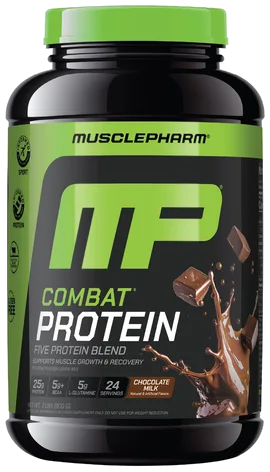
MusclePharm Combat Powder Chocolate Peanut Butter Review
This eBay product page lists the MusclePharm Combat Chocolate Peanut Butter Protein Powder in a 4 lb size, and the listing is marked as currently sold out. The page identifies the brand as MusclePharm and gives the eBay product ID as 6033162697. The product identifiers printed on the page are EAN, GTIN and UPC, all reading 0705105703664. The key features section lists the When to Take field as Any Time, the Main Purpose as Bodybuilding and Fitness, the Flavor as Chocolate Peanut Butter, and the Type as Multiple Proteins and Protein. The additional features section shows Custom Bundle as No. The page shows a 5.0 rating from 5 product ratings. Shoppers can read the reviews section, which includes the labels Would recommend, Good value and Good quality. No ingredients list, nutrition panel, serving count, or price appears in the scraped text for this listing, because the item is sold out at the time of capture. The related items section shows other MusclePharm Combat protein powders in other flavors such as Cookies and Cream, Chocolate Milk, Vanilla, Horchata Flavor and Banana Cream, each listed in 4 lb or 5 lb sizes with 52 or 70 servings and priced at $69.99 or $89.99 with free shipping. A Combat Protein Powder in Chocolate Milk at 4.2 lbs is listed at $75.59. A Combat Protein Powder in Cookies N Cream at 4.2 pounds with 52 servings is listed at $79.83. The page also shows best selling and trending items in protein shakes and bodybuilding from other brands, which are not the product on this page. Those related listings are separate products and should not be read as details of the Chocolate Peanut Butter item.
We don’t sell supplements. We help you make decisions and get the best price.
Lowest prices
Finding the lowest prices at the stores now. This takes a few seconds.
Products with nearly the same formula (Matched on the main ingredients)
Study, Trial or Testing Result Summary
Members OnlyHuman studies
We were not given any ingredient findings for this product, so there is no study evidence to report for muscle building. The label amounts are unknown beyond a serving size of about 70 grams, and the store listing does not name the ingredients either. Because of this, we cannot say which ingredients are present, whether any are at the doses used in research, or whether any are hidden inside a blend. No human studies on muscle building were linked to its ingredients in the material we reviewed. Buyer feedback is very limited, with only five ratings, all positive, and no written reviews could be read, so nothing is known about what those buyers said or whether they noticed any change in strength or muscle. No biohacker statements were available. Until the full label and ingredient research are added, this product stays at an early stage of evidence, and members should treat any claims about muscle growth as unproven for this specific product. Animal and cell studies are never counted.
Review Totals and Summary
Members Only5 reviews · 100% positive
Buyers of MusclePharm Combat Powder in Chocolate Peanut Butter are very happy with it. Across the stores it carries about 5 ratings, and all of the written feedback is positive, with no complaints raised. The sample is small, so treat the themes as a limited picture. **What buyers say it did for them:** Most comments are about getting protein easily rather than about measured results. One buyer says "You need protein every day and this is an easy way to get it," and another calls it good "before or after workout." One reviewer on eBay reports seeing good results while using it, but gives no detail on what changed or over what period. Another review calls it "highly recommended for bodybuilders" and "rich in protein." **What they complain about:** Nothing. No reviewer raises a problem with taste, texture, mixing or price. The one hint of surprise is a buyer who "really didn't think that it will be this much tasty," which reads as pleasant surprise rather than criticism. **Taste, smell and form:** Flavor is the strongest theme. Reviewers call it "very very delicious" and describe a "chocolaty flavor." One says it was "very tasty and not chalky," and another notes "No after taste." On eBay, buyers say the chocolate peanut butter tastes great and is fantastic. Mixing comes up repeatedly there, with one reviewer saying the powder mixes really well. One buyer likens it to "chocolate milk gains." No one comments on smell. **Value for money:** Value is mentioned positively. One buyer says "Tasty protein great value!" and an eBay reviewer describes it as exactly what they wanted at a great price. Another bought it only "as an add on to get free shipping" and was still pleased with it. **Who it suits and who it did not:** It seems to suit people who want a chocolate-flavored protein shake that tastes good, mixes smoothly and isn't chalky. That includes gym-goers and bodybuilders who take it around workouts, and people who simply want to add protein to their day. Nobody reports that it did not suit them. Because the feedback is so uniformly positive and brief, there is no evidence on how it works for people with particular dietary needs or for those who dislike peanut butter flavors. **Other forms:** The eBay page carries only powder feedback as far as the summary shows, and nothing from other product forms such as gummies or capsules is included here. **Bottom line:** For a buyer deciding on the powder, the consistent message is good flavor, no chalkiness or aftertaste, easy mixing and fair value. The small number of ratings means the praise is encouraging but not a broad test.
Biohacker Summary
Members Only10 of 10 recommend it
The main ingredient here is not covered in the panel's statements, so there is nothing to report on it, and every ingredient the panel did discuss is a smaller ingredient in this product. Of those, potassium and sodium drew the most comment. Several panelists use electrolyte drinks with sodium and potassium for hydration and workouts, one taking 500 to 1,000 milligrams of sodium before coffee and another using a 100 milligram potassium can. Others recommend getting enough potassium, since most people get too little, and two prefer to get it from foods like potatoes and bananas rather than supplements. On the caution side, a few warn that most people get too much sodium, with one advising no more than 2,300 milligrams a day, while one other recommends extra sodium for people who feel bad. Amino acids and fiber also drew mostly favorable comments, with one panelist using amino acids as a faster-absorbing alternative to a milky shake.
See all 10 biohackers →Hide the biohackers
Ben Greenfield · Amino Acids · uses
- For longer operations, Ben Greenfield runs intraoperative IV bags of amino acids to mitigate muscle protein breakdown during surgery.
- Gives a nod to amino acids, suggesting they would fit into the same category as collagen peptides for improving skin elasticity, even though studies have focused on collagen peptides.
- Says he is drinking LMNT, which contains sodium, potassium, and magnesium, and states that he actually drinks this stuff.
- Says he is drinking LMNT, which contains sodium, potassium, and magnesium, and states that he actually drinks this stuff.
- Recommends Celtic Sea Salt's new electrolyte drink 'Hydrate' for replenishing electrolytes and trace minerals lost through sweat, noting it contains 70 naturally occurring trace minerals, magnesium, taurine, and potassium, with no added sugar, artificial colors, or synthetic ingredients.
- Notes that while sodium is known to affect blood pressure, the balance between sodium and magnesium is also important, and isolated sodium chloride in ultra-processed foods is more problematic than sodium from other sources.
- States that amino acid intake can help fight age-related muscle loss.
- Warns that sodium nitrate hurts endurance exercise adaptations in women.
- Is considering whether he needs a calcium supplement because lead can displace calcium in bones, affecting bone strength.
- Mentions calcium as a common deficiency.
- Recommends sodium as it is relied upon by the creatine transporter for better creatine efficacy.
- Opens a sparkling electrolyte drink from LMNT, noting it contains 500 mg of sodium, and says he just needs something to wet his whistle.
- Adds a pinch of Celtic Sea Salt® to his post-workout smoothie to replace sodium and trace minerals lost during training, noting it retains minerals like magnesium, potassium, and calcium.
- Recommends adequate intake of calcium for bone strength.
Dr. Eric Berg · Potassium · recommends
- States that people need more potassium than any other mineral, yet most people aren’t getting enough.
- Explains that potassium is essential for peristalsis, the pumping action through the colon, and without it, things can sit there, leading to constipation.
- Explains that the normal requirements for potassium are 4,700 mg every single day, and that very few people get half of that amount. They describe potassium's role in the sodium potassium pump, which is essential for cellular electricity, muscle contraction, and heart function. Deficiency can lead to tiredness, muscle cramps, heart palpitations, or rising blood pressure.
- Recommends increasing potassium to restore balance and support healthy blood pressure.
- Warns that bone loss cannot be fixed with just calcium, as bone is primarily collagen with other essential minerals.
- States that potassium is the most important electrolyte and that most people are not getting enough of it, needing around 4,700 mg daily, or even more, to avoid issues like fatigue, muscle cramps, heart palpitations, high blood pressure, and fluid retention.
- Dr. Eric Berg states that potassium is essential for health, supporting healthy muscles, nerves, and heart function, but warns that getting too much, especially from supplements, can be dangerous.
- Dr. Eric Berg states that most people are getting nowhere near enough potassium to balance the amount of sodium they’re already eating, implying a recommendation for increased potassium intake.
- Dr. Eric Berg discusses sodium in relation to blood pressure, noting that the ratio between sodium and potassium matters.
- States that hydration is water plus electrolytes like sodium, implying its importance for proper hydration.
- Explains that potassium relaxes blood vessels, keeps elasticity in arteries, lowers adrenaline, supports the sympathetic nervous system, protects the endothelial layer of arteries, increases nitric oxide, and keeps insulin receptors sensitive.
- Was very successful in practice using potassium for hypertension, noting that bodies need 4700 mg of potassium every single day.
- States that low potassium can lead to constipation because potassium controls the smooth muscles of the body, affecting the contraction and relaxation of muscles in the colon.
- Mentions that grass-fed liver is loaded with high-quality amino acids.
Thomas DeLauer · Potassium · uses
- Uses Element's cans which contain 100 milligram potassium, finding that electrolytes help his workout performance.
- Uses Element's 500 mg sodium cans first thing in the morning to prime his day and enhance workout performance, noting that the pump is often driven by sodium.
- Uses Element's 100 mg potassium cans first thing in the morning to prime his day and help with workout performance.
- Uses Element's 500 mg sodium cans first thing in the morning to prime his day and help with workout performance and pump.
- Has been starting his day with 500 to 1,000 milligrams of sodium before coffee, noticing a significant difference in mental acuity before going to the gym.
- Suggests that the amount of sodium in restaurant food makes a difference in how one feels, implying a negative impact.
- States that amino acids, including essential amino acids and BCAAs, cannot be consumed during a fast as they can shut down ketosis due to the leucine insulin response.
- Notes that milk contains 120mg of calcium, while sardines contain 351mg, highlighting a 3x difference.
- Has been starting his day with 500 to 1,000 milligrams of sodium before coffee, noticing a significant difference in mental acuity when he goes to the gym an hour later.
- Recommends Element's ready-to-drink sparkling electrolyte drinks as a low or zero-calorie soda replacement that provides 1,000 milligrams of sodium, 200 milligrams of potassium, and 60 milligrams of magnesium.
- Uses Element Electrolytes for about eight years, noting they contain 1000 mg sodium, 200 mg potassium, and 60 mg magnesium, and help curb appetite without adding many calories.
- Suggests that pairing watermelon with sodium post-workout enhances muscle glucose uptake through the insulin-dependent pathway, strategically using both glucose uptake doors.
Dr. Mark Hyman · Potassium · warns
- Warns that potassium bromate, a dough conditioner banned in the EU, UK, and Canada, is still allowed in U.S. bread.
- States that potassium plays a critical role in nerve signaling and muscle contraction, especially in the heart, and low levels can lead to dangerous irregular heart rhythms.
- States that sodium is essential for fluid balance, nerve signaling, and muscle function, and that low levels can cause weakness, confusion, and dizziness, while high levels may indicate dehydration or too much salt.
- Notes that calcium is in bones but is also essential for nerves, muscles, and the heart, and low levels can affect muscle function and heart rhythm.
- Notes that meds flush out potassium.
- States that with potassium, water can fully cross the cell membrane and get inside where it's needed for intracellular hydration.
- States that with sodium, water can fully cross the cell membrane and get inside where it's needed for intracellular hydration.
- States that green leafy vegetables are great sources of calcium.
- Believes that if functional testing is done to replete deficiencies like amino acids before someone stops their medication, withdrawal symptoms can be completely eliminated.
- Recommends using targeted electrolyte support, advising to look for products with meaningful amounts of sodium, potassium, and magnesium, low sugar content, and avoidance of artificial colors, flavors, and sweeteners.
- Warns that potassium bromate, a chemical dough conditioner, has been linked to cancer, oxidative stress, DNA damage, and reproductive harm in animal studies.
- Warns that electrolyte drinks, while marketed for hydration, are loaded with high-glycemic sugars, synthetic potassium salts, and artificial dyes that can trigger insulin resistance, blood sugar crashes, and inflammation.
- Notes that calcium needs are lower than advertised and that stress, soda, and excess sugar can drive calcium loss.
- Recommends promoting potassium enriched low sodium salts as a great life hack, stating that changing the brand of salt used at home can reduce the risk of heart attack, stroke, or early death.
Siim Land · Sodium · neutral
- Mentions that sodium is a mineral necessary for making collagen.
- Has nearly doubled his fiber intake to 50-60g per day over the last 5 years, which has improved his body composition, digestion, gut health, blood work, and gut microbiome diversity.
- Lists potatoes and fruit as sources of Potassium.
- Lists dairy and sardines as sources of Calcium.
- Notes that Boron reduces calcium/magnesium loss.
- Notes that bananas have potassium but there are at least 8 other foods with more potassium than bananas.
- States that potassium is the most abundant intracellular cation that helps to maintain intracellular fluid volume and that without it, one greatly increases the risk of hypertension, cardiovascular disease, diabetes, and stroke.
- States that amino acids are among many other nutrients needed for glutathione.
- Mentions sodium as one of the factors related to blood sugar covered in his book.
- Recommends a high calcium intake for bone health.
- Mentions that amino acids like proline help to expedite results from micro needling and collagen intake for collagen synthesis.
- Places calcium supplementation in the 'bad tier' due to its association with increased cardiovascular events, recommending dairy or bones as easier ways to get calcium, though it can be useful for postmenopausal women with low bone density.
- States he does not quantify his sodium intake and doesn't regularly salt his food or drink electrolytes, estimating his intake to be around 2,500 milligrams a day, which is on the lower end.
- States that he consumes around 5-6 grams of sodium per day, emphasizing its importance for overall health.
Dave Asprey · Sodium · recommends
- Recommends that people who feel bad try more sodium, as it often works, especially for those with low blood pressure and anxiety.
- States that amino acids build muscle and that missing one of the 9 essential amino acids means the signal doesn't fire.
- Confirms that the Ignitrons are dissolved into powdered amino acids that are then dissolved into water.
- States that dietary fiber is a carbohydrate and that there is value to complex carbohydrates as a source of dietary fiber.
- They get into why ketosis works better when you cycle in and out of it, how sodium and electrolytes play a bigger role in insulin resistance than most people realize.
- Notes that when energy intake is too low for training demand, nutrient intake often falls short, especially for calcium, which is associated with reduced bone health.
- Explains that calcium provides the raw material for bones, but it isn't a standalone input and needs a whole system to be effective.
- Notes that people take calcium for their bones.
- Recommends changing one's food, specifically by consuming non-digestible fiber, to replace the microbiome within 3 to 4 weeks, as it promotes the growth of butyrate-producing bacteria.
- Warns that taking calcium without vitamin D, A, and K2 can lead to calcium going into tissues, causing bone spurs and other issues, and recommends a two-to-one ratio of calcium to magnesium.
- Recommends having more potassium during a fast to increase mineral intake.
- Dave Asprey discusses how amino acids influence mTOR, IGF-1, and aging.
- States that people who are salt-sensitive hypertensives usually need more potassium.
- Explains why electrolytes, especially sodium, potassium, and magnesium, are foundational for recovery.
Peter Attia · Sodium · neutral
- Peter discusses lifestyle factors impacting blood pressure, including sodium.
- States there is some evidence that increasing dietary potassium through potassium-rich foods like bananas and potatoes, rather than supplements, can lower blood pressure.
- States that dietary fiber's effect on cardiovascular disease, cancer, and mortality is very consistent in research, showing a dose response and benefit in almost every study.
- Uses amino acids, noting they are absorbed faster than whey protein and are a good alternative when she doesn't want a milky substance.
- Mentions that dietary sodium guidelines are around 5 grams per day, but some newer information suggests 8 to 10 grams might be acceptable before concern.
- Peter explains how different types of fiber affect digestion, satiety, weight management, and glycemic control, and compares their impact to other, more potent metabolic tools.
- Recommends calcium as one of the 'big three' micronutrients for bone health, suggesting a daily intake of 1,000 to 1,200 milligrams, which can be supplemented with calcium carbonate or calcium citrate.
- Explains that bone is 50 to 70% mineral, predominantly calcium, and that virtually all of the body's calcium is contained within bone, making bone important for calcium homeostasis.
- States that no protein or amino acids should be consumed throughout a race because it would divert oxygen away from pure propulsion.
- Recommends calcium for bone health, stating that teenagers probably need about 1000 milligrams a day.
- Discusses bone acting as a reservoir for calcium and how resorption and formation release calcium into the blood when needed.
- Warns that for individuals with gene polymorphisms making them sensitive to salt, a higher sodium intake can significantly increase blood pressure.
- Explains that amino acids are not just building blocks but also signaling molecules that directly stimulate muscle protein synthesis by activating the mTOR pathway.
- Recommends eating a diet rich in fiber, especially after taking meds, to help recolonize the gut microbiome.
Andrew Huberman · Potassium · uses
- Uses Element, an electrolyte drink with sodium, magnesium, and potassium in correct ratios and no sugar, to ensure adequate hydration and electrolytes, especially when starting days fast or during physical exercise.
- Uses Element, an electrolyte drink with sodium, magnesium, and potassium in correct ratios and no sugar, to ensure adequate hydration and electrolytes, especially when starting days fast or during physical exercise.
- Notes that dietary fiber seems to have some benefits for cognitive function.
- Uses Element, which contains potassium in the correct ratios, to ensure proper hydration and electrolyte intake for brain and body function.
- Uses Element, which contains sodium in the correct ratios, to ensure proper hydration and electrolyte intake for brain and body function.
- Mentions potassium as an electrolyte.
- Explains how salt (sodium) affects mental and physical performance, as well as cellular health, and how the brain monitors sodium levels to regulate thirst and fluid balance.
- Uses Element, an electrolyte drink with sodium, magnesium, and potassium in correct ratios and no sugar, to ensure adequate hydration and electrolytes, drinking it first thing in the morning and during physical exercise.
- Uses Element, an electrolyte drink with sodium, magnesium, and potassium in correct ratios and no sugar, to ensure adequate hydration and electrolytes, drinking it first thing in the morning and during physical exercise.
- Uses Element, an electrolyte drink with sodium, magnesium, and potassium in correct ratios and no sugar, to ensure he is hydrated and has sufficient electrolytes. He drinks it first thing in the morning and during physical exercise, especially on hot days.
- Uses Element, an electrolyte drink with sodium, magnesium, and potassium in correct ratios and no sugar, to ensure he is hydrated and has sufficient electrolytes. He drinks it first thing in the morning and during physical exercise, especially on hot days.
- Notes that if you start with a diverse microbiota, you're more likely to respond positively to dietary fiber, but if your gut microbiome is depleted, you may not be able to respond as well.
- Uses Element, an electrolyte drink with sodium, magnesium, and potassium but no sugar, to ensure adequate hydration and electrolytes, especially when waking up and during exercise.
- Uses Element, an electrolyte drink with sodium, magnesium, and potassium but no sugar, to ensure adequate hydration and electrolytes, especially when waking up and during exercise.
Dr. Rhonda Patrick · Sodium · warns
- Advises limiting sodium, ideally closer to 1,500 mg/day and not above 2,300 mg/day, for a diet linked to longer life.
- Mentions that kale delivers calcium, a micronutrient many diets fall short on.
- Warns that most people get too much sodium.
- Recommends getting enough potassium, noting that most people get too much sodium and not enough potassium.
- Rhonda recommends increasing dietary fiber intake as the best defense against microplastics.
- Notes additional gaps in calcium.
- Rhonda states that increasing dietary fiber intake could be one of the simplest and most effective ways to limit microplastic absorption.
- Recommends consuming fiber-rich foods like legumes, fruits, vegetables, and whole grains to bind to lipophilic chemicals like BPA and phthalates in the GI tract, reducing their absorption and promoting their excretion, and potentially aiding in the excretion of larger microplastics.
- Discusses whether dietary fiber can increase microplastic excretion.
- States that dietary fiber fulfills almost every aspect of strong evidence for reducing the risk of cancer, heart disease, and mortality, with known mechanisms and a dose-response relationship.
- Reports that alcohol use disorder is associated with a 20-50% greater prevalence of Calcium deficiency.
- Suggests increasing consumption of dietary fibers as a healthy lifestyle intervention to improve intestinal permeability.
- States that maintaining a high potassium intake is important for hypertension.
- Rhonda states that if you are starving the bacteria of the fiber they need to make short-chain fatty acids, you are also starving the gut epithelial cells which rely on these short-chain fatty acids for energy.
Bryan Johnson · Sodium · warns
- Warns that Taco Bell's beefy five-layer burrito contains 1,290 mg of sodium, almost maxing out the daily reasonable consumption recommended by the American Heart Association, and that sodium increases blood volume, putting pressure on blood vessels.
- Warns against excess sodium, stating it can negatively affect the ability to absorb and hold onto calcium intake.
- Recommends calcium as a mineral that, along with phosphorus, magnesium, and boron, is deposited to fortify the bone structure after the collagen scaffold is in place.
- Agrees that a little extra calcium is probably okay, especially for women, to really hit home for bone mineral density.
- Emphasizes the importance of getting a complete amino acid profile every day for every fundamental element of the body, as nine essential amino acids can only be obtained through food.
- Recommends having a lot of dietary fiber as part of a balanced diet to improve heart rate recovery.
- Includes 7.6 grams of aminos in his Green Giant drink, which he consumes first thing in the morning.
- Recommends sodium during the luteal phase to help reduce water retention and bloating.
- Recommends prioritizing calcium intake for postmenopausal women to help maintain bone density and reduce the risk of osteoporosis.
- Bryan Johnson takes Calcium daily as part of his Longevity Mix, which supports healthy bones and teeth.
- Recommends continuing with calcium to support bone health during the follicular phase.
- Recommends potassium during the luteal phase to help reduce water retention and bloating.
RAL Summary
Members OnlyTier 4 for Muscle and Strength
Tier 4 fits because no human studies on muscle building were given for its ingredients and there are only 5 ratings, far short of the counts needed for a higher tier.
- Emerging: not enough evidence to rank higher yet.
- No human studies on this goal for its ingredients.
More Details
Members OnlyBody systems · Combine with · Possible side effects
Body systems: Muscular system, Digestive system
Combine with: For muscle building, pair this protein with creatine monohydrate (3-5 g daily) to improve strength and lean mass, plus vitamin D3 with K2 and magnesium to support muscle function and bone health. Omega-3 fish oil can help reduce exercise-related inflammation and aid recovery, and a source of carbohydrates after training helps replenish glycogen. If the long-term interest is healthy aging, you could add separate targeted supplements such as NMN or NR, resveratrol or pterostilbene, CoQ10 or ubiquinol, and a diet rich in polyphenols, while discussing them with a healthcare provider, especially if you take medications.
Possible side effects: No major side effects reported.
Supplement Facts
Potassium 230 mg · Total Carbohydrates 6 g · Sugar 3 g
| Calories | 150 | |
| Calories from Fat | 30 | |
| Total Fat | 3 g | |
| Saturated Fat | 0.5 g | |
| Trans Fat | 0 g | |
| Cholesterol | 20 mg | |
| Sodium | 60 mg | |
| Potassium | 230 mg | |
| Total Carbohydrates | 6 g | |
| Dietary Fiber | 1 g | |
| Sugar | 3 g | † |
| Protein | 24 g | |
| Calcium | 0 | |
| Iron | 0 | |
| Multi-Level Amino Acid Growth Matrix | 35 g | † |
Other ingredients: Cocoa, Peanut Powder, Inulin, Soya Lecithin, Guar Gum, Natural & Artificial flavors, Acesulfame Potassium, Sucralose, Potassium Citrate.
Directions: FOR MEN: As a dietary supplement, mix 2 scoops (providing 48 grams of protein) with 8-12 fl oz of cold water or any beverage you prefer. Consume 2-3 times a day for optimal muscle growth. To increase your protein intake per serving and achieve a delicious milkshake taste, use skim or low fat milk instead of water. FOR WOMEN: As a dietary supplement, mix 1 scoop (providing 24 grams of protein) with 4-6 fl oz of cold water or any beverage you prefer. Vary the amount of water to achieve your desired consistency and taste. Consume 2-3 times a day for optimal body shaping requirements. To increase your protein intake per serving and achieve a delicious milkshake taste, use skim or low fat milk instead of water. SUGGESTED USE: As a dietary supplement, mix 1 to 2 scoops of COMBAT POWDE(TM) with 8-12 fl oz of cold water. Vary the amount of water to achieve your desired consistency and taste. Consume 2-3 times a day for optimal muscle growth.
Barcode (UPC) 718122656882 · Label source: NIH label database · Report a label change
Show entire label

More muscle and strength products
Members OnlyThe highest ranked for the same goal
Read more
Our articles on this subject
Graded November 5, 2026 by the Reverse Age Lab evidence engine, from human studies, real reviews and our biohacker panel. How we grade. Is this medical advice? No. Rala organizes the published evidence; go over any change with your doctor, especially if you take meds.
Privacy policyConsumer health dataTermsDo Not Sell or Share My Personal InformationCookie settings