
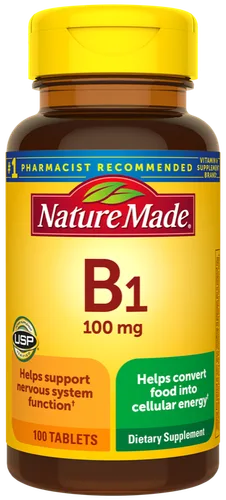
Nature Made Vitamin B1 100 mg Review
Nature Made Vitamin B1 100 mg Tablets is a single-ingredient dietary supplement providing 100 mg of vitamin B1 per tablet, listed on this page as item number 1281. Vitamin B1, also known as thiamin, is part of the family of B vitamins. According to the page, it helps support cellular energy production and normal nervous system function. The product is presented in the Energy category, and the page marks it with a tablet form icon and a 100 mg strength label. The benefits section lists two main points: it helps convert food into cellular energy, and it helps support normal nervous system function. The brand describes itself as the number one pharmacist recommended letter vitamin brand, based on a U.S. News and World Report and Pharmacy Times survey of pharmacists recommending this category. The bottle carries a United States Pharmacopeia USP Verified mark, which the page explains means USP has tested and verified the ingredients, potency and manufacturing process for dietary supplements. The product facts state that it is sourced from high quality ingredients. Labelled claims include gluten free, no artificial flavors, no color added and no preservatives. The suggested use is one tablet daily with water and a meal for adults. The page advises that anyone taking medication, including anticonvulsants, should consult a physician before use, and that potential drug-nutrient interactions may occur. The nutrient shortfall section explains that thiamin plays a role in converting food into cellular energy and supports nerve function, and it notes that the best food sources of thiamin include pork, whole or enriched grains, organ meats, red meats, yeast, nuts, sunflower seeds, peas, milk, cauliflower, spinach and legumes. The count shown is 100 tablets per container with a serving size of one tablet. The page indicates the product is discontinued and that stock is low, and it shows a one-time purchase price alongside a subscribe and save option with a ten percent discount and free shipping. Statements on the page have not been evaluated by the Food and Drug Administration, and the product is not intended to diagnose, treat, cure or prevent any disease.
We don’t sell supplements. We help you make decisions and get the best price.
Lowest prices
Finding the lowest prices at the stores now. This takes a few seconds.
Products with nearly the same formula (Matched on the main ingredients)
Study, Trial or Testing Result Summary
Members Only28 human studies · 10 improved
1 of these 28 human studies gave the ingredient by injection, not by mouth.
Thiamine, or vitamin B1, is the main ingredient here at 100 mg a day, well above the 10 mg that helped in one study. Results for energy are mixed and point to benefit mainly in people who are low in thiamine or have certain long-term illnesses. In older women with mildly low thiamine, 10 mg a day for six weeks lowered fatigue and improved well-being and appetite compared with placebo [1]. In people with inflammatory bowel disease and severe fatigue, very high doses of 600 to 1800 mg a day cut fatigue clearly over four weeks [2], and a small pilot without a placebo group reported similar relief [3]. Other studies found no benefit. The same high dose did not beat placebo in people with a liver disease [4], 300 mg a day for twelve weeks did not change fatigue in bowel disease [5], and a related compound, sulbutiamine, did no better than placebo for fatigue after an infection [6]. The tablet also holds 34 mg of calcium, far below the 1000 mg used in studies, and calcium itself showed little support for energy [7][8]. Animal and cell studies are never counted.
See all 28 studies →Hide the studies
- A review of 32 studies of phone apps for osteoporosis self-management found no clear effect on fatigue or on calcium intake; this was not a test of calcium supplements.Digital Health Technologies for Long-term Self-management of Osteoporosis: Systematic Review and Meta-analysis.
- In 326 people with long-lasting fatigue after an infection, 4 weeks of sulbutiamine (400 or 600 mg a day, a thiamine-related compound) did not reduce fatigue more than placebo overall; women on 600 mg had less fatigue at day 7 only, and it did not last.[Treatment of chronic postinfectious fatigue: randomized double-blind study of two doses of sulbutiamine (400-600 mg/day…
- In 202 hemodialysis patients, 12 weeks of a multinutrient drink that included vitamin B1 did not change fatigue or quality of life compared with placebo, though heart rate variability improved and one herpes virus measure fell.Effects of nutritional supplementation on fatigue, and autonomic and immune dysfunction in patients with end-stage renal…
- In 148 men aged 70 and older, 20 weeks of calcium, vitamin D and protein with strength training and testosterone reduced tiredness and improved chair-stand performance compared with no intervention, but calcium's own effect cannot be separated.Beneficial effects of exercise, testosterone, vitamin D, calcium and protein in older men-A randomized clinical trial.
- In 94 adults, a 4-week high-calcium diet was compared with a DASH-type diet and the abstract reports mood benefits only for the low-sodium, high-potassium diet, not for the high-calcium diet.Dietary electrolytes are related to mood.
- In 80 healthy elderly Irish women with marginal thiamin deficiency, 10 mg of thiamin daily for 6 weeks increased appetite, energy intake and general well-being and decreased fatigue compared with placebo.Influence of thiamin supplementation on the health and general well-being of an elderly Irish population with marginal t…
- In 68 people with chronic fatigue syndrome, vitamin B1 with oryzanol for 4 weeks reduced fatigue scores, but adding acupuncture worked better; the study did not test thiamine against placebo.[Acupuncture in the treatment of chronic fatigue syndrome based on "interaction of brain and kidney" in TCM: a randomize…
- In 41 trained male cyclists, 4 weeks of a combination supplement including 1.1 mg vitamin B1 did not improve aerobic or anaerobic performance or fatigue measures versus placebo, though it lowered blood lactate after hard exercise.l-Carnitine and Alpha-Lipoic Acid Fail to Improve Anaerobic and Aerobic Performance in Trained Cyclists Despite a Reduct…
- In 40 people with quiescent inflammatory bowel disease and severe fatigue, 4 weeks of high-dose thiamine (600-1800 mg a day) reduced fatigue by 4.5 points versus a 0.75-point increase on placebo, with 55% and 75% of the two groups improving on thiamine.Randomised clinical trial: high-dose oral thiamine versus placebo for chronic fatigue in patients with quiescent inflamm…
- In 36 people with primary biliary cholangitis and severe fatigue, 4 weeks of high-dose thiamine (600-1800 mg a day) was safe but not better than placebo at reducing fatigue.High-dose oral thiamine versus placebo for chronic fatigue in patients with primary biliary cholangitis: A crossover ran…
- In 32 healthy young adults, 28 days of a daily B vitamin complex including B1 increased running time to exhaustion 1.26-fold and lowered blood lactate and ammonia during exercise compared with placebo.A functional evaluation of anti-fatigue and exercise performance improvement following vitamin B complex supplementation…
- In 24 adults with low parathyroid function, one month each of calcium citrate and calcium carbonate showed no difference in quality of life scores; the abstract does not report a fatigue difference.Calcium Citrate Versus Calcium Carbonate in the Management of Chronic Hypoparathyroidism: A Randomized, Double-Blind, Cr…
- In 18 trained adults, three days of hydrogen-rich calcium powder lowered breathing rate and blood pH during exercise but did not change oxygen uptake compared with placebo.Application of Molecular Hydrogen as an Antioxidant in Responses to Ventilatory and Ergogenic Adjustments during Increme…
- In 16 male athletes, 100 mg of thiamine daily for 3 days before cycling exercise reduced the rise in blood glucose in those with normal thiamine levels and lowered the number of fatigue complaints after exercise compared with placebo.Effects of thiamine supplementation on exercise-induced fatigue.
- In 14 people given 1 gram a day of a thiamine derivative or placebo for 4 days in a crossover design, there was no difference in oxygen uptake, lactate or 2000-metre cycling time.The effect of a thiamin derivative on exercise performance.
- In eight men doing calf contractions to exhaustion, calcium carbonate used as the control had no effect on time to fatigue, which was similar to the acid and alkaline trials, showing that changing muscle pH did not alter fatigue.The effect of pH on fatigue during submaximal isometric contractions of the human calf muscle.
- In people with quiescent inflammatory bowel disease and chronic fatigue given high dose oral thiamine for 4 weeks, blood levels of other B vitamins were not linked to the fatigue response, and only lower riboflavin was seen in those reporting benefit.B-vitamins, related vitamers, and metabolites in patients with quiescent inflammatory bowel disease and chronic fatigue …
- In young women with premenstrual syndrome, 500 mg of calcium carbonate twice daily for 3 months reduced early tiredness compared with placebo.Effects of calcium supplement therapy in women with premenstrual syndrome.
- In 11 male runners, 4 days of calcium phosphate loading did not improve maximal aerobic capacity or time to exhaustion compared with placebo.Phosphate supplementation, cardiovascular function, and exercise performance in humans.
- In 9 students in a crossover trial, 4 weeks of thiamine tetrahydrofurfuryl disulfide at 10 mg per kg body weight daily lowered blood lactate and ammonia during exercise and reduced perceived exertion compared with placebo.The effects of endurance training and thiamine supplementation on anti-fatigue during exercise.
- In an open-label pilot of 50 people with Parkinson disease, thiamine injections of 100 mg twice a week were followed by better motor and non-motor symptom scores over a mean follow-up of about 42 weeks, but without a placebo group.Long-Term Treatment with High-Dose Thiamine in Parkinson Disease: An Open-Label Pilot Study.
- In 26 people with multiple sclerosis, taking 400 mg of sulbutiamine (a fat-soluble form of thiamine) once daily for two months significantly reduced fatigue scores, with the benefit seen mainly in those also taking disease-modifying treatment; the study had no placebo group.Sulbutiamine shows promising results in reducing fatigue in patients with multiple sclerosis.
- In an open-label pilot of 12 people with ulcerative colitis or Crohn's disease, high-dose oral thiamine (600 to 1500 mg daily, based on body weight) led to complete fatigue relief in 10 patients and nearly complete relief in the other 2 after about 20 days.Thiamine and fatigue in inflammatory bowel diseases: an open-label pilot study.
- In patients with inflammatory bowel disease, 300 mg of thiamine daily for 12 weeks did not significantly change fatigue compared with no thiamine, and fatigue rose over the study period for both groups.Long-term maintenance treatment with 300 mg thiamine for fatigue in patients with inflammatory bowel disease: results fr…
- In a survey of 499 postpartum women in Saudi Arabia, fatigue was linked to lower physical activity, but thiamine intake was only a statistical adjustment factor and was not tested as a treatment for energy.Physical activity patterns among women during the postpartum period: an insight into the potential impact of perceived f…
- In 65 adults with self-reported gluten sensitivity on a gluten-free diet, average calcium intake from food was 695 mg a day, below recommendations, and energy was not studied.Dietary and symptom assessment in adults with self-reported non-coeliac gluten sensitivity.
- In adults with hypophosphatasia, a higher calcium to phosphorus intake ratio was associated with more tiredness and fatigue, and very high or very low calcium intake was linked to more symptoms, based on a 7-day diary.Mineral Intake and Clinical Symptoms in Adult Patients with Hypophosphatasia.
- A survey of U.S. adults found that drinkers had higher energy intake than non-drinkers, but their diets were less nutrient dense, including for calcium; the survey did not test calcium for energy.Alcohol consumption and nutrient density of diets in the Nationwide Food Consumption Survey.
Review Totals and Summary
Members Only911 reviews · 91% positive
Across the stores that sell it, Nature Made Vitamin B1 100 mg carries about 622 ratings, and buyers are mostly happy. Most reviews give 4 or 5 stars, with praise centered on price, brand trust and small, easy-to-swallow tablets. The few complaints are about delivery and low stock, not the tablets themselves. **What buyers say it did for them:** Reports of benefits are brief and personal. One buyer started taking it after gastric bypass surgery and says "they work well." Another buys it for a wife with MS and calls the tablets "perfect." One person uses it "to improve my memory," and a Walgreens summary mentions someone saying it calms their foot nerves. One reviewer doubted that a very high dose is needed, since most of the excess leaves in urine, but did not think it could do harm. Many reviews are general satisfaction with no specific effect described. **What buyers complain about:** The complaints concern buying, not the product. One buyer had delivery "delayed several times" and says they will not buy from that supplier again. Another got the wrong item, writing that a different product "came" instead. A Walgreens shopper reports "low stock" at their store. No review of the tablets complains about quality. **Taste, smell, pill size and form:** The wife-with-MS reviewer says the tablets spare her "the awful taste of this supplement" and the belching it seems to cause. The 100 mg strength also means she does not have to cut pills. The Walgreens summary says five reviewers describe the tablets as nice and small, which suggests they are easy to swallow. The Walmart page notes a bottle count of 100. **Value for money:** Price is the most common theme. One review says "Excellent price and good quality," and another says the price is lower than a prescription. A Walgreens shopper likes that the store "often has buy 1 get 1 free." The Walgreens summary says six reviewers highlight price. The Walmart summary says quality is on par with pricier supplements. The Nature Made site's own page shows top scores for value. **Who it seems to suit and who it did not:** It suits people who need a B1 supplement and want a 100 mg tablet. One buyer says it is "the only brand I buy," and another says none of the other brands "compare to these." The site's reviewers include daily users aged 45 to 65 or older. No reviewer says the tablets themselves did not suit them. The unhappy buyers had problems with a seller, a delivery or an order mix-up. Shoppers who depend on a local Walgreens may find stock thin, so ordering ahead or using pickup may help. Reviews of other forms of the product, such as gummies, capsules and powder, were left out, and this summary covers the tablets only.
Biohacker Summary
Members Only7 of 10 recommend it
Nobody on the panel spoke about vitamin B1, the main ingredient here, so there is nothing from the group to report on it. All ten spoke only about calcium, a smaller ingredient in this product, and their views are mixed. Several recommend it for bone health, with one suggesting 1,000 to 1,200 milligrams a day from food or supplements, and one takes a calcium and magnesium pill, but others prefer food sources like sardines and leafy greens and caution that supplements may raise heart or kidney risks, and one told people to stop calcium supplements.
See all 10 biohackers →Hide the biohackers
Dr. Eric Berg · Calcium · warns
- Warns that bone loss cannot be fixed with just calcium, as bone is primarily collagen with other essential minerals.
- Dr. Berg includes calcium carbonate among the synthetic supplements to avoid.
- Warns against calcium carbonate, also known as limestone, stating that while it lowered hip fractures in a study, it also increased kidney stones and is not good for arteries, requiring the body to work hard to use it.
- Notes that tannins in tea bind calcium, blocking its absorption.
- Indicates that horizontal thin white lines near the base of the nails are indicative of low calcium.
- Warns that calcium carbonate can build up in the arteries and kidneys and increase the risk of a heart attack.
- Dr. Berg mentions that fermented dairy contains vital nutrients, including calcium.
- States that calcium and magnesium are intrinsically linked and work in combination with vitamin D to support the body's calcium balance.
- Explains that calcium triggers muscle contraction, while magnesium is needed to relax the muscles afterward.
- Warns that too much calcium can cause high blood pressure by causing arterial contraction.
Siim Land · Calcium · neutral
- Lists dairy and sardines as sources of Calcium.
- Notes that Boron reduces calcium/magnesium loss.
- Recommends a high calcium intake for bone health.
- Places calcium supplementation in the 'bad tier' due to its association with increased cardiovascular events, recommending dairy or bones as easier ways to get calcium, though it can be useful for postmenopausal women with low bone density.
- Mentions that eating enough calcium matters for bone density, but states that it alone won't transform bone density.
- Warns that calcium is linked to a higher risk of heart disease, though people with low calcium status and intake can take it safely.
- Warns that calcium supplements increase the risk of heart disease by raising blood calcium levels too high, leading to hypercalcemia and more calcium being stored in the arteries, and also increase the risk of arrhythmias.
- Warns against calcium supplementation for most people due to its association with increased cardiovascular events, but notes it can be useful for postmenopausal women with low bone density who don't consume dairy.
- Discusses Calcium as a supplement.
- Recommends consuming calcium from dairy, tofu, leafy greens, and bones, as it is a key nutrient required for ATP synthase in mitochondrial energy production.
Thomas DeLauer · Calcium · neutral
- Notes that milk contains 120mg of calcium, while sardines contain 351mg, highlighting a 3x difference.
- Recommends getting calcium, along with vitamin D, zinc, and magnesium, from foods like sardines, as they are important for inflammatory pathways in the gut.
- Explains that eating sardines with their soft bones provides a serious hit of calcium, which is a perfect combination for bones and may contribute to satiety.
- Mentions that magnesium and calcium should not be taken together as they cancel each other out.
- Tries to get multivitamins without calcium or with a low amount, as he believes supplemental calcium impacts the absorption of other vitamins and minerals and is not as beneficial as hyped. He cautions against it for most people due to the risk of coronary artery calcification.
- Recommends getting calcium from dairy sources like milk, yogurt, kefir, and cheese in the morning to support neurotransmitter synchronization crucial for deep and REM sleep, noting that low dietary calcium is linked to insomnia.
- Warns that calcium competes with magnesium for the same absorption channels, advising to separate magnesium intake from calcium supplements or dairy by at least an hour or two.
- Recommends providing the body with adequate dietary calcium, not a calcium supplement, to ensure a clean, strong spark for efficient insulin release.
- Warns that calcium and magnesium should not be taken together as they cancel each other out, though some products use delayed absorption to mitigate this.
- Warns that most people consume too much calcium relative to magnesium, which can disrupt the balance needed for proper bodily function, comparing it to an electrical circuit.
Dr. Mark Hyman · Calcium · recommends
- Notes that calcium is in bones but is also essential for nerves, muscles, and the heart, and low levels can affect muscle function and heart rhythm.
- States that green leafy vegetables are great sources of calcium.
- Notes that calcium needs are lower than advertised and that stress, soda, and excess sugar can drive calcium loss.
- Does not prescribe calcium supplements at all, teaching people to get it from whole foods instead, because calcium supplements don't work for building bones or preventing fractures, and it's bone quality, not density, that matters.
- Warns that acid blockers inhibit calcium absorption.
- Lists calcium as another important nutrient that people can be tested for and measured.
- States that high doses of calcium supplementation in the elderly were not really impacting bone density, as osteopenic patients still became osteoporotic.
- Warns that meds (meds) impair the absorption of calcium, which increases the risk of hip fractures and osteoporosis.
- Recommends calcium citrate, about 600 milligrams a day, for bone health, noting that much can also be obtained from diet through leafy greens, sesame seeds, tahini, and chia seeds.
- Dr. Hyman notes that while calcium deficiency is not common in terms of blood levels, insufficient intake can lead to osteoporosis as the body pulls calcium from bones. He advises caution with calcium supplementation due to potential heart issues.
Dr. Rhonda Patrick · Calcium · neutral
- Mentions that kale delivers calcium, a micronutrient many diets fall short on.
- Notes additional gaps in calcium.
- Reports that alcohol use disorder is associated with a 20-50% greater prevalence of Calcium deficiency.
- Around 38% doesn't meet the requirement for calcium.
- Takes a calcium-magnesium pill because he believes people tend to be short of both and that the body cares about the ratio of these similar molecules.
- States that 1,000 milligrams of calcium per day is the recommended intake for bone density, and supplementation is an option if this requirement is not met.
- Takes a calcium, vitamin K2, and vitamin D combination supplement in the morning, providing about 600 mg of calcium and another 1,000 IUs of vitamin D.
- Dr. Rhonda Patrick discusses calcium needs.
Dave Asprey · Calcium · neutral
- Notes that when energy intake is too low for training demand, nutrient intake often falls short, especially for calcium, which is associated with reduced bone health.
- Explains that calcium provides the raw material for bones, but it isn't a standalone input and needs a whole system to be effective.
- Notes that people take calcium for their bones.
- Warns that taking calcium without vitamin D, A, and K2 can lead to calcium going into tissues, causing bone spurs and other issues, and recommends a two-to-one ratio of calcium to magnesium.
- Recommends taking calcium citrate during a high oxalate meal to bind the oxalate in the gut.
- Notes that people often take calcium for bone health.
- Believes calcium supplements are overrated, as most people need more vitamin K2 and vitamin D instead.
- Advises taking iron and calcium separately because they will bind together.
- Takes extra calcium to help deal with the burden when eating chocolate or anything with higher levels of oxalates.
- Discusses calcium citrate as a counter to oxalate crystals, specifically when consumed through dairy, but questions if it's the primary form of calcium in dairy.
Ben Greenfield · Calcium · neutral
- Is considering whether he needs a calcium supplement because lead can displace calcium in bones, affecting bone strength.
- Mentions calcium as a common deficiency.
- Recommends adequate intake of calcium for bone strength.
- Is using calcium chloride mixed with PRP before injecting for the P-shot.
- Advises people to stop taking calcium supplements as part of the Root Cause Protocol.
- Warns that in high doses, calcium without the right cofactors can raise cardiovascular risk by contributing to arterial calcification instead of bone strength, and may increase the risk of osteoporosis.
- Explains that 10X separates calcium and zinc into different micro beads, releasing them at different rates and locations in the digestive tract to prevent competition and optimize absorption.
- Covers calcium as a key supplement for kids.
- Warns of calcium deficiency on a carnivore diet, as there is not an appreciable amount in meat, and recommends eating fish with bones or taking a calcium supplement or bone mineral matrix.
- Notes that excess calcium intake can contribute to calcium buildup in the arteries.
Peter Attia · Calcium · recommends
- Recommends calcium as one of the 'big three' micronutrients for bone health, suggesting a daily intake of 1,000 to 1,200 milligrams, which can be supplemented with calcium carbonate or calcium citrate.
- Explains that bone is 50 to 70% mineral, predominantly calcium, and that virtually all of the body's calcium is contained within bone, making bone important for calcium homeostasis.
- Recommends calcium for bone health, stating that teenagers probably need about 1000 milligrams a day.
- Discusses bone acting as a reservoir for calcium and how resorption and formation release calcium into the blood when needed.
- Notes that bone is 50 to 70 percent mineral, with calcium being the predominant mineral, and virtually all of the body's calcium is contained within bone.
- Recommends getting about a gram of calcium a day from organic bone meal, which provides calcium hydroxyapatite, the form humans are meant to consume.
- Suggests that calcium is one of the other signals involved in regulating mitochondrial number, beyond AMPK activation.
- States that in postmenopausal women not on estrogen, calcium and vitamin D have no protective effect against hip fracture because the problem is not the shell of the bone, which is fed by calcium and vitamin D, but the internal girder network.
- Notes that compelling evidence links calcium to reduced risk of osteoporosis, which can impact mortality from specific causes.
Bryan Johnson · Calcium · recommends
- Recommends calcium as a mineral that, along with phosphorus, magnesium, and boron, is deposited to fortify the bone structure after the collagen scaffold is in place.
- Agrees that a little extra calcium is probably okay, especially for women, to really hit home for bone mineral density.
- Recommends prioritizing calcium intake for postmenopausal women to help maintain bone density and reduce the risk of osteoporosis.
- Bryan Johnson takes Calcium daily as part of his Longevity Mix, which supports healthy bones and teeth.
- Recommends continuing with calcium to support bone health during the follicular phase.
Andrew Huberman · Calcium · neutral
- Discusses "hard water" and the role of magnesium and calcium in cardiovascular health.
- Adequate intake of calcium is vital for bone health.
RAL Summary
Members OnlyTier 3 for Energy
More Details
Members OnlyBody systems · Combine with · Possible side effects
Body systems: Nervous system, Metabolic system
Combine with: For energy metabolism and nerve support, thiamine pairs well with other B vitamins such as a B-complex (B2, B3, B6, B12, folate) since they work together in cellular energy pathways. Magnesium is also required as a cofactor for thiamine-dependent enzymes, and alpha-lipoic acid works alongside thiamine in mitochondrial metabolism and nerve health. If the real goal is fast heartburn relief, look instead at calcium carbonate or magnesium/aluminum hydroxide antacids, alginate (sodium alginate) formulas, or short-term options like H2 blockers, and discuss persistent or frequent symptoms with a healthcare provider. For longer-term digestive comfort, consider DGL licorice, zinc-carnosine, or aloe vera, but check with a clinician if you take medications.
Possible side effects: No major side effects reported; high-dose thiamine was described as safe in one trial.
Supplement Facts
Thiamine 100 mg · Calcium 34 mg
Other ingredients: Cellulose Gel, Maltodextrin, Croscarmellose Sodium, Magnesium Stearate.
Directions: Suggested use: Take one tablet daily with a meal. For easier swallowing, take with water before and during ingestion.
Label source: NIH label database · Report a label change
Show entire label

More energy products
Members OnlyThe highest ranked for the same goal
Read more
Our articles on this subject
Graded November 4, 2026 by the Reverse Age Lab evidence engine, from human studies, real reviews and our biohacker panel. How we grade. Is this medical advice? No. Rala organizes the published evidence; go over any change with your doctor, especially if you take meds.
Privacy policyConsumer health dataTermsDo Not Sell or Share My Personal InformationCookie settings