Nature's Sunshine IGF-1 Review
Nature's Sunshine IGF-1 (Spray), listed on this page as discontinued, is described as a metabolite of HGH, human growth hormone (insulin-like growth factor 1). The page states that IGF-1 may promote bone and tissue development and may help recovery from training injury or fatigue. Each bottle is said to contain at least 2,500 nanograms of IGF-1 and other insulin-like growth factors. The product is sold in a 1 fl oz size with stock number 966 and is listed at $45.75, though the page notes it is on backorder for a short time and invites shoppers to submit a form to be contacted when it is available. The page lists the following benefits: helps muscle recovery, may improve endurance and stamina, promotes tissue growth, and supports the immune system. Usage directions say to spray twice under the tongue, 3 times daily, and hold for 20 seconds before swallowing for best results. The product is categorized under Energy, with health conditions listed as Growth Hormone, Muscle Recovery, Bone Density, Athletic Performance, Connective Tissue Health, and Post-Illness Recovery. Body systems listed are Endocrine System, Musculoskeletal System, and Connective Tissue. The page displays no Supplement Facts amounts, no serving size and no days supply, and it reports no technical ingredient information. The page has no customer reviews yet, and visitors are invited to be the first to review it.
Study, Trial or Testing Result Summary
Members Only1 human studies · 0 improved
This product contains insulin-like growth factor 1 at about 81 nanograms a day, plus a small amount of stevia for sweetness. How this amount compares with what was studied is unclear. Only one small human study has looked at this ingredient in a way related to muscle building. In that 2001 trial, 7 children with cystic fibrosis took insulin-like growth factor 1 for six months and a dummy treatment for six months, in turn. Compared with the dummy treatment, it made no meaningful difference in lean body mass, weight gain, height growth or lung function [1]. Some markers of how well the body responds to insulin did improve [1]. The study involved very few people, and they were sick children rather than healthy adults trying to build muscle, so it cannot show whether this ingredient helps or fails for muscle building in general [1]. No study showed an improvement in muscle. No customer reviews were available to add real-world experience. Animal and cell studies are never counted.
See all 1 studies →Hide the studies
- In 7 children with cystic fibrosis given IGF-1 or placebo for 6 months each in a crossover trial, there was no significant difference in height growth, weight gain, lean body mass, or lung function compared with placebo, though insulin sensitivity markers improved.Effect of insulinlike growth factor-1 treatment in children with cystic fibrosis.
Review Totals and Summary
Members OnlyWhat buyers say
2. Ask me to try the search again later. I would need real review sources such as Amazon, the Nature's Sunshine site, or iHerb before I could write the customer summary.
Biohacker Summary
Members Only2 of 10 recommend it
Seven of the eight panelists who spoke about IGF-1 (insulin-like growth factor one) gave a neutral latest view, and two more recent voices lean toward recommending it only as something to measure or raise through fasting, so the panel does not broadly recommend taking it. Those who like it point to muscle growth and repair, fat burning, collagen, skin, hair and bone growth, and one panelist injects a long-acting form into the muscle after exercise, while another describes an injectable form taken before a workout or with the first meal and aims for a blood level of about 270 to 280. Several suggest testing blood levels rather than simply boosting them, and one cites the lowest cancer, heart and early death risk at 120 to 160 nanograms per milliliter. Caution is the main theme: about six of them warn that high levels over a lifetime may shorten life and raise the risk of cancer, heart disease or prostate problems, and that very low levels are also harmful. No one said they stopped taking it, and no one named a supplement pairing beyond the role of exercise, fasting and protein in changing levels.
See all 8 biohackers →Hide the biohackers
Siim Land · IGF-1 · neutral
- Notes that there is a U-shaped association between IGF-1 levels, total mortality, and cancer, with the lowest risk of cancer, cardiovascular disease, and all-cause mortality seen at 120 to 160 nanograms per milliliter.
- Notes that IGF-1, made from growth hormone, rose by 18.8% after sprinting, though this was not statistically significant.
- Notes that Loyal is testing a drug that reduces the expression of IGF-1 to see if large breed dogs live longer, based on the hypothesis that IGF-1 may relate to lifespan.
- Sim considers IGF-1 a low-hanging fruit for gene therapy due to its association with greater longevity in humans.
- States that very high IGF-1 levels throughout life might shorten lifespan and increase cancer risk, and high IGF-1 later in life is associated with cancer, heart disease, and higher mortality.
- States that he has had somewhat low IGF-1 levels for 8 years, around 100 nanogs per milliliter, with his last result being 94 nanogs per milliliter, which he believes is optimal for longevity and minimizing cancer risk.
- States that if IGF-1 levels are too high, it might increase the risk of cancer and premature death, and that low IGF-1 is probably necessary for exceptional longevity.
- Mentions IGF-1 peptides as having anti-aging benefits but notes they come with double-edged sword effects, such as high IGF-1 potentially increasing cancer risk, and he would never benefit from taking them.
- States that in laboratory animals, particularly mice, health span and lifespan can be reproducibly and robustly increased by modulating IGF-1.
- Discusses whether IGF-1 is good or bad.
Thomas DeLauer · IGF-1 · neutral
- States that IGF-1 (insulin-like growth factor one) is a very important growth hormone linked to diseases like cancer and heart disease, with both very low and very high levels being detrimental.
- Recommends IGF-1 LR for injury and muscle growth, specifically for the differentiation phase of muscle, to be used 12 hours or the next day after exercise, injected directly into the muscle group.
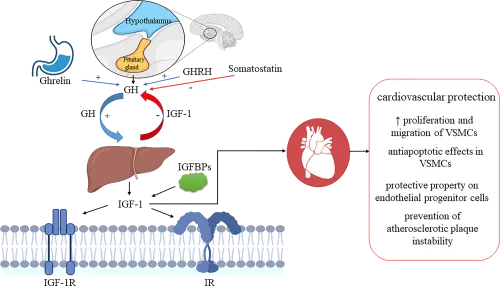
- Explains that insulin increases the synthesis of IGF-1, especially when combined with high levels of growth hormone, and that IGF-1 has downstream effects on cell growth, cell turnover, and lipolysis.
- Notes that IGF-1 and growth hormone are known to grow skin and soft tissue very well, suggesting a powerful effect on skin aging, though he is not super familiar with specific studies.
- Explains that IGF-1 is the next step of growth hormone in building muscle, released by the liver to stimulate tissue recovery and muscle growth.
- Warns that IGF-1, while promoting protein synthesis, can also grow tumors if the mTOR anabolic switch is not turned on. He advises caution regarding the increase of insulin-like growth factor from exogenous HGH use and its effect on tumor growth.
Andrew Huberman · IGF-1 · neutral
- Discusses that increased IGF-1 can decrease lifespan, citing the example of larger dogs living shorter lives due to IGF-1 dosing, but also mentions it is higher in young blood.
- Discusses IGF-1 and its role in growth and metabolism, including associated risks.
- Huberman states that IGF-1 is strongly involved in regulating hair growth.
- Andrew Huberman notes that optimizing growth hormone and IGF-1 up to about age 25 helps with bone density and bone growth.
- Andrew Huberman notes that while growth hormone can increase vitality, it has been demonstrated that increasing growth hormone and IGF-1 decreases lifespan.
- Huberman describes IGF-1 (insulin growth factor one) as a hormone produced by the liver in response to growth hormone, which has synergistic and distinct effects on metabolism, tissue repair, growth, and blood sugar regulation, all associated with youthfulness and vitality.
Dr. Rhonda Patrick · IGF-1 · neutral
- Explains that protein, particularly from animal sources, spikes IGF-1 levels, which can help build muscle and support brain health, but high IGF-1 levels also come with potential downsides like promoting the survival of pre-cancerous cells.
- Dr. Patrick explains that growth hormone and IGF-1 have positive effects associated with youth, such as decreasing fat, increasing lean muscle mass, increasing verbal memory, neurogenesis, and promoting muscle repair, but also notes that high levels are associated with shortened lifespans in animal models.
- IGF-1 seems to have an important role in aging, and its levels are regulated by proteins, particularly certain amino acids.
- Rhonda explains that while IGF-1 is important for growth and repair, it can be very bad in the context of accumulated damaged cells, as it promotes cancer cell growth and overrides the body's protective mechanisms against cancer.
Peter Attia · IGF-1 · neutral
- Notes that in female centenarians, those with the lowest half of IGF-1 levels lived twice as long as those with the highest levels, and these women also had better cognitive function.
- Explains that IGF-1 is the best proxy for endogenous GH production and is used as a metric to dial in the dose of exogenous growth hormone, adjusting it based on whether IGF-1 levels are higher or lower than the target.
- States that IGF-1 stimulates breast tissue development.
- Discusses the role of IGF-1, noting that while it can be problematic in the context of a tumor, exercise causes IGF-1 to go into muscle for repair and into the brain for neurogenesis.
- Acknowledges that too much IGF-1 can be problematic in the context of a tumor, allowing tumor cells to override cell death mechanisms.
- Notes that in a study of female centenarians, those with the lowest half of IGF-1 levels lived twice as long as those with the highest levels, and also had better cognitive function.
- States that systemic IGF-1 is not anabolic to skeletal muscle, and people often misunderstand its role in muscle growth.
- Explains that systemic IGF-1, produced by the liver in response to growth hormone, is not anabolic to skeletal muscle.
- Peter used to believe that IGF-1 and growth hormone should be as low as possible, but he is not convinced of that today.
Ben Greenfield · IGF-1 · neutral
- Ben Greenfield describes IGF-1 LR3 as a potent anabolic peptide that increases muscle by stimulating hyperplasia, often used as an injectable pre-workout or with the first morning meal.
- Started looking into IGF-1 as part of his health routine.
- Discusses IGF-1 levels, noting that he aims for around 270-280 and that it is regenerative, mentioning its presence in a Jiu Jitsu athlete's peptide cocktail for gut issues.
- Notes that IGF-1 is an exception to systemic peptide delivery, as local injections can cause localized fat mobilization, creating 'little holes' where injected.
- Recommends testing IGF-1 as a biomarker associated with aging.
- Ben discusses bodybuilders using IGF-1 for muscle gain.
- A listener asks Ben to discuss IGF-1, noting confusion between the HGH and fitness community embracing it and the back-to-nature crowd warning of health problems from dairy and soy protein isolate due to IGF-1.
- Recommends IGF-1 LR3 as a potent anabolic peptide for increasing muscle by stimulating hyperplasia, with dosing guidelines of 50-150mcg once a day for a 4-week cycle, preferably pre-workout or with the first-morning meal.
- Uses IGF-1 LR3 as part of the "Lean and Mean" stack, stating it works to increase muscle by stimulating hyperplasia.
- Ben Greenfield states that if he had a tumor or polyps, he would probably restrict his intake of anything anabolic, including IGF-1 precursors, that could assist with the creation of new blood vessels.
Dr. Eric Berg · IGF-1 · recommends
- States that fasting increases IGF-1, a hormone made by the liver that works like growth hormone, which can increase collagen growth.
- Explains that IGF-1 mobilizes fat fuel when not eating or when keeping insulin low.
- Explains that IGF-1, made by the liver, works similarly to growth hormone, acting as an anti-aging and fat-burning hormone that increases as insulin decreases.
- Lists IGF-1 as one of the fat-burning hormones.
- Explains that IGF-1, an insulin-like growth factor, is another hormone that can make things grow in the body and contribute to prostate problems.
- States that IGF-1, a hormone made by the liver, controls GAGs and is crucial for anti-aging and youthful skin.
Dr. Mark Hyman · IGF-1 · recommends
- Mentions tests looking at growth hormone related hormones like IGF-1.
- Discusses IGF-1, a growth factor often linked to eating carbs and sugar, and sometimes protein, which has been associated with cancer and aging.
RAL Summary
Members OnlyTier 4 for Muscle and Strength
Rated emerging because the only human study is a tiny trial in 7 children with cystic fibrosis that found no difference in lean body mass, and there are no reviews [1].
- Emerging: not enough evidence to rank higher yet.
Where the evidence disagrees: 1 of the 1 human studies found no effect.
More Details
Members OnlyBody systems · Combine with · Possible side effects
Body systems: Muscular system, Endocrine system
Combine with: For muscle and recovery goals, pair it with creatine monohydrate, whey or essential amino acid/BCAA protein, vitamin D3 with K2, magnesium, and zinc to support training adaptation, hormone balance, and recovery. L-Citrulline can complement arginine for nitric oxide and blood flow. If cellular health and aging support is also desired, add separate agents such as NMN or NR with resveratrol or quercetin, CoQ10, alpha-lipoic acid, and omega-3s, though be cautious combining high IGF-1 stimulation with anti-aging goals. Consult a healthcare provider, especially with diabetes, cancer history, or meds.
Possible side effects: No major side effects reported.
Supplement Facts
IGF-1 27 ng · Stevia leaf extract 1.6 mg
| IGF-1 | 27 ng | † |
| Stevia leaf extract | 1.6 mg | † |
Other ingredients: Purified Water, Natural and Artificial flavors, Xylitol, Citric Acid, Lecithin, Potassium Sorbate.
Directions: RECOMMENDED USE Spray twice under the tongue, 3 times daily. Hold for 20 seconds before swallowing for best results. SHAKE WELL BEFORE USE
Barcode (UPC) 099904009660 · Label source: NIH label database · Report a label change
Show entire label

Where to Buy
Caringsunshine
We sell no supplements. Prices change; check the store.
More muscle and strength products
Members OnlyThe highest ranked for the same goal
Read more
Our articles on this subject
Graded November 3, 2026 by the Reverse Age Lab evidence engine, from human studies, real reviews and our biohacker panel. How we grade. Is this medical advice? No. Rala organizes the published evidence; go over any change with your doctor, especially if you take meds.
Privacy policyConsumer health dataTermsDo Not Sell or Share My Personal InformationCookie settings