
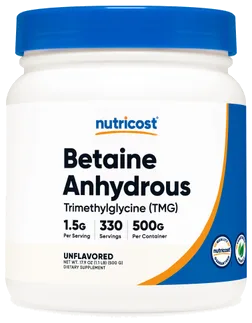
Nutricost Betaine Anhydrous Powder Review
The page sells Nutricost Betaine Anhydrous (TMG) Powder in a 500 gram bottle, unflavored. The listed product details say the bottle holds 500 grams of Betaine Anhydrous (TMG), with a serving size of 1 scoop (1.5g) included. The product is described as vegetarian, non-GMO and gluten free, and made in a GMP compliant, FDA registered facility. The page states it is tested by independent third party ISO-accredited laboratories. The page offers a one-time purchase at $17.97 and a subscribe and save option with a discount of up to 20 percent, with delivery every 30 days, 2 months or 4 months. The page also advertises free unlimited returns for store credit or exchanges, a 60-day money back guarantee, and HSA/FSA eligibility for qualified customers. Shipping is described as processed within one to two business days, with shipment usually taking three to five business days after dispatch, and international customers are responsible for duties, taxes and customs fees. The Nutricost brand says its products are made in the USA using globally sourced ingredients in a GMP compliant facility, and that products are tested by an independent accredited lab. The page lists several other Nutricost products as related or recommended, including Betaine Anhydrous (TMG) Capsules, Beta Alanine Powder, L-Tyrosine Powder and Betaine HCL Powder. The page does not print an ingredients list, a barcode, a star breakdown or a cost per serving figure for this bottle.
We don’t sell supplements. We help you make decisions and get the best price.
Lowest prices
We may earn a commission from some store links. How we choose.
Lowest cost per month first, in stock, at 1 serving a day. Checked Nov 8.
- TargetLowest$10.00 a bottle$0.91/moBuy at Target (opens in a new tab)
Study, Trial or Testing Result Summary
Members Only10 human studies · 6 improved
This powder gives 1.5 grams of betaine per scoop, and two scoops a day reach the 2 gram range used in studies. When betaine is taken on its own, the stronger studies do not show a benefit for liver health. A pooled analysis of trials found betaine did not change liver enzymes or inflammation, and it raised total and bad cholesterol [1]. In 55 people with fatty liver inflammation, 20 grams a day for a year did not improve liver fat, disease activity or scarring compared with placebo [2]. In 27 obese adults, nearly 10 grams a day for 12 weeks did not change liver fat and raised cholesterol [3]. The positive results come mostly from products that mixed betaine with other ingredients. A betaine combination cut liver fat by 25% over 8 weeks in 191 people [4], and a nutrient mix containing betaine modestly lowered liver fat and stiffness in 155 adults [5]. These results cannot be credited to betaine alone. An uncontrolled study of 70 people found lower liver enzymes at 2 to 8 grams a day but not at 1 gram [6]. Without a placebo group, that result is weak evidence. Animal and cell studies are never counted.
See all 10 studies →Hide the studies
- A pooled analysis of trials found betaine supplementation did not change liver enzymes (ALT, AST, GGT) or inflammation (CRP), though it raised total and LDL cholesterol.Effects of betaine supplementation on cardiovascular markers: A systematic review and Meta-analysis.
- In 191 people with fatty liver inflammation, 8 weeks of a betaine glucuronate combination cut liver fat by 25% and lowered liver enzymes, while placebo did not.Efficacy and safety of oral betaine glucuronate in non-alcoholic steatohepatitis. A double-blind, randomized, parallel-g…
- In 155 adults with obesity and metabolic syndrome, 3 months of a nutrient mix containing betaine lowered liver fat score by 4% and liver stiffness by 7.8% versus placebo.Use of a Micronutrient Cocktail to Improve Metabolic Dysfunction-Associated Steatotic Liver Disease (MASLD) in Adults wi…
- In 55 people with biopsy-proven fatty liver inflammation, 20 g of betaine daily for 12 months did not improve liver fat, activity score or fibrosis compared with placebo.Betaine for nonalcoholic fatty liver disease: results of a randomized placebo-controlled trial.
- In 27 obese adults with prediabetes, 9.9 g of betaine daily for 12 weeks did not change liver fat compared with placebo and raised total cholesterol.Metabolic Effects of Betaine: A Randomized Clinical Trial of Betaine Supplementation in Prediabetes.
- In 20 people with fatty liver inflammation, 2 weeks of a multi-ingredient food containing betaine plus diet lowered liver enzymes and body fat, while diet alone did not significantly.[Efficacy of newly developed food for special dietary use in the diet of patients with non-alcoholic steatohepatitis].
- In 41 children with chronic hepatitis B in leukemia remission, adding betaine arginine to standard care left ALT 1.6 times lower and reduced a fibrosis marker versus standard care alone.MODERN APPROACHES IN MANAGEMENT OF CHILDREN WITH CHRONIC HEPATITIS B IN REMISSION OF ACUTE LYMPHOBLASTIC LEUKEMIA.
- In a non-placebo-controlled trial in people with liver disease linked to short bowel syndrome, 10 grams of betaine daily for three months reduced liver fat on MRI, but blood markers of inflammation and liver damage did not significantly improve, and diarrhea and nausea were common.Betaine: a potential agent for the treatment of hepatopathy associated with short bowel syndrome.
- In 70 people with fatty liver disease and high ALT, betaine at 2, 4 or 8 g a day for 12 to 24 weeks lowered liver enzymes and other liver injury markers, but 1 g a day did not.Pilot trials of oral betaine in participants with metabolic dysfunction-associated steatotic liver disease and elevated …
- In 10 adults with NASH, betaine taken for up to 12 months improved liver enzymes and liver biopsy scores in an uncontrolled pilot study, with mild stomach side effects in four patients.Betaine, a promising new agent for patients with nonalcoholic steatohepatitis: results of a pilot study.
Review Totals and Summary
Members Only1,220 reviews · 88% positive
Nutricost Betaine Anhydrous Powder generally receives very positive feedback, with about 1220 ratings across various stores. The vast majority of users are satisfied with its performance, quality, and value. **What Buyers Say It Did For Them** Many customers report significant benefits, particularly related to physical performance and energy. Users experienced increased "energy, mental focus, and workouts," and noted it "helps to keep my muscle." Many found it improved "workout Ability" and supported "strength and endurance," leading to better recovery and reduced fatigue. Some even reported "gaining too much muscle." It's also mentioned for supporting optimal hydration in muscle cells, healthy methylation for energy production, and overall metabolic health. One user called it a "game changer for me" for energy, mental clarity, and endurance. **Complaints** While most feedback is positive, a few users did not experience the desired effects. One customer reported "no perceived benefit" after using it for over a month, primarily as a gym supplement. Another important consideration is the acidity of the powder; one user noted it "caused me a bit of heartburn," especially on an empty stomach, suggesting caution for those with sensitive stomachs. This summary focuses solely on the powder form, excluding feedback on other product forms like capsules. **Taste, Smell, and Form** The product is a powder that generally mixes well. Customers describe it as dissolving "easily in water or shakes" and having "no clumping." It is often noted as "unflavored powder" or having "no strong taste," though some found its "own taste profile that I find acceptable" or that the "taste isn't amazing" but easily masked when mixed with juice or other drinks. It comes with a convenient scoop. **Value for Money** Customers frequently praise the product's affordability and quality. Many reviews highlight it as "good quality for the price" and offering "great price and value." Users appreciate the "generous supply of powder with a scoop" and consider it a "low cost" supplement that delivers on its promises. The competitive pricing is a recurring positive theme. **Who It Seems to Suit and Who It Did Not** This powder appears particularly well-suited for athletes and individuals focused on improving workout performance, strength, endurance, and recovery. Older individuals also reported significant benefits, with one 75-year-old user calling it a "game changer." Those looking for an energy boost and mental clarity may also find it beneficial. However, individuals with sensitive stomachs should be mindful of its acidity and consider taking it with a meal or diluting it well to avoid potential heartburn. It did not suit one user who saw "no perceived benefit" for gym use.
Biohacker Summary
Members Only7 of 10 recommend it
Seven of the ten panelists spoke about betaine, and most of them recommend or use it, in two main forms for two main reasons. Four take or suggest betaine hydrochloride with meals to raise stomach acid for bloating, heartburn, protein digestion and nutrient absorption, with doses ranging from one pill per meal to several before a meal, and one warns against it with a stomach ulcer. Others favor plain betaine, also called trimethylglycine, for methylation, liver support, insulin sensitivity and fat burning, with doses of 1 to 3 grams a day for people who do not respond to creatine, 2 to 3 grams for poor methylators, and at least 4 grams a day to lower homocysteine, while some say whole foods like beets and spinach can supply it. One panelist is neutral and mentions it only as something that may improve power output in exercise, and a couple of them pair it with digestive enzymes, creatine, or acid reducing meds.
See all 8 biohackers →Hide the biohackers
Dr. Eric Berg · Betaine · uses
- States he added 500 mg of betaine to his creatine product because it helps the body make more creatine.
- Recommends betaine hydrochloride for constant bloating and gas, especially if it's due to low stomach acid.
- Recommends taking betaine hydrochloride if an antacid was taken.
- Recommends betaine hydrochloride for heartburn or indigestion, stating it increases stomach acidification and can be taken in multiple pills before a meal.
- States that Betaine hydrochloride can help to restore stomach acid, but warns it should be avoided if one has a stomach ulcer.
- Betaine hydrochloride is an amino acid found naturally in foods, including beets, spinach, beef, and shrimp. It's an excellent natural remedy for increasing stomach acid. Dr. Eric Berg recommends consuming either betaine hydrochloride or apple cider vinegar before each meal.
- Recommends Betaine hydrochloride for heartburn and indigestion, stating it helps acidify the stomach and keep the valve at the top of the stomach closed.
- Suggests that increasing stomach acid with things like betaine hydrochloride could be a solution for acid reflux.
- States that Betaine hydrochloride can help to restore stomach acid, but warns it should be avoided if one has a stomach ulcer.
- Recommends betaine hydrochloride as one of the best ways to re-acidify the stomach, but warns against its use if one has gastritis or an ulcer.
Thomas DeLauer · Betaine · recommends
- Would start taking trimethylglycine (TMG), also known as betaine, due to increasing evidence of its benefits for insulin resistance and its ability to increase fat oxidation.
- Recommends TMG (trimethylglycine or betaine) for improving body composition and insulin sensitivity, and for supporting methylation pathways that keep the endothelium healthy, complementing the shear stress benefits of walking.
- Recommends TMG, also known as betaine, to aid the liver's ability to clear excess cortisol from the system.
- Highlights trimethylglycine (betaine) from beets as a powerful methyl donor that helps the liver break down homocysteine, takes the load off the liver, and is required for carnitine creation, which is crucial for fat burning and addressing fatty liver.
- Highly recommends TMG (trimethlycine or betaine), found in beets or as a supplement, because it's a methyl donor that aids in methylation in the liver, which is required for bile acid synthesis and phase 2 detoxification.
- Cycles TMG (trimethylglycine or betaine) on and off, doing four weeks on and four weeks off, because it helps lower the toxic load on the body, aids in methylation, improves insulin signaling, mitochondrial function, brain function, and has been shown to reduce hepatic triglycerides, liver fat, and increase muscle mass while decreasing fat mass.
- Recommends two to four grams of trimethylglycine (TMG or betaine) to help take a lot of stress off the liver.
- Recommends 3-4 grams of trimethylglycine (betaine) to help regulate homocysteine, which allows the body to deal with insulin resistance better.
- Recommends TMG (trimethylglycine or betaine) as a compound that works well with walking at a cellular level to detoxify the system, amplify energy production and fat loss, and course correct insulin resistance. He suggests a dose of 1.5 to 6 grams per day.
- Recommends TMG (trimethylglycine or betaine) for fat loss and muscle growth, citing studies that show it can prevent the formation of white adipose tissue, increase mitochondrial biogenesis, improve insulin resistance, and reduce total fat mass while increasing or maintaining lean body mass. He suggests taking it pre-workout to induce more fat burning and prevent fat accumulation later in the day.
Dave Asprey · Betaine · recommends
- Recommends taking betaine HCL (stomach acid) with meals to improve protein absorption, as stomach acid decreases with age.
- Takes stomach acid, betaine HCL, and enzymes to help digest food, which he says speeds healing and resilience.
- States that if you take Pepsid, you have to take betaine and enzymes to counteract the digestion-ruining effects, and also suggests taking a little betaine with a meal to help with nutrient absorption.
- Recommends always taking Betaine HCL, which is stomach acid, with food when taking Pepcid AC for long COVID protocols, as it's necessary for the Pepcid to work effectively.
- Recommends taking betaine HCL religiously with every meal during protocols that block histamine response to prevent gut problems from lack of stomach acid.
- Increased his Betaine HCL intake to address low stomach acid, which he believes is necessary when eating a lot of steak.
- Recommends taking Betaine HCL to increase stomach acid if on a med, to help with delayed gastric emptying.
- Advises taking Betaine HCl because Pepcid, which he recommends, blocks stomach acid.
- Recommends taking betaine HCl with every meal when using Pepcid to artificially suppress stomach acid, to ensure food is still at the correct pH for digestion.
- Notes that betaine HCl, which increases stomach acid, is not suitable for everyone, especially younger individuals, and can sometimes make issues worse if neurogenic switching is caused by pathogens or toxicity.
Dr. Mark Hyman · Betaine · uses
- Uses Betaine HCl to provide stomach acid, which helps digest food and reduce SIBO.
- Suggests that betaine hydrochloride can be used to acidify the digestive system, helping to relieve digestive problems associated with chronic pancreatic insufficiency.
- Recommends betaine, found in beets, quinoa, spinach, and regeneratively raised beef and turkey, for supporting methylation.
- Recommends Betaine HCL to increase stomach acid and help with food digestion.
- Recommends replacing digestive enzymes or things like betaine HCl to help the body digest food and break down proteins, especially when the gut is inflamed, though they may not be needed once the gut has healed.
- Uses betaine HCl to support stomach acid in patients.
- Uses betaine in their clinic to address issues with protein digestion, particularly for individuals with a lack of stomach acid, after measuring their acid levels.
- Explains that methylation is regulated by important molecules like B6, B12, folate, betaine, and methionine, which are found in our diet.
- Uses Betaine HCl to increase stomach acid and help the body digest food more effectively.
- Recommends Betaine HCl to increase stomach acid, which helps the body digest food and makes it easier to absorb nutrients, reducing the likelihood of feeding dysbiotic bacteria.
Dr. Rhonda Patrick · Betaine · neutral
- Mentions betaine or trimethylglycine as something that may improve power output during exercise.
Ben Greenfield · Betaine · recommends
- Recommends taking trimethylglycine, also known as betaine, beforehand with NAD IVs to stave off gastric distress and sympathetic nervous system stimulation.
- Recommends betaine hydrochloride, three a day, one per meal, to help with digestion and nutrient absorption.
- Notes that combining blood flow restriction with a blood flow precursor like betaine results in significantly greater training benefits.
- Recommends Thorne ResveraCel as a good source of resveratrol, noting it combines resveratrol with nicotinamide riboside, quercetin, and betaine to support cellular function and methylation, which are affected by EMF.
- Recommends Thorne ResveraCel, which contains Resveratrol, quercetin, and betaine, for anti-aging and to combat free radicals that cause eye damage or glaucoma.
- Lists Betaine HCl digestive enzyme as a resource from the episode.
- Recommends supplementing with Betaine HCl with a protein-based meal to help break down protein, especially if one has an underactive stomach and is not producing enough stomach acid. He personally takes 8 capsules before heavy protein meals.
- Ben discusses Betaine HCL in the context of a listener experiencing insomnia, anxiety, and joint pain from it, and considers if it could be related to suppression of potassium and magnesium.
- Lists Betaine Hydrochloride supplements as a resource for healing the gut.
- Ben mentions Betaine HCL as a resource for caloric needs after an endurance event.
Siim Land · Betaine · recommends
- Recommends getting trimethylglycine (TMG), also known as betaine, from whole foods like beetroot, shrimps, spinach, wheat germ, wheat bran, mushrooms, and various vegetables to support DNA methylation.
- Recommends TMG (trimethylglycine or betaine) for longevity and DNA methylation, especially for poor methylators who might need up to 2000-3000 milligrams per day, while those with good methylation genes might not need to supplement if they eat TMG-rich foods.
- States that betaine, or trimethylglycine, has been shown to decrease plasma homocysteine levels, with supplementation of at least 4 grams a day for a minimum of six weeks being effective.
Andrew Huberman · Betaine · neutral
- Discusses betaine as a potential alternative for creatine non-responders, taken at 1 to 3 grams per day, which helps with amino acid synthesis and energy shunting.
- Mentions that there is some evidence that betaine, also called trimethylglycine, can improve lean mass and power output.
- Notes that many people who have difficulty adjusting their gut pH and microbiota have benefited from taking betaine HCL pepsin tablets or capsules during meals, starting with one or two and experimenting to find a comfortable level.
- Andrew Huberman recommends betaine for creatine non-responders, suggesting a dose of one to three grams per day to help with amino acid synthesis and shunting of energy.
- Huberman discusses betaine as a potential supplement for creatine non-responders or if homocysteine is persistently elevated, with a typical dosage of 1 to 3 grams per day.
RAL Summary
Members OnlyTier 5 for Liver Health
More Details
Members OnlyBody systems · Combine with · Possible side effects
Body systems: Liver, Cardiovascular system, Metabolism
Combine with: To enhance the liver-supporting benefits of Betaine Anhydrous, consider combining it with supplements that further aid methylation, detoxification, and antioxidant defense. B vitamins, particularly folate (B9), B6, and B12, are crucial cofactors in methylation pathways and would synergize well. N-Acetyl Cysteine (NAC) is a precursor to glutathione, the body's master antioxidant, and supports liver detoxification. Milk Thistle is another well-regarded herb for liver protection and regeneration. Choline is also beneficial as it works closely with betaine in fat metabolism and preventing fat accumulation in the liver.
Possible side effects: Studies found betaine raised total and bad cholesterol. One reviewer noted a slight aftertaste in some drinks.
Supplement Facts
Betaine Anhydrous 1.5 g
| Betaine Anhydrous (Trimethylglycine)(TMG) | 1.5 g | † |
Other ingredients: Calcium silicate.
Directions: As a dietary supplement, mix 1 scoop daily with 6-10 oz of water or as directed by your healthcare professional.
Label source: Vitacost · Report a label change
Sizes and barcodes: 17.9 OZ (1.1 LB) (500 G), UPC 8 10139 57252 7 (on market)
Show entire label

More liver health products
Members OnlyThe highest ranked for the same goal
Read more
Our articles on this subject
- Supplements for Stress and Anxiety Relief: What the Evidence SupportsArticle · Oct 26, 2026
- Turmeric vs Curcumin: Which One Should You Take?Article · Nov 14, 2026
Graded October 24, 2026 by the Reverse Age Lab evidence engine, from human studies, real reviews and our biohacker panel. How we grade. Is this medical advice? No. Rala organizes the published evidence; go over any change with your doctor, especially if you take meds.
Privacy policyConsumer health dataAffiliate disclosureTermsDo Not Sell or Share My Personal InformationCookie settings