
Turmeric vs curcumin is a question of concentration: curcumin is the main active compound in turmeric root, and pure turmeric powder holds only about 3% curcumin by weight (Tayyem 2006). Most of the human trials used curcumin extracts at around 500 to 1,000 mg of curcumin a day, which would take 16 to 32 grams of turmeric powder, and both share the same problem: curcumin on its own is poorly absorbed.
Below you'll find what turmeric is and where curcumin comes from, how much curcumin turmeric really holds, why absorption is the problem and what black pepper and formulations change, the two side by side, what the human studies found, and who should check with a doctor first. If you have searched "turmeric or curcumin", this is the research behind the question; the choice stays yours.
What Turmeric Is and Where Curcumin Comes From
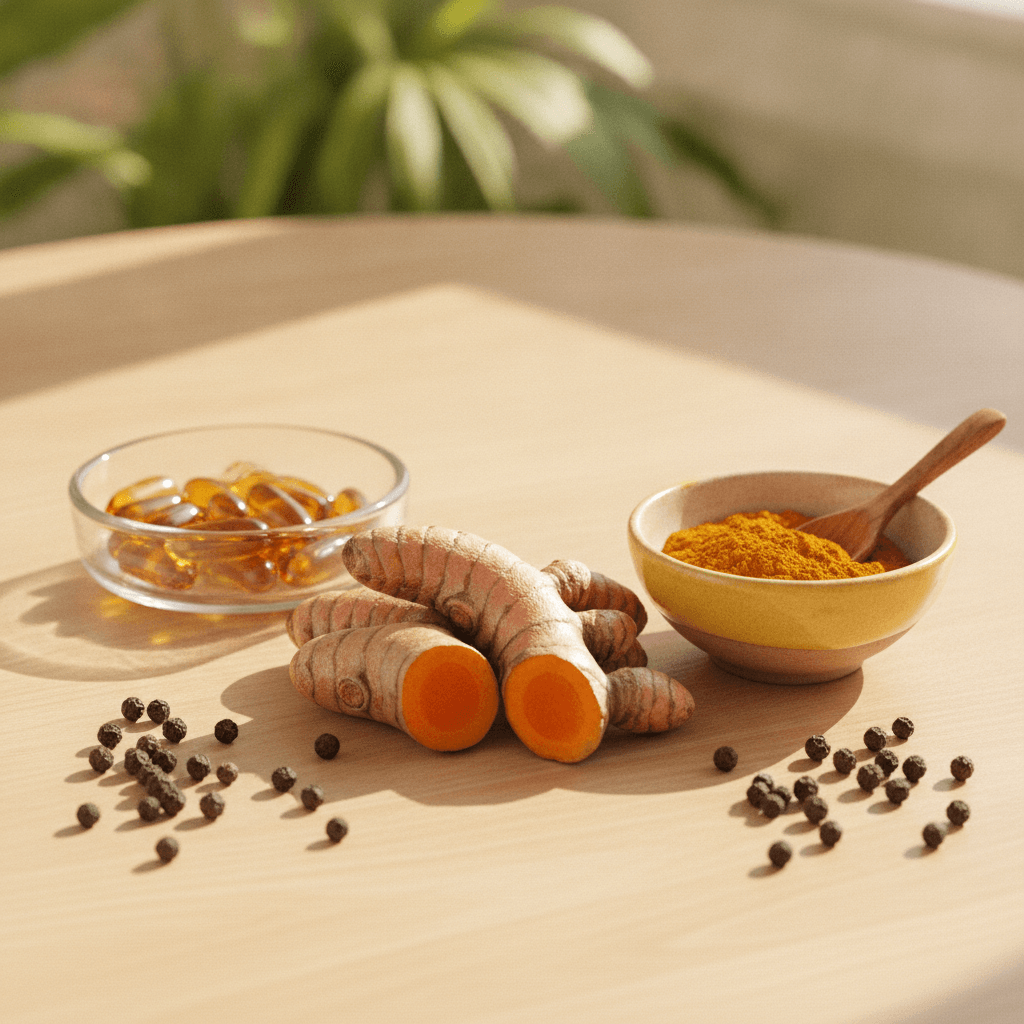
Turmeric is the root of Curcuma longa, a plant in the ginger family, dried and ground into the yellow spice used in curries. Its colour comes from curcuminoids: curcumin, the main one, and two close relatives, demethoxycurcumin and bisdemethoxycurcumin (Jäger 2014). Extracts concentrate them, which is why so many labels say "standardized to 95% curcuminoids".
Our curcumin and turmeric page covers both, with the studies, the doses that worked and the products ranked. In our database, 363 human studies of turmeric or curcumin are graded, and more than 240 of them found an improvement on at least one goal they measured.
How Much Curcumin Is Actually in Turmeric
When researchers tested 28 spice products, pure turmeric powder averaged 3.14% curcumin by weight; the curry powders, with one exception, held much less, and the amounts varied widely (Tayyem 2006). That works out to about 31 mg of curcumin in a gram of turmeric powder. The joint trials pooled below used about 1,000 mg of curcumin a day, which would take about 32 grams of the spice.
Supplement labels show the same split. In our label database, 778 on-market products contain only turmeric or curcumin, some with black pepper. 480 of them name curcumin or curcuminoids, and 298 list turmeric with no curcumin amount or standardization at all. The middle product holds 650 mg of turmeric per serving; at 3%, a plain 650 mg turmeric capsule would hold about 20 mg of curcumin. Where a label gives a curcumin row, the middle one holds 475 mg, and of the 87 labels that state a percentage, 74 say 95% curcuminoids.
Why Absorption Is the Problem, and What Pairing and Formulations Change
Curcumin barely reaches the blood on its own. In 24 healthy volunteers given single doses of a standardized curcumin extract from 500 to 12,000 mg, no curcumin was found in the blood at any dose up to 8,000 mg, and only low levels in two people at 10,000 or 12,000 mg; side effects were minimal (Lao 2006).
Two things change that. The first is black pepper. In healthy volunteers, 2 g of curcumin alone gave blood levels that were very low or undetectable, while adding 20 mg of piperine, the active compound in black pepper, raised curcumin's absorption by 2,000% (Shoba 1998). Piperine works by slowing the breakdown that clears curcumin in the gut and liver. In our label database, 290 of the 778 turmeric or curcumin products add black pepper or piperine; see turmeric with black pepper.
The second is formulation. In a crossover study in healthy volunteers, total curcuminoids in the blood were 1.3 times higher with a formula made with turmeric's own oils, 7.9 times higher with a phytosome (curcumin bound to lecithin) and 45.9 times higher with a formula using a water-loving carrier, each compared with standard curcumin (Jäger 2014). Across all 6,146 on-market labels that list turmeric or curcumin, branded forms appear often: phytosome in 234, C3 Complex in 134, BCM-95 in 117, CurcuWIN in 67, Theracurmin in 52 and Longvida in 48. Our pages for the phytosome, BCM-95 and Longvida forms list their studies.
These studies measured blood levels over hours. They do not show that one formulation eases joints, or anything else, more than another.
Turmeric vs Curcumin: Side by Side
| Turmeric powder | Curcumin extract | |
|---|---|---|
| Curcumin content | About 3% by weight (3.14% average in pure turmeric powders tested) | Usually 95% curcuminoids (74 of the 87 labels that state a percentage) |
| Curcumin per typical serving | About 20 mg in a 650 mg capsule, the middle label serving | Middle 475 mg per serving where a curcumin row is given |
| Absorption | Low; curcumin alone barely reaches the blood | Also low on its own; piperine raised it 2,000% in one study, and formulations 1.3 to 45.9 times in another |
| Dose in studies that showed an improvement | Most trials used extracts, not the spice | 120 to 1,500 mg a day in most of our graded studies, 500 mg in the middle |
| Cost per dose | Divide the price by the mg of curcumin, not turmeric: 1,000 mg of powder holds about 31 mg | Divide the price by the mg of curcuminoids per serving, and check the form named |
| Trials against each other | None found | None found |
Not sure which fits your stack? Get a protocol that checks it for you.
What the Human Studies Found, Ingredient by Ingredient
Joints. Across 8 randomized trials, turmeric extract or curcumin, at about 1,000 mg of curcumin a day, lowered pain scores more than placebo, and in 5 trials pain relief did not differ from pain meds; the authors called the trials too few and too small for a firm conclusion (Daily 2016). A larger pool of 15 trials with 1,621 adults with worn, painful joints found less pain and stiffness and better function than placebo, results similar to common anti-inflammatory pain meds, and fewer side effects than those meds (Zeng 2021). See the joints and mobility goal page.
Inflammation markers. Across 66 randomized trials, turmeric or curcumin lowered C-reactive protein by 0.58 mg/L and two other inflammation signals, TNF-alpha and IL-6, while a fourth, IL-1 beta, did not change; antioxidant capacity in the blood rose (Dehzad 2023).
Blood sugar, cholesterol and weight. An analysis of 103 trials with 7,216 people looked at 42 outcomes: 23 changed significantly, and the evidence was rated high only for fasting blood sugar, C-reactive protein, HDL cholesterol and weight, with 28 outcomes rated low or very low (Jafari 2024). The authors called for larger, longer and better-designed trials.
Turmeric against curcumin. Nearly all of these trials used curcumin or a turmeric extract measured for its curcumin, not kitchen turmeric, and we found no trial that compared the spice with an extract on any outcome. In our grading, 28 studies used curcumin with black pepper and 9 a phytosome form. Our healthy aging goal page shows where curcumin ranks among the ingredients studied for it.
Who Should Check With a Doctor First (People on Meds)
Talk to your doctor or pharmacist before starting turmeric or curcumin supplements if you take meds, especially meds that thin the blood or lower blood sugar, and before adding a black pepper extract, since piperine slows the breakdown of compounds in the gut and liver. In the joint trials, side effects were no more common than on placebo (Zeng 2021).
Liver reactions are rare but serious. A US network that studies liver injury from drugs and supplements linked 10 cases to turmeric products between 2004 and 2022, all of them since 2011 and 6 since 2017; 5 people were hospitalized and 1 died. Three of the 7 products tested also contained black pepper, the injury came on 1 to 4 months after starting, and 7 of the 10 people carried one immune gene type (Halegoua-DeMarzio 2023). Stop and call your doctor if you notice yellowing skin or eyes or dark urine. Rala, the AI behind Reverse Age Lab, checks every product in your stack against your meds before it places anything in your protocol, and blood work is optional.
Is this medical advice? No. This guide sets out the published research on turmeric and curcumin; it is not a diagnosis, and Rala isn't a medical device or a clinician. Talk to your doctor before adding turmeric or curcumin, especially if you take meds.
Bottom Line: Which Form for Which Person
For a person who cooks with turmeric, the spice adds flavour and a little curcumin, about 31 mg in a gram. For a person weighing a supplement, the human trials mostly used curcumin extracts at roughly 500 to 1,000 mg of curcumin a day, an amount food does not reach, and a plain turmeric capsule holds a small share of that. Curcumin is poorly absorbed either way; black pepper and some formulations raised blood levels many times over in short studies, but none has been shown to beat another on how your joints feel. So the practical questions are how many mg of curcumin or curcuminoids each serving holds (not turmeric), whether a form or a pepper extract is named, what it costs per mg of curcumin, and whether your meds call for a word with your doctor first.
Check Your Turmeric or Curcumin Against Your Whole Stack
Your Daily Protocol adds up the turmeric and curcumin in every product you take, including joint formulas and blends, checks them against your meds and places each one at the right time of day. Build My Protocol – 7-Day Free Trial.
Frequently Asked Questions
Is curcumin better than turmeric?
A 95% curcuminoid extract holds about 30 times more curcumin by weight than turmeric powder at about 3%, and most trials used extracts. We found no trial comparing the two on any outcome.
Is turmeric powder as good as a supplement?
A gram of pure turmeric powder holds about 31 mg of curcumin. The joint trials used about 1,000 mg of curcumin a day, which would take about 32 grams of powder.
Does black pepper help curcumin absorption?
In healthy volunteers, 20 mg of piperine raised curcumin's absorption by 2,000% after a 2 g dose. In our label database, 290 of 778 turmeric or curcumin products add black pepper or piperine.
What dose of curcumin did the studies use?
In our grading, most studies that showed an improvement used 120 to 1,500 mg a day, with 500 mg in the middle. The curcumin page shows the dose behind each result.
Is turmeric safe for your liver?
In trials, side effects were no more common than on placebo, but a US liver injury network linked 10 cases to turmeric products between 2004 and 2022, some made with black pepper. Check with your doctor first if you take meds.
Sources
Tayyem RF, Heath DD, Al-Delaimy WK et al. Curcumin content of turmeric and curry powders. Nutrition and Cancer, 2006. PubMed.
Jäger R, Lowery RP, Calvanese AV et al. Comparative absorption of curcumin formulations. Nutrition Journal, 2014. PubMed.
Lao CD, Ruffin MT, Normolle D et al. Dose escalation of a curcuminoid formulation. BMC Complementary and Alternative Medicine, 2006. PubMed.
Shoba G, Joy D, Joseph T et al. Influence of piperine on the pharmacokinetics of curcumin in animals and human volunteers. Planta Medica, 1998. PubMed.
Daily JW, Yang M, Park S. Efficacy of turmeric extracts and curcumin for easing joint symptoms: a systematic review and meta-analysis of randomized clinical trials (title paraphrased). Journal of Medicinal Food, 2016. PubMed.
Zeng L, Yu G, Hao W et al. The efficacy and safety of Curcuma longa extract and curcumin supplements for worn, painful joints: a systematic review and meta-analysis (title paraphrased). Bioscience Reports, 2021. PubMed.
Dehzad MJ, Ghalandari H, Nouri M et al. Antioxidant and anti-inflammatory effects of curcumin/turmeric supplementation in adults: a GRADE-assessed systematic review and dose-response meta-analysis of randomized controlled trials. Cytokine, 2023. PubMed.
Jafari A, Abbastabar M, Alaghi A et al. Curcumin on human health: a comprehensive systematic review and meta-analysis of 103 randomized controlled trials. Phytotherapy Research, 2024. PubMed.
Halegoua-DeMarzio D, Navarro V, Ahmad J et al. Liver injury associated with turmeric, a growing problem: ten cases from the Drug-Induced Liver Injury Network (DILIN). The American Journal of Medicine, 2023. PubMed.