
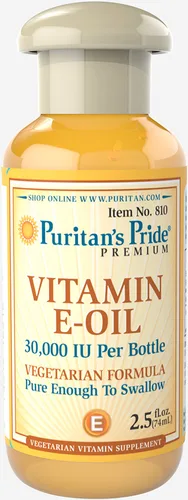
Puritan's Pride Vitamin E-Oil Review
Puritan's Pride Vitamin E in an Oil Blend (Item #000810) is a vitamin E oil sold in a 2.5 fl oz oil bottle with a listed potency of 30000 IU. The page describes it as a Vegetarian Formula and as Pure Enough to Take Orally. The product page presents it as an E-Oil that customers can enjoy for its moisturizing benefits: the page states that Vitamin E Oil, in a base of vegetable oils, will nourish and protect the skin with its moisturizing action. Each serving is 5 drops (0.25 mL), and the Supplement Facts panel lists 100 IU of Vitamin E per serving, shown as 333% Daily Value, from dl-Alpha Tocopheryl Acetate. The container holds 296 servings. The directions say that for adults, five drops (0.25 mL) daily, preferably with a meal, may be taken orally or put in water, juice or food. The same directions say that as a moisturizer, the oil can be applied directly to the skin. The other ingredients listed are soybean oil, corn oil, sesame oil, wheat germ oil and lemon oil. The label states that the product contains no artificial color, flavor or sweetener, no preservatives, no sugar, no starch, no milk, no lactose, no yeast, no fish, and is sodium free. The warning section advises pregnant or nursing people, anyone taking medication, anyone planning a medical procedure, and anyone with a medical condition to consult a doctor before use. It says to discontinue use and consult a doctor if adverse reactions or skin sensitivity occur. For skin use, the label says not to apply to broken or irritated skin or areas affected by rashes, and to avoid contact with eyes. It also says not to use on children or animals, to keep out of reach of children, to store at room temperature, and not to use if the outer seal is torn or missing. Puritan's Pride, as described on the page, has been helping families for more than 50 years and says its products are tested or inspected as many as 15 times during manufacturing. The page also offers one-time purchase and subscription options, with a 20 percent discount shown on the listed price.
We don’t sell supplements. We help you make decisions and get the best price.
Lowest prices
We may earn a commission from some store links. How we choose.
Finding the lowest prices at the stores now. This takes a few seconds.
Study, Trial or Testing Result Summary
Members Only29 human studies · 14 improved
This product is vitamin E alone, at 45 milligrams per serving, which is above the 10 milligrams used in one supplement study. Every skin benefit found so far comes from products that mix vitamin E with other ingredients, so they do not show what vitamin E alone does. In 72 women aged 35 or older, a daily drink with collagen, vitamin C and a vitamin E complex improved skin hydration, elasticity, roughness and density over 12 weeks more than placebo [1]. In 60 women, a similar collagen drink improved facial collagen structure over 12 weeks [2]. In 50 women, a face serum with vitamin C, vitamin E and raspberry leaf extract improved elasticity, smoothness and wrinkles over 8 weeks compared with the untreated side [3]. In 39 volunteers, 10 milligrams of vitamin E taken with carotenoids and selenium for 12 weeks increased skin density and reduced roughness [4]. In postmenopausal women, a mixed supplement with vitamin E, soy isoflavones, lycopene, vitamin C and fish oil gave shallower wrinkles [5]. After laser treatment for acne scars, a serum with vitamins C and E and ferulic acid improved healing and hydration [6]. None of these studies tested vitamin E alone. Animal and cell studies are never counted.
See all 29 studies →Hide the studies
- In 72 healthy women aged 35 or older, a daily drink containing collagen, vitamin C and a vitamin E complex for 12 weeks improved skin hydration, elasticity, roughness and density more than placebo.A Collagen Supplement Improves Skin Hydration, Elasticity, Roughness, and Density: Results of a Randomized, Placebo-Cont…
- In 64 patients with acne scars, a serum with vitamins C and E and ferulic acid applied for 14 days after laser treatment improved wound healing and skin hydration on the treated side compared with saline on the other side.Reparative Effects of a Topical Antioxidant Serum Containing Vitamin C, Vitamin E, and Ferulic Acid After Ablative Fract…
- In 60 adults with atopic dermatitis, 12 weeks of selenium yeast with or without 600 IU vitamin E did not change eczema severity compared with placebo.The effect on atopic dermatitis of supplementation with selenium and vitamin E.
- In 60 healthy women, a daily collagen drink containing vitamin E and other nutrients for 12 weeks improved facial skin collagen structure, while placebo did not.A Dermonutrient Containing Special Collagen Peptides Improves Skin Structure and Function: A Randomized, Placebo-Control…
- In 50 women aged 30-65, a face serum containing vitamin C, vitamin E and raspberry leaf extract applied to one side of the face for 8 weeks improved skin color, elasticity, radiance, smoothness and wrinkles compared with the untreated side, with mild tingling and tightness.Anti-aging and brightening effects of a topical treatment containing vitamin C, vitamin E, and raspberry leaf cell cultu…
- Taking beta-carotene by mouth for about 9 months lowered vitamin E levels in the blood and skin, with a 40% drop from baseline by the last month, so it may reduce vitamin E available to the skin.Reduction in plasma or skin alpha-tocopherol concentration with long-term oral administration of beta-carotene in humans…
- In 45 people with atopic dermatitis, 600 IU vitamin E for 60 days reduced eczema severity score by 35.7%, and by 64.3% when combined with vitamin D, compared with placebo.Randomized controlled trial using vitamins E and D supplementation in atopic dermatitis.
- In a small pilot trial of 40 women receiving breast radiotherapy, a vitamin E nanoparticle cream did not change overall radiation skin reaction grade versus controls, but it delayed the onset of skin reaction in women who did not get a boost dose and reduced mild redness under the breast.Topical application of a cream containing nanoparticles with vitamin E for radiodermatitis prevention in women with brea…
- In 24 women with radiation-induced skin fibrosis after breast cancer, 6 months of vitamin E 1,000 IU daily plus pentoxifylline shrank fibrosis more than placebo, but vitamin E alone was ineffective.Randomized, placebo-controlled trial of combined pentoxifylline and tocopherol for regression of superficial radiation-i…
- Taking 400 mg of vitamin E daily for 3 weeks raised vitamin E levels in facial sebum by about 87-92% by day 21, but this study did not measure wrinkles, elasticity, or hydration.Oral supplementation with all-Rac- and RRR-alpha-tocopherol increases vitamin E levels in human sebum after a latency pe…
- In 18 men and women with sun- and pollution-related pigmentation, a vitamin C, E and ferulic acid serum applied twice daily for 2 weeks after laser treatment reduced skin pigmentation more than laser alone on the untreated side of the face.Effect of a topical antioxidant serum containing vitamin C, vitamin E, and ferulic acid after Q-switched 1064-nm Nd:YAG …
- In 15 patients with surgical scars, vitamin E ointment twice daily for 4 weeks did not improve scar appearance, in 90% it had no effect or made it worse, and 33% developed contact dermatitis.The effects of topical vitamin E on the cosmetic appearance of scars.
- Topical vitamin E acetate applied to the arms for 3 months was absorbed into skin but was not converted to the active free form; skin appearance was not measured as an outcome.Disposition and metabolism of topically administered alpha-tocopherol acetate: a common ingredient of commercially avail…
- In 10 people, taking 1000 IU vitamin E with 2 g vitamin C daily for 8 days raised the UV dose needed to cause sunburn, while the placebo group became more sensitive.Protective effect against sunburn of combined systemic ascorbic acid (vitamin C) and d-alpha-tocopherol (vitamin E).
- In three children with yellow nail syndrome, topical vitamin E solution applied to the nails did not improve nail growth or appearance better than placebo oil.Yellow nail syndrome in three siblings: a randomized double-blind trial of topical vitamin E.
- Vitamin E applied to the skin after ultraviolet exposure, alone or with other antioxidants, did not reduce redness from sun damage.Effect of topical antioxidants on UV-induced erythema formation when administered after exposure.
- In a randomized trial of healthy volunteers, 500 IU of vitamin E daily plus carotenoids for 12 weeks reduced ultraviolet light-induced skin redness more than carotenoids alone.Carotenoids and carotenoids plus vitamin E protect against ultraviolet light-induced erythema in humans.
- Topical vitamin E cream for 6 months raised skin vitamin E levels but did not significantly reduce the number of sun-damage lesions compared with placebo cream.Chemoprevention of human actinic keratoses by topical DL-alpha-tocopherol.
- In a double-blind placebo-controlled trial, postmenopausal women who drank a supplement containing vitamin E with soy isoflavones, lycopene, vitamin C and fish oil for the long term had significantly shallower facial wrinkles, along with more new collagen in the skin.Wrinkle reduction in post-menopausal women consuming a novel oral supplement: a double-blind placebo-controlled randomiz…
- Taking 400 IU of vitamin E by mouth daily for 6 months did not protect healthy adults' skin from sunburn damage compared with placebo.Evaluation of the photoprotective effect of oral vitamin E supplementation.
- In a double-blind study, topical vitamin E applied alone gave a modest protective effect against ultraviolet-induced skin redness, and combining it with vitamin C and topical melatonin protected better than vitamin E alone.Topical melatonin in combination with vitamins E and C protects skin from ultraviolet-induced erythema: a human study in…
- In 69 people with psoriasis, 12 weeks of selenium yeast with or without 600 IU vitamin E did not reduce psoriasis severity compared with placebo.The effect of supplementation with selenium and vitamin E in psoriasis.
- In 39 healthy volunteers, 12 weeks of a supplement with 10 mg vitamin E, carotenoids and selenium increased skin density and thickness and reduced roughness and scaling, while placebo showed no changes.Antioxidant supplements improve parameters related to skin structure in humans.
- In 8 healthy people taking vitamin E 400 IU daily for 8 weeks, skin malondialdehyde (a marker of oxidative damage) fell, but other oxidative stress measures and sensitivity to ultraviolet light did not change.Effects of oral vitamin E and beta-carotene supplementation on ultraviolet radiation-induced oxidative stress in human s…
- In an open comparison study, a vitamin E cream gave lower skin scores than a retinol preparation on stratum corneum resistance and UV-induced shallow wrinkling tests, and the abstract reports no benefit from vitamin E on its own.Topical retinol and the stratum corneum response to an environmental threat.
- In an open-label study of 44 women, a facial regimen containing vitamin E (as alpha-tocopheryl acetate) along with retinol and vitamin C improved hyperpigmentation and photodamage scores over 12 weeks, though the vitamin E effect cannot be separated from the other ingredients; dryness rose at weeks 4 and 8.An Open Label Clinical Trial to Evaluate the Efficacy and Tolerance of a Retinol and Vitamin C Facial Regimen in Women W…
- In 16 healthy Japanese adults, a multi-ingredient antioxidant supplement that also contained vitamin E (dose not stated) raised skin carotenoid levels over 16 weeks, but the study did not measure wrinkles, elasticity, or hydration, and vitamin E was not tested on its own.Effect of an antioxidant supplement containing high dose lutein and zeaxanthin on macular pigment and skin carotenoid le…
- This abstract tests vitamin C derivatives for skin hydration on volunteers' forearms and uses a commercial product containing vitamin E only as a comparison; the abstract does not report the number of people, the duration, or the results for vitamin E.Moisturizing potentials of ascorbyl palmitate and calcium ascorbate in various topical formulations.
- Hydrogels containing vitamin E in lipid nanocarriers improved skin hydration in human volunteers in short tests, and the study authors say longer and larger trials are still needed.Evaluation of the biocompatibility and skin hydration potential of vitamin E-loaded lipid nanosystems formulations: In v…
Review Totals and Summary
Members Only94 reviews · 91% positive
Buyers are very positive about Puritan's Pride Vitamin E-Oil, which carries about 88 ratings across the stores that sell it. The reviews here are all favorable, and they describe it as a versatile liquid used on skin and lips, on scars, and as a drop-dose supplement for people and pets. Only the liquid is covered below; reviews of other forms (gummies, capsules, powder) were left out. **What buyers say it did for them:** Reviewers use it mainly as a skin product. One long-time user applies it as a day moisturizer on his face and lips, and his wife now does the same. She says "It helps minimize wrinkles in the cold climate" where they live in northern Wisconsin. Another buyer found it "Great for post surgery scar!" A pet owner reports that it "promotes a soft and shiny coat" for their animals. Beyond these, one reviewer simply calls it "Everything you would want in a Vit E application." **What buyers complain about:** The reviews contain no complaints. Nothing negative is raised about the product, its quality, or its delivery. With so few detailed comments, though, problems that other buyers might run into may simply not have been mentioned. **Taste, smell, and form:** The liquid form is a selling point for one reviewer, who calls it a "Very convenient form of Vit E, especially for older people" who have trouble swallowing pills, and for pets. The same reviewer says it is "practically tasteless." On scent, the northern Wisconsin reviewer says it "smells DIVINE," which is a welcome point for something applied to the face and lips. **Value for money:** Value is mentioned only once. The reviewer who gives it to pets says only "a few drops daily" are needed to be effective, which makes it "quite economical." Nobody comments on the price itself. One buyer also praises the "fast shipment" and says the product arrived "just as described." **Who it seems to suit and who it did not:** It seems to suit people who want a simple, single-ingredient oil to use as a facial or lip moisturizer, people caring for a post-surgery scar, and anyone who finds pills hard to swallow. It also suits pet owners looking for a way to add vitamin E to an animal's diet. One long-time user has relied on it for decades, and enthusiastic wording like "BEST Vitamin E Oil AROUND" suggests strong loyalty among regular users. No one reports that it did not suit them, so there is no information here on who should avoid it. **Bottom line:** The feedback is warm and consistent, though thin on detail. If you want a liquid vitamin E for skin, scars, or easy dosing, these reviews give you good reason to try it.
Biohacker Summary
Members Only5 of 10 recommend it
The panel is split on vitamin E, with no clear majority recommending it, though most of the ten spoke about it. Those in favor take it for protecting cells and skin, for hair health, or as part of a daily multivitamin or a fat soluble vitamin combination, and a few prefer mixed tocopherols or whole food forms with tocotrienols over the plain synthetic kind. Doses were rarely given; one panelist warned against 335 mg right after a workout for people under 50, and another gives his kids a small daily amount. Several raised cautions: avoiding it for a week before surgery because it can thin the blood, worse outcomes at high doses in lung cancer patients, possible prostate cancer and heart risks, blunted workout gains when combined with vitamin C, and one view that a balanced diet makes it unnecessary. No one said they had stopped taking it, but a few steered shoppers toward food sources like nuts, seeds, avocados and vegetables instead.
See all 10 biohackers →Hide the biohackers
Ben Greenfield · Vitamin E · neutral
- Mentions a recent study showing no significant increase in bleeding for patients on Vitamin E supplementation during open heart surgery, which was interesting for him to learn.
- Notes a new study indicating that vitamin E is a core dietary antioxidant closely associated with a reduced risk of accelerated biological aging.
- Recommends Xtendlife's Tocotrienols Vitamin E for cardiovascular, brain, and healthy aging support, noting that research points to tocotrienols over alpha-tocopherol.
- Recommends whole food vitamin E, explaining that typical supplements only provide alpha-tocopherol, while the whole food complex includes four tocopherols and four tocotrienols, often with selenium at the core.
- Warns against taking 335 mg of vitamin E immediately after a workout for individuals under 50, as it can dull the body's natural adaptation signal.
- Warns that taking a whole bunch of antioxidants like vitamin E after a workout can suppress the body's inflammatory response, which is necessary for benefits like mitochondrial proliferation and satellite cell generation for new muscle.
- Recommends Hiya's best-selling children's vitamin for kids to get the full-body nourishment they need.
- Recommends vitamin E as a powerful antioxidant for pollution, and has tripled his antioxidant intake since arriving in India.
- Explains that vitamin E requires carrier fats for absorption, which is why it's often recommended to take fat-soluble vitamins with food, and 10X Health's microtransporters release vitamin E upon contact with dietary fats.
- Ben Greenfield recommends the tocotrienol form of vitamin E for lung health and air pollution exposure, as it is more effective than tocopherol and difficult to get sufficient levels from food.
Dr. Eric Berg · Vitamin E · neutral
- Mentions that grass-fed liver has vitamin E.
- Dr. Berg states that synthetic vitamin E may be acceptable for short-term use, but long-term use can contribute to oxidative stress.
- Warns against synthetic vitamin E (dl-alpha-tocopherol) for ongoing maintenance, citing a trial where it increased prostate cancer risk and explaining that it can become a free radical and starve out necessary protective forms of vitamin E.
- Recommends taking vitamin E to block the effects of grains.
- Mentions that castor oil contains vitamin E, which is crucial for maintaining skin barrier function.
- Discusses why tocotrienols are better than regular vitamin E.
- Dr. Berg mentions that eggs contain Vitamin E.
- Fat-soluble vitamins like vitamins A, D, E, and K2 are best taken with a meal, making lunchtime an ideal choice.
- Recommends the tocotrienols form of vitamin E for various conditions due to their power, and suggests taking it at lunch with a meal.
- Many one-a-day vitamins are unnecessary. They often contain cheap, synthetic ingredients and fillers that do not benefit your health and may even make matters worse.
Dave Asprey · Vitamin E · uses
- Dave Asprey's kids get a little bit of vitamin E every day, which helps to stabilize the bad oils they get when eating at restaurants.
- Recommends Vitamin E as one of the most important supplements for overall health.
- Takes Vitamin DAKE from Suppgrade Labs because D3, A, K2, and E work together.
- Includes vitamin K2 as a critical ingredient in Vitamin DAKE, stating that the body needs the right fat soluble vitamins for thousands of reactions.
- Mentions Vitamin DAKE from Suppgrade Labs as a product that combines fat-soluble vitamins D, A, K, and E to work together.
- Would have added natural forms of vitamin E after hitting his head.
- Recommends stacking glutathione with vitamin E to help revive oxidized glutathione back to its reduced form.
- Warns against taking 400 IU of synthetic vitamin A (alpha tocopherol) a day, stating it's one of the worst things you can do unless taken with a full spectrum of other tocopherols and tocotrienols.
- Describes a patient whose pain was resolved by taking Vitamin E and ubiquinol.
- Mentions a study where topical vitamin E helped protect against hair loss in mice, and suggests it could be a next step for human trials.
Dr. Mark Hyman · Vitamin E · neutral
- Notes that patients who were very malnourished had extremely low vitamin E.
- Lists Vitamin E as important for cell protection and anti-aging.
- Recommends avoiding Vitamin E for at least a week before surgery because it can thin the blood.
- Notes that Vitamin E levels are low in Parkinson's patients.
- Mentions that people are not getting enough vitamin E, which is found in foods like avocados, nuts, and whole grains.
- Mentions that vitamin E itself is anti-cancer.
- Dr. Hyman reports that 84% of the population is deficient in vitamin E, attributing this to a lack of whole grains in the diet.
- Notes that traditional medicine might give patients with fatty liver disease vitamin E, but often the wrong kind, and many will advise against it.
- States that Vitamin E is important as an antioxidant, helping with skin healing, repair, and moisturization, and his favorite is Metagenics E Complex, which contains a mixture of tocopherols.
- Recommends vitamin E, found in almonds, spinach, olive oil, sunflower seeds, hazelnuts, and avocados, as a great antioxidant.
Dr. Rhonda Patrick · Vitamin E · neutral
- Lutein and zeaxanthin can also be obtained from certain multivitamins.
- Choosing a multivitamin that includes lutein and zeaxanthin ensures you get meaningful amounts every day.
- Notes that ~60% of Americans are low in vitamin E.
- Suggests avoiding a multivitamin if it contains biotin before a testosterone blood test to prevent confounding results.
- Multiple randomized controlled trials show older adults taking a standard multivitamin (like Centrum Silver) had measurable improvements in processing speed, cognition, and episodic memory.
- Currently takes the Pure Encapsulations O.N.E Multivitamin.
- Natural sources of linoleic acid (like nuts, meat, etc.) usually include protective antioxidants (vitamin E) that limit harmful effects.
- Warns that more than 80% of people have low vitamin E levels, unknowingly increasing their risk of heart disease, and even slightly low intake raises oxidized LDL by 8% or more, elevating cardiovascular disease risk.
- Rarely recommends or doses vitamin E due to concerns about its potential to blunt exercise adaptations, especially when combined with vitamin C.
- Reports that alcohol use disorder is associated with a 14-58% greater prevalence of deficiencies in vitamin E.
Thomas DeLauer · Vitamin E · neutral
- Mentions a causal link found between vitamin E and waking up in the middle of the night.
- Recommends using a multivitamin to ensure adequate micronutrient intake, especially when wholesome food is less available.
- Advises checking multivitamins because many contain 100, 200, or 300% of the daily value of selenium, which can contribute to excessive intake.
- Recommends vitamin E for protecting skin cell membranes, reducing oxidative stress, and preventing lipid damage, especially for those with high stress and low dietary intake.
- Recommends taking a multivitamin to ensure adequate intake of important cofactors like B vitamins, magnesium, iron, and zinc, which are essential for the signaling system to be operational.
- Recommends Vitamin E for hair graying, as part of a nutrient-dense diet to combat oxidative stress.
- Mentions vitamin E to a certain degree as a cofactor to support the reversal of hair graying.
- Recommends a multivitamin stack, specifically Fyhealth, for those who are fasting, as it helps ensure adequate nutrition when calorie and food intake are reduced.
- Warns against synthetic multivitamins, arguing that they are an attempt to be smarter than nature by combining isolated nutrients in proportions not found naturally, and that a whole food approach is superior.
- Recommends Hiya multivitamins for kids, describing them as monk fruit sweetened chewable vitamins that provide essential vitamins and minerals children might miss in their diet.
Siim Land · Vitamin E · neutral
- Notes that oral vitamin E and C supplementation has been noted to increase the dose of UVB radiation from the sun needed to cause redness of the skin, suggesting increased resilience against sun damage. He also mentions a trial where a combination of slow-release vitamin C and vitamin E decreased the progression of carotid atherosclerosis in men.
- Mentions vitamin E in comparison to topical melatonin for oxidative defense, stating that melatonin would compete but is not as broadly validated clinically.
- States that the biggest evidence for multivitamin is that it improves cognition and enhances episodic memory in elderly people, who tend to have worse diets and are more likely to be deficient.
- Created Microvitamin, a supplement that bundled all the supplements he was taking, to help fund his a med trial.
- Recommends Vitamin E from vegetables, fruits, nuts, and seeds for skin protection.
- Mentions that years back, a European study revealed risk factors of vitamin E that only showed up with a sufficiently large study.
- Places multivitamins in the 'good' tier, noting that while formulations vary and they don't reduce mortality risk, clinical trials show they can help with cognitive function in elderly people, though generally healthy individuals may not gain much.
- Warns against taking vitamin E around training because it can interfere with muscle growth.
- Warns that taking vitamin E and vitamin C together can eliminate the adaptive benefits of exercise, especially in sedentary individuals doing exercise training, because it blunts the upregulation of mitochondrial biogenesis.
- Mentions that Vitamin E technically lengthens telomeres, but also notes that low vitamin D is linked to cancers, highlighting the complexity of health optimization.
Andrew Huberman · Vitamin E · uses
- Takes a multivitamin every day for longevity.
- Warns that high-dose supplementation of Vitamin E, when given to lung cancer patients, led to worse outcomes than control subjects, highlighting that it's not the same as ingesting it in food.
- Recommends Vitamin E as part of the AREDS2 supplementation for slowing the progression of dry macular degeneration.
- Mentions evidence suggesting that a combination of vitamin C and vitamin E can blunt hypertrophic adaptations because they are anti-inflammatory antioxidants.
- Recommends Vitamin E, especially mixed tocopherols, to help with high prolactin levels.
- Andrew Huberman does not take vitamin E because it spiked his prostate-specific antigen, which he was told is a known effect among urologists.
- Takes a foundational supplement as a source of vitamin A, in addition to food sources.
Peter Attia · Vitamin E · warns
- Notes that there are some downsides to Vitamin E, including cardiovascular longitudinal risk and prostate cancer, and that discussions are needed with patients, especially those with diabetes or cirrhosis, due to studies indicating increased all-cause mortality depending on the dose.
- Peter Attia, involved in the American Urological Association Peyronie's guidelines, stated that vitamin E is not indicated for Peyronie's disease and should not be given.
- States that American Urological Association guidelines advise against giving vitamin E for Peyronie's disease as it is not indicated.
- Suggests that taking vitamin E would almost assuredly not be required if one eats a balanced diet.
- Notes that Vitamin E acetate, generally regarded as safe for ingestion, is not safe when heated to a vapor or steam, linking it to the dangers of vaping.
- Mentions a lung cancer trial where patients taking vitamin E did worse, and this can be recapitulated in mice.
- Notes that vitamin C works better for collagen synthesis when combined with vitamin E.
- Discusses that while observational studies link vitamin E to cognitive health, clinical trials show no effect on dementia risk, suggesting it might act synergistically with other dietary components.
Bryan Johnson · Vitamin E · recommends
- Recommends adequate Vitamin E for hair health, noting it is in the Blueprint stack.
- Uses Vitamin E at 10 IU/ML in his custom topical hair formulation.
RAL Summary
Members OnlyTier 4 for Younger-Looking Skin for Women
Every study counted as an improvement tested vitamin E mixed with collagen, vitamin C, carotenoids, selenium or other ingredients, not vitamin E alone, while vitamin E on its own showed no benefit, so the evidence for this single-ingredient oil is thin. So it is graded Tier 4, lower than the rules alone gave.
- Emerging: not enough evidence to rank higher yet.
Where the evidence disagrees: 11 of the 29 human studies found no effect.
More Details
Members OnlyBody systems · Combine with · Possible side effects
Body systems: Skin
Combine with: For skin and antioxidant support, vitamin E pairs well with vitamin C, which helps regenerate oxidized vitamin E, along with collagen peptides, hyaluronic acid, and astaxanthin or other carotenoids. Selenium and mixed tocopherols/tocotrienols can add complementary antioxidant coverage. If bone health is still your main goal, use a separate bone-specific stack: calcium (citrate or hydroxyapatite), vitamin D3, vitamin K2 (MK-7), magnesium, and optionally boron and collagen. Avoid high-dose vitamin E (above about 400 IU daily) alongside meds or high-dose vitamin K antagonists without medical guidance.
Possible side effects: A vitamin C and E face serum caused mild tingling and tightness in one study. Reviews raised no complaints.
Supplement Facts
Vitamin E 45 mg
| Vitamin E | 45 mg |
Directions: Directions: For adults, take two (2) drops (0.1 mL) daily, preferably with a meal. May be taken orally or put in water, juice or food. As a moisturizer, apply directly to your skin.
Barcode (UPC) 025077027910 · Label source: NIH label database · Report a label change
Show entire label

More younger-looking skin for women products
Members OnlyThe highest ranked for the same goal
Read more
Our articles on this subject
- What Supplements and Vitamins Should Not Be Taken TogetherArticle · Sep 7, 2026
- Are Supplements a Waste of Money? When They Work and When They Don'tArticle · Oct 23, 2026
Graded November 7, 2026 by the Reverse Age Lab evidence engine, from human studies, real reviews and our biohacker panel. How we grade. Is this medical advice? No. Rala organizes the published evidence; go over any change with your doctor, especially if you take meds.
Privacy policyConsumer health dataAffiliate disclosureTermsDo Not Sell or Share My Personal InformationCookie settings