
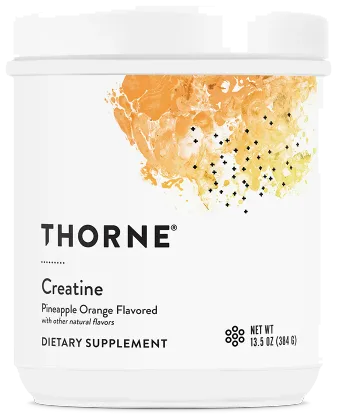
Thorne Creatine - Pineapple Orange Review
High-quality creatine for lean muscle mass, endurance, cellular energy, and brain function. Promote enhanced muscle performance and strength with creatine monohydrate. Great for more than just athletes, it also supports cellular energy production and cognitive function to help you perform at your best. NSF Certified for Sport. The product is listed as a Thorne Creatine Monohydrate Powder with 5 grams of creatine monohydrate per one scoop serving, and each container holds 60 servings. The page describes the product as promoting enhanced muscle performance, endurance, and strength, supporting cellular energy production for exercise and daily activity, and helping maintain healthy cognitive function and brain performance. It also states that the product aids in healthy body composition and muscle hydration. Suggested use is to mix one scoop with at least eight ounces of water, juice, or preferred beverage, taken daily or as recommended by a health-care or performance professional. It can be used 30 to 90 minutes before or after exercise. The powder is described as easy to mix with no added sugars or artificial sweeteners. The creatine is a highly researched, micronized creatine monohydrate for optimal solubility. The flavor is naturally flavored with pineapple orange, using natural colors and sweeteners. The page says the product is suitable for athletes and anyone seeking to support muscle and brain health. NSF Certified for Sport means every batch is tested for compliance with label claims and to ensure the absence of nearly 300 substances banned by many major athletic organizations. The product is also listed as dairy, gluten, and soy free in the comparison table. Thorne states that the creatine is formulated with scientific rigor, with each ingredient carefully selected, clinically studied, and tested through multiple rounds of quality control to ensure purity, potency, and consistency. The page notes the product is available in three varieties, including Strawberry, Pineapple Orange, and unflavored. The FAQ notes that the flavors are naturally derived from pineapple and oranges and other natural flavors, and that the product is not gender-specific in its benefits. Creatine is described on the page as an amino acid found mostly in the muscles and brain that helps make ATP, a molecule needed for intense exercise.
We don’t sell supplements. We help you make decisions and get the best price.
Lowest prices
We may earn a commission from some store links. How we choose.
Finding the lowest prices at the stores now. This takes a few seconds.
Study, Trial or Testing Result Summary
Members Only56 human studies · 28 improved
This product gives 5 grams of creatine monohydrate per scoop. That is a full dose, above the 3 grams that worked in studies. Strong evidence shows creatine helps build muscle when combined with strength training. Across 61 trials, creatine added about 1.39 kilograms of lean mass compared with placebo, in both beginners and experienced lifters [1]. A larger pooled analysis of 143 trials found about 0.82 kilograms more lean mass and slightly lower body fat, with bigger effects alongside strength training [2]. In twelve trials of adults under 50 who lifted weights, creatine added 1.14 kilograms of lean mass and cut fat mass by 0.73 kilograms compared with training alone [3]. In 509 adults under 50, creatine with training raised upper-body strength by 4.4 kilograms and lower-body strength by 11.4 kilograms more than placebo, with clearer gains in men [4]. In 608 postmenopausal women, it added about 0.37 kilograms of lean mass and 7.5 kilograms of leg-press strength, mainly at 5 grams or more a day [5]. In older adults doing strength training, creatine also gave greater gains in lean tissue and strength than placebo [6]. Not every trial found a benefit, so results depend on training and on how long it is taken. Animal and cell studies are never counted.
See all 56 studies →Hide the studies
- In a pooled analysis of 29 trials with 2,255 older adults, creatine (among other nutrients such as amino acids) significantly improved muscle mass, though the best dose and duration were not established.Factors influencing the efficacy of nutritional interventions on muscle mass in older adults: a systematic review and me…
- In 1387 adults doing resistance training, multi-ingredient protein supplements (often protein plus creatine) added about 0.8 kg of lean mass and some strength compared with non-multi-ingredient supplements, but were not better than protein alone.Do multi-ingredient protein supplements augment resistance training-induced gains in skeletal muscle mass and strength? …
- In 763 women across 14 trials combining supplements (protein, amino acids, creatine) with exercise, muscle mass did not improve but bench press and handgrip strength did, particularly in creatine studies.Nutritional Supplementation Combined with Exercise for Musculoskeletal Health in Women: A Systematic Review and Meta-Ana…
- In 608 postmenopausal women across seven trials, creatine added about 0.37 kg of lean mass and 7.5 kg of leg-press strength, mainly at 5 g or more per day with resistance training, with no change in bone density.Creatine monohydrate for lean mass, strength, and bone density in postmenopausal women: a systematic review and meta-ana…
- In 509 adults under 50 across 23 trials, creatine with resistance training raised upper-body strength by 4.4 kg and lower-body strength by 11.4 kg more than placebo, with clearer gains in males than females.Effects of Creatine Supplementation and Resistance Training on Muscle Strength Gains in Adults <50 Years of Age: A Syste…
- In 14 trials with 364 people with muscle diseases, creatine raised muscle strength in muscular dystrophies by about 8.5% over placebo but did not improve strength in metabolic muscle diseases, and high doses worsened daily activities and muscle pain in McArdle disease.Creatine for treating muscle disorders.
- Pooled trials in older adults doing resistance training showed creatine gave greater gains in lean tissue mass and strength than placebo, including when taken only on training days, though strength benefits depended partly on a loading phase.Meta-Analysis Examining the Importance of Creatine Ingestion Strategies on Lean Tissue Mass and Strength in Older Adults…
- In ten trials of healthy adults training for at least 6 weeks, creatine added a very small increase in muscle size measured by imaging, about 0.10 to 0.16 cm in muscle thickness.The Effects of Creatine Supplementation Combined with Resistance Training on Regional Measures of Muscle Hypertrophy: A …
- Across 143 trials, creatine increased fat-free mass by 0.82 kg and reduced body fat percentage by 0.28 points, with larger effects when combined with resistance training.Creatine supplementation protocols with or without training interventions on body composition: a GRADE-assessed systemat…
- In twelve trials of adults under 50 doing resistance training, creatine added 1.14 kg of lean mass and reduced fat mass by 0.73 kg compared with training alone.The Effect of Creatine Supplementation on Resistance Training-Based Changes to Body Composition: A Systematic Review and…
- Across 61 trials, creatine added 1.39 kg of fat-free mass compared with placebo in both novice and experienced lifters, with no significant difference between the two groups.Creatine supplementation and resistance training: a comparison between novice and experienced lifters - a systematic rev…
- In children with spinal muscular atrophy types II and III, creatine showed no clinically important change in motor function compared with placebo across trials lasting three to 24 months.Drug treatment for spinal muscular atrophy types II and III.
- A review of 8 trials in healthy people over 65 combining supplements with exercise, including creatine, concluded the combination may improve strength, balance and speed.[Exercise and nutritional supplements; effects of combined use in people over 65 years; a systematic review].
- In 37 trials of adults aged 60 and over, exercise improved muscle mass and function, but adding supplements including creatine gave extra benefit in only about a quarter of studies.Nutrition and physical activity in the prevention and treatment of sarcopenia: systematic review.
- A systematic review of 23 trials in adults over 60 found six creatine trials showed no consistent effect on muscle mass, strength or physical performance.Effects of Protein, Essential Amino Acids, B-Hydroxy B-Methylbutyrate, Creatine, Dehydroepiandrosterone and Fatty Acid S…
- In older adults, creatine added to exercise may improve muscle strength and lean mass when taken as a continuous low daily dose with at least 12 weeks of resistance training, but benefits were not seen for mental health and effects on bone and cognition remain unclear.The Additive Effects of Creatine Supplementation and Exercise Training in an Aging Population: A Systematic Review of Ra…
- After anterior cruciate ligament reconstruction, creatine in one included trial produced no statistically significant gain in strength or muscle size of the operated leg compared with control.[Effect of dietary supplements and whey protein on muscle mass and strength of the operated limb after anterior cruciate…
- In breast cancer patients, creatine showed limited or no benefit for fatigue or muscle strength in the trials reviewed.Impact of Dietary Supplements on Clinical Outcomes and Quality of Life in Patients with Breast Cancer: A Systematic Revi…
- In 237 postmenopausal women over 2 years, creatine with exercise increased lean tissue mass compared with placebo in completers, but did not increase bench press or squat strength and did not change bone density.A 2-yr Randomized Controlled Trial on Creatine Supplementation during Exercise for Postmenopausal Bone Health.
- In 200 postmenopausal women with osteopenia over two years, 3 grams of creatine daily did not improve bone health, lean mass or muscle function compared with placebo.Creatine Supplementation (3 g/d) and Bone Health in Older Women: A 2-Year, Randomized, Placebo-Controlled Trial.
- In 200 pre-frail and frail older adults doing resistance training for 16 weeks, adding creatine did not improve muscle mass or strength compared with placebo.Supplement-based nutritional strategies to tackle frailty: A multifactorial, double-blind, randomized placebo-controlled…
- In 104 people with amyotrophic lateral sclerosis taking 5 g of creatine daily for 6 months, creatine produced no measurable benefit on muscle strength or function compared with placebo.A clinical trial of creatine in ALS.
- In 103 older adults doing resistance training for 16 weeks, taking 3 g of creatine daily added benefits to strength and daily function and lowered inflammation and oxidative stress markers compared with placebo.Effects of high-load, velocity-intentional variable resistance training combined with creatine supplementation on neurop…
- In 80 resistance-trained men, a pre-workout supplement containing 2 grams of creatine nitrate improved some thinking test scores and strength at 4 weeks, but these benefits were similar to placebo by 8 weeks and body composition did not differ.Effects of ingesting a pre-workout dietary supplement with and without synephrine for 8 weeks on training adaptations in…
- In older adults doing supervised resistance training for one year, creatine increased lower-leg muscle density more than placebo, with some favorable bone area changes.Efficacy of Creatine Supplementation and Resistance Training on Area and Density of Bone and Muscle in Older Adults.
- In 69 young adults during 5 weeks of strength training, a mix of creatine, whey protein and conjugated linoleic acid gave a larger gain in strength and lean mass than the other groups, though the creatine effect could not be separated from the other ingredients.Conjugated linoleic acid combined with creatine monohydrate and whey protein supplementation during strength training.
- In 64 middle-aged and older adults over 12 weeks, 10 grams of creatine per day (5 grams twice daily) increased lean tissue mass and strength with or without exercise and diet, and improved some memory and thinking test scores compared with placebo.Effects of creatine supplementation with and without exercise and diet intervention on body composition, cognitive funct…
- In 63 adults taking 5 grams per day of creatine for 13 weeks, lean body mass rose 0.5 kg more than controls after a 7-day start, mainly in women, but added resistance training gave no extra lean mass gain over 12 weeks.The Effect of Creatine Supplementation on Lean Body Mass with and Without Resistance Training.
- In 60 vulnerable older women over 24 weeks, creatine combined with resistance training increased leg strength and appendicular lean mass more than placebo or creatine alone, while creatine alone matched resistance training alone for lean mass gains.Creatine supplementation and resistance training in vulnerable older women: a randomized double-blind placebo-controlled…
- In 60 young men doing resistance training for 8 weeks, taking creatine (25 g daily for 5 days, then 5 g daily) lowered homocysteine within the group, but the change was not significantly different from placebo or control.Creatine supplementation alters homocysteine level in resistance trained men.
- In older women over 24 weeks, creatine added nothing to the muscle strength gains from strength training; training alone improved strength compared with no training.Creatine supplementation associated or not with strength training upon emotional and cognitive measures in older women: …
- In 47 postmenopausal women over 12 months of resistance training, creatine raised relative bench press strength more than placebo (64% vs 34% gain).Effects of Creatine and Resistance Training on Bone Health in Postmenopausal Women.
- In 45 older adults, resistance training with creatine for 10 weeks produced larger muscle strength gains than training with placebo.The role of resistance training and creatine supplementation on oxidative stress, antioxidant defense, muscle strength, …
- In 42 middle-aged and older men over 14 weeks of resistance training, 5 g of creatine daily added no strength or lean mass benefit beyond training with placebo.The effects of supplementation with creatine and protein on muscle strength following a traditional resistance training …
- In 40 young adults doing resistance training for eight weeks, creatine monohydrate or creatine hydrochloride increased strength, muscle size and lean mass more than placebo, with hydrochloride giving no extra benefit over monohydrate.Supplementing With Which Form of Creatine (Hydrochloride or Monohydrate) Alongside Resistance Training Can Have More Imp…
- In 39 older adults over 32 weeks of resistance training, creatine increased muscle strength more than placebo, and taking it right after training gave the largest lean tissue gain.Strategic creatine supplementation and resistance training in healthy older adults.
- In 36 people with muscular dystrophy taking creatine or placebo for 8 weeks in a crossover design, creatine produced a mild but significant improvement in muscle strength and daily activities.Creatine monohydrate in muscular dystrophies: A double-blind, placebo-controlled clinical study.
- In 33 college football players over 10 weeks of strength training, creatine alone or with beta-alanine produced greater strength gains than placebo, and creatine plus beta-alanine also gave greater gains in lean body mass and reductions in body fat.Effect of creatine and beta-alanine supplementation on performance and endocrine responses in strength/power athletes.
- In 33 older adults taking creatine at high or moderate doses or a placebo for 10 days, creatine did not improve muscle strength or endurance beyond placebo, with or without resistance training.Effect of Creatine Supplementation Dosing Strategies on Aging Muscle Performance.
- In a retrospective analysis of older men with obesity or metabolic risk, a whey-based multi-ingredient supplement containing creatine gave greater muscle and strength gains than a collagen-based alternative over three months, though creatine was not tested alone.Obesity and Metabolic Disease Impair the Anabolic Response to Protein Supplementation and Resistance Exercise: A Retrosp…
- In 30 older adults hospitalized for stroke, 10 g of creatine twice daily for 7 days did not improve physical function, strength or muscle mass compared with placebo, though it lowered progranulin levels.Influence of CReatine Supplementation on mUScle Mass and Strength After Stroke (ICaRUS Stroke Trial): A Randomized Contr…
- In 28 trained young adults over 6 weeks of resistance training, creatine alone or with caffeine produced no between-group differences in strength or body composition, except a small extra gain in knee extensor muscle thickness with creatine alone.Effects of Creatine and Caffeine Supplementation During Resistance Training on Body Composition, Strength, Endurance, Ra…
- In 25 college football players doing resistance training for 9 weeks, creatine (20 g daily for 5 days, then 5 g daily) gave greater gains in body weight, lean mass, strength and anaerobic performance than placebo or no supplement.Creatine supplementation during resistance training in college football athletes.
- In 22 rowers over 6 weeks, creatine monohydrate (a 5-day loading phase followed by a maintenance dose) did not improve performance or training volume beyond placebo, though both groups improved.Effects of creatine monohydrate supplementation during combined strength and high intensity rowing training on performan…
- In 22 physically active young adults doing resistance training for 6 weeks, creatine taken after each training set increased leg press and chest press strength and total body strength, while the placebo group did not change.Effects of Creatine Supplementation during Resistance Training Sessions in Physically Active Young Adults.
- In naturally menstruating women doing at-home resistance training for 6 weeks, 5 g daily of creatine did not produce strength gains beyond placebo, though it increased sleep on training days.Creatine Improves Total Sleep Duration Following Resistance Training Days versus Non-Resistance Training Days among Natu…
- In 20 physically active vegan adults over 4 weeks, creatine monohydrate (0.1 g per kg of body weight daily) increased muscle mass compared with placebo and improved jump performance, while sprint and strength tests did not change.Does creatine supplementation improve strength and power in physically active individuals on a vegan diet? a randomized,…
- In 19 resistance-trained men over 12 weeks of heavy training, creatine at 5 grams daily after a loading week increased fat-free mass, bench press and squat strength, and muscle fiber size more than placebo.Performance and muscle fiber adaptations to creatine supplementation and heavy resistance training.
- In breast cancer survivors, 7 days of creatine (5 g four times daily) did not change muscle performance compared with placebo.Impact of Short-Term Creatine Supplementation on Muscular Performance among Breast Cancer Survivors.
- In young men doing 8 weeks of resistance training, creatine raised strength on several exercises above placebo, starting as early as 2 weeks, though it also increased muscle damage markers.Creatine monohydrate supplementation during eight weeks of progressive resistance training increases strength in as litt…
- In 11 novice resistance-trained men over about 72 hours, creatine improved bench press repetitions at 80% of maximum compared with placebo, though beetroot juice produced broader benefits.Beetroot juice or creatine: which yields greater short-term benefits for resistance training capacity, performance and k…
- In 10 young adults over 8 weeks of resistance training, creatine monohydrate (0.1 g per kg of body weight) given before or after training gave similar gains in muscle thickness and strength on each side of the body.Timing of creatine supplementation does not influence gains in unilateral muscle hypertrophy or strength from resistance…
- In resistance-trained men over 11 weeks of training, creatine with carbohydrate or with whey protein gave greater strength gains and muscle growth than carbohydrate alone.Effects of whey isolate, creatine, and resistance training on muscle hypertrophy.
- In 30 people over 60 recovering from thigh fracture, 500 mg of creatine phosphate injected daily for 20 days with physiotherapy increased thigh muscle thickness by 4.4 mm, versus 1.5 mm with physiotherapy alone.[Evaluation of the recovery of muscular trophicity in aged patients with femoral fractures treated with creatine phospha…
- In under-16 male basketball players doing 8 weeks of training, creatine improved one jump power measure more than control, with no group difference in the other jump tests.A randomized open-labeled study to examine the effects of creatine monohydrate and combined training on jump and scoring…
- In 6 healthy men, 5 days of 21 g per day creatine raised muscle creatine about 30% but did not change how fast muscle protein was built or broken down, at rest or after feeding.Creatine supplementation has no effect on human muscle protein turnover at rest in the postabsorptive or fed states.
Review Totals and Summary
Members Only5,893 reviews · 83% positive
Thorne Creatine in Pineapple Orange is well liked by the buyers who wrote in, with a strong lean toward five stars across the roughly 375 ratings on the stores that sell it. The written feedback is short and positive, though the star breakdown on one store page shows some lower ratings that the review text doesn't explain. **What buyers say it did for them:** Few reviewers describe specific results, and the praise is mostly general. One says "Your products work," and another says it "works great." One exerciser reports that "the creatine itself seems to be relieving fatigue when I exercise." A store's automated summary mentions noticeable results, but no review gives numbers or detail. **What they complain about:** The written reviews contain no complaints about taste, texture, packaging, or side effects. The only sign of dissatisfaction is in the star distribution on one store page. Of 143 ratings there, 106 are five stars, nine are four stars, fourteen are three stars, six are two stars, and eight are one star. That means roughly one in five ratings there is three stars or lower, and the reasons are not given in the text shown. Treat the overall positive tone with that in mind. **Taste, mixing and form:** Flavor is the most common point of praise. Reviewers call the pineapple orange "refreshing and light," and one writes, "This tastes so good!" Another says it is "pretty well" mixed in water, and a third says it "dissolves nicely." The store summary describes the powder as smooth and well mixed. Another reviewer calls it "clean creatine" with a taste that is "great." This is a powder, so pill size does not apply. Reviews of other forms of the product were left out. **Value for money:** No review or store summary discusses price or value, so there is nothing to report on whether buyers think it is worth the cost. **Who it seems to suit and who it did not:** It appears to suit people who want a flavored creatine that dissolves easily in water and tastes pleasant, rather than an unflavored powder. Reviewers also mention trusting the brand, with one calling it a "trusted brand" and another "tried and true," which suggests repeat buyers. One store's summary says customers were satisfied with their purchase. The reviews don't identify anyone it didn't suit, but the lower star ratings suggest that some buyers were disappointed for reasons that aren't stated. The written comments are brief and come from a small sample, so they give a consistent but thin picture.
Biohacker Summary
Members Only7 of 10 recommend it
Creatine is the main ingredient here, and the panel leans clearly positive: four of ten recommend it, four more say they use it, and the rest are neutral, with many taking it for muscle strength, energy, and brain support. Doses vary, with 5 grams a day the most common, while a few go higher at 10 to 15 grams for brain benefits or performance, and one favors a pure powder form on fasting days. Panelists take it in the morning, mix it into water, coffee, hot liquid, or a smoothie, and one notes that taking it with a meal of carbohydrates and protein may slightly help uptake. Cautions came up too: one warned it can cause flatness, fogginess, and bloating if hydration and minerals are not dialed in, another said it may keep you awake if taken late in the evening, and one said a study showed gains that were water retention rather than new muscle. One panelist does not take it every day because he is not deficient and wants to avoid its effects on endurance capacity.
See all 10 biohackers →Hide the biohackers
Siim Land · Creatine · recommends
- Recommends mixing creatine with water or any beverage, noting that taking it with a meal, especially one with carbohydrates and protein, may slightly increase muscle creatine uptake.
- Recommends taking Creatine any time but warns it might keep you awake if taken too late in the evening.
- Does not take creatine every day because he doesn't want to build more muscle strength, is not deficient in creatine, and is interested in avoiding its VO2 max inhibiting effects.
- Mentions an Alzheimer’s pilot study that found increased brain creatine and improvements in some cognitive test scores after 20 g/day for eight weeks, though it involved only 20 people and no placebo group.
- States that creatine supports muscle strength, power, and energy availability.
- Recommends Creatine for strength, muscle and cognition, based primarily on human research, especially randomized controlled trials showing measurable benefits.
- Lists Creatine as one of 15 supplements backed by human studies.
- Notes that creatine acts as an energy buffer supplement, increasing exercise capacity, power, and strength, but it doesn't increase mitochondrial count or biogenesis.
- States that creatine monohydrate tends to be the best and most consistent form of creatine, and it is the cheapest yet most evidence-based for increasing muscle, power, and strength.
- Decided to try taking a half dose of creatine, around 15 grams per day, for recovery from sleep deprivation, and found it worked pretty similar to the larger dose he took before.
Andrew Huberman · Creatine · neutral
- Discusses creatine in the context of its dose, benefits, and safety.
- Each serving of AG1 Pro has 5 g of creatine monohydrate to support muscle strength and performance, as well as brain health.
- Notes that AG1 Pro contains 5 grams of creatine monohydrate to support muscle strength and performance, as well as brain health.
- Mentions creatine in a discussion about supplement use.
- Notes that AG1 Pro contains 5 grams of creatine monohydrate to support muscle strength, performance, and brain health.
- Uses AG1 Pro, which contains 5 grams of creatine monohydrate to support muscle strength, performance, and brain health.
- Ingests 5 grams per day of creatine monohydrate, noting its role in improving cognitive performance by supporting brain networks involved in focus and concentration.
- Notes that AG1 Pro contains 5 grams of creatine monohydrate to support muscle strength, performance, and brain health, and he was already taking some of these ingredients separately.
- Notes that AG1 Pro includes 5 grams of creatine monohydrate, which he was already taking separately, to support muscle strength, performance, and brain health.
- Personally takes creatine monohydrate, which is included in AG1 Pro at 5 grams to support muscle strength, performance, and brain health.
Thomas DeLauer · Creatine · uses
- Is no longer doing super low doses of creatine, finding that the 'magic starts after 10 or 15 g' for fat loss, performance, muscle, strength, and energy. He previously thought low doses were okay but now believes bigger doses are more effective.
- Uses and recommends supplementing creatine to take the burden off the body's natural glycine production, which in turn frees up glycine for other vital functions like sleep and connective tissue repair. He specifically mentions using Klean Athlete's unflavored stick packs and gummies made with pure German Creapure creatine.
- Recommends using Creapure creatine, specifically the powder form during fasting days, to maintain mental alertness and feel more in control.
- States that creatine is a must for those over 30 or 40, as it significantly increases lean mass and strength when combined with resistance training, and directly stimulates satellite cells for faster muscle repair.
- Might have a little creatine before fasted training and takes extra creatine during muscle building phases.
- Started taking creatine consistently and noticed his body felt like it was detoxifying, with his liver working better and processing things more efficiently. He explains that creatine frees up glycine and methyl groups, which are crucial for the body's detoxification system.
- Recommends a low-dose creatine with electrolytes to draw water into muscle cells, keeping them hydrated at a core level.
- Takes creatine himself, calling it a terrific supplement with good science supporting its benefits for mitochondria and cognitive function, especially in Alzheimer's patients.
- Mentions creatine as a molecule that hits mitochondria.
- Recommends taking creatine, specifically a higher dose of 10 to 20 grams, the morning after bad sleep to protect brain energy and cognitive performance, noting that a regular 5-gram daily dose is also good.
Dr. Eric Berg · Creatine · recommends
- Discusses the benefits of creatine, especially for those over 50, and how it can support healthy aging.
- Recommends taking 5g of creatine every day for two weeks to experience benefits like increased muscle energy, faster recovery, improved cognitive function, and better mood.
- States that creatine does more than support physical performance and has surprising effects on the brain.
- Discusses what creatine is, what it does, and why a high creatinine reading on a blood test isn't automatically what people assume it is.
- Dr. Eric Berg recommends creatine supplementation for supporting strength, exercise performance, recovery, brain energy, and cognitive function.
- Recommends creatine to provide energy for workouts.
- Recommends creatine, stating that 5 grams a day combined with exercise training produced the biggest strength and muscle gains in a 24-week trial involving older women.
- Mentions that Ron Williams, a natural bodybuilder, wouldn't even take creatine, highlighting his extreme definition of natural bodybuilding.
- Recommends combining creatine with strength training.
- Recommends creatine monohydrate as a top muscle-building supplement, noting it increases ATP, performance, energy during workouts, hydration, and directly increases muscle stimulus.
Dr. Mark Hyman · Creatine · uses
- Has her creatine on the counter in the morning, ready to take, so she doesn't have a choice.
- Includes creatine in a berry smoothie for breakfast.
- Includes creatine in their smoothie for muscle and brain support.
- Says creatine is one of the few supplements they return to again and again, supporting the rapid energy system used by muscle, and emerging research is exploring its role in brain health, cognition, and healthy aging.
- Uses creatine, stating there's no significant downside for healthy individuals and it helps the brain and muscles.
- Dr. Mark Hyman's AI, based on his labs, is telling him to cool it on the creatine a little bit.
- Takes 5 grams of Creatine in the morning for muscle.
- Dr. Mark Hyman designed 'The World's Smartest Smoothie' using organic ingredients, including Thorne Creatine Monohydrate.
- Takes 5 grams of Creatine in the morning for muscle.
- Takes 5 grams of Creatine in the morning for muscle.
Dr. Rhonda Patrick · Creatine · neutral
- Creatine may help women in perimenopause maintain more consistent sleep when combined with strength training.
- Creatine is a supplement most women should be taking, especially post-menopause. It makes productive training slightly more productive.
- Recommends Creatine monohydrate, noting it is one of the most studied supplements for strength and performance, with 10 g/day being a baseline for brain benefits and higher-dose research showing benefits under sleep deprivation.
- Mentions that he takes a lot of creatine as part of his validated health interventions.
- Says he puts creatine in his coffee.
- Mentions that a certain creatine dose makes one feel like they slept 8 hours.
- Rhonda takes 5 grams of Creatine daily for muscle.
- A single 0.2 g/kg dose of creatine reduced the decline in logical and numerical reasoning, language-related processing speed, and psychomotor vigilance during 21 hours of sleep deprivation.
- Takes 10 grams of creatine.
- Asks if creatine can negate sleep loss.
Dave Asprey · Creatine · recommends
- Suggests that creatine supports brain health and muscle function.
- Warns that plain creatine can lead to flatness, fogginess, and bloating if hydration and minerals are not dialed in, because it pulls water into muscle cells.
- Dave and Michael examine emerging research on creatine supplementation and sleep deprivation, including whether creatine can temporarily support cognitive performance after insufficient sleep.
- Warns that while a big dose of creatine can overcome sleep deprivation, using it daily to intentionally sleep only 5 hours is dangerous, as it allows one to push further before hitting a wall, making the eventual crash worse.
- States that creatine is great for the brain and focus, acting like a battery for cells, and he takes it every single morning. He advises taking 10 to 15 grams a day for brain benefits and dissolving it in hot liquid.
- Takes 10 grams of creatine daily in his Danger Coffee, noting that creatine may do a lot more than support muscle and brain function, and that the immune system needs energy too.
- Takes 10 grams of creatine daily in his Danger Coffee, noting that new research found creatine fuels dendritic cells, helping them activate killer T cells inside tumors, and in mice, daily creatine supplementation also slowed tumor growth.
- Adds creatine to their black coffee at the start of their day as part of a habit stack.
- Mentions creatine as an ingredient he likes for holding water in tissues, noting it helps cells have more water for ATP.
- Recommends Danger Creatine, stating it outperforms half the compounds discussed by upregulating mitochondrial function and has co-factors not found elsewhere.
Bryan Johnson · Creatine · uses
- Takes 5 grams of Creatine in the morning for muscle.
- Warns that creatine did not build muscle or burn fat in a study, attributing the observed 'lean mass' increase to water retention rather than new contractile fibers.
- Mentions that $630,000 of elite Blueprint creatine was stolen earlier this year and a new batch just came off the line.
- Takes 5 grams of Creatine in the morning for muscle.
- Takes 5 grams of Creatine in the morning for muscle.
- He takes 5 g of Creatine in the morning for muscle.
- Takes 5 grams of Creatine in the morning for muscle.
- Takes 5 grams of Creatine in the morning for muscle.
- Takes 5 grams of Creatine in the morning for muscle.
- Takes 5 grams of creatine in the morning for muscle.
Ben Greenfield · Creatine · neutral
- Discusses a study that suggests creatine causes cancer, but explains why the study's methodology makes its findings not applicable to the average creatine user.
- States that creatine isn’t a med and that 5g a day builds lean mass safely.
- Notes that in middle-aged and older adults, creatine increases muscle mass even without exercise.
- Notes that creatine is a trending topic regarding its potential to help with the thymus and immunity in general.
- Mentions creatine as something that helps keep healthy mitochondria efficient.
- Recommends Creatine, stating that research supports its use for building up the energy stores muscles use for short, hard efforts like heavy sets.
- States that creatine comes from glycine and arginine, is found naturally in red meat and fish, is not a controlled substance, and no sports organization bans it.
- Uses creatine, specifically Zenos CreaPure gummies, blending four gummies into their smoothie for a total of 10g each morning, noting its benefits for strength, workouts, cognitive performance, skin health, and healthy aging.
- Notes that creatine can help mitigate the negative effects of a caloric deficit on lean muscle mass and metabolism.
- Has talked before about creatine as a supplement that seems to assist with sleep deprivation.
Peter Attia · Creatine · recommends
- Peter discusses creatine as a key nutritional factor that supports muscle growth.
- Universally recommends creatine as one of the few supplements that consistently demonstrates benefits for strength, power, and muscle mass, acting as a phosphate donor to generate ATP.
- Mentions that the full episode covers the benefits of creatine supplementation.
- The episode covers the benefits of creatine supplementation.
- Notes that creatine pulls water into the cell and can help with fluid in the right places, indirectly supporting performance. He also mentions that creatine might benefit women more by reducing actual bloating and pulling water into the cell, especially during the luteal phase.
- Is reloading on creatine and will redo his resting metabolic rate measurement.
- Peter Attia covers creatine supplementation.
- Notes that initial research on creatine's effects on the brain using 5 grams a day did not seem to get creatine into the brain effectively, leading to potentially misleading conclusions in cognition literature.
- Rhonda became fascinated with creatine, a well-studied, safe, and effective supplement for improving exercise performance, and discusses its overlooked benefits for cognition and brain health.
- Warns against creatine gummies, stating that third-party testing found essentially no creatine monohydrate in 95% of them, and that it's challenging to get active ingredients into gummies due to heat degradation and the large amount of gummies needed for an effective dose.
RAL Summary
Members OnlyTier 2 for Muscle and Strength
More Details
Members OnlyBody systems · Combine with · Possible side effects
Body systems: Muscular system
Combine with: Creatine monohydrate is one of the best-studied ergogenic aids for increasing lean mass, strength, and power when paired with resistance training. To support muscle protein synthesis, combine it with adequate daily protein from whey, casein, or plant protein, or from whole foods, with leucine-rich sources around workouts. Taking it with carbohydrates or a meal can modestly improve muscle uptake via insulin. Other helpful additions include vitamin D3 and magnesium for muscle function and recovery, omega-3 fatty acids (EPA/DHA) to help manage exercise-related inflammation, and HMB or EAAs if protein intake is low or you are in a calorie deficit. Beta-alanine or citrulline malate may complement creatine for training capacity and endurance. Maintain good hydration and consistent daily dosing (typically 3-5 g) rather than relying on timing. People with kidney disease should consult a clinician before use.
Possible side effects: No major side effects reported.
Supplement Facts
Creatine Monohydrate 5 g
| Total Carbohydrate | 1 g | |
| Creatine Monohydrate | 5 g | † |
Other ingredients: Natural Flavors, Citric Acid, Malic Acid, Turmeric and Beet Juice Powder (color), Rebaudioside M.
Directions: Mix 1 scoop with at least 8 ounces of water, juice, or preferred beverage daily or as recommended by your health-care or performance professional. Can be used 30-90 minutes before or after exercise.
Label source: Reverseagelab · Report a label change
Show entire label
More muscle and strength products
Members OnlyThe highest ranked for the same goal
Read more
Our articles on this subject
Graded November 6, 2026 by the Reverse Age Lab evidence engine, from human studies, real reviews and our biohacker panel. How we grade. Is this medical advice? No. Rala organizes the published evidence; go over any change with your doctor, especially if you take meds.
Privacy policyConsumer health dataAffiliate disclosureTermsDo Not Sell or Share My Personal InformationCookie settings