
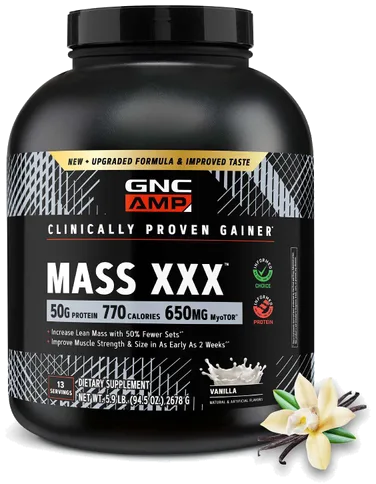
GNC Pro Performance AMP Amplified Mass XXX Chocolate Review
GNC Pro Performance AMP Amplified Mass XXX in Chocolate is a high-calorie, high-protein weight-gainer powder. GNC sells it as exclusive to its stores, and it is built to increase lean mass, body weight, strength and stamina. Newer packaging calls it "AMP Mass XXX with MyoTor." It is mixed into a shake and taken as a calorie and protein supplement alongside resistance training. The Walmart listing for the Strawberry version of the same line gives about 780 calories and 50 g of protein per serving, with 13 servings per tub. I did not confirm the exact Chocolate panel, so check the label on your tub. How it works: 1. **Calorie surplus.** Muscle gain needs more energy than you burn. Each serving supplies a large amount of calories, made up of protein and carbohydrate. This makes it easier to eat in surplus than whole food alone, which helps people who struggle to gain weight. 2. **Protein and amino acids.** The formula is a protein blend with micronized amino acids. An Indian retailer's page says these are broken into smaller particles for quick absorption. It lists glutamine, leucine and arginine among the key amino acids. Leucine is the main amino acid that switches on muscle protein synthesis through the mTOR pathway. Delivering amino acids after training supports repair and growth. 3. **Creatine and betaine.** The Walmart title lists creatine and betaine. Creatine raises phosphocreatine stores in muscle, which supports short bursts of high-intensity effort and lets you do more work per session. Betaine is studied for its role in power output and in cell hydration and methylation. 4. **Clinical backing.** GNC's product page cites an eight-week study. In it, subjects on the supplement gained body weight, fat-free mass, maximal muscle strength and muscle endurance equal to a control group. The supplement group did only 3 sets of resistance training per day, compared with 5 for the control group. This is the company's own claim, and I did not review the study itself. 5. **Quality assurance.** The Indian retailer page says products with the banned-substance-tested logo have been tested for banned substances. This is a quality signal, not a performance mechanism. The product is a food-based supplement and not a drug. Results depend on training, total diet and sleep. The weight gained will include some water, especially from creatine, along with muscle and possibly fat if the surplus is too large. People who are sensitive to dairy, or who have kidney conditions, should check the label or ask a clinician before using it.
We don’t sell supplements. We help you make decisions and get the best price.
Lowest prices
Finding the lowest prices at the stores now. This takes a few seconds.
Products with nearly the same formula (Matched on the main ingredients)
Study, Trial or Testing Result Summary
Members Only68 human studies · 27 improved
This shake gives 50 grams of protein per serving, well above the 15 grams that worked in studies. Large pooled analyses support protein for building muscle, mainly alongside strength training. Across 49 trials in healthy adults lifting for at least 6 weeks, protein supplements increased strength, lean mass and muscle size, with no extra lean mass gain beyond about 1.6 grams per kilogram of body weight per day [1]. Across 78 trials in middle-aged and older adults doing strength training, whey gave the largest gains in muscle mass, grip strength and walking speed [2]. Another analysis of 65 trials found about half a kilogram more lean mass, without clear strength gains [3], and a review of 74 trials found small gains in lean mass and lower body strength with training [4]. In older adults with muscle loss, whey increased muscle mass and walking speed [5]. Protein alone, without training, did not improve muscle size or strength over one year in older adults, while training plus whey did [6]. The listing also names creatine, MyoTOR and BETAPOWER, but the label gives no amounts for them and no study findings for them were provided, so they are not graded here. Animal and cell studies are never counted.
See all 68 studies →Hide the studies
- Across 78 trials with 5272 middle-aged and older adults doing resistance training, whey protein gave the largest gains in muscle mass, handgrip strength and walking speed compared with the other protein types.Comparative Efficacy of Different Protein Supplements on Muscle Mass, Strength, and Physical Indices of Sarcopenia among…
- In 35 trials with 3701 cancer patients, high-protein supplements reduced weight loss, and 11 of 13 studies found more muscle mass and 5 of 5 higher-quality studies found more muscle strength, though many studies had a high risk of bias.Effects of high-protein supplementation during cancer therapy: a systematic review and meta-analysis.
- In a pooled analysis of 59 trials in people with sarcopenia, mixed exercise was best for muscle mass, while physical activity with protein or nutrition supplements ranked best for muscle strength; most studies had a high risk of bias.Management of Sarcopenia: A Network Meta-Analysis of Randomized Controlled Trials.
- Across observational studies of about 3,353 community-dwelling adults averaging 73 years old, older adults with sarcopenia ate significantly less protein than those without it, suggesting low protein intake may be linked to sarcopenia.Protein Intake and Sarcopenia in Older Adults: A Systematic Review and Meta-Analysis.
- In 47 trials with 3218 adults with overweight or obesity losing weight, higher protein intake helped preserve muscle mass, especially above 1.3 g/kg/day, but did not significantly prevent declines in strength or physical function.Enhanced protein intake on maintaining muscle mass, strength, and physical function in adults with overweight/obesity: A…
- In 65 trials with 2907 healthy adults, protein supplements increased lean body mass by about 0.5 to 0.6 kg regardless of timing, but did not clearly improve handgrip or leg press strength.The Role of Protein Intake and its Timing on Body Composition and Muscle Function in Healthy Adults: A Systematic Review…
- In 35 trials with 2331 older adults with sarcopenia, exercise plus nutrition worked best for grip strength, walking speed and muscle mass, while protein alone improved grip strength and walking speed but not muscle mass; certainty of evidence was low to very low.Exercise and nutrition strategies for sarcopenia in older adults: evidence from a network meta-analysis based on EWGSOP …
- In 49 trials with 1863 healthy adults doing resistance training for at least 6 weeks, protein supplements increased strength, fat-free mass and muscle size, with no extra gain in fat-free mass beyond about 1.6 g/kg/day total protein.A systematic review, meta-analysis and meta-regression of the effect of protein supplementation on resistance training-i…
- In 10 trials with 1154 older adults with sarcopenia, whey protein increased muscle mass and gait speed, and with resistance training increased handgrip strength, while also lowering interleukin-6.Improving sarcopenia in older adults: a systematic review and meta-analysis of randomized controlled trials of whey prot…
- Across 16 trials, animal and plant protein gave similar changes in lean mass and muscle strength, but animal protein gave a slightly better percent lean mass, especially in adults under 50.Animal Protein versus Plant Protein in Supporting Lean Mass and Muscle Strength: A Systematic Review and Meta-Analysis o…
- Across 74 trials in healthy adults, eating more protein gave small gains in lean body mass and lower body strength when combined with resistance training, with unclear effects on handgrip strength.Systematic review and meta-analysis of protein intake to support muscle mass and function in healthy adults.
- In 10 trials of women aged 55 and over, whey protein raised biceps curl strength and lower limb lean mass only when combined with resistance training, and had no benefit for strength or lean mass without it.Effect of Whey Protein Supplementation in Postmenopausal Women: A Systematic Review and Meta-Analysis.
- In 30 trials, plant protein led to slightly lower muscle mass than animal protein (mainly versus non-soy plant proteins and in adults under 60), with no difference in muscle strength or physical performance.Effect of Plant Versus Animal Protein on Muscle Mass, Strength, Physical Performance, and Sarcopenia: A Systematic Revie…
- In healthy adults, protein supplements likely did not change lean mass or strength in the first weeks of resistance training, but may boost muscle mass, strength and aerobic and anaerobic power as training volume and duration increase.The effects of protein supplements on muscle mass, strength, and aerobic and anaerobic power in healthy adults: a system…
- In a review of 35 studies of adults with inflammatory bowel disease, about 17% had sarcopenia, and two studies found that a high-protein nutrition plan improved muscle mass.Systematic review of sarcopenia in inflammatory bowel disease.
- A review of trials and studies from 2011 to 2024 suggests that leucine-enriched whey protein plus resistance training may increase lean muscle mass, strength and physical performance in older adults with sarcopenia.Enhancing Muscle Quality: Exploring Leucine and Whey Protein in Sarcopenic Individuals.
- Older adults with low muscle mass who drank a whey protein supplement fortified with vitamin D and leucine twice daily for 13 weeks gained slightly more muscle and improved chair-stand speed compared with a control drink, though grip strength did not differ between groups.Effects of a vitamin D and leucine-enriched whey protein nutritional supplement on measures of sarcopenia in older adult…
- Sarcopenic older adults who took a whey protein, fish oil and vitamin D supplement for 12 weeks gained more appendicular muscle mass and grip strength than the routine-care control group, and lost more fat mass.Effects of nutrition supplementation and physical exercise on muscle mass, muscle strength and fat mass among sarcopenic…
- In 208 healthy older adults over one year, protein supplements alone did not improve muscle size or strength compared with carbohydrate, but heavy resistance training with whey protein improved muscle size and strength compared with whey alone.The effect of daily protein supplementation, with or without resistance training for 1 year, on muscle size, strength, a…
- In pre-frail and frail older adults doing resistance training twice a week for 16 weeks, adding whey or soy protein supplements did not improve muscle gains or function compared with placebo.Supplement-based nutritional strategies to tackle frailty: A multifactorial, double-blind, randomized placebo-controlled…
- In people with cirrhosis and weak muscles, 30 g of daily branched-chain amino acids for 12 months did not improve grip strength, muscle mass or physical performance compared with a whey protein drink.Branched-chain amino acid supplementation does not improve measures of sarcopenia in cirrhosis: results of a randomised …
- Older adults with muscle weakness who were hospitalized for rehabilitation and took a whey protein formula enriched with leucine and vitamin D twice daily until discharge (4 to 8 weeks) gained more walking speed and muscle mass than those given a control formula.Improving rehabilitation in sarcopenia: a randomized-controlled trial utilizing a muscle-targeted food for special medic…
- In 130 sarcopenic elderly people doing a 12-week physical activity program, a supplement of 22 g whey protein, 10.9 g essential amino acids and vitamin D increased fat-free mass by 1.7 kg and grip strength more than placebo, and lowered C-reactive protein.Whey protein, amino acids, and vitamin D supplementation with physical activity increases fat-free mass and strength, fu…
- In 120 frail elderly people, eating 1.5 g protein per kg body weight daily for 12 weeks increased muscle mass and gait speed more than 0.8 g per kg, while 1.2 g per kg showed no clear difference from 0.8 g.Protein supplementation improves muscle mass and physical performance in undernourished prefrail and frail elderly subje…
- In 112 sarcopenic or dynapenic older adults, bodyweight exercise combined with a daily protein and vitamin D supplement for 12 weeks improved thigh muscle quality and knee strength more than either alone or no treatment.Synergistic effect of bodyweight resistance exercise and protein supplementation on skeletal muscle in sarcopenic or dyn…
- Older adults with sarcopenia who took a protein, HMB and vitamin D supplement along with exercise for 12 weeks showed modest gains in lean mass, muscle index and grip strength compared with a group that did not get the supplement, though the effects of exercise and supplement could not be separated.Effects of combined nutritional supplementation and exercise on proxy measures of muscle mass, strength, and function in…
- In 101 adults aged 55 and older doing 12 weeks of self-chosen exercise, whey protein did not add to the gains in strength and mobility seen with exercise alone compared with placebo.Changes in Strength, Mobility, and Body Composition Following Self-Selected Exercise in Older Adults.
- In 100 overweight older adults losing weight over 10 weeks, a high-protein diet of 1.3 g per kg body weight did not significantly preserve fat-free mass, though fat-free mass rose only in those who also did resistance exercise.Effect of a high protein diet and/or resistance exercise on the preservation of fat free mass during weight loss in over…
- In 96 healthy women aged 65 and older, 12 weeks of resistance training plus 5.5 grams of essential amino acids twice daily increased muscle mass and fitness more than either intervention alone and lowered IL-6 and IL-1β.Combined resistance exercise and essential amino acid intake enhance follistatin/myostatin ratio and muscle fitness in o…
- Elderly women who did resistance training for 12 weeks, with or without daily steamed chicken breast, increased muscle size, strength and quality, but training alone raised arterial stiffness while adding chicken prevented that rise.Impact of resistance training and chicken intake on vascular and muscle health in elderly women.
- In older adults with sarcopenia, 11 g whey protein with 2.3 g leucine taken twice weekly alongside resistance training raised muscle mass and grip strength, and after 24 weeks without training those who kept taking the protein kept more of the gains than those who trained alone, though there was no difference at the end of the training period.De-Training Effects Following Leucine-Enriched Whey Protein Supplementation and Resistance Training in Older Adults with…
- In women after gastric bypass surgery, adding strength training to extra whey protein for 18 weeks increased relative lower-limb strength more than usual care or protein alone, but lean body mass loss did not differ between groups.Resistance Training and Protein Supplementation Increase Strength After Bariatric Surgery: A Randomized Controlled Trial…
- In 70 adult childhood cancer survivors doing 24 weeks of resistance training, 21 g daily of whey protein did not add more lean mass or strength than a placebo sucrose drink.Protein Supplementation and Resistance Training in Childhood Cancer Survivors.
- In 60 older adults with sarcopenia over 6 months, a whey protein, vitamin D and vitamin E supplement improved muscle mass, handgrip strength and quality of life compared with a control product.A high whey protein, vitamin D and E supplement preserves muscle mass, strength, and quality of life in sarcopenic older…
- Prostate cancer patients on hormone therapy who did 20 weeks of resistance exercise gained muscle mass and strength, but taking 31 g of whey protein with the exercise added no extra benefit over placebo.Resistance Exercise Training Increases Muscle Mass and Strength in Prostate Cancer Patients on Androgen Deprivation Ther…
- In 60 stroke patients in rehabilitation, a protein jelly taken for 3 months increased body mass index and preserved bone mineral content, but did not improve grip or leg strength compared with rehabilitation alone.Effects of Nutritional Support with a Leucine-Enriched Essential Amino Acid Supplement on Body Composition, Muscle Stren…
- In 54 young men doing 12 weeks of resistance training, 22 g daily of protein did not increase muscle fiber size, satellite cells or myonuclei compared with a maltodextrin placebo, though whole-body lean mass rose slightly more with protein.Protein Supplementation Does Not Affect Myogenic Adaptations to Resistance Training.
- In 53 older men with sarcopenia doing 12 weeks of resistance training, 15 g daily of collagen peptides added more lean mass and leg strength than a placebo powder.Collagen peptide supplementation in combination with resistance training improves body composition and increases muscle …
- In 48 resistance-trained adults on a heavy training program, a high-protein diet of 3.4 g per kg daily reduced body fat more than a 2.3 g per kg diet, while fat-free mass and strength gains were similar in both groups.A high protein diet (3.4 g/kg/d) combined with a heavy resistance training program improves body composition in healthy …
- In 48 untrained young adults doing supervised resistance training three times a week for 12 weeks, whey protein isolate (19 g) and soy protein isolate (26 g), both with 2 g leucine, produced similar gains in lean mass and leg strength, with no difference between the two groups.No Significant Differences in Muscle Growth and Strength Development When Consuming Soy and Whey Protein Supplements Mat…
- In 44 young men doing 12 weeks of resistance training, a 27.5 g protein drink taken before sleep each night produced greater gains in muscle size and strength than a placebo drink.Protein Ingestion before Sleep Increases Muscle Mass and Strength Gains during Prolonged Resistance-Type Exercise Traini…
- Untrained young men who took 45 g daily of either a plant or whey protein blend during 12 weeks of resistance training gained similar amounts of muscle and strength, with no difference between the two protein sources.Similar effects between animal-based and plant-based protein blend as complementary dietary protein on muscle adaptation…
- In 43 resistance-trained young women, taking a 25 gram protein supplement before or after 6 weeks of heavy resistance training increased bench press strength more than no supplement, but leg press strength and body composition did not differ between groups.The effects of nutrient timing on training adaptations in resistance-trained females.
- In 40 resistance-trained women taking whey protein, time-restricted eating over 8 weeks gave the same muscle gain as eating normally, so the eating window did not change results.Time-restricted feeding plus resistance training in active females: a randomized trial.
- In 40 healthy young adults over 9 days of resistance exercise, muscle protein synthesis was similar on omnivorous and vegan diets, and protein spread across the day made no difference.Impact of Vegan Diets on Resistance Exercise-Mediated Myofibrillar Protein Synthesis in Healthy Young Males and Females:…
- In 38 trained men eating a calorie-restricted diet with a fixed high protein intake for 6 weeks, high-volume and moderate-volume resistance training preserved lean mass equally well.Resistance training volume does not influence lean mass preservation during energy restriction in trained males.
- In 37 underactive vegetarian adults, 18 g of mung bean protein daily for 8 weeks produced a small strength gain compared with control, but lean body mass did not change significantly.Mung Bean Protein Supplement Improves Muscular Strength in Healthy, Underactive Vegetarian Adults.
- Trained young adults taking 60 g daily of hemp during 8 weeks of resistance training increased arm muscle thickness in women but not men, while soy increased it in men, with hemp also preserving muscle twitch torque after fatigue in men.Effects of hemp supplementation during resistance training in trained young adults.
- In 31 healthy older men, an extra 50 g per day of whey or pea protein for one week increased muscle protein synthesis above the recommended intake level, while collagen protein did not.The effects of whey, pea, and collagen protein supplementation beyond the recommended dietary allowance on integrated my…
- Healthy older men who ate Icelandic yogurt containing 18 g of protein right after resistance training three times a week for 8 weeks gained more lean mass and strength than those given a placebo yogurt.Effects of Icelandic yogurt consumption and resistance training in healthy untrained older males.
- In 29 older men doing 12 weeks of resistance training, protein taken before or after training did not change muscle mass or strength compared with placebo.Protein supplementation before and after resistance training in older men.
- In middle-aged men with overweight, 10 days of alternate-day fasting or continuous calorie restriction with matched protein intake did not lower muscle protein building rates compared with a normal diet.Short-term intermittent fasting and energy restriction do not impair rates of muscle protein synthesis: A randomised, co…
- In healthy young men doing resistance training for 12 weeks, eating a protein-rich breakfast increased lean mass a bit more than a low-protein breakfast, but the difference was not statistically significant.Evenly Distributed Protein Intake over 3 Meals Augments Resistance Exercise-Induced Muscle Hypertrophy in Healthy Young …
- In 17 young women doing an 8-week resistance training program, a high-protein diet (2.5 g per kg body weight daily) gained more fat-free mass than a low-protein diet (0.9 g per kg), though strength gains were similar between the two groups.Effects of High Versus Low Protein Intake on Body Composition and Maximal Strength in Aspiring Female Physique Athletes …
- In 17 well-trained men and women doing 8 weeks of resistance exercise on a hypercaloric diet with 2.2 g protein per kg daily, time-restricted eating and normal eating both increased fat-free mass similarly, though time-restricted eating produced slightly lower squat strength gains.Hypercaloric 16:8 time-restricted eating during 8 weeks of resistance exercise in well-trained men and women.
- In 12 postmenopausal women doing low-intensity resistance training for 10 weeks, whey protein taken during training did not add any gain in muscle size or strength compared with a placebo drink.Whey protein and high-volume resistance training in postmenopausal women.
- Resistance-trained men who took whey protein during an 11-week weight training program gained more strength and muscle size than those who took carbohydrate only, though the size changes varied across measures.Effects of whey isolate, creatine, and resistance training on muscle hypertrophy.
- In healthy adults, 6 grams a day of a fermented postbiotic made with whey protein for 12 weeks increased dominant-hand grip strength and lowered the inflammatory marker IL-1β, while lean mass and non-dominant grip did not change.Bioconversion-Based Postbiotics Enhance Muscle Strength and Modulate Gut Microbiota in Healthy Individuals: A Randomized…
- In 40 young men on a calorie-restricted diet with intense exercise for 4 weeks, a diet of 2.4 g protein per kg body weight daily gained more lean mass and lost more fat than a diet of 1.2 g per kg.Higher compared with lower dietary protein during an energy deficit combined with intense exercise promotes greater lean…
- In 40 resistance-trained men over 8 weeks of training with 2 g per kg body weight of protein daily, muscle mass and strength rose whether protein was taken before and after exercise or 3 hours around it, with no difference between timing groups.Timing matters? The effects of two different timing of high protein diets on body composition, muscular performance, and…
- In 38 young men doing 12 weeks of resistance training with about 1.6 g protein per kg daily, plant-based and mixed diets produced similar gains in muscle mass and strength.High-Protein Plant-Based Diet Versus a Protein-Matched Omnivorous Diet to Support Resistance Training Adaptations: A Com…
- In 26 resistance-trained men over 12 weeks, whey protein with HMB gave the same muscle and strength gains as whey protein with leucine.Equivalent Hypertrophy and Strength Gains in β-Hydroxy-β-Methylbutyrate- or Leucine-supplemented Men.
- In 56 older adults with sarcopenia, a whey protein supplement enriched with leucine and vitamin D for 12 weeks did not produce significantly greater muscle mass or handgrip strength gains than extra protein from diet alone, though it improved gait speed more in those under 75.Effects of adequate dietary protein with whey protein, leucine, and vitamin D supplementation on sarcopenia in older adu…
- Cancer patients on chemotherapy or immunotherapy who took a high-protein supplement twice daily ate more protein and more often met protein targets than controls, but body weight did not differ between groups.High Protein Oral Nutritional Supplements Enable the Majority of Cancer Patients to Meet Protein Intake Recommendations …
- In 4576 older adults followed for several years, higher protein intake was linked to lower risk of sarcopenia but also to more body fat and higher obesity risk, mainly from animal protein.Dietary protein intake and body composition, sarcopenia and sarcopenic obesity: A prospective population-based study.
- In 2066 community-dwelling adults aged 70-79, those with the highest protein intake lost about 40% less lean mass and appendicular muscle over 3 years than those with the lowest intake.Dietary protein intake is associated with lean mass change in older, community-dwelling adults: the Health, Aging, and B…
- In healthy older men, muscle protein synthesis leveled off only after a larger relative protein dose per meal than in young men, so older men need more protein per meal to maximally stimulate muscle building.Protein ingestion to stimulate myofibrillar protein synthesis requires greater relative protein intakes in healthy older…
- In mice, protein intake early in the day boosted muscle growth, and in people, those who ate more protein at breakfast than at dinner had higher muscle function.Distribution of dietary protein intake in daily meals influences skeletal muscle hypertrophy via the muscle clock.
Review Totals and Summary
Members Only438 reviews · 100% positive
Customers mostly say the product delivers on weight and strength. Reviewers on GNC's page describe quick, noticeable size gains. One says their arms "got big fast" after a single tub. A parent bought it for a football-playing son who needed to add weight for college ball. Long-term users say it works well and is reasonably priced. Others say they felt and saw a difference in size and performance before finishing the first tub, and one had bought about eight tubs. A Walmart reviewer says they gained strength and bigger lifts, and that they would use it again to rebuild mass after a break. Taste is where opinions split, and the split depends on the flavor. Chocolate is the best-liked flavor. One reviewer calls it the best-tasting shake they have had, and another says it tastes like melted Hershey bars. Not everyone agrees. One Walmart reviewer describes a combination of chocolate, chalk and medicine flavor. Other reviewers call vanilla "weird," and one says vanilla and cookies and cream are the worst flavors they have tried. Strawberry gets praise from some buyers. The other recurring points concern who the product suits. Reviewers describe it as a mass builder for lean or "hard gainer" types. At least one overweight, older user reports gains too. Several reviews were collected through promotions or posted on GNC's own site, so they probably skew positive. Ratings vary by retailer. GNC's page shows a very high score from a small number of reviews, and Walmart shows a lower score. Walmart's reviews are more mixed, mainly on taste. Retail pages show little discussion of side effects, digestion or mixing quality in the sample I read, so those themes are less well covered.
Biohacker Summary
Members Only10 of 10 recommend it
Our biohacker panel has not discussed this product’s ingredients yet.
RAL Summary
Members OnlyTier 2 for Muscle and Strength
More Details
Members OnlyBody systems · Combine with · Possible side effects
Body systems: Muscular system, Digestive system
Combine with: For muscle building, pair it with creatine monohydrate (3-5 g daily) for strength and lean mass, along with beta-alanine or citrulline malate for training performance and endurance. Add a quality multivitamin and vitamin D3 with K2 for general and bone support, plus omega-3 fish oil (EPA/DHA) to support recovery and cardiovascular health. If blood pressure is a concern, consider discussing magnesium, potassium-rich foods, CoQ10, or beet root nitrate with a healthcare provider, and keep in mind that mass gainers are high in sugar and calories. Use them in moderation, and make sure your diet and exercise habits support heart health.
Possible side effects: No major side effects reported. Some reviewers dislike the taste, describing a chalky or medicine-like flavor.
Supplement Facts
Total Carbohydrates 124 g · Calcium 500 mg · Iron 1.8 mg
| Calories | 750 | |
| Total Fat | 6 g | |
| Cholesterol | 110 mg | |
| Total Carbohydrates | 124 g | |
| Protein | 50 g | |
| Calcium | 500 mg | |
| Iron | 1.8 mg | |
| Sodium | 650 mg | |
| Potassium | 1,320 mg | |
| Tri-MG Infusion | 3 g | † |
| Creatine Matrix Blend | 3 g | † |
| Micronized Amino Acids | 500 mg | † |
Other ingredients: Maltodextrin, Protein Blend, Cocoa, Natural and Artificial flavors, MCT, Lecithin, Salt, Acesulfame Potassium, Sucralose.
Directions: Directions: As a dietary supplement, mix 4 level scoops (205 g) with 16 fl. oz. of cold water or milk. Consume 1-2 servings daily. When should I take it? For maximum results, Amplified Mass XXX should be taken daily. On training days, the product should be consumed immediately after exercise. On non-training days, the product should be taken first thing in the morning or between meals.
Barcode (UPC) 048107170028 · Label source: NIH label database · Report a label change
Show entire label

More muscle and strength products
Members OnlyThe highest ranked for the same goal
Read more
Our articles on this subject
- Diet and Insulin Resistance: A Comprehensive GuideArticle · Sep 11, 2026
- Layne Norton's Supplement Stack, Reviewed: The Three-Item Core, What He Refuses to Take, and What the Evidence SupportsArticle · Oct 2, 2026
Graded November 5, 2026 by the Reverse Age Lab evidence engine, from human studies, real reviews and our biohacker panel. How we grade. Is this medical advice? No. Rala organizes the published evidence; go over any change with your doctor, especially if you take meds.
Privacy policyConsumer health dataTermsDo Not Sell or Share My Personal InformationCookie settings