
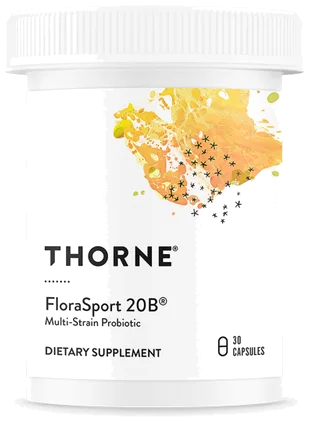
Thorne FloraSport 20B Review
FloraSport 20B is presented by Thorne as a stable, high-potency probiotic blend of clinically studied bacterial strains that support gut health, immune function, and exercise recovery in children and adults, including athletes. The page headline states that the four unique strains provide 20 billion live organisms per capsule. The product is NSF Certified for Sport. The details section describes FloraSport 20B as a blend of four probiotic bacterial strains: Lactobacillus paracasei and L. acidophilus, Bifidobacterium lactis, and Bacillus subtilis. The listed amount is 5000000000 CFU for each of the four strains per capsule, with a serving size of one capsule and 30 servings per container. Other ingredients are medium chain triglycerides, rice maltodextrin, and a hypromellose capsule. The page lists a set of benefits for adults, including support for upper and lower GI health, help maintaining normal bowel habits, benefit for occasional diarrhea and or constipation, relief from gas and bloating, support for the growth of beneficial gut microbes, normal immune function, and healthy cholesterol balance. For children, the page says the product supports the health of the microbiome, reduces GI discomfort in young children, and promotes normal immune function. For athletes and fitness enthusiasts, the page says the product benefits exercise recovery, promotes decreased percent body fat in female athletes to support healthy body composition, and supports a balanced inflammatory response in male athletes. Listed features include that all four strains survive passage through the stomach, that colonization in the intestines begins within three hours of ingestion, that the product is stable at room temperature without refrigeration, that it contains 20 billion live organisms at time of expiration, and that it is suitable for travelers. The page suggests it is suited to people with occasional digestive complaints, people of all ages who want immune support, athletes seeking lifestyle benefits from a daily probiotic, and frequent travelers. Thorne states that the formula reflects its scientific rigor, that each ingredient is selected and clinically studied, and that batches go through multiple rounds of quality control. For NSF Certified for Sport products, every batch is tested for compliance with label claims and for the absence of nearly 300 substances banned by many major athletic organizations. The warnings section states that the product is contraindicated for anyone with a history of hypersensitivity to its ingredients, that pregnant people should consult a health-care practitioner before use, and that there are no known adverse interactions or contraindications at publication date. It also notes that the powder should not be removed from the capsule because the capsule is part of the intended delivery mechanism. The purchase options on the page show a one-time price of $42 for 30 capsules, or $37.80 with a subscription that saves 10 percent, with delivery intervals ranging from every 2 weeks to every 4 months. Additional savings are offered for subscribers to three or more different products, and the page notes that the product is HSA or FSA eligible.
We don’t sell supplements. We help you make decisions and get the best price.
Lowest prices
We may earn a commission from some store links. How we choose.
Finding the lowest prices at the stores now. This takes a few seconds.
Study, Trial or Testing Result Summary
Members Only87 human studies · 54 improved
This capsule holds a probiotic blend of four strains at a full dose, about 20 billion live cultures a day by the listing, well above the amounts that worked in studies. No study given tested these exact four strains together, and results depend on the strain. A 2023 pooled analysis of 82 trials in adults with irritable bowel syndrome found some strains and combinations eased overall symptoms, pain and bloating more than placebo, though certainty was low, and side effects were not higher [1]. A second pooled analysis of 81 trials found similar benefits for symptom severity, pain and bloating, but only some products worked for particular outcomes [2]. Another pooled analysis of 54 trials found probiotics improved symptoms with no serious side effects, though the best strain is unclear [3]. In 350 healthy adults with bloating, six weeks of a multi-species blend with added fiber reduced bloating, gas and discomfort; 72.3% rarely or never bloated versus 55.9% on placebo [4]. Probiotics also cut diarrhea linked to meds by about a third across 47 trials [5]. The strain that ranked best in one analysis, Bacillus coagulans, is not in this product [6]. Animal and cell studies are never counted.
See all 87 studies →Hide the studies
- Across 47 trials of adults and children taking meds, probiotics roughly halved the chance of C. difficile diarrhea and cut a med-associated diarrhea by about a third, though the evidence was low certainty.Probiotics for the prevention of Clostridioides difficile-associated diarrhea in adults and children.
- In 82 trials of adults with irritable bowel syndrome, some probiotic strains and combinations eased overall symptoms, pain and bloating compared with placebo, but certainty was low to very low and side effects were not higher.Efficacy of Probiotics in Irritable Bowel Syndrome: Systematic Review and Meta-analysis.
- In 39 trials of adults and children on meds, probiotics cut C. difficile diarrhea from 4.0% to 1.5% and were not linked to more side effects.Probiotics for the prevention of Clostridium difficile-associated diarrhea in adults and children.
- In 81 trials of adults with irritable bowel syndrome, several probiotic strains and mixtures beat placebo for symptom severity, abdominal pain and bloating, but only some worked for particular outcomes.Outcome-Specific Efficacy of Different Probiotic Strains and Mixtures in Irritable Bowel Syndrome: A Systematic Review a…
- In 33 trials of children on meds, probiotics lowered diarrhea from 19% to 8%, working best at 5 billion or more colony-forming units daily, with no serious side effects linked to probiotics.Read the study on PubMed (31039287) →
- In 53 trials of adults with irritable bowel syndrome, some probiotic combinations or strains seemed to help symptoms and pain, but no firm conclusion could be drawn on which work, and side effects were not higher.Read the study on PubMed (30294792) →
- In 43 trials of adults with irritable bowel syndrome, Bacillus coagulans ranked best for symptom relief, pain, bloating and straining, with 8 weeks of use ranking first for pain and straining.Efficacy of Probiotics for Irritable Bowel Syndrome: A Systematic Review and Network Meta-Analysis.
- Across 16 trials with 1585 people with diarrhea, adding probiotics to usual treatment or comparing with placebo improved stool frequency, stool shape and bowel syndrome symptoms.Meta-analysis of the efficacy of probiotics to treat diarrhea.
- In 17 trials of children with constipation, probiotics beat placebo for bowel movement frequency and soiling but not for treatment success or pain, and added nothing to laxatives, so use was not advised.Efficacy and safety of probiotics and synbiotics for functional constipation in children: A systematic review and meta-a…
- Across 18 trials of 1309 children with functional abdominal pain, probiotics led to more treatment success than placebo (50% vs 33%), but complete pain resolution did not clearly differ and the evidence was low certainty.Probiotics for management of functional abdominal pain disorders in children.
- In six placebo-controlled trials of 970 adults with irritable bowel syndrome, probiotics reduced abdominal pain and bloating but did not significantly reduce overall symptom severity or improve quality of life, with high variation between studies.Efficacy and safety of probiotics in the treatment of irritable bowel syndrome: A systematic review and meta-analysis of…
- A pooled analysis of trials in children and teenagers found probiotics worked better than placebo for stomach pain-related bowel disorders, especially irritable bowel syndrome, but did not help children with long-term constipation.Probiotics for childhood functional gastrointestinal disorders: a systematic review and meta-analysis.
- Pooling 18 studies, probiotics cleared small intestinal bacterial overgrowth more often, lowered hydrogen levels and eased abdominal pain, but did not reduce daily stool frequency or prevent the overgrowth.Probiotics for Preventing and Treating Small Intestinal Bacterial Overgrowth: A Meta-Analysis and Systematic Review of C…
- A pooled analysis of 54 probiotic trials in adults with irritable bowel syndrome found probiotics improved symptoms compared with placebo, with no serious adverse events, though the best strain or combination remains unclear.The Efficacy of Probiotics, Prebiotics, Synbiotics, and Fecal Microbiota Transplantation in Irritable Bowel Syndrome: A …
- In this review of seven controlled trials with 515 children with constipation, probiotics did not significantly improve treatment success compared with placebo or control, and they did not reduce fecal incontinence or abdominal pain, though some strains modestly increased bowel movement frequency.Systematic review: probiotics for functional constipation in children.
- This dietary guideline review of 86 studies for irritable bowel syndrome includes probiotics as one topic, but the abstract gives no specific probiotic result.British Dietetic Association systematic review and evidence-based practice guidelines for the dietary management of irri…
- In children with recurrent abdominal pain, probiotics were more likely than placebo to improve pain in the short term (odds ratio 1.63).Probiotics for Children With Recurrent Abdominal Pain.
- Of 11 randomized trials of probiotics in irritable bowel syndrome, 7 reported symptom improvement over placebo and 4 did not, with multi-strain products taken for 8 weeks or longer showing the clearest benefit.Probiotics in Irritable Bowel Syndrome: An Up-to-Date Systematic Review.
- A review of controlled trials found that certain probiotic strains at certain doses were linked to better tolerance of lactose in people with lactose intolerance, though results varied widely between studies.Effects of Prebiotic and Probiotic Supplementation on Lactase Deficiency and Lactose Intolerance: A Systematic Review of…
- In a review of five trials of people with both fibromyalgia and irritable bowel syndrome, probiotics did not reduce pain significantly more than placebo, while some medicines did.Efficacy and safety of interventions for Fibromyalgia syndrome comorbid with Irritable bowel syndrome: systematic review…
- Among 650 adults taking standard triple therapy for Helicobacter pylori, adding a probiotic for 14 days raised the eradication rate to 87% versus 73% with placebo, and reduced bloating, flatulence and other side effects.Probiotics for standard triple Helicobacter pylori eradication: a randomized, double-blind, placebo-controlled trial.
- In 456 adults with irritable bowel syndrome with constipation, 8 billion daily units of Saccharomyces cerevisiae I-3856 taken for 8 weeks produced more abdominal pain responders (45.1% versus 33.9% on placebo) and higher quality of life scores than placebo.Saccharomyces cerevisiae I-3856 in irritable bowel syndrome with predominant constipation.
- In 350 generally healthy adults with bloating, 6 weeks of a multi-species synbiotic reduced bloating, gas, and abdominal discomfort and improved quality of life compared with placebo, with 72.3% reporting never or rarely bloating versus 55.9% on placebo.A Randomized, Placebo-Controlled Trial Evaluating Multi-Species Synbiotic Supplementation for Bloating, Gas, and Abdomin…
- Among 320 people randomized after a colonoscopy, a probiotic capsule taken for days afterward shortened the number of days with abdominal pain compared with placebo, but did not change bloating or return to normal bowel habits.Randomized controlled trial of probiotics after colonoscopy.
- In 307 adults with diarrhea-predominant irritable bowel syndrome, 10 billion CFU of Lactiplantibacillus plantarum Lpla33 daily for 8 weeks reduced symptom severity more than placebo, and 88.4% of those on this dose became stool-consistency responders.Efficacy and dose response of Lactiplantibacillus plantarum in diarrhea-predominant irritable bowel syndrome.
- In 290 adults with diarrhea-predominant irritable bowel syndrome, a 4-week Bifidobacterium tablet relieved both abdominal pain and diarrhea in 67.59% of users versus 36.55% on placebo.The Short-Term Efficacy of Bifidobacterium Quadruple Viable Tablet in Patients With Diarrhea-Predominant Irritable Bowel…
- In 274 adults with constipation-predominant irritable bowel syndrome, a fermented milk with Bifidobacterium animalis DN-173 010 improved quality of life and reduced bloating more than a control yoghurt over 6 weeks, with 65.2% of the fermented milk group reaching responder status compared with 47.7% of controls.Effect of a fermented milk containing Bifidobacterium animalis DN-173 010 on the health-related quality of life and symp…
- In 257 women receiving H. pylori eradication treatment, a probiotic taken for 14 days had fewer people with bloating and constipation than placebo and better treatment tolerability.Lactiplantibacillus plantarum MH-301 reduces Helicobacter pylori treatment-related adverse events via gut-vaginal axis: …
- In 251 adults with irritable bowel syndrome given one of two probiotic strains or placebo for 8 weeks, symptom changes were similar between groups, though some subtypes improved bowel movement frequency and quality of life compared with their own starting point.Efficacy of Lactobacillus paracasei HA-196 and Bifidobacterium longum R0175 in Alleviating Symptoms of Irritable Bowel S…
- In 250 adults with functional constipation, a 4-week probiotic blend of two strains firmed stool compared with placebo but did not change how often people had bowel movements.Effects of dietary fibers or probiotics on functional constipation symptoms and roles of gut microbiota: a double-blinde…
- In 240 people after a colonoscopy using carbon dioxide, a probiotic capsule taken for two weeks did not reduce discomfort, bloating, or time to normal bowel function compared with placebo, though people with existing symptoms had less bloating.Randomized controlled trial of probiotic use for post-colonoscopy symptoms.
- In 229 adults with functional constipation, 8 weeks of a daily Bifidobacterium lactis HN019 supplement did not increase complete bowel movements more than a placebo.Eight-Week Supplementation With Bifidobacterium lactis HN019 and Functional Constipation: A Randomized Clinical Trial.
- In 214 adults with irritable bowel syndrome, one capsule of Lactobacillus plantarum 299v daily for 4 weeks eased abdominal pain and bloating more than placebo, and 78% rated the effect good or excellent versus 8% on placebo.Clinical trial: Lactobacillus plantarum 299v (DSM 9843) improves symptoms of irritable bowel syndrome.
- In 200 adults with diarrhea-predominant irritable bowel syndrome, taking Bifidobacterium longum CECT 7347 daily for 12 weeks reduced overall symptom severity more than placebo.A randomized double-blind, placebo-controlled trial to evaluate the safety and efficacy of live Bifidobacterium longum C…
- In 200 adults with irritable bowel syndrome without constipation, a probiotic blend taken for 84 days improved overall symptom response, abdominal pain, bloating, and quality of life more than placebo, with 19.3% of the probiotic group responding at day 28 versus 8.9% on placebo.Probiotic Blend of Lactobacillus acidophilus LA-5 and Bifidobacterium animalis ssp. Lactis BB-12 in Non-constipated Irri…
- In 195 people with quiescent ulcerative colitis, a daily fermented milk with Bifidobacterium breve for 48 weeks did not prevent relapse compared with placebo, and the study was stopped for lack of efficacy.Efficacy of Bifidobacterium breve Fermented Milk in Maintaining Remission of Ulcerative Colitis.
- In 180 adults with constipation-predominant irritable bowel syndrome, 4 weeks of Bifidobacterium lactis BLa80 increased stool frequency and reduced symptom severity compared with a placebo supplement.Acacia fiber or probiotic supplements to relieve gastrointestinal complaints in patients with constipation-predominant I…
- In adults with chronic constipation, a daily two-strain probiotic for 4 weeks made stool consistency better than placebo and improved quality of life, but did not change complete spontaneous bowel movements.Probiotics Ameliorate Stool Consistency in Patients with Chronic Constipation: A Randomized, Double-Blind, Placebo-Contr…
- In 120 adults with irritable bowel syndrome, a probiotic taken for 12 weeks improved symptoms more than placebo, raised short-chain fatty acid levels, improved gut barrier markers and lowered inflammatory markers.Effects of short-chain fatty acid-producing probiotic metabolites on symptom relief and intestinal barrier function in p…
- In 110 adults with irritable bowel syndrome, 12 weeks of a cultured milk drink with two lactobacillus strains improved symptom severity, but placebo milk improved symptoms to the same degree.A randomized, double-blinded, placebo-controlled clinical trial on Lactobacillus-containing cultured milk drink as adjuv…
- In 103 adults with irritable bowel syndrome, a daily four-strain probiotic capsule for 6 months cut total symptom scores (pain, bloating, gas, rumbling) by a median 42% versus 6% with placebo.A probiotic mixture alleviates symptoms in irritable bowel syndrome patients: a controlled 6-month intervention.
- In 101 caesarean-born children aged 6 to 24 months, 12 weeks of Lacticaseibacillus paracasei N1115 was safe and well tolerated, and it increased stool frequency and reduced constipation and abdominal pain compared with placebo.Safety and tolerance of Lacticaseibacillus paracasei N1115 in caesarean-born young children: a randomised, placebo-contr…
- In 100 adults with functional constipation, 2 billion CFU of Bacillus coagulans Unique IS2 daily for 4 weeks increased bowel movements compared with placebo, and 98% of the probiotic group reached normal stool consistency.Bacillus coagulans Unique IS2 in Constipation: A Double-Blind, Placebo-Controlled Study.
- In 100 colorectal cancer patients, a postoperative probiotic combination taken through the first chemotherapy course reduced chemotherapy-related gastrointestinal complications, especially diarrhea, compared with placebo.Postoperative Probiotics Administration Attenuates Gastrointestinal Complications and Gut Microbiota Dysbiosis Caused by…
- In 90 adults with irritable bowel syndrome without constipation, MegaSporeBiotic over about 60 days gave severity and rectal sensation results similar to rifaximin followed by a nutraceutical or low-FODMAP diet, but improved quality of life more.Bacillus spp. Spores-A Promising Treatment Option for Patients with Irritable Bowel Syndrome.
- In 90 adults receiving standard treatment for Helicobacter pylori infection, 4 weeks of Lactobacillus reuteri strain 17648 reduced indigestion, constipation and abdominal pain more than placebo.Probiotic containing Lactobacillus reuteri DSM 17648 as an adjunct treatment for Helicobacter pylori infection: A random…
- In 84 adults with irritable bowel syndrome and diarrhea, one capsule a day of a three-strain probiotic for 6 weeks improved quality of life more than placebo.I.31, a new combination of probiotics, improves irritable bowel syndrome-related quality of life.
- In 80 adults with irritable bowel syndrome, taking Lactobacillus casei Shirota twice daily for 8 weeks did not reduce symptoms by 30% more than placebo; a 34% improvement at 16 weeks was not significantly different from placebo.Efficacy of Lactobacillus casei Shirota for patients with irritable bowel syndrome.
- In 80 people taking Helicobacter pylori eradication meds, adding Lactobacillus reuteri for 30 days reduced abdominal pain in 42% of patients versus 19% on placebo and reduced abdominal distension in 25% versus 17%.Randomized, double-blind, placebo-controlled clinical trial on the usefulness of probiotic Lactobacillus reuteri in bism…
- In 76 healthy adults, 6 weeks of 2 billion CFU of Bacillus subtilis BS50 daily produced more improvement in bloating, burping and gas than placebo, with 47.4% of users improving versus 22.2% on placebo.The probiotic Bacillus subtilis BS50 decreases gastrointestinal symptoms in healthy adults: a randomized, double-blind, …
- In 74 adults with irritable bowel syndrome, 8 weeks of probiotic fermented milk raised fecal Lactobacilli and normalized raised blood glucose and tyrosine levels, while placebo did not; clinical symptom results were not reported in the abstract.Metabonomic understanding of probiotic effects in humans with irritable bowel syndrome.
- In 73 children with irritable bowel syndrome or functional dyspepsia, a 6-week three-Bifidobacteria mix fully resolved belly pain more often than placebo in children with irritable bowel syndrome (48% improved quality of life vs 17% on placebo), but not in those with functional dyspepsia.A Mixture of 3 Bifidobacteria Decreases Abdominal Pain and Improves the Quality of Life in Children With Irritable Bowel…
- In a pilot trial of 72 adults with functional gastrointestinal disorders, five probiotic and nutrient combinations taken for 12 weeks produced no statistically significant change in symptoms compared with placebo.Efficacy of probiotics and nutrients in functional gastrointestinal disorders: a preliminary clinical trial.
- In 71 children with irritable bowel syndrome, 4 weeks of twice-daily B. lactis B94 (5 billion CFU) improved belching, bloating after meals, and constipation more than prebiotic inulin alone.Efficacy of synbiotic, probiotic, and prebiotic treatments for irritable bowel syndrome in children: A randomized contro…
- In 70 adults with irritable bowel syndrome, two probiotic combinations for 4 weeks reduced abdominal pain and symptom severity more than a starch placebo, with symptom scores falling about 49 to 56% versus 8 to 14% in the placebo group.Probiotics in the treatment of irritable bowel syndrome.
- In 65 adults with diarrhea-predominant irritable bowel syndrome, a 6-week course of L. reuteri strains did not change gut permeability, while the two-strain combination lowered a blood inflammation marker and reduced symptoms at 3 weeks but not at 6 weeks.The effects of a 6-week intervention with Limosilactobacillus reuteri ATCC PTA 6475 alone and in combination with L. reu…
- In 60 children aged 6 to 16 with functional abdominal pain, 200 million CFU of Lactobacillus reuteri daily for 4 weeks reduced pain intensity compared with placebo.Lactobacillus reuteri in children with functional abdominal pain (FAP).
- In 60 adults with stomach discomfort but no specific disease, a three-strain Bacillus blend taken for 37 days improved burping, bloating, sour taste, and pain scores more than placebo, with no adverse events reported.A prospective, randomized, double-blind, placebo-controlled, parallel-group study to evaluate the efficacy and safety of…
- In 60 children with diarrhea-type irritable bowel syndrome, 14 days of Saccharomyces boulardii reduced symptom severity scores and normalized stool shape compared with placebo.Saccharomyces boulardii's impact on pediatric diarrhea-predominant irritable bowel syndrome: animal model findings.
- In 60 adults with chronic constipation, a multispecies probiotic taken for 29 days led all treated people to reach at least 3 complete bowel movements a week versus 7.69% on placebo, with less bloating and pain.Probiotics for chronic constipation: A randomized, prospective, placebo-controlled study.
- In 55 adults with irritable bowel syndrome, a 6-month multispecies probiotic changed gut bacteria only slightly, with Bifidobacteria decreasing, and the authors concluded symptom relief came from factors other than the bacteria measured.Effects of multispecies probiotic supplementation on intestinal microbiota in irritable bowel syndrome.
- In 50 adults with diarrhea-predominant irritable bowel syndrome, two capsules a day of a dual-coated multi-species probiotic for 4 weeks improved overall discomfort and produced more normal stools than the same probiotic without the coating.Efficacy of double-coated probiotics for irritable bowel syndrome: a randomized double-blind controlled trial.
- In 48 adults with lactose intolerance, 8 weeks of the i3.1 probiotic reduced symptoms such as abdominal pain and gas more than placebo, though it did not change the breath hydrogen test.Efficacy of i3.1 Probiotic on Improvement of Lactose Intolerance Symptoms: A Randomized, Placebo-controlled Clinical Tri…
- In 46 children with enthesitis-related juvenile arthritis, 12 weeks of probiotics alongside standard meds was well tolerated but did not improve disease activity more than placebo, although interleukin-6 levels fell in the probiotic group.Effect of probiotics on clinical and immune parameters in enthesitis-related arthritis category of juvenile idiopathic a…
- In 44 people with irritable bowel syndrome, 8 weeks of daily Bacillus coagulans improved abdominal pain and bloating from their starting levels, while placebo improved only pain at weeks 6 and 8.Bacillus coagulans significantly improved abdominal pain and bloating in patients with IBS.
- In 44 adults with irritable bowel syndrome, Bifidobacterium longum NCC3001 for 6 weeks reduced depression scores more than placebo but did not change anxiety or irritable bowel symptoms.Probiotic Bifidobacterium longum NCC3001 Reduces Depression Scores and Alters Brain Activity: A Pilot Study in Patients …
- In 40 older adults with Parkinson's disease and mild-to-moderate bloating, abdominal pain or constipation, a probiotic tablet taken twice daily for 3 months improved abdominal pain and bloating about as much as trimebutine, but helped less with incomplete bowel emptying.Nonmotor gastrointestinal disorders in older patients with Parkinson's disease: is there hope?
- In 37 adults with type 2 diabetes who could not tolerate a med, a multi-strain probiotic taken in 12-week periods compared with placebo reduced nausea, bloating and pain, and diarrhea, and improved how well a med was tolerated.Read the study on PubMed (37812890) →
- In 35 adults with irritable bowel syndrome without constipation, 12 weeks of a multistrain probiotic with vitamin D improved stool frequency and consistency compared with placebo and reduced a gut barrier marker.Multistrain Probiotics Plus Vitamin D Improve Gut Barrier Function and Gut Microbiota Composition in Irritable Bowel Syn…
- In 31 adults with irritable bowel syndrome, 6 weeks of online yoga with probiotics improved cardiovascular endurance and quality of life, while the abstract does not show a clear benefit of probiotics alone.Interplay of yoga, physical activity, and probiotics in irritable bowel syndrome management: A double-blind randomized s…
- In 30 adults with irritable bowel syndrome with constipation, Lacticaseibacillus rhamnosus IDCC 3201 taken for 8 weeks improved bowel movements, bloating severity and frequency, and satisfaction with bowel habits compared with placebo.Effect of Lacticaseibacillus rhamnosus IDCC 3201 on irritable bowel syndrome with constipation: a randomized, double-bli…
- In 30 women taking a med, a multi-strain probiotic for 12 weeks led to fewer digestive side effects than placebo, such as abnormal stool frequency (18% vs 51%) and hard or lumpy stools (14% vs 26%).Read the study on PubMed (41852479) →
- In 20 children with burns, a probiotic given twice daily was safe, shortened wound healing time, and increased gas (flatulence) compared with placebo.Clinical safety and efficacy of probiotic administration following burn injury.
- Over six months, a four-strain probiotic reduced irritable bowel syndrome symptom scores by 42% versus 6% on placebo.Clinical studies on alleviating the symptoms of irritable bowel syndrome.
- In people with nontyphoid Salmonella infection, Lactobacillus plantarum 299v did not speed clearance of the infection or resolution of symptoms compared with placebo.Effects of probiotic intake and gender on nontyphoid Salmonella infection.
- In long-distance runners, 3 months of a multi-strain probiotic led to less constipation and better self-rated health, and the authors say it may reduce some digestive symptoms.Effect of a Multi-Strain Probiotic Supplement on Gastrointestinal Symptoms and Serum Biochemical Parameters of Long-Dist…
- In adults with functional constipation over 30 days, two probiotic sachets were not significantly different from each other in increasing bowel movement frequency or stool quality, and both were judged safe.The effect of probiotics on functional constipation in adults: A randomized, double-blind controlled trial.
- In 21 healthy adults taking a seven-strain probiotic daily for 60 days, flatulence symptoms decreased, and the decrease was linked to lower levels of the gut methane-producing microbe Methanobrevibacter.Methanobrevibacter attenuation via probiotic intervention reduces flatulence in adult human: A non-randomised paired-des…
- In an open-label study of 145 people with irritable bowel syndrome over six months, probiotic treatment improved clinical and lab measures and quality of life, with results similar to neuropsychiatric treatment.An Open-Label Trial Study of Quality-of-Life Assessment in Irritable Bowel Syndrome and Their Treatment.
- In 54 critically ill adults, daily kefir (a fermented milk) at up to 240 mL was safe and tolerated, and a gut health index improved over time in 13 patients who gave repeat stool samples.Safety, feasibility, and impact on the gut microbiome of kefir administration in critically ill adults.
- In people with irritable bowel syndrome that began after major floods, taking one billion CFU of Bifidobacterium infantis M-63 daily for 3 months improved mental well-being compared with controls, though the small, non-randomised study limits confidence.Bifidobacterium infantis M-63 improves mental health in victims with irritable bowel syndrome developed after a major fl…
- In 48 adults with bacterial overgrowth and diarrhea-predominant irritable bowel syndrome, 15 days of Saccharomyces boulardii plus diet advice reduced bacterial overgrowth and improved symptoms more than diet advice alone in this open-label pilot.Impact of Saccharomyces boulardii CNCM I-745 on Bacterial Overgrowth and Composition of Intestinal Microbiota in Diarrhe…
- In an open-label pilot of 30 adults with diarrhea-predominant IBS and leaky gut, a multistrain probiotic taken for 30 days improved intestinal permeability in 81.5% of the 27 patients who completed the study, and improved abdominal pain, stool consistency and quality of life; there was no placebo group.Effect of a Multistrain Probiotic on Leaky Gut in Patients with Diarrhea-Predominant Irritable Bowel Syndrome: A Pilot S…
- In 30 people with Parkinson's disease and constipation, a 12-week synbiotic (a probiotic plus fiber) improved bowel movement frequency and stool form in an open-label study with no control group.Synbiotic supplementation may globally improve non-motor symptoms in patients with stable Parkinson's disease: results f…
- In a 24-month study of 83 children with irritable bowel syndrome, 41.6% of those given probiotics had symptom resolution versus 63.8% of those given no treatment, a difference that was not statistically significant.Do Children Just Grow Out of Irritable Bowel Syndrome?
- In 56 people with uncomplicated diverticular disease followed for a year, daily Clostridium butyricum CBM588 gave more adequate symptom relief than cyclic rifaximin (77% vs 44%), with similar rates of flare-ups.Management of symptomatic uncomplicated diverticular disease (SUDD) of the colon with Clostridium butyricum CBM588 versu…
- In 42 people with irritable bowel syndrome taking one billion CFU of Bifidobacterium longum 35624 daily for 12 weeks on top of usual treatment, abdominal pain, bloating and bowel problems decreased, with benefits lasting a month after stopping.[Long-term probiotic administration for irritable bowel syndrome: a legal need].
Review Totals and Summary
Members Only1,186 reviews · 93% positive
Thorne FloraSport 20B capsules are well liked, with about 833 ratings across the stores and most written feedback positive. Buyers mainly praise digestive comfort and trust in the Thorne brand, and the complaints are few. **What buyers say it did for them:** Digestion and gut comfort come up most. Reviewers mention less bloating, no upset stomach and easier digestion: "This has helped with my bloating." Others say they "really sense the difference." Some use it after meds or during heavy training, and one writes that gut health "can be the difference between getting stronger or slowly feeling weaker." Store summaries add reports of less bloating and GI distress after workouts, better sleep, and help recovering from meds or surgery. One buyer chose it for a specific strain they believe helps with boils, and another feels "a bit sharper overall." **What buyers complain about:** Complaints are rare. One reviewer gave 1 star, reporting a long, heavy, early period with spotting after 12 days of use, and linked it to the product. A 3-star reviewer saw no great results. On Thorne.com the star histogram shows a few low ratings that the written reviews do not explain. On Vitacost, two reviewers say the package is small. **Taste, smell, pill size or form:** The product is a capsule, and buyers like how easy it is to carry and take: "easy to take when I am on the go." It needs no refrigeration, which makes travel simple, and one reviewer calls it "easy to use and travel with." The Feed summary says the individually wrapped foil compartments keep the capsules stable. One Vitacost reviewer finds the size convenient and the package practical. Nobody mentions taste or smell. Reviews of other forms of the product, if any appeared, were left out. **Value for money:** Opinions are mostly good. One buyer says "Great value for the quality level too." The Feed summary mentions a buyer on their fourth order and a four-star review praising value. Subscription service and timely delivery also get a good word. The one price-related caveat is the Vitacost view that the bottle holds a modest amount for the price. **Who it seems to suit and who it did not:** It seems to suit people who want a shelf-stable probiotic for gut health, including those who train hard, travel, or are recovering from meds. Several buy for family: "the best probiotic for my wife and kids." One buyer with many allergies finds it tolerable, and others take it alongside a multivitamin. It suited less well the reviewer who saw no clear results and the one who connected it to menstrual changes. Buyers wanting a larger bottle may also be disappointed. Thorne.com's AI summary stresses energy, but the written reviews there focus on digestion far more than energy.
Biohacker Summary
Members Only10 of 10 recommend it
Three panelists spoke about the probiotic blend, the main ingredient here, and all three recommend or use one, mostly in a combined probiotic and prebiotic form taken once a day. They take it for gut health, with one citing less bloating, less gas and better regularity, and another saying it helps shift the gut microbiome quickly when paired with honey or when changing diets. Panelists like products with several strains, a capsule designed to deliver the probiotics to the lower gut, and clinical trials that are published openly. One advises taking it a couple of hours apart from fermented foods, and one gave a general probiotic blend to a patient to improve gut health. No one gave a dose, no one reported stopping, and no one raised a caution.
See all 3 biohackers →Hide the biohackers
Thomas DeLauer · Probiotic Blend · recommends
- Recommends Seed probiotic, stating it's the only probiotic he would ever recommend due to its scientific approach and multi-stage delivery system.
- Highly recommends Seed Daily Synbiotic, a prebiotic and probiotic, to capitalize on the beneficial effects of fermented foods and improve gut health, suggesting it be taken a couple of hours apart from fermented foods.
- Recommends Seed Daily Synbiotic, a prebiotic and probiotic in one, especially when changing diet or acclimating to a new diet style, and offers a discount code.
- Recommends Seed's daily symbiotic, which is a prebiotic and probiotic in one capsule, as a great tool to use in conjunction with honey to shift and alter the microbiome rapidly.
- Is a huge fan of Seed Daily Symbiotic and states it's the only probiotic he personally uses, appreciating their transparency in publishing clinical trials, even when results aren't in their favor.
- Recommends Seed's daily symbiotic, which contains a prebiotic and probiotic in one capsule, for good digestive health and notes the brand's commitment to microbiome research.
- Recommends Seed Daily Synbiotic, stating it's the only probiotic he would ever recommend, especially when in a caloric deficit or changing one's diet, due to its unique capsule-in-capsule technology for better colonization of bacteria in the gut.
- Recommends Seed's daily symbiotic, which contains a prebiotic and probiotic in one capsule, for those looking to improve their gut microbiome, noting its unique technology and the company's funding of microbiome research.
- Recommends Seed, a synbiotic that combines a probiotic and prebiotic, for people who are intermittent fasting and may not be getting a wide variety of food, to help support their gut biome.
- Likes that Ample includes a probiotic blend, specifically mentioning L-rhamnosus as a highly researched strain.
Dr. Mark Hyman · Probiotic Blend · uses
- Continues to recommend and take Seed's DS-01 Daily Synbiotic, highlighting its 24 unique probiotic strains, capsule-in-capsule technology, and clinical evidence for reducing bloating, alleviating gas, and improving regularity.
- Gave a good general probiotic blend to a patient to improve gut health.
Ben Greenfield · Probiotic Blend · neutral
- Notes that IM8health includes a full probiotic blend for the gut.
- Recommends Seed's Daily Synbiotic for those who want to add a probiotic + prebiotic to their daily routine, noting that gut health affects whole-body health.
- Uses probiotic blends APO-808™ and APO-19™ as part of Dr. John Lieurance's Travel Hacking Kit, which are designed to assist in gut health by placing probiotics in the lower intestine.
RAL Summary
Members OnlyTier 2 for Digestion and Bloating
Large pooled analyses show probiotic blends ease bloating, pain and overall bowel symptoms more than placebo [1][2], and 93% of 1192 reviews are positive, which meets the tier 2 bar. Note that 54 of 87 studies improved, about 62% rather than 87%, and the evidence is for probiotics broadly rather than these exact strains.
Where the evidence disagrees: 13 of the 87 human studies found no effect.
More Details
Members OnlyBody systems · Combine with · Possible side effects
Body systems: Digestive system, Immune system
Combine with: For its real purpose of gut and digestive support, pair it with a prebiotic fiber such as partially hydrolyzed guar gum or inulin to feed the probiotic, plus digestive enzymes if protein digestion is a concern. L-glutamine or zinc carnosine can support gut lining integrity, and a Lactobacillus/Bifidobacterium multi-strain probiotic adds diversity. Omega-3 fish oil and vitamin D support recovery and immune balance for active users. If the user truly wants cellular and DNA repair support, they should use a different product category, such as NMN or NR with resveratrol or pterostilbene, CoQ10 or PQQ for mitochondria, and antioxidants like vitamin C, vitamin E, or glutathione precursors, and should check with a clinician first. FloraSport could be used alongside those as a general gut-health foundation.
Possible side effects: In the studies, side effects were no more common than on placebo and no serious side effects were seen. One reviewer linked a heavy, early period with spotting to the product.
Supplement Facts
Probiotic Blend 250 mg
| Probiotic Blend | 250 mg | † |
Other ingredients: Rice Maltodextrin, Hydroxypropyl Methylcellulose, Gellan Gum, Water, Medium Chain Triglyceride.
Directions: Suggested Use: Take 1 capsule daily with a meal or as recommended by your health-care practitioner.
Label source: NIH label database · Report a label change
Show entire label

More digestion and bloating products
Members OnlyThe highest ranked for the same goal
Read more
Our articles on this subject
- How to Improve Gut Health Naturally: Fiber, Foods and the Probiotic Strains With Human TrialsArticle · Sep 15, 2026
- Best Probiotic for Bloating: The Strains With Human Trials, and How to Choose OneArticle · Oct 27, 2026
Graded November 5, 2026 by the Reverse Age Lab evidence engine, from human studies, real reviews and our biohacker panel. How we grade. Is this medical advice? No. Rala organizes the published evidence; go over any change with your doctor, especially if you take meds.
Privacy policyConsumer health dataAffiliate disclosureTermsDo Not Sell or Share My Personal InformationCookie settings