
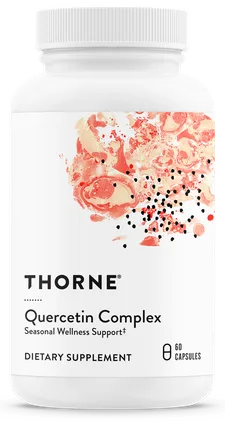
Thorne Quercetin Complex Review
Thorne's Quercetin Complex is a combination of quercetin phytosome and bromelain, presented as a seasonal wellness support product that the page says enhances immune function and helps reduce bruising and swelling after minor injury. The product is sold as capsules, with a serving size of one capsule and 60 servings per container. Each capsule lists 100 mg of bromelain and 250 mg of quercetin phytosome, the latter sourced from Japanese Sophora extract (flower) bound to a phospholipid complex from sunflower. Other ingredients are leucine, microcrystalline cellulose, silicon dioxide and hypromellose derived from cellulose for the capsule shell. The page describes the key ingredients as bromelain and quercetin phytosome. According to the details section, quercetin is one of the two primary ingredients and stabilizes the body's mast cells, which store and release histamine. The page notes that quercetin appears to have other effects on human health, including protection of the gastrointestinal tract and the cardiovascular system, where it scavenges free radicals and inhibits oxidation of LDL cholesterol. The product combines quercetin bound to sunflower-sourced phospholipids, which the page says increases the body's ability to absorb the quercetin, with bromelain, a compound of protein-digesting enzymes derived from pineapple. The page states that bromelain contains constituents that help maintain a healthy cytokine balance. The page also explains that quercetin's positive effects appear to be partly due to its antioxidant activity, and that paired with vitamin C, quercetin can reduce the incidence of oxidative damage to the skin and nerves caused by the natural depletion of glutathione. Phytosome complexes are described as created by a patented process that binds a botanical extract to a phospholipid, which the page calls key components of every cell membrane. Bromelain is described as a mixture of proteolytic enzymes from the pineapple plant (Ananas comosus), which the page says has been shown to promote healing and reduce temporary and minor swelling and bruising after a visit to the dentist. The product has been third-party tested and certified, according to the page, to verify that what is in the package matches the label and to confirm it contains no unsafe levels of contaminants such as heavy metals, pesticides and microorganisms. The warnings section states that the product is contraindicated in individuals with a history of hypersensitivity to any of its ingredients. Pregnant individuals are advised to consult a health-care practitioner before use. Because bromelain has fibrinolytic effects that may inhibit blood clotting, the product should be used with caution or avoided by people on a med therapy. The page also advises that the powder should not be removed from the capsule to take orally, as it can irritate the oral mucosa.
We don’t sell supplements. We help you make decisions and get the best price.
Lowest prices
We may earn a commission from some store links. How we choose.
Finding the lowest prices at the stores now. This takes a few seconds.
Study, Trial or Testing Result Summary
Members Only25 human studies · 14 improved
1 of these 25 human studies gave the ingredient by injection, not by mouth.
Quercetin is the main ingredient, but its amount here is unclear because the label gives the weight of a quercetin and phospholipid complex rather than pure quercetin. Studies of quercetin alone mostly found no immune benefit. In 1002 adults taking 500 or 1000 milligrams daily for 12 weeks, colds and other upper airway infections did not drop compared with placebo, though fit adults aged 40 and over on the higher dose had fewer sick days [1]. In 120 women, immune cell activity and inflammation did not change [2]. Four weeks of quercetin did not improve vaccine responses in 50 adults [3], and infection rates did not differ from placebo in 63 ultramarathon runners [4]. One small trial of 40 cyclists found fewer infections after heavy training, 1 of 20 versus 9 of 20 on placebo [5]. Bromelain is at a full dose. Most of its studies used it combined with other enzymes. A combination cleared fever sooner in children with sepsis [6] and raised an anti-inflammatory signal in people with knee arthritis [7], but the best trial, in 138 marathon runners, found no fewer colds or chest infections [8]. Animal and cell studies are never counted.
See all 25 studies →Hide the studies
- A review of 58 human studies on flavonoids and immune function found only quercetin had been tested as a supplement and said more evidence is needed to know whether it helps immunity.Flavonoids and immune function in human: a systematic review.
- A review of 48 trials and 10 observational studies on supplements for hay fever found promising evidence for isoquercitrin and for a vitamin D3, quercetin and Perilla mix, though the evidence quality was limited.Health supplements for allergic rhinitis: A mixed-methods systematic review.
- A review of lab and clinical studies on rheumatoid arthritis described quercetin as blocking an inflammation-linked enzyme and restoring immune cell balance, calling it a promising candidate, but no pooled human results were given.Mechanistic role of quercetin as inhibitor for adenosine deaminase enzyme in rheumatoid arthritis: systematic review.
- In 1002 adults aged 18 to 85 taking 500 or 1000 mg quercetin daily for 12 weeks, upper respiratory infection rates did not differ from placebo, though fit people aged 40 and over taking 1000 mg had fewer sick days and milder illness.Quercetin supplementation and upper respiratory tract infection: A randomized community clinical trial.
- In 194 matched COVID-19 patients, an herbal granule formula that contains quercetin among other compounds shortened lung lesion and viral clearance time and lowered inflammation markers, but quercetin was not tested alone.Yindan Jiedu granules exhibit anti-inflammatory effect in patients with novel Coronavirus disease (COVID-19) by suppress…
- In 138 healthy male marathon runners, a combination of bromelain, trypsin and rutoside taken for 1 week before and 2 weeks after a marathon did not reduce inflammation markers or upper respiratory illness (50.0% vs 51.5% with placebo).Rutoside and Hydrolytic Enzymes Do Not Attenuate Marathon-Induced Inflammation.
- In 120 women taking 500 or 1000 mg quercetin daily for 12 weeks, blood quercetin rose but natural killer cell activity, immune cell function and inflammation markers did not change compared with placebo.A 12-week supplementation with quercetin does not affect natural killer cell activity, granulocyte oxidative burst activ…
- In 63 ultramarathon runners taking 1000 mg quercetin daily for 3 weeks before and 2 weeks after a 160-km race, illness rates and immune cell and saliva antibody drops did not differ from placebo.Post-160-km race illness rates and decreases in granulocyte respiratory burst and salivary IgA output are not countered …
- In 60 children with sepsis given an enzyme combination containing bromelain or placebo for 14-21 days alongside meds, fever resolved sooner (3 vs 4 days) and circulatory support was needed for fewer days (2 vs 3), though recovery of consciousness and feeding times did not differ significantly.Efficacy and safety of phlogenzym--a protease formulation, in sepsis in children.
- In 50 older or metabolically at-risk adults, 560 mg of quercetin glycoside daily for 4 weeks before a COVID-19 booster did not change antibody or T-cell responses or vaccine reactions compared with placebo.Immune Preconditioning with Oral Quercetin Supplement and COVID-19 mRNA Vaccine Responses: A Randomized, Double-Blind, P…
- In 48 overweight or obese women, 10 weeks of a mixed supplement including 1000 mg quercetin did not change blood inflammation markers or cytokines, but increased activity of antiviral gene pathways and reduced inflammatory phagocytosis-related pathways compared with placebo.A Mixed Flavonoid-Fish Oil Supplement Induces Immune-Enhancing and Anti-Inflammatory Transcriptomic Changes in Adult Obe…
- In 45 people with knee osteoarthritis, 8 weeks of a bromelain, trypsin and rutoside combination raised the anti-inflammatory signal interleukin-10 and alpha-2-macroglobulin and lowered a cartilage breakdown marker compared with placebo, with better pain and symptom scores.Oral enzyme combination therapy reduces systemic inflammation, urinary CTXII and pain in knee osteoarthritis: a proof-of…
- In 40 trained male cyclists, 1000 mg of quercetin daily for 3 weeks before, during and 2 weeks after 3 days of heavy cycling did not change exercise-related immune measures but cut upper respiratory infections in the 2 weeks after (1 of 20 versus 9 of 20 on placebo).Quercetin reduces illness but not immune perturbations after intensive exercise.
- In 40 children aged 5-12 with allergic asthma and rhinitis, 6 months of a multi-ingredient supplement including quercetin improved asthma and nasal symptom control versus placebo and shifted immune cell responses in lab tests, though quercetin's own effect cannot be separated.Exploratory pilot trial of a multicomponent immunonutritional supplement in children with allergic asthma and rhinitis: …
- In 39 trained cyclists, 2 weeks of 1000 mg quercetin plus 120 mg EGCG daily lowered inflammatory markers CRP and IL-6 after 3 days of heavy exercise compared with placebo and increased an immune cell activity measure.Effects of quercetin and EGCG on mitochondrial biogenesis and immunity.
- In a small placebo-controlled pilot trial, young children with cow's milk allergy who took a multicomponent supplement containing quercetin for 6 months gained more weight and height than those given placebo, and their immune cells showed a shift toward tolerance.Immunonutritional effects elicited by a novel multicomponent food supplement in children with cow's milk allergy: result…
- In a crossover trial of 20 adults with a cardiovascular risk profile, 150 mg of quercetin daily for 6 weeks did not produce reproducible changes in monocyte gene expression compared with placebo; the few gene changes found were very small.Quercetin supplementation and its effect on human monocyte gene expression profiles in vivo.
- In a crossover trial of 20 runners, a single 1000 mg quercetin-based chew taken before a 2-hour run raised blood quercetin strongly but did not reduce exercise-induced inflammation or immune changes compared with placebo.The acute effect of ingesting a quercetin-based supplement on exercise-induced inflammation and immune changes in runner…
- In a placebo-controlled crossover trial, single oral doses of bromelain shifted the daily pattern of the T-cell signal interferon gamma in stimulated blood cells, suggesting an effect on the immune system's T-cell activity.Placebo-controlled randomized clinical trial on the immunomodulating activities of low- and high-dose bromelain after or…
- In a randomized trial of people with urogenital chlamydia infection, adding systemic enzyme therapy to meds improved treatment effectiveness and reduced side effects.[Impact of exogenous proteolytic enzymes on immunogenesis in patients with urogenital infections].
- In 356 young adults with hepatitis A, those given quercetin along with other drugs during the acute phase, in addition to standard care, showed better clinical and immune test results, though the quercetin effect could not be separated from the other drugs.[The immunocorrective therapy of patients with viral hepatitis A living under the adverse conditions of an industrial re…
- In 134 dysentery patients given injected quercetin and vitamin E for 7 days versus 154 on routine treatment, clinical signs normalized faster and immune balance was restored better.[The efficacy of quercetin and tocopherol acetate in treating patients with Flexner's dysentery].
- In 40 patients after nose septum surgery, oral enzymes gave less pain, swelling, nasal blockage and discharge and fewer complications than a diclofenac and paracetamol combination over 4 weeks.Role of Oral Enzymes in Post Operative Septoplasty Cases.
- Cancer patients on personalized diets with added functional foods, including garlic, onion, and turmeric, had higher albumin and lower clotting marker levels, and one group also showed reduced markers of oxidative stress; the diets were not compared against a placebo and quercetin was not dosed separately.Read the study on PubMed (26333154) →
- In lab and mouse experiments, quercetin reduced production of the inflammatory signal TNF-alpha through a protein called Slpi, and oral quercetin raised Slpi levels; this was not tested as a treatment in people.Secretory leukoprotease inhibitor is required for efficient quercetin-mediated suppression of TNFα secretion.
Review Totals and Summary
Members Only566 reviews · 93% positive
Buyers rate Thorne Quercetin Complex capsules highly: about 566 ratings across the stores, with most written feedback positive. Praise centers on allergy and histamine-type symptoms, though a few people noticed no change. **What buyers say it did for them.** The most specific praise comes from people managing histamine or mast cell problems. One buyer called it a "game changer" for histamine intolerance and suspected MCAS, and another said it "helped stabilize my MCAS when I use it regularly." A reviewer with long covid, Hashimoto's and MCAS wrote "I can finally breathe" after a month on it alongside other new supplements. Others link it to allergy season, saying it is "great during allergy season," and one store's reviewers say it let them cut back on allergy medication at times. Some mention immune support: one reports "don't get sick anymore" and faster workout recovery, and another recovered faster from colds. One store's reviewer called the effect hard to feel but seemingly beneficial. **What buyers complain about.** Complaints are few and mild. One buyer gave one star: "I'm on my second bottle but still don't see improvements" for sneezing and nose-blowing. A three-star reviewer reported no side effects but "haven't noticed the difference yet." One reviewer said it works well enough but seems to have the same effect as other quercetin brands. Another was unsure about any long-term effect. The store summaries note that no reviewer described side effects. **Taste, smell, pill size and form.** The reviews and store summaries say nothing about taste, smell or capsule size. Only the capsules are covered here, and reviews of other forms were left out. **Value for money.** Price is barely discussed for this product. One store's reviewers said prices were good, but that comment was about the store rather than the capsules. One buyer started a subscription after about four weeks. Thorne's own page also had praise for customer service, and other store pages praised fast shipping. **Who it seems to suit and who it did not.** It seems to suit people looking for support with histamine issues, mast cell concerns or seasonal allergies, especially those willing to take it regularly. One reviewer tied the benefit to regular use. Several reviewers mention trust in the Thorne brand and the quality of the product. It did not work for the buyer still waking with sneezing attacks after two bottles, or the one who noticed no difference. The brand-comparison reviewer found it no better than other quercetin products. Most written reviews are very short and general ("Quality product," "I recommend this product"), so the detail is limited. The store pages are consistent in showing mostly four- and five-star ratings, with a small number of low ones.
Biohacker Summary
Members Only10 of 10 recommend it
Quercetin, the main ingredient, drew comments from all eight panelists who spoke, and the group leans positive: about four recommend it and several others use it, while the rest are neutral and one gives a caution. People take it for allergies and histamine control through mast cell stabilizing, and for longevity, using it as a senolytic that clears aging cells, along with its antioxidant, anti-inflammatory and immune benefits. Several prefer getting it from foods like capers and red onions, one mentions the phytosome form, and one has used intravenous doses every few months. The one dose given is 250 mg once a month for 3 days, and senolytic use is often paired with a med. Two panelists note there are no human trials yet for senolytic use, one saw no huge effects in tests, and one warns that quercetin can impair alcohol metabolism. Bromelain, a smaller ingredient in this product, was said by one panelist to help quercetin absorb.
See all 9 biohackers →Hide the biohackers
Siim Land · Quercetin · neutral
- Mentions quercetin as a phytochemical that has been shown to stimulate GLP-1 expression directly, and also increase glucose uptake and insulin sensitivity.
- Uses IV quercetin every 3 months or so as part of his senolytic regimen, followed by a med.
- Mentions that Quercetin is one of the most common senolytics, but there are no human clinical trials on these yet.
- Did not see huge effects from quercetin in their tests.
- Discusses Quercetin as a senolytic supplement with potential longevity effects, but notes there are no human clinical trials yet to confirm its efficacy, placing it in the 'okay' tier based on current limited evidence.
- Mentions quercetin as a senolytic compound that helps eliminate senescent cells, which accumulate during aging and spread inflammation.
- The absorption rate for quercetin is around 1-3%, which is even lower than pure PCC1, explaining why much bigger doses are needed.
- Warns that quercetin, as a senolytic, can block MAOA, potentially raising adrenaline and causing anxiety or poor sleep in some individuals.
- Places Quercetin in the 'okay tier' for longevity, acknowledging its senolytic properties and potential life extension effects in animals, but highlights the limited human data on its effectiveness and the lack of established protocols for its use.
- Notes that quercetin, a flavonoid found in many fruits and vegetables, when combined with a med, was shown to induce senolysis or death of senescent cells in culture.
Thomas DeLauer · Quercetin · neutral
- Describes quercetin as 'unreal' and notes its high presence in apples and onions, stating it stabilizes mast cells to release less histamine.
- States that capers are the highest quality and most potent source of quercetin, which has huge impacts as an antioxidant and helps upregulate natural antioxidants in the body.
- Recommends quercetin as a polyphenol to be consumed in the evening, stating it's a great one that extends the repair window by inhibiting mTOR and acting as an HDAC inhibitor.
- Personally takes quercetin supplements because quercetin is awesome, and notes it is found in high concentrations in capers and also in maple syrup.
- States that quercetin is currently their favorite supplement in the longevity space, citing its performance properties for recovery, immune benefits, and its role as a powerful senolytic and anti-inflammatory that can be taken at any age.
- Notes that quercetin, found in polyphenol-rich foods like onions, shallots, and capers, can increase in skeletal muscle, allowing glucose to be absorbed into muscle cells without insulin.
- Notes that quercetin, which is in red onion, didn't perform as well as red onion itself in studies but still had a powerful benefit for fat loss.
- Mentions that bee pollen contains quercetin, which can help with the NRF2 pathway and the upregulation of the body's natural antioxidants like superoxide dismutase and glutathione.
- Started taking about 1,000 milligrams of quercetin every day, finding it acts as a potent histamine blocker, which helps him breathe better and feel more rested, especially at night due to congestion from allergies and histamine sensitivities.
- Mentions quercetin as a flavonol found in maple syrup that is great for allergies and has been demonstrated in other studies to reduce inflammation directly, including lipopolysaccharide-induced inflammation.
- Discusses a study where mice were given 1 milligram of bromelain, which increased levels of Akkermansia muciniphila and the thickness of the mucosal layer, and selectively increased intestinal permeability for nutrient absorption.
- Recommends bromelain (pineapple extract) for longevity and pain relief, noting its potency as an anti-inflammatory agent with fewer side effects than meds, potentially impacting the arachidonic acid pathway.
Dr. Eric Berg · Quercetin · recommends
- Dr. Eric Berg recommends adding more quercetin-rich foods such as red onions, capers, kale, dill, and radishes to your diet for seasonal allergies.
- Explains that the quercetin in onions decreases DHT, a powerful form of testosterone that is often the reason for hair loss.
- Lists quercetin as an epigenetic factor that may help with cancer prevention.
- Recommends quercetin-rich foods like onions, broccoli, and capers, as they support a healthy inflammatory response and help protect cells from oxidative stress for kidney health.
- Suggests that quercetin can be beneficial to counter some of the effects of a hypoxic state in cancer and inflammation.
- Recommends bromelain as a supplement to prevent clotting.
- Recommends quercetin, found in onions, for kidney health.
- States that quercetin has great properties for the kidney, including anti-inflammatory effects and preventing scar tissue.
- States that quercetin is very beneficial for building up antioxidant reserves.
- Recommends quercetin as a way to get iron out of tissues, with onions being one of the best sources.
- Recommends quercetin, found in onions, as a food that can increase NAD and should be part of a healthy diet for people over 50.
- Recommends bromelain, an enzyme found in pineapple, as a natural anti-inflammatory that also helps with sinus congestion.
- Suggests taking quercetin with bromelain to increase its bioavailability and help absorb quercetin.
- Recommends Bromelain from pineapples, noting its benefits for heart health and its ability to decrease stroke risk.
Dave Asprey · Quercetin · recommends
- Recommends quercetin, found in foods like capers and red onions, as a plant compound that directly slows down the demolition crew inside cells, which destroys NAD+.
- Recommends Bromelain, stating it supports healthy circulation.
- Dave Asprey recommends quercetin, a plant compound found in capers and red onions, as it has been shown to directly slow down the demolition crew inside cells that breaks down NAD+.
- Believes quercetin is important for addressing mast cell activation.
- Sees great success with quercetin as a mast cell stabilizer.
- Recommends quercetin as a strategy to decrease inflammation, particularly post-COVID anxiety.
- Dave Asprey mentions that supplements like quercetin rival pharmaceuticals in keeping uric acid under control.
- Suggests bromelain as something to experiment with for nightshade sensitivity, though he doesn't have confidence it would fully work.
- Mentions that something as simple as quercetin could make a big difference in IQ if histamine is holding it down.
- Mentions that quercetin has anti-parasitic properties and is useful.
- Dave states that pure quercetin is not well absorbed orally because it never existed in isolated form in nature, making rutin a better option.
- Lists quercetin as a mass cell stabilizer that works well for treating Mass Cell Activation.
- Recommends taking a bromelain enzyme with food to help break down food structures.
- Recommends bromelain, a digestive enzyme, for helping digest protein and potentially breaking up mucus.
Dr. Mark Hyman · Quercetin · uses
- States that he uses Quercetin, a flavonoid and one of the best-studied natural mast cell stabilizers, for allergies and as a longevity compound, noting it pairs well with bromelain for absorption.
- Notes that bromelain pairs well with quercetin for absorption.
- Mentions that HTB Immune Energy Chews contain over 100 immune active polyphenols like quercetin, which are studied for supporting healthy immune balance and longevity.
- Notes that quercetin is one of the immune active polyphenols found in sprouted Himalayan tardy buckwheat, studied for supporting healthy immune balance and longevity.
- Dr. Mark Hyman, agreeing with the guest, mentions Quercetin as a supplement that can help with modifying the histamine response.
- Recommends quercetin, a natural mast cell stabilizer and plant bioflavonoid, to help stabilize mast cells that release histamine, which causes allergy symptoms.
- Recommends bromelain to reduce inflammation in the nasal passages, which helps with allergy symptoms.
- Recommends bromelain, a compound from pineapple, for swelling before and after surgery.
- Recommends quercetin, a polyphenol from onion skins, as part of a 4 or 5-day senolytic intervention to kill zombie cells and lower the burden of toxic, pro-inflammatory cells.
- Uses Himalayan tartary buckwheat sprout powder daily, which is high in quercetin, and recommends quercetin for its antiviral, anti-inflammatory, anti-cancer, and antioxidant properties, noting its effectiveness against COVID-19 and its ability to reverse biological age.
- Recommends quercetin, stating it is a mast cell stabilizer, helps the body excrete uric acid, is great for longevity, works on AMPK, and can help lower uric acid and improve fatty liver.
- Recommends focusing on foods naturally rich in quercetin, such as onions and apples, and also adding quercetin supplements, due to their natural a med qualities.
- Recommends pairing high-dose IV vitamin C and L-lysine with a lot of antiviral supplements, including quercetin, to have as much antiviral fighting capacity on a daily basis as possible.
- States that patients with acute COVID have responded well to bromelain.
Ben Greenfield · Quercetin · uses
- States that quercetin inhibits proteasome, which has an effect on Nrf2 activation.
- Mentions quercetin or other senolytics to clear senescent cells as a recommended intervention on the True Age test.
- States that quercetin, a powerful flavonoid, is found in fruit tree leaves and was named after its inclusion in oak tree leaves.
- Mentions quercetin as a polyphenol that can confer benefits when consumed.
- Includes quercetin in their Lumat blue product along with methylene blue, phycocyanin, riboflavin, green tea extract, and lutein.
- Ben Greenfield mentions quercetin as an exercise mimetic.
- Mentions that a report for a client with high gut inflammation suggested using quercetin.
- Mentions quercetin as an example of a senolytic agent that helps get rid of senescent cells.
- Expresses caution about quercetin, noting it is an anti-cancer drug with antimitotic activities, and questions how hard one should push the body for extra years compared to living a good lifestyle.
- Recommends layering in quercetin to support antioxidant stores, especially for those with high oxidative loads.
- Recommends bromelain, a proteolytic enzyme, for lung repair after smoke exposure or for COPD, noting its use for soreness and breaking down inflammatory byproducts.
- Recommends high-dose bromelain as a proteolytic enzyme to break down candida and yeast biofilms.
- Mentions bromelain as one of the ingredients in Osteodenx.
- Ben recommends Bromelain, an enzyme found in pineapple, to help reduce inflammation.
Peter Attia · Quercetin · warns
- Quercetin, a bioactive flavonoid present in red wine, can impair alcohol metabolism.
- Notes that Quercetin is often given in combination with a med as an anti-senescent drug.
- Mentions that quercetin, found in fruits and onions, was one of the first two plant molecules discovered to activate human sirtuin one, alongside piceatannol, before resveratrol was identified.
- Takes 250 mg of Quercetin once a month for 3 days for longevity.
- Identifies Quercetin as a flavonoid compound and senolytic, often used with a med, and details its dosage in a pilot study for mild cognitive impairment or early-stage AD.
Dr. Rhonda Patrick · Quercetin · neutral
- Discusses a hypothesis that quercetin 3-glucuronide, a derivative of quercetin present in red wine, may cause red wine headaches by inhibiting an enzyme responsible for metabolizing acetaldehyde.
- Discusses quercetin, a flavonoid found in various plants, noting its reported ability to block the entry of SARS-CoV-1 in host cells and its potential role as a zinc ionophore, with clinical trials for SARS-CoV-2 beginning.
- Mentions quercetin, found in onions, as a plant polyphenol that has hormetic effects.
- Has supplemented with quercetin, particularly during COVID-19 for its antiviral properties, and now has the phytosome form from Thorne, which she might take again due to its anti-inflammatory and senescence effects.
- States that flavonoids like quercetin inhibit mast cell activation and histamine release, but much of the evidence is from animal work.
- Dr. Rhonda Patrick mentions that quercetin has been reported to block the entry of SARS-CoV-1 into host cells.
- Quercetin functions as a polyphenolic antioxidant, donating electrons and upregulating endogenous antioxidant enzymes to neutralize ROS.
- Notes that quercetin, found in yellow onions, activates FOXO3, which is associated with longevity.
- A combined anthocyanins and bromelain supplement improves endothelial function and skeletal muscle oxygenation status in adults.
Andrew Huberman · Quercetin · uses
- Takes quercetin supplements, noting that it activates sirtuins and helps kill senescent cells, contributing to longevity.
RAL Summary
Members OnlyTier 4 for Immune Health
The grade claims a clear improvement from quercetin, but the largest and best trials of quercetin alone found no immune benefit, and the positive results came mostly from one small trial or from mixed formulas, so the evidence is mixed rather than clear. So it is graded Tier 4, lower than the rules alone gave.
- Emerging: not enough evidence to rank higher yet.
Where the evidence disagrees: 7 of the 25 human studies found no effect.
More Details
Members OnlyBody systems · Combine with · Possible side effects
Body systems: Immune system, Respiratory system
Combine with: For immune and allergy support, pair it with vitamin C, which regenerates quercetin and supports histamine metabolism, plus zinc, vitamin D3, and optionally nettle leaf or NAC. If the user also wants joint support, add a dedicated joint stack such as undenatured type II collagen or hydrolyzed collagen peptides, glucosamine and chondroitin, curcumin with piperine or a phytosome form, omega-3 fish oil (EPA/DHA), and MSM. Take bromelain-containing products between meals if using it for systemic anti-inflammatory effects. Use caution and consult a clinician if on meds, meds, or quinolones, since quercetin and bromelain can interact.
Possible side effects: No major side effects reported.
Supplement Facts
Quercetin Phytosome Complex 250 mg · Bromelain 100 mg
| Quercetin Phytosome Complex | 250 mg | † |
| Bromelain | 100 mg | † |
Other ingredients: Hypromellose, Microcrystalline Cellulose, Leucine, Silicon Dioxide.
Directions: Suggested use: Take 1 capsule three times daily or as recommended by your health-care practitioner.
Barcode (UPC) 693749332022 · Label source: NIH label database · Report a label change
Show entire label


More immune health products
Members OnlyThe highest ranked for the same goal
Read more
Our articles on this subject
Graded November 6, 2026 by the Reverse Age Lab evidence engine, from human studies, real reviews and our biohacker panel. How we grade. Is this medical advice? No. Rala organizes the published evidence; go over any change with your doctor, especially if you take meds.
Privacy policyConsumer health dataAffiliate disclosureTermsDo Not Sell or Share My Personal InformationCookie settings