
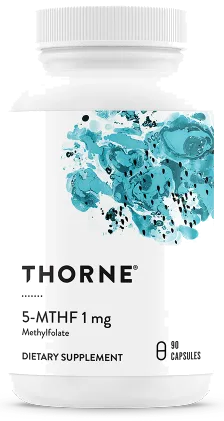
Thorne Research 5-MTHF 1 Mg Methylfolate Review
Thorne Research 5-MTHF 1 mg Methylfolate (60 Capsules) is presented as a folate supplement that supplies 5-MTHF, an active form of folate. The page explains that the body's conversion of synthetic, inactive folic acid is a multi-step biochemical process that occurs in the intestines and liver. When intestinal or liver function is impaired, this conversion may not be sufficient to meet the body's needs. The page also states that up to 60 percent of the Canadian population may have a genetic enzyme defect that makes it difficult to convert folic acid into active 5-MTHF. For these individuals and many others, Thorne Research 5-MTHF supplementation may be a more effective method of folate repletion. The page describes 5-MTHF, in concert with vitamin B12, as a methyl-group donor involved in converting the amino acid homocysteine to methionine. It says methyl-group donation is vital to many biochemical processes, including the synthesis of serotonin, melatonin and DNA. It also says 5-MTHF is involved in producing the catecholamine neurotransmitters dopamine, norepinephrine and epinephrine, and in producing nitric oxide in vascular endothelial cells, which promotes healthy blood vessel function. The product provides 1,000 mcg of folate as calcium L-5-methyltetrahydrofolate per one-capsule serving, with 60 servings per container. The recommended dose is one capsule daily or as advised by a health-care practitioner. The page advises supplementing with 2.4 mcg per day of vitamin B12. Non-medicinal ingredients are hypromellose capsule, microcrystalline cellulose, L-leucine and silicon dioxide. The page also shows images of third-party quality testing, manufacturing standards, and the product being recommended to health professionals and athletes.}
We don’t sell supplements. We help you make decisions and get the best price.
Lowest prices
We may earn a commission from some store links. How we choose.
Finding the lowest prices at the stores now. This takes a few seconds.
Study, Trial or Testing Result Summary
Members Only50 human studies · 23 improved
This product gives folate as methylfolate at a full dose, above the 500 micrograms that helped in studies and above the daily recommended limit, so members can take less. Most of the evidence is for folate added to a med medicine, not used alone. A pooled analysis of 192 trials with 17,437 adults found that adding folate eased depression more than medicine alone [1]. Nine trials with 1,061 adults agreed, with side effects similar to placebo [2]. Pooled trials of about 500 adults found a modest benefit from the methylfolate form added to meds [3]. A review of 20 trials with 2,256 adults found that folate forms, along with other B vitamins and vitamin D, lowered depression scores [4]. Not every study agreed. In 475 adults on meds, 5 milligrams of folic acid a day for 12 weeks did not improve mood [5]. In 4,331 older women, folic acid with vitamins B6 and B12 for about seven years did not prevent depression [6]. Overall, folate looks most useful as an add-on for people already being treated for low mood, and less proven for preventing it. Animal and cell studies are never counted.
See all 50 studies →Hide the studies
- In a pooled analysis of 192 trials with 17,437 adults with depression across 44 supplements, adding folate to a med medicine eased depressive symptoms more than a med alone.Comparative efficacy and tolerability of nutraceuticals for depressive disorder: A systematic review and network meta-an…
- In nine trials with 1,061 adults with major depression, adding folate beat placebo for improving depressive symptoms, with similar side effects and dropouts.Adjunctive folate for major mental disorders: A systematic review.
- In pooled trials of about 500 adults with major depression, adding L-methylfolate to meds gave a modest improvement in depressive symptoms and response compared with meds alone.Systematic Review and Meta-Analysis of L-Methylfolate Augmentation in Depressive Disorders.
- In people with schizophrenia, adding folate to antipsychotics did not improve depressive symptoms or total symptoms more than placebo, though negative symptoms improved slightly.Folic acid/methylfolate for the treatment of psychopathology in schizophrenia: a systematic review and meta-analysis.
- In three trials with 247 people with depression, adding folate to other treatment lowered depression scores by about 2.65 more points over 10 weeks, but folate alone was not better than trazodone.Folate for depressive disorders: systematic review and meta-analysis of randomized controlled trials.
- This pooled analysis found people with depression had somewhat lower blood folate and dietary folate than people without depression, but it did not test supplements.The association of folate and depression: A meta-analysis.
- A review of many meta-analyses found folate linked to lower risk of death and many chronic diseases, but also to adverse effects including depression, prostate cancer and asthma.Association Between Folate and Health Outcomes: An Umbrella Review of Meta-Analyses.
- A review of 13 observational studies of 12,742 pregnant and postpartum women found low folate intake, along with low calcium and iron, was associated with maternal depression.Association of Maternal depression with diet: A systematic review.
- Across 20 randomized trials with 2,256 adults, folic acid or L-methylfolate, along with other B vitamins and vitamin D, lowered depression scores, either added to standard medicine or used alone.Efficacy of B-vitamins and vitamin D therapy in improving depressive and anxiety disorders: a systematic review of rando…
- In three trials with 247 people with depression, adding folate to other treatment lowered depression scores by about 2.65 more points at ten weeks, while folate in place of trazodone showed no significant benefit.Folate for depressive disorders.
- A systematic review of nutrient treatments for bipolar disorder found that preliminary randomized trials suggest folate may help reduce manic symptoms, but the evidence is limited and needs larger studies.Nutrient-based therapies for bipolar disorder: a systematic review.
- In a review of 14 trials in women, folate did not reduce anxiety in older women, whereas vitamin B6 did.The impact of essential fatty acid, B vitamins, vitamin C, magnesium and zinc supplementation on stress levels in women:…
- A review of 23 trials and open-label studies, 9 of them in major depression, found folate supplements, especially 5-methylfolate, were linked to better clinical outcomes in several psychiatric conditions and were well tolerated.The potential use of folate and its derivatives in treating psychiatric disorders: A systematic review.
- Of 58 studies on pregnancy-related depression, 31 found lower folate, vitamin B12, iron, zinc or vitamin D linked to depression, with the evidence for folate considered mixed and inconclusive.A Systematic Review of the Correlation Between Micronutrient Levels and Perinatal Depression.
- In 4331 women aged around 64, daily folic acid 2.5 mg with vitamin B6 and B12 for about 7 years did not reduce the risk of developing depression compared with placebo, even though homocysteine levels fell.Effect of long-term supplementation with folic acid and B vitamins on risk of depression in older women.
- In rural Malawi, pregnant women given a fat-rich nutrient supplement, a multiple-micronutrient capsule, or iron-folate capsules had similar depressive symptoms at 6 months after birth, so the supplement did not reduce postnatal depression.The impact of maternal diet fortification with lipid-based nutrient supplements on postpartum depression in rural Malawi…
- In 475 adults with moderate to severe depression taking meds, adding 5 mg per day of folic acid for 12 weeks did not improve mood or quality of life compared with placebo.Folate Augmentation of Treatment--Evaluation for Depression (FolATED): randomised trial and economic evaluation.
- In 459 Guatemalan women, weekly and daily folic acid combined with iron, zinc and vitamin B-12 for 12 weeks lowered depression scores by 2.3 points on average, with no difference between the weekly and daily groups. Lower red blood cell folate at baseline was linked to more depressive symptoms, though this association was not statistically significant.Micronutrient supplementation may reduce symptoms of depression in Guatemalan women.
- In 225 hospitalised older patients, a daily multi-nutrient drink providing 100% of recommended vitamins and minerals (including folate) for 6 weeks led to fewer depressive symptoms than placebo at 6 months. Folate was not studied alone.Effects of dietary supplements on depressive symptoms in older patients: a randomised double-blind placebo-controlled tr…
- In two trials of 223 adults with depression who had not fully responded to a med meds, adding 15 mg daily of L-methylfolate for 30 days improved depression scores more than placebo in the second trial of 75 people, but the first trial using 7.5 or 15 mg showed no significant difference.Read the study on PubMed (23212058) →
- In 211 women of various ages, 750 mcg of folate daily for 35 days did not improve mood compared with placebo, although it slightly improved some memory tests.Short-term folate, vitamin B-12 or vitamin B-6 supplementation slightly affects memory performance but not mood in women…
- In an 8-week placebo-controlled trial of 158 people with major depression, blood folate levels did not predict or track improvement, while changes in omega-3 fatty acids did.EPA and DHA as markers of nutraceutical treatment response in major depressive disorder.
- In 127 adults with major depression taking a med, adding 500 mcg of folic acid daily for 10 weeks gave greater improvement than placebo, and this benefit was seen in women. 93.9% of women on folic acid had a good response (over 50% reduction in symptom score), compared with 61.1% on placebo.Read the study on PubMed (10967371) →
- In 106 people with Alzheimer's disease, a multi-ingredient nutrient formula containing folate improved thinking test scores compared with placebo over 3 months, but caregiver-reported mood and behavior changes were not statistically significant.A Phase II Randomized Clinical Trial of a Nutritional Formulation for Cognition and Mood in Alzheimer's Disease.
- In 75 adults with depression who did not respond fully to a med, 15 mg per day of L-methylfolate for about 60 days improved depression scores more than placebo, especially in people with high BMI or elevated inflammatory markers.Read the study on PubMed (24813065) →
- In 55 adults with metabolic syndrome on a six-month weight loss diet, those who increased their folate intake showed larger improvements in self-reported depression, although both diets improved mood similarly.Longitudinal relationship of diet and oxidative stress with depressive symptoms in patients with metabolic syndrome afte…
- In 55 people with schizophrenia taking stable antipsychotics, 15 mg of L-methylfolate daily for 12 weeks raised blood folate and improved overall symptom scores more than placebo, but mood and cognition scores did not differ from placebo.Biochemical, physiological and clinical effects of l-methylfolate in schizophrenia: a randomized controlled trial.
- In 41 people with depression or schizophrenia who had low red-cell folate, 15 mg of methylfolate daily for 6 months added to usual treatment improved clinical and social recovery more than placebo, with the gap widening over time.Enhancement of recovery from psychiatric illness by methylfolate.
- In 41 people with depression or schizophrenia who had low red-cell folate, 15 mg of methylfolate daily for 6 months added to usual treatment improved clinical and social recovery more than placebo, with the gap widening over time.Enhancement of recovery from psychiatric illness by methylfolate.
- In 30 older adults with mild cognitive decline, 2 months of a combined nutraceutical containing folate improved depression scores, but placebo improved similarly, so the mood benefit was not shown to be greater than placebo.Short-Term Impact of a Combined Nutraceutical on Cognitive Function, Perceived Stress and Depression in Young Elderly wi…
- In frail nursing home residents, 8 weeks of selenium, vitamin C and folate supplements improved depression scores in a subgroup with higher depression scores, while the placebo group did not change; folate was not tested alone.Effect of micronutrient supplementation on mood in nursing home residents.
- In adults with depression who did not respond fully to a med, 15 mg per day of L-methylfolate calcium over about 60 days improved depression scores more than placebo, with the greatest benefit in people with high BMI and elevated inflammatory markers.Read the study on PubMed (26613389) →
- In people with bipolar depression taking quetiapine, adding folic acid reduced a med benefit of added lamotrigine over 12 weeks, with no mood benefit from folic acid itself.Biochemical and genetic predictors and correlates of response to lamotrigine and folic acid in bipolar depression: Analy…
- In 22 adults over 60 with depression who were treated with a med, higher folate levels measured at the start predicted better improvement, especially on the self-rated scale, with a med group showing the stronger link. Folate was measured, not given as a supplement.Read the study on PubMed (12826993) →
- In 68 adults with depression who were already taking a med, 15 mg of L-methylfolate daily for up to 12 months led to full recovery in 38 percent of them, with no recurrences of depression.Long-term efficacy, safety, and tolerability of L-methylfolate calcium 15 mg as adjunctive therapy with selective seroto…
- In an open-label trial of 44 adults with depression, adding 800 micrograms daily of methylfolate to a med for 4 weeks produced a 40.33% improvement in depression symptoms versus 26.43% with a med alone, though remission rates did not differ significantly.Read the study on PubMed (39844190) →
- In an open-label study of 24 people with Alzheimer's disease taking a multi-ingredient formula containing folate for one year, thinking skills and behavior symptoms stayed at their starting level instead of declining, though there was no placebo group in this study.Maintenance of Cognitive Performance and Mood for Individuals with Alzheimer's Disease Following Consumption of a Nutrac…
- In 22 adults with depression that did not fully respond to a med, adding 15 to 30 mg per day of leucovorin (folinic acid) for 8 weeks lowered depression scores, with about 27% of the group reaching response, though there was no placebo group.Read the study on PubMed (12046638) →
- In 20 elderly adults with depression, 50 mg per day of methyltetrahydrofolate for 6 weeks led to marked improvement, with 81% of the 16 who completed at least 4 weeks responding, though there was no placebo group.An open trial of methyltetrahydrofolate in elderly depressed patients.
- In an open-label registry of 10 adults with bipolar depression taking 15 mg daily of L-methylfolate alongside usual treatment for 6 weeks, depression scores fell from 23.4 to 13.9, and 6 of 10 people had at least a 50% drop in symptoms.L-Methylfolate For Bipolar I depressive episodes: An open trial proof-of-concept registry.
- In a national survey of 2524 US adults, those with the highest blood folate levels had lower odds of elevated depressive symptoms, especially among women (odds ratio 0.37 compared with the lowest tertile).Serum folate, vitamin B-12, and homocysteine and their association with depressive symptoms among U.S. adults.
- In 517 Japanese adults, higher dietary folate intake was linked to fewer depressive symptoms in men but not in women. Men in the highest intake quartile had about half the odds of depressive symptoms compared with the lowest quartile.Dietary intake of folate, other B vitamins, and omega-3 polyunsaturated fatty acids in relation to depressive symptoms i…
- In 332 elderly men followed in the Zutphen Elderly Study, dietary folate and vitamin B6 and B12 intake and blood homocysteine were not related to depressive symptoms.Dietary intake of B(6-9-12) vitamins, serum homocysteine levels and their association with depressive symptoms: the Zutp…
- In 181 female students, sticking more closely to a Nordic diet was linked to higher intakes of many nutrients including folate, and higher vegetable intake was linked to lower stress and anxiety scores. Folate itself was not tested against mood.Impact of a Nordic diet on psychological function in young students.
- In 141 young Japanese women, those eating more than 240 mcg of folate daily from food had lower odds of depressive symptoms (adjusted odds ratio 0.22). This was an observational association and not proof of cause.Impact of dietary folate intake on depressive symptoms in young women of reproductive age.
- In 116 women treated for major depression, lower blood folic acid was linked to more severe depression, and folic acid was significantly lower in those with treatment-resistant depression.Blood Concentrations of Folic Acid and Homocysteine Are Associated with Treatment-Resistant Depression Among Female Depr…
- In 97 adults with bipolar or major depressive disorder, 64% had folate intake below the estimated average requirement, compared with 27% in a general population survey. This study did not measure mood changes from folate.Vitamin and mineral intakes in adults with mood disorders: comparisons to nutrition standards and associations with soci…
- People with depression had lower folate and vitamin B12 levels and lower folate intake than controls, but no supplement was tested in this study.Evaluation of Nutritional Status of Patients with Depression.
- Blood 5-methyltetrahydrofolate was lower in 26 depressed people than in 21 healthy volunteers, both before and after electroconvulsive therapy. Folate deficiency was related to depression severity but not to treatment response.5-Methyltetrahydrofolate level in the serum of depressed subjects and its relationship to the outcome of ECT.
- In people with folate deficiency whose mental symptoms, nerve problems and depression eased with folic acid, a serotonin-related breakdown product in spinal fluid returned to normal after treatment, while it stayed low in people whose symptoms did not respond.Effect of folic acid and vitamin B12 deficiencies on 5-hydroxyindoleacetic acid in human cerebrospinal fluid.
Review Totals and Summary
Members Only10,847 reviews · 95% positive
**Overall:** Buyers rate Thorne 5-MTHF 1 mg capsules very highly, with about 8,452 ratings across the stores. Most reviewers are happy with the quality and effect, and the complaints are few: a mislabeled-strength surprise, fillers, price and delivery timing. Only the capsules are covered here; reviews of other forms were left out. **What buyers say it did for them:** Many report feeling better. One wrote "My brain feels clearer!" and another "Made a huge difference in just a month!" One buyer saw their nails improve within a month. Another said it "has made a noticeable difference in my life" with digestive issues. A reviewer who let a subscription lapse for a week "noticed a difference in my overall health and energy." Others say it raised their folate levels or gave them peace of mind about the MTHFR gene. A store summary adds that one long-term user, who takes it for a genetic methylation problem, reports no new heavy metal buildup. **What they complain about:** The sharpest complaint is about strength. One buyer wrote "it is not 5mg. it is in fact 1mg," saying the listing never shows the milligrams, and would have needed five pills a day. Another liked the product but wished the maker had not added fillers. One subscriber said the deliveries seem to arrive late. One reviewer found the brand "very expensive." **Taste, smell, pill size, form:** The only comment on form is that the capsules "are small so they are easy to swallow." No one mentions taste or smell. Several reviewers like that it is the methylfolate form, not folic acid, and one calls it "more effective." **Value for money:** Price comes up rarely. One reviewer calls the brand "very expensive," though also "a solid brand." The buyer who was surprised by the strength said the price matched the manufacturer's own site. Many reviewers trust Thorne for "great quality" and accurate potency information, which seems to justify the cost for them. **Who it suits and who it did not:** It seems to suit people with an MTHFR gene variant, people told to take it by a doctor (or a pediatrician, per a store summary), and women who want extra folate when their prenatal falls short, including around pregnancy. It also suits people who already trust Thorne and take several of its products. One reviewer takes two capsules daily for a chronic condition. It suited less well anyone who expected a higher dose per capsule, such as the buyer who thought they were getting 5 mg, and anyone who wants a product without fillers. Check the strength on the label before ordering. One store page shows a 4.93 average, and its written reviews are all positive.
Biohacker Summary
Members Only10 of 10 recommend it
Most of the panel backs folate, and five of the ten give a clear recommendation, with several of them taking methylfolate themselves. The main reason is to lower homocysteine, with others citing brain and mood health, mitochondrial function, pregnancy and IVF preparation, and low levels or deficiency. Methylfolate is the form they prefer, over synthetic folic acid, because the body can use it directly without conversion, and it is often pointed to for people with an MTHFR variant or trouble with methylation. One panelist takes the lower of two strengths once a day, and others pair it with B12, B6, other B vitamins or taurine, while food sources such as dark leafy greens and liver also come up. Two panelists warn of overdoing it: one says many people feel muscle tension and anxiety on methylfolate, and another says overdosing can overstimulate, especially with creatine, and that his own levels were maxed out.
See all 10 biohackers →Hide the biohackers
Dr. Mark Hyman · Folate · neutral
- Notes that taking folate can lower homocysteine levels, which has shown health benefits and physical improvements in brain scans in clinical trials.
- Notes that some people may need a little bit extra folate with a supplement.
- Optimized a child's nutrient status with folate, as the child had low folate levels and was not eating greens.
- Notes that a med depletes folate.
- States that folate is a nutritional deficiency that impacts mental health.
- Recounts giving a patient with MCI high-dose methylfolate, along with B12 shots and B6, which completely cured her MCI.
- Recommends folate with vitamin B6 and B12 as supplements with strong evidence for PMS.
- Explains that folate metabolism is very involved in neurotransmitter function and mood, and that folate can be a treatment for some cases of depression, especially for those with MTHFR genetic variants.
- Explains why methylated folate matters and differentiates it from folic acid in the context of prenatal vitamins.
- Recommends folate for male fertility, stating it targets cellular damage.
Dr. Eric Berg · Folate · neutral
- Notes that birth control pills deplete the body of folate, which is needed for the brain to make serotonin.
- Dr. Berg mentions that fermented dairy contains vital nutrients, including folate.
- States that folate is a co-factor or nutrient involved in making melatonin.
- States that if one is deficient in folate, cells cannot repair, and recommends dark leafy green vegetables, liver, and avocados as good sources.
- Mentions that fermented dairy provides vital nutrients such as folate.
- States that Folate (vitamin B9) repairs DNA, helps prevent cancer, and supports melanin production.
- Mentions that eggs contain folate, which is beneficial for methylation, DNA repair, detoxification, and neurotransmitter production, particularly for those with genetic predispositions.
- Mentions a trial where synthetic folate boosted IQs by 25% to 50% compared to a placebo.
- Mentions recommending natural methylfolate for an average person, noting that it handles one pathway, while the synthetic version handles multiple pathways and bypasses absorption barriers.
- Recommends ensuring sufficient folate intake, as a deficiency can cause DNA damage similar to radiation exposure, and suggests getting it from dark leafy green vegetables or liver.
Dave Asprey · Folate · neutral
- States that folate can affect how the body responds to a supplement.
- Recommends methylfolate as a better option than folic acid.
- Dave Asprey notes that 80% of their clients have a problem absorbing certain forms of folate, and when the exact form of folate or folinic acid is dialed in, clients experience shifts, with the brain waking up as one of the first improvements.
- Dave breaks down why a daily stack of taurine, B6, folate, and B12 works for motivation when either ingredient alone doesn't.
- Warns that many people who take methylfolate experience muscle tension and anxiety from it, suggesting it's not always the right form for methylation issues.
- Notes that not everyone can metabolize methylfolate.
- Warns against taking methyl folate, stating that it causes muscle cramping throughout the body and that overmethylating is a nasty sensation.
- States that most people can use methylfolate as their best brain source for making neurotransmitters, and mentions studies showing 15 milligrams was effective for depression with no side effects.
- Explains that methylfolate is the bioactive form of folate required for DNA replication and that deficiency can impair peristaltic activity in the gut.
- Discusses the potential to simulate the effects of adding more methylfolate to a virtual body based on personal genetics.
Ben Greenfield · Folate · recommends
- Recommends methylfolate as an active form of folate that the body can use directly without conversion.
- Recommends bioavailable folate, not synthetic folic acid, as folate deficiencies seem to impact hearing health in older individuals.
- Recommends introducing methylfolate into the diet to address high homocysteine levels.
- Would refine the guidelines to include clearer distinctions between synthetic folic acid and natural folate.
- Notes that some people do better on certain forms of B12, B complexes, SAM E, and methylated folates, specifically five methyl folates, for methylation.
- Notes that magnesium requires co-factors like B12 and folate to work, and BiOptimizers has considered these nutrients to help lower homocysteine levels and protect against DNA damage, promoting better health and longevity.
- Warns of folate deficiency on a carnivore diet, as it is low in meat but found in organ meats like liver, heart, kidney, and thymus glands.
- Ben recommends treating methylation deficits with bioavailable sources of natural folic acid like methylfolate or methyl tetrahydrofolate.
- Recommends looking for methyl tetrahydrofolate (MTHF) as an alternative to folic acid in supplements and foods, as it does not cause the negative effects associated with synthetic folic acid.
- Ben discusses the debate on folic acid versus methyltetrahydrofolate, agreeing with Ivor that folate or MTHF is the preferred form.
Dr. Rhonda Patrick · Folate · recommends
- Recommends ensuring adequate methyl folate intake, ideally through a prenatal vitamin, for women preparing for IVF.
- Notes that dark leafy greens are a great source of folate.
- States that for his mother, who is homozygous for MTHFR, methyl folate along with a high dose B supplement is necessary to prevent her homocysteine and blood pressure from going high.
- Dr. Patrick mentions that her smoothie is rich in folate, which is required for producing thymine and prevents DNA strand breaks.
- Has experimented with L-methylfolate in the past to lower homocysteine, as he is a poor methylator.
- Dr. Patrick states that studies have shown supplementing with 5-methyltetrahydrofolate can successfully circumvent some shortcomings of MTHFR gene polymorphisms and lower homocysteine levels.
- Dr. Patrick states that her smoothie, containing spinach, has around 480 micrograms of folate, which is essential for the incorporation of thymine into DNA and is very important in regulating epigenetics.
- Dr. Patrick states that adequate levels of folate have been shown to prevent cancer, and conversely, inadequate levels can damage DNA, which is known to cause cancer.
- Dr. Rhonda Patrick discusses folic acid vs. folate.
- Ensured she was getting a ton of folate up to a year before pregnancy to help with baby development.
Thomas DeLauer · Folate · recommends
- Recommends taking methylfolate as a methylated form of B vitamin for mitochondrial function.
- Recommends methylfolate as a runner-up for insulin resistance, especially for individuals with the MTHFR variant, as it directly enters the methylation cycle without conversion.
- Mentions folate as a critical B vitamin for reducing homocysteine.
- Lists folate as a metal donor found in green leafy vegetables, liver, and legumes, especially sprouted legumes.
- Mentions methylfolate as the usable form that folic acid is converted into in the human body.
- Suggests that avocados' high folate content helps break down homocysteine, increasing circulation and energy to the brain, which reduces neuroinflammation and positively impacts mood.
- States that macadamia nut oil is higher in Folate (B9), which is associated with metabolism and neurological functions.
- Recommends supplementing with good amounts of folate (Vitamin B9) for telomere regeneration and stabilization, citing a study where it prevented telomere damage from sleep deprivation.
- Mentions that Folate (Vitamin B9), along with Vitamin B12, regulates communication between the gut microbiome and the host, suggesting attention to it for synergistic communication.
- Recommends natural folates like B9 from vegetables, stating they are critical for metabolic function and proper glucose metabolism.
Siim Land · Folate · neutral
- States that Homocysteine levels can often be improved through adequate folate intake.
- Notes that Brian's folate levels are over 20, which is too high and above the reference range, possibly due to supplementation.
- Warns that many people are overdosing on methyl folate, which can contribute to overstimulation when combined with creatine.
- Notes that folate resulted in negative effects on epigenetic age, meaning it increased epigenetic age.
- Takes methylfolate, and his levels were 'off the charts' and 'maxed out' at 24, in an effort to reduce homocysteine.
- Personally needs more methyl folate.
- States that glycine synthesis is dependent on carbohydrate and folate, and that converting serine to glycine requires the unmethylated form of folate, thus requiring a high folate intake.
- Folate is a methyl donor that can be obtained from leafy green vegetables and is important for DNA methylation.
- Warns against excessively pushing methylation forward by simply taking supplemental folate and B12, as it doesn't lead to living forever and can have reasons for concern.
- Mentions folate as a nutraceutical with anti-thrombotic potential, increasing cyclic GMP.
Andrew Huberman · Folate · recommends
- States that B12, folate, and iron are essential to mitochondrial function and if deficient, mitochondria will not function properly, which is consistent with the mitochondrial theory of neuropsychiatric disorders.
- Recommends taking methyl folate as part of methylated B vitamins to lower homocysteine levels and reduce cardiovascular risk.
- Takes methyl folate because elevated levels of homocysteine are associated with negative outcomes, and taking methyl folate is known to lower homocysteine. This might lower ADMA and SDMA and raise nitric oxide synthesis, potentially impacting vascular disease.
- Discusses folate as a potential factor in mitigating cancer risk, particularly in relation to alcohol consumption.
- Recommends the consumption of folate and other B vitamins, especially B12, as it has been shown to partially decrease cancer risk in people who ingest alcohol, though it does not completely offset it.
- Discusses L-5-Methyltetrahydrofolate as a novel pain relief compound and mentions it in the context of a protocol for pain.
- Explains that 5-methyltetrahydrofolate (5-MTHF) is now being used as a strategy to increase endogenous SAMe levels, as it is a precursor molecule necessary for its conversion.
- Recommends Methylfolate as part of methylated B vitamins to lower homocysteine and reduce cardiovascular risk.
Peter Attia · Folate · recommends
- Highlights folate supplementation as a significant practical progress in nutrition science, which has radically reduced spinabifida.
- Takes Jarrow methylfolate to keep homocysteine levels below nine, taking the lower of two available strengths once a day.
- Takes Jarrow methylfolate, a methylated version, once a day at the lower of two strengths, to keep homocysteine levels below nine.
- Mentions that in a mouse model for obesity, the amount of folate given to the mother mouse during pregnancy affects the epigenetics of her offspring, leading to changes in coat color and obesity.
- Personally takes methylfolate to help get homocysteine into the desired zone and prefers the Jarrow brand.
- Takes methyl folate as a supplement.
- Considers 400 micrograms of methylfolate in a typical supplement to be reasonable and more than sufficient, but notes that if it doesn't fix homocysteine, the deficit lies elsewhere.
- Uses and vouches for Jarrow's combined lozenge of methylfolate and methyl B12, stating they choose specific supplements because they know they work and are verified by blood tests.
Bryan Johnson · Folate · recommends
- Recommends supplementing with folate for brain health for both the mother and the baby during pregnancy.
RAL Summary
Members OnlyTier 2 for Mood
Several pooled analyses show that folate, including methylfolate, improves depressive symptoms when added to meds, and the product has over 10,000 reviews with 95 percent positive, which meets tier 2.
Where the evidence disagrees: 14 of the 50 human studies found no effect.
More Details
Members OnlyBody systems · Combine with · Possible side effects
Body systems: Nervous system, Blood
Combine with: For methylation and mood support, methylfolate pairs well with methylcobalamin (B12), vitamin B6 as P5P, riboflavin, and betaine (TMG), which work together in the methylation and homocysteine cycle. Omega-3s and magnesium can add to mood and nervous system support. For the sensitive-digestion goal, consider a separate gut-focused stack: a multi-strain probiotic (Lactobacillus and Bifidobacterium), a broad-spectrum digestive enzyme, peppermint oil enteric-coated capsules, ginger, partially hydrolyzed guar gum or other gentle soluble fiber, and L-glutamine or zinc carnosine for gut lining support. Consult a healthcare provider, especially if you have a diagnosed GI condition or take medications.
Possible side effects: Studies found side effects similar to placebo. Reviewers mostly raise fillers, price and dose confusion rather than side effects.
Supplement Facts
Folate 1700 mcg DFE
Other ingredients: Microcrystalline Cellulose, Hypromellose (derived from cellulose) capsule, Leucine, Silicon Dioxide.
Directions: Take 1 capsule one to three times daily or as recommended by your health-care practitioner.
Barcode (UPC) 693749017554 · Label source: Reverseagelab · Report a label change
Show entire label

More mood products
Members OnlyThe highest ranked for the same goal
Read more
Our articles on this subject
- Folate vs Folic Acid: What the Studies Show About Each FormArticle · Oct 29, 2026
- Supplements for Stress and Anxiety Relief: What the Evidence SupportsArticle · Oct 26, 2026
Graded November 5, 2026 by the Reverse Age Lab evidence engine, from human studies, real reviews and our biohacker panel. How we grade. Is this medical advice? No. Rala organizes the published evidence; go over any change with your doctor, especially if you take meds.
Privacy policyConsumer health dataAffiliate disclosureTermsDo Not Sell or Share My Personal InformationCookie settings