Thorne Research Ubiquinol Review
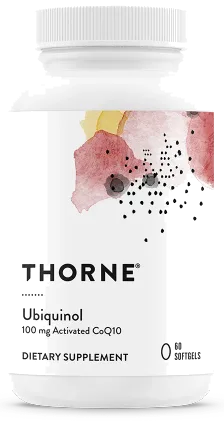
Thorne Ubiquinol is a dietary supplement. Each softgel contains 100 mg of Kaneka® Ubiquinol, the reduced, "active" form of coenzyme Q10 (CoQ10). Thorne's product page lists the other ingredients as medium-chain triglycerides, beeswax, sunflower lecithin, and a gelatin, glycerin, water and annatto softgel shell. The company lists it as gluten-, dairy- and soy-free, and the label carries NSF Contents Certified status. The suggested use is one softgel once or twice daily, or as directed by a health-care practitioner. Thorne positions it for people who want a highly bioavailable, activated CoQ10 for healthy aging, cellular energy, cardiovascular health, antioxidant status and fertility. CoQ10 is a lipid-soluble, vitamin-like compound made in the body and present in nearly every cell. It is most concentrated in high-energy organs such as the heart, liver, kidneys and brain. It works in two main ways. 1. **Energy production.** CoQ10 sits in the inner mitochondrial membrane. There it shuttles electrons from Complexes I and II to Complex III of the electron transport chain. This electron flow drives the proton gradient that powers ATP synthase, so CoQ10 is directly involved in producing cellular energy. 2. **Antioxidant protection.** In its reduced ubiquinol form, CoQ10 donates electrons to neutralize free radicals. It protects membrane lipids, lipoproteins and DNA from oxidative damage. It also helps regenerate other antioxidants, such as vitamin E. Once it gives up electrons it becomes ubiquinone, the oxidized form. The body continually recycles ubiquinone back to ubiquinol using enzymes. The case for supplementing with ubiquinol is that the body's own CoQ10 production and its conversion efficiency decline with age. A med medications can also lower CoQ10 levels. Taking ubiquinol supplies the already-reduced form, which may bypass some of that conversion step. Ubiquinol is chemically unstable and oxidizes easily. Kaneka's fermentation-derived, stabilized ubiquinol is meant to address this. Thorne also suspends it in an oil-based fill inside a softgel, because CoQ10 is fat-soluble and absorbs best when dissolved in lipids and taken with a meal that contains fat. Be aware that Thorne also sells a separate "CoQ10" product containing ubiquinone, and some retailers mix up the two listings. Some practitioners argue that ubiquinone is equally well absorbed. Evidence that ubiquinol is superior for healthy adults is mixed, and the case is strongest for older adults and people with impaired conversion. CoQ10 can interact with meds such as a med and with blood-pressure and meds. People on these drugs should consult a clinician first.
We don’t sell supplements. We help you make decisions and get the best price.
Lowest prices
We may earn a commission from some store links. How we choose.
Finding the lowest prices at the stores now. This takes a few seconds.
Study, Trial or Testing Result Summary
Members Only12 human studies · 7 improved
No study measured biological age directly. The evidence comes from markers linked to aging, and the results are mixed. At the full dose this product provides, 200 milligrams a day of ubiquinol for 2 weeks lowered exercise-related oxidative damage, including damage to genetic material, in 100 healthy trained adults [1]. However, the same dose for 1 month in 21 young athletes did not change oxidative damage to genetic material, although it lowered cell oxidants [2]. In 50 people with type 2 diabetes, 100 milligrams a day of liquid ubiquinol for 12 weeks lowered long-term blood sugar and raised antioxidant enzyme activity [3]. In 62 people with heart failure, ubiquinol combined with L-carnitine lowered inflammation markers, so ubiquinol's own effect cannot be separated out [4]. Two other trials used a form that is not clearly ubiquinol. In 44 people with rheumatoid arthritis, coenzyme Q10 lowered one oxidative stress marker and one inflammation marker but not others [5]. In 49 people with diabetic nerve damage, the ubiquinone form improved symptoms and lowered a fat oxidation marker [6]. Animal and cell studies are never counted.
See all 12 studies →Hide the studies
- In 100 healthy trained adults, 200 mg a day of ubiquinol for 2 weeks lowered the oxidative damage markers (including DNA damage) caused by strenuous exercise compared with placebo.Short-term ubiquinol supplementation reduces oxidative stress associated with strenuous exercise in healthy adults: A ra…
- In 62 people with heart failure, 270 mg a day of ubiquinol plus L-carnitine for 12 weeks lowered inflammation markers (IL-6 and TNF-alpha) and improved walking distance and symptoms compared with placebo.Effect of carni Q-gel (ubiquinol and carnitine) on cytokines in patients with heart failure in the Tishcon study.
- In 50 people with type 2 diabetes, 100 mg a day of liquid ubiquinol for 12 weeks lowered long-term blood sugar (HbA1c) and raised antioxidant enzyme activity compared with placebo.Effect of liquid ubiquinol supplementation on glucose, lipids and antioxidant capacity in type 2 diabetes patients: a do…
- In 49 people with diabetic nerve damage, 400 mg a day of ubiquinone for 12 weeks improved symptoms and nerve conduction and lowered a fat oxidation marker compared with placebo.The effect of ubiquinone in diabetic polyneuropathy: a randomized double-blind placebo-controlled study.
- In 44 people with rheumatoid arthritis, 100 mg a day of coenzyme Q10 for 2 months lowered an oxidative stress marker and TNF-alpha, but not IL-6 or total antioxidant capacity, compared with placebo.Effects of Coenzyme Q10 Supplementation on Inflammatory Cytokines (TNF-α, IL-6) and Oxidative Stress in Rheumatoid Arthr…
- In 44 women having hysterectomy with tube removal, 300 mg a day of coenzyme Q10 for 14 days before surgery did not protect ovarian reserve (AMH hormone drop) compared with placebo.The effect of coenzyme Q10 pretreatment on ovarian reserve in women undergoing hysterectomy with bilateral salpingectomy…
- In 37 male marathon runners, 90 mg a day of coenzyme Q10 with a small dose of vitamin E for 3 weeks raised blood levels but did not reduce exercise-induced fat oxidation or muscle damage compared with placebo.Effect of combined coenzyme Q10 and d-alpha-tocopheryl acetate supplementation on exercise-induced lipid peroxidation an…
- In 34 people with oral lichen planus, CoQ10 tablets applied in the mouth three times daily for one month reduced pain, lesion size and a saliva oxidative stress marker, similar to a med paste.Read the study on PubMed (37480004) →
- In 21 young male athletes, 200 mg of ubiquinol daily for 1 month prevented the exercise-related drop in coenzyme Q10 and lowered cell reactive oxygen species, but did not change oxidative DNA damage, physical performance or muscle damage markers.Effect of ubiquinol supplementation on biochemical and oxidative stress indexes after intense exercise in young athletes…
- In 15 healthy exercise-trained adults aged 30-65, 300 mg of ubiquinol daily for four weeks raised blood CoQ10 levels but did not improve exercise performance or reduce signs of oxidative stress compared with placebo.Impact of oral ubiquinol on blood oxidative stress and exercise performance.
- In healthy people given a med for 8 weeks, adding 300 mg of ubiquinol daily for the last 4 weeks partly reversed a med-induced mitochondrial slowing, but the difference from placebo was not statistically significant.Read the study on PubMed (28943100) →
- In 16 healthy adults, a daily antioxidant supplement containing 60 mg of coenzyme Q10 for 30 days raised blood levels of ubiquinol and lowered markers of fat damage, without a placebo group for comparison.The regular supplementation with an antioxidant mixture decreases oxidative stress in healthy humans. Gender effect.
Review Totals and Summary
Members Only168 reviews
Review data for this exact ubiquinol softgel is sparse. Thorne's own page and the iHerb UK listing show only a handful of reviews, while the sibling Thorne CoQ10 (ubiquinone) product has over a thousand on iHerb. The themes below combine both. The ubiquinol-specific feedback is positive, and the broader Thorne CoQ10 feedback points the same way. Customers most often praise Thorne's trustworthiness. Many say they chose it because the company is independent and does third-party testing. They also like that it is NSF-certified and has a clean, minimal ingredient list. Buyers frequently describe the brand as "bioavailable" and say it is the kind of product their doctor or practitioner recommends. Several long-term users say they have taken it for years and keep rebuying. On results, people describe noticeable support for energy and heart health. One reviewer said it helped a husband who had stents placed. Others say they can perceive the effect and plan to reorder. Customers say the softgels are small, tasteless, not sticky and easy to swallow, and they report few stomach complaints. The most common criticism is price. At roughly $49 for 60 servings, or about £48 in the UK, it costs more than competing Kaneka ubiquinol brands such as Doctor's Best, NOW or Jarrow. Some independent reviewers say the savings elsewhere make those brands better value. A second theme is confusion over the form. Reviewers of the CoQ10 listings point out that it is ubiquinone, not ubiquinol, and one comparison site marks it down for that reason. Retailer text also argues over which form absorbs better, which leaves some shoppers unsure which Thorne product to buy. A small number of buyers mention limited availability or low stock on some international storefronts. There is also the usual caveat that effects are subtle and gradual, so people who expect an instant energy boost may feel nothing. Overall, buyers value purity, quality control and ease of use. Their main reservations are cost and uncertainty about the form.
Biohacker Summary
Members Only7 of 10 recommend it
Our biohacker panel has not discussed this product’s ingredients yet.
RAL Summary
Members OnlyTier 4 for Healthy Aging
Tier 2 needs over 100 reviews with two thirds positive, but no reviews of this ubiquinol were counted, and the review summary mixes in reviews of Thorne's separate ubiquinone product, so only thin, mixed aging-marker evidence remains. So it is graded Tier 4, lower than the rules alone gave.
- Emerging: not enough evidence to rank higher yet.
Where the evidence disagrees: 4 of the 12 human studies found no effect.
More Details
Members OnlyBody systems · Combine with · Possible side effects
Body systems: Cellular metabolism, Cardiovascular system, Immune system, Endocrine system
Combine with: Ubiquinol is the active antioxidant form of CoQ10. It supports mitochondrial electron transport and protects cell membranes and lipoproteins from oxidative damage, which makes it a reasonable fit for a cellular aging goal. It is not a direct DNA repair agent, so it works best as part of a broader stack. Good partners include an NAD+ precursor such as nicotinamide riboside or NMN, which supports sirtuin activity and DNA repair enzymes (PARPs). PQQ complements ubiquinol by supporting mitochondrial biogenesis. Alpha-lipoic acid and N-acetylcysteine or glutathione support the body's antioxidant network and help recycle other antioxidants. Omega-3 fish oil and vitamin E (mixed tocopherols and tocotrienols) help protect cell membranes. Magnesium and B vitamins support mitochondrial energy metabolism. Take ubiquinol with a fat-containing meal for better absorption. People on meds such as a med, on meds, or on meds should check with a clinician first, because CoQ10 can interact with these drugs.
Possible side effects: The studies given report no major side effects. Reviewers mention few stomach complaints, but much of that feedback concerns a sibling product.
Supplement Facts
Kaneka® Ubiquinol 100 mg
| Kaneka® Ubiquinol | 100 mg | † |
Other ingredients: Medium Chain Triglycerides, Softgel (Gelatin (bovine), Glycerin (vegetable source), Purified Water, Annatto (color)), Beeswax, Sunflower Lecithin.
Directions: Take 1 softgel one to two times daily or as recommended by your health-care practitioner.
Barcode (UPC) 693749017400 · Label source: Reverseagelab · Report a label change
Show entire label

More healthy aging products
Members OnlyThe highest ranked for the same goal
Read more
Our articles on this subject
- Healthy Aging Tips: A Science-Backed Guide to Living Better for LongerArticle · Mar 17, 2026
- NAD Anti-Aging Supplements: Benefits, Evidence, and How to ChooseArticle · Jun 15, 2026
Graded November 5, 2026 by the Reverse Age Lab evidence engine, from human studies, real reviews and our biohacker panel. How we grade. Is this medical advice? No. Rala organizes the published evidence; go over any change with your doctor, especially if you take meds.
Privacy policyConsumer health dataAffiliate disclosureTermsDo Not Sell or Share My Personal InformationCookie settings