
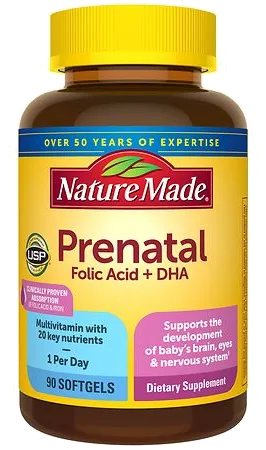
Well At Walgreens Prenatal Multi + DHA Review
Well At Walgreens Prenatal Multi + DHA is a softgel supplement that has not yet been scored with a complete product TrustScore. The serving size is 1 softgel, with 30 servings per container. The page lists key active ingredients as Docosahexaenoic Acid, Calcium, Iron, and Zinc. The nutrient panel shows Calcium 38mg, Docosahexaenoic Acid 250mg, Folic Acid 800mcg, Iron 27mg, Niacin 18mg, and Riboflavin 1mg, with a link to see all 16 nutrients. The inactive ingredient section rates four items as safe: gelatin, used as capsule material and binder; yellow beeswax, used as an emulsifier and coating; glycerin, used as a humectant and solvent; and soy lecithin, used as an emulsifier. The page states that the product has an unrated TrustScore because there is insufficient data, and that product-specific testing is not currently verified by SuppCo. The page shows a popularity rank of Low, a trending figure of plus 100 percent compared to the last 30 days, a quality rank of Low with a lower TrustScore than 89 percent of prenatal products, and a cost rank of Affordable, more affordable than 100 percent of prenatal products. No price per serving is shown, and no customer ratings or written reviews appear on this page. The standard FDA disclaimer applies: these statements have not been evaluated by the Food and Drug Administration, and the content is not intended to diagnose, treat, cure, or prevent any disease.
We don’t sell supplements. We help you make decisions and get the best price.
Lowest prices
We may earn a commission from some store links. How we choose.
Finding the lowest prices at the stores now. This takes a few seconds.
Products with nearly the same formula (Matched on the main ingredients)
Study, Trial or Testing Result Summary
Members Only20 human studies · 7 improved
This prenatal multivitamin contains docosahexaenoic acid, an omega-3 fat, but the amount is hidden in a blend, so it is unknown whether it matches the doses studied. Evidence for women's hormone and menopause health is mixed. In 42 women around menopause, 625 milligrams daily for 6 months improved menopause symptom scores, quality of life and sexual function, but there was no placebo group [1]. In 20 women with depression during menopause, 2 grams of fish oil daily for 8 weeks lowered depression scores, with 70% responding, also without a placebo group [2]. A larger placebo-controlled trial of 355 women found that an omega-3 oil, mostly a different omega-3 with some docosahexaenoic acid, did not reduce hot flashes or improve sleep or mood [3]. Twelve weeks of fish oil did not change estrogen in women after menopause but raised it in women before menopause [4]. In 27 women after menopause, 2.14 grams daily for 6 weeks lowered cholesterol but did not change estrogen breakdown [5]. A review found scattered, mixed results with no clear benefit [6]. Animal and cell studies are never counted.
See all 20 studies →Hide the studies
- A review of studies of omega-3 fats in women going through menopause found scattered and mixed results for hot flashes, depression and thinking problems, with no clear benefit.N-3 Polyunsatured Fatty Acids in Menopausal Transition: A Systematic Review of Depressive and Cognitive Disorders with A…
- In 1170 postmenopausal women, one year of hormone therapy raised red blood cell DHA by 11% compared with placebo; DHA itself was not given as a supplement.Effects of menopausal hormone therapy on erythrocyte n-3 and n-6 PUFA concentrations in the Women's Health Initiative ra…
- In 355 perimenopausal and postmenopausal women, 12 weeks of omega-3 (mostly EPA, with some DHA) did not reduce hot flashes, or improve sleep or mood, compared with placebo.Efficacy of omega-3 for vasomotor symptoms treatment: a randomized controlled trial.
- In postmenopausal women followed for up to 2 years, raloxifene 150 mg and estrogen plus progestin raised blood DHA by about 15 to 22% versus placebo; DHA was not given as a supplement.Raloxifene and hormone replacement therapy increase arachidonic acid and docosahexaenoic acid levels in postmenopausal w…
- In 120 middle-aged women with psychological distress, 8 weeks of mostly EPA with a little DHA did not beat placebo overall, but women without major depression improved more than those on placebo.Ethyl-eicosapentaenoic acid for the treatment of psychological distress and depressive symptoms in middle-aged women: a …
- In 92 pre- and postmenopausal women, 12 weeks of fish oil raised omega-3 levels equally in both groups and did not change estrogen in postmenopausal women, but raised estradiol and estrone in premenopausal women.The incorporation of marine n-3 PUFA into platelets and adipose tissue in pre- and postmenopausal women: a randomised, d…
- In 74 women going through menopause, 3 months of fish oil plus vitamin E lowered total and LDL cholesterol, while fish oil alone raised an oxidative stress marker compared with placebo.FISH OIL AND VITAMIN E CHANGE LIPID PROFILES AND ANTI-LDL-ANTIBODIES IN TWO DIFFERENT ETHNIC GROUPS OF WOMEN TRANSITIONI…
- In 64 overweight or obese women with a breast health history, 12 weeks of DHA raised red blood cell omega-3 levels but did not change breast tissue inflammation or aromatase compared with placebo.A Randomized Multicenter Phase II Study of Docosahexaenoic Acid in Patients with a History of Breast Cancer, Premalignan…
- In 38 postmenopausal breast cancer survivors taking estrogen-lowering drugs, 4 g daily of fish oil (EPA and DHA) for 3 months reduced bone breakdown in those who responded compared with placebo, but did not change inflammation markers.High-dose eicosapentaenoic acid and docosahexaenoic acid supplementation reduces bone resorption in postmenopausal breas…
- In 27 postmenopausal vegetarian women, 2.14 g of DHA daily for 6 weeks lowered plasma cholesterol but did not change estrogen metabolism markers or oxidative stress compared with corn oil.Effects of docosahexaenoic acid supplementation on blood lipids, estrogen metabolism, and in vivo oxidative stress in po…
- In 12 postmenopausal women and 9 men with low-grade inflammation, 3 g daily of DHA for 10 weeks raised blood DHA similarly in both sexes, but women had lower levels of some anti-inflammatory lipid mediators than men.Sex differences in lipid mediators derived from omega-3 fatty acids in older individuals with low-grade chronic inflamma…
- In overweight or obese postmenopausal women, 16 weeks of DHA-rich omega-3 lowered diastolic blood pressure and triglycerides and improved lower-limb muscle quality, with no added benefit when combined with resistance training.Effects of DHA-Rich n-3 Fatty Acid Supplementation and/or Resistance Training on Body Composition and Cardiometabolic Bi…
- In 42 perimenopausal women taking 625 mg of DHA daily, menopause symptom scores, quality of life, and sexual function improved over 6 months, though the study had no placebo group.Neurovegetative disorders of perimenopausal women treated with docosahexaenoic acid (DHA, 625 mg).
- In an open-label trial of 20 women with depression during menopause, 2 grams of omega-3 fish oil daily for 8 weeks lowered depression scores, with 70% of women responding, though there was no placebo group.Omega-3 fatty acids for major depressive disorder associated with the menopausal transition: a preliminary open trial.
- In a survey of 446 German women aged 40 to 60, most had low long-chain omega-3 levels in their red blood cells, with 62.8% below the healthy range.Low long chain omega-3 fatty acid status in middle-aged women.
- In 393 Iranian postmenopausal women, those eating the most omega-3 fats from their diet had fewer somatic and urogenital menopausal symptoms, including fewer symptoms linked to DHA and EPA intake, though some results were not statistically significant.Higher intake of dietary n-3 PUFA and lower MUFA are associated with fewer menopausal symptoms.
- In 320 women seeking fertility care, hair mercury alone was not linked to menstrual symptoms, but among women with high blood omega-3 levels (EPA plus DHA), those with the highest mercury levels reported fewer hot flashes and headaches than those with the lowest mercury levels.Hair Mercury, Serum ω-3 Fatty Acids, and Menstrual Symptoms among Women Seeking Fertility Care.
- In 186 women going through menopause, lower blood levels of omega-3 DHA and higher levels of omega-6 arachidonic acid were associated with higher triglycerides and waist-to-height ratio, which are linked to metabolic syndrome.Changes in polyunsaturated fatty acids are linked to metabolic syndrome in climacteric syndrome patients.
- In 72 people, the share of blood choline-related fats carrying docosahexaenoic acid tracked liver enzyme activity and changed on a low-choline diet, suggesting it may serve as a noninvasive test, but no treatment effect was tested.Docosahexaenoic acid in plasma phosphatidylcholine may be a potential marker for in vivo phosphatidylethanolamine N-meth…
- A genetic analysis of women found that higher blood levels of DHA were causally linked to later natural menopause, without changing the age of first period.Genetically Determined Plasma Docosahexaenoic Acid Showed a Causal Association with Female Reproductive Longevity-Relate…
Review Totals and Summary
Members Only13,000 reviews · 90% positive
Customer feedback is limited and mostly positive. It comes largely from sampling-program reviewers (some reviews were collected as part of a promotion) and a handful of retailer reviews, so the sample is small and may skew favorable. The most frequent praise is for the simplicity of one softgel a day that contains the essentials, namely folic acid, iron and DHA. Reviewers describe the formula as well balanced and say it gives them what they felt they were lacking. One reviewer credited it with helping them fight first-trimester fatigue. Ease of swallowing is the other main theme. Users say the softgels, especially the mini version, go down easily. That matters for people dealing with morning sickness or a sensitive gag reflex. Shoppers also value that the DHA is plant-based, and several mention this as a plus. A recurring comparison is to competing national brands. Reviewers say it seems to work just as well as those brands, and they see Walgreens' lower store-brand pricing and the convenience of pickup or delivery as an advantage. Reviewers in this sample raised few complaints. In similar prenatal softgel products, the usual concerns are an aftertaste or burps, nausea or constipation from the iron, and capsule size. Those concerns did not show up prominently in the reviews I could find. I could not verify them for this product, so treat them as possibilities and not documented findings. Overall, customers see it as a dependable, affordable and easy-to-take prenatal option. Its main limits are that independent, long-term feedback is thin and that sampling-program reviews tend to be positive.
Biohacker Summary
Members Only8 of 10 recommend it
Our biohacker panel has not discussed this product’s ingredients yet.
RAL Summary
Members OnlyTier 3 for Hormone Balance for Women
Tier 3 rests on 13000 reviews, 90% positive, with only thin and mixed study support: small open studies suggest benefit while a larger placebo-controlled trial and a review found none [1][3][6].
- Docosahexaenoic Acid: amount hidden in a blend
Where the evidence disagrees: 6 of the 20 human studies found no effect.
More Details
Members OnlyBody systems · Combine with · Possible side effects
Body systems: Reproductive system, Endocrine system, Nervous system
Combine with: For thyroid support, selenium (about 100-200 mcg) is the most relevant addition because it supports deiodinase enzymes and helps protect the thyroid from oxidative stress. Do not exceed upper limits. If pregnant, confirm any additions with your OB or provider. Vitamin D3 status and adequate B12 are worth checking, especially with autoimmune thyroid conditions, and the multi already provides some of both. Magnesium glycinate can support general metabolic and sleep health. If you take a med, separate it from this product by at least 4 hours because iron and calcium reduce its absorption. Avoid adding more iodine or kelp unless advised, since excess iodine can worsen thyroid dysfunction. Have TSH and free T4 monitored, and consult a healthcare provider before supplementing.
Possible side effects: No major side effects reported.
Supplement Facts
Vitamin A 4000 IU · Vitamin C 60 mg · Vitamin D3 400 IU
| Calories | 5 | |
| Total Fat | 0.5 g | |
| Vitamin A | 4,000 IU | |
| Vitamin C | 60 mg | |
| Vitamin D3 | 400 IU | |
| Vitamin E | 11 IU | |
| Thiamine | 1.5 mg | |
| Riboflavin | 1.7 mg | |
| Niacin | 18 mg | |
| Vitamin B6 | 2.6 mg | |
| Folic Acid | 800 mcg | |
| Vitamin B12 | 4 mcg | |
| Calcium | 38 mg | |
| Iron | 27 mg | |
| Zinc | 25 mg | |
| Docosahexaenoic Acid | 250 mg | † |
Other ingredients: Gelatin, Glycerin, yellow Beeswax, Soy Lecithin.
Directions: Just one pill
Label source: NIH label database · Report a label change
Show entire label

More hormone balance for women products
Members OnlyThe highest ranked for the same goal
Graded November 6, 2026 by the Reverse Age Lab evidence engine, from human studies, real reviews and our biohacker panel. How we grade. Is this medical advice? No. Rala organizes the published evidence; go over any change with your doctor, especially if you take meds.
Privacy policyConsumer health dataAffiliate disclosureTermsDo Not Sell or Share My Personal InformationCookie settings