
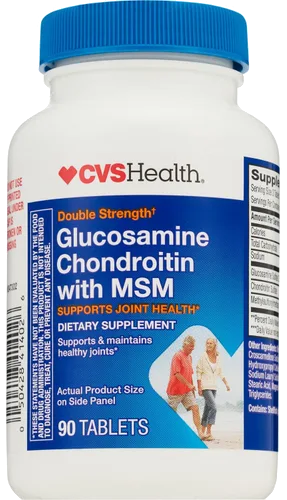
CVS Health Double Strength Glucosamine Chondroitin With MSM Review
CVS Health Double Strength Glucosamine Chondroitin With MSM is an over-the-counter joint-health dietary supplement. It combines three compounds that are commonly used for joint comfort. Third-party listings give the per-serving amounts as about 1,500 mg glucosamine, 1,200 mg chondroitin sulfate and 500 mg methylsulfonylmethane (MSM). The product is also sold as a caplet or tablet, and the serving size is several caplets a day. The "double strength" label refers to the higher per-serving dose compared with CVS's standard formula. Check the Supplement Facts panel on your own bottle, because CVS sells several versions of this product, such as HCl or sulfate forms and "triple strength". I could not retrieve the official CVS product page directly, so the amounts above come from an indexing site (SuppCo). How the ingredients work: - **Glucosamine** is an amino sugar that the body makes naturally. It is a building block for glycosaminoglycans and proteoglycans, which are the structural molecules of articular cartilage and synovial fluid. Supplementing it is intended to supply raw material for cartilage maintenance. Some laboratory work suggests it may also modestly dampen inflammatory signaling in joint tissue, for example through NF-κB pathways. - **Chondroitin sulfate** is a glycosaminoglycan found in cartilage. It draws water into the cartilage matrix and helps it resist compression. It may also inhibit cartilage-degrading enzymes such as matrix metalloproteinases, and it may reduce inflammatory mediators in the joint. - **MSM** is an organic sulfur compound. Sulfur is needed to build connective tissue, including collagen and the sulfated glycosaminoglycans. MSM is also studied for antioxidant and anti-inflammatory effects, and for reducing exercise-related soreness. In practice, these ingredients are thought to work gradually. They are not analgesics in the way a med is. They are meant to support cartilage structure and ease inflammation over weeks, and users are usually advised to take them consistently for roughly 4–12 weeks before judging the effect. Clinical evidence is mixed. Some trials report modest improvement in osteoarthritis pain, and others find results close to placebo. The effect probably varies with the salt form and the person. It is generally considered low-risk. Possible side effects include stomach upset, and caution is advised for people on meds such as a med, people with shellfish allergy (depending on the source), and people with diabetes, pregnancy or other medical conditions. Ask a clinician before starting it. As a supplement, it is not FDA-approved to treat any disease.
We don’t sell supplements. We help you make decisions and get the best price.
Lowest prices
We may earn a commission from some store links. How we choose.
Finding the lowest prices at the stores now. This takes a few seconds.
Products with nearly the same formula (Matched on the main ingredients)
Study, Trial or Testing Result Summary
Members Only58 human studies · 27 improved
1 of these 58 human studies gave glucosamine by injection, not by mouth.
The main studied ingredient here is glucosamine, but the label hides its amount in a blend, so we cannot tell whether it matches the doses used in studies. Chondroitin and methylsulfonylmethane are listed, but no findings for them alone were given. For glucosamine sulfate in knee arthritis, a pooled analysis of 47 trials in over 22,000 people found less pain and slower joint narrowing than placebo, though the estimates were uncertain [1]. A 2024 pooled analysis of nine trials also found less joint narrowing, while adding chondroitin did not clearly improve pain or function [2]. A 3-year trial in 319 women found glucosamine sulfate stopped joint narrowing and eased symptoms [3]. Pain relief, however, looks small: one pooled analysis found a real but small benefit of unclear importance [4]. A 24-week trial of 1,583 people found no clear pain benefit from glucosamine alone, though the combination with chondroitin helped people with moderate to severe pain [5]. A 2-year trial of 605 people found no pain benefit from glucosamine alone, and only the combination with chondroitin slowed joint narrowing [6]. Overall, any benefit is modest and mostly on joint structure. Animal and cell studies are never counted.
See all 58 studies →Hide the studies
- In a pooled analysis of 47 trials of 22,037 people with knee osteoarthritis followed for at least a year, glucosamine sulfate was linked to less pain and less joint space narrowing than placebo, though the estimates were uncertain.Association of Pharmacological Treatments With Long-term Pain Control in Patients With Knee Osteoarthritis: A Systematic…
- In eight trials of 3,793 people with knee osteoarthritis, glucosamine plus chondroitin beat placebo on the overall joint symptom score and slightly on joint space narrowing, but showed no benefit on pain scores.Efficacy and safety of the combination of glucosamine and chondroitin for knee osteoarthritis: a systematic review and m…
- In 16 studies of 901 people with jaw joint osteoarthritis, hyaluronic acid injections with or without glucosamine helped over time, but whether they beat conservative care was inconsistent, and glucosamine was not assessed on its own.Effectiveness of treatments for temporomandibular joint osteoarthritis: a systematic review and meta-analysis.
- In a pooled analysis of trials in hand, hip or knee osteoarthritis, glucosamine gave statistically significant pain relief over placebo, but the effect was small and of unclear clinical importance, with no clinically important effect at long term.Dietary supplements for treating osteoarthritis: a systematic review and meta-analysis.
- In 30 trials in knee or hip osteoarthritis, glucosamine beat placebo only on stiffness, not on pain or function, and the combination with chondroitin lacked enough evidence to beat placebo.Effectiveness and safety of glucosamine and chondroitin for the treatment of osteoarthritis: a meta-analysis of randomiz…
- In nine placebo-controlled trials in knee osteoarthritis, glucosamine sulfate significantly reduced joint space narrowing, and the combination with chondroitin did not significantly improve pain or function.Evaluation of efficacy and safety of glucosamine sulfate, chondroitin sulfate, and their combination regimen in the mana…
- In a review of three small trials of jaw joint osteoarthritis, glucosamine appeared about as effective as a med, with no placebo comparison reported.Interventions for the management of temporomandibular joint osteoarthritis.
- A review of treatments for osteoarthritis found glucosamine hydrochloride had no effect on pain while glucosamine sulfate had a moderate effect, and none of the supplements changed how the disease progressed.Supplementary methods in the nonsurgical treatment of osteoarthritis.
- A review of diet studies in rheumatic diseases found moderate evidence that glucosamine in osteoarthritis gives a small benefit on disease progression.Effects of diet on the outcomes of rheumatic and musculoskeletal diseases (RMDs): systematic review and meta-analyses in…
- A review of 146 studies, mostly on osteoarthritis and joint pain, found over 90% of efficacy studies reported positive outcomes with glucosamine and chondroitin, commonly given at 1500 mg glucosamine daily, with few side effects.The Safety and Efficacy of Glucosamine and/or Chondroitin in Humans: A Systematic Review.
- In 1583 people with painful knee osteoarthritis, 1500 mg of glucosamine daily for 24 weeks did not reduce knee pain significantly better than placebo, though the combination with chondroitin helped a subgroup with moderate-to-severe pain (79.2% vs 54.3%).Glucosamine, chondroitin sulfate, and the two in combination for painful knee osteoarthritis.
- In 1,120 adults with knee osteoarthritis, glucosamine sulfate 500 mg three times daily combined with chondroitin reduced knee pain and improved walking function over 16 weeks, with no difference between the capsule, sachet, and glucosamine hydrochloride versions.Combined glucosamine and chondroitin sulfate, once or three times daily, provides clinically relevant analgesia in knee …
- In 627 adults with knee osteoarthritis, a new fixed-dose glucosamine sulfate 1,500 mg with chondroitin 1,200 mg daily for 24 weeks reduced pain as well as the reference product, with 89.4% of people meeting the responder threshold.Treatment of knee osteoarthritis with a new formulation of a fixed-dose combination of glucosamine sulfate and bovine ch…
- In 606 people with painful knee osteoarthritis, glucosamine hydrochloride plus chondroitin for 6 months reduced pain about as much as a med, with 79.7% meeting response criteria, and had few side effects.Read the study on PubMed (25589511) →
- Over 2 years, 1500 mg daily glucosamine sulfate alone did not reduce knee pain more than placebo, and only the glucosamine plus chondroitin combination slowed joint space narrowing.Glucosamine and chondroitin for knee osteoarthritis: a double-blind randomised placebo-controlled clinical trial evaluat…
- In 407 middle-aged overweight women without knee osteoarthritis, glucosamine sulfate taken for 2.5 years did not significantly reduce the development of knee osteoarthritis compared with placebo.Prevention of knee osteoarthritis in overweight females: the first preventive randomized controlled trial in osteoarthri…
- Over 3 years in 319 postmenopausal women with knee osteoarthritis, glucosamine sulfate stopped joint space narrowing seen with placebo and improved WOMAC symptom scores.Glucosamine sulfate reduces osteoarthritis progression in postmenopausal women with knee osteoarthritis: evidence from t…
- In 255 adults with osteoarthritis, a 4-week course of glucosamine produced pain relief similar to a Chinese herbal capsule, but the herbal capsule scored better on overall joint symptom and quality-of-life measures."Efficacy and safety of Xinfeng capsule in the treatment of osteoarthritis: a multicenter, randomized, double-blinded, c…
- In a placebo-controlled trial of 252 adults with knee osteoarthritis, 1,500 mg daily of glucosamine sulfate for 4 weeks produced a larger drop in Lequesne symptom scores than placebo, and 55% of glucosamine users were responders versus 38% on placebo.Glucosamine sulfate in osteoarthritis of the knee.
- In 251 people with Kashin-Beck disease, glucosamine hydrochloride alone did not significantly improve WOMAC scores over 6 months compared with placebo, while a combination with chondroitin sulfate did.Chondroitin sulfate and/or glucosamine hydrochloride for Kashin-Beck disease: a cluster-randomized, placebo-controlled s…
- In a placebo-controlled trial of 222 adults with hip osteoarthritis, 1500 mg of glucosamine sulfate daily for two years did not reduce pain or stiffness, or slow joint narrowing, better than placebo.Effect of glucosamine sulfate on hip osteoarthritis: a randomized trial.
- In 216 Thai adults with knee osteoarthritis, 1500 mg daily of prescription-grade glucosamine sulfate for 24 weeks did not reduce symptoms more than placebo.A Comparison of Clinical Outcomes Among Undenatured Collagen Type II, Glucosamine Sulfate, and Diacerein on Osteoarthrit…
- In a placebo-controlled trial of 201 adults with chronic knee pain, 1,500 mg daily of glucosamine hydrochloride for 24 weeks did not slow knee cartilage damage or reduce a urine marker of cartilage breakdown compared with placebo.Effect of oral glucosamine on joint structure in individuals with chronic knee pain: a randomized, placebo-controlled cl…
- In 200 people with knee osteoarthritis, 500 mg of glucosamine sulfate three times daily for 4 weeks worked about as well as a med, with 48 percent responding, and caused far fewer side effects.Read the study on PubMed (11548225) →
- In 178 Chinese adults with knee osteoarthritis, 1500 mg glucosamine sulfate daily for 4 weeks significantly reduced symptoms, as effective as a med but with fewer side effects and dropouts.Read the study on PubMed (9638313) →
- In 177 people with hip or knee osteoarthritis taking 1500 mg glucosamine sulfate daily for 26 weeks, 94% reached at least a 20% reduction in WOMAC pain, with or without omega-3 fatty acids added.Effect of glucosamine sulfate with or without omega-3 fatty acids in patients with osteoarthritis.
- In 150 adults with Kashin-Beck disease, oral glucosamine sulfate for 12 weeks significantly reduced pain, stiffness and WOMAC scores compared with placebo, though less than hyaluronic acid injections.Hyaluronic acid and glucosamine sulfate for adult Kashin-Beck disease: a cluster-randomized, placebo-controlled study.
- In 143 adults with knee or hip osteoarthritis, glucosamine hydrochloride for 6 weeks gave better relief of joint pain and stiffness than glucosamine sulfate, with 75.4% of patients rated as effectively treated.[Efficacy and safety evaluation of glucosamine hydrochloride in the treatment of osteoarthritis].
- In 137 people with knee osteoarthritis who had improved on glucosamine, stopping it for 6 months did not lead to more flares than placebo, so no added benefit from continuing was seen.Randomized, double-blind, placebo-controlled glucosamine discontinuation trial in knee osteoarthritis.
- In 136 people with jaw joint osteoarthritis, oral glucosamine plus hyaluronic acid injection gave greater long-term benefit than placebo plus injection at one year, with lower inflammatory markers (IL-6 and IL-1β) and higher TGF-β; the dose was not stated.Glucosamine oral administration as an adjunct to hyaluronic acid injection in treating temporomandibular joint osteoarth…
- In 128 people with knee osteoarthritis, adding glucosamine hydrochloride to a med gave better function and pain scores and lower inflammatory markers than a med alone.Read the study on PubMed (34602400) →
- In a placebo-controlled trial of 120 adults over 90 days, a liquid supplement combining collagen with glucosamine and chondroitin reduced joint pain by 43% and improved joint mobility by 39%, alongside better skin elasticity.Daily oral supplementation with collagen peptides combined with vitamins and other bioactive compounds improves skin ela…
- In 100 Japanese adults with knee pain, a supplement containing 1,200 mg glucosamine daily for 16 weeks improved knee function in both groups, with only some measures of leg strength and walking speed beating placebo and no overall difference from placebo.Glucosamine-containing supplement improves locomotor functions in subjects with knee pain: a randomized, double-blind, p…
- In 98 people with knee osteoarthritis, 500 mg of glucosamine three times daily for 2 months did not reduce pain more than placebo.Randomized, controlled trial of glucosamine for treating osteoarthritis of the knee.
- In 80 adults with Kashin-Beck disease, a chondroitin and glucosamine mixture taken twice daily for 8 months kept knee joint space stable, while the placebo group's joint space narrowed.Effects of chondroitin sulfate and glucosamine in adult patients with Kaschin-Beck disease.
- In 70 adults with knee osteoarthritis over six months, a glucosamine and chondroitin combination improved pain and function scores, but it did not differ from a newer multi-ingredient product, which reduced stiffness more and showed a larger drop in knee joint inflammation on scans.[Comparative efficacy of a combination of undenatured type II collagen, Boswellic acids, methylsulfonylmethane, vitamins…
- In 65 people with knee osteoarthritis, a nutrition formula with glucosamine plus exercise improved WOMAC scores faster than placebo plus exercise, with 63% reaching a clinically important improvement at 3 months versus 31% on placebo.Nutrition supplementation combined with exercise versus exercise alone in treating knee osteoarthritis: a double-blinded…
- In 60 people with knee osteoarthritis flares, adding collagen to a glucosamine and chondroitin combination reduced pain and improved walking more than the same combination without collagen over 8 weeks.[Combination therapy for exacerbations of pain in osteoarthritis with non-fixed combinations].
- In 59 adults with jaw joint osteoarthritis, 1,200 mg daily of glucosamine sulfate for 6 weeks did not reduce pain or improve jaw opening more than placebo.No effect of glucosamine sulfate on osteoarthritis in the temporomandibular joints--a randomized, controlled, short-term…
- In a 12-week placebo-controlled pilot of 54 people, a supplement with glucosamine, chondroitin and collagen improved knee symptoms, quality of life, and stiffness more than placebo.Effects of cartilage-supporting nutritional supplementation on knee osteoarthritis symptoms and quality of life in a 12-…
- In 53 people with knee osteoarthritis, a glucosamine, chondroitin and curcumin supplement with physical therapy improved pain on movement and Lequesne function scores more than placebo, but resting pain did not differ between groups.The efficacy and safety of a combination of glucosamine hydrochloride, chondroitin sulfate and bio-curcumin with exercis…
- In 43 college soccer players without joint disorders, 2 g of glucosamine daily for 16 weeks lowered blood and urine markers of cartilage breakdown compared with placebo, with no supplement-related side effects.Evaluation of the effect of the administration of a glucosamine‑containing supplement on biomarkers for cartilage metabo…
- In 39 women with knee osteoarthritis, adding 1500 mg daily of glucosamine sulfate to exercise for 12 weeks gave no extra benefit over exercise alone for pain, function, or knee cartilage on MRI.Assessment of the effect of glucosamine sulfate and exercise on knee cartilage using magnetic resonance imaging in patie…
- In 36 older adults with knee osteoarthritis doing strength training for 12 weeks, glucosamine lowered a blood marker of cartilage turnover (COMP) by 13% compared with placebo, while a med did not.Read the study on PubMed (19679221) →
- In a 16-week crossover trial of 34 men with knee or low back joint disease, 1500 mg daily glucosamine with chondroitin and manganese ascorbate relieved knee osteoarthritis symptoms more than placebo.Glucosamine, chondroitin, and manganese ascorbate for degenerative joint disease of the knee or low back: a randomized, …
- In a small trial of 31 adults with jaw joint disc displacement, 1,500 mg daily of glucosamine with chondroitin for 8 weeks improved mouth opening and lowered inflammatory markers IL-1β and IL-6 more than tramadol, though pain relief was similar.Effects of glucosamine-chondroitin combination on synovial fluid IL-1β, IL-6, TNF-α and PGE2 levels in internal derangem…
- In 24 adults with knee osteoarthritis, adding glucosamine and chondroitin for 4 weeks to exercise and manual therapy gave no extra benefit on pain, function, or other outcomes.Effects of glucosamine and chondroitin sulfate supplementation in addition to resistance exercise training and manual th…
- In 16 people with degenerated kneecap cartilage, glucosamine sulfate over 6 months reduced pain and improved knee function compared with the control group.Glucosamine sulfate effect on the degenerated patellar cartilage: preliminary findings by pharmacokinetic magnetic reson…
- Glucosamine hydrochloride did not significantly reduce knee osteoarthritis pain compared with placebo on the main questionnaire over 8 weeks, though some secondary measures favored it and 49 percent of users said they were better.Effect of glucosamine hydrochloride in the treatment of pain of osteoarthritis of the knee.
- Over 90 days in adults with knee osteoarthritis, a glucosamine and chondroitin combination reduced pain scores by about 14% and daily-activity scores by 6%, less than the 33% and 20% gains from undenatured type II collagen, with no placebo group.Safety and efficacy of undenatured type II collagen in the treatment of osteoarthritis of the knee: a clinical trial.
- In a small preliminary trial, a glucosamine and chondroitin skin cream applied with ultrasound plus exercise showed no statistically significant difference between groups for knee cartilage pain and stiffness, though some patients had less pain.Phonophoretic application of a glucosamine and chondroitin nanoemulsion for treatment of knee chondropathies.
- In 96 people with exercise-related knee injuries, adding glucosamine hydrochloride tablets to rehabilitation for 8 weeks improved knee scores, pain, and C-reactive protein more than rehabilitation alone; this article has been retracted, so the result should be treated with caution.Comprehensive Rehabilitation Therapy Plus Glucosamine Hydrochloride for Exercise-Induced Knee Injuries and the Effect on…
- In 54 people with osteoarthrosis, 1200 mg daily of glucosamine hydrochloride for 2 months reduced walking pain and stiffness scores and lowered the need for anti-inflammatory painkillers compared with diclofenac, with the benefit lasting about 3 months.[Experience with glucosamine hydrochloride in the treatment of patients with osteoarthrosis].
- In 53 people with knee osteoarthritis, glucosamine sulphate given by iontophoresis, massage, or both for 12 weeks reduced pain and improved knee movement and function in all groups, while joint space width changes differed between methods; no placebo group was used.Symptoms-modifying effects of electromotive administration of glucosamine sulphate among patients with knee osteoarthrit…
- In an uncontrolled study of 46 people with knee osteoarthritis, 3 months of a glucosamine-chondroitin-quercetin supplement improved pain, daily activity and knee joint fluid properties, but 22 people with rheumatoid arthritis showed no such benefit.Effects of an oral administration of glucosamine-chondroitin-quercetin glucoside on the synovial fluid properties in pat…
- In 2030 people with osteoarthritis taking two glucosamine, copper and ginger capsules daily for 6 months, good adherence was seen in 80 percent and was linked to pain reduction; the study had no control group and the glucosamine dose per capsule was not stated.Predictive factors of adherence to an association of glucosamine sulfate, copper, and ginger extracts in patients with s…
- In a long-term study of people with painful knee osteoarthritis, taking anti-inflammatory meds and not meeting physical activity guidelines were linked to more joint space narrowing over one to two years; the abstract does not report a separate effect of glucosamine.Clinical risk factors associated with radiographic osteoarthritis progression among people with knee pain: a longitudina…
- A six-month cost analysis found glucosamine sulphate cost-effective compared with paracetamol and placebo for knee osteoarthritis, though between-group differences in quality-of-life scores were not consistently significant.Glucosamine sulphate in the treatment of knee osteoarthritis: cost-effectiveness comparison with paracetamol.
Review Totals and Summary
Members Only485 reviews
The reviews I could retrieve were limited. They came mostly from Instacart and Influenster for the closely related CVS Double Strength Glucosamine HCl Chondroitin product, plus a few eBay comments on other CVS glucosamine versions. I did not find a large body of reviews for this exact MSM formula. Customers describe it as effective for joint comfort. They report less joint pain and better flexibility, usually after a few weeks of consistent daily use rather than right away. Several reviewers say it suits people who are starting to notice joint stiffness in their 40s and older, and they like that side effects seem minimal. Value is another theme, as shoppers see it as an affordable store-brand alternative to pricier name brands. Reviewers also call the ingredients and the simple packaging and instructions satisfactory. The most common complaint is pill size. The caplets are large and some people find them hard to swallow. People who take several a day find this more annoying, and spreading the doses out helps. Some customers get stomach upset, and taking the caplets with food helps with that. A smaller group felt no benefit at all or had a negative reaction. This matches the general uncertainty about how well these supplements work and how much it varies between people. Some of the Influenster reviews were collected as part of a promotion, so they may lean positive. Treat the overall picture as generally favorable but based on thin evidence.
Biohacker Summary
Members Only8 of 10 recommend it
The panel is split on glucosamine, the main ingredient here, with only a few clear fans: three of the eight who spoke recommend or use it for joint pain, while the rest are neutral or cautious. Those in favor mostly take it for joint comfort and cartilage support, and one also points to possible skin and longevity benefits; one said it helped his knee pain, and he prefers the hydrochloride form over the sulfate form at up to a gram. Several others call the evidence weak, mixed or small, one said people spend a lot for virtually no benefit, and one would skip it for collagen protein. Pairings that came up were whey protein, glutamine and flaxseed oil in a recovery smoothie, and collagen, turmeric and vitamin C in joint formulas, and one panelist advises avoiding the sulfate form during pregnancy.
See all 9 biohackers →Hide the biohackers
Siim Land · Glucosamine · recommends
- States that glucosamine does actually improve joint pain, despite some thinking it's a scam supplement.
- Notes that glucosamine, often considered a gimmick for joint health, may also be beneficial for skin anti-aging due to its sulfur content supporting glutathione production and inhibiting MMPs.
- Notes that Glucosamine Sulfate is known for joint benefits, has anti-inflammatory effects, and even skin anti-aging effects, possibly through its sulfur content aiding glutathione synthesis, rating it as 'good' but not 'god tier'.
- Would include glucosamine in an 'unlimited' supplement stack due to research for joint health and its association with lower heart disease and mortality, though it's not a top priority.
- Recommends glucosamine, stating it has joint benefits, is associated with reduced mortality and heart disease in humans, increases autophagy, and has shown longevity benefits in animal studies.
- Discusses Glucosamine as a popular supplement for joint health, often used for osteoarthritis, but notes that its role in longevity is not as prominent as other compounds.
- Used to take glucosamine in the past but no longer does, as he has already tested most supplements.
- States that Glucosamine Sulfate is known for joint benefits, has anti-inflammatory effects, and skin anti-aging effects, possibly due to its sulfur content aiding glutathione synthesis. He places it in the 'good tier'.
- Increased his glucosamine dosage based on a recommendation, which led to him experiencing diarrhea, indicating his gut could not handle the higher dose.
- Is a fan of orotine and glucosamine sulfate as underappreciated molecules.
Ben Greenfield · Glucosamine · neutral
- Does not personally take D-glucosamine but plans to research its dosage and sourcing after seeing data suggesting it mimics calorie restriction and extends lifespan.
- Mentions glucosamine sulfate as an ingredient in the NOVOS supplement, which has decent human research for cellular longevity and staving off DNA damage.
- Ben Greenfield recommends glucosamine as a natural compound that supports recovery and joint comfort.
- He says that his company Kion combines ancestral nutrients with modern molecules like glucosamine chondroitin.
- Uses glucosamine chondroitin as part of his herbal anti-inflammatories for soreness.
- Says he personally designed and formulated Kion Flex, a complete shotgun formula for joints, containing elements like cidel, mirastoliates, turmeric, glucosamine chondroitin, and tart cherry to heal the body.
- Consumes glucosamine chondroitin along with other nutrients to control inflammation levels.
- Mentions glucosamine sulfate as a substance injected in Prolotherapy to trigger healing.
- Includes glucosamine as an ingredient for joints.
- Recommends glucosamine chondroitin as something that can enhance the effects of Celadrin.
Dave Asprey · Glucosamine · warns
- Notes that people dealing with osteoarthritis typically take high doses of glucosamine, MSM, and similar supplements, spending about $60-70 a month with virtually no benefit.
- Found that taking glucosamine HCL significantly improved his knee pain when he was younger.
- Recommends glucosamine HCL, not glucosamine sulfate, as an affordable old-school supplement for knee and joint pain, suggesting up to a gram.
Thomas DeLauer · Glucosamine · neutral
- Notes that glucosamine chondroitin used to be popular for joint pain, but the literature on its efficacy was weak.
- Notes that the literature for glucosamine and glucosamine chondroitin for joint pain was pretty weak in terms of efficacy.
- Has been taking glucosamine religiously since the 90s after meeting a jacked 63-year-old man who recommended it, leading to the creation of his own 'Joint Warfare' supplement which includes it.
- Mentions that people might suggest glucosamine for joint or muscle stiffness, but implies there are other factors at play.
- Advises skipping glucosamine and chondroitin, suggesting to go straight for a quality collagen protein instead.
Dr. Rhonda Patrick · Glucosamine · neutral
- States they don't use glucosamine chondroitin much and haven't looked into the database in many years, noting mixed evidence and that it wouldn't be their first, second, or third line of defense for consistent injury issues.
- Discusses whether glucosamine chondroitin actually helps joints.
- Considers glucosamine a 'tier two' supplement, noting that while the effect is small, there seems to be some evidence for its efficacy.
- Dr. Rhonda Patrick discusses glucosamine and Alzheimer's.
Dr. Mark Hyman · Glucosamine · uses
- Uses N-acetylglucosamine (NAG), describing it as a safe, non-toxic compound derived from shrimp, to support the gut wall.
- Notes that glucosamine is found only in beef and a lack of it has been associated with harm to the body, including connective tissue dysfunction.
Dr. Eric Berg · Glucosamine · recommends
- Recommends glucosamine for osteoarthritis, noting it is a precursor for cartilage, increases lubrication and synovial fluid in joints, and helps prevent the breakdown of cartilage.
- Recommends N-Acetyl Glucosamine (NAG) as a precursor to the GAG structure, which can help improve psoriasis by controlling rapidly dividing cells, stimulating GAG production in the colon and skin, and providing an immunosuppressive and anti-inflammatory effect.
- Dr. Berg lists glucosamine as a remedy for dental pathogens.
- Recommends glucosamine to help build up the joints and provide relief for osteoarthritis.
- Recommends his Joint Pain Relief product, which he created for himself, containing traditional ingredients like glucosamine, natural vitamin C, Tendoguard collagen for tendons and cartilage repair, adrenal extracts for anti-inflammatory support, stinging nettle root, turmeric, and boswellia.
Peter Attia · Glucosamine · uses
- Would make a smoothie with whey protein isolate, glutamine, glucosamine, and flaxseed oil for recovery after his run.
Bryan Johnson · Glucosamine · warns
- Advises avoiding Glucosamine Sulfate during pregnancy.
- Bryan Johnson takes Glucosamine Sulfate KCI daily as part of his Longevity Mix, which supports cartilage, joints, & skin.
RAL Summary
Members OnlyTier 4 for Joints and Mobility
The review summary comes mostly from a related CVS glucosamine hydrochloride and chondroitin product without methylsulfonylmethane and from other CVS glucosamine versions, not this exact formula, so those reviews are set aside. Its reviews are set aside, so it is graded on its studies alone. Its studied ingredients are not at the doses that worked in studies, and reviews are not strong enough on their own.
- Emerging: not enough evidence to rank higher yet.
- Glucosamine: amount hidden in a blend
Where the evidence disagrees: 14 of the 58 human studies found no effect.
More Details
Members OnlyBody systems · Combine with · Possible side effects
Body systems: Musculoskeletal system
Combine with: Glucosamine, chondroitin, and MSM already form a classic joint-support base for cartilage maintenance and comfort. Consider stacking with omega-3 fatty acids (EPA/DHA fish oil) to help support a healthy inflammatory response, and with turmeric/curcumin (ideally with piperine or in a bioavailable form) or Boswellia serrata for added comfort support. Undenatured type II collagen (UC-II) or hydrolyzed collagen peptides with vitamin C can support cartilage and connective tissue. Hyaluronic acid may help support joint lubrication. Vitamin D3 with K2 and calcium and magnesium help support the bone structure surrounding joints. Note that glucosamine is often derived from shellfish, and chondroitin may interact with meds such as a med, so check with a healthcare provider if you use meds or have shellfish allergies. Benefits usually take 8 to 12 weeks of consistent use.
Possible side effects: No major side effects reported.
Supplement Facts
Total Carbohydrates 2 g · Glucosamine Sulfate 1500 mg · Chondroitin Sulfate 1200 mg
| Calories | 10 | |
| Total Carbohydrates | 2 g | |
| Sodium | 105 mg | |
| Glucosamine Sulfate | 1,500 mg | † |
| Chondroitin Sulfate | 1,200 mg | † |
| Methylsulfonyl-Methane | 500 mg | † |
Other ingredients: Cellulose, Croscarmellose, Contains <2% of:.
Directions: - 3 tablets per day Directions: For adults, take three (3) tablets daily, preferably with a meal.
Barcode (UPC) 050428254325 · Label source: NIH label database · Report a label change
Show entire label
More joint health products
Members OnlyThe highest ranked for the same goal
Read more
Our articles on this subject
Graded November 7, 2026 by the Reverse Age Lab evidence engine, from human studies, real reviews and our biohacker panel. How we grade. Is this medical advice? No. Rala organizes the published evidence; go over any change with your doctor, especially if you take meds.
Privacy policyConsumer health dataAffiliate disclosureTermsDo Not Sell or Share My Personal InformationCookie settings