
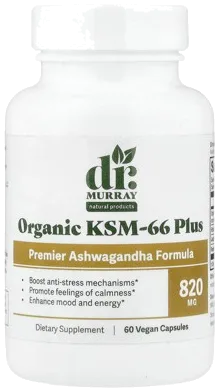
Dr. Murray's Dr. Murray's, Organic KSM-66 Plus, 60 Vegan Capsules Review
We don’t sell supplements. We help you make decisions and get the best price.
Lowest prices
We may earn a commission from some store links. How we choose.
In stock, lowest price first. Checked Nov 17.
- Vitacost$25.99 a bottleThe store does not state the bottle size, so there is no cost per month.Buy at Vitacost (opens in a new tab)
Also at: iHerb · Target · Doctormurray
Study, Trial or Testing Result Summary
Members Only64 human studies · 51 improved
The main ingredient, ashwagandha, is at a full dose of 600 milligrams a day and has strong human support for lowering the stress hormone cortisol. A pooled analysis of 23 placebo-controlled trials with 1706 adults found lower cortisol than placebo [1], and another of nine trials found lower cortisol, stress and anxiety [2]. A third pooled analysis found cortisol fell, but perceived stress did not change significantly [3]. In 141 stressed adults, 600 milligrams a day for 8 weeks lowered cortisol, stress and anxiety [4]. One review noted that no trial directly tested adrenal function. Rhodiola reaches a full dose only at three servings a day. It eased burnout and the morning stress hormone rise in one trial [5] and reduced fatigue in soldiers [6]. However, nursing students on shift work had worse fatigue on it [7], and reviews call the results mixed [8]. The probiotic reaches a full dose only at four servings a day, and no study tested this exact strain. A related strain eased stress and anxiety but did not clearly lower cortisol [9]. Pantethine has no human studies for this goal. Animal and cell studies are never counted.
See all 64 studies →Hide the studies
- Across 23 placebo-controlled trials with 1706 adults, ashwagandha lowered cortisol compared with placebo, raised serotonin and thyroxine modestly, and raised testosterone in men but not women.Hormonal Modulation with Withania somnifera: Systematic Review and Meta-Analysis of Randomized-controlled Trials.
- Across nine randomized trials with 558 people, ashwagandha lowered blood cortisol, perceived stress and anxiety scores compared with placebo, with mild to moderate side effects in four trials.Effects of Ashwagandha (Withania Somnifera) on stress and anxiety: A systematic review and meta-analysis.
- Across seven to eight randomized trials with 488 people taking at least 250 mg daily, ashwagandha lowered cortisol by about 1.16 micrograms per deciliter but did not significantly change perceived stress.Dual impact of Ashwagandha: Significant cortisol reduction but no effects on perceived stress - A systematic review and …
- A review of plant adaptogens including Rhodiola reported benefits for chronic fatigue, thinking problems and immune protection, though human trials are limited and no specific numbers were given.Plant Adaptogens-History and Future Perspectives.
- In a review of 52 trials of plant products, the most consistent finding was that ashwagandha lowered morning cortisol, while effects of most other plants were unclear.Modulation of the hypothalamic-pituitary-adrenal (HPA) axis by plants and phytonutrients: a systematic review of human t…
- In nine trials of stressed people lasting 30 to 112 days, ashwagandha lowered cortisol without significant side effects, but no trial checked effects on adrenal function or long-term outcomes.Effects of Withania somnifera on Cortisol Levels in Stressed Human Subjects: A Systematic Review.
- A review of 19 ashwagandha trials using 120 to 1000 mg daily for 3 to 16 weeks reported less stress and anxiety, better sleep and favourable hormonal changes, though the trials were small and varied.Clinical evidence for the adaptogenic effects of Withania somnifera and Rhodiola rosea - A systematic review with molecu…
- A review of 14 ashwagandha studies using 30 to 600 mg daily found benefits for anxiety, stress and sleep with a pooled cortisol reduction of 3.27 micrograms per deciliter, and noted liver safety concerns.Efficacy and Safety of Saffron and Ashwagandha for Stress-Related Mental Health Outcomes: A Systematic Review of Randomi…
- Across 11 trials of Rhodiola for physical and mental fatigue, results were contradictory: 2 of 6 physical fatigue trials and 3 of 5 mental fatigue trials found it helpful, and all had flaws or risk of bias.Rhodiola rosea for physical and mental fatigue: a systematic review.
- In 543 soldiers with symptoms after returning from high altitude, 15 days of Rhodiola capsules reduced fatigue, drowsiness, chest tightness, palpitations, vertigo and memory loss more than placebo.[Three preparations of compound Chinese herbal medicines for de-adaptation to high altitude: a randomized, placebo-contr…
- In 186 stressed adults over 60 days, full-spectrum ashwagandha root reduced perceived stress, anxiety and improved sleep quality more than placebo, with no change in mental alertness.Effects of multi-herb and ashwagandha root formulas on stress modulation: a randomized, double-blind, placebo-controlled…
- In 161 young cadets, a single dose of Rhodiola extract (standard or 50% higher) reduced fatigue during mental work more than placebo, with no difference between the two doses.A randomized trial of two different doses of a SHR-5 Rhodiola rosea extract versus placebo and control of capacity for m…
- In 141 stressed adults, 600 mg a day of a proprietary ashwagandha root extract for 8 weeks lowered cortisol, stress and anxiety scores, and it beat both standard ashwagandha extract and placebo on stress, anxiety and mood scores.A proprietary herbal extract of ashwagandha root for stress and anxiety in healthy adults: a randomized, double-blind, t…
- In 135 adults with functional constipation, a blend of ashwagandha root and okra fruit extract (300 or 500 mg a day) for 60 days eased constipation, lowered cortisol and the inflammation marker IL-6, and improved sleep, anxiety and depression symptoms.A Novel Herbal Composition Alleviates Functional Constipation, Reduces Gastrointestinal Transit Time, and Improves Bowel…
- In 135 stressed healthy adults, 150 or 300 mg a day of sustained-release ashwagandha for 60 days reduced perceived stress and improved sleep, eating behavior and well-being versus placebo, and the 300 mg dose also lowered cortisol.Efficacy and safety of Ashwagandha root extract sustained-release (AshwaSR) capsules in healthy adult, stressed subjects…
- In 130 stressed healthy adults, 300 mg a day of sustained-release ashwagandha for 90 days lowered stress scores and cortisol and improved memory, sleep quality and well-being compared with placebo.Efficacy and Safety of Ashwagandha Root Extract on Cognitive Functions in Healthy, Stressed Adults: A Randomized, Double…
- In 103 stressed adults given Lactobacillus plantarum P8 daily for 12 weeks, stress, anxiety, inflammatory markers, memory and cognition improved versus placebo, while cortisol was only marginally lower and not significantly different.Probiotic Lactobacillus plantarum P8 alleviated stress and anxiety while enhancing memory and cognition in stressed adul…
- In 100 moderately stressed adults, a single dose of a combination of magnesium, B vitamins, green tea and rhodiola raised relaxed-alert brain activity and reduced subjective stress, anxiety and mood disturbance after a social stress test compared with placebo.A combination of green tea, rhodiola, magnesium and B vitamins modulates brain activity and protects against the effects…
- In 100 people with long COVID symptoms, two weeks of a rhodiola, eleutherococcus and schisandra combination shortened fatigue and pain by one to two days and increased daily walking and lowered IL-6, but most symptom improvements were similar to placebo.Efficacy of Adaptogens in Patients with Long COVID-19: A Randomized, Quadruple-Blind, Placebo-Controlled Trial.
- In 98 chronically stressed adults, a water-extracted ashwagandha root and leaf extract at 125 mg daily for 8 weeks reduced perceived stress compared with placebo, with effects that increased at higher doses of 250 and 500 mg.Effects of Withania somnifera Extract in Chronically Stressed Adults: A Randomized Controlled Trial.
- In 96 male college soccer players, 4 weeks of 2.4 g a day Rhodiola lowered perceived exertion and helped maintain heading height in later repeated trials, with the broadest benefits when combined with caffeine.Effects of Combined Caffeine and Rhodiola rosea Supplementation on Repeated Aerial Duel Performance and Neck Neuromuscul…
- In 91 adults analyzed from 100 randomized, 600 mg daily of ashwagandha root extract for 24 weeks reduced body weight and stress scores more than placebo, with only mild side effects reported.Efficacy and safety of Ashwagandha (Withania somnifera) root extract on stress and weight management in adults: a prospe…
- In 90 adults with mild to moderate stress, 125 mg daily of the Zenroot ashwagandha formulation for 84 days improved stress scores, anxiety, mood and sleep quality compared with placebo, and was well tolerated.A New Ashwagandha Formulation (Zenroot™) Alleviates Stress and Anxiety Symptoms While Improving Mood and Sleep Quality: …
- In 79 patients with major depression taking meds, adding Lactobacillus plantarum 299v for 8 weeks improved attention and verbal memory and lowered kynurenine compared with placebo, but cortisol and inflammatory markers did not change.Probiotic Lactobacillus Plantarum 299v decreases kynurenine concentration and improves cognitive functions in patients w…
- In 70 healthy young men, 7 weeks of a rhodiola and ginkgo supplement raised maximal oxygen uptake more than placebo and kept cortisol and the testosterone-to-cortisol ratio steady, while both worsened on placebo.Dietary supplement with a combination of Rhodiola crenulata and Ginkgo biloba enhances the endurance performance in heal…
- In a 60-day placebo-controlled trial of 64 stressed adults, 300 mg of ashwagandha root extract twice daily lowered stress scores and serum cortisol compared with placebo, with mild side effects similar to placebo.A prospective, randomized double-blind, placebo-controlled study of safety and efficacy of a high-concentration full-spe…
- In a 60-day placebo-controlled trial of 60 stressed adults, 240 mg of Shoden ashwagandha extract once daily produced greater reductions in morning cortisol and the adrenal hormone DHEA sulfate than placebo and lowered anxiety scores.An investigation into the stress-relieving and pharmacological actions of an ashwagandha (Withania somnifera) extract: A…
- In an 8-week placebo-controlled trial of 60 stressed adults, ashwagandha root extract at 250 mg/day and 600 mg/day reduced perceived stress and serum cortisol, and the groups taking it reported better sleep quality than placebo.Adaptogenic and Anxiolytic Effects of Ashwagandha Root Extract in Healthy Adults: A Double-blind, Randomized, Placebo-co…
- In a 30-day placebo-controlled trial of 60 stressed adults, ashwagandha root and leaf extract at 400 mg or 225 mg daily lowered cortisol over time and improved some thinking skills compared with placebo, but mood and stress questionnaire results did not differ by group.Efficacy of Withania somnifera supplementation on adult's cognition and mood.
- In 60 adults with high stress and anxiety, 60 mg or 120 mg a day of ashwagandha extract for 60 days lowered morning cortisol by about 66-67% and raised testosterone, versus about a 2% cortisol change with placebo.Shoden promotes Relief from stress and anxiety: A randomized, double-blind, placebo-controlled study on healthy subjects…
- In 60 women aged 45 to 55, ashwagandha root extract for 56 days reduced menopausal symptoms and stress scores more than placebo, and improved some hormone levels.A prospective, randomized, double-blind, placebo-controlled study on efficacy and safety of Ashwagandha root extract (Wi…
- In a 60-day placebo-controlled trial of 60 adults with stress, anxiety and high blood pressure, 300 mg of Ashwagen twice daily cut serum cortisol by 28.99% along with reducing anxiety and stress scores.Safety and efficacy of ashwagen (a standardized withania somnifera extract) in stress and anxiety with hypertension and …
- In 60 stressed adults, 30 mg a day of ashwagandha extract for 28 days reduced self-reported stress more than placebo and kept saliva cortisol steadier during a stress test, but most other measures showed no difference.An Examination into the Anti-stress and Anti-fatigue Effects of an Ashwagandha Extract (Ashwa.30™) in Stressed Adults: A…
- In 60 adults with stress-related fatigue, 576 mg a day of Rhodiola extract for 4 weeks reduced burnout scores, improved concentration and lowered the cortisol response to waking more than placebo.A randomised, double-blind, placebo-controlled, parallel-group study of the standardised extract shr-5 of the roots of R…
- In a 16-week crossover trial of 57 overweight men aged 40 to 70, 21 mg a day of Shoden ashwagandha extract over 8 weeks raised the hormone DHEA sulfate and testosterone more than placebo, but cortisol and estradiol did not differ and feelings of fatigue and vigor did not improve more than placebo.A Randomized, Double-Blind, Placebo-Controlled, Crossover Study Examining the Hormonal and Vitality Effects of Ashwagand…
- In 56 team sports athletes, 600 mg daily of ashwagandha root extract for 42 days stopped the rise in stress hormone cortisol seen with placebo, improved recovery feelings in female athletes, and increased jump performance in male athletes.Ashwagandha Root Extract Stabilises Physiological Stress Responses in Male and Female Team Sports Athletes During Pre-Se…
- In 56 healthy young physicians on night duty, one low-dose Rhodiola tablet daily for 2 weeks improved mental performance and reduced fatigue compared with placebo in a crossover trial.Rhodiola rosea in stress induced fatigue--a double blind cross-over study of a standardized extract SHR-5 with a repeate…
- In a 60-day placebo-controlled trial of 54 healthy adults taking 500 mg of standardized ashwagandha root extract nightly, morning salivary cortisol fell more than with placebo, alongside better stress and anxiety scores.A standardized Ashwagandha root extract alleviates stress, anxiety, and improves quality of life in healthy adults by mo…
- In an 8-week placebo-controlled trial of 52 adults under chronic stress, 300 mg of ashwagandha root extract twice daily improved stress, food cravings, happiness and body weight measures, with serum cortisol among the secondary measures that improved.Body Weight Management in Adults Under Chronic Stress Through Treatment With Ashwagandha Root Extract: A Double-Blind, R…
- In 50 healthy athletic adults, ashwagandha root extract at 300 mg twice daily for 8 weeks improved maximum aerobic capacity and recovery scores more than placebo, with no adverse events reported.A double-blind, randomized, placebo-controlled trial on the effect of Ashwagandha (Withania somnifera dunal.) root extra…
- In 50 healthy active young adults, 60 mg a day of salidroside (a Rhodiola compound) for 16 days improved oxygen use during intense exercise, reduced a muscle damage marker and kept mood and fatigue stable compared with placebo.Salidroside and exercise performance in healthy active young adults - an exploratory, randomized, double-blind, placebo-…
- In a 14-day placebo-controlled trial of 48 adults with functional constipation, 500 mg a day of a blend of ashwagandha root and okra fruit extract lowered cortisol and IL-6 and reduced stress, with no adverse events reported.A blend of Withania somnifera (L.) Dunal root and Abelmoschus esculentus (L.) Moench fruit extracts relieves constipatio…
- In 48 nursing students on shift work, 364 mg daily of Rhodiola rosea for 42 days led to worse fatigue scores than placebo.Rhodiola rosea for mental and physical fatigue in nursing students: a randomized controlled trial.
- In 48 male volleyball players over four weeks of leg training, taking Rhodiola rosea with caffeine improved jump height and reduced fatigue compared with placebo, though the abstract does not give the Rhodiola dose.Effects of the Combined Supplementation of Caffeine and Rhodiola Rosea with Resistance Training on Lower Limb Explosive …
- In 30 people, one week of Rhodiola rosea pills lowered ultra-weak photon emission from the hands and reduced self-reported tiredness compared with placebo.The influence of adaptogens on ultraweak biophoton emission: a pilot-experiment.
- In 30 men, a single 350 mg dose of a Rhaponticum and Rhodiola herbal blend taken 90 minutes before leg exercise did not change muscle performance fatigue compared with placebo, though participants reported feeling better afterward.The Acute Effects of a Multi-Ingredient Herbal Supplement on Performance Fatigability: A Double-Blind, Randomized, and P…
- In 30 active women, 150 mg per day of salidroside taken with eccentric training for 4 weeks improved late-stage reactive leg strength and lowered muscle damage markers more than training with placebo.Combined Rhodiola rosea and eccentric training boost endurance performance and lower-limb reactive strength in recreatio…
- In 26 healthy men, 600 mg per day of Rhodiola rosea extract for 4 weeks shortened reaction times and raised antioxidant capacity in the blood, but did not change endurance exercise capacity or hormone levels.Effects of Rhodiola rosea supplementation on mental performance, physical capacity, and oxidative stress biomarkers in h…
- In 24 male football players, 4 weeks of Rhodiola rosea improved high-intensity intermittent running and decision-making under fatigue compared with placebo, with lower blood lactate after sprints; the dose was not stated and adrenal function was not measured.Effects of Rhodiola rosea on Physical and Decision-Making Performance in Football Players: A Randomised Controlled Trial…
- In 24 female taekwondo athletes with premenstrual syndrome, 500 mg per day of Rhodiola rosea extract for 10 days eased several premenstrual symptoms, shortened reaction time, and lowered perceived exertion compared with placebo.Short-term Rhodiola rosea supplementation improves premenstrual symptoms, reaction time, and perceived exertion in femal…
- In 21 active college-aged men over 14 weeks of training, a multi-ingredient supplement containing Rhodiola rosea and Cordyceps sinensis did not improve body composition, overall training outcomes, or blood health markers compared with placebo, although both groups gained bench press strength.Effects of Concurrent Training and a Multi-Ingredient Performance Supplement Containing Rhodiola rosea and Cordyceps sin…
- In 18 people, a single dose of Rhodiola rosea taken one hour before exercise lowered heart rate during warm-up, shortened a 6-mile bike time trial, and reduced perceived effort compared with a carbohydrate placebo.The effects of an acute dose of Rhodiola rosea on endurance exercise performance.
- In 18 young adults, four days of Rhodiola rosea extract did not change mental fatigue or visual-thinking performance compared with placebo, but it increased the number of bench press repetitions in some sets and bench pull speed in a non-stressed condition.The Impact of Rhodiola Rosea Extract on Strength Performance in Alternative Bench-Press and Bench-Pull Exercises Under R…
- In a randomized placebo-controlled study of adults with mild allergic rhinitis, a turmeric and ashwagandha combination taken twice daily for 28 days improved nasal symptom scores, sleep quality, energy, and fatigue compared with placebo and a curcumin product; the ashwagandha dose and number of participants were not stated in the abstract.Short-term influence of Immufen™ on mild allergic rhinitis: a randomized, double-blind, placebo-controlled study.
- In a placebo-controlled study of students during a 20-day exam period, a low repeated dose of Rhodiola SHR-5 extract improved physical fitness and mental fatigue compared with placebo; the authors noted the dose may have been too low.A double-blind, placebo-controlled pilot study of the stimulating and adaptogenic effect of Rhodiola rosea SHR-5 extract…
- In 48 professional male basketball players, 28 days of Rhodiola improved simulated game time, endurance, maximal oxygen uptake and antioxidant capacity compared with an empty-capsule control group.The Effect of Short-Term Rhodiola rosea Supplementation on Simulated Game Time, Perceived Fatigue, and Performance in Ba…
- In 20 healthy young men over eight days of heat training, 432 mg daily of Rhodiola SHR-5 gave no added benefit over placebo for endurance, heart rate, temperature or perceived exertion.Influence of Rhodiola rosea on the heat acclimation process in young healthy men.
- In a seven-hour bicycle test, Rhodiola rosea cryopowder improved cardiorespiratory efficiency and delayed fatigue compared with control, though the number of participants and dose were not reported in the abstract.[Effect of cryopowder Rhodiola rosae L. on cardiorespiratory parameters and physical performance of humans].
- During a 45-day bed rest simulating spaceflight, Rhodiola reduced a protective immune signal and slowed the rise of inflammatory cytokines, but did not boost protective T cell immunity.Changes of cytokines during a spaceflight analog--a 45-day head-down bed rest.
- In 101 people with life stress symptoms, 200 mg twice daily of Rhodiola extract for four weeks was followed by improvements in stress symptoms, fatigue and disability, with no serious side effects; there was no placebo group.Therapeutic effects and safety of Rhodiola rosea extract WS® 1375 in subjects with life-stress symptoms--results of an o…
- In an uncontrolled study of 100 adults with prolonged or chronic fatigue, 400 mg of Rhodiola rosea extract daily for 8 weeks was followed by statistically significant fatigue improvement, with no placebo group for comparison.Rhodiola rosea in Subjects with Prolonged or Chronic Fatigue Symptoms: Results of an Open-Label Clinical Trial.
- In 191 healthy adults taking ashwagandha root extract for 12 months, no clinically significant safety problems appeared, serum cortisol fell, quality of life improved, and 68.7% of patients were rated as improved overall.Safety of 12-Months Administration of Ashwagandha ( Withania somnifera ) Standardized Root Extract in Healthy Adults: A …
- In 13 adults with subthreshold insomnia who completed two weeks of 750 mg nightly of a Rhodiola rosea and lotus extract mixture, sleep quality scores improved, but the abstract does not compare this with a control group.Mixture of Rhodiola rosea and Nelumbo nucifera Extracts Ameliorates Sleep Quality of Adults with Sleep Disturbance.
- In foreign students during academic study, the Rhodiola preparation rhodaxon increased physical work capacity and reduced psychological fatigue and anxiety.[The effect of the preparation rodakson on the psychophysiological and physical adaptation of students to an academic lo…
Review Totals and Summary
Members Only37 reviews · 98% positive
Extensive customer reviews and qualitative feedback are currently being aggregated for this product. Check back soon for a detailed sentiment analysis.
Biohacker Summary
Members Only10 of 10 recommend it
Most of the panel is positive on ashwagandha: five recommend it, one uses it, and three stay neutral, with one of the neutral voices calling the data weak and noting it may not help everyone. People take it mainly to lower cortisol, ease stress and anxiety, and improve sleep, and some also link it to testosterone and mood. Doses named were 250 mg a day, 400 to 600 mg, and a wider range of 120 to 1,000 mg taken for at least six weeks, and two panelists prefer standardized patented extracts. One advises two weeks on then two weeks off, one recommends it in the evening or at night, one suggests it only after cortisol patterns are sorted out, and one stopped after it caused a mouth sore. Rhodiola, a smaller ingredient in this product, is the herb most often paired with it for stress and energy.
See all 10 biohackers →Hide the biohackers
Thomas DeLauer · Ashwagandha · recommends
- Recommends ashwagandha, but only after establishing proper cortisol patterns, as it helps the testosterone-cortisol axis by removing cortisol-mediated suppression of testosterone.
- Recommends taking Rhodiola rosea in the morning with breakfast to balance stress hormone feedback, reduce fatigue, and normalize cortisol rhythm without flattening the morning cortisol curve.
- Recommends ashwagandha extract, noting a study where 57 overweight men over 40 saw a 14.7% increase in testosterone and an 18% increase in DHEA over 16 weeks, suggesting it removes the cortisol block suppressing the entire hormonal cascade.
- Mentions ashwagandha as part of a full testosterone protocol, supporting production through different pathways.
- Describes rhodiola as a great adaptogen primarily for pure stress mitigation, distinguishing it from salidrosides which also have mitochondrial effects.
- Mentions Rhodiola Rosea as an adaptogen that increases oxygenation in the blood because it adapts to low oxygen conditions.
- Recommends ashwagandha, noting it modulates the HPA axis and dropped cortisol by approximately 23% in 60 days, but advises cycling it, especially if feeling emotionally numb.
- Recommends Rhodiola for inhibiting MAO/COMT, thereby keeping serotonin and dopamine active.
- Cautions against Ashwagandha due to its potential for emotional numbing effects.
- Suggests ashwagandha at night to help regulate cortisol, but advises playing around with it as some people find it makes them feel weird.
- Recommends Ashwagandha, Rhodiola, and Ginseng as adaptogens to help the body adapt to stress, bring cortisol levels back to homeostasis, and support heat shock proteins and stress chaperoning pathways, especially when in a caloric deficit.
- Recommends Rhodiola, Ginseng, and Ashwagandha as adaptogens to help the body adapt to stress, bring cortisol levels back to homeostasis, and support heat shock proteins and stress chaperoning pathways, especially when in a caloric deficit.
- Recommends Ashwagandha in the evening time for its anti-cortisol effect, helping to regulate cortisol for better balance in the morning.
- Recommends ashwagandha as an adaptogen with a profound effect on cortisol, acknowledging that it can make some people feel numb but may still be helpful.
Dr. Mark Hyman · Ashwagandha · recommends
- Lists ashwagandha as an herb that can help lower anxiety or depression symptoms.
- Lists rhodiola rosea as an herb that can help lower anxiety or depression symptoms.
- Notes that there was a recent study on ashwagandha for sperm health, indicating it's an evolving area of research.
- Suggests trying ashwagandha, noting that some people respond to it, and recommends a dose of 400 to 600 mg.
- Recommends adaptogenic herbs like ashwagandha, particularly at night, rhodiola, lemon balm, and catclaw for stress relief.
- Recommends adaptogenic herbs like ashwagandha, particularly at night, rhodiola, lemon balm, and catclaw for stress relief.
- Recommends ashwagandha at night as an adaptogen to help with high cortisol and promote sleep for those who are tired and wired.
- Recommends rhodiola as an herbal supplement for deep sleep and relaxation, especially for those who are tired, wired, and stressed.
- Recommends ashwagandha, stating it can help convert T4 to T3, but advises ensuring a clear source and monitoring liver enzymes.
- Suggests adaptogens like rhodiola, ashwagandha, ginseng, and Siberian ginseng can be helpful for actively managing stress.
- Suggests adaptogens like rhodiola, ashwagandha, ginseng, and Siberian ginseng can be helpful for actively managing stress.
- States that Mosh protein bars contain ashwagandha to support a healthy brain.
- Recommends stimulating supplements like Rhodiola for spontaneous brain types to improve happiness.
- Recommends adaptogens like Ashwagandha if one has a lot of stress.
Dr. Eric Berg · Ashwagandha · recommends
- Recommends ashwagandha, suggesting 250 milligrams per day over time to increase stress tolerance and help the cortisol receptor.
- Rates Ashwagandha on a scale from 1 to 10.
- Lists ashwagandha as one of the best ways to lower luteinizing hormone, which goes too high as people age and is related to dementia.
- Notes that some people take ashwagandha or other adaptogens to help calm them down when they assume their problem is cortisol, and sometimes it works.
- States that taking ashwagandha on a regular basis can greatly help the adrenals.
- Recommends Ashwagandha to help make the process of quitting coffee smoother.
- Recommends taking adaptogens like ashwagandha for super powerful and real energy inputs without artificial side effects.
- Recommends Ashwagandha to help sleep through the night.
- Recommends taking Ashwagandha in the evening before bed as a remedy for problems with elevated cortisol around 2 AM, when cortisol should be at its lowest point.
- Recommends trying ashwagandha to lower stress levels.
- Rhodiola is good for stamina and is a natural energy booster, but it doesn’t reduce stress or anxiety.
- Discusses rhodiola as an adaptogen that may help with exercise endurance by increasing efficiency in the body, rather than just reducing perceived effort.
- Highlights fascinating data showing Rhodiola is a prominent anti-altitude sickness remedy, helping people adapt to lower oxygen levels at high altitudes by decreasing oxygen consumption and increasing oxygen transportation.
- Recommends the herb rhodiola as a good adaptogen for problems related to stress.
Siim Land · Ashwagandha · recommends
- Recommends Ashwagandha for stress, sleep and performance, based primarily on human research, especially randomized controlled trials showing measurable benefits.
- Lists Ashwagandha as one of 15 supplements backed by human studies.
- Notes that Ashwagandha is one of several supplements with human evidence.
- States that ashwagandha, unless contaminated, is not going to raise liver enzymes.
- Stopped taking ashwagandha because it immediately caused a mouth sore.
- States that ashwagandha consistently reduces stress and anxiety in randomized controlled trials.
- States that Rhodiola rosea is not going to reduce fatigue if one is mentally or overall exhausted, and that there is not enough evidence yet to support claims of lowering stress and anxiety or increasing VO2 max.
- States that Ashwagandha helps with testosterone primarily in stressed out or poor sleeping people.
- States that ashwagandha has strong evidence for increasing testosterone, mostly in stressed or infertile men.
- Mentions ashwagandha as an example of a testosterone-boosting supplement he has no interest in taking.
- Places Ashwagandha, specifically the KSM66 form, in the 'god tier' due to extensive research supporting its benefits for stress, sleep, testosterone production, estrogen, and even V2 max, while personally not experiencing any negative side effects some people report.
- Places Rhodiola Rosea in the 'good' tier, acknowledging it as an adaptogen with mixed evidence for V2 max and hormones, but some evidence suggests it helps with hormones, stress, and exercise performance.
- Recommends Rhodiola Rosea for stress.
- Notes that a 2025 study found giving mice the probiotic strain Lactyliplantibbacillus plantarum DT88 increased polystyrene excretion by 34% and reduced residual polystyrene particles in the intestine by 67%.
Ben Greenfield · Ashwagandha · neutral
- Ashwagandha, taken as 120–1,000 mg for at least 6 weeks, with most studies providing a dose of 400–600 mg/d, can lower cortisol levels, improve sleep quality, and enhance cognitive resilience for athletes during challenging phases consisting of high-volume resistance training.
- Notes that ashwagandha is an ingredient in MTE.
- Mentions Ashwagandha as a supplement people cycle through when still sleeping poorly, suggesting it might not be addressing the true sleep problem.
- Notes that ashwagandha is a nightshade herb, but it is taken as a supplement and not used for cooking.
- Was already taking rhodiola, which they noted was an ingredient in the Novos product.
- Recommends Rhodiola to help retrain the brain to be less excitable, as part of a strategy to dampen the stress response and improve sleep.
- States that Ashwagandha helps regulate stress response and steady the nervous system, influencing biological systems tied to sleep quality.
- Has found that adaptogens like ashwagandha, taken about half an hour before using the Shift Wave, seem to enhance its effects on tuning up the nervous system. He also found it helped him and his co-founder achieve slower respiratory heart rate coherence.
- Has found that adaptogens like rhodiola, taken about half an hour before using the Shift Wave, seem to enhance its effects on tuning up the nervous system.
- Uses Ashwagandha, as part of IM8 Health, to quiet the stress response for sleep.
- Mentions ashwagandha as an herb that has more data than fruit tree leaves.
- Ben Greenfield notes that IM8 contains ashwagandha, an adaptogen, to help manage stress and support the immune system.
- Ben Greenfield notes that IM8 contains rhodiola, an adaptogen, to help manage stress and support the immune system.
- Sometimes takes ashwagandha to help get back to sleep if he wakes up in the middle of the night.
Dave Asprey · Ashwagandha · neutral
- Dave Asprey notes that ashwagandha, when taken as a real standardized extract at a real dose, genuinely lowers cortisol and shows effects on stress and sleep quality in randomized trials, but lacks polysomnography data.
- Dave discusses options like a med and Rhodiola rosea that support norepinephrine and dopamine, and how they compare.
- Uses Rhodiola Rosea, an adaptogenic herb, to help keep norepinephrine at optimal levels in the prefrontal cortex, reduce cortisol, and improve mental performance under stress, noting it has somewhat similar but not as strong effects as a med.
- Dave Asprey discusses ashwagandha as part of an adaptogen trio that works together for stress response and human performance.
- Mentions ashwagandha as an adaptogen in MTE that helps blunt the cortisol spike.
- Suggests that rhodiola can provide more drive because it helps with the production of both cortisol and dopamine.
- Advises against ashwagandha for low cortisol, stating that salt and water are needed instead.
- Recommends Rhodiola rosea to balance cortisol, support mood and focus, and help with norepinephrine, noting that the combination with a med is powerful.
- Warns that ashwagandha can raise testosterone in women, causing irritability, and therefore needs to be cycled.
- Dave Asprey mentions ashwagandha as a supplement and cofactor that supports thyroid activation.
- Recommends ashwagandha as a cofactor that can help thyroid function, especially with conversion issues.
- Dave Asprey lists ashwagandha as part of a supplement stack that supports healthy hormone levels.
- Recommends Rhodiola the day after doing ketamine to restore norepinephrine reserves.
- Discusses how to stack nicotine with rhodiola for maximum energy and motivation, and for sharper thinking and sustained focus.
Peter Attia · Ashwagandha · neutral
- Peter reviews the evidence for select off-label medications and supplements commonly used for sleep, including glycine, magnesium, ashwagandha, and phosphatidylserine.
- Finds ashwagandha a little bit helpful for sleep, though notes it may not be for everyone.
- Finds ashwagandha "a little bit helpful" for sleep, but notes that it may not be for everyone.
- Finds ashwagandha a little bit helpful for sleep, but notes it may not be for everyone.
- States that the data for ashwagandha are weak.
- Discusses the current evidence for ashwagandha's effects on sleep, stress, and anxiety.
- Mentions ashwagandha as an evergreen shrub historically used in traditional Indian medicine for indications such as sleep, stress, and immune health.
- Mentions ashwagandha as something that can help with sleep in the setting of chronic stress and hypercortisolemia.
- Takes 600 mg of Solgar ashwagandha at night, having recently switched to this brand and returned to taking it after a previous hiatus.
- Takes 600 milligrams of ashwagandha at night, having recently switched to the Solgar brand and having returned to taking it after a long break.
- Takes 600 mg of Pantethine twice a day for cholesterol.
Andrew Huberman · Ashwagandha · recommends
- He shares science-based tools for modulating aggression, including supplementation with ashwagandha.
- Warns that while ashwagandha is a potent inhibitor of cortisol, chronic supplementation for longer than two weeks can disrupt other hormone and neurotransmitter pathways, so it should be used with a two-week break after two weeks of use.
- Recommends Ashwagandha as a supplement to reduce cortisol.
- Explains how to optimize hormone levels through supplements such as ashwagandha.
- Mentions ashwagandha as a potent commercial compound in supplement form that can be used to reduce chronic stress, especially late in the day, by significantly decreasing cortisol.
- Discusses Ashwagandha as a supplement to better manage stress.
- Uses ashwagandha when feeling particularly stressful to lower anxiety and cortisol, but does not take it year-round or on a regular basis.
- Takes ashwagandha for sleep.
- Recommends Ashwagandha as a good adaptogen, but advises cycling it if taking high doses due to potential issues with liver and thyroid.
- Suggests using Rhodiola stacked with L-theanine to help with sleep, particularly for women experiencing insomnia due to hot flashes and menopausal symptoms.
- Has used Rhodiola Rosea for many years and has started taking it before workouts, finding that he could push much harder and longer through weight training sessions with minimal fatigue.
- Warns that taking ashwagandha as a prophylactic or before training is counterproductive because it blunts cortisol, which can cause immunosuppression and suppress adaptation.
- States that Rhodiola rosea is very effective and has been shown in multiple randomized trials to lower cortisol, and she personally takes it later in the day, finding it improves her late-day cognition.
- Mentions Rhodiola Rosea as a supplement.
Dr. Rhonda Patrick · Ashwagandha · recommends
- Recommends Ashwagandha supplementation, specifically standardized for withanolides (KSM-66 at 5% or Sensoril at 10%), to indirectly boost testosterone by reducing cortisol levels, and also to improve anxiety, stress resilience, and sleep quality.
- Recommends ashwagandha, specifically patented extracts like Sensoril or KSM66 standardized to sufficient quantities of withanolides, for its indirect effect on testosterone by suppressing cortisol and stress response, which can be beneficial for anxious individuals and improve sleep.
- Rhodiola rosea reliably boosts muscle endurance and reduces fatigue during intense exercise. Most benefits are seen around 150mg/day, with some studies testing doses as high as 800mg.
- Asks if one should supplement with Rhodiola rosea.
- Mentions rhodiola in comparison to beetroot juice, noting that the science for beetroot juice is more robust.
- Has been using Rhodiola Rosea for over a decade and notes that it shows benefits for muscle endurance and mitigates the stress response without compromising performance, recommending a starting dose of 150 milligrams in the morning.
- Discusses Rhodiola rosea as a potential fatigue fighter or placebo.
- Is very bullish on Ashwagandha, citing meta-analyses showing improved lean mass, strength, sleep, and stress management. He notes it also raises testosterone but not enough to explain the lean mass changes.
- Really likes Rhodiola Rosea as a cognitive enhancer and adaptogen, noting it improves time to fatigue, perception of fatigue, and mental fatigue. He suggests a dose between 100 to 600 milligrams.
- Discusses ashwagandha.
- Discusses Rhodiola rosea.
- Uses ashwagandha as a supplement to help with sleep.
- Dr. Rhonda Patrick discusses curcumin & ashwagandha safety.
- His regular sleep supplements are glycine, ashwagandha, magnesium L-threonate, and magnesium oxide.
Bryan Johnson · Ashwagandha · uses
- Drinks his Blueprint longevity mix with additional morning supplements, including ashwagandha.
- Drinks his Blueprint longevity mix with additional morning supplements, including rhodiola.
- States that Blueprint Ashwagandha can be used to stabilize mood.
- States that Blueprint Rhodiola can be used to stabilize mood.
- Mentions that Ashwagandha is included in the LA Longevity Mix, which condenses his 100 daily pills into a drink.
- Mentions ashwagandha as a potential therapy that could positively influence sperm health.
- Mentions ashwagandha as an ingredient in his 'bag of goodies', indicating he uses it.
- Takes ashwagandha for anti-anxiety, improved cortisol management, improved sleep, and increased testosterone.
- Recommends ashwagandha at 300 to 600 mg daily to support stress resilience and overall well-being during the luteal phase for women.
- Ashwagandha + Rhodiola is part of the Blueprint protocol for energy and stress support.
- Suggests ashwagandha as an optional supplement to support calmness and resilience during stress, and to support the body's healthy response to stress.
- Lists "Ashwagandha + Rhodiola" with "120mg" as part of his supplements, implying its use.
- Recommends rhodiola at 200 to 400 mg daily to support stress resilience and overall well-being during the luteal phase for women.
- Suggests rhodiola as an optional supplement to support calmness and resilience during stress, and to support the body's healthy response to stress.
RAL Summary
Members OnlyTier 4 for Adrenal Support
Ashwagandha is well supported for lowering cortisol and stress, with 28 of 31 human studies showing improvement [1]. The product stays at the emerging tier because it has only 47 reviews, below the number needed to rank higher.
Take 4 servings a day to match the dose that worked in the studies.
- Emerging: not enough evidence to rank higher yet.
Where the evidence disagrees: 4 of the 64 human studies found no effect.
More Details
Members OnlyBody systems · Combine with · Possible side effects
Body systems: Endocrine system, Nervous system, Digestive system
Combine with: Combine with a healthy diet and lifestyle.
Possible side effects: Mild to moderate side effects were reported in four ashwagandha trials. In one Rhodiola trial, shift-working nursing students had worse fatigue than on placebo.
Supplement Facts
Organic KSM-66 Ashwagandha® 600 mg · Rhodiola rosea extract 120 mg · Lactiplantibacillus plantarum LP815® 50 mg
| Organic KSM-66 Ashwagandha® | 600 mg | † |
| Rhodiola rosea (root) extract | 120 mg | † |
| Lactiplantibacillus plantarum LP815® | 50 mg | † |
| Pantethine | 50 mg | † |
Other ingredients: Hydroxypropyl methylcellulose, microcrystalline cellulose and monolaurin.
Directions: Two capsules daily or as directed by your health care provider.
Label source: Reverseagelab · Report a label change
Show entire label

More adrenal support products
Members OnlyThe highest ranked for the same goal
Read more
Our articles on this subject
- Ashwagandha vs Rhodiola: What the Human Studies Show About EachArticle · Nov 18, 2026
- Supplements for Stress and Anxiety Relief: What the Evidence SupportsArticle · Oct 26, 2026
Graded November 22, 2026 by the Reverse Age Lab evidence engine, from human studies, real reviews and our biohacker panel. How we grade. Is this medical advice? No. Rala organizes the published evidence; go over any change with your doctor, especially if you take meds.
Privacy policyConsumer health dataAffiliate disclosureTermsBrand and legal noticesDo Not Sell or Share My Personal InformationCookie settings