
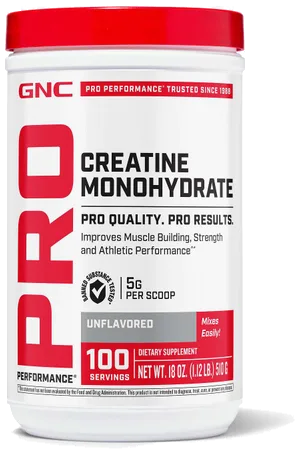
GNC Pro Performance Creatine Review
We don’t sell supplements. We help you make decisions and get the best price.
Lowest prices
Lowest cost per month first, in stock, at 1 serving a day. Checked Nov 19.
- GNCLowest$19.99 a bottle$6.00/moBuy at GNC (opens in a new tab)
- AmazonPrice at AmazonCheck price at Amazon (opens in a new tab)
Also at: Walmart
Some store links earn us a commission.
Study, Trial or Testing Result Summary
Members Only94 human studies · 50 improved
This product gives 5 grams of creatine monohydrate a day, above the 3 grams that worked in studies. Creatine is one of the best-studied supplements for building muscle. A pooled analysis of 143 trials found creatine added about 0.82 kilograms of lean mass and slightly lowered body fat, with larger effects alongside strength training [1]. Another analysis of 61 trials found about 1.39 kilograms more lean mass than placebo in both new and experienced lifters [2]. In adults under 50, creatine with strength training raised upper-body strength by 4.4 kilograms and lower-body strength by 11.4 kilograms more than placebo, with clearer gains in men [3]. Across 69 trials, it modestly improved bench press, squat, jump height and power, but not handgrip or leg press strength [4]. In older adults and people with chronic illness, pooled trials showed better chair-stand performance, strength and lean mass, though the evidence quality was low [5]. In dialysis patients taking 5 grams daily for a year, 65% gained muscle compared with about 16% on placebo [6]. Animal and cell studies are never counted.
See all 94 studies →Hide the studies
- In a pooled analysis of 29 trials with 2,255 older adults, creatine (among other nutrients such as amino acids) significantly improved muscle mass, though the best dose and duration were not established.Factors influencing the efficacy of nutritional interventions on muscle mass in older adults: a systematic review and me…
- Across 69 trials with 1,937 adults, creatine plus resistance training modestly improved bench press, squat, jump height and peak power versus placebo, but not handgrip or leg press strength, with clearer benefits in younger adults and men.The Effects of Creatine Supplementation on Upper- and Lower-Body Strength and Power: A Systematic Review and Meta-Analys…
- In 1387 adults doing resistance training, multi-ingredient protein supplements (often protein plus creatine) added about 0.8 kg of lean mass and some strength compared with non-multi-ingredient supplements, but were not better than protein alone.Do multi-ingredient protein supplements augment resistance training-induced gains in skeletal muscle mass and strength? …
- Across 33 placebo-controlled trials with 1076 older adults and adults with chronic disease, creatine improved sit-to-stand performance, upper-body and handgrip strength, and lean tissue mass, though the evidence quality was low or very low.Creatine supplementation for optimization of physical function in the patient at risk of functional disability: A system…
- In 763 women across 14 trials combining supplements (protein, amino acids, creatine) with exercise, muscle mass did not improve but bench press and handgrip strength did, particularly in creatine studies.Nutritional Supplementation Combined with Exercise for Musculoskeletal Health in Women: A Systematic Review and Meta-Ana…
- In 608 postmenopausal women across seven trials, creatine added about 0.37 kg of lean mass and 7.5 kg of leg-press strength, mainly at 5 g or more per day with resistance training, with no change in bone density.Creatine monohydrate for lean mass, strength, and bone density in postmenopausal women: a systematic review and meta-ana…
- In 509 adults under 50 across 23 trials, creatine with resistance training raised upper-body strength by 4.4 kg and lower-body strength by 11.4 kg more than placebo, with clearer gains in males than females.Effects of Creatine Supplementation and Resistance Training on Muscle Strength Gains in Adults <50 Years of Age: A Syste…
- In 14 trials with 364 people with muscle diseases, creatine raised muscle strength in muscular dystrophies by about 8.5% over placebo but did not improve strength in metabolic muscle diseases, and high doses worsened daily activities and muscle pain in McArdle disease.Creatine for treating muscle disorders.
- In 357 older adults doing resistance training for about 13 weeks, adding creatine increased fat-free mass, chest press and leg press strength, and chair-stand performance more than training alone.Creatine supplementation during resistance training in older adults-a meta-analysis.
- In 10 trials of 211 older women, creatine with resistance training increased upper-body strength but not lower-body strength or muscle mass overall, with gains in both strength types when training lasted 24 weeks or more.Efficacy of Creatine Supplementation Combined with Resistance Training on Muscle Strength and Muscle Mass in Older Femal…
- Pooling placebo-controlled studies, creatine produced small but significant gains in lean body mass and short high-intensity exercise performance, with larger effects for upper-body exercise and no difference by sex or training status.Effect of creatine supplementation on body composition and performance: a meta-analysis.
- Pooled trials in older adults doing resistance training showed creatine gave greater gains in lean tissue mass and strength than placebo, including when taken only on training days, though strength benefits depended partly on a loading phase.Meta-Analysis Examining the Importance of Creatine Ingestion Strategies on Lean Tissue Mass and Strength in Older Adults…
- In ten trials of healthy adults training for at least 6 weeks, creatine added a very small increase in muscle size measured by imaging, about 0.10 to 0.16 cm in muscle thickness.The Effects of Creatine Supplementation Combined with Resistance Training on Regional Measures of Muscle Hypertrophy: A …
- Across 143 trials, creatine increased fat-free mass by 0.82 kg and reduced body fat percentage by 0.28 points, with larger effects when combined with resistance training.Creatine supplementation protocols with or without training interventions on body composition: a GRADE-assessed systemat…
- In twelve trials of adults under 50 doing resistance training, creatine added 1.14 kg of lean mass and reduced fat mass by 0.73 kg compared with training alone.The Effect of Creatine Supplementation on Resistance Training-Based Changes to Body Composition: A Systematic Review and…
- Pooled trials showed creatine significantly increased muscle strength, with greater gains in untrained people, with low-to-moderate doses, and with high-intensity training.Effects of creatine supplementation on muscle strength gains-a meta-analysis and systematic review.
- Across 61 trials, creatine added 1.39 kg of fat-free mass compared with placebo in both novice and experienced lifters, with no significant difference between the two groups.Creatine supplementation and resistance training: a comparison between novice and experienced lifters - a systematic rev…
- In seven studies of 463 people with cancer, creatine did not clearly improve lean body mass compared with placebo, and effects on weight and fat mass varied.Effect of Creatine Supplementation on Body Composition in Cancer Patients: A Systematic Review.
- Across 7 trials with 263 adults, taking creatine and β-alanine together for at least 4 weeks improved high-intensity exercise performance, but did not improve maximal strength or body composition more than creatine alone, and results for lean mass were mixed.Effects of Creatine and β-Alanine Co-Supplementation on Exercise Performance and Body Composition: A Systematic Review.
- In children with spinal muscular atrophy types II and III, creatine showed no clinically important change in motor function compared with placebo across trials lasting three to 24 months.Drug treatment for spinal muscular atrophy types II and III.
- A review of 8 trials in healthy people over 65 combining supplements with exercise, including creatine, concluded the combination may improve strength, balance and speed.[Exercise and nutritional supplements; effects of combined use in people over 65 years; a systematic review].
- In 37 trials of adults aged 60 and over, exercise improved muscle mass and function, but adding supplements including creatine gave extra benefit in only about a quarter of studies.Nutrition and physical activity in the prevention and treatment of sarcopenia: systematic review.
- A systematic review of 23 trials in adults over 60 found six creatine trials showed no consistent effect on muscle mass, strength or physical performance.Effects of Protein, Essential Amino Acids, B-Hydroxy B-Methylbutyrate, Creatine, Dehydroepiandrosterone and Fatty Acid S…
- In older adults, creatine added to exercise may improve muscle strength and lean mass when taken as a continuous low daily dose with at least 12 weeks of resistance training, but benefits were not seen for mental health and effects on bone and cognition remain unclear.The Additive Effects of Creatine Supplementation and Exercise Training in an Aging Population: A Systematic Review of Ra…
- After anterior cruciate ligament reconstruction, creatine in one included trial produced no statistically significant gain in strength or muscle size of the operated leg compared with control.[Effect of dietary supplements and whey protein on muscle mass and strength of the operated limb after anterior cruciate…
- This review of reviews found creatine during resistance training safely increased total and lean body mass, strength and performance in short, repeated high-intensity tasks in healthy young people and athletes.Performance-Enhancing Drugs in Healthy Athletes: An Umbrella Review of Systematic Reviews and Meta-analyses.
- In breast cancer patients, creatine showed limited or no benefit for fatigue or muscle strength in the trials reviewed.Impact of Dietary Supplements on Clinical Outcomes and Quality of Life in Patients with Breast Cancer: A Systematic Revi…
- In 19 studies of combat sport athletes, creatine increased body mass, fat-free mass, strength and power, but did not change endurance, recovery or fatigue, with no serious side effects.Creatine Supplementation in Combat Sport Athletes: A Narrative Systematic Review.
- In 237 postmenopausal women over 2 years, creatine with exercise increased lean tissue mass compared with placebo in completers, but did not increase bench press or squat strength and did not change bone density.A 2-yr Randomized Controlled Trial on Creatine Supplementation during Exercise for Postmenopausal Bone Health.
- In 200 postmenopausal women with osteopenia over two years, 3 grams of creatine daily did not improve bone health, lean mass or muscle function compared with placebo.Creatine Supplementation (3 g/d) and Bone Health in Older Women: A 2-Year, Randomized, Placebo-Controlled Trial.
- In 200 pre-frail and frail older adults doing resistance training for 16 weeks, adding creatine did not improve muscle mass or strength compared with placebo.Supplement-based nutritional strategies to tackle frailty: A multifactorial, double-blind, randomized placebo-controlled…
- In 104 people with amyotrophic lateral sclerosis taking 5 g of creatine daily for 6 months, creatine produced no measurable benefit on muscle strength or function compared with placebo.A clinical trial of creatine in ALS.
- In 103 older adults doing resistance training for 16 weeks, taking 3 g of creatine daily added benefits to strength and daily function and lowered inflammation and oxidative stress markers compared with placebo.Effects of high-load, velocity-intentional variable resistance training combined with creatine supplementation on neurop…
- In 80 resistance-trained men, a pre-workout supplement containing 2 grams of creatine nitrate improved some thinking test scores and strength at 4 weeks, but these benefits were similar to placebo by 8 weeks and body composition did not differ.Effects of ingesting a pre-workout dietary supplement with and without synephrine for 8 weeks on training adaptations in…
- In older adults doing supervised resistance training for one year, creatine increased lower-leg muscle density more than placebo, with some favorable bone area changes.Efficacy of Creatine Supplementation and Resistance Training on Area and Density of Bone and Muscle in Older Adults.
- In 69 young adults during 5 weeks of strength training, a mix of creatine, whey protein and conjugated linoleic acid gave a larger gain in strength and lean mass than the other groups, though the creatine effect could not be separated from the other ingredients.Conjugated linoleic acid combined with creatine monohydrate and whey protein supplementation during strength training.
- In 64 middle-aged and older adults over 12 weeks, 10 grams of creatine per day (5 grams twice daily) increased lean tissue mass and strength with or without exercise and diet, and improved some memory and thinking test scores compared with placebo.Effects of creatine supplementation with and without exercise and diet intervention on body composition, cognitive funct…
- In 63 adults taking 5 grams per day of creatine for 13 weeks, lean body mass rose 0.5 kg more than controls after a 7-day start, mainly in women, but added resistance training gave no extra lean mass gain over 12 weeks.The Effect of Creatine Supplementation on Lean Body Mass with and Without Resistance Training.
- In 60 vulnerable older women over 24 weeks, creatine combined with resistance training increased leg strength and appendicular lean mass more than placebo or creatine alone, while creatine alone matched resistance training alone for lean mass gains.Creatine supplementation and resistance training in vulnerable older women: a randomized double-blind placebo-controlled…
- In 60 young men doing resistance training for 8 weeks, taking creatine (25 g daily for 5 days, then 5 g daily) lowered homocysteine within the group, but the change was not significantly different from placebo or control.Creatine supplementation alters homocysteine level in resistance trained men.
- In older women over 24 weeks, creatine added nothing to the muscle strength gains from strength training; training alone improved strength compared with no training.Creatine supplementation associated or not with strength training upon emotional and cognitive measures in older women: …
- In 50 people with Down syndrome, 5 grams of creatine daily for 6 months (after a 5-day loading phase) reduced arm and leg fat percentage versus placebo but did not change total fat or lean mass.Creatine supplementation modifies fat deposition in arm and leg tissues in individuals with Down syndrome.
- In 49 healthy older men, 20 weeks of a twice-daily supplement containing creatine, whey protein, vitamin D and fish oil increased lean mass and strength over 6 weeks versus placebo, and upper body strength stayed greater after exercise training was added.A whey protein-based multi-ingredient nutritional supplement stimulates gains in lean body mass and strength in healthy …
- In 47 postmenopausal women over 12 months of resistance training, creatine raised relative bench press strength more than placebo (64% vs 34% gain).Effects of Creatine and Resistance Training on Bone Health in Postmenopausal Women.
- In 45 older adults, resistance training with creatine for 10 weeks produced larger muscle strength gains than training with placebo.The role of resistance training and creatine supplementation on oxidative stress, antioxidant defense, muscle strength, …
- In 43 resistance-trained young men who trained four times a week for 8 weeks, creatine (a week of loading at 0.3 g per kg of body weight daily, then 0.03 g per kg daily) built more lean muscle than placebo, most in the arms (7.1% gain) versus the legs (3.2%) and trunk (2.1%).Creatine supplementation elicits greater muscle hypertrophy in upper than lower limbs and trunk in resistance-trained me…
- In 42 middle-aged and older men over 14 weeks of resistance training, 5 g of creatine daily added no strength or lean mass benefit beyond training with placebo.The effects of supplementation with creatine and protein on muscle strength following a traditional resistance training …
- In 40 young adults doing resistance training for eight weeks, creatine monohydrate or creatine hydrochloride increased strength, muscle size and lean mass more than placebo, with hydrochloride giving no extra benefit over monohydrate.Supplementing With Which Form of Creatine (Hydrochloride or Monohydrate) Alongside Resistance Training Can Have More Imp…
- In 39 older adults over 32 weeks of resistance training, creatine increased muscle strength more than placebo, and taking it right after training gave the largest lean tissue gain.Strategic creatine supplementation and resistance training in healthy older adults.
- In 38 healthy older adults, 12 weeks of a twice-daily amino acid supplement containing creatine and vitamin D increased lean mass, strength and power compared with placebo.Effects of 12 Weeks of Essential Amino Acids (EAA)-Based Multi-Ingredient Nutritional Supplementation on Muscle Mass, Mu…
- In 37 adults having knee replacement surgery, creatine monohydrate (10 grams daily for 10 days before surgery, then 5 grams daily for 30 days after) did not improve body composition, muscle strength or recovery compared with placebo.Creatine monohydrate supplementation does not improve functional recovery after total knee arthroplasty.
- In 36 people with muscular dystrophy taking creatine or placebo for 8 weeks in a crossover design, creatine produced a mild but significant improvement in muscle strength and daily activities.Creatine monohydrate in muscular dystrophies: A double-blind, placebo-controlled clinical study.
- In 33 college football players over 10 weeks of strength training, creatine alone or with beta-alanine produced greater strength gains than placebo, and creatine plus beta-alanine also gave greater gains in lean body mass and reductions in body fat.Effect of creatine and beta-alanine supplementation on performance and endocrine responses in strength/power athletes.
- In 33 older adults taking creatine at high or moderate doses or a placebo for 10 days, creatine did not improve muscle strength or endurance beyond placebo, with or without resistance training.Effect of Creatine Supplementation Dosing Strategies on Aging Muscle Performance.
- In 32 sedentary older men doing home resistance band training for 12 weeks, a supplement containing creatine plus protein, vitamin D and omega-3 improved lean mass, grip and leg strength, and muscle fiber size, but creatine was not tested on its own.A Five-Ingredient Nutritional Supplement and Home-Based Resistance Exercise Improve Lean Mass and Strength in Free-Livin…
- In a retrospective analysis of older men with obesity or metabolic risk, a whey-based multi-ingredient supplement containing creatine gave greater muscle and strength gains than a collagen-based alternative over three months, though creatine was not tested alone.Obesity and Metabolic Disease Impair the Anabolic Response to Protein Supplementation and Resistance Exercise: A Retrosp…
- In 31 untrained adults around age 58 doing 12 weeks of resistance training, adding creatine at 0.1 grams per kilogram daily increased muscle mass and body mass more than placebo, with greater benefit in men than women.Effect of creatine supplementation and drop-set resistance training in untrained aging adults.
- In 30 men averaging 70 years old doing 12 weeks of resistance training, creatine at 0.07 g per kg of body weight per day after a 5-day loading phase increased lean mass, leg strength, leg endurance, and power more than placebo.Creatine supplementation combined with resistance training in older men.
- In a crossover trial of 30 boys with Duchenne muscular dystrophy, about 4 months of creatine monohydrate at roughly 0.10 g per kg body weight daily increased fat-free mass and dominant hand grip strength compared with placebo, with no change in functional tasks.Creatine monohydrate enhances strength and body composition in Duchenne muscular dystrophy.
- In 30 healthy young men, a 5-day creatine loading dose of 20 g per day did not prevent loss of thigh muscle size or leg strength during 7 days of leg immobilization in a cast, compared with placebo.Creatine Loading Does Not Preserve Muscle Mass or Strength During Leg Immobilization in Healthy, Young Males: A Randomiz…
- In 30 men with prostate cancer on androgen deprivation therapy, adding creatine to a 12-week resistance exercise program produced no greater gains in lean mass, strength, or physical function than exercise plus placebo, though both groups improved.Creatine supplementation does not add to resistance training effects in prostate cancer patients under androgen deprivat…
- In 30 older adults hospitalized for stroke, 10 g of creatine twice daily for 7 days did not improve physical function, strength or muscle mass compared with placebo, though it lowered progranulin levels.Influence of CReatine Supplementation on mUScle Mass and Strength After Stroke (ICaRUS Stroke Trial): A Randomized Contr…
- In 30 active older adults doing a training program, 6 weeks of creatine plus HMB improved functional strength and endurance, but changes in muscle mass within the group were not statistically significant.Combined creatine and HMB co-supplementation improves functional strength independent of muscle mass in physically activ…
- In 28 trained young adults over 6 weeks of resistance training, creatine alone or with caffeine produced no between-group differences in strength or body composition, except a small extra gain in knee extensor muscle thickness with creatine alone.Effects of Creatine and Caffeine Supplementation During Resistance Training on Body Composition, Strength, Endurance, Ra…
- In 28 recreationally active men doing 8 weeks of resistance training, creatine monohydrate increased overall quadriceps muscle size more than placebo, but leg extension strength and endurance did not differ between groups.Effects of a Blend of Trisodium Citrate, Creatine Monohydrate, Leucine, and Blueberry Extract on Training-Induced Change…
- In 26 people doing 10 weeks of resistance training, a multi-ingredient supplement including creatine produced a greater increase in type II muscle fiber size than collagen, though creatine's effect alone cannot be separated out.The Effect of Multi-Ingredient Protein versus Collagen Supplementation on Satellite Cell Properties in Males and Females…
- In 25 college football players doing resistance training for 9 weeks, creatine (20 g daily for 5 days, then 5 g daily) gave greater gains in body weight, lean mass, strength and anaerobic performance than placebo or no supplement.Creatine supplementation during resistance training in college football athletes.
- In 23 resistance-trained men over 8 weeks, creatine plus training gave larger effect sizes for lean mass and squat strength than training alone, but differences between groups were not statistically significant.Creatine Enhances the Effects of Cluster-Set Resistance Training on Lower-Limb Body Composition and Strength in Resistan…
- In 22 rowers over 6 weeks, creatine monohydrate (a 5-day loading phase followed by a maintenance dose) did not improve performance or training volume beyond placebo, though both groups improved.Effects of creatine monohydrate supplementation during combined strength and high intensity rowing training on performan…
- In 22 physically active young adults doing resistance training for 6 weeks, creatine taken after each training set increased leg press and chest press strength and total body strength, while the placebo group did not change.Effects of Creatine Supplementation during Resistance Training Sessions in Physically Active Young Adults.
- In naturally menstruating women doing at-home resistance training for 6 weeks, 5 g daily of creatine did not produce strength gains beyond placebo, though it increased sleep on training days.Creatine Improves Total Sleep Duration Following Resistance Training Days versus Non-Resistance Training Days among Natu…
- Over six weeks of resistance training in 20 active adults aged about 52, a post-workout blend containing creatine improved fat-free mass and reduced fat mass compared with a carbohydrate-only drink, but did not add further muscle thickness gains.Effect of a Multi-Ingredient Post-Workout Dietary Supplement on Body Composition and Muscle Strength - A Randomized Cont…
- In 20 physically active vegan adults over 4 weeks, creatine monohydrate (0.1 g per kg of body weight daily) increased muscle mass compared with placebo and improved jump performance, while sprint and strength tests did not change.Does creatine supplementation improve strength and power in physically active individuals on a vegan diet? a randomized,…
- In 19 resistance-trained men over 12 weeks of heavy training, creatine at 5 grams daily after a loading week increased fat-free mass, bench press and squat strength, and muscle fiber size more than placebo.Performance and muscle fiber adaptations to creatine supplementation and heavy resistance training.
- In breast cancer survivors, 7 days of creatine (5 g four times daily) did not change muscle performance compared with placebo.Impact of Short-Term Creatine Supplementation on Muscular Performance among Breast Cancer Survivors.
- In young men doing 8 weeks of resistance training, creatine raised strength on several exercises above placebo, starting as early as 2 weeks, though it also increased muscle damage markers.Creatine monohydrate supplementation during eight weeks of progressive resistance training increases strength in as litt…
- In 18 injured adolescent swimmers, creatine during rehabilitation gave a larger gain in ankle strength and lower pain and muscle damage marker levels than placebo, with similar lean mass regain in both groups.Creatine Supplementation Supports the Rehabilitation of Adolescent Fin Swimmers in Tendon Overuse Injury Cases.
- In 17 recreationally active young women, adding creatine to four weeks of high-intensity interval training did not improve fitness, performance or body composition more than placebo with the same training.Creatine Monohydrate Supplementation Does Not Augment Fitness, Performance, or Body Composition Adaptations in Response …
- In 17 male high school canoeists, 20 grams of creatine daily for 6 days increased upper-body maximal strength but did not change explosive power.Effects of Creatine Supplementation on Muscle Strength and Optimal Individual Post-Activation Potentiation Time of the U…
- In 17 healthy men doing 8 weeks of bicep curls with either blood flow restriction or traditional training, creatine increased muscle thickness compared with placebo in both training types, though the difference between creatine and placebo was not statistically significant.Creatine supplementation combined with blood flow restriction training enhances muscle thickness and performance: a rand…
- In 15 women recovering from weight-loss surgery, 8 grams of creatine before each strength training session, three times a week for 8 weeks, did not reduce muscle loss any more than placebo.Creatine Supplementation Prior to Strength Exercise Training Is Not Superior in Preventing Muscle Mass Loss Compared wit…
- In 13 female collegiate dancers taking creatine monohydrate for 42 days, lean mass estimates rose from about 39.8 to 41.5 kg, though the abstract reports this change within the creatine group without a direct comparison to placebo.Creatine monohydrate supplementation changes total body water and DXA lean mass estimates in female collegiate dancers.
- In a placebo-controlled crossover trial of 13 children with facioscapulohumeral muscular dystrophy, creatine monohydrate (100 mg per kg daily, capped at 10 g) for 12-week periods did not significantly change the primary motor function score compared with placebo, though the 6-minute walk distance trended upward and creatine was well tolerated.Effect of creatine monohydrate on motor function in children with facioscapulohumeral muscular dystrophy: A multicenter,…
- In 11 novice resistance-trained men over about 72 hours, creatine improved bench press repetitions at 80% of maximum compared with placebo, though beetroot juice produced broader benefits.Beetroot juice or creatine: which yields greater short-term benefits for resistance training capacity, performance and k…
- In 10 young adults over 8 weeks of resistance training, creatine monohydrate (0.1 g per kg of body weight) given before or after training gave similar gains in muscle thickness and strength on each side of the body.Timing of creatine supplementation does not influence gains in unilateral muscle hypertrophy or strength from resistance…
- In 10 resistance-trained men in a crossover trial, 10 grams of creatine daily for 5 days raised maximum leg force by about 10%, increased body mass by about 2%, and improved muscle endurance compared with placebo.Creatine supplementation enhances maximum voluntary isometric force and endurance capacity in resistance trained men.
- In resistance-trained men over 11 weeks of training, creatine with carbohydrate or with whey protein gave greater strength gains and muscle growth than carbohydrate alone.Effects of whey isolate, creatine, and resistance training on muscle hypertrophy.
- In older adults with frailty doing 14 weeks of resistance training, adding creatine to whey protein did not improve muscle function or body composition more than whey protein alone, though both groups improved on functional tests.Resistance Training and Co-supplementation with Creatine and Protein in Older Subjects with Frailty.
- In untrained healthy older men doing 8 weeks of high-velocity resistance training, creatine at 0.1 g per kg of body weight per day plus maltodextrin gave greater gains in leg press and total lower-body strength than placebo, while muscle strength and thickness rose in both groups.Effects of high-velocity resistance training and creatine supplementation in untrained healthy aging males.
- In hemodialysis patients taking 5 g of creatine per day for one year, 65% of patients increased their skeletal muscle mass index at 6 months compared with 15.8% on placebo, and fat-free mass rose in the creatine group.Effect of Creatine Supplementation on Body Composition and Malnutrition-Inflammation Score in Hemodialysis Patients: An …
- In 30 people over 60 recovering from thigh fracture, 500 mg of creatine phosphate injected daily for 20 days with physiotherapy increased thigh muscle thickness by 4.4 mm, versus 1.5 mm with physiotherapy alone.[Evaluation of the recovery of muscular trophicity in aged patients with femoral fractures treated with creatine phospha…
- In under-16 male basketball players doing 8 weeks of training, creatine improved one jump power measure more than control, with no group difference in the other jump tests.A randomized open-labeled study to examine the effects of creatine monohydrate and combined training on jump and scoring…
- In 6 healthy men, 5 days of 21 g per day creatine raised muscle creatine about 30% but did not change how fast muscle protein was built or broken down, at rest or after feeding.Creatine supplementation has no effect on human muscle protein turnover at rest in the postabsorptive or fed states.
- In an open label pilot of adults on chronic hemodialysis, 5 g of creatine daily for 8 weeks improved physical performance scores and increased skeletal muscle mass and fat-free mass, though there was no placebo group and handgrip strength did not change significantly.Oral creatine in hemodialysis patients increases physical functional capacity and muscle mass, an open label study.
Review Totals and Summary
Members Only185 reviews · 97% positive
Extensive customer reviews and qualitative feedback are currently being aggregated for this product. Check back soon for a detailed sentiment analysis.
Biohacker Summary
Members Only8 of 10 recommend it
Creatine is the main ingredient here, and all ten panelists spoke about it. Most of the panel recommends or uses it, with seven or so taking it daily, mainly for muscle strength and size, and many also for brain health, energy, mood and healthy aging. The preferred form is creatine monohydrate, and doses are usually 5 grams a day, while two panelists take 10 grams or more and one cites 20 grams a day in a small early brain study. People mix it into smoothies, protein shakes, water or other drinks, in the morning or with a meal, and one advises choosing a product with third party NSF certification because of contaminants such as lead, while another warns that taking it late in the evening may keep you awake. One panelist skips it on some days because he is not deficient and wants to avoid its possible effect on aerobic capacity, another says lean mass gains in one study came from water retention, and another notes it can change kidney related blood test results.
See all 10 biohackers →Hide the biohackers
Dave Asprey · Creatine · uses
- Dave uses higher doses of creatine for cognitive performance, and the notes say creatine supports brain energy.
- Takes creatine every day for muscle. They say brain research gives them one more reason to stay consistent, while holding the human brain claims loosely because the cited study was in rats.
- Dave and Phil examine creatine dosing, hydration, electrolytes, absorption, and why creatine supplementation can influence kidney-related blood test results.
- Loves creatine and believes it is the very best, stating that every study he looks at supports its benefits. He recommends a dose of 5 to 10 grams daily, noting that higher doses are not necessarily more useful for most people and can lead to problems.
- Suggests that creatine supports brain health and muscle function.
- Warns that plain creatine can lead to flatness, fogginess, and bloating if hydration and minerals are not dialed in, because it pulls water into muscle cells.
- Dave and Michael examine emerging research on creatine supplementation and sleep deprivation, including whether creatine can temporarily support cognitive performance after insufficient sleep.
- Warns that while a big dose of creatine can overcome sleep deprivation, using it daily to intentionally sleep only 5 hours is dangerous, as it allows one to push further before hitting a wall, making the eventual crash worse.
- States that creatine is great for the brain and focus, acting like a battery for cells, and he takes it every single morning. He advises taking 10 to 15 grams a day for brain benefits and dissolving it in hot liquid.
- Takes 10 grams of creatine daily in his Danger Coffee, noting that creatine may do a lot more than support muscle and brain function, and that the immune system needs energy too.
Siim Land · Creatine · neutral
- Says creatine and glycine are very different supplements but quite related, and made a video comparing their effects and ranking which could be more useful.
- Creatine is described as one of the most researched supplements for strength, muscle, and power. Siim Land says doses of 3 to 5 grams are already adequate based on the research, and that about 100 mg per kilogram would be a maximal dose, which is more than needed.
- Recommends mixing creatine with water or any beverage, noting that taking it with a meal, especially one with carbohydrates and protein, may slightly increase muscle creatine uptake.
- Recommends taking Creatine any time but warns it might keep you awake if taken too late in the evening.
- Does not take creatine every day because he doesn't want to build more muscle strength, is not deficient in creatine, and is interested in avoiding its VO2 max inhibiting effects.
- Mentions an Alzheimer’s pilot study that found increased brain creatine and improvements in some cognitive test scores after 20 g/day for eight weeks, though it involved only 20 people and no placebo group.
- States that creatine supports muscle strength, power, and energy availability.
- Recommends Creatine for strength, muscle and cognition, based primarily on human research, especially randomized controlled trials showing measurable benefits.
- Lists Creatine as one of 15 supplements backed by human studies.
- Notes that creatine acts as an energy buffer supplement, increasing exercise capacity, power, and strength, but it doesn't increase mitochondrial count or biogenesis.
Dr. Mark Hyman · Creatine · uses
- Takes 10 grams of creatine with his morning protein shake and says it is good for muscle and brain. He notices muscle loss when he travels without it.
- Has her creatine on the counter in the morning, ready to take, so she doesn't have a choice.
- Includes creatine in a berry smoothie for breakfast.
- Includes creatine in their smoothie for muscle and brain support.
- Says creatine is one of the few supplements they return to again and again, supporting the rapid energy system used by muscle, and emerging research is exploring its role in brain health, cognition, and healthy aging.
- Uses creatine, stating there's no significant downside for healthy individuals and it helps the brain and muscles.
- Dr. Mark Hyman's AI, based on his labs, is telling him to cool it on the creatine a little bit.
- Takes 5 grams of Creatine in the morning for muscle.
- Dr. Mark Hyman designed 'The World's Smartest Smoothie' using organic ingredients, including Thorne Creatine Monohydrate.
- Takes 5 grams of Creatine in the morning for muscle.
Thomas DeLauer · Creatine · recommends
- Says creatine is the one supplement he might give a lifelong approval to, outside of supplements tied to deficiencies and priorities.
- Recommends taking creatine first thing in the morning on an empty stomach, before coffee or food, as it can help stabilize the energy network and grid energy properly, especially for those dealing with metabolic dysfunction.
- Notes that while the body can make creatine, meat eaters have far higher levels because creatine is only found in meats, suggesting that consuming it leads to more optimal levels.
- Recommends Create's German Creapure creatine, noting it makes his brain feel better and helps him feel more in control on fasting days.
- Is no longer doing super low doses of creatine, finding that the 'magic starts after 10 or 15 g' for fat loss, performance, muscle, strength, and energy. He previously thought low doses were okay but now believes bigger doses are more effective.
- Uses and recommends supplementing creatine to take the burden off the body's natural glycine production, which in turn frees up glycine for other vital functions like sleep and connective tissue repair. He specifically mentions using Klean Athlete's unflavored stick packs and gummies made with pure German Creapure creatine.
- Recommends using Creapure creatine, specifically the powder form during fasting days, to maintain mental alertness and feel more in control.
- States that creatine is a must for those over 30 or 40, as it significantly increases lean mass and strength when combined with resistance training, and directly stimulates satellite cells for faster muscle repair.
- Might have a little creatine before fasted training and takes extra creatine during muscle building phases.
- Started taking creatine consistently and noticed his body felt like it was detoxifying, with his liver working better and processing things more efficiently. He explains that creatine frees up glycine and methyl groups, which are crucial for the body's detoxification system.
Andrew Huberman · Creatine · uses
- Each serving has 5 g of creatine monohydrate to support muscle strength and performance as well as brain health.
- Notes that AG1 Pro contains 5g of creatine monohydrate to support muscle strength, performance, and brain health.
- Notes that AG1 Pro contains 5g of creatine monohydrate to support muscle strength, performance, and brain health.
- Discusses creatine in the context of its dose, benefits, and safety.
- Each serving of AG1 Pro has 5 g of creatine monohydrate to support muscle strength and performance, as well as brain health.
- Notes that AG1 Pro contains 5 grams of creatine monohydrate to support muscle strength and performance, as well as brain health.
- Mentions creatine in a discussion about supplement use.
- Notes that AG1 Pro contains 5 grams of creatine monohydrate to support muscle strength, performance, and brain health.
- Uses AG1 Pro, which contains 5 grams of creatine monohydrate to support muscle strength, performance, and brain health.
- Ingests 5 grams per day of creatine monohydrate, noting its role in improving cognitive performance by supporting brain networks involved in focus and concentration.
Bryan Johnson · Creatine · uses
- Takes 5 grams of Creatine in the morning for muscle.
- Takes 5 grams of Creatine in the morning for muscle.
- Warns that creatine did not build muscle or burn fat in a study, attributing the observed 'lean mass' increase to water retention rather than new contractile fibers.
- Mentions that $630,000 of elite Blueprint creatine was stolen earlier this year and a new batch just came off the line.
- Takes 5 grams of Creatine in the morning for muscle.
- Takes 5 grams of Creatine in the morning for muscle.
- He takes 5 g of Creatine in the morning for muscle.
- Takes 5 grams of Creatine in the morning for muscle.
- Takes 5 grams of Creatine in the morning for muscle.
- Takes 5 grams of Creatine in the morning for muscle.
Dr. Rhonda Patrick · Creatine · recommends
- States that creatine has value alongside resistance training for women, particularly after menopause, when maintaining muscle and strength becomes increasingly important.
- Suggests considering creatine, particularly for people with a stressed brain, noting pilot studies where people with Alzheimer's disease taking 20g of creatine monohydrate daily for about 2 months improved brain creatine levels and cognitive function.
- Recommends ensuring creatine is NSF certified due to potential contaminants like lead that can be harmful.
- Notes that 20 g/day of Creatine for 8 weeks increased brain creatine by 11% and improved several cognitive measures in a small Alzheimer’s pilot study, calling it promising but preliminary.
- Discusses emerging research on creatine, noting pilot studies where 20g of creatine monohydrate daily for two months improved brain creatine levels and cognitive function in Alzheimer's patients, suggesting it may help a stressed brain.
- Creatine may help women in perimenopause maintain more consistent sleep when combined with strength training.
- Creatine is a supplement most women should be taking, especially post-menopause. It makes productive training slightly more productive.
- Recommends Creatine monohydrate, noting it is one of the most studied supplements for strength and performance, with 10 g/day being a baseline for brain benefits and higher-dose research showing benefits under sleep deprivation.
- Mentions that he takes a lot of creatine as part of his validated health interventions.
- Says he puts creatine in his coffee.
Dr. Eric Berg · Creatine · recommends
- Highly recommends 5g per day of creatine monohydrate, noting that it may be one of the fastest acting meds ever studied and can improve depression by addressing the brain's energy failure.
- Recommends creatine, especially for brain energy, memory, focus, concentration, and reaction time, noting that plant-based diets provide almost zero dietary creatine.
- Discusses the benefits of creatine, especially for those over 50, and how it can support healthy aging.
- Recommends taking 5g of creatine every day for two weeks to experience benefits like increased muscle energy, faster recovery, improved cognitive function, and better mood.
- States that creatine does more than support physical performance and has surprising effects on the brain.
- Discusses what creatine is, what it does, and why a high creatinine reading on a blood test isn't automatically what people assume it is.
- Dr. Eric Berg recommends creatine supplementation for supporting strength, exercise performance, recovery, brain energy, and cognitive function.
- Recommends creatine to provide energy for workouts.
- Recommends creatine, stating that 5 grams a day combined with exercise training produced the biggest strength and muscle gains in a 24-week trial involving older women.
- Mentions that Ron Williams, a natural bodybuilder, wouldn't even take creatine, highlighting his extreme definition of natural bodybuilding.
Ben Greenfield · Creatine · neutral
- Discusses a study that suggests creatine causes cancer, but explains why the study's methodology makes its findings not applicable to the average creatine user.
- States that creatine isn’t a med and that 5g a day builds lean mass safely.
- Notes that in middle-aged and older adults, creatine increases muscle mass even without exercise.
- Notes that creatine is a trending topic regarding its potential to help with the thymus and immunity in general.
- Mentions creatine as something that helps keep healthy mitochondria efficient.
- Recommends Creatine, stating that research supports its use for building up the energy stores muscles use for short, hard efforts like heavy sets.
- States that creatine comes from glycine and arginine, is found naturally in red meat and fish, is not a controlled substance, and no sports organization bans it.
- Uses creatine, specifically Zenos CreaPure gummies, blending four gummies into their smoothie for a total of 10g each morning, noting its benefits for strength, workouts, cognitive performance, skin health, and healthy aging.
- Notes that creatine can help mitigate the negative effects of a caloric deficit on lean muscle mass and metabolism.
- Has talked before about creatine as a supplement that seems to assist with sleep deprivation.
Peter Attia · Creatine · recommends
- Peter discusses creatine as a key nutritional factor that supports muscle growth.
- Universally recommends creatine as one of the few supplements that consistently demonstrates benefits for strength, power, and muscle mass, acting as a phosphate donor to generate ATP.
- Mentions that the full episode covers the benefits of creatine supplementation.
- The episode covers the benefits of creatine supplementation.
- Notes that creatine pulls water into the cell and can help with fluid in the right places, indirectly supporting performance. He also mentions that creatine might benefit women more by reducing actual bloating and pulling water into the cell, especially during the luteal phase.
- Is reloading on creatine and will redo his resting metabolic rate measurement.
- Peter Attia covers creatine supplementation.
- Notes that initial research on creatine's effects on the brain using 5 grams a day did not seem to get creatine into the brain effectively, leading to potentially misleading conclusions in cognition literature.
- Rhonda became fascinated with creatine, a well-studied, safe, and effective supplement for improving exercise performance, and discusses its overlooked benefits for cognition and brain health.
- Warns against creatine gummies, stating that third-party testing found essentially no creatine monohydrate in 95% of them, and that it's challenging to get active ingredients into gummies due to heat degradation and the large amount of gummies needed for an effective dose.
RAL Summary
Members OnlyTier 3 for Muscle and Strength
96% of its 195 reviews are positive and human studies support Creatine (50 of 94 human studies showed an improvement). The final check notes: Several large pooled analyses show creatine clearly adds lean mass and strength, and 96% of 195 reviews are positive, which supports a higher tier.
Where the evidence disagrees: 25 of the 94 human studies found no effect.
More Details
Members OnlyBody systems · Combine with · Possible side effects
Body systems: Musculoskeletal system
Combine with: Combine with a healthy diet and lifestyle.
Possible side effects: No major side effects reported.
Supplement Facts
Creatine Monohydrate 5 g
| Creatine Monohydrate | 5 g | † |
Directions: Directions: As a dietary supplement, mix one heaping teaspoon (5g) with water, juice (preferably grape or apple juice) or your favorite sports drink daily.
Barcode (UPC) 048107072315 · Label source: NIH label database · Report a label change
Show entire label
More muscle and strength products
Members OnlyThe highest ranked for the same goal
Read more
Our articles on this subject
Graded November 28, 2026 by the Reverse Age Lab evidence engine, from human studies, real reviews and our biohacker panel. How we grade. Is this medical advice? No. Rala organizes the published evidence; go over any change with your doctor, especially if you take meds.
Privacy policyConsumer health dataAffiliate disclosureTermsBrand and legal noticesDo Not Sell or Share My Personal InformationCookie settings