
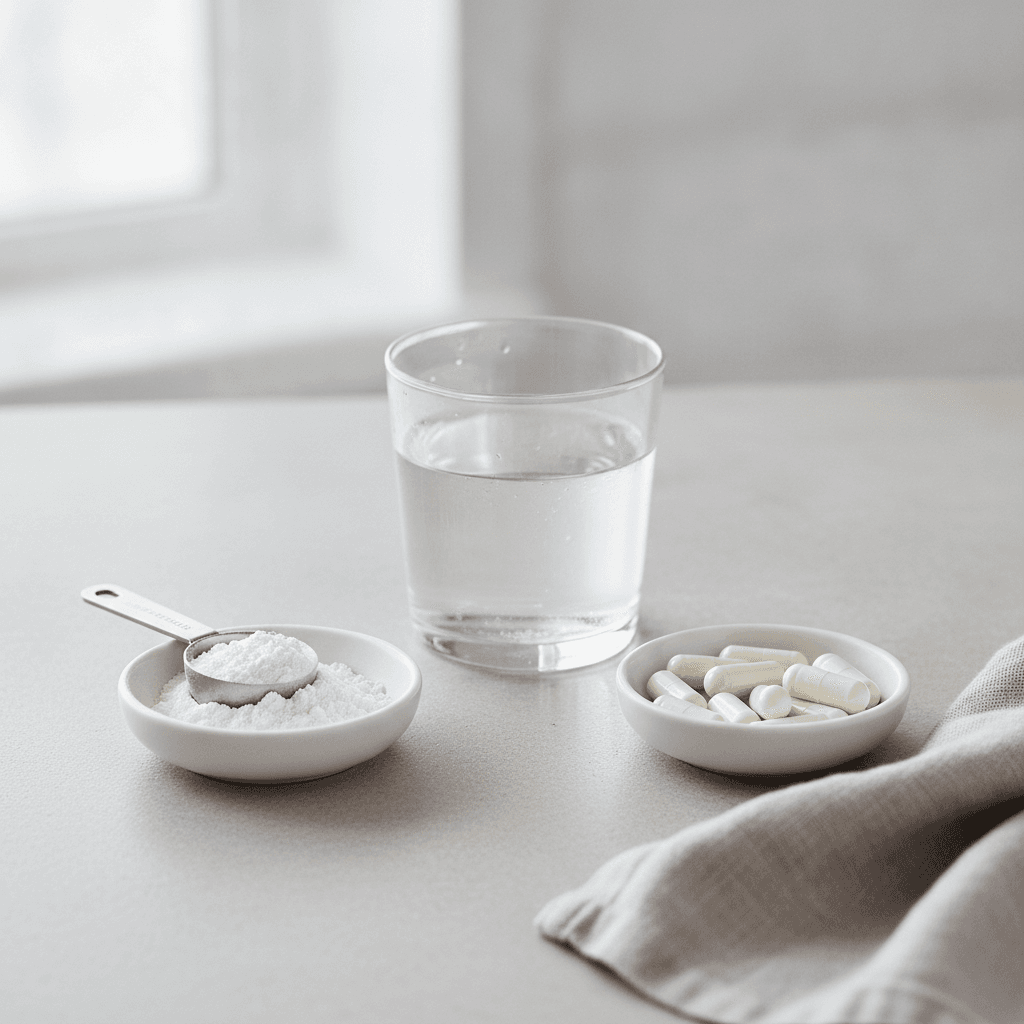
Creatine monohydrate vs HCl comes down to the evidence behind each form more than any claim on the label. Monohydrate is the form in almost every human study, while HCl dissolves far more easily in water, so its labels use much smaller servings; in the one head-to-head trial of the same dose, HCl showed no benefit over monohydrate.
Below you'll find what each form is, what the studies found, how loading, stomach comfort and servings compare, what creatine has shown for muscle, strength and memory as we age, and who should check with a doctor first. If you have searched for the "best form of creatine", this is the research behind the question; the choice stays yours.
What Creatine Does and Why the Form Matters
Creatine is a compound your muscles use to make quick energy, and your brain holds it too. Your body makes some, and you get a little from meat and fish. Taking it as a supplement raises the amount stored in muscle, which is why it is studied for strength, muscle and exercise work.
The form matters because it decides how much creatine is in each serving, how well it dissolves and how much research stands behind it. Our creatine page lists every form we graded. In our database, 140 human studies of creatine are graded and 70 name the form they used: 68 used monohydrate and 1 used HCl.
Creatine Monohydrate: The Most Studied Form
Monohydrate is plain creatine bound to one water molecule. A review of the research found it raises muscle creatine and phosphocreatine by about 15% to 40%, and that nearly 99% of an oral dose is either taken up by muscle or passed in urine (Jäger 2011). The same group's update in 2022 concluded that monohydrate is the only form with substantial evidence of absorption, effect and safety, and that professional societies name it; its authors report paid work with creatine makers (Kreider 2022).
In our grading, 27 of the 68 monohydrate studies showed an improvement, and the studies that did gave 5 to 20 g a day. Our grade for creatine and muscle building is an improvement, across 8 meta-analyses, the largest of 2,255 people. See the monohydrate page for the studies and products.
Most labels use the same serving. In our label database, the middle single-ingredient monohydrate label (459 on-market products, mostly powders) holds 5 g of creatine per serving.
Creatine HCl: What It Claims and What the Evidence Shows
HCl is creatine bound to hydrochloric acid. The pitch is that it dissolves more easily, so a smaller serving does the same job with less stomach upset and no loading phase. The first part is true in the lab: HCl was 38 times more soluble in water than monohydrate, and in a gut-cell model the two crossed the cell layer about equally (Gufford 2010).
What matters is whether that changes results in people. We found three small trials:
HCl against monohydrate, 8 weeks. Forty young adults trained with weights and took HCl, monohydrate with a loading phase, monohydrate without one, or placebo. HCl and the no-loading monohydrate were both given at 0.03 g per kg of body weight a day, about 2.4 g for an 80 kg person. Every creatine group beat placebo for strength, muscle size and body fat, and HCl showed no benefit over monohydrate (Eghbali 2024).
HCl against monohydrate, 4 weeks. Forty college soccer players took monohydrate, ethyl ester, HCl or placebo during sprint training. All three creatine forms beat placebo, and the HCl and ethyl ester groups gained more in jump, sprint and peak power than the monohydrate group (Duan 2026). With 10 players per group and 4 weeks, it needs repeating.
HCl against placebo, 8 weeks. Thirty-six women around menopause took 750 mg or 1,500 mg of HCl a day, or placebo. At 1,500 mg, frontal brain creatine rose 16.4% against 0.9% on placebo, and no severe side effects were reported (Korovljev 2026).
So the two trials that compared the forms disagree, each is small, and none ran beyond 8 weeks. Our HCl page shows the one HCl study in our graded set, since the newer trials are still being added.
Creatine Monohydrate vs HCl: Side by Side
| Monohydrate | HCl | |
|---|---|---|
| Research depth | 68 of the 70 creatine studies in our database that name their form | 1 graded study; three small trials of 36 to 40 people since |
| Dose in studies | 5 to 20 g a day in the studies that showed an improvement; 3 g a day in a loading study | 0.03 g per kg a day (about 2.4 g at 80 kg), and 750 to 1,500 mg a day |
| Creatine per serving on labels (middle) | 5 g | 750 mg (most between 750 mg and 2 g; 40 on-market products) |
| Servings to reach 5 g | 1 | About 3 to 7 |
| Solubility in water | Low | 38 times higher in the lab |
| Gut-cell absorption model | Baseline | No significant difference from monohydrate |
| Loading phase | Optional; both ways improved in an 8-week trial | Sold as not needed; no trial tested it on its own |
| Stomach comfort | Diarrhoea linked to 10 g in one serving | No trial compared it with monohydrate |
| Cost per dose | Divide the price by the grams of creatine in the bottle | Same sum; each serving holds less creatine |
Not sure which fits your stack? Get a protocol that checks it for you.
Creatine Loading Phase: Do You Need One?
A loading phase means taking a large amount for about a week to fill your muscles quickly, then dropping to a smaller daily amount. In 31 men, 20 g a day for 6 days raised muscle creatine by about 20%, and 2 g a day held it there. Taking only 3 g a day gave a similar 20% rise, but slowly, over 28 days (Hultman 1996).
The 8-week trial above compared monohydrate with and without a loading phase (0.3 g per kg for 5 days, then 0.03 g per kg) and both groups improved on strength and muscle size (Eghbali 2024). Loading is a way to get there faster; the groups that skipped it still gained.
Stomach Comfort: What the Studies Show
Stomach upset with creatine tracks the dose. In 59 soccer players over 28 days, 10 g a day taken as two 5 g servings did not raise stomach complaints above placebo, while 10 g in a single serving raised diarrhoea to 55.6%, against 28.6% for the split dose and 35.0% on placebo (Ostojic 2008). Splitting a dose, or using a form with a smaller serving, both keep each serving small. We found no trial that compared stomach comfort between monohydrate and HCl, so that claim rests on the solubility figures.
Creatine for Healthy Aging: Muscle, Strength and Brain
Muscle and strength. Across 22 trials of 721 adults averaging 57 to 70 years, creatine on top of resistance training added about 1.4 kg of lean tissue mass compared with training alone, and a little more strength in chest press and leg press (Chilibeck 2017). Our muscle and strength goal page and healthy aging goal page rank the ingredients by what the studies found.
Memory and thinking. A review of 16 trials of 492 people aged 20 to 76, all using monohydrate, found a small improvement in memory (moderate certainty), and none in overall thinking or planning (Xu 2024). See the focus and memory goal page.
Safety record. The International Society of Sports Nutrition reports that up to 30 g a day for 5 years was safe and well tolerated in healthy people (Kreider 2017), and kidney measures did not differ between people who had used creatine for 10 months to 5 years and people who had not (Poortmans 1999). That safety research is on monohydrate.
Who Should Check With a Doctor First (People on Meds)
Talk to your doctor or pharmacist before starting creatine if you take meds, are pregnant or have been told to watch your kidney health. Creatine in the studies above was tested mostly in healthy adults. Rala, the AI behind Reverse Age Lab, checks every product in your stack against your meds before it places anything in your protocol, and blood work is optional.
Is this medical advice? No. This guide sets out the published research on two forms of creatine; it is not a diagnosis, and Rala isn't a medical device or a clinician. Talk to your doctor before adding creatine, especially if you take meds.
Bottom Line: Which Form Gives the Best Value
Monohydrate has the deeper research: 68 of the 70 creatine studies that name a form, and a safety record that runs to years. HCl has three small trials, one showing no benefit over monohydrate and one showing larger gains. Value comes down to the grams of creatine you get for the price: HCl servings hold much less creatine, so it takes more of them to reach the doses used in studies, while monohydrate fits in one scoop. Either way, the number to compare is the price per gram of creatine.
See Where Creatine Fits in Your Own Stack
Your Daily Protocol adds up the creatine in every product you take, including pre-workouts and blends, checks it against your meds and places each one at the right time of day. Build My Protocol – 7-Day Free Trial.
Frequently Asked Questions
Is creatine HCl better than monohydrate?
The studies do not agree. In an 8-week trial at the same dose, HCl showed no benefit over monohydrate; in a smaller 4-week trial of soccer players, HCl gained more. Monohydrate has far more research behind it.
Do you need a loading phase with creatine HCl?
No trial tested HCl with and without loading. For monohydrate, a loading phase raised muscle creatine in a week, and 3 g a day reached the same level in about a month.
How much creatine HCl equals 5 g of monohydrate?
No trial set an equivalence. The 8-week trial gave the same 0.03 g per kg a day of each, and HCl labels hold about 750 mg to 2 g per serving, against 5 g for most monohydrate scoops.
Does creatine HCl cause less stomach upset?
We found no trial that compared them. HCl dissolves far more easily in water, and with monohydrate, upset tracked the amount taken at once: diarrhoea was more common with 10 g in one serving than with two 5 g servings.
Is creatine monohydrate safe to take long term?
In healthy adults, studies of up to 5 years found no kidney changes and no safety problems at up to 30 g a day. Check with your doctor first if you take meds or have been told to watch your kidney health.
Sources
Gufford BT, Sriraghavan K, Miller NJ et al. Physicochemical characterization of creatine N-methylguanidinium salts. Journal of Dietary Supplements, 2010. PubMed.
Jäger R, Purpura M, Shao A et al. Analysis of the efficacy, safety, and regulatory status of novel forms of creatine. Amino Acids, 2011. PubMed.
Kreider RB, Jäger R, Purpura M. Bioavailability, efficacy, safety, and regulatory status of creatine and related compounds: a critical review. Nutrients, 2022. PubMed.
Eghbali E, Arazi H, Suzuki K. Supplementing with which form of creatine (hydrochloride or monohydrate) alongside resistance training can have more impacts on anabolic/catabolic hormones, strength and body composition? Physiological Research, 2024. PubMed.
Duan C, Wang Z, Wang Q. Creatine formulations and repeated sprint training: effects on physical and physiological adaptations in soccer players during the short-term preparation phase. Journal of the International Society of Sports Nutrition, 2026. PubMed.
Korovljev D, Ostojic J, Panic J et al. The effects of 8-week creatine hydrochloride and creatine ethyl ester supplementation on cognition, clinical outcomes, and brain creatine levels in women around menopause (CONCRET-MENOPA): a randomized controlled trial. Journal of the American Nutrition Association, 2026. PubMed.
Hultman E, Söderlund K, Timmons JA et al. Muscle creatine loading in men. Journal of Applied Physiology, 1996. PubMed.
Ostojic SM, Ahmetovic Z. Gastrointestinal distress after creatine supplementation in athletes: are side effects dose dependent? Research in Sports Medicine, 2008. PubMed.
Chilibeck PD, Kaviani M, Candow DG et al. Effect of creatine supplementation during resistance training on lean tissue mass and muscular strength in older adults: a meta-analysis. Open Access Journal of Sports Medicine, 2017. PubMed.
Xu C, Bi S, Zhang W et al. The effects of creatine supplementation on cognitive function in adults: a systematic review and meta-analysis. Frontiers in Nutrition, 2024. PubMed.
Kreider RB, Kalman DS, Antonio J et al. International Society of Sports Nutrition position stand: safety and efficacy of creatine supplementation in exercise, sport, and medicine. Journal of the International Society of Sports Nutrition, 2017. PubMed.
Poortmans JR, Francaux M. Long-term oral creatine supplementation does not impair renal function in healthy athletes. Medicine and Science in Sports and Exercise, 1999. PubMed.