
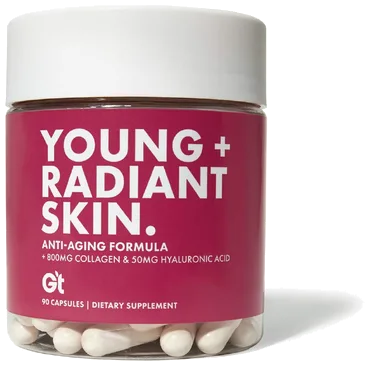
GT Genesis Today Young + Radiant Skin. Review
GT Genesis Today Young + Radiant Skin is an oral "beauty-from-within" dietary supplement. It is sold as capsules or softgels in 60- and 90-count bottles. The brand markets it as a 1,000 mg collagen formula. The supplement facts panel on retailer pages shows a more specific breakdown. Each two-capsule serving contains about 800 mg of hydrolyzed bovine collagen, 50 mg of hyaluronic acid, 2,500 mcg of biotin (833% Daily Value) and 800 IU of vitamin A as beta carotene (16% DV). The other ingredients are microcrystalline cellulose, silica and magnesium stearate. The label also says the product is non-GMO, gluten free and sugar free. A 90-capsule bottle holds 45 servings. Each active ingredient has a different role in how the product is meant to work: - **Hydrolyzed collagen.** Collagen is the main structural protein of the dermis. Natural production falls with age. Hydrolysis breaks the protein into small peptides, which the gut can absorb more easily. Research on oral collagen peptides suggests that circulating di- and tripeptides may signal dermal fibroblasts. The proposed effect is more collagen, elastin and extracellular-matrix synthesis, which would support firmness and elasticity. - **Hyaluronic acid.** The brand says it is already native to skin. It is a glycosaminoglycan that binds many times its weight in water, so it helps tissue retain moisture. Taken orally, it is intended to support hydration, plumpness and a smoother look. - **Biotin.** This B vitamin is a cofactor for carboxylase enzymes involved in fatty-acid and amino-acid metabolism. It supports keratin infrastructure, so it is commonly used for hair and nails as well as skin. - **Vitamin A (beta carotene).** It supports epithelial cell turnover and differentiation, and it contributes to normal skin maintenance. Taken together, the formula aims to supply the raw material and the signalling cues for the dermal matrix. It does this from the inside, in contrast to topical products that act on the surface. The suggested use of two capsules a day is meant to be lower-burden than collagen powders or pill regimens that need five or six capsules. As with most supplements, the claims are structure-function claims. The product is not intended to diagnose, treat or cure disease. Results usually take weeks of consistent use. Individual response varies, and the evidence for oral collagen and hyaluronic acid is still developing. High-dose biotin can interfere with some laboratory tests, including thyroid and troponin assays. People should tell their clinician they take it. Those who are pregnant, on medication, or allergic to bovine products should check with a healthcare professional first. The bovine source also means the product is not suitable for vegetarians or vegans.
We don’t sell supplements. We help you make decisions and get the best price.
Lowest prices
We may earn a commission from some store links. How we choose.
Finding the lowest prices at the stores now. This takes a few seconds.
Study, Trial or Testing Result Summary
Members Only69 human studies · 61 improved
13 of these 69 human studies gave the ingredient by injection, not by mouth.
Collagen is the main ingredient here. Large pooled analyses of placebo-controlled trials found that collagen taken by mouth improved skin hydration and elasticity [1], and after about 90 days also improved wrinkles, mostly in women [2]. A newer pooled analysis found the same overall benefit, but the highest-quality studies and those without company funding showed no clear effect [3]. In 114 women, 1000 milligrams a day for 24 weeks improved elasticity and roughness versus placebo [4]. Other trials used 2.5 grams a day [5]. This product gives 800 milligrams, slightly below the lowest studied dose. Hyaluronic acid by mouth improved hydration, elasticity and wrinkle depth across 7 placebo-controlled trials [6], but in one 16-week trial, adding 30 milligrams to collagen gave no extra benefit [7]. The vitamin A studies tested creams and lotions applied to the skin, which clearly improved fine wrinkles [8][9]. They do not show what 800 units swallowed in a capsule does for skin. Biotin has no human studies for skin aging in the evidence given. Animal and cell studies are never counted.
See all 69 studies →Hide the studies
- Across 23 trials with 3905 people, creams with vitamin A-type compounds (a med, retinol, tretinoin) significantly improved fine wrinkles and tretinoin and retinol improved pigmentation in sun-aged facial skin.Comparative efficacy of topical interventions for facial photoaging: a network meta-analysis.
- Across 26 randomized trials with 1721 people, hydrolyzed collagen improved skin hydration and elasticity compared with placebo.Effects of Oral Collagen for Skin Anti-Aging: A Systematic Review and Meta-Analysis.
- Across 23 randomized trials with 1474 people, collagen improved hydration, elasticity and wrinkles overall, but studies without pharmaceutical funding and high-quality studies showed no significant effect.Effects of Collagen Supplements on Skin Aging: A Systematic Review and Meta-Analysis of Randomized Controlled Trials.
- Across 19 randomized trials with 1125 people (95% women), hydrolyzed collagen for about 90 days improved skin hydration, elasticity and wrinkles compared with placebo.Effects of hydrolyzed collagen supplementation on skin aging: a systematic review and meta-analysis.
- Pooling seven studies, beta-carotene (a plant form of vitamin A) taken for at least 10 weeks protected against sunburn, with more protection the longer it was taken.Protection from sunburn with beta-Carotene--a meta-analysis.
- Pooling 6 studies, hyaluronic acid injections improved skin hydration and radiance but did not significantly change skin elasticity or melanin index compared with controls.The Effect of Local Hyaluronic Acid Injection on Skin Aging: A Systematic Review and Meta-Analysis.
- Combining 7 placebo-controlled trials, oral hyaluronic acid significantly improved skin hydration, elasticity and wrinkle depth, while firmness, wrinkle volume and water loss showed only non-significant trends.Oral Hyaluronic Acid Supplement: Efficacy in Skin Hydration, Elasticity, and Wrinkle Depth Reduction.
- In 24 studies of 1,410 patients, mostly women, hyaluronic acid fillers persisted 60-86.4% at 12 months and 50-86% at 24 months, with rare long-term side effects.Clinical Durability of Hyaluronic Acid-Based Dermal Fillers for Facial Application: A Systematic Review.
- A review of 32 studies with 1236 people on anti-aging skin products gave retinol (vitamin A) its top recommendation grade for anti-aging, with few significant side effects.Cosmeceuticals for antiaging: a systematic review of safety and efficacy.
- Across 11 placebo-controlled trials with 805 people, oral collagen at 2.5 to 10 grams daily for 4 to 24 weeks increased skin elasticity, hydration and dermal collagen density.Oral Collagen Supplementation: A Systematic Review of Dermatological Applications.
- In 25 studies comparing other creams with tretinoin (a vitamin A drug), the others worked better in 7, equally in 13 and worse in 3, and most were gentler on skin, though study quality was mostly poor.Comparing Tretinoin to Other Topical Therapies in the Treatment of Skin Photoaging: A Systematic Review.
- A review of 10 publications found that almost all reported oral collagen improved skin health.Collagen supplementation for skin health: A mechanistic systematic review.
- A review of 37 articles on lip rejuvenation found hyaluronic acid was the most used agent with few side effects, and one report showed 94.3% improvement in lip fullness one month after re-treatment.Perspectives and challenges in lip rejuvenation: a systematic review.
- A review found combined hyaluronic acid and calcium hydroxylapatite fillers gave high rated facial improvement and satisfaction with minor side effects, with a slight decline after six months.Combined and Hybrid Treatments of Hyaluronic Acid (HA) and Calcium Hydroxylapatite (CaHA): A Systematic Review of Mechan…
- In 903 adults under 55 given 30 mg of beta-carotene or placebo daily for about 4.5 years, beta-carotene had no overall effect on skin aging.Sunscreen and prevention of skin aging: a randomized trial.
- In 439 people with nasolabial folds, injected bovine collagen filler gave shorter-lasting correction than hyaluronic acid fillers over up to 24 weeks; this tested an injected filler, not a collagen supplement.Comparison of smooth-gel hyaluronic acid dermal fillers with cross-linked bovine collagen: a multicenter, double-masked,…
- In 149 people with nasolabial folds, an injected porcine collagen filler improved wrinkle scores for 6 months, about the same as a hyaluronic acid filler; this was an injection, not a collagen supplement.A randomized, multicenter study of the safety and efficacy of Dermicol-P35 and non-animal-stabilized hyaluronic acid gel…
- In 149 people given an injected porcine collagen filler for nasolabial wrinkles, 95.3% kept the improvement at 9 months and 76.5% at 12 months; this was an injection, not a collagen supplement.Twelve-month persistency of a novel ribose-cross-linked collagen dermal filler.
- In 120 women with sun-aged skin, a nightly retinol 0.2% cream used for 3 months improved wrinkles, pigmentation and pores about as much as tretinoin 0.025% cream and was better tolerated.A double-blind randomized study comparing the association of Retinol and LR2412 with tretinoin 0.025% in photoaged skin.
- In 120 people, a daily collagen drink combined with vitamins and other ingredients for 90 days raised skin elasticity by 40% versus placebo and improved skin structure and joint pain.Daily oral supplementation with collagen peptides combined with vitamins and other bioactive compounds improves skin ela…
- In 114 women aged 45-65, 2.5 grams of collagen peptides daily for 8 weeks reduced eye wrinkle volume by 20% versus placebo and raised skin procollagen and elastin.Oral intake of specific bioactive collagen peptides reduces skin wrinkles and increases dermal matrix synthesis.
- In 114 women aged 20-50, 1000 mg of low-molecular-weight collagen peptide daily for 24 weeks improved cellulite, skin roughness and skin elasticity versus placebo.Low-Molecular-Weight Collagen Peptide Supplementation Improves Cellulite Severity, Skin Elasticity, and Hair Shaft Diame…
- In 100 healthy adults taking low-molecular-weight collagen peptides for 12 weeks, wrinkles, elasticity and hydration improved significantly more than with placebo, with no related side effects.Low-molecular-weight collagen peptides supplement promotes a healthy skin: A randomized, double-blinded, placebo-control…
- In 87 women, a cream containing retinol reduced the appearance of wrinkles more than placebo, by 23.5% after 4 weeks and 27.8% after 8 weeks.The skin aging index: a new approach for documenting anti-aging products or procedures.
- In 87 women aged 40 to 65, 5 g of hydrolysed collagen with vitamin C daily for 16 weeks improved skin density, texture and wrinkle severity compared with placebo, but did not change elasticity or hydration.The Effects of Dietary Supplementation with Collagen and Vitamin C and Their Combination with Hyaluronic Acid on Skin De…
- In 77 healthy women, 5000 mg per day of bioactive collagen peptides for 12 weeks improved skin hydration, water loss, and dermal density compared with placebo, and the gains held through a 4-week washout.The Sustained Effects of Bioactive Collagen Peptides on Skin Health: A Randomized, Double-Blind, Placebo-Controlled Clin…
- In 72 women aged 35 or older, 2.5 g of collagen peptides daily for 12 weeks significantly improved skin hydration, elasticity, roughness and density compared with placebo, and most of the gains held for 4 weeks after stopping.A Collagen Supplement Improves Skin Hydration, Elasticity, Roughness, and Density: Results of a Randomized, Placebo-Cont…
- In 69 women aged 35 to 55, 2.5 g or 5 g of collagen peptides daily for 8 weeks significantly improved skin elasticity compared with placebo, with no side effects noted.Oral supplementation of specific collagen peptides has beneficial effects on human skin physiology: a double-blind, plac…
- In 64 people, 1000 mg of low-molecular-weight collagen peptide daily for 12 weeks improved skin hydration, wrinkling and elasticity compared with placebo, with no related side effects.Oral Intake of Low-Molecular-Weight Collagen Peptide Improves Hydration, Elasticity, and Wrinkling in Human Skin: A Rand…
- In 61 Asian adults with nasolabial folds, a porcine collagen filler improved wrinkle scores over 12 months, with results not significantly different from a bovine collagen filler and no serious side effects.Efficacy and safety of porcine collagen filler for nasolabial fold correction in Asians: a prospective multicenter, 12 m…
- In 54 Chinese adults with photoaging, injected collagen combined with a collagen serum produced better skin satisfaction, fine lines, and firmness than injection alone by 12 weeks, with no related side effects; this was an injection study, not an oral supplement.Effectiveness and Safety of Recombinant Type III Humanized Collagen Solution Injection Combined With Collagen-III Multi-…
- In 44 people using 0.5% retinol cream daily on the face for 12 weeks, wrinkle surface area and dark spots decreased, similar to bakuchiol, but retinol caused more scaling and stinging.Prospective, randomized, double-blind assessment of topical bakuchiol and retinol for facial photoageing.
- In 40 women with sun-aged skin, a retinol, lactose and glycolic acid cream applied twice daily for 12 weeks improved skin appearance, surface texture and moisture compared with a placebo cream on the other side of the face.Combined retinol-lactose-glycolic acid effects on photoaged skin: a double-blind placebo-controlled study.
- In 36 elderly people (average age 87), 0.4% retinol lotion applied up to 3 times a week for 24 weeks reduced fine wrinkling much more than the vehicle lotion on the other arm and increased skin collagen and water-holding molecules.Improvement of naturally aged skin with vitamin A (retinol).
- In 23 Korean volunteers, a retinaldehyde cream applied for 8 weeks improved wrinkle depth, skin firmness and hydration, and did somewhat better than a retinol cream on the other side of the face.The efficacy and safety of multilamellar vesicle containing retinaldehyde: A double-blinded, randomized, split-face cont…
- In women, 0.25% retinol applied after a salicylic acid peel for 4 weeks improved sun damage signs compared with baseline, though tretinoin was slightly better.Combination Superficial Peels With Salicylic Acid and Post-Peel Retinoids.
- In women with facial sun damage, a 1.1% retinol ester cream for 24 weeks did not differ significantly from 0.02% tretinoin in photoaging scores, though it caused redness less often.Biomarkers of Tretinoin Precursors and Tretinoin Efficacy in Patients With Moderate to Severe Facial Photodamage: A Rand…
- In 20 adults with acne scars, a porcine collagen filler and a subcision procedure both improved scars over 6 months, and blinded evaluators found no significant difference between them.Subcuticular incision versus naturally sourced porcine collagen filler for acne scars: a randomized split-face compariso…
- In 16 adults, a 0.1% retinol forearm cream for 3 weeks significantly increased most skin aging biomarkers measured.Climbazole boosts activity of retinoids in skin.
- In women with cellulite, topical retinol for 6 months increased skin elasticity by 10.7% compared with placebo on the other side, though the lumpy appearance changed little.A randomized, placebo-controlled trial of topical retinol in the treatment of cellulite.
- After a botulinum toxin injection, a retinol, adenosine and hyaluronic acid skincare routine used for 2 months gave extra benefit over placebo for fine lines, wrinkles and smoothness of the face.A skincare containing retinol adenosine and hyaluronic acid optimises the benefits from a type A botulinum toxin injecti…
- In women aged 45 to 60, a hydrolyzed marine collagen supplement for 12 weeks reduced wrinkle scores by 35% from baseline and gave greater improvements in wrinkles, elasticity, hydration, and firmness than placebo.A randomized, triple-blind, placebo-controlled, parallel study to evaluate the efficacy of a freshwater marine collagen …
- In 76 women with moderate sun-aged skin, injections of hyaluronic acid combined with platelet-rich plasma worked significantly better than hyaluronic acid injections alone on skin hydration, firmness and satisfaction scores.Comparative analysis of effects induced by hyaluronic acid and its combined formula on skin functional parameters in sec…
- In 80 people who had repeat Juvéderm filler in nasolabial folds, wrinkle scores stayed mild at 48 weeks, 78-90% responded, and 60% less filler was needed than at first treatment.Duration of wrinkle correction following repeat treatment with Juvéderm hyaluronic acid fillers.
- In 57 volunteers using creams twice daily for 56 days, milk thistle extract reduced wrinkles similarly to retinol and better than bakuchiol, while 43% reported discomfort with retinol versus 0% with the extract.Silybum marianum Extract: A Highly Effective Natural Alternative to Retinoids to Prevent Skin Aging Without Side Effects…
- In 37 volunteers using retinol serum once daily for 12 weeks (0.3% on one side of the face, 0.5% on the other), dark spots, uneven skin and wrinkles decreased gradually, with more skin irritation on the 0.5% side.A Clinical Anti-Ageing Comparative Study of 0.3 and 0.5% Retinol Serums: A Clinically Controlled Trial.
- In a split-face trial of 31 Chinese women, 0.03% hydroxypinacolone 9-cis retinoate applied daily for 4 weeks improved wrinkles, elasticity, and hydration as well as or better than 0.3% retinol, without irritation.Hydroxypinacolone 9-cis retinoate mitigates UV-induced photoaging by modulating extracellular matrix, fibroblasts, infla…
- In 30 Japanese women with crow's feet wrinkles, a retinol lotion applied to one side of the face for 8 weeks produced marked or moderate improvement in 34% of subjects, with wrinkle length and area reduced more than on the untreated control side, and no significant side effects.Evaluation of anti-wrinkle effects of a novel cosmetic containing retinol using the guideline of the Japan Cosmetic Indu…
- In 11 Korean women over 30 with eye-area wrinkles, a 0.06% retinyl retinoate cream applied for 12 weeks reduced wrinkle depth and area, performing about 22% better than a 0.075% retinol cream.Retinyl retinoate, a novel hybrid vitamin derivative, improves photoaged skin: a double-blind, randomized-controlled tri…
- In 1462 people applying a retinaldehyde and hyaluronic acid fragment cream daily for 90 days, overall photoaging, wrinkles (up to 34% less) and skin elasticity signs (about 32% better) improved significantly.Retinaldehyde/hyaluronic acid fragments: a synergistic association for the management of skin aging.
- In 44 women using a niacinamide and hyaluronic acid formula for two months, fine lines, wrinkles and smoothness improved, and in 30 other women skin biopsies showed lower activity of aging-related inflammatory genes.Senomorphic activity of a combination of niacinamide and hyaluronic acid: correlation with clinical improvement of skin …
- In 44 women with mild to moderate hyperpigmentation and photodamage, a 0.5% retinol treatment plus a vitamin C moisturizer used for 12 weeks significantly improved all clinically graded signs at weeks 8 and 12, with dryness rising early and resolving by week 12.An Open Label Clinical Trial to Evaluate the Efficacy and Tolerance of a Retinol and Vitamin C Facial Regimen in Women W…
- In 40 women using an antioxidant serum containing hyaluronic acid daily for 90 days, signs of skin aging improved significantly and the serum was well tolerated.Efficacy of a topical serum containing L-ascorbic acid, neohesperidin, pycnogenol, tocopherol, and hyaluronic acid in re…
- In 35 women aged 35 to 65 with mild to moderate facial aging, twice-daily use of a multi-ingredient skincare regimen containing retinol for 12 weeks improved skin smoothness, dryness, fine lines and firmness compared with their starting point, though there was no control group.Novel Facial Treatment Regimen Improves Aging Skin Appearance.
- In 34 people treated on the face, neck, chest and hands with hyaluronic acid jetted into the skin (not a supplement taken by mouth), wrinkle scores on the face and neck fell by about 39% and 30% at 1-3 months, and 80% were satisfied.Clinical results of skin remodeling using a novel pneumatic technology.
- In 30 Chinese women using hyaluronic acid microneedle patches under the eyes three times a week for 4 weeks, skin firmness increased and crow's feet and eye bags significantly reduced.Efficacy and safety testing of dissolving microarray patches in Chinese subjects.
- In 30 Chinese women given two hyaluronic acid injection sessions four weeks apart, skin hydration and water loss improved significantly by week 12, while elasticity changes were not significant.Efficacy and Tolerability of Stable Hybrid Cooperative Complexes of High- and Low-Molecular Weight Hyaluronic Acid in As…
- In 23 adults aged 45 to 68 using a topical cosmetic retinol product for 12 weeks without a control group, photodamage, uneven skin ttone, roughness and fine and coarse wrinkles improved significantly.Assessing changes in facial skin quality using noninvasive in vivo clinical skin imaging techniques after use of a topic…
- In 20 adults with photoaged face and neck skin, a 0.2% retinol cream with tripeptides and glaucine used for 3 months produced clinical and tissue improvements in all 20 participants.Clinical and histologic findings after use of a novel combined retinol, tripeptide, and glaucine containing cream in the…
- In 20 women with sun-aged hands, weekly hyaluronic acid microinjections for 4 weeks increased a skin ultrasound marker of photoaging by 31.3%, improving it in 15 of 19 who finished.Mesotherapy for skin rejuvenation: assessment of the subepidermal low-echogenic band by ultrasound evaluation with cross…
- In 8 people, an injected collagen filler improved nasolabial folds over 12 weeks with no reported side effects, in an open-label pilot without a control group.A Two-Phase Pilot Study to Evaluate the Safety and Tolerability of an In Situ Polymerizing Collagen.
- A topical retinol cream gave better skin barrier and wrinkling scores than a vitamin E cream and limited shallow wrinkles caused by UV exposure.Topical retinol and the stratum corneum response to an environmental threat.
- In 129 patients with skin aging, one hybrid filler treatment led physicians to rate all patients as improved in facial appearance at 9 months, with only minor side effects.HArmonyCa™ hybrid filler to restore connective tissue: An Italian real-life retrospective study.
- In 42 patients with 74 frown-line wrinkles, ultrasound showed an artery at the wrinkle in 30 lines (filler skipped there) and lateral in 44, where filler was injected safely to correct the wrinkles.Safe Glabellar Wrinkle Correction With Soft Tissue Filler Using Doppler Ultrasound.
- In a 1984 questionnaire of people who had collagen injections for wrinkles, many reported benefit, but it lasted under a year, about 6 months; most nonresponders gave no follow-up, and this was an injection study, not a supplement.Collagen injections for aging skin lines (wrinkles).
- In 33 Chinese women aged 20 to 45, a supramolecular retinol eye cream used for 6 weeks reduced dark circles, fine wrinkles and sagging, and firmness (skin elasticity) rose by 13%, with good tolerance.Improvement of urban eye skin in Chinese female by supramolecular retinol plus acmella oleracea extract-containing produ…
- In 31 people with melasma and facial photodamage, a 4% hydroquinone plus 1% retinol regimen over 24 weeks improved melasma and photodamage, with fine wrinkles, crepiness, and laxity improving by week 8 and most attributes improving in over three quarters of participants.Clinical Evaluation of a 4% Hydroquinone + 1% Retinol Treatment Regimen for Improving Melasma and Photodamage in Fitzpat…
- In lab and skin models, a type V collagen peptide increased collagen production and fiber density, and a preliminary clinical trial found improved skin barrier, density, and elastic recovery; the human evidence is preliminary.The Human-Like Collagen Alpha-1 Type V Peptides Strengthen the Dermal Fiber Network and Improve the Regeneration Ability…
- In a study in mice with sun-damaged skin, a tilapia collagen gel containing cerium oxide nanoparticles, injected into the skin, reduced skin oxidative stress, decreased wrinkles and skin thickening, and increased collagen, with effects lasting seven months. This was an animal study, not a human trial, and it tested an injected filler, not a collagen supplement.Autocatalytic Ceria Nanoparticle-Embedded Tilapia Collagen Hydrogels as Enhanced Antioxidative and Long-Lasting Dermal F…
Review Totals and Summary
Members Only24 reviews · 80% positive
Customers most often praise visible changes in skin quality. Many describe a "glow", better hydration, and skin that feels plumper, bouncier and more elastic. Several say dryness eased, dullness faded, or fine lines around the eyes softened. Some reviewers report skin clearing up if they were acne-prone, or evening out. Others say dark circles looked better. Some noticed results within days to two weeks. Others needed a few months of steady use before they felt sure of any change. A second theme is hair and nails. Buyers often mention faster hair growth, shinier hair and less brittle nails. Several came for skin or even for muscle recovery and were pleasantly surprised by the hair benefits. Reviewers who had taken biotin on its own with no change said the combination with collagen and hyaluronic acid worked noticeably better for them. Shoppers also like the convenience and value. They like that the dose is two capsules a day, where many collagen products ask for five or six. They also like that the product combines collagen, vitamin A, hyaluronic acid and biotin at an affordable price. Several people call it an inexpensive, effective skin vitamin and say they plan to keep buying it. Some value the inside-out approach, because topical creams alone gave only temporary or slight improvement. Criticism is less common and comes in a few forms. A minority report little or no visible effect. Some are cautious, and one reviewer who is a nurse says the evidence for oral collagen needs careful reading. A few buyers rate it four stars and say they are only "seeing results" gradually, so they say patience is needed. Availability is another complaint. One long-time user said the product could no longer be found and called it the best face vitamin they had used. Stock and packaging have also varied, with 60- and 90-count versions and a "1,000mg" headline claim that is really 800 mg of collagen plus 50 mg of hyaluronic acid. That may disappoint buyers who read the label closely. Overall, reviews on Amazon (including international storefronts) and Walmart lean strongly positive. Most praise centres on glowing skin, hair improvement and easy dosing. Most reservations concern slow or inconsistent results and supply.
Biohacker Summary
Members Only10 of 10 recommend it
Collagen, the main ingredient, gets a mostly positive response, with four of the ten panelists recommending it and four more saying they use it. One is neutral, noting it is weaker than whey for building muscle, and one has stopped taking it. They take it for skin, joints, connective tissue, muscle, gut and sleep, and they favor collagen peptides, often as powder in coffee or food. Doses run from 2.5 to 5 grams a day for at least eight weeks for skin elasticity, up to 10 grams in the morning for muscle or skin, and 15 grams an hour before a workout, often paired with vitamin C. One panelist cautions that collagen will not repair a damaged gut wall, and another says lifestyle matters more than collagen. Hyaluronic acid, a smaller ingredient in this product, was praised by two panelists for hydrating skin.}</br>The</br>
See all 10 biohackers →Hide the biohackers
Dr. Eric Berg · Collagen · recommends
- Recommends collagen as it is critical for healthy aging, supporting connective tissues, skin health, and cardiovascular health.
- Notes that low vitamin A can lead to dry eyes, dry mouth, and night vision issues.
- Recommends collagen powder as an alternative to bone broth, to be put in coffee, for its benefits in building connective tissue and providing glycine for sleep.
- Mentions that grass-fed liver is loaded with collagen.
- Mentions that grass-fed liver has the active form of vitamin A, called retinol, which is important for eyes, thyroid, immune system, and skin.
- Dr. Berg warns that synthetic vitamin A can cause problems, including competing with vitamin D, increasing the risk of birth defects during pregnancy, and increasing the risk of bone fractures, recommending food sources like egg yolks and cod liver oil instead.
- States that the body is begging for collagen if one experiences weak ligaments and tendons, joint pain, wrinkles or saggy skin, thin dry fragile hair, brittle slow growing nails, loss of muscle, increased need for longer repair after exercise, and bone loss.
- Mentions vitamin A deficiency as a possibility for dry mouth, but emphasizes that vitamin A doesn't work without zinc.
- States that thinning hair often indicates low biotin, which is required to produce keratin for hair, skin, and nails.
- Recommends increasing collagen intake because a lack of it can make it harder for the body to repair itself.
- Discusses collagen in relation to changes in joints, skin, hair, nails, and recovery, suggesting these could be signs of needing more collagen.
- Uses one scoop of collagen in their coffee every single morning, noting that the average person needs between 10 and 15 grams minimum daily for benefits like improved joints, nails, hair, gut health, and youthful skin.
- Warns against consuming collagen powder while fasting.
- Warns that many people mistake beta-carotene for vitamin A, but most of it does not convert into the active form.
Siim Land · Collagen · recommends
- Recommends taking Collagen 1 hour before exercise with vitamin C to support joint collagen synthesis.
- Recommends Collagen for joints, skin and connective tissue, based primarily on human research, especially randomized controlled trials showing measurable benefits.
- Lists Collagen as one of 15 supplements backed by human studies.
- Lists liver and carrots as sources of Vitamin A.
- Takes 10 grams of collagen peptides a day, which provides 3 grams of glycine.
- 30% of collagen is glycine, as glycine is every third amino acid in the collagen triple helix.
- Recommends marine collagen peptides, citing a study where 5g daily for 12 weeks reduced AGE levels and improved insulin sensitivity.
- Mentions that taking 15 grams of collagen before bed has been seen to reduce the number of awakenings during the night.
- Notes that taking 15 grams of collagen before bed has been seen to reduce the number of awakenings during the night.
- Mentions that glycine makes up one-third of collagen.
- Recommends taking Collagen one hour before exercise with a vitamin.
- Notes that red light therapy increases hyaluronic acid in the skin, which supports skin elasticity.
- Notes that the addition of 30 mg of hyaluronic acid provided some small additional benefits for skin health when combined with vitamin C and hydrolyzed collagen.
- States that the biggest evidence for multivitamin is that it improves cognition and enhances episodic memory in elderly people, who tend to have worse diets and are more likely to be deficient.
Thomas DeLauer · Collagen · uses
- Says he takes collagen to take care of his gut.
- Recommends collagen as a direct dietary source of glycine, suggesting a 15g serving of pure collagen. He advises taking it an hour before a workout for connective tissue benefits or before bed on rest days to help with sleep.
- Recommends taking 15 grams of collagen an hour before working out to target connective tissue, as it has been shown to double a marker of collagen synthesis and help rebuild tendons and ligaments that are loaded harder with age.
- Always eats collagen, considering it one of the most underrated things they do for sustainability and recovery, as it supports connective tissue protein synthesis.
- Mentions that if curling fingers are due to a collagen issue, there's a case for taking collagen peptides to help rebuild connective tissue.
- Recommends taking 15 grams of collagen about 30 minutes before bed, especially on rest days, for its glycine content to aid sleep onset and for connective tissue repair.
- Recommends opting for foods rich in collagen because modern diets lack it compared to traditional nose-to-tail eating.
- Recommends 15 grams of collagen before bed, as it provides 3 grams of glycine and supports connective tissue repair, which peaks during sleep, making it a good way to get glycine for testosterone production.
- Wanted a smoothie option for their kids that included collagen.
- Recommends collagen, found in bone broth, to directly feed goblet cells and enterocytes.
- Recommends vitamin A, obtainable from eggs, dairy, and liver, as a raw material for goblet cells to produce mucus.
- Recommends using a multivitamin to ensure adequate micronutrient intake, especially when wholesome food is less available.
- Advises checking multivitamins because many contain 100, 200, or 300% of the daily value of selenium, which can contribute to excessive intake.
- Thinks biotin is a little overhyped, suggesting that consuming adequate protein is probably more effective for hair, skin, and nails. He notes that some people might be deficient, especially if consuming a lot of eggs with avidin, but doesn't consider it the 'Mecca of perfect hair'.
Dave Asprey · Collagen · uses
- States he made collagen into a billion-dollar industry because he needed it for his joints due to Ehlers-Danlos syndrome.
- Recommends taking collagen for better skin health.
- Dave Asprey agrees with taking collagen, but warns that using bone broth and collagen to repair a compromised gut wall is like trying to rebuild a collapsed house using nothing but craft glue, as it doesn't provide the rapid high demand energy gut cells need.
- Mentions Puori CP1 Pure Collagen as a sponsor, offering a discount on a subscription.
- Notes that eating collagen can break down into amino acids and create a signaling molecule that tells the body the skin has been injured, leading to thicker skin.
- Explains that One Skin uses collagen amino acids in their formula because they are hygroscopic and help hold water, acting as natural moisturizing factors.
- Has updated his stance on collagen, now believing there may be some benefit for certain populations in having collagen peptides, especially since they are small and get absorbed.
- Dave and Jenny walk through the biohacking protocol that helped her son recover from autism, including collagen and hypermobility support.
- Recommends increasing collagen intake, specifically about 20 grams of collagen protein, for individuals with hypermobility, but warns against exceeding this amount due to oxalate concerns.
- Recommends real vitamin A for people on the spectrum, noting that many cannot convert plant vitamin A and need the good stuff he includes in his Vitam DAKNE product.
- Dave Asprey warns that collagen supplements have small, short-term effects on skin, mostly from industry-funded studies, and explains that the body breaks it down into amino acids, not directly targeting skin; he suggests taking cheaper protein if protein-deficient.
- Takes Vitamin DAKE from Suppgrade Labs because D3, A, K2, and E work together.
- Explains that hyaluronic acid is gradually laid down through access points in the shaft for girth enhancement, using six syringes of filler per treatment. He notes that the body slowly absorbs it, and men usually need a top-off every 18 months to maintain their goal girth.
- Includes vitamin K2 as a critical ingredient in Vitamin DAKE, stating that the body needs the right fat soluble vitamins for thousands of reactions.
Ben Greenfield · Collagen · recommends
- Mentions that two separate meta-analyses found real improvement in skin elasticity when people consumed 2.5 to 5 g of collagen peptides a day for eight weeks.
- Recommends 2.5 to 5 grams a day of hydrolyzed collagen peptides for at least 8 weeks to improve skin elasticity and address sagging skin.
- Notes that Vitamin A is a fat-soluble vitamin that supports healthy skin cell turnover.
- Recommends 2.5-5 g/day of hydrolyzed collagen for at least 8 weeks, citing a meta-analysis that found real improvement in skin elasticity.
- Recommends starting with collagen for body remodeling.
- A new meta-analysis reviewed the existing evidence on collagen supplementation and found that collagen peptides may support several aspects of health, including skin aging, osteoarthritis symptoms, fat-free mass, tendon quality, and markers of metabolic health.
- The latest meta-analysis on collagen backs up collagen benefits for skin aging, osteoarthritis, fat-free mass, tendon quality, and overall metabolic health, with effective doses ranging from 5 to 15g.
- Recommends collagen for skin repair post-tattoo.
- Combined hyaluronic acid with exosomes and did a full facial.
- Notes that collagen is not a complete protein, so while it can be added to things, it should not be relied upon as the sole protein source.
- Recommends a hyaluronic acid serum after applying hypochlorous acid because hypochlorous acid can be drying, and hyaluronic acid is a hydrating molecule that works well with it.
- Recommends collagen peptides or essential amino acids to support the dermal matrix that anchors hair follicles, considering them important for hair health.
- Takes 10 grams of collagen in the morning.
- Recommends vitamin A derivatives like retinol for targeting wrinkles and laxity, as they work deeper without aggravating the surface.
Bryan Johnson · Collagen · uses
- Takes 10 grams of Collagen in the morning for muscle.
- Considers hyaluronic acid essential for their routine, stating it retains moisture, giving the skin extra firmness and texture, and helps counteract the decrease in levels that occurs with age, leading to dehydrated skin.
- Consumes collagen peptides at 4:55 am.
- Uses collagen peptides as an ingredient in Nutty Pudding.
- Takes 10 grams of Collagen in the morning for muscle.
- He takes 10 g of Collagen in the morning for muscle.
- Takes 10 grams of Collagen in the morning for skin health.
- Takes 10 grams of Collagen in the morning for muscle.
- Takes 10 grams of Collagen in the morning for muscle.
- Takes 10 grams of collagen in the morning for muscle.
- He takes 10 grams of Collagen in the morning for muscle.
- Uses hyaluronic acid as part of his nighttime skincare routine.
- Mentions biotin as an example of an ingredient that AG1 lists with a specific dose, but then contrasts it with other ingredients in proprietary blends where doses are not disclosed.
- Takes 300 milligrams of hyaluronic acid a day for joint health.
Dr. Mark Hyman · Collagen · neutral
- Dr. Hyman mentions collagen supplements in the context of skin aging.
- Likes working with Pique for healthy skin, specifically their Radiant Skin Duo, which combines BT Fountain (electrolytes, ceramides, hyaluronic acid) and Sun Goddess Matcha (antioxidants, L-theanine) to support hydration and skin barrier from the inside.
- Mentions that vitamin A levels can be looked at to get a deep sense of what's happening with nutrient levels.
- Is on 'team collagen' and believes there's enough data to support collagen consumption, noting that it sends signals to help the body build better collagen, though lifestyle factors are more important.
- Mentions hyaluronic acid as a nice hydrating ingredient.
- Recommends taking 50,000 units of vitamin A for three to five days right at the onset of symptoms if one feels they might be getting sick.
- Adds Peak's marine collagen to his routine for a powerful longevity ritual, supporting skin elasticity, hydration, hair, nails, and whole body vitality.
- Notes that night blindness is caused by vitamin A deficiency.
- Mentions vitamin A as something that might be helpful for gut repair.
- Adds Peak's Carrera Marine Collagen to their morning ritual for a powerful longevity ritual, supporting skin elasticity, hydration, hair, nails, and whole body vitality.
- States that collagen powder may modestly improve elasticity and hydration of the skin.
- Notes that most people focus on collagen powders for skin aging, but healthy skin is built inside the body.
- Takes 10 grams of Collagen in the morning for muscle.
- Adds Peak's Carrera Marine Collagen to their morning ritual for a powerful longevity ritual, supporting skin elasticity, hydration, hair, nails, and whole body vitality.
Andrew Huberman · Collagen · uses
- Takes 10 grams of Collagen in the morning for muscle.
- Takes 10 grams of Collagen in the morning for muscle.
- Takes 10 grams of Collagen in the morning for muscle.
- Takes 10 grams of Collagen in the morning for skin health.
- Takes 10 grams of collagen in the morning for muscle.
- Takes 10-20 grams of Collagen every day for muscle.
- Takes a multivitamin every day for longevity.
- Takes 10 grams of Collagen in the morning for muscle.
- He takes 10 grams of Collagen in the morning for muscle.
- Takes 10 grams of Collagen in the morning for skin health.
- He takes 10 grams of Collagen in the morning for skin health.
- Mentions biotin.
- Found the Met RX Big 100 Bar to be 'magic' on the trail because it's a hunk of calories with protein and fortified with vitamins and minerals, despite being something they would never eat in normal life.
- Highlights Vitamin A as essential for vision and recommends it for supporting vision.
Dr. Rhonda Patrick · Collagen · stopped
- Is no longer taking collagen.
- Lutein and zeaxanthin can also be obtained from certain multivitamins.
- Choosing a multivitamin that includes lutein and zeaxanthin ensures you get meaningful amounts every day.
- Suggests avoiding a multivitamin if it contains biotin before a testosterone blood test to prevent confounding results.
- Advises avoiding biotin-containing supplements before a testosterone blood test as they can cross-detect with estrogens and confound results.
- Multiple randomized controlled trials show older adults taking a standard multivitamin (like Centrum Silver) had measurable improvements in processing speed, cognition, and episodic memory.
- Currently takes the Pure Encapsulations O.N.E Multivitamin.
- Uses Hydrolyzed Collagen Peptides as a source of glycine and proline to support connective tissue and skin health.
- Dr. Rhonda Patrick, who was previously unconvinced, now recommends hydrolyzed collagen powder prophylactically for connective tissue and ligaments, especially if someone has a soft tissue injury history, to be taken 30 to 60 minutes pre-exercise with 50 milligrams of vitamin C.
- Discusses whether collagen can actually strengthen tendons.
- Warns that collagen is a suboptimal protein choice for those engaged in resistance training and wanting to improve skeletal muscle protein synthesis because it does not significantly enhance muscle protein synthesis or muscle connective protein synthesis at rest or after exercise.
- Discusses whether collagen supplementation benefits the skin.
- Suggests that collagen might be more relevant for tissues like cartilage, bone, tendons, ligaments, and skin, which are more than 80% collagen, especially after surgery where collagen structures need to be renewed.
- Includes 2 scoops of Great Lakes collagen powder in her smoothie recipe, which she describes as packed with micronutrients.
Peter Attia · Collagen · neutral
- Explains that collagen has a much lower quality amino acid composition than whey and tends to be rich in only a handful of amino acids like glycine and proline, making it less effective for muscle protein synthesis.
- Notes that in mouse studies, there was a combined effect of alpha ketoglutarate with vitamin A for male mice.
- In mouse studies, Peter Attia's team found a combined effect of AKG with Vitamin A for male mice.
- Mentions that a lot of the profound transformation of a cell into a sperm, specifically the making of a tail, is vitamin A driven.
- Warns that biotin, found in many supplements, can completely obscure findings and render a non-LCMS test for estradiol and testosterone irrelevant due to interference with ELISA-based assays.
- Notes that antioxidants like vitamins A, C, and E have been looked at for cataract formation but have shown no effect.
- Advises that collagen protein is not a very complete protein and suggests supplementing it with something else if consumed, despite his wife's preference for it.
- Says that based on current data, there is no benefit in myofibrillar or muscle connective tissue protein synthesis using collagen versus whey or casein, especially in exercising individuals. He warns that using collagen as a sole supplemental protein source compromises myofibrillar muscle protein synthesis due to its poor amino acid balance.
- States that as a scientist, he hasn't seen evidence that collagen leads to greater connective tissue protein synthesis rates in muscle, but if he were recovering from a hip or knee injury, he would take a protein supplement with some collagen to ensure enough glycine and proline for ligaments, tendons, bone, and cartilage.
- Advises that if taking a biotin supplement, one should discontinue it for at least a few days, if not a week, before a blood test, as it can dramatically skew thyroid values.
- Warns that certain things, like biotin, should not be taken before a blood test because they can mess up readings.
- Notes that hyaluronic acid injections are doing better than cortisone for joint pain, and that combining hyaluronic acid with PRP seems more effective than other treatments, though not astronomically so.
- Mentions that hyaluronic acid injections are another treatment option that performs better than cortisone over a year.
- Says he would give hyaluronic acid in the hip, even though it's not FDA approved for that application, as it can be used off-label and some studies suggest it can help.
RAL Summary
Members OnlyTier 4 for Younger-Looking Skin for Women
Collagen has good human support for skin hydration, elasticity and wrinkles across several pooled analyses [1][2], but this product has only 24 reviews, too few to rank higher, and its collagen dose is slightly below the studied amount.
- Emerging: not enough evidence to rank higher yet.
Where the evidence disagrees: 5 of the 69 human studies found no effect.
More Details
Members OnlyBody systems · Combine with · Possible side effects
Body systems: Skin, Hair and nails
Combine with: Collagen peptides and hyaluronic acid work best with cofactors that support collagen synthesis and protect existing collagen. Vitamin C is essential for collagen formation (prolyl and lysyl hydroxylase), so take it with this product, ideally 250-500 mg daily. Antioxidants such as astaxanthin, vitamin E, or a polyphenol blend (green tea, pomegranate) help limit UV and oxidative damage that breaks down collagen. Ceramides (such as wheat-derived phytoceramides) support the skin barrier and moisture retention alongside hyaluronic acid. Biotin, zinc, and silica can support skin, hair, and nails. Omega-3 fish oil helps reduce inflammation and supports skin hydration. Daily broad-spectrum sunscreen and a topical retinoid remain the most evidence-based ways to prevent and reduce wrinkles. Consult a healthcare provider if you are pregnant, nursing, on medication, or have a fish or shellfish allergy (many collagens are marine-sourced).
Possible side effects: No major side effects reported in the collagen trials taken by mouth. Skin dryness, scaling and stinging were seen only with stronger retinol creams applied to the skin.
Supplement Facts
Vitamin A 800 IU · Biotin 2500 mcg · Hydrolyzed Collagen 800 mg
| Vitamin A | 800 IU | |
| Biotin | 2,500 mcg | |
| Hydrolyzed Collagen | 800 mg | † |
| Hyaluronic Acid | 50 mg | † |
Other ingredients: Microcrystalline Cellulose, Silica, Magnesium Stearate.
Directions: Suggested use: Take 2 capsules daily. For maximum effect, take daily for at least 30 days.
Barcode (UPC) 812711018256 · Label source: NIH label database · Report a label change
Show entire label
More younger-looking skin for women products
Members OnlyThe highest ranked for the same goal
Read more
Our articles on this subject
Graded November 8, 2026 by the Reverse Age Lab evidence engine, from human studies, real reviews and our biohacker panel. How we grade. Is this medical advice? No. Rala organizes the published evidence; go over any change with your doctor, especially if you take meds.
Privacy policyConsumer health dataAffiliate disclosureTermsDo Not Sell or Share My Personal InformationCookie settings