
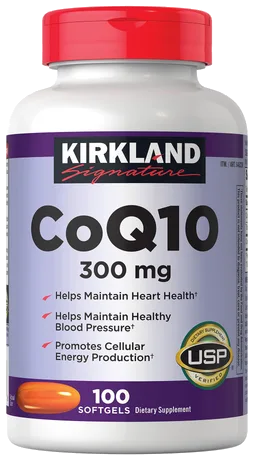
Kirkland Signature CoQ10 300 mg Review
Kirkland Signature CoQ10 300 mg is presented on this page as an antioxidant that is a necessary nutrient for cell function in the body with numerous health benefits. The page notes that CoQ10 concentrations may decrease as we age. The listing names the product as 100 softgels in a 3 pack, sold under the Kirkland brand, with a stated total of 300 servings per container. The About this item section highlights that it is intended to help maintain healthy blood pressure and promote energy production, and that it is USP Verified. Product details list the item form as softgel, the primary supplement type as CoQ10, the product benefit as heart health support, the age range as adult, and the flavor as unflavored. Special ingredients are listed as coenzyme Q10 (ubidecarenone), bovine gelatin, glycerin, silica, soy lecithin and soybean oil. The features section describes the item as rectangular and multi-colored, and the materials section lists it as gluten free and vegan. The seller shown is East Cost Trading NJ, and the item is marked non-returnable due to food safety reasons. The page also states that statements regarding dietary supplements have not been evaluated by the FDA and that the product is not intended to diagnose, treat, cure, or prevent any disease or health condition.
We don’t sell supplements. We help you make decisions and get the best price.
Lowest prices
We may earn a commission from some store links. How we choose.
Finding the lowest prices at the stores now. This takes a few seconds.
Study, Trial or Testing Result Summary
Members Only72 human studies · 43 improved
This product gives 300 mg of coenzyme Q10 a day, which is above the 100 mg dose that worked in studies. The strongest evidence, a pooled analysis of 26 randomized trials in 1,831 people with heart and metabolic conditions, found coenzyme Q10 lowered the top blood pressure number by about 4.8 points, with the biggest benefit at roughly 100 to 200 mg a day [1]. Another pooled analysis of 17 trials in 684 people found the top number fell but the bottom number did not change [2]. In a 24-week trial of 101 people with abnormal blood fats, 120 mg a day lowered both numbers more than placebo and also improved cholesterol [3]. In a 12-week trial of 83 people with high top readings, 60 mg twice a day lowered the top number by about 18 points [4]. Not all studies agree. A pooled analysis of seven trials in 356 people with diabetes found no change in blood pressure [5], and two small trials in 50 people with high blood pressure found no clear change in either number [6]. Overall, the benefit looks modest and mostly affects the top number. Animal and cell studies are never counted.
See all 72 studies →Hide the studies
- Across 26 randomized trials of 1,831 people with heart and metabolic conditions, coenzyme Q10 lowered the top blood pressure number by about 4.8 mmHg, with the biggest benefit at roughly 100-200 mg a day.Dose-Response Effect of Coenzyme Q10 Supplementation on Blood Pressure among Patients with Cardiometabolic Disorders: A …
- In 16 trials of 1,364 people with acute viral heart inflammation, adding trimetazidine to coenzyme Q10 improved treatment success more than coenzyme Q10 alone over 2-12 weeks; blood pressure was not measured.Combination of trimetazidine and coenzyme Q10 for the treatment of acute viral myocarditis: a systematic review and meta…
- Across 17 randomized trials of 684 people with metabolic diseases, coenzyme Q10 significantly lowered the top blood pressure number but did not significantly change the bottom number.The Effects of Coenzyme Q10 Supplementation on Blood Pressures Among Patients with Metabolic Diseases: A Systematic Revi…
- Across 12 trials of 362 people with high blood pressure, coenzyme Q10 lowered the top number by up to about 17 mmHg and the bottom number by up to about 10 mmHg, with no significant side effects.Coenzyme Q10 in the treatment of hypertension: a meta-analysis of the clinical trials.
- In seven placebo-controlled trials of 356 people with diabetes lasting at least 12 weeks, coenzyme Q10 did not change blood pressure, though it lowered triglycerides.Effects of coenzyme Q10 supplementation on metabolic profile in diabetes: a systematic review and meta-analysis.
- In trials of people with chronic heart failure taking 60-200 mg a day for 1-6 months, coenzyme Q10 improved the heart's pumping fraction by 3.7%; blood pressure was not reported.The impact of coenzyme Q10 on systolic function in patients with chronic heart failure.
- In three placebo-controlled trials of 96 people with high blood pressure, coenzyme Q10 lowered the top number by 11 mmHg and the bottom by 7 mmHg, though the authors said the studies may be unreliable.Blood pressure lowering efficacy of coenzyme Q10 for primary hypertension.
- In two placebo-controlled trials of 50 people with high blood pressure, coenzyme Q10 did not significantly change the top or bottom blood pressure numbers.Blood pressure lowering efficacy of coenzyme Q10 for primary hypertension.
- Pooling eight placebo-controlled trials in people with congestive heart failure, coenzyme Q10 improved how much blood the heart pumps (stroke volume, cardiac output, ejection fraction), though not exercise work capacity; this is not a blood pressure outcome.Treatment of congestive heart failure with coenzyme Q10 illuminated by meta-analyses of clinical trials.
- Across 14 trials of 1067 mostly older men with heart disease or high blood pressure, coenzyme Q10 improved heart failure outcomes and inflammation markers, but its effects on high blood pressure were inconclusive.Coenzyme Q10 as Adjunctive Therapy for Cardiovascular Disease and Hypertension: A Systematic Review.
- Across eight published trials in high blood pressure, coenzyme Q10 lowered average systolic pressure by 16 mm Hg and diastolic pressure by 10 mm Hg, though the trials were small and varied.Systematic review of effect of coenzyme Q10 in physical exercise, hypertension and heart failure.
- This review of recent trials in coronary heart disease found coenzyme Q10 had only less impressive effects on risk factors such as blood pressure, and did not support routine use.Recent Developments in the Role of Coenzyme Q10 for Coronary Heart Disease: a Systematic Review.
- In a randomized trial of 892 adults with hypertension, 100 mg a day of coenzyme Q10 added to standard care for 12 months was followed by fewer non-fatal heart attacks (5.4% vs 8.4%) and fewer fatal heart attacks (1.5% vs 3.1%) than standard care alone.Role of Coenzyme Q10 in Prophylaxis of Myocardial Infarction.
- In 443 healthy elderly people given selenium plus coenzyme Q10 for four years, heart-related deaths over 12 years were lower than with placebo (28.1% vs 38.7%), including in those with high blood pressure.Still reduced cardiovascular mortality 12 years after supplementation with selenium and coenzyme Q10 for four years: A v…
- In 216 older adults with heart failure with preserved ejection fraction, 12 weeks of ubiquinol (600 mg a day) and/or d-ribose improved symptom scores, heart pumping and a heart strain blood marker, but not walking distance; blood pressure was not reported.Effects of Ubiquinol and/or D-ribose in Patients With Heart Failure With Preserved Ejection Fraction.
- In 124 patients with acute viral heart inflammation, coenzyme Q10 lowered inflammation and oxidative stress markers, and combining it with trimetazidine worked better; blood pressure was not reported.Combination Therapy With Coenzyme Q10 and Trimetazidine in Patients With Acute Viral Myocarditis.
- In 105 people with mixed high blood fats on a med, adding 200 mg a day of coenzyme Q10 to omega-3 for 3 months lowered systolic blood pressure, cholesterol and inflammation markers more than a med plus omega-3 alone.Read the study on PubMed (28541926) →
- In 101 people with abnormal blood fats, 120 mg a day of coenzyme Q10 for 24 weeks lowered systolic and diastolic blood pressure more than placebo, and also improved cholesterol and insulin resistance.Treatment of coenzyme Q10 for 24 weeks improves lipid and glycemic profile in dyslipidemic individuals.
- In 88 adults with metabolic syndrome, taking coenzyme Q10 for 12 weeks did not change systolic or diastolic blood pressure compared with placebo.Effects of curcumin and/or coenzyme Q10 supplementation on metabolic control in subjects with metabolic syndrome: a rand…
- In 86 women with polycystic ovary syndrome, 8 weeks of coenzyme Q10 or vitamin E, alone or together, lowered systolic blood pressure compared with placebo, and diastolic pressure fell only with the combination.Independent and Additive Effects of Coenzyme Q10 and Vitamin E on Cardiometabolic Outcomes and Visceral Adiposity in Wom…
- In 85 people with moderate-to-severe chronic kidney disease, 200 mg of coenzyme Q10 daily for 8 weeks had no independent effect on blood pressure and increased heart rate, while omega-3 lowered blood pressure.The effects of [omega]3 fatty acids and coenzyme Q10 on blood pressure and heart rate in chronic kidney disease: a rando…
- In 83 men and women with isolated systolic hypertension, 60 mg of coenzyme Q10 twice daily for 12 weeks lowered systolic blood pressure by an average of 17.8 mm Hg.Randomized, double-blind, placebo-controlled trial of coenzyme Q10 in isolated systolic hypertension.
- In 80 people with type 2 diabetes and high cholesterol, 200 mg of coenzyme Q10 daily for 12 weeks lowered systolic blood pressure, but did not significantly improve blood flow in the forearm when taken alone.Combined effect of coenzyme Q10 and fenofibrate on forearm microcirculatory function in type 2 diabetes.
- In 74 adults with type 2 diabetes and dyslipidaemia, 200 mg per day of coenzyme Q10 for 12 weeks lowered systolic blood pressure by about 6 mmHg and diastolic by about 3 mmHg compared with placebo.Coenzyme Q10 improves blood pressure and glycaemic control: a controlled trial in subjects with type 2 diabetes.
- In 74 people with type 2 diabetes and diastolic heart dysfunction taking 200 mg of coenzyme Q10 daily for 6 months, 24-hour diastolic blood pressure fell compared with placebo, though heart filling did not improve.Hemodynamic effects of fenofibrate and coenzyme Q10 in type 2 diabetic subjects with left ventricular diastolic dysfunct…
- In 74 adults with chronic kidney disease taking 200 mg of coenzyme Q10 daily for 8 weeks, blood pressure did not fall more than with placebo, while omega-3 fatty acids did lower it.n-3 fatty acids reduce plasma 20-hydroxyeicosatetraenoic acid and blood pressure in patients with chronic kidney disease…
- In 67 adults with chronic heart failure, a daily 320 mg coenzyme Q10 terclatrate plus creatine combination for 8 weeks raised peak oxygen uptake during exercise more than placebo.Coenzyme Q10 terclatrate and creatine in chronic heart failure: a randomized, placebo-controlled, double-blind study.
- In 65 hemodialysis patients taking 1,200 mg of coenzyme Q10 daily for 4 months, oxidative stress markers fell compared with placebo, but predialysis blood pressure did not change.Effect of Coenzyme Q10 on Biomarkers of Oxidative Stress and Cardiac Function in Hemodialysis Patients: The CoQ10 Biomar…
- In 64 hypertensive adults taking compound fish oil capsules for 3 weeks, blood pressure did not change compared with corn oil, though blood flow in one heart artery improved.Effect of compound fish oil capsules on microvascular function in hypertensive individuals: a triple-blind, randomized, …
- In 60 mildly hypertensive adults, 100 mg daily of coenzyme Q10 for 12 weeks lowered inflammatory markers IL-6 and hs-CRP compared with placebo; the abstract does not report a blood pressure outcome.The Effect of Coenzyme Q10 Supplementation on Pro-Inflammatory Factors and Adiponectin in Mildly Hypertensive Patients: …
- In 60 burn patients, 300 mg a day of coenzyme Q10 for 10 days did not change blood pressure or inflammation compared with placebo, though albumin rose.Coenzyme Q10 supplementation in burn patients: a double-blind placebo-controlled randomized clinical trial.
- In 59 hypertensive adults with coronary artery disease taking 60 mg of coenzyme Q10 twice daily for 8 weeks, systolic and diastolic blood pressure fell more than with a B vitamin control, along with lower lipid peroxides.Effect of hydrosoluble coenzyme Q10 on blood pressures and insulin resistance in hypertensive patients with coronary art…
- In 56 patients with weak heart pumping from coronary disease, 300 mg daily of coenzyme Q10 for 8 weeks improved mitochondrial function and blood vessel dilation but did not change blood pressure compared with placebo.Reversal of mitochondrial dysfunction by coenzyme Q10 supplement improves endothelial function in patients with ischaemi…
- In 54 people with irregular heartbeats, a micronutrient combination containing coenzyme Q10 for 6 weeks reduced heart muscle mass and improved insulin levels compared with placebo, though extra beats were unchanged.Dietary intervention with a specific micronutrient combination for the treatment of patients with cardiac arrhythmias: t…
- In 50 patients with diastolic heart failure, 8 weeks of enalapril plus coenzyme Q10 and vitamin E lowered several hormone levels linked to heart failure, while the abstract does not report a separate effect of coenzyme Q10 alone.[The changes of PRA, ATII, ald, ET and ANP in patients with left ventricular diastolic heart failure and intervention wi…
- In 41 patients with left ventricular dysfunction undergoing bypass surgery, a supplement containing coenzyme Q10 raised heart muscle levels of coenzyme Q10 and reduced left ventricular end-diastolic volume compared with placebo.Nutritional supplementation with MyoVive repletes essential cardiac myocyte nutrients and reduces left ventricular size …
- In 39 older adults with heart failure and preserved pumping function, 4 months of coenzyme Q10 did not significantly improve heart filling measures or NT-proBNP compared with placebo.Coenzyme Q10 in the Treatment of Heart Failure with Preserved Ejection Fraction: A Prospective, Randomized, Double-Blind…
- In 38 children with idiopathic dilated cardiomyopathy, coenzyme Q10 for 6 months improved diastolic heart function more than placebo, with 10 of 17 treated children improving; the dose was not stated.Coenzyme Q10 improves diastolic function in children with idiopathic dilated cardiomyopathy.
- In 32 young kendo athletes, 600 mg of ubiquinol daily for about 11 days during a training camp lowered diastolic blood pressure compared with placebo, but did not reduce exercise-related muscle damage.Effect of reduced coenzyme Q10 (ubiquinol) supplementation on blood pressure and muscle damage during kendo training cam…
- In 30 elderly people with heart failure, a high-dose multi-vitamin and mineral capsule that also contained coenzyme Q10 for 9 months improved heart chamber size, pumping strength and quality of life compared with placebo; the effect of coenzyme Q10 alone cannot be separated out.The effect of micronutrient supplementation on quality-of-life and left ventricular function in elderly patients with ch…
- In 30 people with metabolic syndrome and uncontrolled blood pressure on medication, 100 mg of coenzyme Q10 twice daily for 12 weeks did not significantly lower 24-hour blood pressure compared with placebo.A randomized, double-blind, placebo-controlled crossover study of coenzyme Q10 therapy in hypertensive patients with the…
- In 30 adults with heart failure with preserved ejection fraction, 100 mg of coenzyme Q10 three times daily for 30 days gave no added benefit to heart filling function compared with usual care alone.Effects of coenzyme Q10 supplementation on diastolic function in patients with heart failure with preserved ejection fra…
- In 28 hemodialysis patients randomized to 200 mg per day of coenzyme Q10 for 8 weeks versus placebo in a crossover design, diastolic heart function did not improve significantly compared with placebo.Coenzyme Q10 supplementation and diastolic heart functions in hemodialysis patients: a randomized double-blind placebo-c…
- In 26 healthy young adults, a single 50 mg dose of coenzyme Q10 caused a small, short-lived rise in systolic blood pressure compared with placebo, and had no effect on heart rhythm readings.Electrocardiographic and hemodynamic effects of coenzyme Q10 in healthy individuals: a double-blind, randomized controll…
- In 25 people with a weakened, enlarged heart, about 100 mg of coenzyme Q10 daily for 4 months did not improve heart pumping, heart size, exercise tolerance, or heart rhythm compared with placebo.Ubiquinone (coenzyme Q10) in the long-term treatment of idiopathic dilated cardiomyopathy.
- In 23 adults with heart failure, 300 mg of coenzyme Q10 daily for 4 weeks improved peak oxygen use during exercise and blood vessel function compared with placebo, without side effects.Coenzyme Q10 and exercise training in chronic heart failure.
- In 23 volunteers on a 17-day trek to Everest Base Camp, 300 mg per day of coenzyme Q10 did not prevent the loss of heart muscle mass or the change in diastolic function seen in people without it.Oral Coenzyme Q10 supplementation does not prevent cardiac alterations during a high altitude trek to everest base cAMP.
- In 21 people with heart failure, 100 mg of coenzyme Q10 three times daily for 4 weeks improved heart pumping and muscle contraction compared with placebo, and increased peak oxygen use during exercise.Coenzyme Q10 improves contractility of dysfunctional myocardium in chronic heart failure.
- In 18 adults with chronic kidney disease, 20 mg daily of a mitochondria-targeted ubiquinol for 4 weeks improved blood vessel flexibility compared with placebo, but did not lower central aortic blood pressure.Effects of a mitochondrial-targeted ubiquinol on vascular function and exercise capacity in chronic kidney disease: a ra…
- In 18 male endurance athletes, 28 days of coenzyme Q10 raised blood levels of the nutrient but did not consistently change oxygen uptake, lactate, heart rate or blood pressure during cycling tests compared with placebo.Does exogenous coenzyme Q10 affect aerobic capacity in endurance athletes?
- In patients with heart failure taking 100 mg of ubiquinone daily for 7 months, heart pump measures and symptoms improved.Role of metabolic therapy in cardiovascular disease.
- In 131 people with borderline high blood pressure, a multi-ingredient supplement including coenzyme Q10 for 3 months improved cholesterol and glucose but left blood pressure unchanged.The Effects of a New Generation of Nutraceutical Compounds on Lipid Profile and Glycaemia in Subjects with Pre-hypertens…
- In 104 people with metabolic syndrome, red yeast rice with coenzyme Q10 for 2 months lowered systolic blood pressure by 5.2 and diastolic by 4.9 mmHg versus 3.0 and 2.9 with diet alone.Effect of Monacolin K and COQ10 supplementation in hypertensive and hypercholesterolemic subjects with metabolic syndrom…
- In 66 people with mild high blood pressure and high cholesterol, a daily multi-ingredient tablet containing coenzyme Q10 for 6 months lowered 24-hour systolic blood pressure compared with diet alone; the effect of coenzyme Q10 alone could not be separated out.Nutraceuticals for Serum Lipid and Blood Pressure Control in Hypertensive and Hypercholesterolemic Subjects at Low Cardi…
- In 55 people with congestive heart failure given coenzyme Q in 1976 doses of 30 to 100 mg per day, a mild but stable benefit was seen alongside digitalis, with no significant change in heart rate or blood pressure.A clinical study of the effect of coenzyme Q on congestive heart failure.
- In heart failure patients taking standard medicines, a Pycnogenol and coenzyme Q10 combination for 12 weeks lowered systolic and diastolic blood pressure and increased treadmill walking distance more than in the control group.Investigation of Pycnogenol® in combination with coenzymeQ10 in heart failure patients (NYHA II/III).
- In children with load-induced heart dysfunction, coenzyme Q10 at 3.0 to 3.4 mg per kg daily for 7 days restored normal diastolic (heart relaxation) patterns under stress.Recovery of load-induced left ventricular diastolic dysfunction by coenzyme Q10: echocardiographic study.
- In 30 children with load-induced heart contractility depression, coenzyme Q10 therapy restored a normal heart pumping response to stress (Frank-Starling mechanism).Recovery of the Frank-Starling mechanism by coenzyme Q10 in patients with load-induced contractility depression.
- In a double-blind crossover study of 19 adults with chronic heart muscle disease, 18 reported better activity tolerance with coenzyme Q10 replacement, alongside significant gains in stroke volume and ejection fraction; the dose and duration were not stated.Effective treatment with coenzyme Q10 of patients with chronic myocardial disease.
- In 17 people with congestive heart failure, 30 mg of coenzyme Q10 daily for 6 weeks did not produce a measurable change in heart pumping function, while taurine at 3 g daily did.Usefulness of taurine in chronic congestive heart failure and its prospective application.
- In 424 adults with various heart diseases followed for about 18 months on average, coenzyme Q10 at an average of 242 mg daily was linked to heart function gains, with most patients improving by at least one heart failure class, and no placebo group.Usefulness of coenzyme Q10 in clinical cardiology: a long-term study.
- In 115 people with fatigue, chest pain, or irregular heartbeat and stiff heart muscle, coenzyme Q10 replacement was followed by lower blood pressure in 80% of those with high readings and better heart filling in all patients with follow-up scans, though the study had no placebo group and did not state dose or duration.Isolated diastolic dysfunction of the myocardium and its response to CoQ10 treatment.
- In 30 people with very high triglycerides, 150 mg daily of coenzyme Q10 for 6 weeks lowered blood pressure during fenofibrate treatment in one group and during fish-oil treatment in the other group, with no change in the control group on the other treatments.Possible role of ubiquinone in the treatment of massive hypertriglyceridemia resistant to PUFA and fibrates.
- In 26 adults with high blood pressure, 50 mg of coenzyme Q10 taken twice daily for 10 weeks lowered average systolic blood pressure from about 164 to about 147 mmHg and diastolic from about 98 to about 86 mmHg, with no control group.Coenzyme Q10 in essential hypertension.
- In an open-label study of 17 adults with congestive cardiomyopathy, coenzyme Q10 for 4 months improved functional class by about 20% and heart failure score by 27%, with no placebo group; the dose was not stated.The clinical and hemodynamic effects of coenzyme Q10 in congestive cardiomyopathy.
- In 15 children with dilated cardiomyopathy, 9 months of coenzyme Q10 at about 3.1 mg per kg per day added to usual heart drugs was followed by better heart failure class, but the improvement was not significant after multiple-comparison adjustment and there was no placebo group.The effect of coenzyme Q10 on idiopathic chronic dilated cardiomyopathy in children.
- In 1,191 people with ischemic heart failure, blood coenzyme Q10 levels were not an independent predictor of outcomes, and a med did not worsen outcomes in those with low levels.Read the study on PubMed (20883926) →
- In 109 adults with high blood pressure, an average of 225 mg of coenzyme Q10 daily added to their usual medicines was followed by significantly lower blood pressure and some patients were able to reduce their meds, though there was no control group.Treatment of essential hypertension with coenzyme Q10.
- In 20 children with a genetic coenzyme Q10 deficiency kidney disease, coenzyme Q10 plus a med lowered protein in the urine in five patients, and blood pressure fell over 6 to 12 months after kidney transplant.COQ8B nephropathy: Early detection and optimal treatment.
- In 11 people with moderate to severe heart failure taking standard drugs, 60 mg a day of coenzyme Q10 for about 8 months was followed by better symptoms, better quality of life, and smaller heart chamber measurements.[Efficacy of ubidecarenone in the treatment of patients with cardiac insufficiency].
- In 5 adults with essential hypertension given coenzyme Q10 for 3 to 5 months, blood pressure fell, with the largest drop in one 74-year-old man.Bioenergetics in clinical medicine. VIII. Adminstration of coenzyme Q10 to patients with essential hypertension.
- In patients whose heart filling worsened on a med, coenzyme Q10 supplementation improved diastolic heart function measured by echocardiography.Read the study on PubMed (15541254) →
Review Totals and Summary
Members Only8,392 reviews · 96% positive
Across the stores that sell it, Kirkland Signature CoQ10 300 mg softgels carry about 8,392 ratings, and the feedback is strongly positive. Buyers like the price and a med-related benefits most, and the complaints are mostly about softgel size and a few reports of leaking. **What buyers say it did for them:** Most of the benefit stories involve meds. One person had foot and leg cramps after a bedtime a med dose and said "from the VERY FIRST NIGHT" they stopped. Another reported muscle aches that eased the same day, and said they came back after switching to a liquid form. Others take it as a precaution, with one saying "no side effects, and my readings have all been good." A few mention blood pressure, with one reviewer saying their doctor calls theirs "athletic." One buyer orders a double dose for a husband with a neurological disorder. Some of these benefits are the reviewers' own beliefs. One reviewer notes that opinions differ on what CoQ10 does. **What they complain about:** The sharpest complaint is a one-star review saying two bottles over six months had softgels "not sealed and leaking," which the reviewer took as a sign of poor quality control and a reason to doubt potency. The store summary also mentions one reviewer who wished for a 200 mg version. One reviewer noted a delayed shipment from a seller. **Taste, smell, pill size and form:** Several people say the softgels are easy to swallow, and one found them to have "no aftertaste." One reviewer chews them and says they taste like nothing. The size is not for everyone. A reviewer who has no trouble herself found it "too large for my mom" and planned to switch to a name brand. Another reviewer moved to a liquid form to avoid gelatin but went back to the capsules when the aches returned. Reviews of other forms or strengths on these pages were left out of this summary, apart from this mention. **Value for money:** Price is the most common praise. Buyers call it "the best price I have found" and "great value." One cites a consumer laboratory ranking Kirkland the most cost-effective CoQ10, and says the same product costs about 20% more at a big online retailer. Another says the brand is cheaper than the name brand sold at Costco. Buying two bottles at once was also called a good deal. **Who it seems to suit and who it did not:** It seems to suit people on meds who want to address muscle aches or cramps. It also suits people who want a trusted store brand. Reviewers mention that it carries the USP certification, one saying it was the only CoQ10 they found with that mark, and that Consumer Reports rates Kirkland supplements highly. One older reviewer said "probably all older people should take this," though that is one person's opinion. It suited people with a swallowing problem less well, because of the large softgel. It also did not suit the reviewer who found leaking bottles and lost confidence in the quality.
Biohacker Summary
Members Only7 of 10 recommend it
Coenzyme Q10 is the main ingredient here, and the panel leans favorable: of the nine who spoke about it, three say they take it daily, three more recommend it, and the rest are neutral. Most take it to support the mitochondria, the parts of cells that make energy, and for heart health, fatigue, brain health and fighting oxidative stress; others bring up migraines, fertility and lung repair. Doses mentioned run from 100 to 400 mg a day, with one panelist taking 300 mg daily and another saying some people go up to 1200 mg; one advises taking it with a fatty meal, and another prefers the ubiquinol form. Several link it to meds that lower the body's own levels, though one says the data do not show it prevents muscle symptoms from meds, and another says there is no real evidence it extends lifespan. One panelist said standard forms are poorly absorbed, and one appears to have stopped taking it in search of an easier approach.
See all 9 biohackers →Hide the biohackers
Dr. Eric Berg · Coenzyme Q10 · neutral
- Mentions that grass-fed liver has coenzyme Q10.
- Recommends that anyone with a med prescription should also take coenzyme Q10, specifically the ubiquinol form, to support heart and muscle function.
- Notes that Merck filed a patent for a med combined with coenzyme Q10, but never added it back into the formula, and that major heart organizations do not recommend taking coenzyme Q10 alongside meds.
- Recommends taking coenzyme Q10, specifically ubiquinol, to prevent the side effects of meds, especially for those experiencing muscle weakness, pain, fatigue, or exercise intolerance. He suggests a dose of 200 to 400 mg, or even up to 1200 mg a day for some individuals.
- Mentions that coenzyme Q10 supports the heart and mitochondria as a powerful antioxidant, and meds deplete its production.
- States that coenzyme Q10 has been known to help people with fibromyalgia feel better.
- Recommends Coenzyme Q10, especially for those on meds, as it's a key nutrient for energy in the mitochondria and works with vitamin E and selenium, and suggests taking it at lunch with a meal.
- Recommends coenzyme Q10 as a remedy for long COVID.
- Mentions that meds block coenzyme Q10 and refers to another video where he discusses it.
- Dr. Berg highlights coenzyme Q10 as a key essential nutrient for mitochondria in the heart, and recommends taking it if on meds, as meds deplete this nutrient.
Dave Asprey · Coenzyme Q10 · uses
- States he takes 300 mg of Coenzyme Q10 every day for 20 years because it is necessary for mitochondria to function and is important for longevity, noting that meds lower it.
- Recommends coenzyme Q10 (CoQ10) to support mitochondria, as it helps generate energy and fights oxidative stress.
- Mentions that there are methylation genes for Coenzyme Q10 that convert it to ubiquinol.
- Suggests taking Coenzyme Q10 to optimize mitochondria.
- Mentions Coenzyme Q10 as something that can change blood viscosity, alongside sunlight and earthing.
- Includes Coenzyme Q10 as a helpful addition to a med protocol.
- Used to give his dog coenzyme Q10 for mitochondrial function.
- Dave Asprey mentions Coenzyme Q10 as something one might take to boost ATP production.
- Dave Asprey mentions that Coenzyme Q10 is a big deal for a lot of people regarding energy.
- Mentions Coenzyme Q10 as one of the micronutrients that can help protect the glycocalyx.
Andrew Huberman · Coenzyme Q10 · uses
- Personally takes Omega-3 and Coenzyme Q10 every day, noting they are known to support cardiovascular health, cellular health and energy, and brain health.
- Personally takes coenzyme Q10 every day, noting it supports cardiovascular health, cellular health, energy, and brain health.
- Discusses a study where probiotics, magnesium orotate, and coenzyme Q10 showed a short-term improvement in symptoms of major depression.
- Discusses Coenzyme Q10 as a fertility supplement.
- Recommends Coenzyme Q10 at 100 to 400 milligrams per day, taken with a meal containing fat, ideally dinner, to improve sperm quality by supporting mitochondrial health, which is vital for sperm formation and fertilization.
- States that coenzyme Q10 should be taken with food.
- Mentions Coenzyme Q10 as a tool for fertility.
- Andrew Huberman says he personally takes AG1's new Omega-3 Coenzyme Q10 product every day, noting that Omega-3 and Coenzyme Q10 are known to support cardiovascular health, cellular health, energy, and brain health.
- Andrew Huberman notes that some papers suggest coenzyme Q10 might be beneficial for egg quality.
Thomas DeLauer · Coenzyme Q10 · uses
- States that coenzyme Q10 is one of his favorite compounds for the mitochondria, and it is found in sardines.
- Recommends getting coenzyme Q10 from good quality red meat and organ meat, or through supplementation, to act as an electron catcher in the mitochondria, optimizing energy production and reducing oxidative stress.
- Recommends utilizing coenzyme Q10 to support mitochondrial function and the electron transport chain, making hydration more effective.
- Recommends coenzyme Q10 as a runner-up for energy and mitochondrial function, explaining it's an electron carrier in the mitochondrial chain that focuses on the last complex, creating a bigger net to catch electrons and reduce oxidative stress.
- Recommends Coenzyme Q10 for fatigue, stating it's essential for electron transport, ATP regeneration, and reducing oxidative stress, and can be found in organ meats, fatty fish, pistachios, and sesame seeds.
- Mentions Coenzyme Q10 as a micronutrient essential for the complex biological workings of metabolism in the mitochondria.
- Recommends 300-600mg of Coenzyme Q10 for those intermittent fasting or on low carb, to help utilize fuel better, support heart health, and strengthen mitochondrial function by improving the proton gradient.
- Recommends Coenzyme Q10 for people who are fasting or on a ketogenic diet, explaining that it helps fuel the electron transport chain, leading to more efficient energy processing and increased energy during OMAD and the eating period.
- Recommends 300 to 600 milligrams of Coenzyme Q10 during the eating period to help the electron transport chain and utilize food for energy.
- Notes that Coenzyme Q10 is good for mitochondrial health and energy, and there's growing evidence linking it to nitric oxide production, suggesting a supplement if one doesn't get enough from meat.
Dr. Mark Hyman · Coenzyme Q10 · recommends
- Mentions that coenzyme Q10 is important in mitochondrial function and can be a factor in migraines.
- Tried coenzyme Q10 as part of a meticulous effort to address energy and metabolism issues, but implies they no longer use it as they were looking for an easier solution.
- Included coenzyme Q10 in a mitochondrial rejuvenation program to support mitochondrial function.
- States that mitochondria need coenzyme Q10 and that PQQ has been shown to work very well with it.
- States that coenzyme Q10 can be very helpful if fatigue is a significant problem, and is a mitochondrial support for energy recovery.
- Recommends Coenzyme Q10 for better mitochondrial function, lower inflammation, improved insulin sensitivity, and blood sugar, especially for those taking meds or experiencing age-related decline in CoQ10 production.
- Takes Coenzyme Q10, believing it affects the mitochondria and the aging process, even without full scientific confirmation.
- Mentions that coenzyme Q10 was part of the mitochondrial therapy that helped a child with autism improve, and later states it is a key component of mitochondrial supplementation.
- Recommends coenzyme Q10 for mitochondrial repair, stating that high doses of 200 to 400 milligrams a day are needed, spread out with food.
- Recommends Coenzyme Q10 for mitochondrial function, especially for fatigue and heart problems, at doses of 200 to 400 milligrams a day, spread out as 100 milligrams three or four times a day with food, noting its safety and effectiveness for conditions like migraine headaches.
Ben Greenfield · Coenzyme Q10 · neutral
- Discusses Coenzyme Q10 as an ingredient that MitoQ uses in a mitochondria-directed form, noting that standard CoQ10 rarely achieves movement past the cell membrane and into mitochondria.
- Discusses Coenzyme Q10 (CoQ10) in the context of MitoQ Pure being an upgraded form of it.
- Is currently using CoQ10 because any type of a med, including natural ones like red yeast rice extract, can deplete the body's coenzyme Q10 levels, affecting mitochondrial health.
- Is a big proponent of crystal-free coenzyme Q10, explaining that most CoQ10 products have poor absorption due to crystallization, and recommends Pharma Nord's patented process for keeping CoQ10 in solution, which achieves three to ten times higher plasma levels.
- Recommends coenzyme Q10 for lung repair, highlighting its importance for mitochondrial and cardiopulmonary function, especially for those exposed to pollution or who have smoked.
- Takes coenzyme Q10 in the morning for heart disease.
- Is currently using CoQ10 because meds, whether prescription or natural like red yeast rice extract, can strip the body of coenzyme Q10 levels.
- Suggests it is smart to include Coenzyme Q10 for reducing fatigue, referencing a systematic review and meta-analysis.
- Believes Coenzyme Q10 is probably beneficial for 80-year-olds with cardiac issues, but not great for most people, as they are not deficient in it when aging starts around 30-35.
- Recommends a stack of Coenzyme Q10, MitoQ, and PQQ for mitochondrial support, noting that supplements stacking all three are available on Amazon.
Siim Land · Coenzyme Q10 · neutral
- Describes Coenzyme Q10 as a mitochondrial supportive supplement that may increase energy production, but notes there isn't actual lifespan or longevity evidence for it.
- Takes 300 milligrams of Coenzyme Q10 daily as a supplement, noting it helps with energy production, fat oxidization, heart health, and longevity.
Peter Attia · Coenzyme Q10 · neutral
- Notes there isn't good data that Coenzyme Q10 prevents a med Associated muscle symptoms, but doesn't object if patients want to take it because it makes them feel better about taking a med.
Dr. Rhonda Patrick · Coenzyme Q10 · neutral
- A daily dose of coenzyme Q10 reduces blood pressure by about 4mmHg systolic and 3mmHg diastolic in people with type 2 diabetes, potentially lowering cardiovascular risk.
RAL Summary
Members OnlyTier 3 for Blood Pressure
More Details
Members OnlyBody systems · Combine with · Possible side effects
Body systems: Cardiovascular system
Combine with: For cardiovascular support, pair CoQ10 with magnesium (glycinate or taurate), omega-3 fish oil (EPA/DHA), and possibly L-carnitine for heart muscle energy metabolism. If the user still wants cellular aging support, consider adding NAD+ precursors (nicotinamide riboside or NMN), PQQ for mitochondrial biogenesis, and trans-resveratrol or pterostilbene for sirtuin activation. Alpha-lipoic acid, vitamin C and vitamin E, and a B-complex with methylfolate and B12 can support antioxidant recycling and DNA methylation. Take CoQ10 with a fat-containing meal to improve absorption. Consult a physician if taking a med, meds, or chemotherapy, since CoQ10 can interact with them.
Possible side effects: No major side effects were reported in the studies. Buyers mention large softgels that can be hard to swallow and a few reports of leaking softgels.
Supplement Facts
Coenzyme Q10 300 mg
| Calories | 10 | |
| Total Fat | 1 g | |
| Coenzyme Q10 | 300 mg | † |
Other ingredients: Soybean Oil, Coenzyme Q10, Gelatin, Glycerin, Soy Lecithin, Silica.
Directions: Suggested use: Take one (1) softgel daily or as directed by a physician.
Barcode (UPC) 096619928118 · Label source: NIH label database · Report a label change
Show entire label
More blood pressure products
Members OnlyThe highest ranked for the same goal
Read more
Our articles on this subject
- How to Lower Diastolic Blood Pressure for LongevityArticle · Sep 17, 2026
- DASH Diet for High Blood Pressure: What It Lowers, What to Eat, and How to StartArticle · Sep 19, 2026
Graded November 8, 2026 by the Reverse Age Lab evidence engine, from human studies, real reviews and our biohacker panel. How we grade. Is this medical advice? No. Rala organizes the published evidence; go over any change with your doctor, especially if you take meds.
Privacy policyConsumer health dataAffiliate disclosureTermsDo Not Sell or Share My Personal InformationCookie settings