
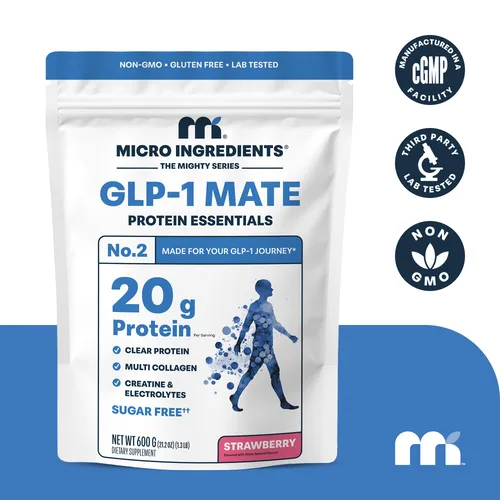
Micro Ingredients GLP-1 Mate Protein Essentials Powder, 600g Review
Protein Essentials is a clear protein drink made for the GLP-1 journey. Each serving delivers 20g of protein from clear whey isolate and multi collagen in a light, sugar-free strawberry formula. The makers describe it as lacking the heavy, creamy texture of traditional shakes, and say it is easy to enjoy even on low-appetite days. Each serving brings together creatine, electrolytes, prebiotic fiber, and beauty-supporting nutrients to help people reach their daily protein goals. The page lists three areas of support. The first is muscle, hydration and gut support. Protein and creatine monohydrate are said to support lean muscle and strength. A full electrolyte profile of potassium, sodium, magnesium, and calcium is said to support hydration, and prebiotic inulin fiber from chicory root is said to support digestive health as eating habits change. The second is hair, skin and nail support. A multi collagen complex of five types (I, II, III, V, and X) from four sources is combined with hyaluronic acid, biotin, and vitamin C to support healthy hair, skin, and nails from the inside out as the body changes. The third is quality. The product is third-party lab tested for purity, safety, and potency. It is non-GMO and made in a cGMP-compliant facility. It is sugar-free and free of gluten and soy, but it contains milk, fish, and egg. The suggested use is to mix 3 scoops into water or a beverage of choice once daily. It can be enjoyed as a light morning start, an afternoon refresher, or a post-workout sip. On low-appetite days, the page suggests sipping it slowly throughout the day. It advises using the product as directed by a healthcare professional. The page also notes that the statements have not been evaluated by the Food and Drug Administration and that the product is not intended to diagnose, treat, cure, or prevent any disease. The size shown is 600g, and the one-time price is listed at $32.95, with subscription options offered at 10 percent savings for delivery every one, two, or three months. The product is currently shown as sold out or unavailable in the 600g variant. The brand, Micro Ingredients, also states that it sources ingredients directly from single-origin suppliers, emphasizes non-GMO ingredients, and offers free shipping on orders over $59 with a 30-day return policy.
We don’t sell supplements. We help you make decisions and get the best price.
Lowest prices
We may earn a commission from some store links. How we choose.
We hold no current store prices for it yet: check the store.
- AmazonPrice at AmazonCheck price at Amazon (opens in a new tab)
Also at: Micro Ingredients. Some links earn us a commission; price comes first, and a commission only decides the order of prices within 2%. As an Amazon Associate we earn from qualifying purchases.
Study, Trial or Testing Result Summary
Members Only69 human studies · 29 improved
1 of these 69 human studies gave whey protein isolate by drip, not by mouth.
This powder gives 20 grams of clear whey protein isolate per serving, close to the roughly 21 grams that helped older adults keep leg muscle [1]. A large 2024 pooled analysis of 78 trials in older adults doing strength training ranked whey as the best protein for muscle mass, grip strength and walking speed [1]. Another pooled analysis of 116 trials found milk proteins, including whey, improved muscle mass and strength with training, though not physical performance tests [2]. In older adults with age-related muscle loss, whey increased muscle mass and walking speed [3], and an enriched whey drink added leg muscle over 13 weeks without changing grip strength [4]. In trained adults, whey gave small extra gains in lean mass and strength [5]. Exercise matters: a one-year trial found 20 grams twice daily without training did not build muscle or strength, while adding heavy training did [6]. The store listing also names collagen, creatine and electrolytes, but the label shows no amounts for them, so their doses are unknown. Animal and cell studies are never counted.
See all 69 studies →Hide the studies
- Across 78 trials with 5272 older adults doing resistance training, whey protein was the best-ranked protein for boosting muscle mass, handgrip strength and walking speed.Comparative Efficacy of Different Protein Supplements on Muscle Mass, Strength, and Physical Indices of Sarcopenia among…
- Across 116 trials with 4711 adults doing resistance training, milk proteins including whey improved muscle mass and strength, but no protein type improved physical performance tests.Effects of Timing and Types of Protein Supplementation on Improving Muscle Mass, Strength, and Physical Performance in A…
- In 18 trials with 1341 older adults with or at risk of sarcopenia, adding protein supplements to exercise improved grip strength and muscle mass index but not walking mobility, and whey-based options looked promising but the evidence was very low certainty.Comparative effectiveness of protein or protein-related supplementation combined with resistance or functional exercise …
- In 10 trials with 1154 older adults with sarcopenia, whey protein increased muscle mass and gait speed, and with resistance training increased handgrip strength, while also lowering interleukin-6.Improving sarcopenia in older adults: a systematic review and meta-analysis of randomized controlled trials of whey prot…
- In 3 trials with 637 patients with sarcopenia, whey protein with leucine and vitamin D increased limb muscle mass, and improved strength and function when combined with exercise.Effects of Whey Protein, Leucine, and Vitamin D Supplementation in Patients with Sarcopenia: A Systematic Review and Met…
- In 7 trials with 591 older people with sarcopenia, adding whey protein to resistance training modestly increased muscle mass and handgrip strength, though the evidence quality was low to very low.Effectiveness of Whey Protein Supplementation during Resistance Exercise Training on Skeletal Muscle Mass and Strength i…
- In 7 trials with 472 older people with sarcopenia, strength training with whey protein or HMB increased fat-free mass and some performance measures, with whey plus training improving handgrip strength.Combined effects of strength training, whey protein, and HMB on sarcopenia in older people: A systematic review and meta…
- In 9 trials with 266 people doing resistance training for at least 6 weeks, whey and soy protein produced similar strength gains with no difference in lean mass change between them.No Difference Between the Effects of Supplementing With Soy Protein Versus Animal Protein on Gains in Muscle Mass and St…
- Across nine trials of 192 resistance-trained adults training for at least 6 weeks, whey protein alone or in multi-ingredient supplements gave small extra gains in lean mass and in upper and lower body strength compared with calorie-matched carbohydrate or non-whey protein.Effects of Whey Protein Alone or as Part of a Multi-ingredient Formulation on Strength, Fat-Free Mass, or Lean Body Mass…
- Across 13 controlled trials in young healthy adults, whey protein gave small to medium improvements in recovery of muscle function from under 24 hours to 96 hours after resistance training compared with control, though only half of the individual studies found a benefit.The Effect of Whey Protein Supplementation on the Temporal Recovery of Muscle Function Following Resistance Training: A …
- In postmenopausal women, whey protein improved biceps curl strength and leg lean mass only when combined with resistance training; without training it had no significant effect on strength or lean mass.Effect of Whey Protein Supplementation in Postmenopausal Women: A Systematic Review and Meta-Analysis.
- In a pooled analysis of trials in older adults, whey protein did not improve lean mass or strength overall but improved physical function, and it improved lean mass and function in frail or sarcopenic older adults, while adding vitamin D improved lean mass and strength.Whey Protein Supplementation with or without Vitamin D on Sarcopenia-Related Measures: A Systematic Review and Meta-Anal…
- In a network analysis of 51 trials in healthy adults, a single dose of whey protein after resistance exercise modestly raised the hourly rate of muscle protein building, and was the only protein source with a statistically significant effect, with best responses at 18 to 25 grams.Impact of different protein sources on acute muscle protein synthesis following resistance training: a systematic review…
- In older adults with sarcopenia, regular resistance exercise combined with daily essential amino acids or whey protein plus vitamin D maintained or increased muscle mass and lean mass, with added gains in strength, speed, and balance across 16 included studies.Exercise Programs Combined with Diet Supplementation Improve Body Composition and Physical Function in Older Adults with…
- A review of older adults with muscle loss suggests that leucine-enriched whey protein plus resistance training increases lean muscle mass, strength and physical performance.Enhancing Muscle Quality: Exploring Leucine and Whey Protein in Sarcopenic Individuals.
- In 380 sarcopenic older adults taking a vitamin D and leucine-enriched whey drink twice daily for 13 weeks, leg muscle mass and chair-stand performance improved more than with a control drink, but grip strength and overall physical performance did not differ.Effects of a vitamin D and leucine-enriched whey protein nutritional supplement on measures of sarcopenia in older adult…
- In sarcopenic older adults over 12 weeks, nutrition supplements with whey protein, fish oil and vitamin D raised muscle mass and grip strength and lowered fat mass compared with routine care.Effects of nutrition supplementation and physical exercise on muscle mass, muscle strength and fat mass among sarcopenic…
- Over one year in 208 healthy adults over 65, taking 20 g whey protein twice daily without exercise did not increase thigh muscle size or strength compared with a carbohydrate drink, whereas adding heavy resistance training did.The effect of daily protein supplementation, with or without resistance training for 1 year, on muscle size, strength, a…
- In 150 people with Parkinson disease or parkinsonism during a 30-day intensive rehabilitation program, twice-daily whey protein formula enriched with leucine and vitamin D improved walking distance over six minutes by about 18 meters more than standard hospital diet alone and preserved muscle mass.Muscle-targeted nutritional support for rehabilitation in patients with parkinsonian syndrome.
- In 150 people with cirrhosis followed for 12 months, branched-chain amino acids did not improve muscle strength or mass compared with whey protein, which was the control supplement.Branched-chain amino acid supplementation does not improve measures of sarcopenia in cirrhosis: results of a randomised …
- In sarcopenic elderly people over 12 weeks of exercise, 22 g whey protein with amino acids and vitamin D increased fat-free mass and grip strength and lowered C-reactive protein more than placebo.Whey protein, amino acids, and vitamin D supplementation with physical activity increases fat-free mass and strength, fu…
- In 128 healthy adults aged 65 and older, raising protein intake to 1.5 grams per kilogram of body weight daily with whey protein for 24 weeks did not improve muscle power, physical performance, or muscle mass compared with placebo, although blood IGF-1 levels were higher.Independent effects of whey protein and alkali supplementation on muscle health in healthy older adults: factorial rando…
- In 127 hospitalized older adults with sarcopenia, a whey-based formula with leucine and vitamin D twice daily during rehabilitation improved walking speed, physical performance, muscle mass and length of hospital stay compared with a control formula.Improving rehabilitation in sarcopenia: a randomized-controlled trial utilizing a muscle-targeted food for special medic…
- In 101 adults aged 55 and older doing 12 weeks of resistance and walking exercise, whey protein added no extra gain in strength or body composition compared with placebo.Changes in Strength, Mobility, and Body Composition Following Self-Selected Exercise in Older Adults.
- In older adults with sarcopenia, leucine-enriched whey taken after resistance training showed no group difference in muscle mass or strength at the end of 24 weeks, but at 24 weeks after training stopped the whey group kept more muscle mass and grip strength than the training-only group.De-Training Effects Following Leucine-Enriched Whey Protein Supplementation and Resistance Training in Older Adults with…
- In 80 obese older adults on a calorie-restricted diet with resistance training for 13 weeks, a supplement providing about 21 grams of whey protein plus leucine and vitamin D helped preserve leg muscle mass, which rose slightly while it fell in the control group.A high whey protein-, leucine-, and vitamin D-enriched supplement preserves muscle mass during intentional weight loss i…
- In 76 women after gastric bypass surgery, extra whey protein alone did not change lean body mass, but whey protein combined with 18 weeks of supervised strength training increased lower-limb strength more than usual care.Resistance Training and Protein Supplementation Increase Strength After Bariatric Surgery: A Randomized Controlled Trial…
- In adult childhood cancer survivors doing resistance training for 24 weeks, 21 g whey protein per day did not add lean mass or strength compared with placebo.Protein Supplementation and Resistance Training in Childhood Cancer Survivors.
- In 70 pre-frail and frail older adults over six months of exercise, twice-daily 20 g whey or rice protein drinks produced no group differences in gait speed, grip strength or physical performance, though whey caused more stomach symptoms.A Randomized Controlled Pilot Exercise and Protein Effectiveness Supplementation Study (EXPRESS) on Reducing Frailty Ris…
- In 68 previously untrained men doing 12 weeks of resistance training, post-workout whey protein gave a larger relative gain in fat-free mass and greater abdominal fat loss than carbohydrate alone, while muscle size and strength did not differ.The effects of whey protein with or without carbohydrates on resistance training adaptations.
- In 66 healthy older Danes followed for one year, daily whey protein supplementation did not change muscle protein synthesis rate or the muscle metabolome compared with an isocaloric carbohydrate control, with or without resistance training.Effect of 1-year daily protein supplementation and physical exercise on muscle protein synthesis rate and muscle metabol…
- In 63 adults doing about nine months of resistance training, whey protein supplements produced greater lean body mass gains (3.3 kg) than carbohydrate (2.3 kg) or soy protein (1.8 kg).Whey protein supplementation during resistance training augments lean body mass.
- In untrained young adults doing resistance training for 12 weeks, 19 g whey protein isolate daily gave the same gains in lean mass and strength as soy protein matched for leucine.No Significant Differences in Muscle Growth and Strength Development When Consuming Soy and Whey Protein Supplements Mat…
- In sarcopenic older adults over 6 months, a whey protein drink with vitamin D and E improved muscle mass, handgrip strength and quality of life more than a placebo drink.A high whey protein, vitamin D and E supplement preserves muscle mass, strength, and quality of life in sarcopenic older…
- In 60 prostate cancer patients on hormone therapy doing 20 weeks of resistance training, adding 31 g whey protein after exercise and at night gave no extra gain in muscle mass or strength compared with a placebo drink.Resistance Exercise Training Increases Muscle Mass and Strength in Prostate Cancer Patients on Androgen Deprivation Ther…
- In 54 healthy young men doing 12 weeks of resistance training, a 22 gram daily whey protein isolate supplement did not increase muscle fiber growth, muscle stem cell content, or new muscle nuclei compared with a placebo drink, and whey was no different from a soy-dairy blend.Protein Supplementation Does Not Affect Myogenic Adaptations to Resistance Training.
- In 45 community-dwelling Korean adults aged 65 and older, 38 grams daily of fermented whey protein for 10 weeks produced greater gains in skeletal muscle mass index and physical performance scores, and grip strength rose, than a dextrin placebo.Fermented Whey Protein Supplement Slows the Progression of Frailty and Sarcopenia Among Older Korean Adults: A Randomize…
- In 44 untrained adults doing eight weeks of low-volume cycling and resistance training, 40 g of whey protein after each session produced greater leg strength gains than a placebo drink.Protein Supplementation Increases Adaptations to Low-Volume, Intra-Session Concurrent Training in Untrained Healthy Adul…
- In 44 young untrained men doing resistance training for 12 weeks, 45 g daily of whey or a plant protein blend produced similar gains in muscle size, leg lean mass and strength.Similar effects between animal-based and plant-based protein blend as complementary dietary protein on muscle adaptation…
- In 40 active women doing 8 weeks of resistance training, all groups took whey protein and gained similar lean mass whether they ate on a time-restricted schedule or not, with or without HMB.Time-restricted feeding plus resistance training in active females: a randomized trial.
- In 36 healthy older men over 12 weeks, 25 g whey isolate twice daily without exercise did not increase strength or muscle mass, though it did improve gait speed.Effects of resistance exercise and whey protein supplementation on skeletal muscle strength, mass, physical function, an…
- In 33 young men doing 12 weeks of elbow flexor training, whey protein taken around each workout did not increase muscle size or strength compared with placebo.Whey protein does not enhance the adaptations to elbow flexor resistance training.
- In men doing supervised resistance exercise for 4 weeks on controlled meals, those taking whey protein isolate gained more muscle mass and strength than those taking placebo.Effects of Whey Protein Supplement on 4-Week Resistance Exercise-Induced Improvements in Muscle Mass and Isokinetic Musc…
- In 31 older adults over 12 weeks of resistance training, adding 20 g whey protein at breakfast and 20 g at dinner did not improve muscle strength or mass beyond placebo.Can supplemental protein to low-protein containing meals superimpose on resistance-training muscle adaptations in older …
- In 30 healthy elderly men, a single session of light-load leg exercise increased muscle protein synthesis, and this increase was the same whether they then took whey protein or a placebo drink.Light-load resistance exercise increases muscle protein synthesis and hypertrophy signaling in elderly men.
- In 27 adults aged 50 to 70 over 10 days, resistance training raised muscle protein synthesis, but whey-based and pea-based diets at 1.0 g per kg body weight per day produced the same results.Resistance training increases myofibrillar protein synthesis in middle-to-older aged adults consuming a typical diet wit…
- In 26 resistance-trained men taking 25 g whey twice daily, adding HMB or leucine over 12 weeks of training produced no difference in muscle size or strength between the two groups.Equivalent Hypertrophy and Strength Gains in β-Hydroxy-β-Methylbutyrate- or Leucine-supplemented Men.
- In 26 healthy young adults doing 10 weeks of resistance training, a multi-ingredient supplement containing 20 g whey twice daily gained more lean mass than a collagen placebo.The Effect of a Multi-ingredient Supplement on Resistance Training-induced Adaptations.
- In 26 adults doing 10 weeks of resistance training, a multi-ingredient supplement with whey produced greater growth of type II muscle fibers than collagen, but no difference in satellite cell or myonuclear measures.The Effect of Multi-Ingredient Protein versus Collagen Supplementation on Satellite Cell Properties in Males and Females…
- In 26 young Asian men with unhealthy body weight, four weeks of alternate-day fasting reduced body, fat and muscle mass, and adding 25 g of whey protein on fasting days did not reduce that muscle loss.Effects of Four Weeks of Alternate-Day Fasting with or Without Protein Supplementation-A Randomized Controlled Trial.
- In 25 cancer patients, a single 40 g high-leucine medical food containing whey raised muscle protein synthesis, while a casein-only medical food did not.Muscle protein synthesis in cancer patients can be stimulated with a specially formulated medical food.
- In 24 trained young men, 80 g of whey spread as 20 g every 3 hours after resistance exercise increased muscle protein building more than spreading it as smaller, more frequent doses or one large bolus.Timing and distribution of protein ingestion during prolonged recovery from resistance exercise alters myofibrillar prot…
- In 24 healthy older men, a 21 g leucine-enriched whey drink with vitamin D before breakfast for 6 weeks increased leg lean mass more than a placebo drink.Supplementing Breakfast with a Vitamin D and Leucine-Enriched Whey Protein Medical Nutrition Drink Enhances Postprandial…
- In 24 male master-age triathletes over 10 weeks, 20 g of whey protein daily did not improve muscle thickness compared with a carbohydrate control, and whey users saw a decrease in vastus medialis thickness.Effects of Supplementation with Beef or Whey Protein Versus Carbohydrate in Master Triathletes.
- In 22 people doing 12 weeks of knee extension training, a high-leucine whey protein drink with carbohydrate increased quadriceps muscle size by 7.3 percent versus 3.4 percent with carbohydrate alone, regardless of how the muscle was trained.Whey protein hydrolysate augments tendon and muscle hypertrophy independent of resistance exercise contraction mode.
- In 22 untrained young adults doing a 10-week resistance program, whey protein increased muscle thickness more than leucine-matched collagen peptides, though strength and power gains were similar.Whey Protein Supplementation Is Superior to Leucine-Matched Collagen Peptides to Increase Muscle Thickness During a 10-W…
- In 16 resistance-trained men over a 7-day intensified training block, whey protein added to a controlled diet did not change muscle protein synthesis or daily recovery measures compared with a control supplement.The Effect of Whey Protein Supplementation on Myofibrillar Protein Synthesis and Performance Recovery in Resistance-Trai…
- In postmenopausal women doing high-volume resistance training for 10 weeks, whey protein taken during training did not increase muscle strength or thickness more than maltodextrin placebo.Whey protein and high-volume resistance training in postmenopausal women.
- In 12 resistance-trained people, high-quality and low-quality protein supplements made no meaningful difference to how well strength and performance recovered after intense training.Effect of protein quality on recovery after intense resistance training.
- In 9 well-trained adults, whey protein hydrolysate taken before a carbohydrate-restricted endurance ride did not increase muscle protein synthesis compared with flavored water.Effects of protein intake prior to carbohydrate-restricted endurance exercise: a randomized crossover trial.
- In resistance-trained men doing an 11-week supervised weight program, whey protein gave greater strength gains and muscle growth than a carbohydrate-only control.Effects of whey isolate, creatine, and resistance training on muscle hypertrophy.
- This 8-week randomized trial compared whey protein isolate with rice protein isolate, both taken in large isocaloric doses after exercise, for effects on body composition and exercise performance; the abstract states the aim but does not report the results.The effects of 8 weeks of whey or rice protein supplementation on body composition and exercise performance.
- In older adults with frailty doing 14 weeks of resistance training, adding creatine to whey protein did not improve muscle function or body composition beyond whey protein alone.Resistance Training and Co-supplementation with Creatine and Protein in Older Subjects with Frailty.
- During three days of calorie restriction, whey protein taken after resistance exercise did not prevent a blunted growth-related hormone response, so the anabolic response to exercise stayed reduced.Caloric restriction induces anabolic resistance to resistance exercise.
- In 38 young men doing twice-weekly resistance training for 12 weeks, whey protein added to a mixed diet to reach 1.6 g protein per kg per day gave muscle and strength gains no different from soy protein added to a plant-based diet.High-Protein Plant-Based Diet Versus a Protein-Matched Omnivorous Diet to Support Resistance Training Adaptations: A Com…
- In 11 people with chronic tetraplegia doing 6 months of circuit training, strength rose similarly with or without whey protein, while arm aerobic capacity rose significantly only in the group that took whey right before and after exercise.Circuit training and protein supplementation in persons with chronic tetraplegia.
- In 56 sarcopenic older adults eating 1.2 to 1.5 g protein per kg per day for 12 weeks, a whey supplement improved walking speed more than extra protein from diet counseling, but muscle mass and grip strength did not differ between the groups.Effects of adequate dietary protein with whey protein, leucine, and vitamin D supplementation on sarcopenia in older adu…
- In 73 functionally limited adults aged 70 to 85 given whey protein or placebo with resistance exercise for 6 months, blood compounds linked to gut bacteria, fat-burning signaling, and insulin sensitivity were associated with physical function, but the abstract does not report a whey-specific gain in muscle.Metabolites related to gut bacterial metabolism, peroxisome proliferator-activated receptor-alpha activation, and insuli…
- In a cross-sectional study of 49 resistance-trained men, whey protein use was linked to lower body fat, but it was not linked to any difference in strength.Association between whey protein, regional fat mass, and strength in resistance-trained men: a cross-sectional study.
Review Totals and Summary
Members Only22 reviews
I could not find a body of product-specific customer reviews for this exact item. It is a very new listing. The official Micro Ingredients page showed only a "Write a Review" prompt. The Amazon listing showed a featured shopper video titled around a morning protein fix, but I could not read any full review text. The themes below therefore combine what is available for this product with feedback on the same brand's closely related multi-collagen powder. The multi-collagen powder is reviewed on Walmart, and it shares the collagen blend used here. Please treat them as indicative, not confirmed for this product. Feedback on the brand's collagen powder is consistently positive about mixability and taste neutrality. Shoppers describe it as tasteless, gritless and clump-free. They say it dissolves in coffee, juice or water without changing the flavor. Several like the pouch with a scoop. Others say they prefer it to store-bought alternatives, including a warehouse-club brand, and some say they would not switch. Many reviewers report perceived benefits for hair, skin and joints. They mention reduced hair shedding, better skin elasticity and less joint achiness, often in the context of midlife or perimenopause. These are personal impressions, not verified results. The brand's customers also like the collagen-type variety, saying it has more types than competitors. Complaints are less common in what I saw. They include a pouch arriving crinkled and difficulty finding the brand in physical stores, because it must be shipped. One negative review listing alleged poor collagen quality, but I could not read its detail. For this clear protein, the product page and listing stress a light, refreshing, non-creamy drink that suits low-appetite days. The most likely areas of customer judgment are the strawberry flavor intensity, sweetness from the sugar-free sweeteners, how clear and non-chalky it feels, and any bloating from the fiber. I could not verify any of these from real reviews. Check the Amazon and brand pages again once more reviews have accumulated.
Biohacker Summary
Members Only9 of 10 recommend it
Our biohacker panel has not discussed this product’s ingredients yet.
RAL Summary
Members OnlyTier 4 for Muscle and Strength
The review summary is built mostly from reviews of the same brand's separate multi-collagen powder, not this clear whey protein, so those themes are set aside. Its reviews are set aside, so it is graded on its studies alone. Human studies support Whey Protein Isolate (29 of 69 human studies showed an improvement), but there are not yet enough reviews to confirm it (0).
- Emerging: not enough evidence to rank higher yet.
Where the evidence disagrees: 29 of the 69 human studies found no effect.
More Details
Members OnlyBody systems · Combine with · Possible side effects
Body systems: Musculoskeletal system
Combine with: For blood sugar support, pair with ingredients that have clinical evidence for glycemic control, such as berberine, chromium picolinate, alpha-lipoic acid, magnesium, and cinnamon extract (Ceylon). Soluble fiber such as psyllium or glucomannan taken with meals can help slow glucose absorption and enhance satiety. For heart health, consider omega-3 fish oil (EPA/DHA), CoQ10, and magnesium. If using the powder for muscle preservation on GLP-1 therapy, creatine monohydrate, vitamin D3 with K2, and adequate hydration and electrolytes are useful additions. Consult a healthcare provider before combining with diabetes or cardiovascular medications, since berberine, chromium and others can potentiate glucose-lowering drugs.
Possible side effects: No major side effects reported.
Supplement Facts
Includes 0g Added Sugars 0 · Vitamin C 100 mg · Biotin 4500 mcg
| Calories | 80 | |
| Total Carbohydrate | 3 g | |
| Dietary Fiber | 2 g | |
| Total Sugars | 0 g | |
| Includes 0g Added Sugars | ||
| Protein | 20 g | |
| Vitamin C | 100 mg | |
| Biotin | 4,500 mcg | |
| Calcium | 45 mg | |
| Magnesium | 84 mg | |
| Sodium | 125 mg | |
| Potassium | 890 mg | |
| Clear Protein & Collagen Complex (Types I, II, III, V, X) | 20 g | † |
| Creatine Monohydrate | 2,000 mg | † |
| Inulin | 2,000 mg | † |
| Hyaluronic Acid | 100 mg | † |
Other ingredients: Malic acid, citric acid, natural flavors, stevia leaf extract.
Directions: Mix 3 scoops into water or your beverage of choice once daily. Enjoy it as a light morning start, an afternoon refresher, or a post-workout sip. On low-appetite days, sip it slowly throughout the day. Use as directed by a healthcare professional.
Label source: Reverseagelab · Report a label change
Show entire label

More muscle and strength products
Members OnlyThe highest ranked for the same goal
Read more
Our articles on this subject
Graded November 6, 2026 by the Reverse Age Lab evidence engine, from human studies, real reviews and our biohacker panel. How we grade. Is this medical advice? No. Rala organizes the published evidence; go over any change with your doctor, especially if you take meds.
Privacy policyConsumer health dataAffiliate disclosureTermsDo Not Sell or Share My Personal InformationCookie settings