
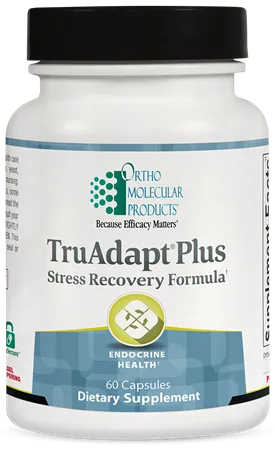
Ortho Molecular Products TruAdapt Plus Review
TruAdapt Plus is presented as a Stress Support Supplement from Ortho Molecular Products, described as a blend of adaptogenic botanicals and adrenal concentrate formulated to support the body's resistance to fatigue, improve attention and immune function, and help maintain balanced cortisol and DHEA levels. The page lists the categories Endocrine Health and Specialty Health, and five clinical applications: strengthening the body's stress response and improving stress resilience, supporting healthy energy levels, supporting a healthy immune response, improving mental and physical performance, and helping maintain a balanced cortisol-to-DHEA ratio. The page shows the product in 60 count and 120 count sizes. The product overview explains that stress is any disturbance, such as extreme cold or heat, psychological stress, sleep deprivation, work overload, physical trauma, or toxic exposure, that can trigger the stress response. The body's stress response system is the hypothalamic-pituitary-adrenal (HPA) axis, and prolonged stress moves through three stages: alarm, resistance and exhaustion. The initial alarm phase is the normal fight-or-flight response, characterized by elevated cortisol. The resistance phase allows the body to keep buffering extended stress after that response fades, with cortisol and DHEA released by the adrenals helping support this reaction. Extended stress can create an imbalance in cortisol and DHEA production and can result in mental and physical fatigue, nervous tension, irritability, poor memory and decreased immunity, which the page associates with stage three. According to the page, TruAdapt Plus combines botanicals and adrenal concentrate to support the adrenal glands and the body's ability to counteract the negative effects of stress. The botanical components are described individually. Holy basil is an adaptogenic herb said to enhance the stress and immune response, with reported effects on neurocognition, immunity and metabolism, and it is described as showing promise for low mood and attention. Ashwagandha root extract is described for stress resilience, immune response support, sleep cycle regulation, healthy thyroid function, protection against nervous system exhaustion, and mood regulation. Rhodiola rosea root extract is described as an adaptogen used to support the nervous system, mood, mental clarity, work performance and sleep. Schisandra berry extract is described as used for mental clarity, stress response and emotional wellness, with mention of nitric oxide and circulation effects and support for learning, memory and brain health. Licorice root extract is described for its glycyrrhetic acid and glycyrrhizin components, its reported effect on the enzyme that converts cortisol to cortisone, and its use in maintaining normal cortisol levels in small doses. Adrenal concentrate is described as a bovine glandular concentrate based on the concept that organ extracts support the same organ in humans, intended to rejuvenate the adrenal stress system. Suggested use is 2 capsules taken one or two times per day, or as recommended by a healthcare professional. The page also links a quick reference guide for choosing the best product for patients, a product information sheet, and a product video. The page states that these statements have not been evaluated by the Food and Drug Administration and that the products are not intended to diagnose, treat, cure or prevent any disease.
We don’t sell supplements. We help you make decisions and get the best price.
Lowest prices
Finding the lowest prices at the stores now. This takes a few seconds.
Study, Trial or Testing Result Summary
Members Only74 human studies · 48 improved
1 of these 74 human studies gave the ingredient by drip, not by mouth.
Ashwagandha is the best-studied ingredient here, and this product gives a full dose of 500 milligrams a day. Across 23 placebo-controlled trials with 1706 adults, it lowered the stress hormone cortisol [1]. Another review of 558 people found lower cortisol, stress and anxiety [2], though one review of 488 people found cortisol fell while stress scores did not change much [3]. Stressed adults taking 300 milligrams a day for 90 days had lower stress and cortisol and better sleep [4]. Rhodiola is also at a full dose. In adults with stress-related fatigue it eased burnout and blunted the morning cortisol rise [5], and it reduced fatigue in soldiers [6], but nursing students on shift work had worse fatigue [7]. A blend of rhodiola, holy basil and schisandra lowered stress and anxiety and improved sleep in 186 stressed adults, though doses may differ from this product [8]. Holy basil alone did not lower cortisol more than placebo [9]. Licorice is below the studied dose here. At higher doses it slows cortisol breakdown but raised blood pressure [10]. The adrenal concentrate has no human studies. Animal and cell studies are never counted.
See all 74 studies →Hide the studies
- Across 23 placebo-controlled trials with 1706 adults, ashwagandha lowered cortisol compared with placebo, raised serotonin and thyroxine modestly, and raised testosterone in men but not women.Hormonal Modulation with Withania somnifera: Systematic Review and Meta-Analysis of Randomized-controlled Trials.
- Across nine randomized trials with 558 people, ashwagandha lowered blood cortisol, perceived stress and anxiety scores compared with placebo, with mild to moderate side effects in four trials.Effects of Ashwagandha (Withania Somnifera) on stress and anxiety: A systematic review and meta-analysis.
- Across seven to eight randomized trials with 488 people taking at least 250 mg daily, ashwagandha lowered cortisol by about 1.16 micrograms per deciliter but did not significantly change perceived stress.Dual impact of Ashwagandha: Significant cortisol reduction but no effects on perceived stress - A systematic review and …
- A review of plant adaptogens including Rhodiola reported benefits for chronic fatigue, thinking problems and immune protection, though human trials are limited and no specific numbers were given.Plant Adaptogens-History and Future Perspectives.
- A review of 52 randomized human trials of single plants found the effects of most plants, including holy basil, on stress-hormone activity were unclear; only ashwagandha showed a fairly consistent morning cortisol-lowering effect.Modulation of the hypothalamic-pituitary-adrenal (HPA) axis by plants and phytonutrients: a systematic review of human t…
- In nine trials of stressed people lasting 30 to 112 days, ashwagandha lowered cortisol without significant side effects, but no trial checked effects on adrenal function or long-term outcomes.Effects of Withania somnifera on Cortisol Levels in Stressed Human Subjects: A Systematic Review.
- A review of 19 ashwagandha trials using 120 to 1000 mg daily for 3 to 16 weeks reported less stress and anxiety, better sleep and favourable hormonal changes, though the trials were small and varied.Clinical evidence for the adaptogenic effects of Withania somnifera and Rhodiola rosea - A systematic review with molecu…
- A review of 14 ashwagandha studies using 30 to 600 mg daily found benefits for anxiety, stress and sleep with a pooled cortisol reduction of 3.27 micrograms per deciliter, and noted liver safety concerns.Efficacy and Safety of Saffron and Ashwagandha for Stress-Related Mental Health Outcomes: A Systematic Review of Randomi…
- Across 11 trials of Rhodiola for physical and mental fatigue, results were contradictory: 2 of 6 physical fatigue trials and 3 of 5 mental fatigue trials found it helpful, and all had flaws or risk of bias.Rhodiola rosea for physical and mental fatigue: a systematic review.
- In 543 soldiers with symptoms after returning from high altitude, 15 days of Rhodiola capsules reduced fatigue, drowsiness, chest tightness, palpitations, vertigo and memory loss more than placebo.[Three preparations of compound Chinese herbal medicines for de-adaptation to high altitude: a randomized, placebo-contr…
- In 186 adults with high stress, a blend of Rhodiola, holy basil and Schisandra taken for 60 days lowered perceived stress, anxiety and mood problems and improved sleep more than placebo, though stress hormones were not reported and mental alertness did not change.Effects of multi-herb and ashwagandha root formulas on stress modulation: a randomized, double-blind, placebo-controlled…
- In 161 young cadets, a single dose of Rhodiola extract (standard or 50% higher) reduced fatigue during mental work more than placebo, with no difference between the two doses.A randomized trial of two different doses of a SHR-5 Rhodiola rosea extract versus placebo and control of capacity for m…
- In 141 stressed adults, 600 mg a day of a proprietary ashwagandha root extract for 8 weeks lowered cortisol, stress and anxiety scores, and it beat both standard ashwagandha extract and placebo on stress, anxiety and mood scores.A proprietary herbal extract of ashwagandha root for stress and anxiety in healthy adults: a randomized, double-blind, t…
- In 135 adults with functional constipation, a blend of ashwagandha root and okra fruit extract (300 or 500 mg a day) for 60 days eased constipation, lowered cortisol and the inflammation marker IL-6, and improved sleep, anxiety and depression symptoms.A Novel Herbal Composition Alleviates Functional Constipation, Reduces Gastrointestinal Transit Time, and Improves Bowel…
- In 135 stressed healthy adults, 150 or 300 mg a day of sustained-release ashwagandha for 60 days reduced perceived stress and improved sleep, eating behavior and well-being versus placebo, and the 300 mg dose also lowered cortisol.Efficacy and safety of Ashwagandha root extract sustained-release (AshwaSR) capsules in healthy adult, stressed subjects…
- In 130 stressed healthy adults, 300 mg a day of sustained-release ashwagandha for 90 days lowered stress scores and cortisol and improved memory, sleep quality and well-being compared with placebo.Efficacy and Safety of Ashwagandha Root Extract on Cognitive Functions in Healthy, Stressed Adults: A Randomized, Double…
- In 100 people with long COVID, two weeks of an adaptogen combination including Schisandra shortened fatigue and pain by one to two days and lowered IL-6, but most symptom improvements were similar to placebo.Efficacy of Adaptogens in Patients with Long COVID-19: A Randomized, Quadruple-Blind, Placebo-Controlled Trial.
- In 98 chronically stressed adults, a water-extracted ashwagandha root and leaf extract at 125 mg daily for 8 weeks reduced perceived stress compared with placebo, with effects that increased at higher doses of 250 and 500 mg.Effects of Withania somnifera Extract in Chronically Stressed Adults: A Randomized Controlled Trial.
- In 96 male college soccer players, 4 weeks of 2.4 g a day Rhodiola lowered perceived exertion and helped maintain heading height in later repeated trials, with the broadest benefits when combined with caffeine.Effects of Combined Caffeine and Rhodiola rosea Supplementation on Repeated Aerial Duel Performance and Neck Neuromuscul…
- In 91 adults analyzed from 100 randomized, 600 mg daily of ashwagandha root extract for 24 weeks reduced body weight and stress scores more than placebo, with only mild side effects reported.Efficacy and safety of Ashwagandha (Withania somnifera) root extract on stress and weight management in adults: a prospe…
- In 90 adults with mild to moderate stress, 125 mg daily of the Zenroot ashwagandha formulation for 84 days improved stress scores, anxiety, mood and sleep quality compared with placebo, and was well tolerated.A New Ashwagandha Formulation (Zenroot™) Alleviates Stress and Anxiety Symptoms While Improving Mood and Sleep Quality: …
- In a 60-day placebo-controlled trial of 64 stressed adults, 300 mg of ashwagandha root extract twice daily lowered stress scores and serum cortisol compared with placebo, with mild side effects similar to placebo.A prospective, randomized double-blind, placebo-controlled study of safety and efficacy of a high-concentration full-spe…
- In a 60-day placebo-controlled trial of 60 stressed adults, 240 mg of Shoden ashwagandha extract once daily produced greater reductions in morning cortisol and the adrenal hormone DHEA sulfate than placebo and lowered anxiety scores.An investigation into the stress-relieving and pharmacological actions of an ashwagandha (Withania somnifera) extract: A…
- In an 8-week placebo-controlled trial of 60 stressed adults, ashwagandha root extract at 250 mg/day and 600 mg/day reduced perceived stress and serum cortisol, and the groups taking it reported better sleep quality than placebo.Adaptogenic and Anxiolytic Effects of Ashwagandha Root Extract in Healthy Adults: A Double-blind, Randomized, Placebo-co…
- In a 30-day placebo-controlled trial of 60 stressed adults, ashwagandha root and leaf extract at 400 mg or 225 mg daily lowered cortisol over time and improved some thinking skills compared with placebo, but mood and stress questionnaire results did not differ by group.Efficacy of Withania somnifera supplementation on adult's cognition and mood.
- In 60 women aged 45 to 55, ashwagandha root extract for 56 days reduced menopausal symptoms and stress scores more than placebo, and improved some hormone levels.A prospective, randomized, double-blind, placebo-controlled study on efficacy and safety of Ashwagandha root extract (Wi…
- In a 60-day placebo-controlled trial of 60 adults with stress, anxiety and high blood pressure, 300 mg of Ashwagen twice daily cut serum cortisol by 28.99% along with reducing anxiety and stress scores.Safety and efficacy of ashwagen (a standardized withania somnifera extract) in stress and anxiety with hypertension and …
- In 60 adults with stress-related fatigue, 576 mg a day of Rhodiola extract for 4 weeks reduced burnout scores, improved concentration and lowered the cortisol response to waking more than placebo.A randomised, double-blind, placebo-controlled, parallel-group study of the standardised extract shr-5 of the roots of R…
- In 60 patients with sepsis, a decoction containing 10 g honey-fried licorice plus monkshood and dried ginger taken for 7 days raised cortisol and lowered ACTH earlier than routine care alone, with no difference in death rate.[Effect of Sini decoction on function of hypothalamic-pituitary-adrenal axis in patients with sepsis].
- In a 16-week crossover trial of 57 overweight men aged 40 to 70, 21 mg a day of Shoden ashwagandha extract over 8 weeks raised the hormone DHEA sulfate and testosterone more than placebo, but cortisol and estradiol did not differ and feelings of fatigue and vigor did not improve more than placebo.A Randomized, Double-Blind, Placebo-Controlled, Crossover Study Examining the Hormonal and Vitality Effects of Ashwagand…
- In 56 team sports athletes, 600 mg daily of ashwagandha root extract for 42 days stopped the rise in stress hormone cortisol seen with placebo, improved recovery feelings in female athletes, and increased jump performance in male athletes.Ashwagandha Root Extract Stabilises Physiological Stress Responses in Male and Female Team Sports Athletes During Pre-Se…
- In 56 healthy young physicians on night duty, one low-dose Rhodiola tablet daily for 2 weeks improved mental performance and reduced fatigue compared with placebo in a crossover trial.Rhodiola rosea in stress induced fatigue--a double blind cross-over study of a standardized extract SHR-5 with a repeate…
- In a 60-day placebo-controlled trial of 54 healthy adults taking 500 mg of standardized ashwagandha root extract nightly, morning salivary cortisol fell more than with placebo, alongside better stress and anxiety scores.A standardized Ashwagandha root extract alleviates stress, anxiety, and improves quality of life in healthy adults by mo…
- In an 8-week placebo-controlled trial of 52 adults under chronic stress, 300 mg of ashwagandha root extract twice daily improved stress, food cravings, happiness and body weight measures, with serum cortisol among the secondary measures that improved.Body Weight Management in Adults Under Chronic Stress Through Treatment With Ashwagandha Root Extract: A Double-Blind, R…
- In 50 healthy athletic adults, ashwagandha root extract at 300 mg twice daily for 8 weeks improved maximum aerobic capacity and recovery scores more than placebo, with no adverse events reported.A double-blind, randomized, placebo-controlled trial on the effect of Ashwagandha (Withania somnifera dunal.) root extra…
- In 50 healthy active young adults, 60 mg a day of salidroside (a Rhodiola compound) for 16 days improved oxygen use during intense exercise, reduced a muscle damage marker and kept mood and fatigue stable compared with placebo.Salidroside and exercise performance in healthy active young adults - an exploratory, randomized, double-blind, placebo-…
- In a 14-day placebo-controlled trial of 48 adults with functional constipation, 500 mg a day of a blend of ashwagandha root and okra fruit extract lowered cortisol and IL-6 and reduced stress, with no adverse events reported.A blend of Withania somnifera (L.) Dunal root and Abelmoschus esculentus (L.) Moench fruit extracts relieves constipatio…
- In 48 nursing students on shift work, 364 mg daily of Rhodiola rosea for 42 days led to worse fatigue scores than placebo.Rhodiola rosea for mental and physical fatigue in nursing students: a randomized controlled trial.
- In 48 male volleyball players over four weeks of leg training, taking Rhodiola rosea with caffeine improved jump height and reduced fatigue compared with placebo, though the abstract does not give the Rhodiola dose.Effects of the Combined Supplementation of Caffeine and Rhodiola Rosea with Resistance Training on Lower Limb Explosive …
- In 45 postmenopausal women, 1000 mg per day of Schisandra extract for 12 weeks increased thigh muscle strength and lowered resting lactate compared with placebo, with no change in other measures.Effect of Schisandra Chinensis Extract Supplementation on Quadriceps Muscle Strength and Fatigue in Adult Women: A Rando…
- In 30 people, one week of Rhodiola rosea pills lowered ultra-weak photon emission from the hands and reduced self-reported tiredness compared with placebo.The influence of adaptogens on ultraweak biophoton emission: a pilot-experiment.
- In 30 men, a single 350 mg dose of a Rhaponticum and Rhodiola herbal blend taken 90 minutes before leg exercise did not change muscle performance fatigue compared with placebo, though participants reported feeling better afterward.The Acute Effects of a Multi-Ingredient Herbal Supplement on Performance Fatigability: A Double-Blind, Randomized, and P…
- In 30 active women, 150 mg per day of salidroside taken with eccentric training for 4 weeks improved late-stage reactive leg strength and lowered muscle damage markers more than training with placebo.Combined Rhodiola rosea and eccentric training boost endurance performance and lower-limb reactive strength in recreatio…
- In 26 healthy men, 600 mg per day of Rhodiola rosea extract for 4 weeks shortened reaction times and raised antioxidant capacity in the blood, but did not change endurance exercise capacity or hormone levels.Effects of Rhodiola rosea supplementation on mental performance, physical capacity, and oxidative stress biomarkers in h…
- In 24 male football players, 4 weeks of Rhodiola rosea improved high-intensity intermittent running and decision-making under fatigue compared with placebo, with lower blood lactate after sprints; the dose was not stated and adrenal function was not measured.Effects of Rhodiola rosea on Physical and Decision-Making Performance in Football Players: A Randomised Controlled Trial…
- In 24 female taekwondo athletes with premenstrual syndrome, 500 mg per day of Rhodiola rosea extract for 10 days eased several premenstrual symptoms, shortened reaction time, and lowered perceived exertion compared with placebo.Short-term Rhodiola rosea supplementation improves premenstrual symptoms, reaction time, and perceived exertion in femal…
- In 21 active college-aged men over 14 weeks of training, a multi-ingredient supplement containing Rhodiola rosea and Cordyceps sinensis did not improve body composition, overall training outcomes, or blood health markers compared with placebo, although both groups gained bench press strength.Effects of Concurrent Training and a Multi-Ingredient Performance Supplement Containing Rhodiola rosea and Cordyceps sin…
- In 18 people, a single dose of Rhodiola rosea taken one hour before exercise lowered heart rate during warm-up, shortened a 6-mile bike time trial, and reduced perceived effort compared with a carbohydrate placebo.The effects of an acute dose of Rhodiola rosea on endurance exercise performance.
- In 18 young adults, four days of Rhodiola rosea extract did not change mental fatigue or visual-thinking performance compared with placebo, but it increased the number of bench press repetitions in some sets and bench pull speed in a non-stressed condition.The Impact of Rhodiola Rosea Extract on Strength Performance in Alternative Bench-Press and Bench-Pull Exercises Under R…
- In 17 male college tennis players doing hard training for 4 weeks, a herbal drink with Schisandra lowered ammonia and liver enzymes and raised IgA compared with placebo, with no change in lactic acid.Effect of Saengmaeksan on Fatigue, Liver Function, and Immunity Combined with High-Intensity Training.
- In 7 dialysis patients, 1 g per day glycyrrhetinic acid for two weeks raised the blood cortisol-to-cortisone ratio in every patient and lowered blood potassium from 5.5 to 4.5 mM/L, without changing blood pressure.Glycyrrhetinic acid decreases plasma potassium concentrations in patients with anuria.
- In healthy adults taking 300 mg of holy basil leaf extract daily for 30 days, thinking speed and accuracy improved more than with placebo, while salivary cortisol and anxiety improved over time only in the holy basil group without a significant difference versus placebo.Holy basil (Ocimum sanctum Linn.) leaf extract enhances specific cognitive parameters in healthy adult volunteers: A pla…
- In a placebo-controlled study of students during a 20-day exam period, a low repeated dose of Rhodiola SHR-5 extract improved physical fitness and mental fatigue compared with placebo; the authors noted the dose may have been too low.A double-blind, placebo-controlled pilot study of the stimulating and adaptogenic effect of Rhodiola rosea SHR-5 extract…
- In 48 professional male basketball players, 28 days of Rhodiola improved simulated game time, endurance, maximal oxygen uptake and antioxidant capacity compared with an empty-capsule control group.The Effect of Short-Term Rhodiola rosea Supplementation on Simulated Game Time, Perceived Fatigue, and Performance in Ba…
- In 21 volunteers and 21 reference subjects, two weeks of liquorice raised blood pressure and lowered the urinary cortisone-to-cortisol metabolite ratio from 0.70 to 0.31, showing blocked cortisol breakdown, while the reference group stayed unchanged.Liquorice ingestion attenuates vasodilatation via exogenous nitric oxide donor but not via β2-adrenoceptor stimulation.
- In 32 women with polycystic ovary syndrome, adding 3.5 g of licorice daily to spironolactone lowered activation of the renin-aldosterone system and reduced volume-depletion symptoms compared with spironolactone alone.Treatment of polycystic ovary syndrome with spironolactone plus licorice.
- In 20 healthy young men over eight days of heat training, 432 mg daily of Rhodiola SHR-5 gave no added benefit over placebo for endurance, heart rate, temperature or perceived exertion.Influence of Rhodiola rosea on the heat acclimation process in young healthy men.
- In 18 healthy volunteers, 225 mg of glycyrrhizin daily for 7 days caused mineralocorticoid-type effects such as low potassium and suppressed renin, and raised urinary cortisol while lowering cortisone.Glycyrrhizin induces mineralocorticoid activity through alterations in cortisol metabolism in the human kidney.
- In 13 healthy people eating 100 to 200 g of licorice for 1 to 4 weeks, urinary cortisol more than doubled in most, while blood cortisol and ACTH stayed unchanged, suggesting kidney handling changed rather than adrenal stimulation.Licorice raises urinary cortisol in man.
- During a 45-day bed rest simulating spaceflight, Rhodiola reduced a protective immune signal and slowed the rise of inflammatory cytokines, but did not boost protective T cell immunity.Changes of cytokines during a spaceflight analog--a 45-day head-down bed rest.
- In 101 people with life stress symptoms, 200 mg twice daily of Rhodiola extract for four weeks was followed by improvements in stress symptoms, fatigue and disability, with no serious side effects; there was no placebo group.Therapeutic effects and safety of Rhodiola rosea extract WS® 1375 in subjects with life-stress symptoms--results of an o…
- In an uncontrolled study of 100 adults with prolonged or chronic fatigue, 400 mg of Rhodiola rosea extract daily for 8 weeks was followed by statistically significant fatigue improvement, with no placebo group for comparison.Rhodiola rosea in Subjects with Prolonged or Chronic Fatigue Symptoms: Results of an Open-Label Clinical Trial.
- In 17 people with Addison's disease taking cortisone tablets, two 3-day periods of licorice or grapefruit juice raised the amount of cortisol available in the blood after a dose, compared with usual treatment alone.Grapefruit juice and licorice increase cortisol availability in patients with Addison's disease.
- In 9 healthy young women taking 3.5 g of licorice daily for two cycles, blood testosterone fell, while blood cortisol and blood pressure did not change.Licorice reduces serum testosterone in healthy women.
- In 9 healthy young women taking 3.5 g of licorice daily for 2 months, cortisol and blood pressure did not change, although parathyroid hormone and urinary calcium rose and aldosterone fell; all returned to baseline after stopping.Effect of licorice on PTH levels in healthy women.
- In healthy volunteers taking one of three glycyrrhizin-containing traditional Chinese medicines for 3 days, the effect on prednisolone levels and enzyme activity differed among the three products despite similar glycyrrhizin content.Different effects of traditional Chinese medicines containing similar herbal constituents on prednisolone pharmacokineti…
- In 378 children born to mothers who ate high amounts of licorice in pregnancy, cortisol levels showed no difference at age 12, but the children had lower IQ scores and more attention problems and more advanced puberty.Maternal Licorice Consumption During Pregnancy and Pubertal, Cognitive, and Psychiatric Outcomes in Children.
- Children of mothers who ate the most licorice in pregnancy (500 mg or more glycyrrhizin per week) had higher daytime and stress-test cortisol levels at about age 8, with the effect rising with dose.Maternal prenatal licorice consumption alters hypothalamic-pituitary-adrenocortical axis function in children.
- In 191 healthy adults taking ashwagandha root extract for 12 months, no clinically significant safety problems appeared, serum cortisol fell, quality of life improved, and 68.7% of patients were rated as improved overall.Safety of 12-Months Administration of Ashwagandha ( Withania somnifera ) Standardized Root Extract in Healthy Adults: A …
- In 13 adults with subthreshold insomnia who completed two weeks of 750 mg nightly of a Rhodiola rosea and lotus extract mixture, sleep quality scores improved, but the abstract does not compare this with a control group.Mixture of Rhodiola rosea and Nelumbo nucifera Extracts Ameliorates Sleep Quality of Adults with Sleep Disturbance.
- In 20 healthy people, one week of 500 mg per day glycyrrhetinic acid raised the urinary cortisol metabolite ratio, showing reduced cortisol breakdown, and the rise was larger in salt-sensitive people.In vivo 11beta-HSD-2 activity: variability, salt-sensitivity, and effect of licorice.
- In a tracer study of human tissues, licorice was used to inhibit an enzyme that converts cortisone to cortisol, and the study mainly showed that cortisol and cortisone recycle actively in muscle, fat, and the gut; it did not test an adrenal health outcome.Recycling between cortisol and cortisone in human splanchnic, subcutaneous adipose, and skeletal muscle tissues in vivo.
- In foreign students during academic study, the Rhodiola preparation rhodaxon increased physical work capacity and reduced psychological fatigue and anxiety.[The effect of the preparation rodakson on the psychophysiological and physical adaptation of students to an academic lo…
- Single oral doses of glycyrrhetinic acid, a licorice compound, in healthy volunteers changed the blood cortisol-to-cortisone ratio in a dose-related way, but the study did not measure any adrenal health outcome.Kinetics and dynamics of orally administered 18 beta-glycyrrhetinic acid in humans.
Review Totals and Summary
Members Only4 reviews · 75% positive
I could find very little genuine customer feedback for TruAdapt Plus, so this summary is thin and tentative. The product is mainly sold through practitioner and online pharmacy channels, and most retailer pages carry few or no written reviews. One independent store page shows only a single review, and it was positive. The Amazon Singapore listing for the related TruAdapt shows just two ratings and no written reviews. The star ratings I saw on Walmart's page appeared to belong to other products, so I did not use them. I therefore can't report real recurring praise or complaints, such as pill size, taste, or side effects, without making them up. The nearest thing to themes comes from retailer and educational copy, which is not customer testimony. That copy sets expectations that mental focus and energy come first, within 1 to 2 weeks. It says calmer stress reactivity and steadier energy follow over 4 to 8 weeks. It also cautions that rhodiola may feel stimulating or disrupt sleep in some people, and that licorice may raise blood pressure in sensitive users. If you need a true sentiment summary, the best sources would be practitioner-channel reviews on sites like Fullscript, or Reddit threads on adaptogen or adrenal blends. I could not reach these here.
Biohacker Summary
Members Only9 of 10 recommend it
Most of the panel backs ashwagandha: five recommend it, one uses it, and three are neutral, with one of those finding the data weak. People take it mainly to lower stress hormone levels, calm anxiety and improve sleep, and a few add testosterone support. Doses named were 250 mg a day, 400 to 600 mg, and a wider range of 120 to 1,000 mg for at least six weeks, with several preferring standardized branded extracts. Cautions were common: several advise cycling it or taking breaks, others warn of emotional numbing, irritability in women, or that it is wrong for people with low stress hormone levels, and one stopped after it caused a mouth sore. Licorice, a smaller ingredient in this product, drew praise for gut and throat support, though one panelist warns it raises stress hormones and blood pressure and can clash with meds.
See all 10 biohackers →Hide the biohackers
Dr. Mark Hyman · Ashwagandha · recommends
- Lists ashwagandha as an herb that can help lower anxiety or depression symptoms.
- Recommends licorice to help repair the gut lining.
- Notes that there was a recent study on ashwagandha for sperm health, indicating it's an evolving area of research.
- Suggests trying ashwagandha, noting that some people respond to it, and recommends a dose of 400 to 600 mg.
- Recommends licorice root, marshmallow root, and slippery elm bark as herbs that can help soothe the gut lining, reduce inflammation, and promote healing, especially when taken in powdered form or as a tea before or after meals or before bed.
- Recommends adaptogenic herbs like ashwagandha, particularly at night, rhodiola, lemon balm, and catclaw for stress relief.
- Recommends ashwagandha at night as an adaptogen to help with high cortisol and promote sleep for those who are tired and wired.
- Recommends ashwagandha, stating it can help convert T4 to T3, but advises ensuring a clear source and monitoring liver enzymes.
- Includes licorice in herbal antimicrobial regimens.
- Recommends licorice root as a gut-healing nutrient.
- Suggests adaptogens like rhodiola, ashwagandha, ginseng, and Siberian ginseng can be helpful for actively managing stress.
- States that Mosh protein bars contain ashwagandha to support a healthy brain.
- Recommends adaptogens like Ashwagandha if one has a lot of stress.
- States that ashwagandha can stimulate osteoblasts, which helps with bone building, especially for those with a genetic predisposition to low bone density.
Dr. Eric Berg · Ashwagandha · recommends
- Recommends ashwagandha, suggesting 250 milligrams per day over time to increase stress tolerance and help the cortisol receptor.
- Rates Ashwagandha on a scale from 1 to 10.
- Recommends Licorice root, noting it has traditionally been used to soothe the throat and respiratory tract.
- Recommends Licorice root, noting its traditional use to soothe the throat and respiratory tract during chest infections.
- Recommends licorice root as an ancient remedy that is great for sore throats, viral-related issues, lung infections, coughing, and asthma attacks, suggesting it be taken orally as a supplement.
- Lists ashwagandha as one of the best ways to lower luteinizing hormone, which goes too high as people age and is related to dementia.
- Notes that some people take ashwagandha or other adaptogens to help calm them down when they assume their problem is cortisol, and sometimes it works.
- States that taking ashwagandha on a regular basis can greatly help the adrenals.
- Dr. Berg warns that consuming too much licorice, even chronic low doses like 100 mg of licorice candy daily for 2 weeks or two cups of licorice tea per day, can cause sodium retention, potassium flushing, muscle cramps, and heart arrhythmias, especially for older individuals, those with high blood pressure, or those on certain medications.
- Recommends Ashwagandha to help make the process of quitting coffee smoother.
- Recommends taking adaptogens like ashwagandha for super powerful and real energy inputs without artificial side effects.
- Recommends Ashwagandha to help sleep through the night.
- Recommends taking Ashwagandha in the evening before bed as a remedy for problems with elevated cortisol around 2 AM, when cortisol should be at its lowest point.
- Recommends trying ashwagandha to lower stress levels.
Siim Land · Ashwagandha · recommends
- Recommends Ashwagandha for stress, sleep and performance, based primarily on human research, especially randomized controlled trials showing measurable benefits.
- Lists Ashwagandha as one of 15 supplements backed by human studies.
- Notes that Ashwagandha is one of several supplements with human evidence.
- States that ashwagandha, unless contaminated, is not going to raise liver enzymes.
- Stopped taking ashwagandha because it immediately caused a mouth sore.
- States that ashwagandha consistently reduces stress and anxiety in randomized controlled trials.
- States that Ashwagandha helps with testosterone primarily in stressed out or poor sleeping people.
- States that ashwagandha has strong evidence for increasing testosterone, mostly in stressed or infertile men.
- Mentions ashwagandha as an example of a testosterone-boosting supplement he has no interest in taking.
- Places Ashwagandha, specifically the KSM66 form, in the 'god tier' due to extensive research supporting its benefits for stress, sleep, testosterone production, estrogen, and even V2 max, while personally not experiencing any negative side effects some people report.
- Warns that licorice root, often found in thyroid supplements, can raise adrenaline levels, leading to overstimulation and anxiety.
- Included schisandra in his morning tonic to build blood, circulate good blood from head to toe, and help rid his body of toxins, impurities, and inflammation.
Thomas DeLauer · Ashwagandha · recommends
- Recommends ashwagandha extract, noting a study where 57 overweight men over 40 saw a 14.7% increase in testosterone and an 18% increase in DHEA over 16 weeks, suggesting it removes the cortisol block suppressing the entire hormonal cascade.
- Mentions ashwagandha as part of a full testosterone protocol, supporting production through different pathways.
- Recommends ashwagandha, noting it modulates the HPA axis and dropped cortisol by approximately 23% in 60 days, but advises cycling it, especially if feeling emotionally numb.
- Cautions against Ashwagandha due to its potential for emotional numbing effects.
- Suggests ashwagandha at night to help regulate cortisol, but advises playing around with it as some people find it makes them feel weird.
- Recommends Ashwagandha, Rhodiola, and Ginseng as adaptogens to help the body adapt to stress, bring cortisol levels back to homeostasis, and support heat shock proteins and stress chaperoning pathways, especially when in a caloric deficit.
- Recommends Ashwagandha in the evening time for its anti-cortisol effect, helping to regulate cortisol for better balance in the morning.
- Recommends ashwagandha as an adaptogen with a profound effect on cortisol, acknowledging that it can make some people feel numb but may still be helpful.
- Discusses Ashwagandha as an adaptogen with quite a bit of evidence for various benefits like cognitive ability, stress, stamina, cardiovascular benefits, and lipid panels. He notes that long-term use might lead to a level of tolerance or an apathetic sense, suggesting it should be used when sincerely needed.
- Recommends Schisandra sinensis, highlighting its historical use in traditional Chinese medicine as a prestigious adaptogen that can offer cardiovascular and cognitive benefits without being stimulative.
- Recommends Ashwagandha to help regulate oxidative stress.
- Recommends DGL (deglycyrrhizinated licorice), especially when combined with aloe vera gel and slippery elm, to be taken any time for symptoms of acid reflux.
- Mentions that compounds in licorice can lessen inflammation through the same pathway as fasting, but notes it's not a realistic daily consumption.
- Mentions clinical studies on schisandra.
Ben Greenfield · Ashwagandha · neutral
- Ashwagandha, taken as 120–1,000 mg for at least 6 weeks, with most studies providing a dose of 400–600 mg/d, can lower cortisol levels, improve sleep quality, and enhance cognitive resilience for athletes during challenging phases consisting of high-volume resistance training.
- Notes that ashwagandha is an ingredient in MTE.
- Mentions Ashwagandha as a supplement people cycle through when still sleeping poorly, suggesting it might not be addressing the true sleep problem.
- Notes that ashwagandha is a nightshade herb, but it is taken as a supplement and not used for cooking.
- Recommends Holy Basil to help retrain the brain to be less excitable, as part of a strategy to dampen the stress response and improve sleep.
- States that Ashwagandha helps regulate stress response and steady the nervous system, influencing biological systems tied to sleep quality.
- Has found that adaptogens like ashwagandha, taken about half an hour before using the Shift Wave, seem to enhance its effects on tuning up the nervous system. He also found it helped him and his co-founder achieve slower respiratory heart rate coherence.
- Uses Ashwagandha, as part of IM8 Health, to quiet the stress response for sleep.
- Mentions ashwagandha as an herb that has more data than fruit tree leaves.
- Ben Greenfield notes that IM8 contains ashwagandha, an adaptogen, to help manage stress and support the immune system.
- Sometimes takes ashwagandha to help get back to sleep if he wakes up in the middle of the night.
- Mentions that a report for a client with high gut inflammation suggested using DGL, a form of licorice acid.
- Recommends some forms of DGL licorice for H. pylori issues in the gut.
- Recommends holy basil for cortisol support, suggesting a dose of about 500 milligrams in the morning, noting its long history of providing a sense of the divine.
Dave Asprey · Ashwagandha · neutral
- Dave Asprey notes that ashwagandha, when taken as a real standardized extract at a real dose, genuinely lowers cortisol and shows effects on stress and sleep quality in randomized trials, but lacks polysomnography data.
- Dave Asprey discusses ashwagandha as part of an adaptogen trio that works together for stress response and human performance.
- Mentions ashwagandha as an adaptogen in MTE that helps blunt the cortisol spike.
- Advises against ashwagandha for low cortisol, stating that salt and water are needed instead.
- Warns that ashwagandha can raise testosterone in women, causing irritability, and therefore needs to be cycled.
- Dave Asprey mentions ashwagandha as a supplement and cofactor that supports thyroid activation.
- Recommends ashwagandha as a cofactor that can help thyroid function, especially with conversion issues.
- Dave Asprey lists ashwagandha as part of a supplement stack that supports healthy hormone levels.
- Recommends licorice root extract (not DGL) as an effective way to increase cortisol, especially for those with chronic fatigue syndrome, but advises caution for individuals with high blood pressure.
- Discusses ashwagandha as a common adaptogenic herb used by biohackers to deal with stress, noting it was banned in Denmark and can cause anhidonia and reduced ability to reach orgasm at higher doses.
- The episode discusses the dangers of chronic ashwagandha use.
- Says he takes herbs like licorice root to support his body's ability to have a healthy stress response during global public speaking trips.
- Started using licorice root to support adrenal function and recovery from adrenal fatigue.
- Mentions licorice root as a way to keep blood pressure up if needed.
Peter Attia · Ashwagandha · neutral
- Peter reviews the evidence for select off-label medications and supplements commonly used for sleep, including glycine, magnesium, ashwagandha, and phosphatidylserine.
- Finds ashwagandha a little bit helpful for sleep, though notes it may not be for everyone.
- Finds ashwagandha "a little bit helpful" for sleep, but notes that it may not be for everyone.
- Finds ashwagandha a little bit helpful for sleep, but notes it may not be for everyone.
- States that the data for ashwagandha are weak.
- Discusses the current evidence for ashwagandha's effects on sleep, stress, and anxiety.
- Mentions ashwagandha as an evergreen shrub historically used in traditional Indian medicine for indications such as sleep, stress, and immune health.
- Mentions ashwagandha as something that can help with sleep in the setting of chronic stress and hypercortisolemia.
- Takes 600 mg of Solgar ashwagandha at night, having recently switched to this brand and returned to taking it after a previous hiatus.
- Takes 600 milligrams of ashwagandha at night, having recently switched to the Solgar brand and having returned to taking it after a long break.
- Recommends licorice root as a potent ingredient in adrenal support supplements to help increase cortisol levels in patients with low free cortisol, citing an anecdote about its strong effect.
Andrew Huberman · Ashwagandha · recommends
- He shares science-based tools for modulating aggression, including supplementation with ashwagandha.
- Warns that while ashwagandha is a potent inhibitor of cortisol, chronic supplementation for longer than two weeks can disrupt other hormone and neurotransmitter pathways, so it should be used with a two-week break after two weeks of use.
- Mentions that a component of licorice root can significantly increase cortisol but warns that it can be contraindicated with many medications.
- Warns that licorice root potently increases cortisol and should be avoided at night and approached with caution, as it can raise blood pressure and is contraindicated with some medications.
- States that licorice root is a potent elevator of cortisol and can be used early in the day, but advises caution due to potential medication interactions, and mentions personally using it in the morning.
- Recommends Ashwagandha as a supplement to reduce cortisol.
- Recommends black licorice as a nutritional strategy to increase morning cortisol.
- Explains how to optimize hormone levels through supplements such as ashwagandha.
- Mentions ashwagandha as a potent commercial compound in supplement form that can be used to reduce chronic stress, especially late in the day, by significantly decreasing cortisol.
- Discusses Ashwagandha as a supplement to better manage stress.
- Uses ashwagandha when feeling particularly stressful to lower anxiety and cortisol, but does not take it year-round or on a regular basis.
- Takes ashwagandha for sleep.
- Recommends Ashwagandha as a good adaptogen, but advises cycling it if taking high doses due to potential issues with liver and thyroid.
- Recommends Holy basil (Tulsi) as another adaptogen.
Dr. Rhonda Patrick · Ashwagandha · recommends
- Recommends Ashwagandha supplementation, specifically standardized for withanolides (KSM-66 at 5% or Sensoril at 10%), to indirectly boost testosterone by reducing cortisol levels, and also to improve anxiety, stress resilience, and sleep quality.
- Recommends ashwagandha, specifically patented extracts like Sensoril or KSM66 standardized to sufficient quantities of withanolides, for its indirect effect on testosterone by suppressing cortisol and stress response, which can be beneficial for anxious individuals and improve sleep.
- Is very bullish on Ashwagandha, citing meta-analyses showing improved lean mass, strength, sleep, and stress management. He notes it also raises testosterone but not enough to explain the lean mass changes.
- Discusses ashwagandha.
- Uses ashwagandha as a supplement to help with sleep.
- Dr. Rhonda Patrick discusses curcumin & ashwagandha safety.
- His regular sleep supplements are glycine, ashwagandha, magnesium L-threonate, and magnesium oxide.
- She mentions that Peter Attia takes 600 milligrams of ashwagandha from Solgar.
Bryan Johnson · Ashwagandha · uses
- Drinks his Blueprint longevity mix with additional morning supplements, including ashwagandha.
- States that Blueprint Ashwagandha can be used to stabilize mood.
- Mentions that Ashwagandha is included in the LA Longevity Mix, which condenses his 100 daily pills into a drink.
- Mentions ashwagandha as a potential therapy that could positively influence sperm health.
- Mentions ashwagandha as an ingredient in his 'bag of goodies', indicating he uses it.
- Takes ashwagandha for anti-anxiety, improved cortisol management, improved sleep, and increased testosterone.
- Uses Ashwagandha + Rhodiola for energy and stress support.
- Recommends Ashwagandha during the luteal phase to help reduce stress, balance hormones, reduce PMS related fatigue, and combat water retention and bloating, and also for stress and mood management in perimenopausal and menopausal women.
- Lists "Ashwagandha + Rhodiola" with "120mg" as part of his supplements, implying its use.
- During menopause, Bryan Johnson recommends adding ashwagandha based on individual needs.
RAL Summary
Members OnlyTier 4 for Adrenal Support
Ashwagandha at a full dose has strong human evidence for lowering cortisol and stress [1][2], but with only 4 ratings and no written reviews, there is not enough customer feedback to rank it higher.
- Emerging: not enough evidence to rank higher yet.
Where the evidence disagrees: 13 of the 74 human studies found no effect.
More Details
Members OnlyBody systems · Combine with · Possible side effects
Body systems: Endocrine system, Nervous system, Cardiovascular system
Combine with: TruAdapt Plus pairs ashwagandha and rhodiola, two well-studied adaptogens that help modulate the HPA axis and cortisol response to stress. To build on that, consider a high-quality B-complex with methylated B vitamins (especially B5 pantothenic acid and B6) to support adrenal hormone synthesis and energy metabolism, plus vitamin C, which is concentrated in adrenal tissue and used during stress hormone production. Magnesium glycinate can support relaxation, nervous system balance, and sleep quality. Phosphatidylserine may help blunt elevated evening cortisol, and L-theanine can promote calm focus without sedation. Omega-3 fish oil supports a healthy inflammatory response to chronic stress. If sleep is disrupted, consider adding glycine or low-dose melatonin at night. Take rhodiola-containing products earlier in the day to avoid overstimulation. Consult a healthcare provider if you have thyroid conditions, are pregnant, or take sedatives, immunosuppressants, or thyroid or meds, as ashwagandha may interact with them.
Possible side effects: Ashwagandha trials reported mild to moderate side effects in some studies. Licorice at higher doses raised blood pressure and lowered potassium, though this product has a lower dose; rhodiola may feel stimulating or disturb sleep in some people.
Supplement Facts
Holy Basil Leaf Extract 300 mg · Ashwagandha root extract 250 mg · Adrenal concentrate 220 mg
| Holy Basil Leaf Extract | 300 mg | † |
| Ashwagandha root extract | 250 mg | † |
| Adrenal concentrate | 220 mg | † |
| Rhodiola rosea Root Extract | 200 mg | † |
| Schisandra berry extract | 150 mg | † |
| Licorice Root Extract | 75 mg | † |
Other ingredients: Natural Vegetable Capsules, Microcrystalline Cellulose, Magnesium Stearate, Silicon Dioxide.
Directions: Suggested use: 2 capsules 1-2 times per day or as recommended by your health care professional. Consult your physician for further information. Please read the ingredient panel carefully prior to ingestion.
Barcode (UPC) 615033019082 · Label source: NIH label database · Report a label change
Show entire label

More adrenal support products
Members OnlyThe highest ranked for the same goal
Read more
Our articles on this subject
- Supplements for Stress and Anxiety Relief: What the Evidence SupportsArticle · Oct 26, 2026
- When Is the Best Time to Take Vitamins and Supplements?Article · Jun 15, 2026
Graded November 4, 2026 by the Reverse Age Lab evidence engine, from human studies, real reviews and our biohacker panel. How we grade. Is this medical advice? No. Rala organizes the published evidence; go over any change with your doctor, especially if you take meds.
Privacy policyConsumer health dataTermsDo Not Sell or Share My Personal InformationCookie settings