
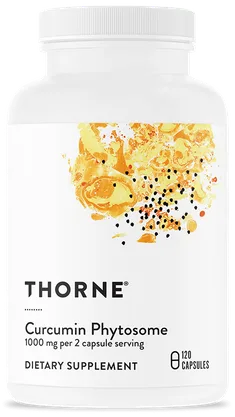
Thorne Curcumin Phytosome - Sustained Release Review
Thorne's Curcumin Phytosome - Sustained Release is a capsule supplement that pairs curcumin with a phospholipid complex from sunflower. The page describes turmeric as extensively researched, noting that curcuminoids, the most active components in turmeric, are associated with promoting joint health and flexibility, supporting the liver and digestive system, and aiding cardiovascular health, and that curcumin acts as a powerful antioxidant. The product is presented as helping with a healthy inflammatory response, which the page says makes it especially helpful for those dealing with intermittent physical discomfort, and it states that curcumin can help ease tension in muscles and joints caused by overuse. The page also says a balanced inflammatory response is vital for the brain, eyes, liver, digestive tract, kidneys, and cardiovascular system. Thorne states that its curcumin is formulated exclusively with Meriva, which it describes as the most clinically studied curcumin on the market. As a phytosome complex, Meriva is described as providing superior absorption over other curcumin extracts, and the page cites a human study showing 29-times greater absorption of Meriva than ordinary curcumin. The Sustained Release formula uses Time-Sorb, described as a patented combination of high- and low-viscosity hydroxypropyl methylcellulose with magnesium citrate laurate, which the page says is designed to delay absorption and help protect the active curcumin compounds as they pass through the stomach. Listed benefits include easing joint stiffness, encouraging flexibility, alleviating minor aches and muscle soreness, shielding muscles from exercise-related stress and possibly helping reduce delayed onset muscle soreness, possibly lessening cellular damage from intense training, and helping guard muscle tissue from age-related decline. For metabolic health, the page lists encouraging healthy cholesterol processing, boosting liver enzyme activity, and helping support normal blood sugar levels. The page notes that the product does not use black pepper or piperine, because black pepper can irritate the gut mucosa. The serving size is 2 capsules with 60 servings per container, and the listed curcumin phytosome amount is 500mg per serving. The product is stated to be third-party tested and certified to verify that what is in the package matches the label and contains no unsafe levels of contaminants such as heavy metals, pesticides, and microorganisms. The warnings section states the product is contraindicated in individuals with a history of hypersensitivity to its ingredients, advises pregnant users to consult a health-care practitioner, and notes curcumin may reduce the efficacy of cyclophosphamide and interact with irinotecan, so concurrent use with these agents should be avoided. The phospholipid complex is extracted from sunflower oil, and the page advises against use for people with a sunflower allergy.
We don’t sell supplements. We help you make decisions and get the best price.
Lowest prices
We may earn a commission from some store links. How we choose.
Finding the lowest prices at the stores now. This takes a few seconds.
Study, Trial or Testing Result Summary
Members Only21 human studies · 18 improved
This product gives curcumin in a phospholipid complex at 1000 milligrams a day, which is above the 250 milligrams that worked in studies. Curcumin has strong support for joint health. A large pooled analysis of 23 trials with 2175 people with knee osteoarthritis found curcumin reduced pain, joint symptom scores and the use of rescue meds compared with placebo, with fewer side effects than meds [1]. Another analysis of 15 trials with 1621 people found turmeric extract and curcumin eased pain and stiffness and improved function, working about as well as meds. The authors suggest taking it for more than 12 weeks [2]. In rheumatoid arthritis, six studies with 539 people showed fewer tender and swollen joints and lower inflammation [3]. A trial in 106 adults with knee pain found 250 milligrams a day of a turmeric extract for 90 days lowered walking pain more than placebo [4]. A pooled look at 39 trials found curcumin showed potential for improving function, though another herb ranked higher [5]. Many trials were small and of low quality, so the size of the benefit is less certain [6]. Animal and cell studies are never counted.
See all 21 studies →Hide the studies
- Across 39 trials with 4599 adults with knee osteoarthritis, curcumin along with several other supplements showed benefits in some outcomes compared with placebo, with Boswellia ranking best and curcumin showing potential for improving function, and no increase in side effects.Comparative Effectiveness of Nutritional Supplements in the Treatment of Knee Osteoarthritis: A Network Meta-Analysis.
- Pooling 47 trials with 3852 people with rheumatoid arthritis, dietary polyphenols including curcumin improved disease activity, lowered inflammation markers and oxidative stress without more side effects.Efficacy and safety of dietary polyphenols in rheumatoid arthritis: A systematic review and meta-analysis of 47 randomiz…
- In 29 randomized trials with 2396 people with different types of arthritis, taking 120 to 1500 mg of curcumin or turmeric extract for 4 to 36 weeks eased pain and inflammation, but the trials were small and low in quality.Efficacy and Safety of Curcumin and Curcuma longa Extract in the Treatment of Arthritis: A Systematic Review and Meta-An…
- Across 23 trials with 2175 people with knee osteoarthritis, curcumin reduced pain scores and total WOMAC scores and the use of rescue medication compared with placebo, and caused fewer adverse reactions than meds.Efficacy and safety of curcumin therapy for knee osteoarthritis: A Bayesian network meta-analysis.
- In 15 randomized trials with 1621 people with osteoarthritis, turmeric extract and curcumin reduced pain and stiffness and improved function versus placebo, worked similarly to meds with fewer side effects, and the authors suggest using them for more than 12 weeks.The efficacy and safety of Curcuma longa extract and curcumin supplements on osteoarthritis: a systematic review and met…
- Across 12 studies with 724 curcumin users and 714 controls with osteoarthritis, curcumin improved pain and function compared with placebo but not compared with active treatments such as meds.A Meta-Analysis of the Impact of Nutritional Supplementation on Osteoarthritis Symptoms.
- Across 5 randomized trials with 599 people with osteoarthritis, curcumin lowered joint pain and stiffness scores, and caused no more side effects than a med.Efficacy and side effect of curcumin for the treatment of osteoarthritis: A meta-analysis of randomized controlled trial…
- Across six studies with 539 people with rheumatoid arthritis, curcumin lowered disease activity, the number of tender and swollen joints, and a blood marker of inflammation compared with controls.Effect of curcumin on rheumatoid arthritis: a systematic review and meta-analysis.
- In 8 randomized trials, turmeric extract (about 1000 mg a day of curcumin) lowered arthritis pain and joint symptom scores versus placebo and matched meds, though the trials were too few and small to be definitive.Efficacy of Turmeric Extracts and Curcumin for Alleviating the Symptoms of Joint Arthritis: A Systematic Review and Meta…
- In a review of 69 placebo-controlled trials of supplements for osteoarthritis, curcumin and turmeric extract gave large short-term pain relief, though the overall evidence quality was very low and no supplement helped over the long term.Dietary supplements for treating osteoarthritis: a systematic review and meta-analysis.
- Across 21 randomized trials (14 on joint health), turmeric extract and curcumin supplements were judged effective add-on options for musculoskeletal health with few side effects, and a water-dispersible extract at 250 mg a day appeared most effective, though doses and durations varied widely.Safety and Efficacy of Turmeric (Curcuma longa) Extract and Curcumin Supplements in Musculoskeletal Health: A Systematic…
- Pooling 11 meta-analyses of trials, curcumin significantly reduced pain, stiffness and difficulty with movement in people with knee osteoarthritis.The efficacy of curcumin in relieving osteoarthritis: A meta-analysis of meta-analyses.
- This review found mostly laboratory and animal studies and only one human study, in which curcumin improved morning stiffness, walking time and joint swelling in people with rheumatoid arthritis.Curcumin and rheumatoid arthritis: A systematic review of literature.
- Across 17 randomized trials lasting 4 weeks to 8 months, various curcumin formulations significantly improved pain and overall WOMAC scores in people with osteoarthritis without severe side effects, with better-absorbed forms tending to work better.A Systematic Review of the Clinical Use of Curcumin for the Treatment of Osteoarthritis.
- An overview of 161 meta-analyses of trials found that ginger-family plants and curcumin clearly relieved osteoarthritis pain and were generally safe, though better-quality research is still needed.Zingiberaceae plants/curcumin consumption and multiple health outcomes: An umbrella review of systematic reviews and met…
- In 139 people with knee osteoarthritis, 1500 mg curcumin daily for 28 days relieved pain about as well as the drug diclofenac, with fewer side effects (13% vs 38%), and this was an open-label comparison without placebo.Safety and efficacy of curcumin versus diclofenac in knee osteoarthritis: a randomized open-label parallel-arm study.
- In 106 healthy adults with chronic knee pain, 250 mg a day of a turmeric extract (150 mg curcuminoids) for 90 days cut walking pain scores more than placebo (1.5 vs 0.6 points) and improved walking and stair-climb times.A Multicenter, Randomized, Double-Blind, Placebo-Controlled Trial Assessing Efficacy and Safety of a Novel Low-Dose Turm…
- In 84 adults with knee osteoarthritis, a combination including 500 mg curcumin daily for 12 weeks reduced knee pain no more than placebo (difference 0.16 mm on a 100 mm scale).Effect of an oral complementary medicine combination for symptomatic knee osteoarthritis: A double-blind, randomized, pl…
- In 70 people with knee osteoarthritis and joint swelling, turmeric extract for 12 weeks reduced knee pain more than placebo (9.1 mm on a 100 mm scale) but did not reduce joint swelling or change cartilage.Effectiveness of Curcuma longa Extract for the Treatment of Symptoms and Effusion-Synovitis of Knee Osteoarthritis : A R…
- In 60 people with chronic knee osteoarthritis, a turmeric, black pepper and ginger mix taken for 4 weeks lowered an inflammation chemical (PGE2) similarly to the drug a med, with no difference between groups.Read the study on PubMed (32180294) →
- In 48 women with rheumatoid arthritis, 500 mg curcumin daily for 8 weeks reduced tender and swollen joints, pain and disease activity scores more than placebo and raised antioxidant capacity.The efficacy of curcumin supplementation on serum total antioxidant capacity, malondialdehyde, and disease activity in w…
Review Totals and Summary
Members Only3,362 reviews · 92% positive
Across the stores, Thorne Curcumin Phytosome Sustained Release carries about 2,485 ratings, and most are positive. Buyers mainly report relief from joint pain and inflammation, though some notice no change, and a few had stomach trouble or ordering problems. This summary covers the capsules only; no other forms appear in the material, so none were left out. **What buyers say it did for them:** The strongest praise is for joint and exercise-related pain. One osteoarthritis sufferer says it took about two weeks to work and then "allowed me to stop taking OTC pain killers" for hip pain. Another says it "seems to decrease the pains I typically get from exercising." A third simply says it "seems to reduce inflation" (inflammation, presumably). The Thorne page summary adds that reviewers describe relief for arthritis and knee discomfort, with one saying it worked better than a med shots they had been getting, and another feeling it helps after more than a month and planning to continue. One long-term user says "Used this product for years. . . . Love it." **What buyers complain about:** Complaints are few. One buyer found it hard to order, saying "I had a heck of a time ordering my last bottle." Another reports that an order was cancelled by the vendor. One reviewer gave 2 stars after "a few days" because of stomach issues. Another says "Have not seen any difference so far." The page's own AI summary also says some users report significant differences in health while others notice no change. **Taste, smell, pill size and form:** The reviews say little here. They do not describe taste, aftertaste or pill size. One buyer mentions taking 2 capsules in the morning and 2 in the evening, which suggests a multi-capsule daily routine. **Value for money:** Price comes up only on the Thorne page summary, where one reviewer calls the product very good quality but expensive. That is the only criticism in that page's visible written feedback. **Quality and trust:** Several buyers value the brand. One calls Thorne a "top-tier company" and says the products are well tested. The Thorne page summary mentions reviewers who are very happy with the quality and results. **Who it seems to suit and who it did not:** It seems to suit people looking for a supplement for joint pain, arthritis or exercise soreness, including those who want an alternative to over-the-counter painkillers. One reviewer calls it a "Healthy alternative to meds" and says it "doesn't upset stomach," although another buyer had stomach problems. Buyers who expect fast results may be disappointed: one needed about two weeks, another says "Need to give it time," and a couple saw no clear difference. Those who struggled with stomach upset or ordering were the least satisfied. Of the reviews with star ratings, about 89% gave 4 or 5 stars. The Thorne page's histogram is similarly favorable, but its written reviews are a small sample.
Biohacker Summary
Members Only9 of 10 recommend it
Curcumin gets a mostly positive but mixed reception from the panel: about five of the ten recommend it, several use it, and a few stay neutral. The main reason people take it is to calm inflammation, with joint comfort, mood, brain health and blood sugar support also mentioned. One panelist prefers the phytosomal form because plain curcumin is poorly absorbed and quickly broken down, and that person takes 500 mg daily; another cited 500 to 1000 mg in trials, and others pointed to black pepper or other well-absorbed forms, and some pair it with omega-3 or sulforaphane. On the caution side, one panelist warns against high doses and says to check sourcing for lead contamination, one says to avoid it during pregnancy, one stopped taking it because he saw too little evidence, and another says it should not replace other treatments or healthy habits.
See all 10 biohackers →Hide the biohackers
Dave Asprey · Curcumin · uses
- Says CallaCurcumin is like "mommy's little helper" and he takes it when he knows he's going to eat late at night, around 5:00 or 6:00, to avoid overeating.
- Recommends Tetrahydro Curcuminoids, stating they lower inflammation.
- Recommends CurcuLite, a curcumin product, for turning up AMPK, which is foundational to energy, longevity, and detox.
- Takes curcumin, an extract of turmeric, to bypass the oxalate content while still getting the benefits.
- Dave Asprey mentions that supplements like curcumin support pain relief and mood.
- Notes that adding curcumins to a med can make it work significantly better, and it is included in their "happy saffron" product. They also recommend a combination of curcumins and omega-3 fatty acids for pain.
- Notes that turmeric curcumin is also an NRF2 activator, though less bioavailable than sulforaphane.
- Dave Asprey and his guests reveal how curcumin can rival meds, delivering natural ways to improve metabolism and regulate dopamine.
- Mentions that curcumin also has anti-parasitic properties and is useful.
- Recommends combining specific nutrients like curcumin with red meat consumption to bind to iron and pull it out, rather than absorb it.
Dr. Eric Berg · Curcumin · neutral
- Mentions that turmeric contains curcumin, which has been studied for its effects on inflammation, joint discomfort, mood, and blood sugar.
- Notes that Curcumin barely absorbs without black pepper.
- Recommends curcumin, stating it delivers powerful antioxidant and anti-inflammatory effects linked to cardiovascular health and mental well-being.
- Dr. Eric Berg states that curcumin may support blood sugar, but it should not be treated as an equivalent substitute for other treatments.
- Lists curcumin as an epigenetic factor that may help with cancer prevention.
- Curcumin is a compound that delivers powerful antioxidant and anti-inflammatory effects.
- States that curcumin, found in turmeric, delivers powerful antioxidant and anti-inflammatory effects linked to cardiovascular health, mental well-being, and more.
- Suggests that curcumin can be beneficial to counter some of the effects of a hypoxic state in cancer and inflammation.
- States that curcumin, a potent compound in turmeric, can naturally alleviate pain and inflammation, and a study found that 1500 mg of turmeric with black pepper produced results comparable to a med without side effects.
- Recommends increasing curcumin for best kidney health.
Thomas DeLauer · Curcumin · recommends
- Notes that PET scans showed a significant reduction in amyloid plaque build-up in the group taking curcumin, suggesting fewer instances of Alzheimer's and dementia.
- Discusses a UCLA study where curcumin led to a 28% increase in cognitive function and a significant reduction in amyloid plaque buildup, suggesting less instance of Alzheimer's and dementia. He also mentions a study where curcumin helped mood as much as a med.
- Uses Curcumin Gold in their recipe, stating it is amazing because it contains ginger oil, DHA, and curcumin, which work in harmony for the body to operate at its best, helping with inflammation and brain energy.
- Discusses a UCLA study where participants taking 90 milligrams of curcumin daily for 18 months showed a 28% increase in cognitive function and a significant reduction in amyloid plaque buildup.
- Recommends Curcumin, stating that 500-1000mg lowers CRP and IL-6 in trials and has over 2000 studies.
- States that curcumin plus vitamin D is probably the most powerful brain booster and brain protector, explaining that curcumin helps macrophages enlarge to gobble up more amyloid beta.
- Recommends curcumin, especially when stacked with ginger, noting its anti-inflammatory efficacy and its ability to increase antioxidant defense systems and reduce oxidative stress. He emphasizes taking it with black pepper or piperine, or in a liposomal form, for bioavailability.
- Recommends curcumin with black pepper for general inflammation, explaining it blocks the primary transcription factor nuclear factor kappa B, shutting down the master regulatory at a genetic level for inflammation genes.
- Curcumin with black pepper shuts down the NF-κB inflammatory pathway at the source, with pepper making it absorbable.
- Cites a study showing that curcumin can shift gene expression in microglial cells, increasing anti-inflammatory genes and reducing pro-inflammatory signaling and migration, thereby slowing the snowball effect of inflammation.
Siim Land · Curcumin · recommends
- Recommends Curcumin for joint pain and inflammation, based primarily on human research, especially randomized controlled trials showing measurable benefits.
- Lists Curcumin as one of 15 supplements backed by human studies.
- Thinks curcumin has some of the strongest evidence and is worth considering.
- Mentions curcumin as a compound that can increase autophagy, but notes it doesn't come close to exercise in effectiveness.
- States that curcumin, unless contaminated, is not going to raise liver enzymes.
- Did not see a big extension from curcumin in their tests.
- Mentions that it is infeasible to obtain sufficient curcumin from food.
- Mentions curcumin as a supplement that has been shown to lower CRP and improve metabolic health.
- Recommends curcumin for metabolic health, especially for insulin resistance and dyslipidemia.
- Places Curcumin in the 'god tier' for longevity, based on its ability to extend lifespan in a few animal models and consistent human study findings of lower inflammation, better lipid profiles, and improved metabolic health.
Dr. Mark Hyman · Curcumin · recommends
- States that curcumin is great for immune support and is anti-inflammatory, suggesting making curries.
- Mentions that curcumin has been studied for its anti-inflammatory effects, but emphasizes that no supplement can replace the daily signals created by sleep, nutrition, exercise, stress management, and metabolic health.
- Recommends curcumin as an anti-inflammatory supplement that can be helpful.
- States that curcumin helps to lower broader inflammatory levels in the body.
- Explains that curcumin is the key compound in turmeric, a polyphenol that research shows supports the body against conditions like cancer, cardiovascular stress, and neurogenic diseases like dementia, and can also help with inflammation, metabolic balance, joint comfort, and mood.
- Lists curcumin as a phytochemical that helps mitochondrial function.
- Mentions curcumin from turmeric as an example of a powerful phytochemical that affects the body.
- Notes that curcumin is an amazing NRF2 activator, but its bioavailability is only 5% compared to sulforaphane from home-grown broccoli sprouts.
- Recommends a curcumin supplement with black pepper (piperine) for indigestion, including reflux, noting that a recent trial found it as effective as a med.
- Mentions that curcumin can modify the expression of genes, which in turn affects stress response and mental health.
Dr. Rhonda Patrick · Curcumin · neutral
- Curcumin may be one of the most powerful naturally occurring dietary compounds for lowering age-related inflammation. The phytosomal form is preferred because standard curcumin is rapidly broken down by the liver, while phytosomal delivery makes it far more bioavailable.
- Asks if curcumin can slow aging.
- Curcumin may be one of the most effective natural compounds for lowering age-related inflammation. The phytosomal form matters because standard curcumin is poorly absorbed and rapidly metabolized, while phytosomal delivery makes it much more bioavailable.
- Takes phytosomal curcumin daily because it is much more bioavailable than standard curcumin and human evidence suggests it is potent for lowering TNF-α, a major inflammatory cytokine linked to biological aging.
- Rhonda takes 500 mg of liposomal Curcumin daily for inflammation.
- Uses Phytosomal curcumin, stating it is one of the only naturally occurring compounds shown to meaningfully lower TNF-alpha, a master inflammatory cytokine that accelerates aging.
- Took Meriva, a phytosomal curcumin, which has been shown to help with DOMS in some small studies.
- States that curcumin, found in turmeric root, also activates antioxidant defenses.
- Suggests that if someone is an 'immuno-ager,' they might want to take curcumin to help with their immune system.
- Rhonda mentions curcumin as a xenohormetic compound that, in a small dose, is slightly toxic and activates cellular stress response pathways, helping the body deal with stress better.
Ben Greenfield · Curcumin · neutral
- Mentions curcumin as another Nrf2 activator, but notes that sulforaphane outperforms it.
- States that their curcumin product affects the Nrf2 pathway by activating PKC delta, which phosphorylates Nrf2, allowing it to go into the nucleus, and works synergistically with sulforaphane.
- Ben Greenfield's clinic photoactivates curcumin before use, finding it to be very anti-cancer when photoactivated.
- Says curcumin at low doses, such as sprinkled turmeric onto food, acts as a hormetic stressor, increasing internal defense systems, antioxidants, and repair pathways, leading to overall reductions in inflammation.
- Recommends MitoQ +Curcumin, a Mitoquinol-enhanced blend with Longvida Curcumin for antioxidant and joint health synergy.
- Gets nerdy about curcumin and explains which longevity supplements actually work, according to the science in mammals.
- Uses curcumin, taking Keon Flex at night on an empty stomach and a heaping tablespoon of Row Nutrition's liposomal curcumin at some point during the day, but not right after a workout due to its mTor signaling inhibition.
- Mentions curcumin as a polyphenol that can confer benefits when consumed.
- Recommends curcumin to reduce inflammation, especially when combined with the Weber laser treatment.
- Tells people to take curcumin to block the secondary function of cancer pulling other things like glutamate and converting it through gluconeogenesis.
Andrew Huberman · Curcumin · neutral
- Discusses curcumin as a supplement for prenatal care and sperm health.
- Does not recommend high-dose curcumin supplements for general use, suggesting it's only for specific purposes under a doctor's guidance to target excess inflammation.
- Notes that people are excited about the possible health benefits of curcumin, which is found in turmeric.
- Includes curcumin in his diet because it has been shown to stimulate GLP-1.
- Warns against taking high doses of curcumin, noting potential negative effects like limiting dihydrotestosterone production, and advises checking sourcing carefully due to lead contamination concerns.
- Mentions curcumin in the context of 5-alpha reductase.
- States he once took curcumin in high dosages (1-2 gram capsules) and felt terrible, vowing never to take it again due to his sensitivity to its effects on the DHT pathway.
- Warns that some people, including himself, are very sensitive to curcumin because it can potently reduce DHT, leading to decreased libido and drive, though these effects reverse quickly after stopping.
- Warns against taking high dosages of curcumin, such as 8000 milligrams per day, because it can alter hormonal pathways, specifically inhibiting dihydrotestosterone (DHT) synthesis, which can lead to undesirable effects like reduced libido.
- Notes that if there's a strong genetic predisposition to enlarged prostates or early, fast-growing prostate cancers, individuals could consider taking curcumin as an anti-androgen, if they can tolerate it.
Peter Attia · Curcumin · uses
- Uses a specific nanoparticle version of curcumin at a reasonable dose, which may have anti-TNF alpha effects and help with inflammation.
- States that a well-absorbed curcumin with high-dose omega-3 is as good as or better than any a med and helps improve brain function, mood, cognition, and may reduce dementia.
- Says that for a 27-year-old woman with an early-onset Alzheimer's gene, they would be "loading her up with curcumin" to prevent symptoms for 25 years.
- Used to take Curcumin for longevity but stopped because he didn't see enough evidence.
- Mentions curcumin as another example of a niche compound with numerous RCTs, reinforcing the point that research can be done without pharma sponsorship.
Bryan Johnson · Curcumin · warns
- Advises avoiding Curcumin during pregnancy.
RAL Summary
Members OnlyTier 2 for Joints and Mobility
More Details
Members OnlyBody systems · Combine with · Possible side effects
Body systems: Musculoskeletal system, Immune system
Combine with: For joint and inflammation support, curcumin phytosome pairs well with omega-3 fish oil (EPA/DHA), which has complementary anti-inflammatory effects, and with glucosamine/chondroitin or collagen peptides for cartilage support. Boswellia serrata offers additional joint comfort support through a different inflammatory pathway, and vitamin D3 with K2 supports bone and joint health. Taking it with a meal containing some fat helps absorption, and a small amount of black pepper extract is unnecessary with the phytosome form. If the real goal is post-meal upper-abdominal comfort, consider instead a combination of ginger root extract, broad-spectrum digestive enzymes, artichoke leaf extract, or a peppermint/caraway oil blend, and consult a healthcare provider if symptoms persist, especially if you take meds or have gallbladder disease, since curcumin can affect bile flow and platelet function.
Possible side effects: Studies found fewer side effects than meds. A few buyers reported stomach upset.
Supplement Facts
Curcumin Phytosome 500 mg
| Curcumin Phytosome | 500 mg | † |
Other ingredients: High and low viscosity hydroxypropyl methylcellulose, Calcium Citrate, and Calcium Laurate (Time-Sorb††), Hypromellose (derived from cellulose) capsule, Leucine, Silicon Dioxide, Microcrystalline Cellulose.
Directions: Take 1-2 capsules two times daily or as recommended by your health-care practitioner.
Label source: Reverseagelab · Report a label change
Show entire label

More joint health products
Members OnlyThe highest ranked for the same goal
Read more
Our articles on this subject
Graded November 6, 2026 by the Reverse Age Lab evidence engine, from human studies, real reviews and our biohacker panel. How we grade. Is this medical advice? No. Rala organizes the published evidence; go over any change with your doctor, especially if you take meds.
Privacy policyConsumer health dataAffiliate disclosureTermsDo Not Sell or Share My Personal InformationCookie settings